About Ebykr
Ebykr celebrates classic and vintage lightweight bicycles through provocative imagery and opinion. Ride along with us.
About Ebykr
Ebykr celebrates classic and vintage lightweight bicycles through provocative imagery and opinion. Ride along with us.

Source: Gallica (Bibliothèque nationale de France), L'Officiel du cycle, du motocycle et du camping, 29 October 1955, N° 22, pages 15, 17, 19, 21, 22, 25, 27, 29, 31 and 32; ark:/12148/bd6t54201145h. Source gallica.bnf.fr / BnF.
| Type | Review |
|---|---|
| Year | 1955 |
| Publisher | L'Officiel du cycle |
| Country | France |
| Language | French |
| Pages | 11 |
| Source | Gallica (Bibliothèque nationale de France), L'Officiel du cycle, du motocycle et du camping, 29 October 1955, N° 22, pages 15, 17, 19, 21, 22, 25, 27, 29, 31 and 32; ark:/12148/bd6t54201145h. Source gallica.bnf.fr / BnF. |
| Credit | Ebykr archive; Bibliothèque nationale de France |
| Identifier | Gallica (BnF) ark:/12148/bd6t54201145h/f15 |
| Transcription | Headings and specifications transcribed; article text summarized |
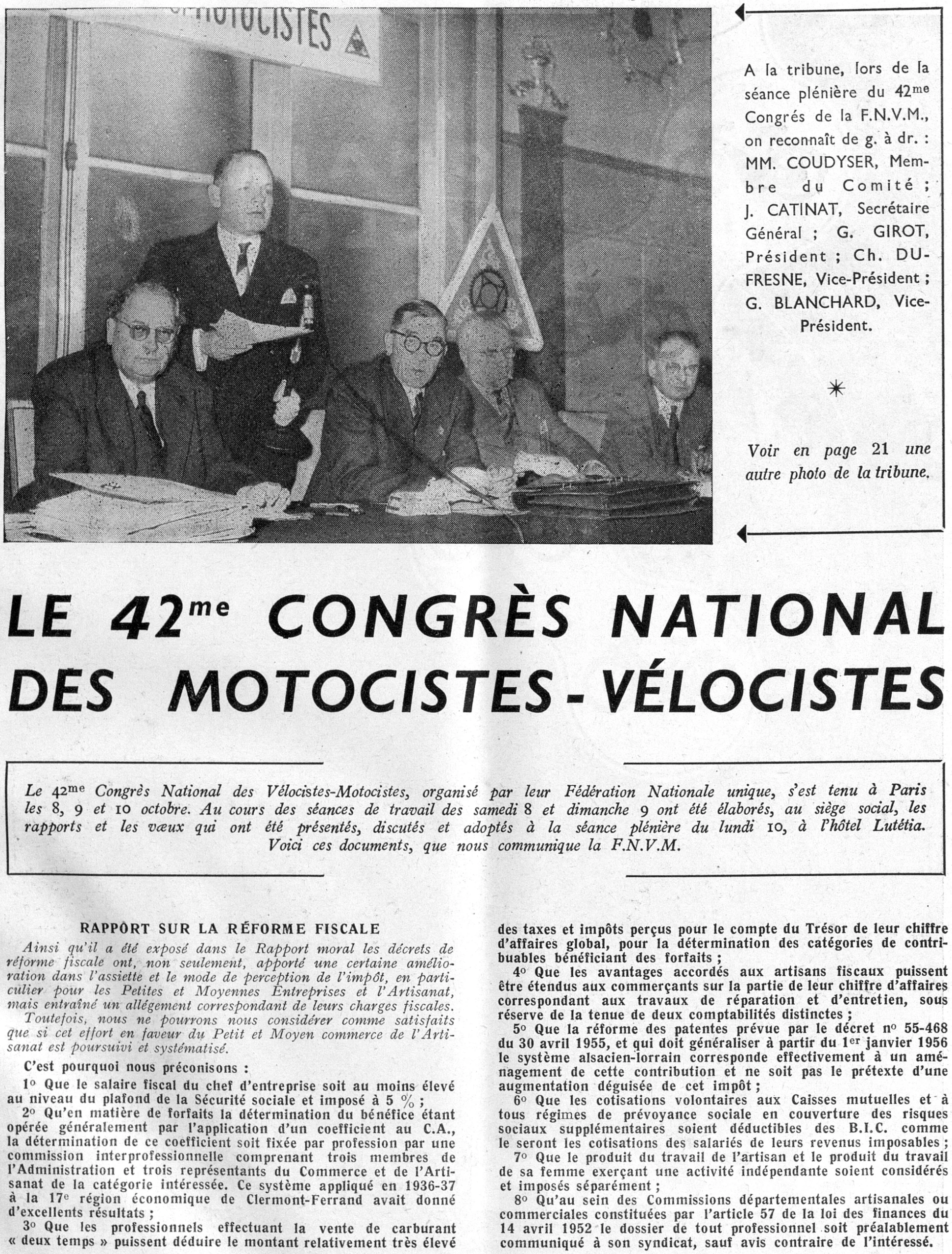
A la tribune, lors de la séance plénière du 42me Congrés de la F.N.V.M., on reconnaît de g. à dr. : MM. COUDYSER, Mem- bre du Comité ; J. CATINAT, Secrétaire Général ; G. GIROT, Président ; Ch. DU- FRESNE, Vice-Président ; G. BLANCHARD, Vice- Président. * Voir en page 21 une autre photo de …
This is a magazine article, so its running text is summarized here rather than reproduced; the headline, byline, specifications and scores are transcribed as printed.
From L’Officiel du cycle, du motocycle et du camping, 29 October 1955, the paper’s first number reporting the 1955 Paris Salon du Cycle et du Motocycle, pages 15 to 32: the paper’s report of the 42nd national congress of the cycle and motorcycle dealers, its resolutions, the federation’s moral report, the speeches of G. Girot and J. Catinat, the tombola and the banquet. The title, headings, captions and lists are transcribed as printed; the text is summarized in Ebykr’s words, and the page images carry it in full.
— Page 1 —
A la tribune, lors de la
séance plénière du 42me
Congrés de la F.N.V.M.,
on reconnaît de g. à dr. :
MM. COUDYSER, Mem-
bre du Comité ;
J. CATINAT, Secrétaire
Général ; G. GIROT,
Président ; Ch. DU-
FRESNE, Vice-Président ;
G. BLANCHARD, Vice-
Président.
*
Voir en page 21 une
autre photo de la tribune.
LE 42me CONGRÈS NATIONAL
DES MOTOCISTES – VÉLOCISTES
Le 42me Congrès National des Vélocistes-Motocistes, organisé par leur Fédération Nationale unique, s’est tenu à Paris les 8, 9 et 10 octobre. Au cours des séances de travail des samedi 8 et dimanche 9 ont été élaborés, au siège social, les rapports et les vœux qui ont été présentés, discutés et adoptés à la séance plénière du lundi 10, à l’hôtel Lutétia.
Voici ces documents, que nous communique la F.N.V.M.
RAPPORT SUR LA RÉFORME FISCALE
[Ebykr summary; the article’s text is not reproduced. The report opens, in italic, by recalling that, as set out in the Rapport moral, the fiscal reform decrees have not only brought a certain improvement in the assessment and the mode of collection of the tax, in particular for the Petites et Moyennes Entreprises and the Artisanat, but have also brought a corresponding lightening of their fiscal charges; the federation will consider itself satisfied, however, only if this effort in favor of small and medium commerce and of the Artisanat is pursued and made systematic. It therefore recommends, in eight numbered points set in bold: 1° that the fiscal salary of the head of a business be raised at least to the level of the Sécurité sociale ceiling and taxed at 5 %; 2° that, since under the forfait system profit is generally fixed by applying a coefficient to the C.A. (turnover), that coefficient be set profession by profession by an interprofessional commission of three members of the Administration and three representatives of the Commerce and Artisanat of the category concerned, a system that was applied in 1936-37 in the 17e région économique of Clermont-Ferrand with excellent results; 3° that professionals selling “deux temps” (two-stroke) fuel may deduct the relatively very high amount of the taxes and duties they collect for the Trésor from their global turnover when the categories of taxpayers entitled to the forfait are determined; 4° that the advantages granted to “artisans fiscaux” be extended to traders on the part of their turnover that comes from repair and maintenance work, on condition that two separate sets of accounts are kept; 5° that the reform of the patentes provided by décret n° 55-468 of 30 avril 1955, which is to extend the Alsace-Lorraine system generally from 1er janvier 1956, be a genuine adjustment of that contribution and not the pretext for a disguised increase of the tax; 6° that voluntary contributions to Caisses mutuelles and to any social-provident scheme covering additional social risks be deductible from the B.I.C., as wage earners’ contributions will be from their taxable income; 7° that the earnings of the artisan and those of his wife carrying on an independent activity be considered and taxed separately; 8° that within the Commissions départementales artisanales ou commerciales set up by article 57 of the loi des finances of 14 avril 1952, the file of any professional be first communicated to his syndicat, unless the person concerned objects. None of the eight points names the bicycle or the vélociste alone: the third concerns dealers who sell two-stroke fuel, a motor-trade matter, and the fourth the repair and maintenance side shared by the cycle and the motorcycle shop.]
[A full page. A large halftone photograph fills the upper two-thirds of the width: five men in dark suits sit and stand behind a table spread with papers and bottles, the man in the center standing and holding a sheet, the others seated, two of them in round spectacles; above them a hanging banner, its lettering cut by the top edge of the page so that only “…MOTOCISTES” shows, ends in a small triangular emblem, and a large triangular pennant bearing a circular device hangs between the men at the right. To the right of the photograph the caption stands in a box ruled on three sides and opened toward the picture by two arrows pointing left, at its head and at its foot; it is set in roman sans-serif, followed by a single star ornament and an italic cross-reference. Below, the headline crosses the full width in two lines of heavy sans-serif capitals, and an italic standfirst sits within a broken frame whose rules, above and below, run in from each corner and stop short of the middle. The report follows in two columns under a heading in spaced bold capitals: its opening paragraphs are in italic and the numbered demands in a bold condensed roman. The photograph carries no signature.]
— Page 2 —
RAPPORT SUR LE STATUT PROFESSIONNEL
[Ebykr summary; the article’s text is not reproduced. The few professional statutes now in force were voted, the report says, “par surprise”. The present tendency of Parliament, and in particular of the Commission des Affaires économiques chaired by M. Ramonet, député de l’Indre, is to treat professional statutes as a matter for regulation rather than legislation, the decree being more flexible than the law. The federation has nevertheless reworked its proposition de loi tabled on 17 février 1953 by M. Bernard Lafay and, in agreement with its rapporteur M. André Hugues, drawn up a statute particular to the profession of Vélociste-Motociste. The report notes that the décret of 20 mai 1955 amending certain provisions of the Code de l’Artisanat provides that decrees taken for each trade or group of trades will fix the conditions of the certificat d’artisan (instituted by article 32 of the Code de l’Artisanat), setting either the diplomas, titles or equivalences or the length of prior apprenticeship or practice of the trade required for it; a transitional provision adds that for five years from the publication of those decrees, professionals who prove their capacity by an apprenticeship as long as the one customary in the Profession will be considered artisans. The Chambres de Métiers are thus charged with issuing the artisanal certificates needed for registration in the Registre des Métiers and with organizing training and professional improvement in artisanal firms, which gives them ever greater authority. The report fears, however, that a regulation limited to the Artisanat would in fact encourage unqualified newcomers to enter the Profession in the position of unregulated traders, and concludes that the regulation must extend to the whole Profession. The Congress then states its vœu, in bold: that the draft statute particular to the profession of Vélociste-Motociste be submitted as soon as possible to the Commission des Affaires économiques; that if Parliament does not accept the principle of a legal professional statute, the syndical organizations be empowered to seek another route, for example a decree or a règlement d’administration publique, reaching practically the same results; and that, until the decrees provided by article 1er, paragraphe 4 of the décret of 20 mai 1955 are applied, the federation’s syndical organizations be consulted, compulsorily and beforehand, by the Chambres de Métiers both on the issue of the artisanal certificates needed for registration in the Registre des Métiers, and henceforth also in the Registre du Commerce, and on the organization and regulation of training and professional improvement in artisanal firms. This report concerns the vélociste directly: the statute it asks for covers the whole trade of Vélociste-Motociste.]
*
RAPPORT SUR LES CONVENTIONS COLLECTIVES
[Ebykr summary; the article’s text is not reproduced. Two agreements were concluded, on 16 juillet 1954 and on 23 juillet 1955, between the groupe des Industries métallurgiques de la région parisienne and the major workers’ confederations, and many regional agreements followed; they make compulsory a number of new provisions that weigh very heavily on the signatory firms. The two conventions do not apply to the federation’s trades, since its syndical organizations were not parties to the talks, but the report stresses 1° that they will have repercussions on the trades’ workmen, for whom they may serve as an example or a precedent, and 2° that in labor disputes the Conseils de prud’hommes may be tempted to refer to them. Lacking collective agreements of their own, small and medium firms therefore face a grave danger, and the greatest prudence is urged, most provisions of the conventions of 16 juillet 1954 and 23 juillet 1955 being beyond what the trades can bear. The Congress forms the vœu, in bold, that no discussion in the branche Automobile take place without the representatives of the federation’s branch. The report concerns the cycle and motorcycle trades alike and names neither the bicycle nor the motorcycle.]
*
RAPPORT SUR LES REMISES DANS LE CYCLE
ET LE MOTOCYCLE
[Ebykr summary; the article’s text is not reproduced. A joint and simultaneous negotiation with the Direction des Prix and the manufacturers’ syndical organizations is, the report says, no longer possible in present conditions because of the opposition of certain of their leaders; the federation has nevertheless approached several Constructeurs and found its view shared by a great number of them. It is almost unanimously recognized that the problem of the sale cannot be taken in isolation but must be considered together with those of the guarantee, maintenance and repair: a machine is relatively easy to sell, but only a qualified professional can meet the customer’s wishes, that is, provide the “service après-vente” during and after the guarantee period. That obligation, normal in itself, must not swallow the whole of a remise (the dealer’s discount), which is too low in every branch of the trade. Some Constructeurs believed they had found a satisfactory answer by placing machines with their agents on consignment and invoicing the customers themselves; this solves the stocking problem but brings the remise down to less than 10 %, and the report says the practice cannot be generalized and would in fact worsen the position of the Vélocistes-Motocistes. It follows that the present minimum taux de marque must be raised substantially, and without delay, for the cyclomoteur, and the Congress is asked to give the bureau fédéral a formal and express mandate to take every step toward that end by voting the following mandate by show of hands. The mandate, set in bold, opens “Le Congrès,” and considers that the remises now practiced in the Cycle and the Motocycle no longer correspond to present economic conditions and that in this branch competition, with the charges it entails (stocking, advertising, maintenance and so on), is — the sentence running on to the following page. The demand for a higher margin is made for the cyclomoteur in particular; the opening considerations cover the Cycle and the Motocycle together.]
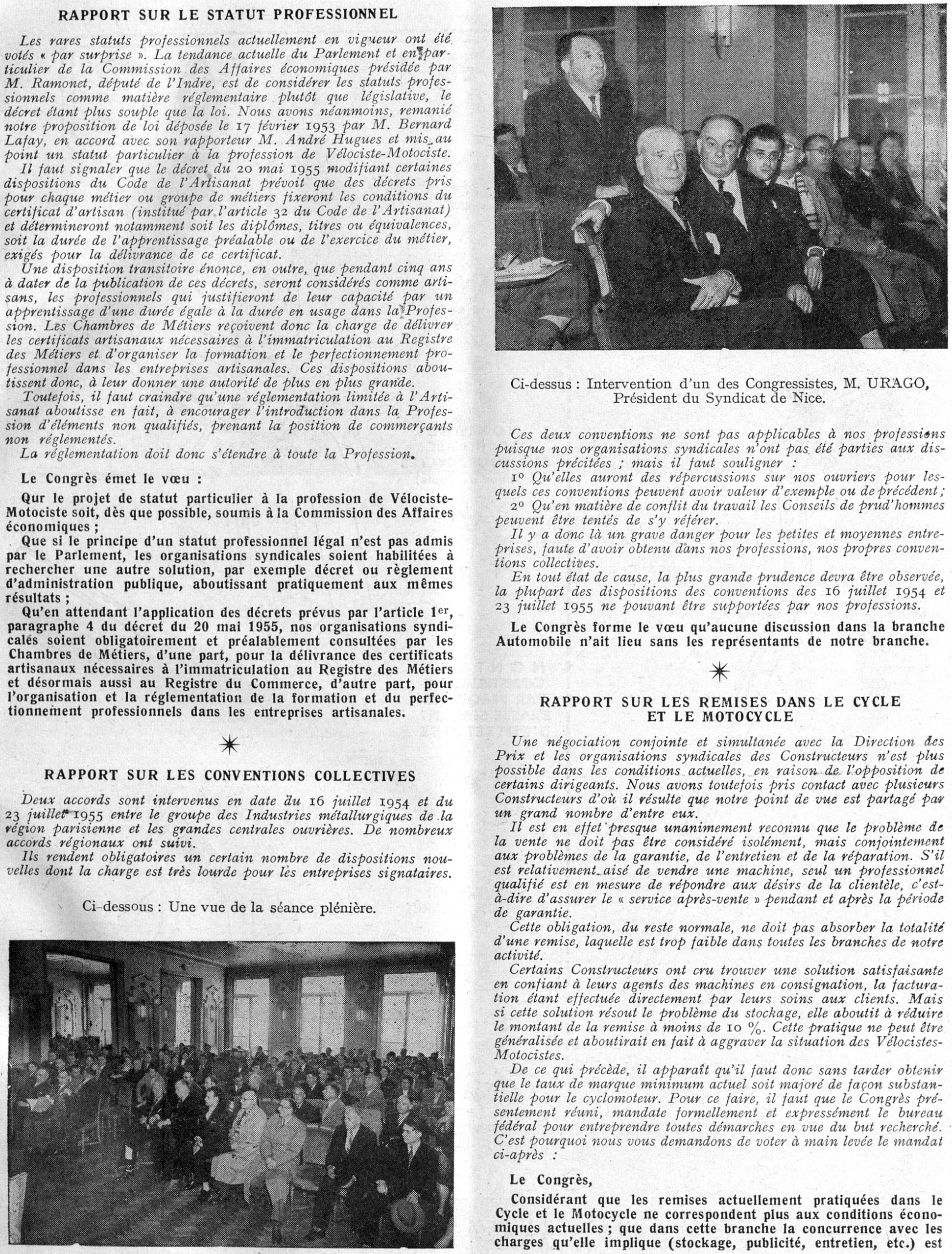
Ci-dessus : Intervention d’un des Congressistes, M. URAGO,
Président du Syndicat de Nice.
Ci-dessous : Une vue de la séance plénière.
[A full page of text in two columns, with no headline, carrying three of the congress reports one after another; each opens under a heading in spaced bold roman capitals, the reports are divided by a single star ornament, their argument is set in italic and the Congress’s vœux and mandate in bold roman. A halftone photograph heads the right column: in a hotel salon with a wall sconce and tall windows, a man in a dark suit stands at the left behind a row of seated delegates, the nearest of them a white-haired man resting one hand on the arm of his chair, with further rows of men behind; its caption, set centered in roman, sits under it. A second halftone fills the foot of the left column, its caption above it: a wide view of a crowded hall lit by tall windows, the delegates seated in close rows facing the camera. Neither photograph carries a signature.]
— Page 3 —
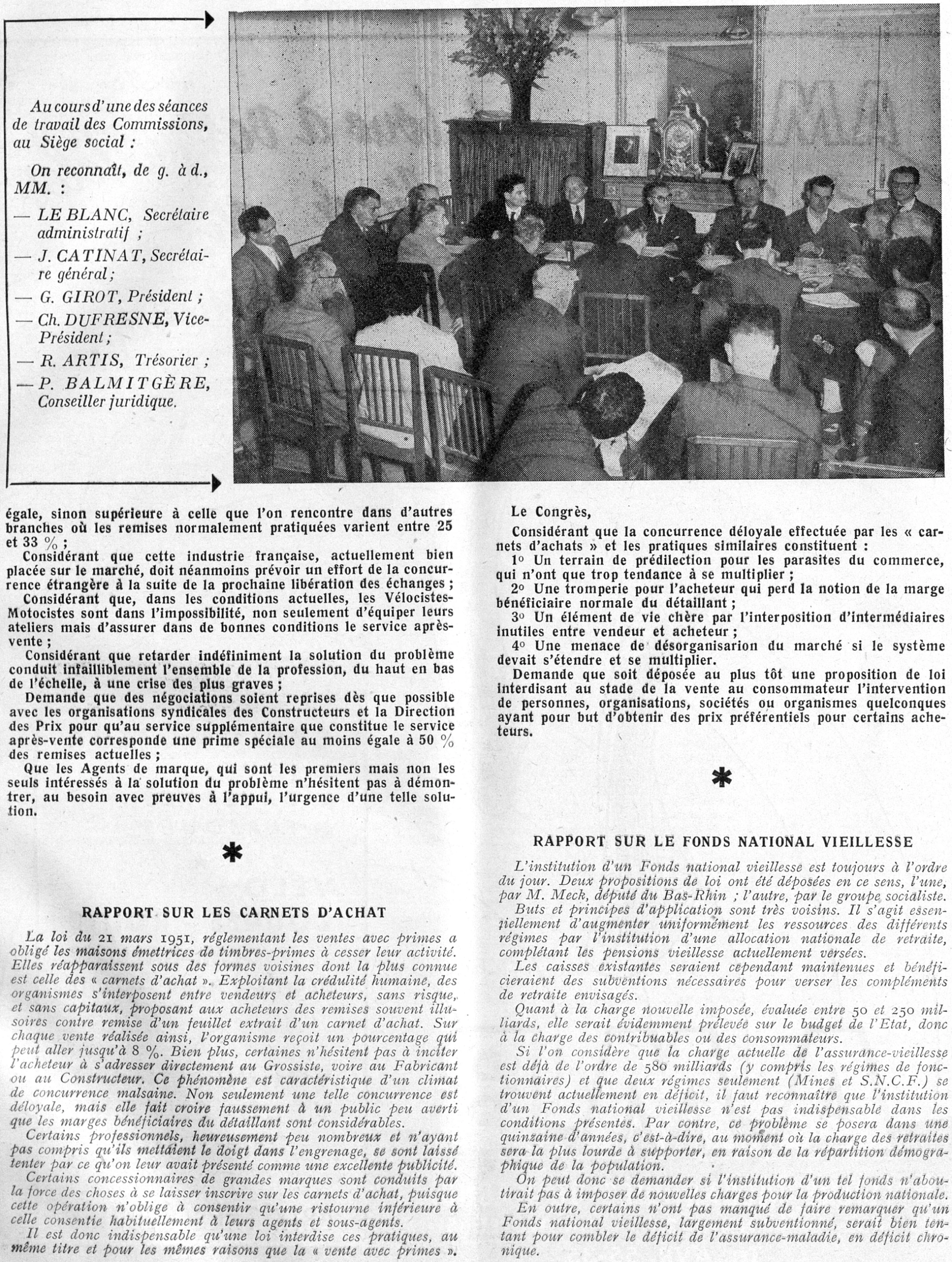
Au cours d’une des séances
de travail des Commissions,
au Siège social :
On reconnaît, de g. à d.,
MM. :
— LE BLANC, Secrétaire
administratif ;
— J. CATINAT, Secrétai-
re général ;
— G. GIROT, Président ;
— Ch. DUFRESNE, Vice-
Président ;
— R. ARTIS, Trésorier ;
— P. BALMITGÈRE,
Conseiller juridique.
[Ebykr summary; the article’s text is not reproduced. The page opens on the rest of the mandate of the RAPPORT SUR LES REMISES DANS LE CYCLE ET LE MOTOCYCLE, carried over from the previous page and set in bold. Its sentence ends by saying that competition in this branch, with the charges it entails, is equal to if not greater than in other branches where the remises normally practiced run between 25 and 33 %. The Congress further considers that this French industry, now well placed on the market, must nevertheless expect a push from foreign competition after the coming liberalization of trade; that in present conditions the Vélocistes-Motocistes can neither equip their workshops nor provide the service après-vente in good conditions; and that to put off the solution indefinitely leads the whole profession, from the top of the ladder to the bottom, infallibly into a most serious crisis. It asks that negotiations be resumed as soon as possible with the Constructeurs’ syndical organizations and the Direction des Prix so that the additional service represented by the service après-vente is matched by a special premium of at least 50 % of the present remises, and that the Agents de marque, the first but not the only parties concerned, do not hesitate to show the urgency of such a solution, with proof where needed. The mandate covers the Cycle and the Motocycle together and the agents of both trades.]
*
RAPPORT SUR LES CARNETS D’ACHAT
[Ebykr summary; the article’s text is not reproduced. The loi of 21 mars 1951 regulating sales with premiums forced the firms issuing timbres-primes (trading stamps) to stop, but they have reappeared in neighboring forms, the best known being the “carnets d’achat”. Playing on human credulity, these bodies place themselves between sellers and buyers, without risk and without capital, offering buyers discounts that are often illusory in exchange for a leaf torn from a carnet d’achat, and they take on each sale made this way a percentage that can reach 8 %; some even urge the buyer to go straight to the Grossiste, or to the Fabricant or the Constructeur. The report calls this the mark of an unhealthy climate of competition, disloyal in itself and leading a poorly informed public to believe falsely that the retailer’s margins are considerable. A few professionals, fortunately not many, failing to see that they were putting a finger in the gears, were tempted by what was presented to them as excellent publicity, and some concessionnaires of the large marques are driven by circumstances to sign up with the carnets d’achat, because the operation obliges them to grant only a rebate smaller than the one they usually allow their agents and sub-agents. A law must therefore forbid these practices on the same grounds as the “vente avec primes”. The resolution, set in bold and opening “Le Congrès,”, considers that the disloyal competition of the “carnets d’achats” and similar practices constitutes 1° a favorite ground for the parasites of commerce, who tend only too much to multiply; 2° a deception of the buyer, who loses sight of the retailer’s normal profit margin; 3° a factor in the high cost of living through the interposition of useless intermediaries between seller and buyer; and 4° a threat of disorganization of the market (printed “désorganisarion”) if the system were to spread and multiply. It asks that a proposition de loi be tabled as soon as possible forbidding, at the stage of sale to the consumer, the intervention of any person, organization, company or body whose aim is to obtain preferential prices for certain buyers. The report names no product; it concerns every retail sale of the trade.]
*
RAPPORT SUR LE FONDS NATIONAL VIEILLESSE
[Ebykr summary; the article’s text is not reproduced. The creation of a Fonds national vieillesse is still on the agenda, and two propositions de loi have been tabled to that end, one by M. Meck, député du Bas-Rhin, the other by the groupe socialiste. Their aims and principles are very close: essentially to raise uniformly the resources of the various schemes by creating a national retirement allowance to supplement the old-age pensions now paid, while keeping the existing caisses, which would receive the subsidies needed to pay the planned supplements. The new charge, estimated at between 50 and 250 milliards, would be drawn from the State budget and so fall on taxpayers or consumers. Since the present cost of old-age insurance is already about 580 milliards (civil servants’ schemes included) and only two schemes, the Mines and the S.N.C.F., are now in deficit, the report holds that such a fund is not indispensable in present conditions; the problem will arise, however, in some fifteen years, when the burden of pensions will be heaviest because of the age structure of the population. The report asks whether such a fund would not end by imposing new charges on national production, and notes that some have pointed out that a heavily subsidized Fonds national vieillesse would be a tempting means of filling the chronic deficit of sickness insurance. The Congress’s resolution follows on page 21. The report has no bearing on the bicycle as such.]
[A full page of text in two columns, with no headline, continuing the congress reports. A large halftone photograph spans the upper part of the page from the middle of the left column to the right margin: in a paneled room with a large potted plant at the left, a heavy draped cabinet and a mantelpiece carrying an ornate clock between two framed portraits under a tall mirror, six men in dark suits sit facing the camera behind a table, while in the foreground delegates seen from behind sit at tables covered with papers. Its caption fills a box at the upper left, ruled on three sides and opened toward the picture by two arrows pointing right, at head and foot; it is set in italic, with the six names as a dashed list and the surnames in capitals. Below, the report text runs in two columns: headings in spaced bold roman capitals, argument in italic, resolutions and mandates in bold roman, the reports divided by a heavy asterisk ornament. The photograph carries no signature.]
— Page 4 —
[Ebykr summary; the article’s text is not reproduced. The page opens on the resolution closing the RAPPORT SUR LE FONDS NATIONAL VIEILLESSE begun on page 19, set in bold under “Le Congrès,”. While approving the principle of equalizing and raising pensions, the Congress asks that the creation of a Fonds national vieillesse 1° bring no unbearable charges on national production; 2° not infringe the autonomy of the various old-age schemes; 3° bring no transfers from one risk to another within the same scheme, notably from the sickness scheme to the old-age risk (the last word printed “vieillssee”); and 4° not complicate the existing pension schemes still further instead of clarifying and coordinating them. Nothing in it is specific to the cycle trade.]
*
RAPPORT SUR LA RÉVISION DES BAUX COMMERCIAUX
[Ebykr summary; the article’s text is not reproduced. Since 1945 the rents of artisanal and commercial professional premises have risen without a break; if the trend continued it would eliminate the federation’s firms in favor of more profitable businesses. The proposition de loi of M. Jean-Louis Vigier, voted on 13 mai last by the Assemblée nationale and amending article 37 of the décret of 30 septembre 1953 governing relations between landlords and tenants over commercial leases, can therefore be considered satisfactory: its single article provides that requests for a rent increase will not be admissible after the last amicable or court-fixed rent unless the economic indices have moved by more than 15 %, or unless proof is brought of a material change in the local commercial factors of the premises that has by itself caused a change of more than 15 % in the rental value. Despite the steps taken by the professional syndicates and by the federation’s two Confédérations, a well-orchestrated campaign by the representatives of property owners has had the debate before the Conseil de la République put off to the parliamentary reopening of 5 octobre. The report says the measure must be voted urgently, since it is absurd to seek price stability while sharply increasing the trade’s charges: since 1951 the indices have not moved by 12 %, while commercial rents have risen by 300 to 700 %. The resolution, set in bold under “Le Congrès,”, considers that the dizzying rise of commercial rents in a period of relative price stability is making the charges of traders and artisans unbearable, and that, normal conditions of supply and demand having in no way been restored for professional premises any more than for dwellings, regulation must be maintained. It asks that the Conseil de la République vote as soon as possible the Vigier proposition de loi adopted on 13 mai by the Assemblée nationale amending article 37 of the décret of 30 septembre 1953, and, secondarily and separately, that article 1er of the décret of 30 septembre 1953 extend the legislation on commercial leases to all artisans without distinction. The report concerns the shop premises of the whole trade and names no product.]
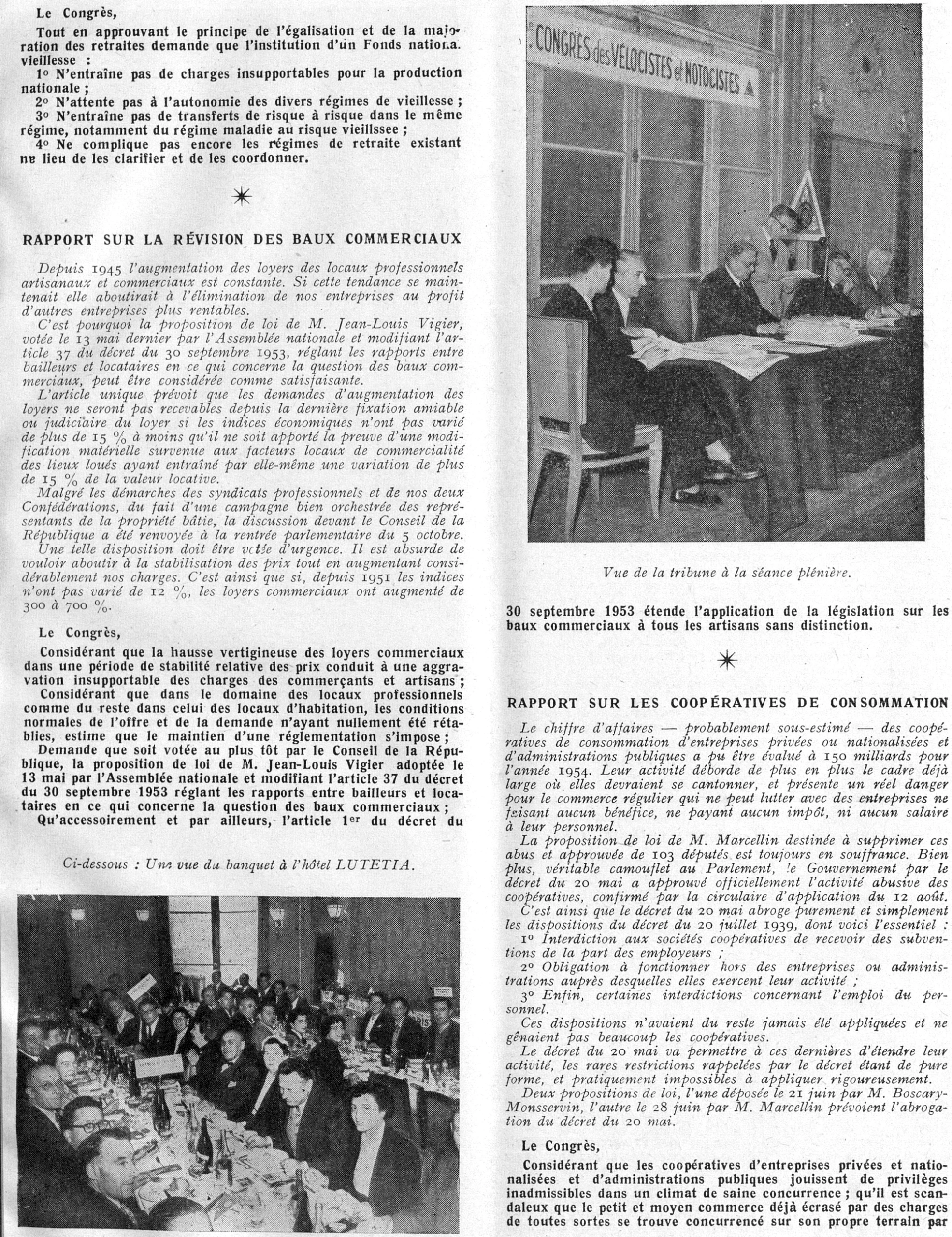
Vue de la tribune à la séance plénière.
*
RAPPORT SUR LES COOPÉRATIVES DE CONSOMMATION
[Ebykr summary; the article’s text is not reproduced. The turnover of the consumer cooperatives of private or nationalized firms and of public administrations, probably underestimated, was put at 150 milliards for 1954. Their activity overflows more and more the already broad field to which they should keep, and is a real danger to regular commerce, which cannot compete with concerns that make no profit, pay no tax and pay no wages to their staff. The proposition de loi of M. Marcellin meant to end these abuses, approved by 103 députés, is still in abeyance; worse, in what the report calls a real snub to Parliament, the Government officially approved the cooperatives’ abusive activity by the décret of 20 mai, confirmed by the application circular of 12 août. That décret simply repeals the provisions of the décret of 20 juillet 1939, whose essentials were 1° a ban on cooperative societies receiving subsidies from employers; 2° an obligation to operate outside the firms or administrations in which they are active; and 3° certain restrictions on the employment of staff. Those provisions had in fact never been applied and hardly troubled the cooperatives, and the décret of 20 mai will let them widen their activity, the few restrictions it recalls being pure form and practically impossible to apply strictly. Two propositions de loi, one tabled on 21 juin by M. Boscary-Monsservin and the other on 28 juin by M. Marcellin, provide for the repeal of the décret of 20 mai. The resolution, set in bold under “Le Congrès,”, begins by considering that the cooperatives of private and nationalized firms and of public administrations enjoy privileges inadmissible in a climate of healthy competition, and that it is scandalous that small and medium commerce, already crushed by charges of every kind, should face competition on its own ground from — the sentence running on to the following page. The report concerns retail competition in general and names neither the bicycle nor the motorcycle.]
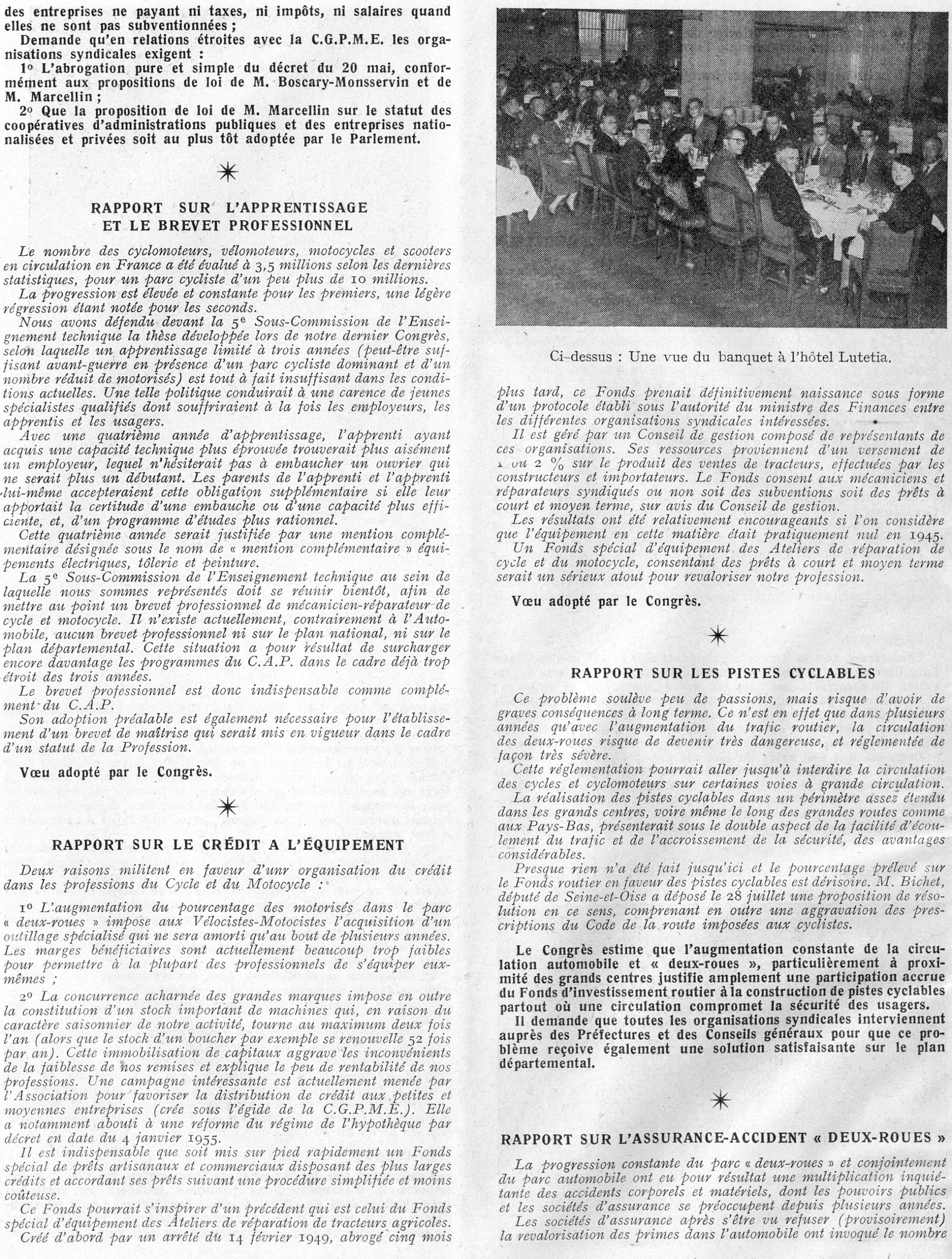
Ci-dessous : Une vue du banquet à l’hôtel LUTETIA.
[A full page of text in two columns, with no headline, continuing the congress reports: headings in spaced bold roman capitals, argument in italic, resolutions in bold roman, the reports divided by a single star ornament. A tall halftone photograph heads the right column: the tribune of the plenary session, where men in dark suits sit along a table spread with papers before tall windows, one man standing at the center to read from a sheet in front of a large triangular pennant on a stand; a hanging banner above them is lettered in tall condensed capitals “…CONGRÈS des VELOCISTES et MOTOCISTES”, its first characters lost at the left edge of the picture, and ends in a small triangle. Its italic caption sits beneath it. The foot of the left column holds a second halftone, its italic caption above it with two letters broken in the type: the banquet, a long table laid with white cloths, bottles and glasses running back into a hall lit by wall lanterns and tall windows, the diners in rows turned toward the camera and table cards standing on wire holders. Neither photograph carries a signature.]
— Page 5 —
[Ebykr summary; the article’s text is not reproduced. The page opens on the rest of the bold resolution closing the RAPPORT SUR LES COOPÉRATIVES DE CONSOMMATION, carried over from page 21: the competition faced by small and medium commerce comes from concerns that pay neither taxes, nor duties, nor wages when they are not subsidized. The Congress asks that the syndical organizations, in close liaison with the C.G.P.M.E., demand 1° the outright repeal of the décret of 20 mai, in line with the propositions de loi of M. Boscary-Monsservin and M. Marcellin, and 2° the earliest possible adoption by Parliament of M. Marcellin’s proposition de loi on the statute of the cooperatives of public administrations and of nationalized and private firms.]
*
RAPPORT SUR L’APPRENTISSAGE
ET LE BREVET PROFESSIONNEL
[Ebykr summary; the article’s text is not reproduced. According to the latest statistics the number of cyclomoteurs, vélomoteurs, motocycles and scooters in circulation in France is put at 3,5 millions, against a bicycle fleet (parc cycliste) of a little over 10 millions; the first group is growing fast and steadily, while a slight decline is noted for the second. Before the 5e Sous-Commission de l’Enseignement technique the federation has defended the position taken at its last Congress: an apprenticeship limited to three years, perhaps enough before the war when the bicycle dominated and motorized machines were few, is quite insufficient today and would lead to a shortage of young qualified specialists, to the cost of employers, apprentices and users alike. With a fourth year the apprentice, his technical ability better proven, would find an employer more easily, and the employer would not hesitate to hire a workman who was no longer a beginner; parents and apprentice would accept the extra obligation if it brought the certainty of a job or a more effective skill, together with a more rational course of study. The fourth year would be sanctioned by a “mention complémentaire” in electrical equipment, sheet-metal work and painting (équipements électriques, tôlerie et peinture). The 5e Sous-Commission, on which the federation is represented, is to meet soon to draw up a brevet professionnel de mécanicien-réparateur de cycle et motocycle: unlike the Automobile trade, the cycle and motorcycle trade has at present no brevet professionnel at either national or departmental level, which overloads the C.A.P. syllabus within the already too narrow frame of three years. The brevet professionnel is therefore indispensable as a complement to the C.A.P., and its prior adoption is also needed before a brevet de maîtrise can be set up within a statute of the Profession. The report closes with the bold line “Vœu adopté par le Congrès.” It bears directly on the bicycle: it gives the size and the slight decline of the French bicycle fleet, and the brevet it seeks is for the mechanic-repairer of the cycle as well as the motorcycle.]
*
RAPPORT SUR LE CRÉDIT A L’ÉQUIPEMENT
[Ebykr summary; the article’s text is not reproduced. Two reasons argue for organized credit in the Cycle and Motocycle trades. 1° The rising share of motorized machines in the “deux-roues” fleet forces the Vélocistes-Motocistes to buy specialized tooling that will pay for itself only after several years, and present margins are far too low to let most of them equip themselves. 2° The fierce competition of the large marques also forces them to hold a large stock of machines which, the trade being seasonal, turns over at most twice a year, where a butcher’s stock, for example, is renewed 52 times a year; this tied-up capital worsens the effect of the low remises and explains the poor profitability of the trade. An interesting campaign is being led by the Association pour favoriser la distribution de crédit aux petites et moyennes entreprises, set up under the aegis of the C.G.P.M.E. (the word printed “crée”), which has notably obtained a reform of the mortgage system by a décret dated 4 janvier 1955. A Fonds spécial de prêts artisanaux et commerciaux, with the widest credits and lending by a simpler and cheaper procedure, must be set up quickly. It could follow the precedent of the Fonds spécial d’équipement des Ateliers de réparation de tracteurs agricoles, first created by an arrêté of 14 février 1949, repealed five months later, and finally established as a protocol drawn up under the authority of the ministre des Finances among the syndical organizations concerned. That fund is run by a Conseil de gestion of their representatives; its resources come from a levy of 1 or 2 % on the proceeds of tractor sales by manufacturers and importers, and on the Conseil’s advice it grants mechanics and repairers, union members or not, either subsidies or short- and medium-term loans. Its results are called relatively encouraging, equipment in that field having been practically nil in 1945. A Fonds spécial d’équipement des Ateliers de réparation du cycle et du motocycle lending at short and medium term would be a serious asset in raising the standing of the profession. The report closes with the bold line “Vœu adopté par le Congrès.” It covers the cycle and the motorcycle workshop together; the tooling argument rests on the motorized share of the fleet, the stock argument on both.]
Ci-dessus : Une vue du banquet à l’hôtel Lutetia.
*
RAPPORT SUR LES PISTES CYCLABLES
[Ebykr summary; the article’s text is not reproduced. The question rouses few passions but may have grave consequences in the long run: within a few years, as road traffic grows, two-wheeler traffic risks becoming very dangerous and being very severely regulated, and the regulation could go as far as banning cycles and cyclomoteurs from certain main roads. Cycle paths built over a fairly wide area in the large towns, and even along the main roads as in the Pays-Bas, would bring considerable advantages in both the flow of traffic and safety. Almost nothing has been done so far, and the share of the Fonds routier set aside for cycle paths is derisory. M. Bichet, député de Seine-et-Oise, tabled on 28 juillet a proposition de résolution to this effect, which also includes a tightening of the Code de la route rules imposed on cyclists. In bold, the Congress judges that the constant growth of automobile and “deux-roues” traffic, particularly near the large towns, amply justifies a larger contribution from the Fonds d’investissement routier to the building of cycle paths wherever traffic endangers road users, and asks every syndical organization to approach the Préfectures and the Conseils généraux so that the problem also finds a satisfactory solution at departmental level. This report concerns the bicycle directly, the cyclist and the cyclomoteur rider together.]
*
RAPPORT SUR L’ASSURANCE-ACCIDENT « DEUX-ROUES »
[Ebykr summary; the article’s text is not reproduced. The steady growth of the “deux-roues” fleet, together with that of the automobile fleet, has brought a worrying multiplication of accidents causing injury and damage, which have concerned the public authorities and the insurance companies for several years. The insurance companies, after being refused (provisionally) an increase of automobile premiums, invoked the number — the sentence running on to page 25.]
[A full page of text in two columns, with no headline, continuing the congress reports: headings in spaced bold roman capitals, argument in italic, the Congress’s resolutions and the closing line of each vœu in bold roman, the reports divided by a single star ornament. A halftone photograph heads the right column: a crowded banquet hall, the diners seated close together along tables laid with white cloths, bottles and glasses, many of them turned toward the camera, with a pale blurred shape at the left edge and tall dark doorways behind. Its caption, in roman, sits centered beneath it. The photograph carries no signature.]
— Page 6 —
[Ebykr summary; the article’s text is not reproduced. The section opens on the rest of the italic argument of the RAPPORT SUR L’ASSURANCE-ACCIDENT « DEUX-ROUES », carried over from page 22. The insurance companies point to the relatively high number of serious accidents suffered by owners of motorized “deux-roues” and argue from it for a considerable increase (coefficient 2 à 3) in the corresponding premiums, a view the federation calls mistaken: very few “deux-roues” owners are insured “tous risques”, and the great majority of serious accidents caused by a third party are collisions with a motor car, so that the compensation is borne by the company of the car driver found responsible. Raising “deux-roues” premiums would thus make riders pay for a risk they run not through their own imprudence but through that of others; the increase of a premium matching a heavier risk must be borne by whoever is responsible for that risk, and any other solution would halt the growth of an industry in full expansion and would be painfully felt, in particular, in the federation’s profession. The resolution, set in bold under “Le Congrès,”, considers that the rise in the number of serious accidents said to befall riders of cyclomoteurs, vélomoteurs, motocycles and scooters is due not to their particular imprudence but to the matching growth of the automobile fleet, and that it would be unjust to demand from “deux-roues” riders a considerable increase of premiums on the ground of heavier risks for which they are not responsible, all the more as the compensation paid to them is generally borne by the companies of the car drivers. It refuses any increase in the rate of “deux-roues” insurance premiums, an increase that would paralyze the growth of this industry, and asks that every step be taken jointly with the bodies and syndicates concerned to avoid such a measure, and that in any case no increase of insurance premiums be agreed unless buyers of machines on credit, who are obliged to be insured, may spread their bills over a longer period. The report and resolution concern the motorized two-wheeler, from the cyclomoteur upward; the pedal bicycle is not named.]
*
VŒU SUR LES STOCKS DES SINISTRÉS
[Ebykr summary; the article’s text is not reproduced. Under “Le Congrès,”, set in bold: considering that the flat-rate valuation of the stock of Vélocistes-Motocistes who suffered war damage is at present taken into account for only three months of activity, and that this valuation is plainly below the reality, the trade’s seasonal activity obliging it to hold a stock equal to at least six months of activity, the Congress asks that negotiations be opened as soon as possible with the Service d’évaluation des dommages de guerre to set a restocking coefficient closer to reality. The vœu concerns the stocks of every vélociste-motociste shop with war-damage claims.]
*
VŒU A L’ATTENTION DES GROSSISTES
[Ebykr summary; the article’s text is not reproduced. Under “Le Congrès,”, set in bold: considering the undisputed representative standing of the federation, the Congress asks that a representative of the Fédération henceforth sit on the Comité charged with drawing up the rules of distribution and settling disputes. It wishes the statute of distribution to include a ban on Grossistes accepting order forms of public administrations and of nationalized and private firms when the bearer offers to pay in cash: only payment by cheque would prevent private persons who wrongly invoke their firm or their administration from obtaining discounts to which they have no right as mere private buyers. The vœu concerns the wholesale supply of the whole trade and names no product.]
[The upper part of a page of text in two columns, with no photograph and no headline, continuing the congress resolutions. The argument of the insurance report is set in italic; the resolutions under “Le Congrès,” are in bold roman; the two vœux open under headings in spaced bold roman capitals and are divided by single star ornaments. Faint traces of large rounded lettering from the reverse of the leaf show through behind the right column.]
— Page 7 —
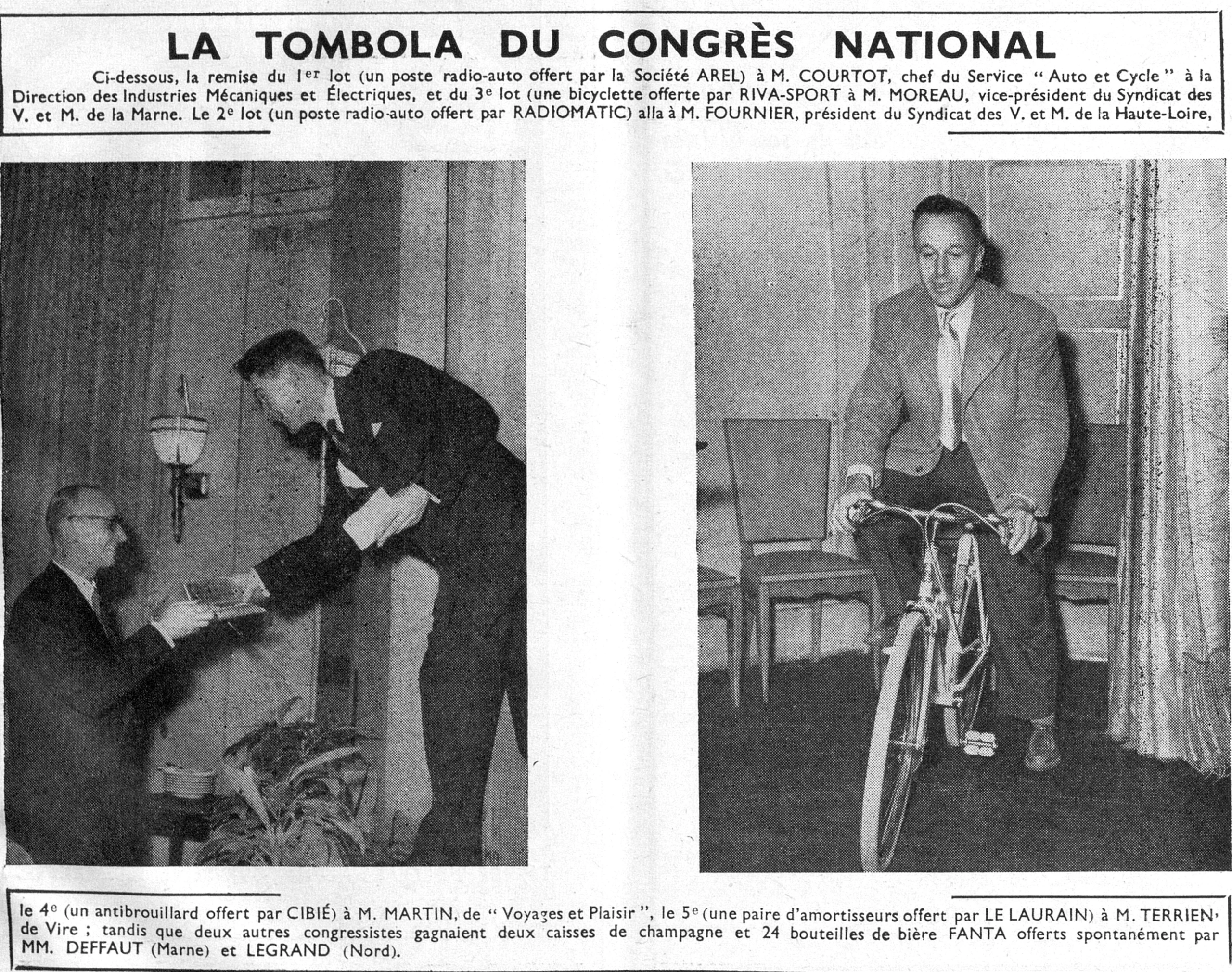
LA TOMBOLA DU CONGRÈS NATIONAL
Ci-dessous, la remise du 1er lot (un poste radio-auto offert par la Société AREL) à M. COURTOT, chef du Service “ Auto et Cycle ” à la
Direction des Industries Mécaniques et Électriques, et du 3e lot (une bicyclette offerte par RIVA-SPORT à M. MOREAU, vice-président du Syndicat des
V. et M. de la Marne. Le 2e lot (un poste radio-auto offert par RADIOMATIC) alla à M. FOURNIER, président du Syndicat des V. et M. de la Haute-Loire,
le 4e (un antibrouillard offert par CIBIÉ) à M. MARTIN, de “ Voyages et Plaisir ”, le 5e (une paire d’amortisseurs offert par LE LAURAIN) à M. TERRIEN,
de Vire ; tandis que deux autres congressistes gagnaient deux caisses de champagne et 24 bouteilles de bière FANTA offerts spontanément par
MM. DEFFAUT (Marne) et LEGRAND (Nord).
[The lower part of a page, framed above and below by two boxed captions. The headline crosses the full width in heavy sans-serif capitals inside a frame of heavy rules whose bottom rule is left open across the middle, and the opening of the prize list runs beneath it in a roman sans-serif, the firm and prize-winners’ names in capitals; the third prize’s parenthesis is left unclosed. Below are two halftone photographs side by side. At the left, in a room with a wall lamp on a bracket and a potted plant in the foreground, a gray-haired man in round spectacles, seated, reaches up to take a small packet held out to him by a tall dark-haired man in a dark suit who bends toward him from the right. At the right, a man in a light tweed jacket, pale shirt and tie sits astride a light-colored bicycle seen nearly head-on, one foot on the floor and both hands on a flat, slightly swept handlebar, a pedal with its reflector showing below; behind him are two upholstered chairs against a paneled wall and a long draped curtain at the right. The prize list ends in a second box under the photographs, set like the first, inside a frame of heavy rules whose top rule is left open across the middle. The photographs carry no signature.]
— Page 8 —
LE RAPPORT MORAL DE LA F.N.V.M.
[Ebykr summary; the article’s text is not reproduced. The report, addressed to the delegates, recalls the anxiety expressed in 1954 about the position of the federation’s firms facing economic and fiscal difficulties, and the alarm it raised then: despite some achievements the situation was very grave on every front, and it was said that no profession was as threatened as this one, by a heavy, clumsy, fussy and often arbitrary fiscal system, by a steady rise in overheads, and by an ill-disposed regulation blocking not only margins on goods supplied but also the prices of repairs and services. At a time when the Construction du Cycle et du Motocycle was already issuing its first bulletins of victory, it seemed that everything was being done to eliminate precisely those to whom the industry owed its extraordinary growth in France. A review of the results won by hard struggle in 1954-55 will show, the report says, that this is hardly an exaggeration. The return to commercial liberalism was the first aim: so long as an absurd regulation survives, ten years after the war and in an industry that boasts of being the first in the world, the worst may be expected.]
[Ebykr summary, after the first asterisk ornament. The freeing of repair tariffs for cycles and motorcycles by the arrêté of 1er juin 1955 was the first step toward raising the standing of the trades. The federation has set new hourly rates which, while they bring no considerable increase in the Paris region, have let colleagues in the provinces, far too disadvantaged, make certain adjustments refused to them until then; strict syndical discipline will be needed, in particular to avoid price-cutting. The revaluation of the remises met difficulties of another kind, since there was not one party to convince, the Direction des Prix at the Ministère des Affaires économiques, but also the Chambre Syndicale des Constructeurs. The officials of the Quai Branly were persuaded, not without trouble, and now accept the soundness of the argument, but they add that in the present political climate no minister will dare sign an arrêté raising the remises and thereby authorizing a price increase. The report calls this argument false, since many price increases have been authorized recently, but grants it a grain of truth in view of the opposition of certain manufacturers and their Chambre syndicale. This section concerns the cycle repairer directly: the freed tariffs are for cycles as well as motorcycles.]
[Ebykr summary, after the second asterisk ornament. Inter-syndical negotiations having proved sterile, the federation turned to direct contact with a number of the more understanding manufacturers and found 1° that the manufacturers opposed to any change in the remises count less on the inertia of the public authorities than on the trade’s own divisions (the word printed “oposés”), and 2° that a very clear movement is forming among others in favor of an extra premium for an effective guarantee, the present remise of 14 % on the cyclomoteur, for example, being regarded as payment for the sale alone and giving in itself no right to any guarantee.]
[Ebykr summary, after the third asterisk ornament. A very great danger was averted by the federation’s constant action and many approaches to members of Parliament: the obligation of a permis de conduire for vélomoteurs under the “trop fameuse proposition Beauvais”, supported by very many députés and sénateurs. The federation had to accept a compromise, embodied in the loi de finances of 27 mai, in the form of a “licence de conduite des vélomoteurs”, that is, for the Administration, any machine of more than 50 cm3 and up to and including 125 cm3. The licence is issued without examination but against payment of 500 francs (“il n’est pas de petits profits pour le Trésor !”) and may be withdrawn like the driving license, by the same procedure, for a serious breach of the Code de la route; the report calls this a lesser evil compared with the grave harm a true driving license would have caused. The licence could not, however, be put into force this year because the administrative arrangements were still to be settled. This concerns the vélomoteur, not the bicycle or the cyclomoteur.]
[Ebykr summary, after the fourth asterisk ornament. The décrets of 30 avril 1955 at last met several essential demands of the trades. The taxe à l’achat on used vehicles and equipment bought from private persons is abolished, as are the taxe de transaction and the taxe locale on used machines and equipment and on the commissions earned in that business, so that no tax of any kind now hampers transactions in a field where saturation of the market is always to be feared. The taxes locales and the taxe de transaction on fuels and lubricants are also abolished; taxes on these products will henceforth be collected at production, lightening the fuel accounts.]
[Ebykr summary, after the fifth asterisk ornament. In purely fiscal matters the so-called « réforme » brought, as expected, no revolution, only some reliefs and simplifications toward greater social justice. A true « salaire fiscal » of the head of a business is now recognized, by analogy with wage incomes, at 5 % for the fractions of income not exceeding 300.000 for the commercial professions, managing majority partners of S.A.R.L. included, and 440.000 for artisans. At the Commission départementale des Contributions directes, which rules on forfaits, the chairman, who as an official always tipped the balance toward the Administration, no longer has a casting vote, and some of those present, the report says, know the federation’s direct part in obtaining this. Finally the taxes on turnover have been brought down to 3, which gives a definite lightening of the fiscal burden and above all simplifies the accounts.]
[Ebykr summary, after the sixth asterisk ornament. These are the main results obtained, alone or with the various professional and inter-professional bodies, and the federation still judges them insufficient. Its effectiveness will depend 1° on the participation of the greatest number of members: too many colleagues, from modesty, lack of time or above all negligence, leave the leaders to defend their interests, which is a grave mistake, since paying the subscription is not enough and their advice and their support with members of Parliament are needed; and 2° on syndical regrouping, which since the merger of the Congrès d’Agen must go on without a break, the weight of a syndical organization depending on its membership. The results so far are far from discouraging: most syndicates have grown, in particular those that have entrusted the collection of subscriptions to their Fédération; failures have been rare and should soon be overcome, and many syndicates have become more active. The report announces the re-establishment of the Syndicat des Vélocistes et Motocistes de la Marne, which promises to be particularly active, and appeals to the departments still without a Syndicat de Vélocistes et Motocistes, saying that few lack the conditions for setting one up and that the Fédération and the Syndicat Général will always give such initiatives their unreserved support.]
[Ebykr summary, after the seventh asterisk ornament. Addressing “Mesdames et Messieurs”, the report closes by calling these the main results of the year, and says that the policy for the coming months, and the results the federation hopes to present next year, perhaps in the same hall, will be found in the reports on its various problems and in the vœux it asks the Congress to approve. The report carries no signature on this page.]
[A full page of text in two columns. The headline crosses the width in heavy slab-serif capitals inside a frame of heavy rules whose bottom rule is left open across the middle. The report is set in a roman sans-serif, its sections divided by bold asterisk ornaments; there are no photographs, drawings or signature.]
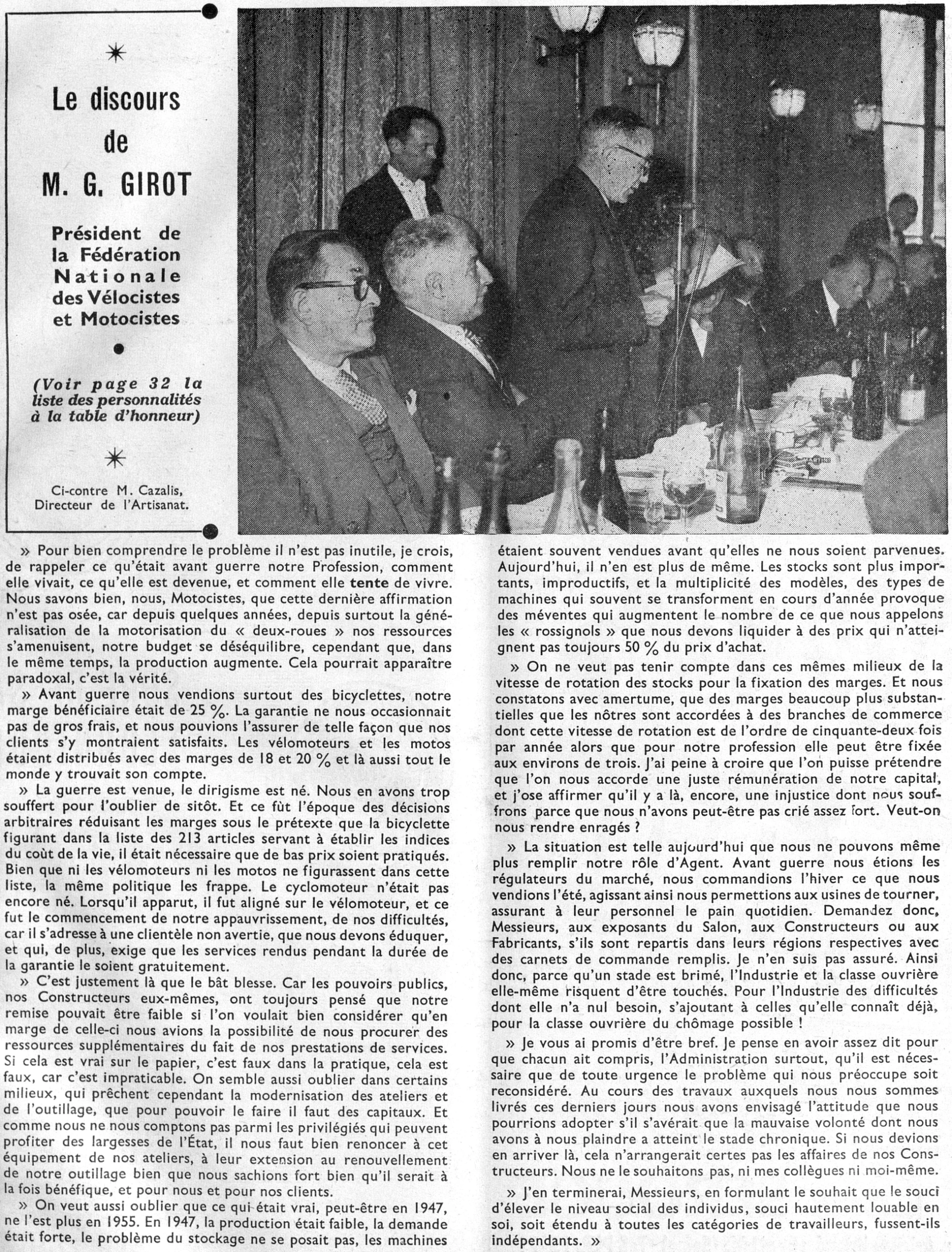
Le discours
de
M. G. GIROT
Président de
la Fédération
Nationale
des Vélocistes
et Motocistes
(Voir page 32 la
liste des personnalités
à la table d’honneur)
*
Ci-contre M. Cazalis,
Directeur de l’Artisanat.
[Ebykr summary; the article’s text is not reproduced. Every paragraph of the speech opens with a guillemet » and the last closes with one; no opening « appears on this page. To understand the problem, M. Girot says, one must recall what the Profession was before the war, how it lived, what it has become and how it tries to live, the word “tente” set in bold. The Motocistes know this is no exaggeration: for some years, above all since the motorization of the “deux-roues” became general, their resources have dwindled and their budget fallen out of balance while production rises, which may seem paradoxical but is the truth. Before the war the trade sold mainly bicycles, at a profit margin of 25 %; the guarantee cost little and could be given to the customers’ satisfaction, and vélomoteurs and motorcycles were distributed at margins of 18 and 20 %, so that everyone found his account. Then came the war and dirigisme, the period of arbitrary decisions cutting margins on the pretext that the bicycle, being on the list of 213 articles used to set the cost-of-living indices, had to be sold cheaply. Although neither vélomoteurs nor motorcycles were on that list, the same policy struck them. The cyclomoteur was not yet born; when it appeared it was aligned on the vélomoteur, and that was the beginning of the trade’s impoverishment and difficulties, for it is sold to an inexperienced clientele that has to be educated and that demands free service for the length of the guarantee. Here, he says, is where the shoe pinches: the public authorities and the Constructeurs themselves have always held that the remise could be low because the dealer could earn extra from his services, which is true on paper but false in practice because unworkable. Those who preach the modernization of workshops and tooling forget that it needs capital, and since the trade is not among the privileged who enjoy the State’s largesse it must give up equipping and extending its workshops and renewing its tools, although that would benefit both the trade and its customers. What was true perhaps in 1947 is no longer true in 1955: in 1947 production was low, demand strong and stocking no problem, machines often being sold before they arrived. Today stocks are larger and unproductive, and the multiplicity of models and types of machine, often changed in the course of the year, causes slow sales that swell the number of what the trade calls « rossignols », to be cleared at prices that do not always reach 50 % of the purchase price. The same quarters refuse to take stock turnover into account in fixing margins, and he notes with bitterness that far larger margins are granted to branches of commerce whose stock turns over some fifty-two times a year, while for this profession it can be put at about three; he can hardly believe anyone could claim the trade’s capital is fairly paid, calls it an injustice suffered perhaps for not shouting loudly enough, and asks “Veut-on nous rendre enragés ?”. The situation is now such that the dealers can no longer play their part as Agents: before the war they regulated the market, ordering in winter what they sold in summer and so keeping the factories running and their staff in daily bread. He invites the audience to ask the exhibitors at the Salon, the Constructeurs or the Fabricants, whether they went home with full order books, and says he is not sure of it; because one stage is held down, industry and the working class are both at risk, the one of difficulties it does not need on top of its present ones, the other of possible unemployment. Having promised to be brief, he believes he has said enough for all, the Administration above all, to understand that the problem must be reconsidered most urgently. In the work of the last few days the federation has considered what attitude it might take if the ill will it complains of proved chronic; that would certainly not suit the Constructeurs’ interests, and neither his colleagues nor he wish it. He ends, addressing “Messieurs”, with the wish that the concern to raise the social standing of individuals, laudable in itself, be extended to every category of worker, even the self-employed. The speech bears directly on the bicycle: it sets the prewar bicycle margin of 25 % against 18 and 20 % for vélomoteurs and motorcycles, and blames the bicycle’s place among the 213 cost-of-living articles for the cut in margins.]
[A full page. The upper left holds a tall box framed by thin rules, each rule ending in a solid round dot at the open corner, which carries the title in tall condensed sans-serif capitals and lowercase, the speaker’s office in bold sans-serif, a bold italic cross-reference in parentheses, a small dot and two star ornaments, and the photograph’s caption at the foot in roman. To its right a large halftone photograph shows a banquet table: a gray-haired man in spectacles and a dark suit stands at a microphone on a stand reading from a sheet, while in the foreground two men sit in profile looking toward him, the nearer in heavy dark-rimmed spectacles, and a man in evening dress with a white shirt-front stands behind them; bottles, glasses and a cloth fill the lower edge, and wall lamps and a tall window light the room behind. The speech runs below in two columns set in a roman sans-serif, with no headings. The photograph carries no signature.]
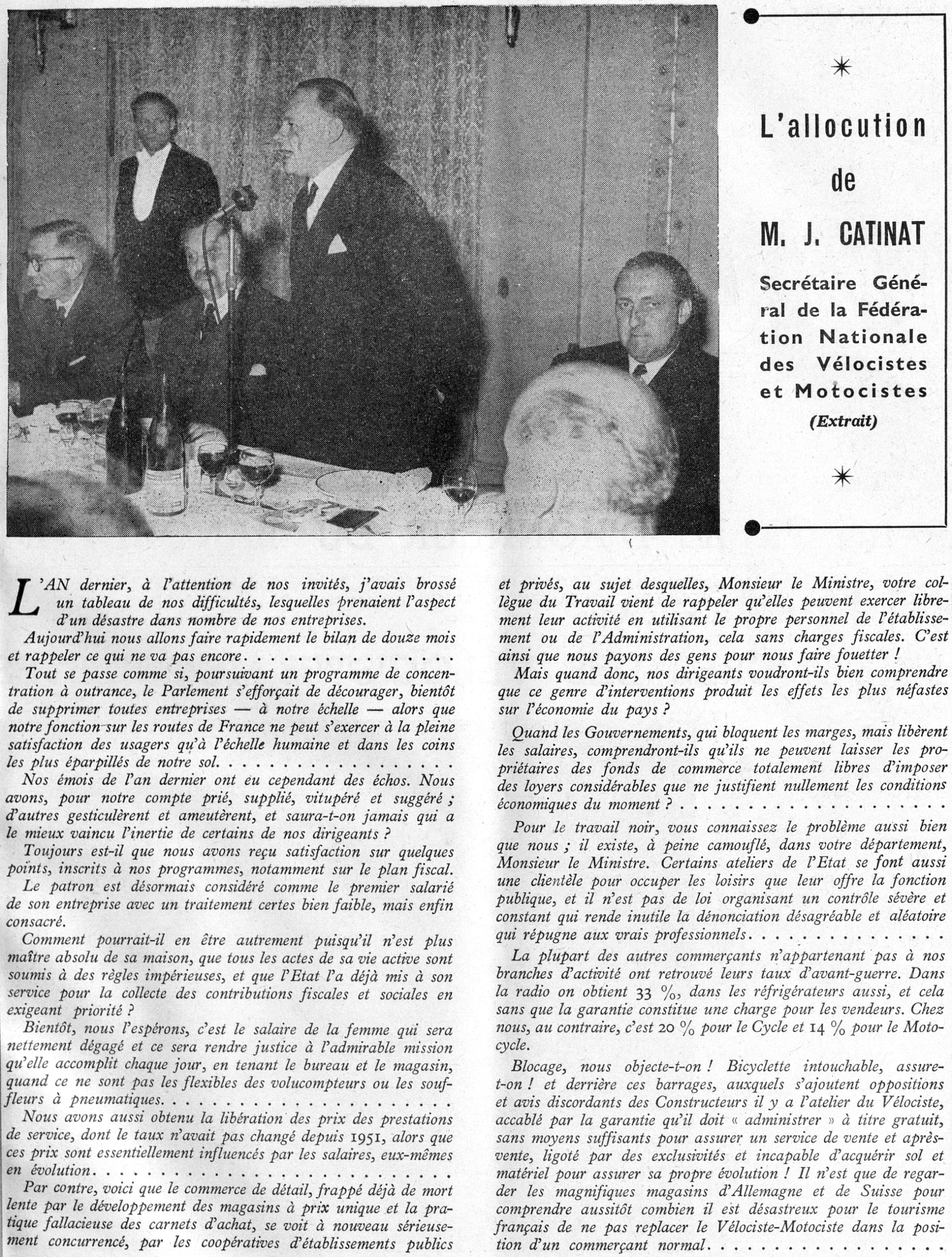
L’allocution
de
M. J. CATINAT
Secrétaire Géné-
ral de la Fédéra-
tion Nationale
des Vélocistes
et Motocistes
(Extrait)
*
[Ebykr summary; the article’s text is not reproduced. The extract is printed in italic, its omissions marked by rows of leader dots at the end of several paragraphs. Last year, M. Catinat recalls, he described to the guests the trade’s difficulties, which in many of its firms looked like a disaster; today he will quickly sum up twelve months and recall what is still wrong. It is as if Parliament, pursuing a program of concentration at all costs, were trying to discourage and soon to abolish every firm of the trade’s size, while its function on the roads of France can be carried out to the full satisfaction of users only on a human scale and in the most scattered corners of the country. Last year’s protests have had echoes: the federation prayed, begged, railed and suggested, others gesticulated and stirred up crowds, and no one will ever know who best overcame the inertia of certain leaders. Satisfaction has been obtained on a few points of the program, notably in fiscal matters. The employer is now treated as the first wage earner of his firm, with a salary certainly very small but at last recognized; it could hardly be otherwise, since he is no longer absolute master of his house, every act of his working life is subject to strict rules, and the State has already put him to work collecting taxes and social contributions while demanding priority. Soon, it is hoped, the wife’s salary will be clearly set apart, which will do justice to the admirable task she performs every day keeping the office and the shop, when it is not the hoses of the petrol pumps (« volucompteurs ») or the tire inflators. The federation has also won the freeing of the prices of services, whose rate had not changed since 1951 although those prices depend mainly on wages, themselves rising. On the other hand, retail commerce, already condemned to a slow death by the growth of single-price stores and the deceptive practice of the carnets d’achat, now faces serious competition again from the cooperatives of public and private establishments, about which, he tells “Monsieur le Ministre”, his colleague of Labor has just recalled that they may freely carry on their activity using the staff of the establishment or of the Administration, and without taxes: “C’est ainsi que nous payons des gens pour nous faire fouetter !” He asks when the leaders will understand that such interventions do the greatest harm to the national economy, and when Governments, which block margins but free wages, will understand that they cannot leave owners of business premises (fonds de commerce) entirely free to impose heavy rents that present economic conditions in no way justify. Undeclared work (travail noir), he tells the Minister, exists barely disguised in the Minister’s own department; certain State workshops also build up a clientele to fill the leisure that public service leaves them, and no law organizes a strict and constant control that would make unnecessary the unpleasant and uncertain denunciation that true professionals find repugnant. Most other traders outside the trade’s branches have recovered their prewar rates: in radio the margin is 33 %, and in refrigerators too, without the guarantee being a charge on the seller, while in this trade it is 20 % for the Cycle and 14 % for the Motocycle. To the objections “Blocage” and “Bicyclette intouchable” (the bicycle cannot be touched), to which are added the opposition and conflicting views of the Constructeurs, he answers that behind these barriers stands the Vélociste’s workshop, crushed by the guarantee it must « administrer » free of charge, without the means to provide a sales and after-sales service, tied by exclusive agreements and unable to acquire premises and equipment for its own development. One need only look at the splendid shops of Germany and Switzerland, he says, to see how disastrous it is for French tourism not to restore the Vélociste-Motociste to the position of a normal trader. The extract bears directly on the bicycle: it gives the dealer’s margin as 20 % on the Cycle against 14 % on the Motocycle and names the bicycle’s frozen price as the obstacle.]
[A full page. A large halftone photograph fills the upper two-thirds of the width: at a banquet table laid with white cloth, bottles and glasses, a heavy-set man in a dark suit with a white pocket handkerchief stands speaking at a microphone on a stand, while a man in a white jacket stands against the curtained wall behind him, two older men sit at the table at the left, the nearer in spectacles, and at the right a heavy-set man sits looking toward the camera beside the blurred back of a woman’s fair head in the foreground. To its right a tall box, framed by thin rules ending in solid round dots at the open corners, holds the title in tall condensed sans-serif capitals and lowercase, the speaker’s office in bold sans-serif, a bold italic “(Extrait)” and two star ornaments. The extract runs below in two columns of italic, opening with a large roman drop capital L. The photograph carries no caption and no signature.]
— Page 11 —
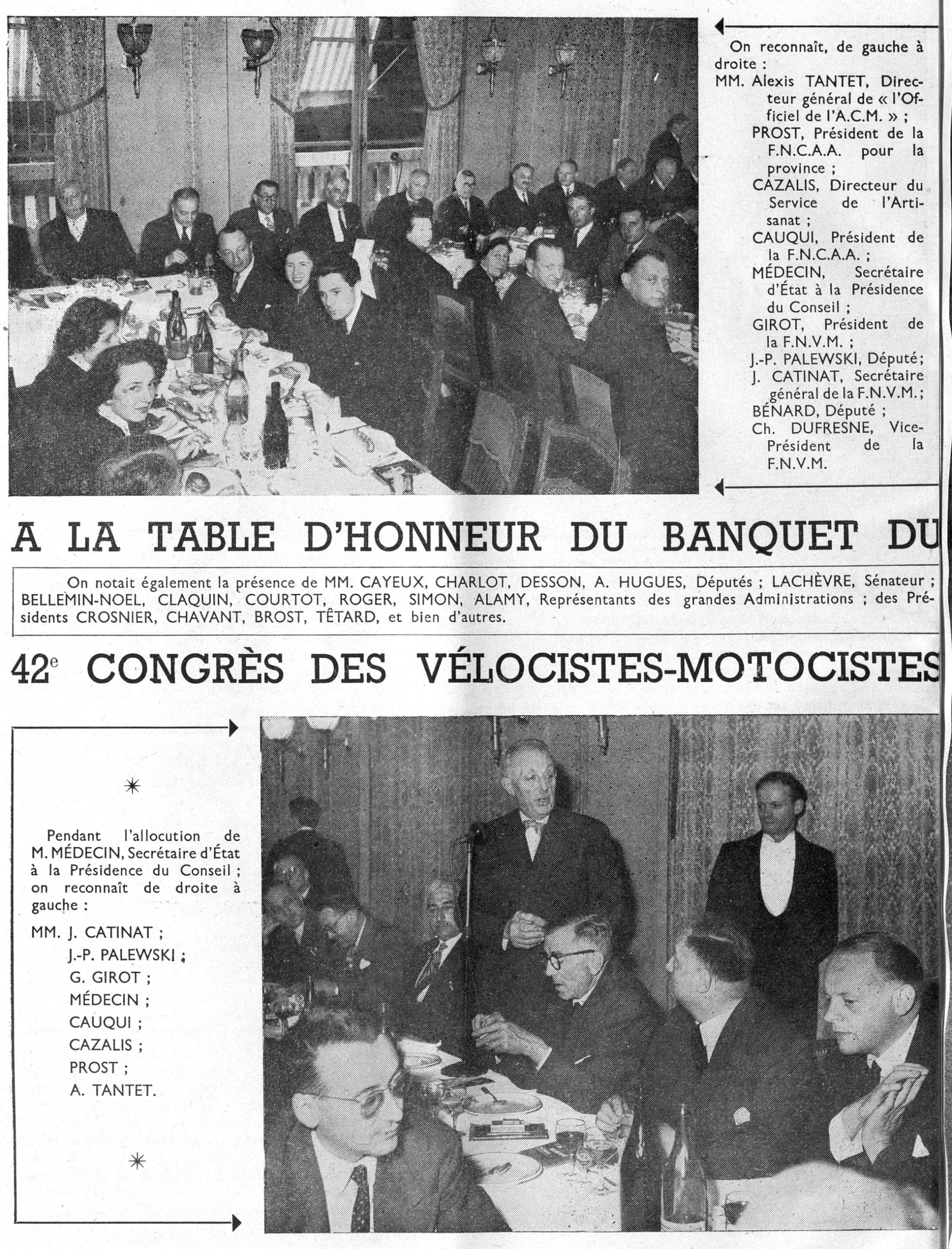
On reconnaît, de gauche à
droite :
MM. Alexis TANTET, Direc-
teur général de « l’Of-
ficiel de l’A.C.M. » ;
PROST, Président de la
F.N.C.A.A. pour la
province ;
CAZALIS, Directeur du
Service de l’Arti-
sanat ;
CAUQUI, Président de
la F.N.C.A.A. ;
MÉDECIN, Secrétaire
d’État à la Présidence
du Conseil ;
GIROT, Président de
la F.N.V.M. ;
J.-P. PALEWSKI, Député;
J. CATINAT, Secrétaire
général de la F.N.V.M.;
BÉNARD, Député ;
Ch. DUFRESNE, Vice-
Président de la
F.N.V.M.
A LA TABLE D’HONNEUR DU BANQUET DU
On notait également la présence de MM. CAYEUX, CHARLOT, DESSON, A. HUGUES, Députés ; LACHÈVRE, Sénateur ;
BELLEMIN-NOEL, CLAQUIN, COURTOT, ROGER, SIMON, ALAMY, Représentants des grandes Administrations ; des Pré-
sidents CROSNIER, CHAVANT, BROST, TÊTARD, et bien d’autres.
42e CONGRÈS DES VÉLOCISTES-MOTOCISTES
*
Pendant l’allocution de
M. MÉDECIN, Secrétaire d’État
à la Présidence du Conseil ;
on reconnaît de droite à
gauche :
MM. J. CATINAT ;
J.-P. PALEWSKI ;
G. GIROT ;
MÉDECIN ;
CAUQUI ;
CAZALIS ;
PROST ;
A. TANTET.
*
[A full page of photographs and captions with no running text. A large halftone photograph fills the upper left: a long banquet table laid with white cloths, bottles and glasses runs back into a hall with draped curtains, wall lamps on brackets and a tall window, the diners, men in dark suits and a few women, seated along both sides and turned toward the camera. Its caption stands at the right in a column opened by arrows pointing left at its head and foot, set in a roman sans-serif with the surnames in capitals. The headline crosses the page in two lines of heavy slab-serif capitals, divided by a ruled box holding the further list of guests; the right end of both headline lines runs into the binding fold, the last letters reaching it but still legible. The lower half holds a second halftone at the right: a gray-haired man in a dark suit stands at a microphone on a stand behind a table set with plates, glasses and bottles, a man in evening dress with a white shirt-front stands against the curtained wall at the right, and seated men fill the foreground, one in heavy spectacles at the lower left and two looking away at the right, the right edge of the picture running into the fold. Its caption sits at the left in a box opened by arrows pointing right at its head and foot, with two star ornaments and the names in a stepped list. Neither photograph carries a signature.]
Ebykr presents this material for research and education. If you hold rights to it or notice an ownership issue, please contact us and we will respond promptly.
The Ebykr Digest
New articles, timelines, catalog finds and registry activity — assembled from the archive once a month. Your address is never shared.
Double opt-in. One email per month. Unsubscribe at any time with one click.