About Ebykr
Ebykr celebrates classic and vintage lightweight bicycles through provocative imagery and opinion. Ride along with us.
About Ebykr
Ebykr celebrates classic and vintage lightweight bicycles through provocative imagery and opinion. Ride along with us.

Source: Gallica (Bibliothèque nationale de France), L'Officiel du cycle, du motocycle et du camping, 29 October 1955, N° 22, page 79; ark:/12148/bd6t54201145h. Source gallica.bnf.fr / BnF.
| Type | Review |
|---|---|
| Year | 1955 |
| Publisher | L'Officiel du cycle |
| Country | France |
| Language | French |
| Pages | 1 |
| Source | Gallica (Bibliothèque nationale de France), L'Officiel du cycle, du motocycle et du camping, 29 October 1955, N° 22, page 79; ark:/12148/bd6t54201145h. Source gallica.bnf.fr / BnF. |
| Credit | Ebykr archive; Bibliothèque nationale de France |
| Identifier | Gallica (BnF) ark:/12148/bd6t54201145h/f78 |
| Transcription | Headings and specifications transcribed; article text summarized |
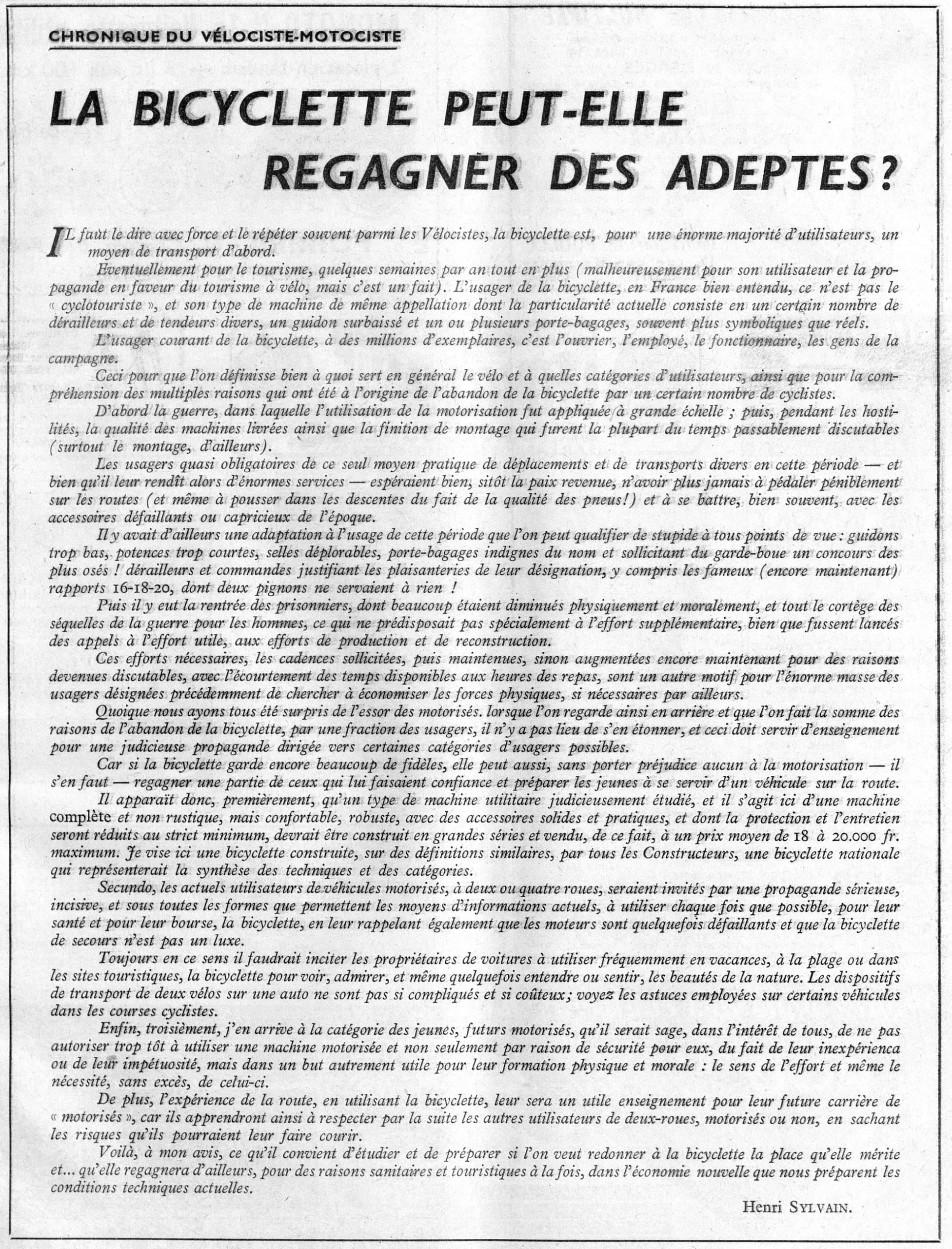
CHRONIQUE DU VÉLOCISTE-MOTOCISTE LA BICYCLETTE PEUT-ELLE REGAGNER DES ADEPTES ? Henri SYLVAIN.
This is a magazine article, so its running text is summarized here rather than reproduced; the headline, byline, specifications and scores are transcribed as printed.
From L’Officiel du cycle, du motocycle et du camping, 29 October 1955, the paper’s first number reporting the 1955 Paris Salon du Cycle et du Motocycle, page 79: Henri Sylvain’s column for the dealers on whether the bicycle can win back its riders. The title, headings, captions and lists are transcribed as printed; the text is summarized in Ebykr’s words, and the page images carry it in full.
— Page 1 —
CHRONIQUE DU VÉLOCISTE-MOTOCISTE
LA BICYCLETTE PEUT-ELLE
REGAGNER DES ADEPTES ?
[Ebykr summary; the article’s text is not reproduced. The author insists that Vélocistes must say it forcefully and often: for an enormous majority of its users the bicycle is first a means of transport, and only incidentally, a few weeks a year at most, a touring machine, regrettably for the propaganda in favor of cycle touring. The French bicycle user is not the “cyclotouriste” and his machine of that name, marked today by an array of dérailleurs and tensioners, a dropped handlebar and luggage racks more symbolic than real; the everyday user, by the millions, is the worker, the clerk, the civil servant and the country people. Defining the bicycle’s use in this way explains why a number of cyclists abandoned it. First came the war, in which motorization was applied on a large scale, and during the hostilities machines of a quality and above all an assembly that were mostly rather questionable. Those all but compelled to use this sole practical means of travel, though it served them enormously, hoped once peace returned never again to pedal painfully on the roads, to push even on the descents because of the quality of the tires, or to fight with the failing accessories of the time. The author calls the period’s adaptations stupid on every count: handlebars too low, stems too short, deplorable saddles, luggage racks unworthy of the name that asked the mudguard for the most daring help, and dérailleurs and controls that justified the jokes made about them, including the famous gears “16-18-20”, still found today, two of whose sprockets served no purpose. Then came the return of the prisoners, many diminished physically and morally, and the other after-effects of the war, which did not dispose men to extra effort despite the calls for production and reconstruction. Those efforts and the work rates demanded, kept up or even raised today for reasons become questionable, together with shortened meal breaks, gave the great mass of users another motive to spare their physical strength. Although all were surprised by the rise of the “motorisés”, the sum of these reasons makes the abandonment unsurprising, and it should guide a judicious propaganda aimed at particular categories of possible users. The bicycle keeps many faithful and could, without harming motorization, win back part of those who trusted it and prepare the young to use a vehicle on the road. First, a carefully studied utility machine, complete rather than rustic but comfortable and robust, with solid practical accessories and minimal protection and upkeep, should be built in large series and sold at an average price of 18 à 20.000 fr. at most; the author has in mind a bicycle built to similar definitions by all the Constructeurs, a national bicycle that would be a synthesis of the techniques and categories. Second, present users of motor vehicles with two or four wheels should be urged by serious, incisive propaganda in every form of modern information to ride the bicycle whenever possible for their health and their purse, and reminded that engines sometimes fail and that a spare bicycle is no luxury; car owners in particular should be encouraged to use bicycles on holiday, at the beach or at tourist sites, to see and enjoy nature, since racks carrying two bicycles on a car are neither complicated nor costly, as the devices used on certain vehicles in cycle races show. Third, the young, the future “motorisés”, should not be allowed a motor machine too early, not only for their own safety given their inexperience or impetuosity but for their physical and moral formation, the sense of effort and its necessity without excess; road experience on a bicycle will also teach them to respect other two-wheel users, motorized or not, and the risks they could cause them. This, in the author’s view, is what must be studied and prepared to give the bicycle back the place it deserves, a place it will in any case regain for reasons of health and touring in the new economy that present technical conditions are preparing.]
Henri SYLVAIN.
[A full page of text only, enclosed in a single ruled frame. At the upper left the department heading “Chronique du Vélociste-Motociste” stands in spaced bold sans-serif capitals over a short rule. The question title follows in two lines of very large bold italic sans-serif capitals with a gray drop shadow, the first line set to the left and the second to the right. The article is one wide justified column of italic roman with a large roman initial I; the word “complète” near the middle is set in roman by mistake, the figures “16-18-20” and “18 à 20.000” are in old-style roman numerals, and the printed text reads “inexpérienca” for “inexpérience”. The signature, in roman with the surname in small capitals, stands at the lower right inside the frame. Faint lines of type from the reverse of the leaf show through the blank areas.]
Ebykr presents this material for research and education. If you hold rights to it or notice an ownership issue, please contact us and we will respond promptly.
The Ebykr Digest
New articles, timelines, catalog finds and registry activity — assembled from the archive once a month. Your address is never shared.
Double opt-in. One email per month. Unsubscribe at any time with one click.