About Ebykr
Ebykr celebrates classic and vintage lightweight bicycles through provocative imagery and opinion. Ride along with us.
About Ebykr
Ebykr celebrates classic and vintage lightweight bicycles through provocative imagery and opinion. Ride along with us.

Source: Gallica (Bibliothèque nationale de France), L'Officiel du cycle, du motocycle et du camping, November 1954, N° 46, pages 107, 109, 111, 113, 115, 117, 119, 121, 123 and 125; ark:/12148/bd6t54196207z. Source gallica.bnf.fr / BnF.
| Type | Review |
|---|---|
| Year | 1954 |
| Publisher | L'Officiel du cycle |
| Country | France |
| Language | French |
| Pages | 10 |
| Source | Gallica (Bibliothèque nationale de France), L'Officiel du cycle, du motocycle et du camping, November 1954, N° 46, pages 107, 109, 111, 113, 115, 117, 119, 121, 123 and 125; ark:/12148/bd6t54196207z. Source gallica.bnf.fr / BnF. |
| Credit | Ebykr archive; Bibliothèque nationale de France |
| Identifier | Gallica (BnF) ark:/12148/bd6t54196207z/f106 |
| Transcription | Headings and specifications transcribed; article text summarized |
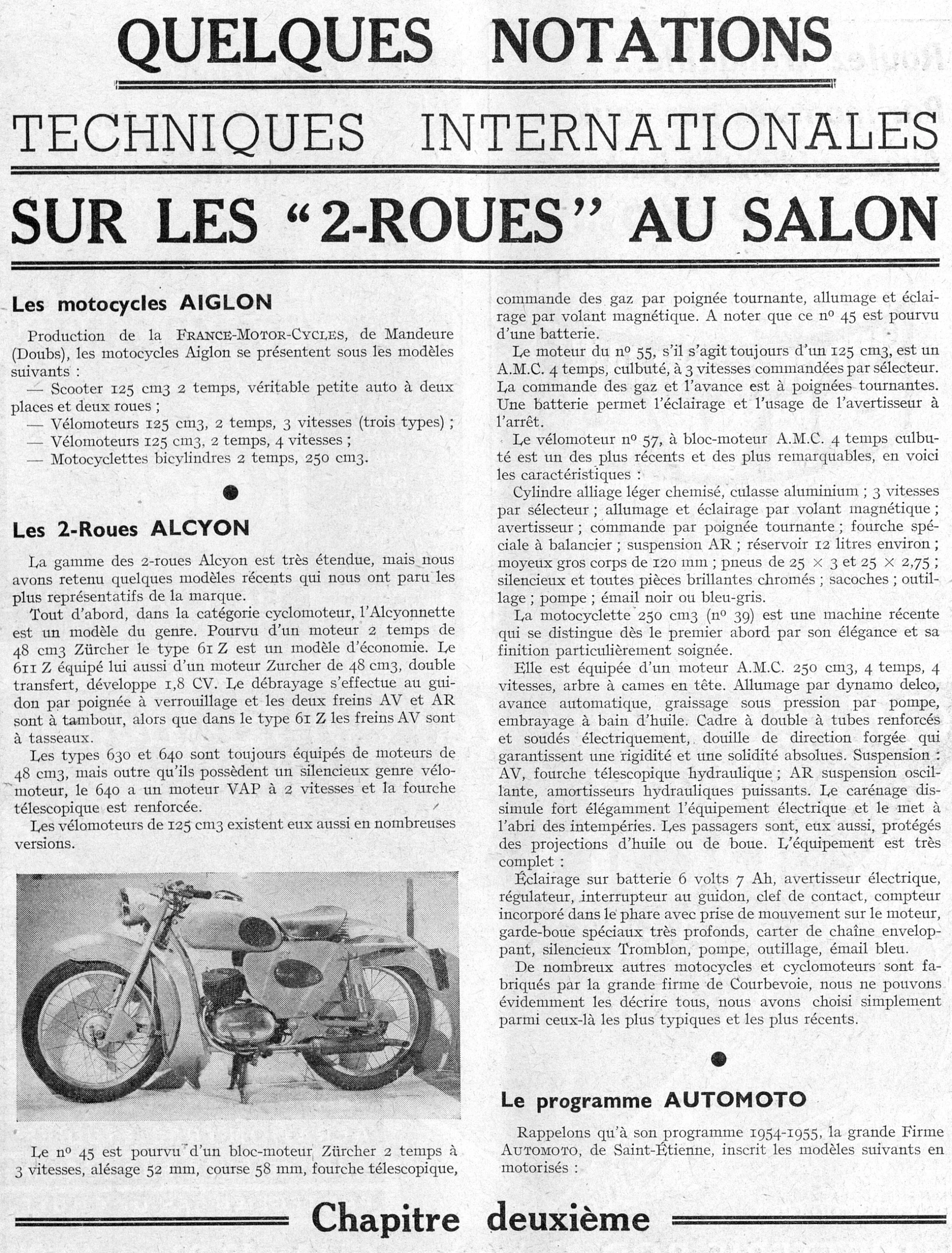
QUELQUES NOTATIONS TECHNIQUES INTERNATIONALES SUR LES "2-ROUES" AU SALON Les motocycles AIGLON — Scooter 125 cm3 2 temps, véritable petite auto à deux places et deux roues ; — Vélomoteurs 125 cm3, 2 temps, 3 vitesses (trois types) ; — Vélomoteurs 125 cm3, 2 temps, 4 vitesses ; — Motocyclettes bicylindres 2 temps, 250 cm3. …
This is a magazine article, so its running text is summarized here rather than reproduced; the headline, byline, specifications and scores are transcribed as printed.
From L’Officiel du cycle, du motocycle et du camping, November 1954, the paper’s number reporting the 1954 Paris Salon du Cycle et du Motocycle, pages 107 to 125: chapter two of the survey of the machines shown at the Salon, make by make. The title, headings, captions and lists are transcribed as printed; the text is summarized in Ebykr’s words, and the page images carry it in full.
— Page 1 —
QUELQUES NOTATIONS
TECHNIQUES INTERNATIONALES
SUR LES “2-ROUES” AU SALON
Les motocycles AIGLON
[Ebykr summary; the article’s text is not reproduced. Aiglon motorcycles are made by France-Motor-Cycles of Mandeure (Doubs), in the following models.]
— Scooter 125 cm3 2 temps, véritable petite auto à deux places et deux roues ;
— Vélomoteurs 125 cm3, 2 temps, 3 vitesses (trois types) ;
— Vélomoteurs 125 cm3, 2 temps, 4 vitesses ;
— Motocyclettes bicylindres 2 temps, 250 cm3.
Les 2-Roues ALCYON
[Ebykr summary; the article’s text is not reproduced. The Alcyon range is very wide, so the writer picks a few recent and representative models. In the cyclemotor class the Alcyonnette is a model of its kind: the type 61 Z has a 48 cm3 two-stroke Zürcher engine and is built for economy; the 611 Z, also with a 48 cm3 Zurcher engine, double transfer, gives 1.8 CV, declutches at the handlebar by a locking grip and has drum brakes front and rear, where the 61 Z has a block (“à tasseaux”) front brake. Types 630 and 640 still use 48 cm3 engines but carry a vélomoteur-style silencer; the 640 has a two-speed VAP engine and a strengthened telescopic fork. The 125 cm3 vélomoteurs come in many versions. No. 45 has a two-stroke Zürcher three-speed unit engine, bore 52 mm, stroke 58 mm, telescopic fork, twist-grip throttle, flywheel-magneto ignition and lighting, and a battery. No. 55 is still a 125 cm3 but with an A.M.C. four-stroke overhead-valve engine, three speeds by selector, twist-grip throttle and spark advance, and a battery for lighting and the horn when stopped.]
[Ebykr summary, continued. The vélomoteur No. 57, with an A.M.C. four-stroke overhead-valve unit engine, is one of the most recent and remarkable; its specification is given as a list.]
Cylindre alliage léger chemisé, culasse aluminium ; 3 vitesses par sélecteur ; allumage et éclairage par volant magnétique ; avertisseur ; commande par poignée tournante ; fourche spéciale à balancier ; suspension AR ; réservoir 12 litres environ ; moyeux gros corps de 120 mm ; pneus de 25 × 3 et 25 × 2,75 ; silencieux et toutes pièces brillantes chromés ; sacoches ; outillage ; pompe ; émail noir ou bleu-gris.
[Ebykr summary, continued. The 250 cm3 motorcycle (No. 39) is a recent machine notable for its elegance and careful finish: A.M.C. 250 cm3 four-stroke, four speeds, overhead camshaft, ignition by Delco dynamo, automatic advance, pressure lubrication by pump, oil-bath clutch; a double frame of reinforced, electrically welded tubes with a forged head tube; hydraulic telescopic fork in front and swinging-arm rear suspension with powerful hydraulic dampers. A fairing hides the electrical equipment from the weather and shields the riders from oil and mud. The equipment is listed.]
Éclairage sur batterie 6 volts 7 Ah, avertisseur électrique, régulateur, interrupteur au guidon, clef de contact, compteur incorporé dans le phare avec prise de mouvement sur le moteur, garde-boue spéciaux très profonds, carter de chaîne enveloppant, silencieux Tromblon, pompe, outillage, émail bleu.
[Ebykr summary, continued. The great Courbevoie firm makes many other motorcycles and cyclemotors; only the most typical and recent are described.]
Le programme AUTOMOTO
[Ebykr summary; the article’s text is not reproduced. For 1954-1955 the Saint-Étienne firm Automoto lists the following powered models (the list continues overleaf).]
Chapitre deuxième
— Page 2 —
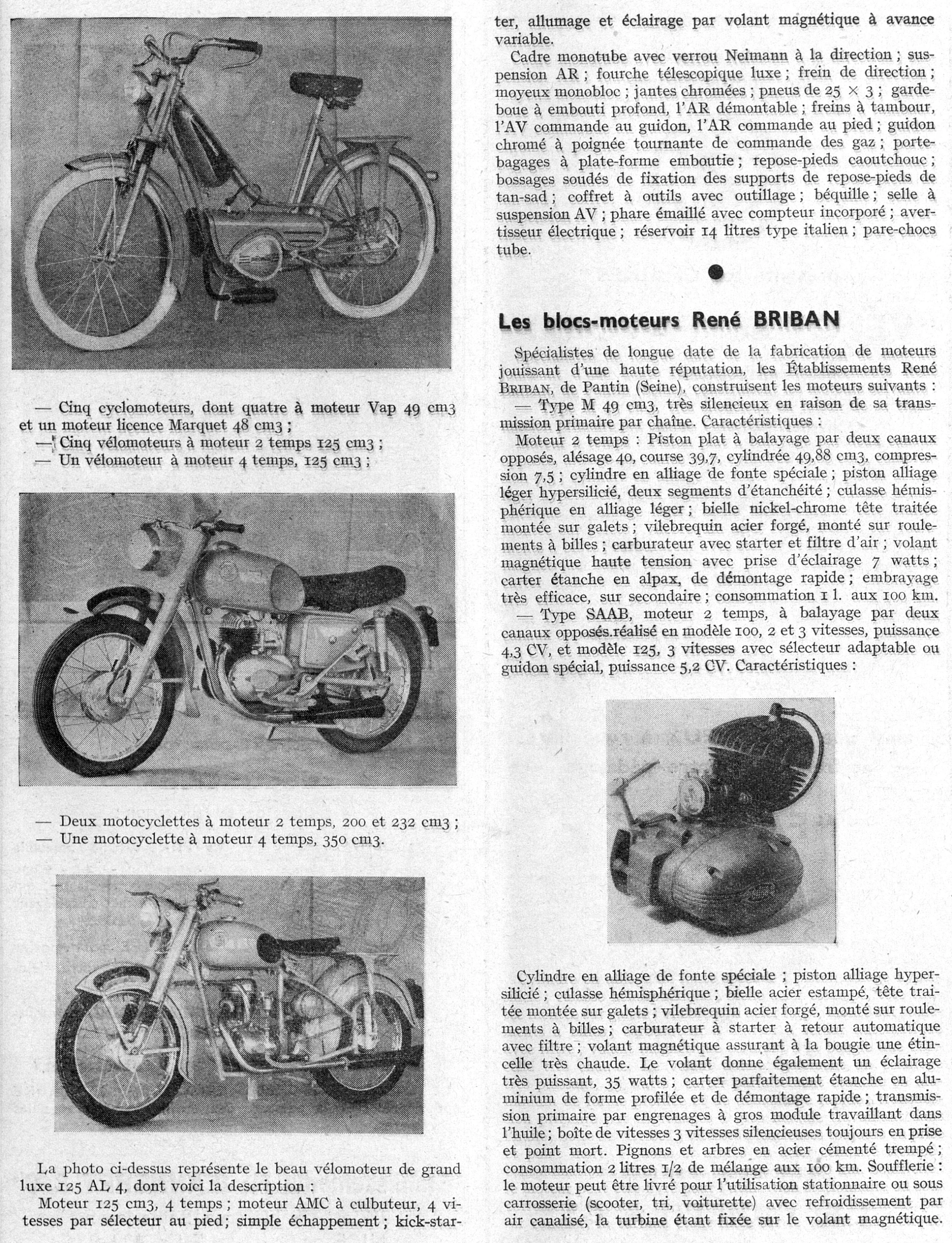
— Cinq cyclomoteurs, dont quatre à moteur Vap 49 cm3 et un moteur licence Marquet 48 cm3 ;
— Cinq vélomoteurs à moteur 2 temps 125 cm3 ;
— Un vélomoteur à moteur 4 temps, 125 cm3 ;
— Deux motocyclettes à moteur 2 temps, 200 et 232 cm3 ;
— Une motocyclette à moteur 4 temps, 350 cm3.
[Ebykr summary, continued. The photograph above it shows the luxury vélomoteur 125 AL 4, described as follows.]
Moteur 125 cm3, 4 temps ; moteur AMC à culbuteur, 4 vitesses par sélecteur au pied ; simple échappement ; kick-starter, allumage et éclairage par volant magnétique à avance variable.
Cadre monotube avec verrou Neimann à la direction ; suspension AR ; fourche télescopique luxe ; frein de direction ; moyeux monobloc ; jantes chromées ; pneus de 25 × 3 ; garde-boue à embouti profond, l’AR démontable ; freins à tambour, l’AV commande au guidon, l’AR commande au pied ; guidon chromé à poignée tournante de commande des gaz ; porte-bagages à plate-forme emboutie ; repose-pieds caoutchouc ; bossages soudés de fixation des supports de repose-pieds de tan-sad ; coffret à outils avec outillage ; béquille ; selle à suspension AV ; phare émaillé avec compteur incorporé ; avertisseur électrique ; réservoir 14 litres type italien ; pare-chocs tube.
Les blocs-moteurs René BRIBAN
[Ebykr summary; the article’s text is not reproduced. The Établissements René Briban of Pantin (Seine), long-time makers of well-regarded engines, build the following.]
— Type M 49 cm3, très silencieux en raison de sa transmission primaire par chaîne. Caractéristiques :
Moteur 2 temps : Piston plat à balayage par deux canaux opposés, alésage 40, course 39,7, cylindrée 49,88 cm3, compression 7,5 ; cylindre en alliage de fonte spéciale ; piston alliage léger hypersilicié, deux segments d’étanchéité ; culasse hémisphérique en alliage léger ; bielle nickel-chrome tête traitée montée sur galets ; vilebrequin acier forgé, monté sur roulements à billes ; carburateur avec starter et filtre d’air ; volant magnétique haute tension avec prise d’éclairage 7 watts ; carter étanche en alpax, de démontage rapide ; embrayage très efficace, sur secondaire ; consommation 1 l. aux 100 km.
— Type SAAB, moteur 2 temps, à balayage par deux canaux opposés.réalisé en modèle 100, 2 et 3 vitesses, puissance 4,3 CV, et modèle 125, 3 vitesses avec sélecteur adaptable ou guidon spécial, puissance 5,2 CV. Caractéristiques :
Cylindre en alliage de fonte spéciale ; piston alliage hypersilicié ; culasse hémisphérique ; bielle acier estampé, tête traitée montée sur galets ; vilebrequin acier forgé, monté sur roulements à billes ; carburateur à starter à retour automatique avec filtre ; volant magnétique assurant à la bougie une étincelle très chaude. Le volant donne également un éclairage très puissant, 35 watts ; carter parfaitement étanche en aluminium de forme profilée et de démontage rapide ; transmission primaire par engrenages à gros module travaillant dans l’huile ; boîte de vitesses 3 vitesses silencieuses toujours en prise et point mort. Pignons et arbres en acier cémenté trempé ; consommation 2 litres 1/2 de mélange aux 100 km. Soufflerie : le moteur peut être livré pour l’utilisation stationnaire ou sous carrosserie (scooter, tri, voiturette) avec refroidissement par air canalisé, la turbine étant fixée sur le volant magnétique.
— Page 3 —
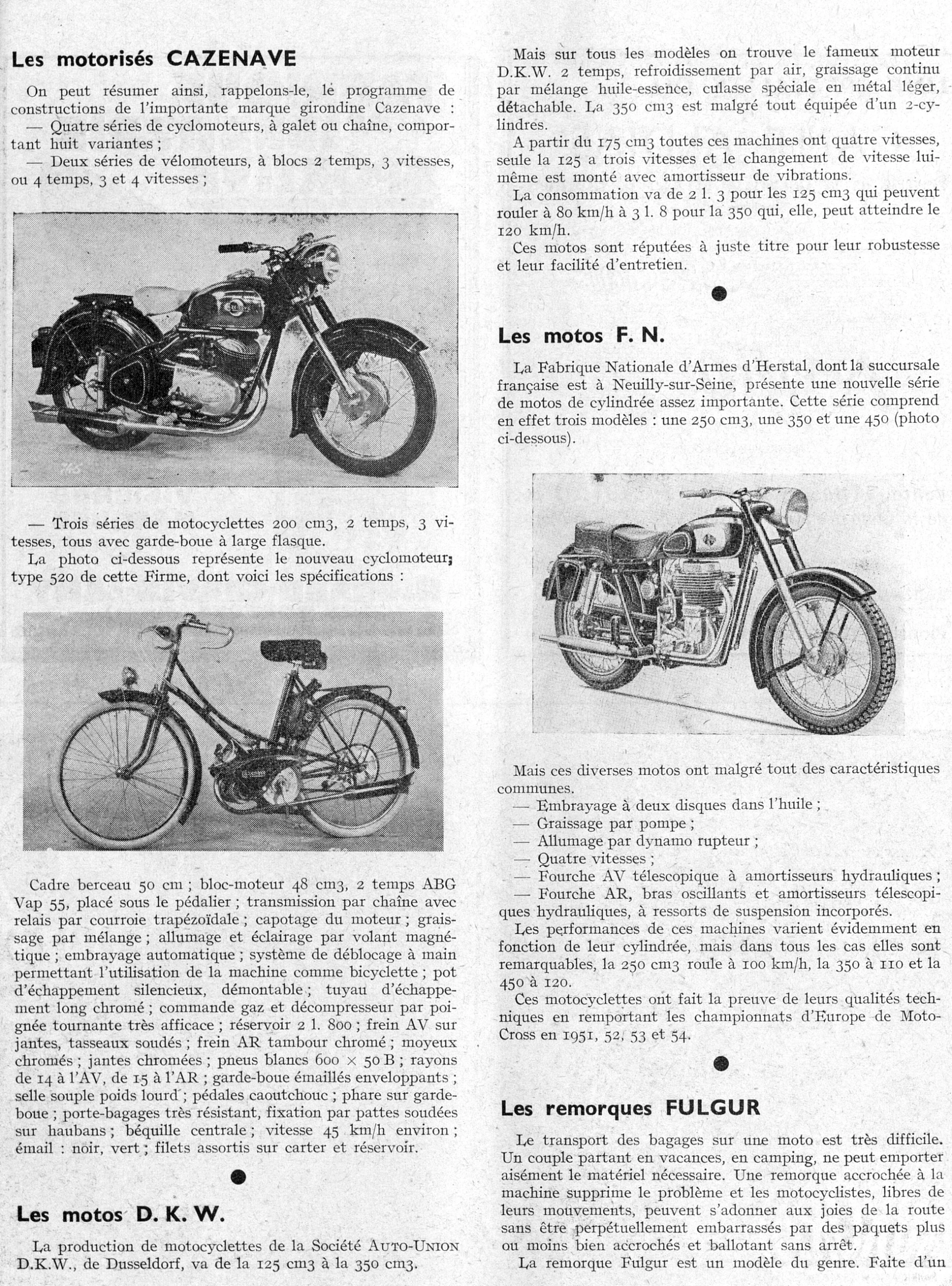
Les motorisés CAZENAVE
[Ebykr summary; the article’s text is not reproduced. The program of the important Gironde marque Cazenave is summed up as follows.]
— Quatre séries de cyclomoteurs, à galet ou chaîne, comportant huit variantes ;
— Deux séries de vélomoteurs, à blocs 2 temps, 3 vitesses, ou 4 temps, 3 et 4 vitesses ;
— Trois séries de motocyclettes 200 cm3, 2 temps, 3 vitesses, tous avec garde-boue à large flasque.
[Ebykr summary, continued. The photograph below shows the firm’s new cyclemotor type 520, with these specifications.]
Cadre berceau 50 cm ; bloc-moteur 48 cm3, 2 temps ABG Vap 55, placé sous le pédalier ; transmission par chaîne avec relais par courroie trapézoïdale ; capotage du moteur ; graissage par mélange ; allumage et éclairage par volant magnétique ; embrayage automatique ; système de déblocage à main permettant l’utilisation de la machine comme bicyclette ; pot d’échappement silencieux, démontable ; tuyau d’échappement long chromé ; commande gaz et décompresseur par poignée tournante très afficace ; réservoir 2 l. 800 ; frein AV sur jantes, tasseaux soudés ; frein AR tambour chromé ; moyeux chromés ; jantes chromées ; pneus blancs 600 × 50 B ; rayons de 14 à l’AV, de 15 à l’AR ; garde-boue émaillés enveloppants ; selle souple poids lourd ; pédales caoutchouc ; phare sur garde-boue ; porte-bagages très résistant, fixation par pattes soudées sur haubans ; béquille centrale ; vitesse 45 km/h environ ; émail : noir, vert ; filets assortis sur carter et réservoir.
Les motos D. K. W.
[Ebykr summary; the article’s text is not reproduced. The motorcycle output of the Société Auto-Union D.K.W. of Dusseldorf runs from 125 cm3 to 350 cm3. Every model has the famous D.K.W. two-stroke engine, air-cooled, lubricated continuously by oil-and-petrol mixture, with a special detachable light-alloy head; the 350 cm3 is nonetheless a twin. From 175 cm3 up all have four speeds; only the 125 has three, and its gear change is mounted with a vibration damper. Consumption runs from 2.3 liters for the 125 cm3, which can do 80 km/h, to 3.8 liters for the 350, which reaches 120 km/h. The machines are justly known for robustness and ease of upkeep.]
Les motos F. N.
[Ebykr summary; the article’s text is not reproduced. The Fabrique Nationale d’Armes d’Herstal, whose French branch is at Neuilly-sur-Seine, shows a new series of fairly large motorcycles in three models: a 250 cm3, a 350 and a 450 (the photograph). They share these features.]
— Embrayage à deux disques dans l’huile ;
— Graissage par pompe ;
— Allumage par dynamo rupteur ;
— Quatre vitesses ;
— Fourche AV télescopique à amortisseurs hydrauliques ;
— Fourche AR, bras oscillants et amortisseurs télescopiques hydrauliques, à ressorts de suspension incorporés.
[Ebykr summary, continued. Performance varies with capacity but is remarkable in every case: the 250 cm3 does 100 km/h, the 350 110 and the 450 120. The machines proved themselves by winning the European Moto-Cross championships in 1951, 52, 53 and 54.]
Les remorques FULGUR
[Ebykr summary; the article’s text is not reproduced. Carrying luggage on a motorcycle is very hard, and a couple going camping cannot easily take what they need; a trailer hitched to the machine solves this and frees the riders from loose, swinging parcels. The Fulgur trailer is a model of its kind (the description continues overleaf).]
— Page 4 —
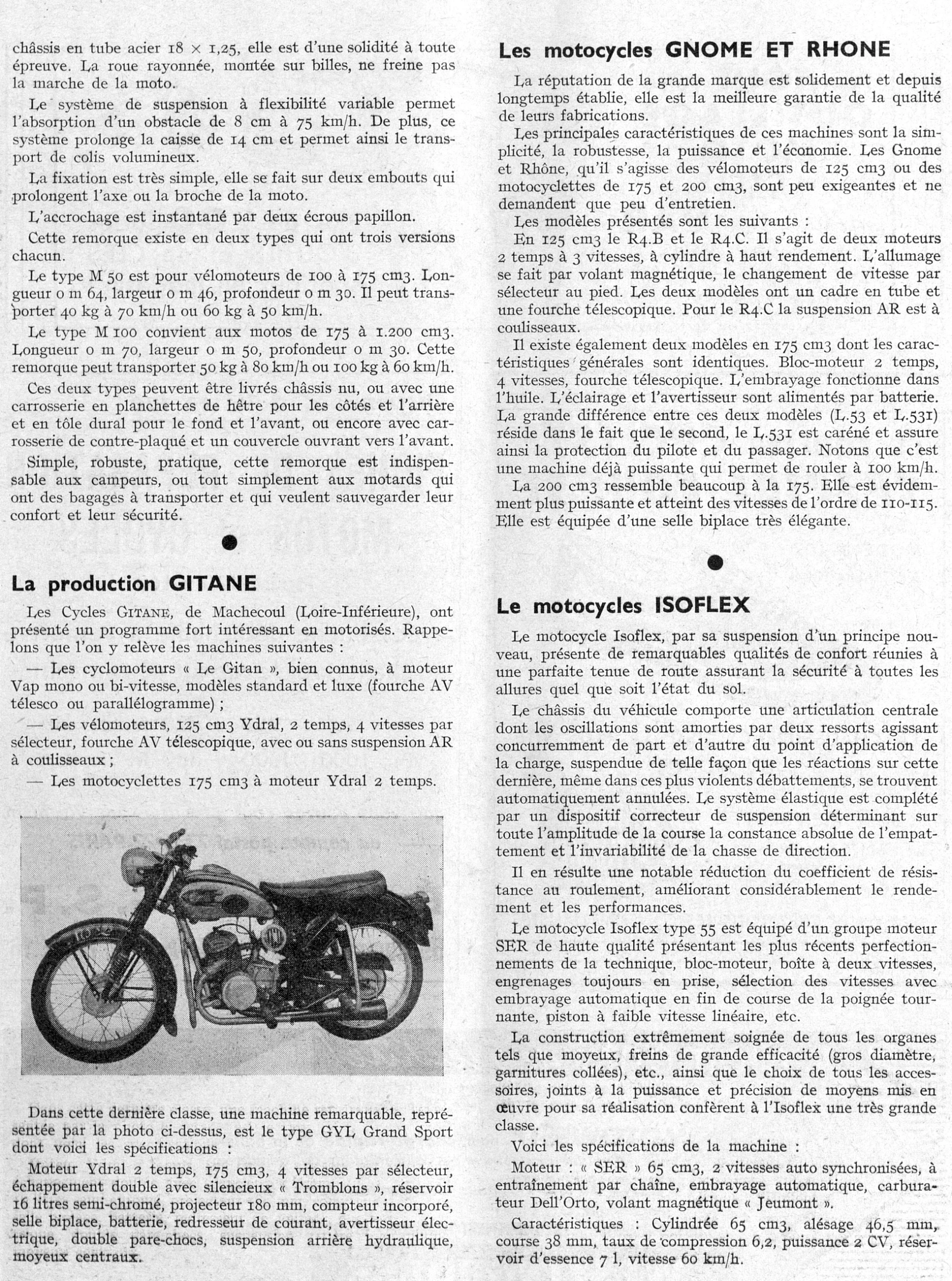
[Ebykr summary, continued from the previous page. The Fulgur trailer has a chassis of 18 × 1.25 steel tube and is extremely strong; its spoked wheel runs on ball bearings and does not hold the motorcycle back. A variable-flexibility suspension absorbs an 8 cm obstacle at 75 km/h and lengthens the body by 14 cm for bulky loads. It fixes very simply on two end pieces that extend the motorcycle’s axle or spindle, and hitches instantly with two wing nuts. There are two types in three versions each. Type M 50 is for vélomoteurs of 100 to 175 cm3: length 0 m 64, width 0 m 46, depth 0 m 30; it carries 40 kg at 70 km/h or 60 kg at 50 km/h. Type M 100 suits motorcycles of 175 to 1,200 cm3: length 0 m 70, width 0 m 50, depth 0 m 30; it carries 50 kg at 80 km/h or 100 kg at 60 km/h. Both come as a bare chassis, with a body of beech slats on the sides and back and dural sheet on the floor and front, or with a plywood body and a lid opening forward. Simple, robust and practical, it is called indispensable to campers and to any rider with luggage who wants to keep comfort and safety.]
La production GITANE
[Ebykr summary; the article’s text is not reproduced. The Cycles Gitane of Machecoul (Loire-Inférieure) showed a very interesting program of powered machines, as follows.]
— Les cyclomoteurs « Le Gitan », bien connus, à moteur Vap mono ou bi-vitesse, modèles standard et luxe (fourche AV télesco ou parallélogramme) ;
— Les vélomoteurs, 125 cm3 Ydral, 2 temps, 4 vitesses par sélecteur, fourche AV télescopique, avec ou sans suspension AR à coulisseaux ;
— Les motocyclettes 175 cm3 à moteur Ydral 2 temps.
[Ebykr summary, continued. In this last class a remarkable machine, shown in the photograph, is the type GYL Grand Sport, with these specifications.]
Moteur Ydral 2 temps, 175 cm3, 4 vitesses par sélecteur, échappement double avec silencieux « Tromblons », réservoir 16 litres semi-chromé, projecteur 180 mm, compteur incorporé, selle biplace, batterie, redresseur de courant, avertisseur électrique, double pare-chocs, suspension arrière hydraulique, moyeux centraux.
Les motocycles GNOME ET RHONE
[Ebykr summary; the article’s text is not reproduced. The great marque’s long-established reputation is the best guarantee of quality; its machines stand for simplicity, robustness, power and economy, and the 125 cm3 vélomoteurs and the 175 and 200 cm3 motorcycles alike need little upkeep. In 125 cm3 are the R4.B and R4.C, two-stroke three-speed engines with a high-efficiency cylinder, flywheel-magneto ignition, foot selector, tube frame and telescopic fork; the R4.C has plunger rear suspension. Two 175 cm3 models (L.53 and L.531) share a two-stroke four-speed unit engine, telescopic fork, oil-bath clutch and battery lighting and horn; the L.531 is faired to protect rider and passenger and is already powerful enough for 100 km/h. The 200 cm3 closely resembles the 175, is more powerful, reaches 110-115 and has a very elegant dual seat.]
Le motocycles ISOFLEX
[Ebykr summary; the article’s text is not reproduced. The Isoflex owes remarkable comfort and roadholding on any surface to a suspension on a new principle: the chassis has a central articulation whose movement is damped by two springs acting on either side of the load point, so that reactions on the load cancel out even in the hardest travel, and a corrector keeps the wheelbase and steering trail constant over the whole stroke. Rolling resistance falls notably, improving efficiency and performance. The Isoflex type 55 has a SER unit engine with a two-speed constant-mesh gearbox, gear selection with automatic clutch at the end of the twist grip’s travel and a low-piston-speed design; careful hubs, large-diameter brakes with bonded linings and well-chosen accessories give it real class. Its specifications follow.]
Moteur : « SER » 65 cm3, 2 vitesses auto synchronisées, à entraînement par chaîne, embrayage automatique, carburateur Dell’Orto, volant magnétique « Jeumont ».
Caractéristiques : Cylindrée 65 cm3, alésage 46,5 mm, course 38 mm, taux de compression 6,2, puissance 2 CV, réservoir d’essence 7 l, vitesse 60 km/h.
— Page 5 —
Fourche : Fourche AV renforcée type moto. Guidon amortisseur sur silentbloc.
Freins : A l’AR, commandé au pied, sur large moyeu tambour à freinage central, garniture collée. A l’AV, commandé à main avec les mêmes caractéristiques que celui de l’AR.
Roues : De 600 × 55 équipées de pneus de grosse section de 600 × 60.
Éclairage : Phare à trois éclairages : lanternes code phare commandé par combinateur, compteur de vitesse incorporé sur demande, feu arrière réglementaire.
Capotage : Enveloppant de forme très étudiée pour la protection du pilote.
Échappement : Par silencieux de grande efficacité.
Selle : Spéciale grand confort.
Poignées de commande : Une poignée tournante commandant les gaz au carburateur, une poignée tournante commandant le débrayage et le changement de vitesse auto-synchronisé.
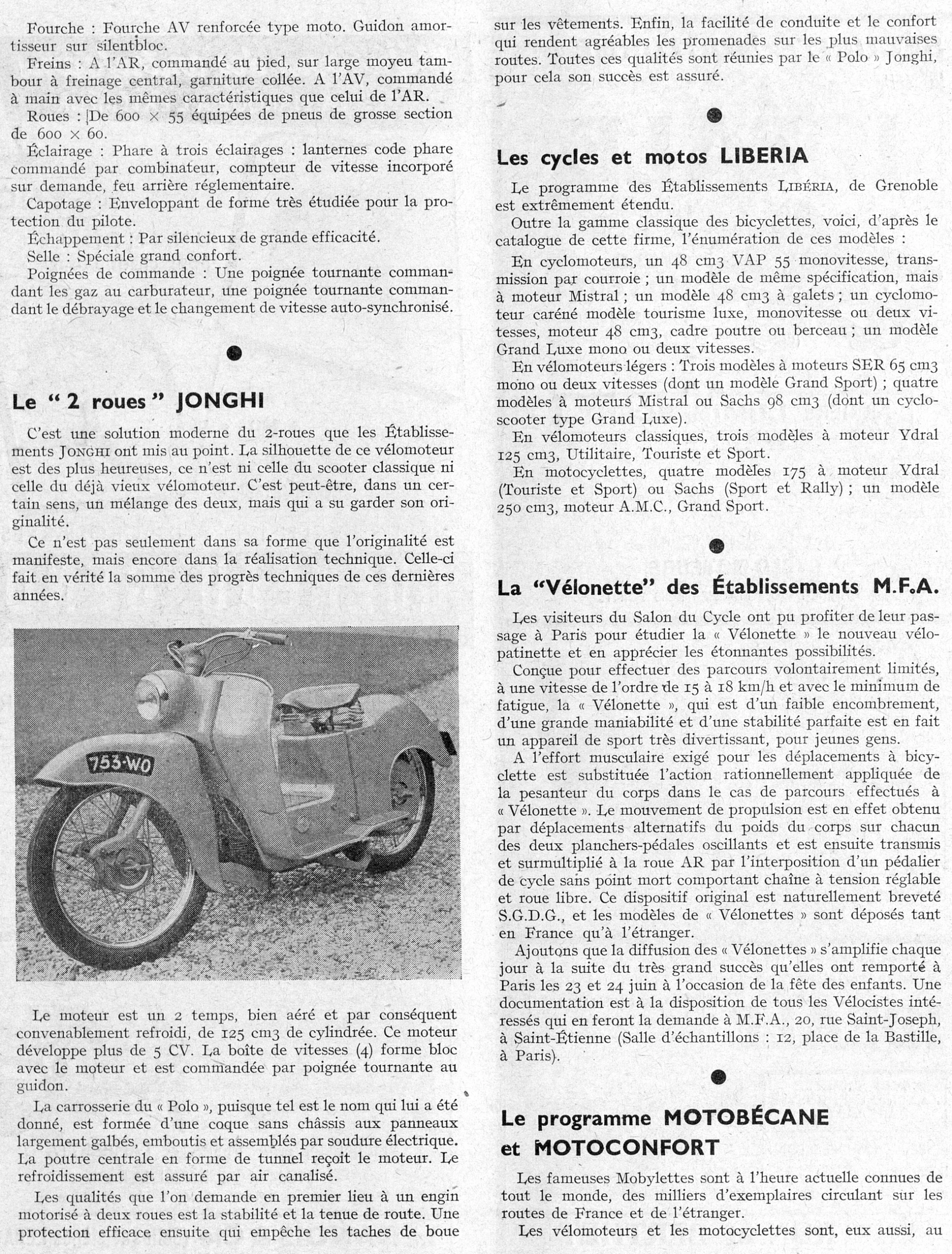
Le “2 roues” JONGHI
[Ebykr summary; the article’s text is not reproduced. The Établissements Jonghi have worked out a modern two-wheeler whose very happy silhouette is neither the classic scooter nor the by now old vélomoteur but an original blend of the two, and whose engineering sums up recent technical progress. The engine is a well-ventilated, properly cooled 125 cm3 two-stroke of more than 5 CV, with a four-speed gearbox in unit, worked by twist grip at the handlebar. The body of the « Polo », as it is named, is a chassisless shell of deeply curved pressed panels joined by electric welding; a tunnel-shaped central beam holds the engine, which is cooled by ducted air. Stability and roadholding come first in a powered two-wheeler, then protection that keeps mud off the clothes, then ease of handling and comfort on the worst roads; the « Polo » Jonghi combines them all, so its success is assured.]
Les cycles et motos LIBERIA
[Ebykr summary; the article’s text is not reproduced. The program of the Établissements Libéria of Grenoble is extremely wide. Besides the classic range of bicycles, the firm’s catalog lists: in cyclemotors, a 48 cm3 VAP 55 single-speed with belt drive; the same with a Mistral engine; a 48 cm3 roller-drive model; a faired touring de luxe cyclemotor, single or two-speed, 48 cm3 engine, beam or cradle frame; and a Grand Luxe model, single or two-speed. In light vélomoteurs, three models with SER 65 cm3 engines, single or two-speed (one a Grand Sport), and four with Mistral or Sachs 98 cm3 engines (one a Grand Luxe cyclo-scooter). In classic vélomoteurs, three Ydral 125 cm3 models: Utilitaire, Touriste and Sport. In motorcycles, four 175 models with Ydral (Touriste and Sport) or Sachs (Sport and Rally) engines, and one 250 cm3 A.M.C.-engined Grand Sport. The bicycles themselves are not described.]
La “Vélonette” des Établissements M.F.A.
[Ebykr summary; the article’s text is not reproduced. Visitors to the Salon du Cycle could study the « Vélonette », the new « vélo-patinette », and its surprising possibilities. Designed for deliberately short trips at about 15 to 18 km/h with the least fatigue, it is compact, very maneuverable and perfectly stable, and is in fact a highly entertaining sporting machine for young people. In place of the muscular effort of cycling it uses the rider’s body weight, rationally applied: propulsion comes from shifting the weight alternately onto each of two oscillating platform-pedals, and the motion is transmitted and geared up to the rear wheel through a cycle crankset without dead center, with a chain of adjustable tension and a freewheel. The device is patented S.G.D.G. and the « Vélonette » designs are registered in France and abroad. Its spread grows daily after its great success in Paris on 23 and 24 June at the children’s festival. Literature is available to all interested « Vélocistes » on request to M.F.A., 20, rue Saint-Joseph, à Saint-Étienne (Salle d’échantillons : 12, place de la Bastille, à Paris).]
Le programme MOTOBÉCANE
et MOTOCONFORT
[Ebykr summary; the article’s text is not reproduced. The famous Mobylettes are now known to everyone, with thousands on the roads of France and abroad; the vélomoteurs and motorcycles are likewise (continued overleaf).]
— Page 6 —
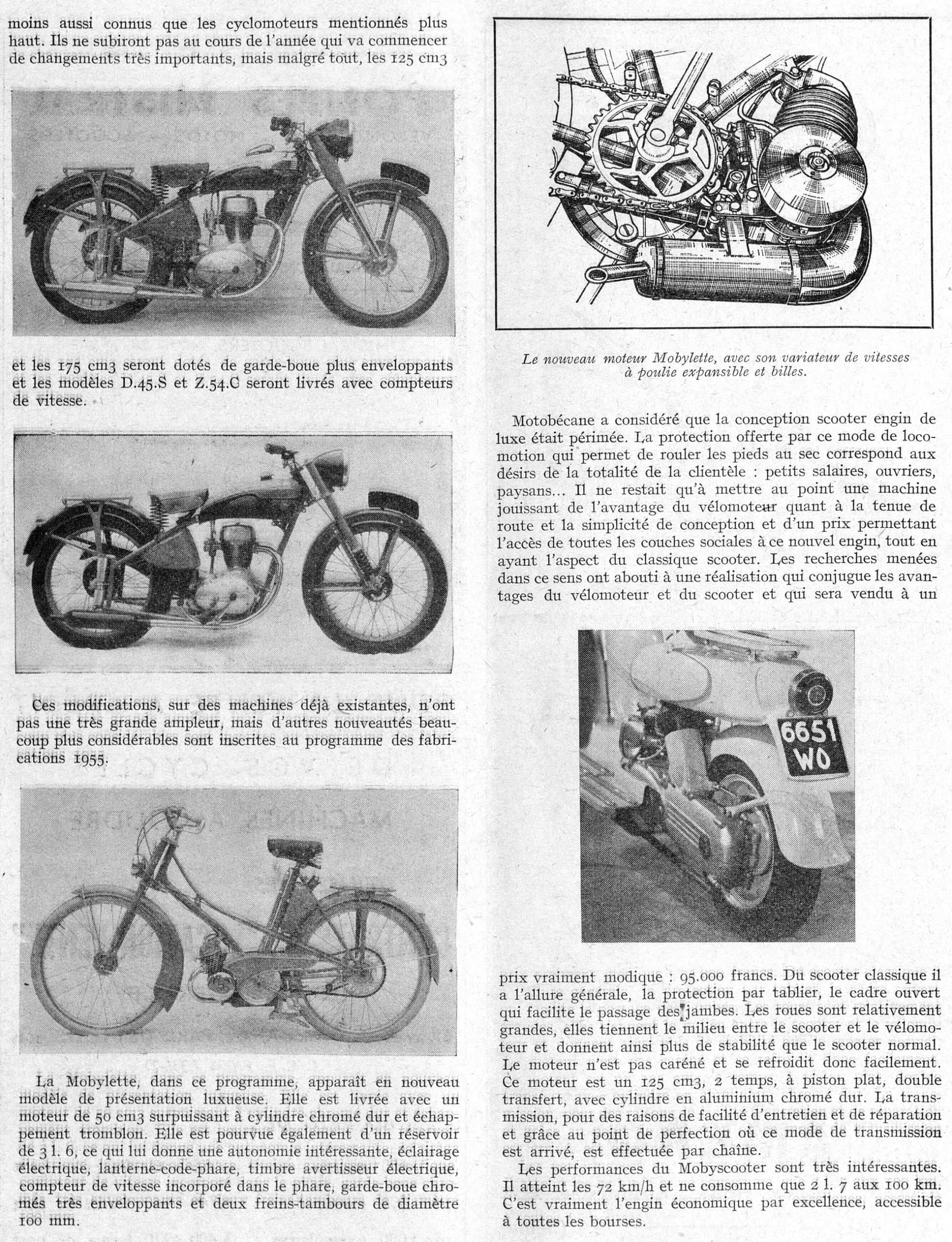
[Ebykr summary, continued from the previous page. The Motobécane vélomoteurs and motorcycles are at least as well known as the cyclemotors. They will not change much in the coming year, but the 125 cm3 and 175 cm3 will get more enveloping mudguards and the D.45.S and Z.54.C models will come with speedometers. These are modest changes; much bigger novelties are on the 1955 program. The Mobylette appears in a new, luxurious version with a high-output 50 cm3 engine with hard-chromed cylinder and « tromblon » exhaust, a 3.6-liter tank giving useful range, electric lighting with lantern-dip-main headlamp, electric horn, speedometer built into the headlamp, very enveloping chromed mudguards and two 100 mm drum brakes.]
Le nouveau moteur Mobylette, avec son variateur de vitesses
à poulie expansible et billes.
[Ebykr summary, continued. Motobécane judged the luxury-scooter concept out of date. The protection of riding with dry feet suits the whole clientele (small wage earners, workers, farmers), so it remained to build a machine with the vélomoteur’s roadholding and simplicity, at a price open to every social class, yet with the look of the classic scooter. The result combines vélomoteur and scooter and will sell at the truly modest price of 95.000 francs. From the scooter it takes the general look, the apron and the open frame for easy stepping through; its relatively large wheels, between scooter and vélomoteur size, give more stability than a normal scooter. The engine is not enclosed and so cools easily: 125 cm3, two-stroke, flat piston, double transfer, hard-chromed aluminum cylinder. Final drive is by chain, for ease of upkeep and repair and because chain drive has reached such perfection. The Mobyscooter reaches 72 km/h and uses only 2.7 liters per 100 km, the economical machine par excellence, within every budget.]
— Page 7 —
Les vélomoteurs et cyclomoteurs
MANDILLE ET ROUX
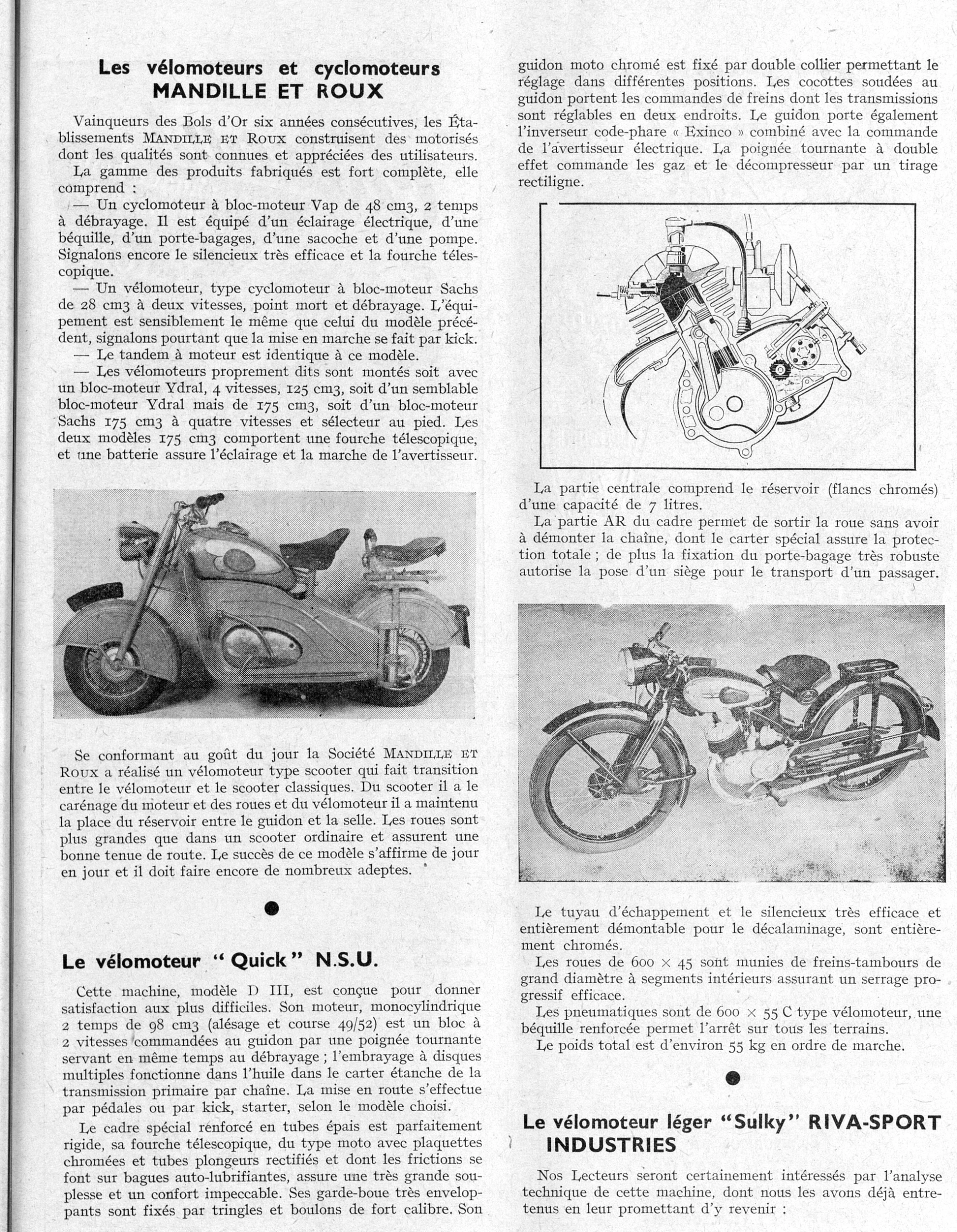
[Ebykr summary; the article’s text is not reproduced. Winners of the Bol d’Or six years running, the Établissements Mandille et Roux build powered machines whose qualities riders know well. The range is very complete: a cyclemotor with a 48 cm3 two-stroke Vap unit with clutch, electric lighting, stand, carrier, bag and pump, a very effective silencer and a telescopic fork; a vélomoteur of cyclemotor type with a 28 cm3 Sachs unit, two speeds, neutral and clutch, much the same equipment but kick-started; a motor tandem identical to that model; and true vélomoteurs with a four-speed 125 cm3 Ydral unit, a similar Ydral unit of 175 cm3, or a four-speed 175 cm3 Sachs unit with foot selector. Both 175 cm3 models have a telescopic fork, and a battery feeds the lighting and horn. Following the fashion of the day the firm has built a scooter-type vélomoteur that bridges the classic vélomoteur and scooter: from the scooter it takes the enclosure of engine and wheels, from the vélomoteur the tank between handlebar and saddle; its wheels are larger than an ordinary scooter’s and hold the road well. Its success grows daily.]
Le vélomoteur “Quick” N.S.U.
[Ebykr summary; the article’s text is not reproduced. This machine, model D III, is built to satisfy the most demanding. Its single-cylinder two-stroke engine of 98 cm3 (bore and stroke 49/52) is a two-speed unit worked at the handlebar by a twist grip that also declutches; the multi-plate clutch runs in oil in the sealed primary chain case. It starts by pedals or by kick-starter, according to the model. The special reinforced frame of thick tube is perfectly rigid; the motorcycle-type telescopic fork, with chromed plates, ground sliders and self-lubricating bushes, gives great suppleness and comfort. The very enveloping mudguards are fixed by stays and heavy bolts. The chromed motorcycle handlebar is held by a double clamp adjustable to several positions; lugs welded to it carry the brake levers, whose cables adjust at two points; it also carries the « Exinco » dip switch combined with the electric horn button, and a double-acting twist grip works throttle and decompressor by a straight pull. The central section holds the 7-liter tank with chromed flanks. The rear of the frame lets the wheel come out without removing the chain, which a special case fully encloses, and the very strong carrier mounting takes a pillion seat. The exhaust pipe and very effective silencer, fully removable for decarbonizing, are entirely chromed. The 600 × 45 wheels have large-diameter internal-shoe drum brakes giving progressive, effective braking; the tires are 600 × 55 C vélomoteur type; a reinforced stand holds the machine on any ground. Weight in running order is about 55 kg.]
Le vélomoteur léger “Sulky” RIVA-SPORT
INDUSTRIES
[Ebykr summary; the article’s text is not reproduced. Readers will be interested in the technical analysis of this machine, already mentioned in these pages with a promise to return to it (continued overleaf).]
— Page 8 —
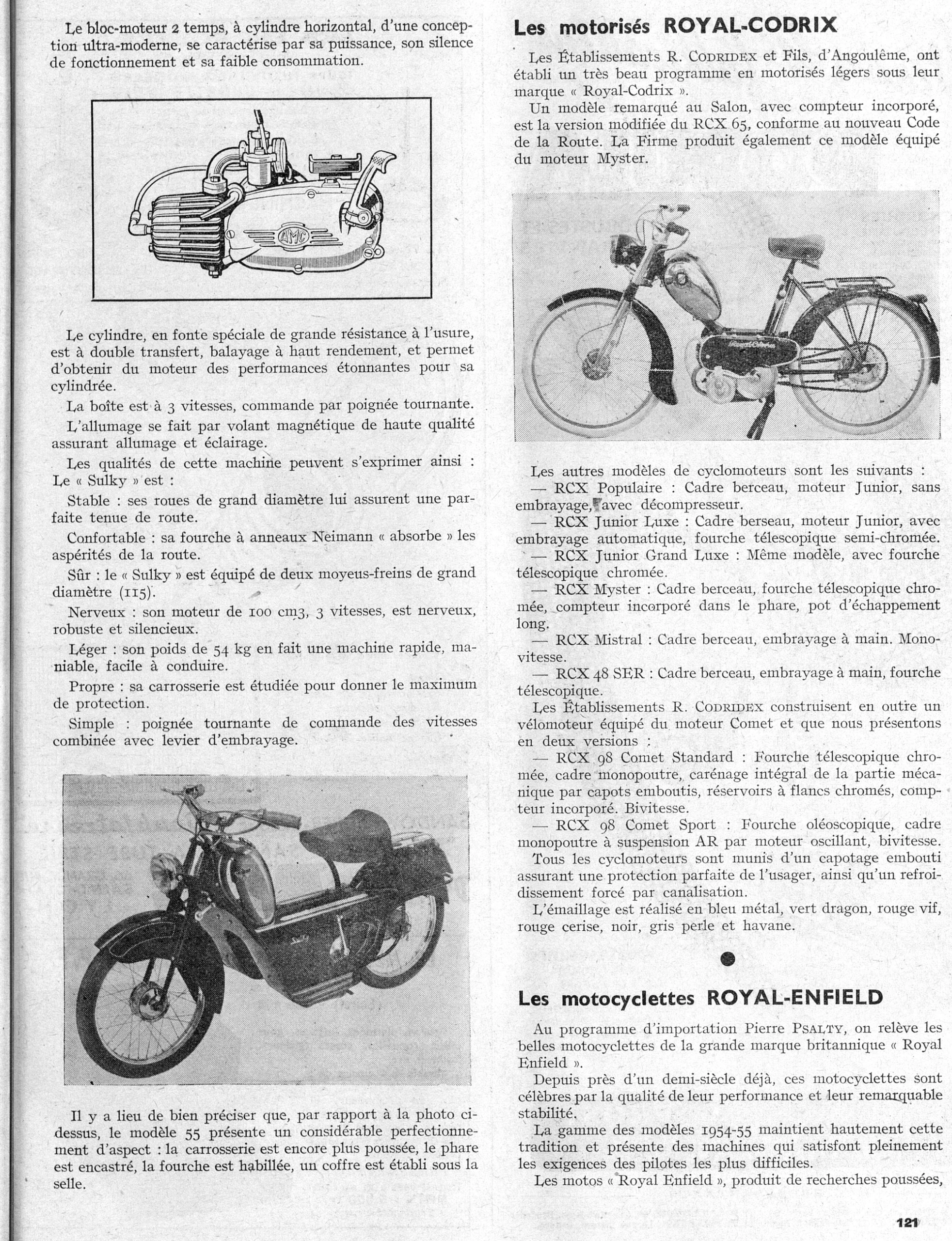
[Ebykr summary, continued from the previous page. The Riva-Sport « Sulky » has an ultra-modern two-stroke unit engine with a horizontal cylinder, noted for power, quiet running and low consumption (shown in the drawing, whose crankcase carries the AMC badge). The cylinder, of special wear-resistant cast iron, has double transfer and high-efficiency scavenging and gives surprising performance for its capacity. The gearbox has three speeds worked by twist grip; a high-quality flywheel magneto provides ignition and lighting. Its qualities are listed as follows.]
Le « Sulky » est :
Stable : ses roues de grand diamètre lui assurent une parfaite tenue de route.
Confortable : sa fourche à anneaux Neimann « absorbe » les aspérités de la route.
Sûr : le « Sulky » est équipé de deux moyeus-freins de grand diamètre (115).
Nerveux : son moteur de 100 cm3, 3 vitesses, est nerveux, robuste et silencieux.
Léger : son poids de 54 kg en fait une machine rapide, maniable, facile à conduire.
Propre : sa carrosserie est étudiée pour donner le maximum de protection.
Simple : poignée tournante de commande des vitesses combinée avec levier d’embrayage.
[Ebykr summary, continued. Compared with the photograph, the 55 model is considerably improved in looks: the bodywork goes further, the headlamp is recessed, the fork is enclosed and a locker sits under the saddle.]
Les motorisés ROYAL-CODRIX
[Ebykr summary; the article’s text is not reproduced. The Établissements R. Codridex et Fils of Angoulême have a very fine program of light powered machines under the « Royal-Codrix » name. A model noticed at the Salon, with built-in speedometer, is the modified RCX 65, conforming to the new Code de la Route; the firm also makes it with the Myster engine. The other cyclemotors are listed.]
— RCX Populaire : Cadre berceau, moteur Junior, sans embrayage, avec décompresseur.
— RCX Junior Luxe : Cadre berseau, moteur Junior, avec embrayage automatique, fourche télescopique semi-chromée.
— RCX Junior Grand Luxe : Même modèle, avec fourche télescopique chromée.
— RCX Myster : Cadre berceau, fourche télescopique chromée, compteur incorporé dans le phare, pot d’échappement long.
— RCX Mistral : Cadre berceau, embrayage à main. Monovitesse.
— RCX 48 SER : Cadre berceau, embrayage à main, fourche télescopique.
[Ebykr summary, continued. The firm also builds a vélomoteur with the Comet engine, in two versions.]
— RCX 98 Comet Standard : Fourche télescopique chromée, cadre monopoutre, carénage intégral de la partie mécanique par capots emboutis, réservoirs à flancs chromés, compteur incorporé. Bivitesse.
— RCX 98 Comet Sport : Fourche oléoscopique, cadre monopoutre à suspension AR par moteur oscillant, bivitesse.
[Ebykr summary, continued. All the cyclemotors have a pressed-steel cowling that fully protects the rider and gives forced ducted cooling. The enamel colors are listed.]
L’émaillage est réalisé en bleu métal, vert dragon, rouge vif, rouge cerise, noir, gris perle et havane.
Les motocyclettes ROYAL-ENFIELD
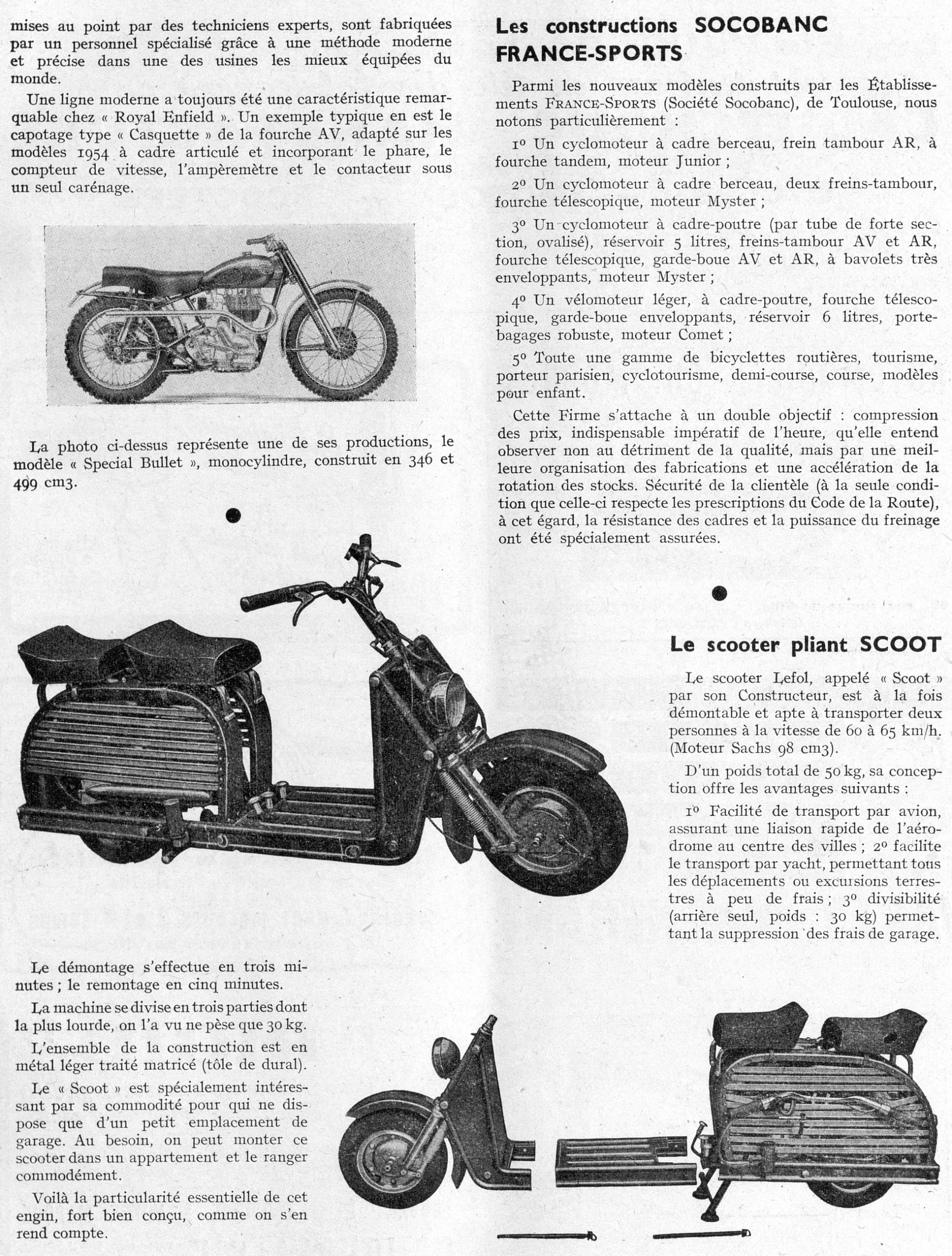
[Ebykr summary; the article’s text is not reproduced. The import program of Pierre Psalty includes the fine motorcycles of the great British marque « Royal Enfield », famous for nearly half a century for performance and remarkable stability. The 1954-55 range keeps up that tradition and satisfies the most demanding riders; the « Royal Enfield » machines, the product of thorough research (continued overleaf).]
121
— Page 9 —
[Ebykr summary, continued from the previous page. The « Royal Enfield » machines are developed by expert technicians and built by specialist staff, by modern and precise methods, in one of the best-equipped factories in the world. A modern line has always marked the marque: a typical example is the « Casquette » cowl on the front fork, fitted to the 1954 models with sprung frame, which houses headlamp, speedometer, ammeter and switch under one fairing. The photograph shows one of its products, the « Special Bullet » single-cylinder, built in 346 and 499 cm3.]
Les constructions SOCOBANC
FRANCE-SPORTS
[Ebykr summary; the article’s text is not reproduced. Among the new models of the Établissements France-Sports (Société Socobanc) of Toulouse the writer notes in particular the following.]
1° Un cyclomoteur à cadre berceau, frein tambour AR, à fourche tandem, moteur Junior ;
2° Un cyclomoteur à cadre berceau, deux freins-tambour, fourche télescopique, moteur Myster ;
3° Un cyclomoteur à cadre-poutre (par tube de forte section, ovalisé), réservoir 5 litres, freins-tambour AV et AR, fourche télescopique, garde-boue AV et AR, à bavolets très enveloppants, moteur Myster ;
4° Un vélomoteur léger, à cadre-poutre, fourche télescopique, garde-boue enveloppants, réservoir 6 litres, porte-bagages robuste, moteur Comet ;
5° Toute une gamme de bicyclettes routières, tourisme, porteur parisien, cyclotourisme, demi-course, course, modèles pour enfant.
[Ebykr summary, continued. The firm pursues a double aim. The first is lower prices, the indispensable imperative of the hour, reached not at the expense of quality but by better organization of manufacture and faster stock turnover. The second is the customer’s safety (provided the customer obeys the Code de la Route), to which end the strength of the frames and the power of the brakes have received special care. The bicycle range is named by type only; no bicycle is described further.]
Le scooter pliant SCOOT
[Ebykr summary; the article’s text is not reproduced. The Lefol scooter, called « Scoot » by its maker, can be taken apart and still carries two people at 60 to 65 km/h (Sachs 98 cm3 engine). It weighs 50 kg in all, and its design offers these advantages: 1° easy carriage by air, giving a quick link from airfield to town center; 2° easy carriage by yacht, allowing cheap trips and excursions ashore; 3° divisibility (rear section alone 30 kg), doing away with garage costs. It comes apart in three minutes and goes back together in five; it divides into three parts, the heaviest weighing only 30 kg. The whole is built of treated, die-formed light metal (dural sheet). The « Scoot » is especially handy for anyone with little garage space; if need be it can be carried up into an apartment and stored easily. That is the essential feature of this very well designed machine.]
— Page 10 —
Les constructions STELLA
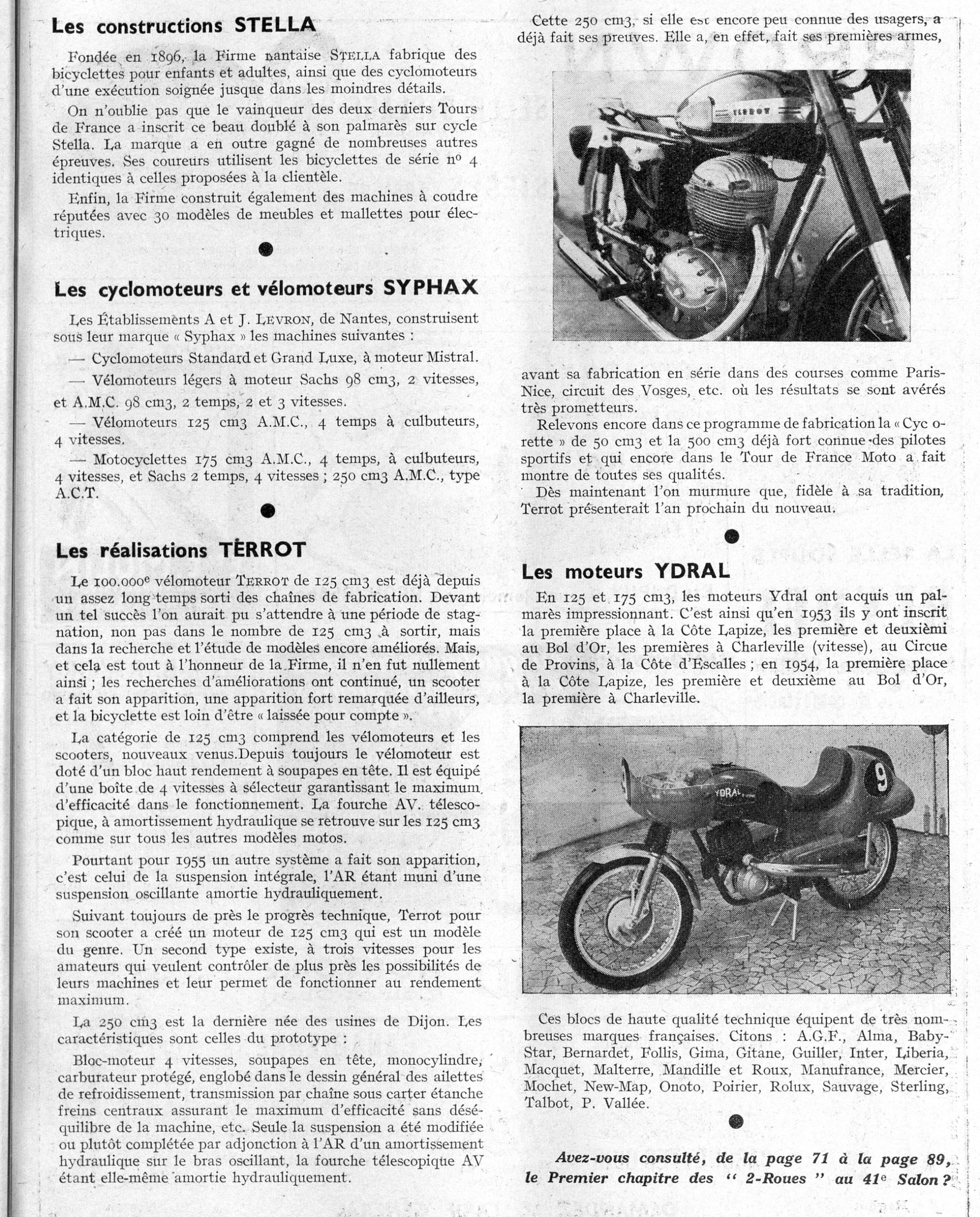
[Ebykr summary; the article’s text is not reproduced. Founded in 1896, the Nantes firm Stella makes bicycles for children and adults, and cyclemotors, finished with care down to the smallest detail. The winner of the last two Tours de France scored that fine double on a Stella cycle, and the marque has won many other events besides. Its racers ride the series No. 4 bicycles, identical to those offered to the public. The firm also makes well-known sewing machines, with 30 models of cabinets and cases for electric machines.]
Les cyclomoteurs et vélomoteurs SYPHAX
[Ebykr summary; the article’s text is not reproduced. The Établissements A et J. Levron of Nantes build the following machines under their « Syphax » name.]
— Cyclomoteurs Standard et Grand Luxe, à moteur Mistral.
— Vélomoteurs légers à moteur Sachs 98 cm3, 2 vitesses, et A.M.C. 98 cm3, 2 temps, 2 et 3 vitesses.
— Vélomoteurs 125 cm3 A.M.C., 4 temps à culbuteurs, 4 vitesses.
— Motocyclettes 175 cm3 A.M.C., 4 temps, à culbuteurs, 4 vitesses, et Sachs 2 temps, 4 vitesses ; 250 cm3 A.M.C., type A.C.T.
Les réalisations TERROT
[Ebykr summary; the article’s text is not reproduced. The 100,000th Terrot 125 cm3 vélomoteur left the lines some time ago. Such success might have brought a pause, not in output but in developing better models; to the firm’s credit it did not: improvement went on, a much-noticed scooter appeared, and the bicycle is far from neglected. The 125 cm3 class covers the vélomoteurs and the newly arrived scooters. The vélomoteur has always had a high-efficiency overhead-valve unit with a four-speed selector gearbox; the hydraulically damped telescopic front fork is found on the 125 cm3 as on all the motorcycle models. For 1955 full suspension appears, the rear with a hydraulically damped swinging arm. For its scooter Terrot created a 125 cm3 engine that is a model of its kind; a second, three-speed type lets enthusiasts control their machines more closely and run them at full efficiency. The 250 cm3 is the newest product of the Dijon works and keeps the prototype’s specification: four-speed overhead-valve single-cylinder unit, protected carburetor within the general design of the cooling fins, chain drive in a sealed case, central brakes giving the best effect without unbalancing the machine; only the suspension has been modified, or rather completed, by hydraulic damping on the rear swinging arm, the telescopic front fork being itself hydraulically damped. Little known to riders as yet, this 250 cm3 has proved itself before series production in races such as Paris-Nice and the circuit des Vosges, with very promising results. The program also includes the 50 cm3 « Cyclorette » (printed « Cyc orette ») and the 500 cm3, well known to sporting riders, which again showed all its qualities in the Tour de France Moto. It is already whispered that Terrot, true to tradition, will show something new next year.]
Les moteurs YDRAL
[Ebykr summary; the article’s text is not reproduced. In 125 and 175 cm3 the Ydral engines have an impressive record: in 1953 first place at the Côte Lapize, first and second (printed « deuxièmi ») in the Bol d’Or, firsts at Charleville (speed), at the Circuit de Provins (printed « Circue ») and at the Côte d’Escalles; in 1954 first place at the Côte Lapize, first and second in the Bol d’Or and first at Charleville. These units of high technical quality power a great many French marques, named as follows.]
Citons : A.G.F., Alma, Baby-Star, Bernardet, Follis, Gima, Gitane, Guiller, Inter, Liberia, Macquet, Malterre, Mandille et Roux, Manufrance, Mercier, Mochet, New-Map, Onoto, Poirier, Rolux, Sauvage, Sterling, Talbot, P. Vallée.
Avez-vous consulté, de la page 71 à la page 89,
le Premier chapitre des ” 2-Roues ” au 41e Salon ?
[Ten odd-numbered text pages (107 to 125) of an editorial survey, each set in two justified columns of a roman book face with firm headings in heavy sans-serif, the firm’s name in capitals, and the sections parted by a single solid black dot. The first page opens under a three-line display title running across both columns, “QUELQUES NOTATIONS / TECHNIQUES INTERNATIONALES / SUR LES “2-ROUES” AU SALON”, the first and third lines in heavy roman capitals and the middle line in light open capitals, each separated by double rules. Through the pages are set halftone photographs of the machines described, each in a thin-ruled or vignetted frame: motorcycles and vélomoteurs in side or three-quarter view (among them an enclosed Mandille et Roux scooter-type vélomoteur, the N.S.U. “Quick”, the Royal-Codrix RCX 65, the Riva-Sport “Sulky”, the Royal Enfield “Special Bullet”, a close view of the Terrot 250 engine with “TERROT” on the tank and an Ydral-engined racer with the number 9 and “YDRAL” on its fairing), and the Lefol “Scoot” shown twice, assembled with its slatted engine cover and two saddles, and taken apart into three sections with its two pins laid below. Several ruled line drawings show engines in section or elevation: a two-stroke cyclemotor unit in partial cutaway on page 119, the horizontal-cylinder Sulky unit with an “AMC” badge on its crankcase on page 121 and the Mobylette engine with its expanding-pulley variator on page 117, the last with a short caption beneath. No signature, monogram or agency mark (no “DR”, no “Rebour”, no “G. Gédo”) was found on any drawing or photograph, and no byline naming R. Ducoudray appears on these pages. A folio “121” stands at the foot of page 121, and page 125 closes with a two-line italic notice referring the reader to the survey’s first chapter on pages 71 to 89.]
Ebykr presents this material for research and education. If you hold rights to it or notice an ownership issue, please contact us and we will respond promptly.
The Ebykr Digest
New articles, timelines, catalog finds and registry activity — assembled from the archive once a month. Your address is never shared.
Double opt-in. One email per month. Unsubscribe at any time with one click.