About Ebykr
Ebykr celebrates classic and vintage lightweight bicycles through provocative imagery and opinion. Ride along with us.
About Ebykr
Ebykr celebrates classic and vintage lightweight bicycles through provocative imagery and opinion. Ride along with us.

Source: Gallica (Bibliothèque nationale de France), L'Officiel du cycle, du motocycle et du camping, November 1954, N° 46, pages 71, 73, 74, 77, 79, 81, 83, 84, 87 and 89; ark:/12148/bd6t54196207z. Source gallica.bnf.fr / BnF.
| Type | Review |
|---|---|
| Year | 1954 |
| Publisher | L'Officiel du cycle |
| Country | France |
| Language | French |
| Pages | 10 |
| Source | Gallica (Bibliothèque nationale de France), L'Officiel du cycle, du motocycle et du camping, November 1954, N° 46, pages 71, 73, 74, 77, 79, 81, 83, 84, 87 and 89; ark:/12148/bd6t54196207z. Source gallica.bnf.fr / BnF. |
| Credit | Ebykr archive; Bibliothèque nationale de France |
| Identifier | Gallica (BnF) ark:/12148/bd6t54196207z/f70 |
| Transcription | Headings and specifications transcribed; article text summarized |
QUELQUES NOTATIONS TECHNIQUES INTERNATIONALES SUR LES "2-ROUES" AU SALON Le cyclomoteur "Javelin" ARLIGUIE Les cycles "AQUILA" et les cylomoteurs "AQUILETTE" Les cycles d'enfants BABY-STAR (Suite page 73.) Chapitre premier Les productions BALLANDRAS Les cyclomoteurs BENOIT-FAURE Le cyclo-scooter "Cabri" BERNARDET — Bloc-moteur : Deux temps, 49 cm3, double transfert, cylindre fonte horizontal, culasse alliage léger, chambre …
This is a magazine article, so its running text is summarized here rather than reproduced; the headline, byline, specifications and scores are transcribed as printed.
From L’Officiel du cycle, du motocycle et du camping, November 1954, the paper’s number reporting the 1954 Paris Salon du Cycle et du Motocycle, pages 71 to 89: chapter one of the survey of the machines shown at the Salon, make by make: bicycles, cyclomoteurs, scooters and motorcycles, with their models, engines and prices. The title, headings, captions and lists are transcribed as printed; the text is summarized in Ebykr’s words, and the page images carry it in full.
— Page 1 —
QUELQUES NOTATIONS
TECHNIQUES INTERNATIONALES
SUR LES “2-ROUES” AU SALON
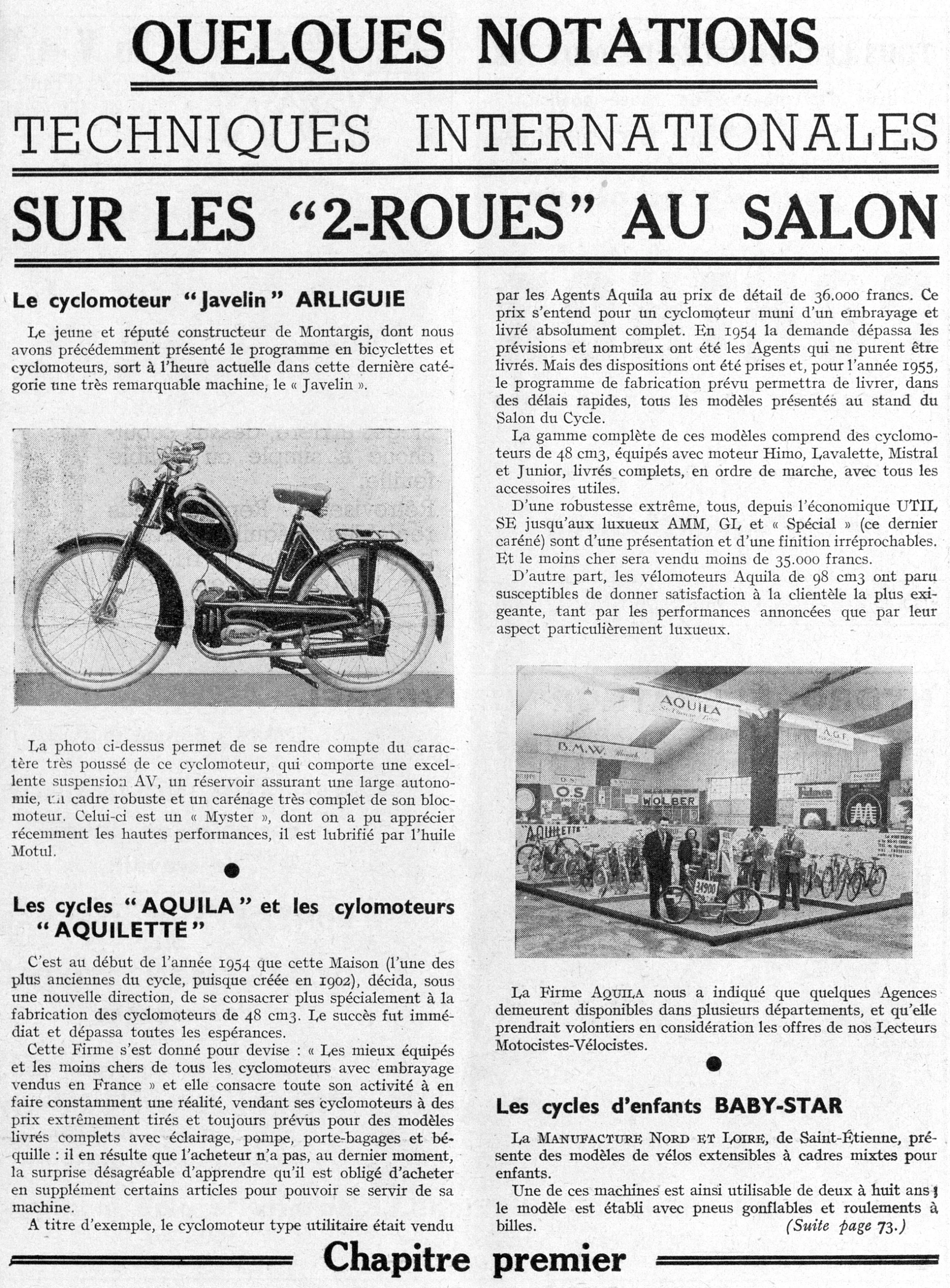
Le cyclomoteur “Javelin” ARLIGUIE
[Ebykr summary; the article’s text is not reproduced. The young and reputed maker of Montargis, whose bicycle and cyclomoteur program the paper had already presented, now brings out in the cyclomoteur class a very remarkable machine, the « Javelin ». The photograph shows how far it is developed: an excellent front suspension, a tank giving a long range, a sturdy frame and a very complete fairing of its engine unit. The engine is a « Myster », whose high performance had recently been shown, lubricated with Motul oil.]
Les cycles “AQUILA” et les cylomoteurs
“AQUILETTE”
[Ebykr summary, after the bullet. Early in 1954 this house, one of the oldest in the cycle trade since it was founded in 1902, decided under a new management to give itself chiefly to building 48 cm3 cyclomoteurs; success was immediate and beyond all hopes. Its motto: « Les mieux équipés et les moins chers de tous les cyclomoteurs avec embrayage vendus en France ». Its machines are sold at keen prices, always complete with lighting, pump, carrier and stand, so that the buyer need buy nothing extra. For example, the utility-type cyclomoteur was sold by the Aquila agents at a retail price of 36.000 francs, with a clutch and fully complete. In 1954 demand outran forecasts and many agents could not be supplied; for 1955 the production program will deliver promptly every model shown on the stand at the Salon du Cycle. The full range comprises 48 cm3 cyclomoteurs with Himo, Lavalette, Mistral and Junior engines, delivered complete and ready to run with all useful accessories. All are very sturdy and impeccably presented and finished, from the economical UTIL SE to the luxurious AMM, GL and « Spécial » (the last one faired), and the cheapest will sell for under 35.000 francs. The Aquila 98 cm3 vélomoteurs seemed able to satisfy the most demanding buyer by their claimed performance and particularly luxurious look. The firm says that some agencies remain open in several départements and that it would gladly consider offers from the paper’s motorcycle and cycle dealer readers.]
Les cycles d’enfants BABY-STAR
[Ebykr summary, after the bullet. The Manufacture Nord et Loire, of Saint-Étienne, shows extensible children’s bicycles with mixed frames. One of them can be used from two to eight years of age; the model has pneumatic tires and ball bearings.]
(Suite page 73.)
Chapitre premier
— Page 2 —
[Ebykr summary, continuing Baby-Star from page 71. Another model, for ages five to eleven, corresponds to eight models of the usual sizes; it is a true bicycle, delivered with two brakes and full equipment. The firm also makes luxury scooters for children and strong steel-tube trailers (pneumatic tires and ball bearings).]
Les productions BALLANDRAS
[Ebykr summary, after the bullet. The Salon du Cycle confirmed the success of the great Saint-Étienne house run by M. Georges Ballandras, a friend of the paper well known in industrial circles. The thirteen models bearing the Cyclorev mark drew the admiration of many visitors, each model a novelty; prices run from 36.900 to 51.900 francs. Both for the V.B.F. cycles and for the Cyclorev cyclomoteurs his bold methods, drawn from long experience, bear fruit. Special mention goes to the « 70 Lavalette » and the « 98 Mistral », high-efficiency machines for touring and sporting riders.]
Les cyclomoteurs BENOIT-FAURE
[Ebykr summary, after the bullet. Benoît Faure, the reputed Saint-Étienne make, showed four high-quality models, all with drum brakes and the Mistral engine. The popular « monovitesse UTYL » (moins de 38.000 fr.) is praised for its careful development. Three high-class models: « monovitesse Concurrence » (42.900 fr.), « monovitesse grand luxe » (46.750 fr.) and « deux vitesses grand luxe » (58.900 fr.). Two elegant vélomoteurs complete the range: « Comet 98 » (78.500 fr.) and « Mistral 98 » (81.500 fr.).]
Le cyclo-scooter “Cabri” BERNARDET
[Ebykr summary, after the bullet. The paper recalls the main features of this ultra-light machine by the Bernardet firm, which it calls the pioneer of the scooter in France.]
— Bloc-moteur :
Deux temps, 49 cm3, double transfert, cylindre fonte horizontal, culasse alliage léger, chambre d’explosion hémisphérique.
Carburateur commandé par poignée tournante.
Allumage, éclairage par volant magnétique puissant.
Mise en marche par pédale se verrouillantautomatiquement en position horizontale.
Boîte à deux vitesses commandée par poignée tournante à gauche.
Transmission secondaire par chaîne dans carter moulé, à bain d’huile.
— Partie cycle :
Suspension AR oscillante par bloc de caoutchouc à flexibilité progressive et anneaux Neiman travaillant à la réaction : suspension avant à roue tirée, à grand débattement, anneaux Neiman.
Les productions André BERTIN
[Ebykr summary, after the bullet. The Société des Cycles André Bertin, of Saint-Laurent-Blangy (Pas-de-Calais), holds a strong position in the Nord and builds the full range of cycles, cyclomoteurs and motorcycles, along with well-liked children’s bicycles. It is also a wholesale specialist in cycle and motorcycle accessories, and an exporter and importer.]
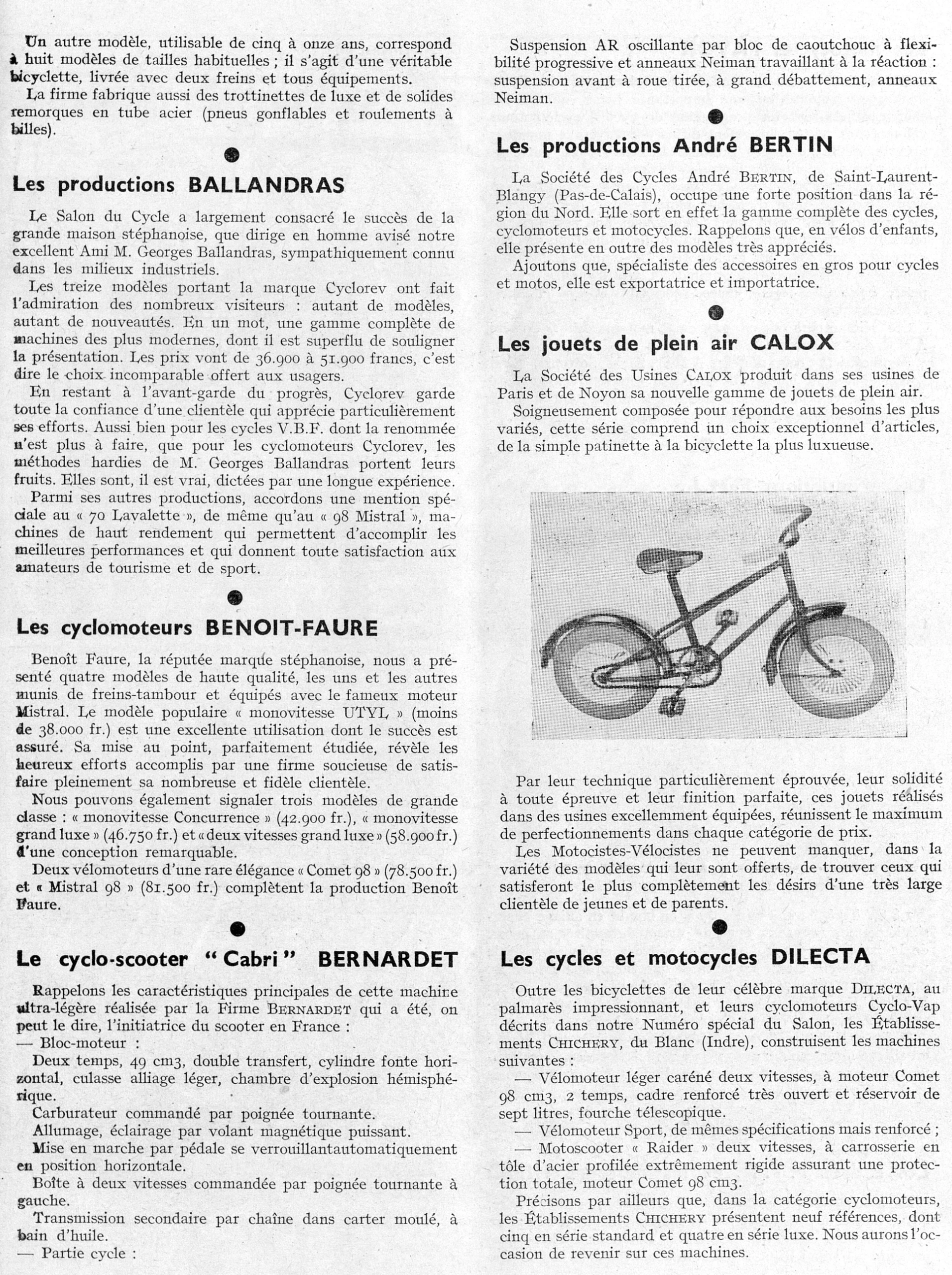
Les jouets de plein air CALOX
[Ebykr summary, after the bullet. The Société des Usines Calox builds its new range of outdoor toys in its Paris and Noyon works, from the simple patinette to the most luxurious bicycle. Proven technique, toughness and finish give the most refinements in each price class, and dealers will find models to suit a wide clientele of children and parents.]
Les cycles et motocycles DILECTA
[Ebykr summary, after the bullet. Besides the Dilecta bicycles, with an impressive racing record, and the Cyclo-Vap cyclomoteurs described in the paper’s special Salon number, the Établissements Chichery, of Le Blanc (Indre), build the following machines:]
— Vélomoteur léger caréné deux vitesses, à moteur Comet 98 cm3, 2 temps, cadre renforcé très ouvert et réservoir de sept litres, fourche télescopique.
— Vélomoteur Sport, de mêmes spécifications mais renforcé ;
— Motoscooter « Raider » deux vitesses, à carrosserie en tôle d’acier profilée extrêmement rigide assurant une protection totale, moteur Comet 98 cm3.
[Ebykr summary, continued. In cyclomoteurs Chichery shows nine references, five in the standard series and four in the luxury series, to which the paper promises to return.]
— Page 3 —
Les motocycles FAVOR
[Ebykr summary; the article’s text is not reproduced. Founded at Clermont-Ferrand in 1898, the Société des Cycles Favor is now an important firm producing each year a whole program of cycles, cyclomoteurs, vélomoteurs and motorcycles sold widely across the world. Besides its quality bicycles this old make showed at the 1954 Salon the following motor machines. Its 49 cm3 cyclomoteurs come in standard and grand luxe types; the grand luxe, with an Alter engine unit, two built-in speeds with neutral, clutch and a single chain, is called a cyclomoteur of high class, its frame of original and very happy design: an ultra-light, racy, quiet little motorcycle gracefully faired in a dural pressing. Its vélomoteurs of 66, 98 and 125 cm3 use Alter, Comète, A.M.C. Sachs, Sotecma and Ydral engines; its 175 cm3 motorcycles use A.M.C., Sachs, Sotecma and Ydral engines. The paper expects Favor agents to be keenly interested in these new models.]
Les productions F.M.L.
[Ebykr summary, after the bullet. The Établissements F.M.L., of Levallois, market three very remarkable engines adopted by many makers:]
— Le « Junior », 49 cm3, simple, puissant, robuste et sûr ;
— Le « Myster », 49 cm3, de lignes générales, solution mécanique et fixation nouvelles. En voici les spécifications essentielles (photo ci-dessous) moteur deux temps double transfert, donnant :
1,8 CV à 4.850 tours-minute. Piston bombé en alliage hypersilicié permettant sans danger de serrage de profiter au mieux de la puissance du moteur. Monocylindre en fonte spéciale particulièrement étudié au point de vue thermique et mettant à profit au maximum un écoulement rationnel des gaz. Culasse hémisphérique en alliage léger contribuant à un bon refroidissement du moteur. Vitesse de croisière : 50 km/h.
— Le « Comet », 98 cm3, deux vitesses, pièces en majorité en alliage léger coulées sous pression ; pièces mécaniques traitées par les procédés modernes d’induction à haute fréquence et de sulfinuzation ; mise en route par kick à main.
Les cadres F.T.K. et les moteurs HIMO
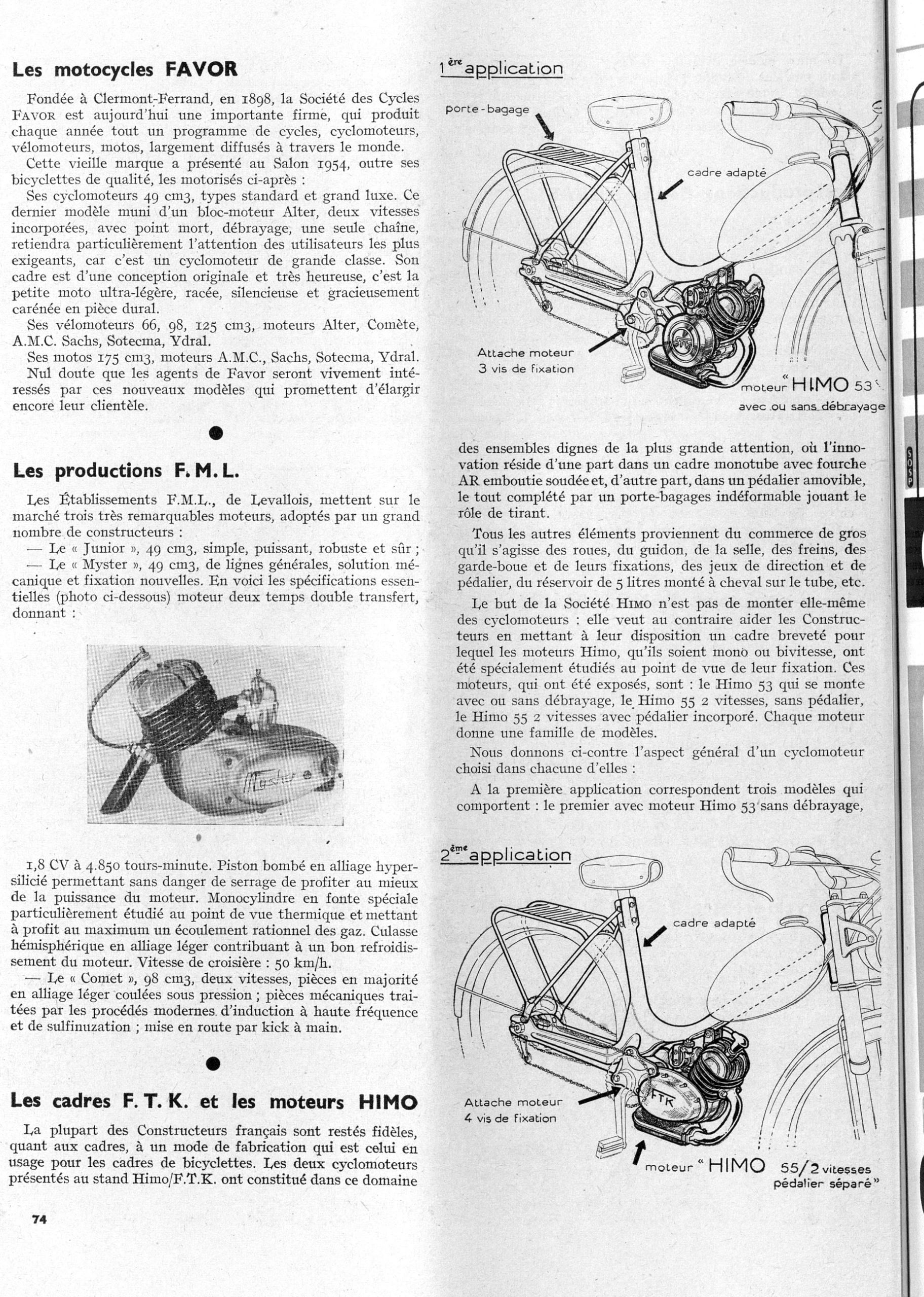
[Ebykr summary, after the bullet. Most French makers have kept, for their frames, the method used for bicycle frames. The two cyclomoteurs on the Himo/F.T.K. stand were assemblies worth close attention: the novelty lies in a single-tube frame with a pressed and welded rear fork and in a removable bottom bracket, completed by a rigid carrier that acts as a tie. All other parts come from the wholesale trade: wheels, handlebar, saddle, brakes, mudguards and their fittings, headset and bottom bracket sets, and the 5-liter tank straddling the tube. The Société Himo does not intend to assemble cyclomoteurs itself but to help makers by offering a patented frame for which the Himo engines, single- or two-speed, were specially designed as to their mounting. The engines shown were the Himo 53, fitted with or without clutch, the Himo 55 2 vitesses without bottom bracket and the Himo 55 2 vitesses with built-in bottom bracket; each gives a family of models, and the drawings show one cyclomoteur from each. To the first application correspond three models, the first with the Himo 53 engine without clutch (continued on page 77).]
1ère application
porte-bagage
cadre adapté
Attache moteur
3 vis de fixation
moteur “HIMO 53”
avec ou sans débrayage
2ème application
cadre adapté
Attache moteur
4 vis de fixation
moteur “HIMO 55/2 vitesses
pédalier séparé”
74
— Page 4 —
[Ebykr summary, continuing F.T.K. and Himo from page 74. Of the three first-application models, the first has a Himo 53 without clutch and an ordinary fork, the second a Himo 53 with clutch and an ordinary fork, the third a Himo 53 with clutch and a telescopic fork. The second application gives two models, with ordinary and with telescopic fork, and the third application likewise two. The range runs from the simplest and cheapest cyclomoteur to the most refined, all with a sturdy frame and shapes suited to French taste; all share the same accessories and a rear wheel with drum brake, differing only in engine, control grips and fork. The method standardizes parts and accessories, so that fewer types are bought in larger numbers at lower cost, the maker’s store is lightened and supply delays shortened. Himo/F.T.K. has also selected suitable bought-in parts that guarantee the maker a good result. The Himo engines themselves are standardized: a single model of cylinder head, cylinder, crank assembly, piston and gaskets, and the two new engines share many parts, the carburetor and flywheel magneto being the same on all three types. This eases the supply of spare parts and lightens the stock held by wholesalers and agents, which the writer calls praiseworthy and helpful to the spread of the cyclomoteur.]
Les cycles et cyclomoteurs GEMINIANI
et CARRARA
[Ebykr summary, after the bullet. Under the Raphaël Geminiani and Carrara marks a fine range of adults’ and children’s bicycles and cyclomoteurs is shown. The paper singles out a beam-frame cyclomoteur with a Myster engine, very lively, well suited to mountain districts and as sturdy as it is elegant. Under the Geminiani mark there were also cycle models in the handsome « bleu Bianchi » color. These machines are built by the Établissements Randoin, of Montluçon, and Carrara, of Créteil.]
Les motocycles René GILLET
[Ebykr summary, after the bullet. The present production of the Montrouge firm is summed up thus:]
— Cyclomoteurs 48 cm3, types Standard et Luxe.
— Vélomoteurs 125 cm3, à moteur 2 temps 125 cm3, piston plat. Le modèle V/2 est caractérisé par sa suspension AR à fourche oscillante, ses freins incorporés dans les moyeux, ses paliers-moteur sur roulements à billes, sa transmission moteur boîte par chaîne.
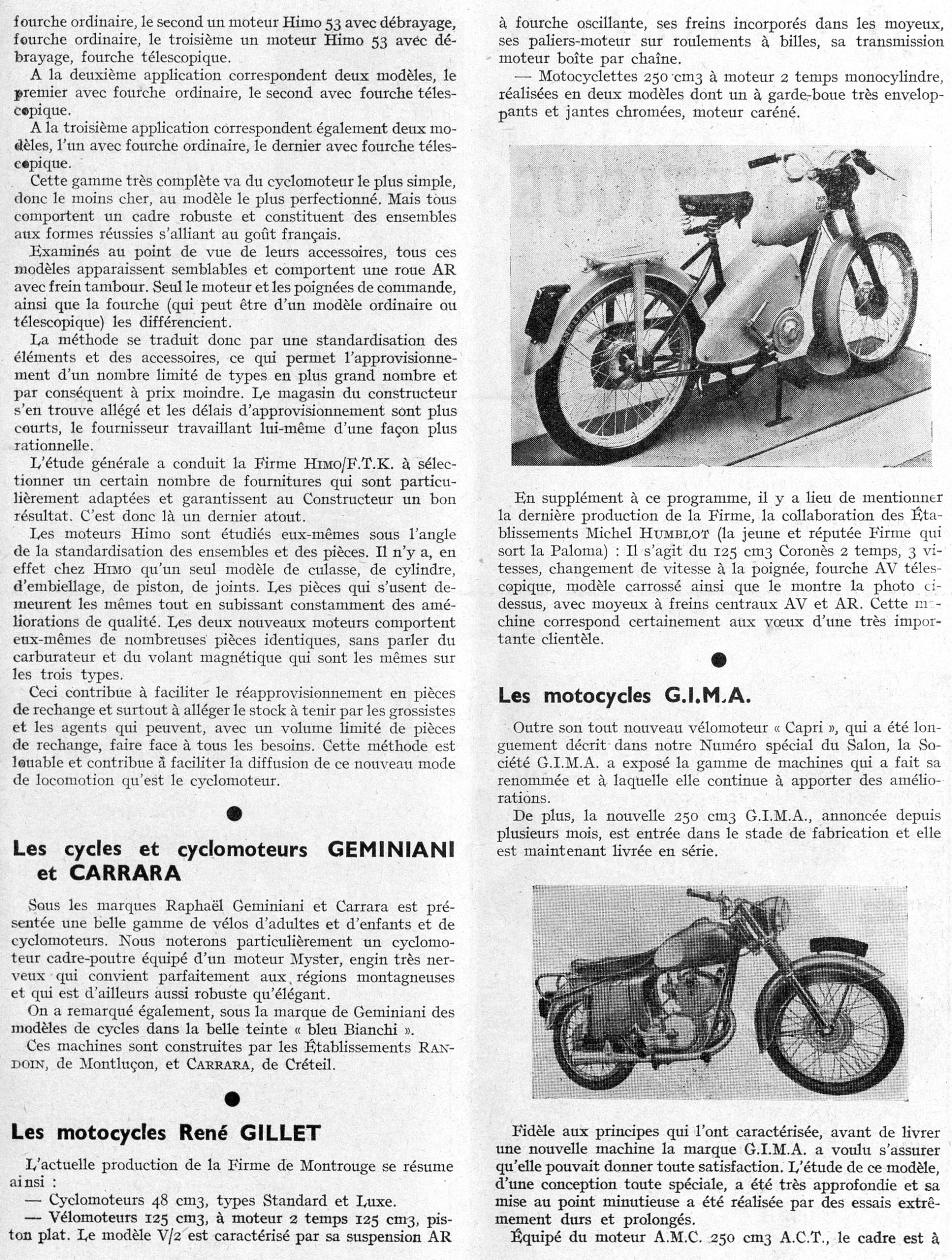
— Motocyclettes 250 cm3 à moteur 2 temps monocylindre, réalisées en deux modèles dont un à garde-boue très enveloppants et jantes chromées, moteur caréné.
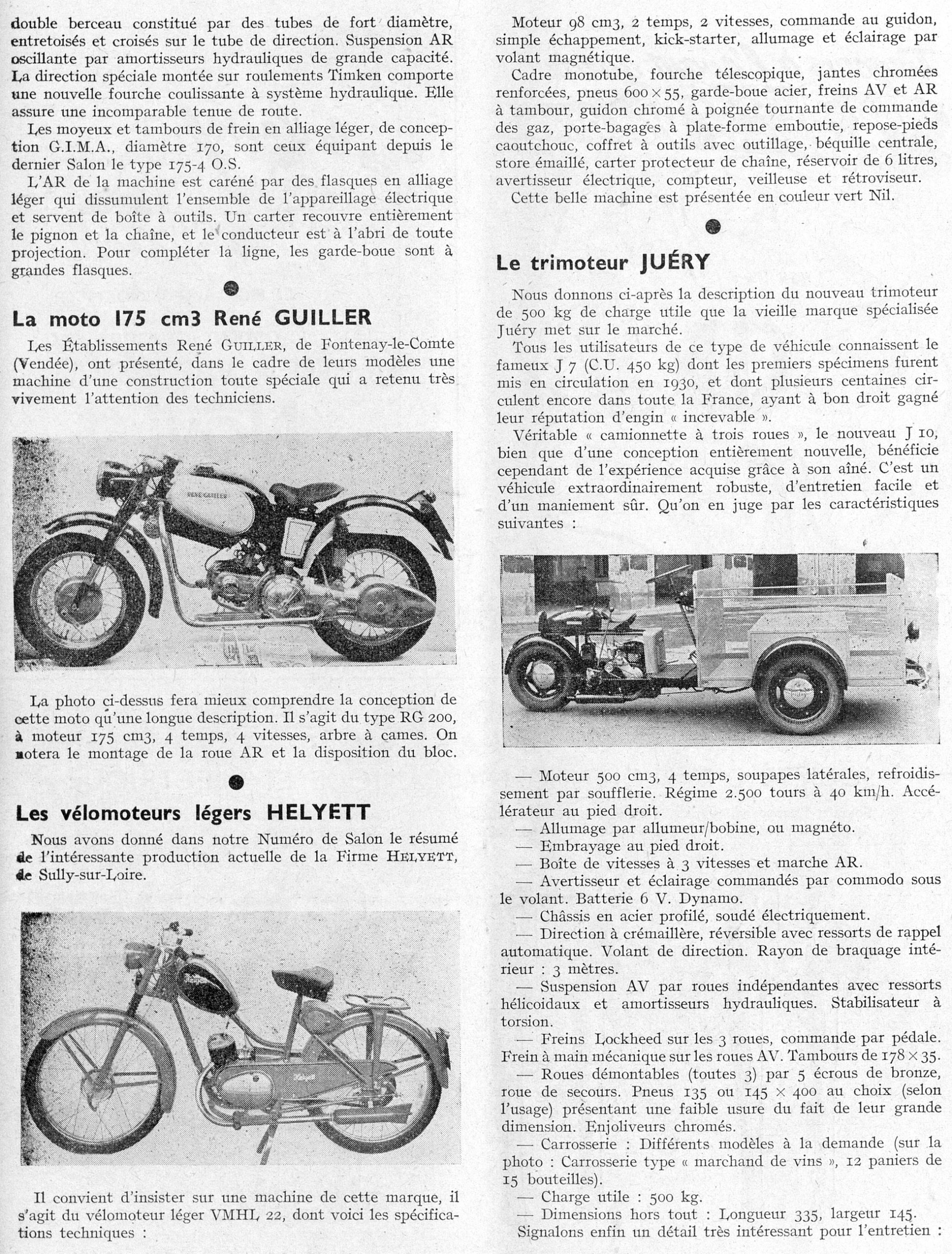
[Ebykr summary, continued below the photograph. In addition there is the firm’s latest product, made in collaboration with the Établissements Michel Humblot (the young and reputed firm that makes the Paloma): the 125 cm3 Coronès, two-stroke, three speeds with twist-grip change, telescopic front fork, a bodied model as the photograph shows, with central-drum hubs front and rear; the writer expects it to meet the wishes of a very large clientele.]
Les motocycles G.I.M.A.
[Ebykr summary, after the bullet. Besides its new « Capri » vélomoteur, described at length in the paper’s special Salon number, the Société G.I.M.A. showed the range that made its name, still being improved. The new 250 cm3 G.I.M.A., announced for several months, has entered production and is now delivered in series. True to its principles, the make tested the model, of very special design, at length through extremely hard and prolonged trials before delivering it. With the A.M.C. 250 cm3 A.C.T. engine, the frame is (continued on page 79).]
— Page 5 —
[Ebykr summary, continuing G.I.M.A. from page 77. The frame of the new 250 cm3 is a double cradle of large-diameter tubes, braced and crossed at the head tube; swinging-arm rear suspension with large hydraulic dampers; a special steering head on Timken bearings carries a new hydraulic sliding fork, said to give incomparable roadholding. The light-alloy hubs and brake drums of G.I.M.A. design, diameter 170, are those fitted since the last Salon to the type 175-4 O.S. The rear of the machine is enclosed by light-alloy side panels that hide the electrical equipment and serve as a toolbox; a case fully covers the sprocket and chain, protecting the rider from all spray, and the mudguards have deep valances.]
La moto 175 cm3 René GUILLER
[Ebykr summary, after the bullet. The Établissements René Guiller, of Fontenay-le-Comte (Vendée), showed a machine of very special construction that drew the close attention of technicians. The photograph explains it better than a long description: it is the type RG 200, with a 175 cm3 four-stroke engine, four speeds and camshaft; the paper points to the mounting of the rear wheel and the arrangement of the engine unit.]
Les vélomoteurs légers HELYETT
[Ebykr summary, after the bullet. The paper had summarized in its Salon number the current production of the Helyett firm, of Sully-sur-Loire, and here dwells on one machine, the VMHL 22 light vélomoteur, whose technical specifications are:]
Moteur 98 cm3, 2 temps, 2 vitesses, commande au guidon, simple échappement, kick-starter, allumage et éclairage par volant magnétique.
Cadre monotube, fourche télescopique, jantes chromées renforcées, pneus 600 × 55, garde-boue acier, freins AV et AR à tambour, guidon chromé à poignée tournante de commande des gaz, porte-bagages à plate-forme emboutie, repose-pieds caoutchouc, coffret à outils avec outillage, béquille centrale, store émaillé, carter protecteur de chaîne, réservoir de 6 litres, avertisseur électrique, compteur, veilleuse et rétroviseur.
Cette belle machine est présentée en couleur vert Nil.
Le trimoteur JUÉRY
[Ebykr summary, after the bullet. The paper describes the new three-wheeled carrier of 500 kg payload put on the market by the old specialist make Juéry. Users know the famous J 7 (C.U. 450 kg), first put on the road in 1930, several hundred of which still run all over France with a reputation as « increvable ». The new J 10, a true « camionnette à trois roues », is of entirely new design but draws on its predecessor’s experience; it is called extraordinarily sturdy, easy to maintain and safe to handle, with these characteristics:]
— Moteur 500 cm3, 4 temps, soupapes latérales, refroidissement par soufflerie. Régime 2.500 tours à 40 km/h. Accélérateur au pied droit.
— Allumage par allumeur/bobine, ou magnéto.
— Embrayage au pied droit.
— Boîte de vitesses à 3 vitesses et marche AR.
— Avertisseur et éclairage commandés par commodo sous le volant. Batterie 6 V. Dynamo.
— Châssis en acier profilé, soudé électriquement.
— Direction à crémaillère, réversible avec ressorts de rappel automatique. Volant de direction. Rayon de braquage intérieur : 3 mètres.
— Suspension AV par roues indépendantes avec ressorts hélicoidaux et amortisseurs hydrauliques. Stabilisateur à torsion.
— Freins Lockheed sur les 3 roues, commande par pédale. Frein à main mécanique sur les roues AV. Tambours de 178 × 35.
— Roues démontables (toutes 3) par 5 écrous de bronze, roue de secours. Pneus 135 ou 145 × 400 au choix (selon l’usage) présentant une faible usure du fait de leur grande dimension. Enjoliveurs chromés.
— Carrosserie : Différents modèles à la demande (sur la photo : Carrosserie type « marchand de vins », 12 paniers de 15 bouteilles).
— Charge utile : 500 kg.
— Dimensions hors tout : Longueur 335, largeur 145.
[Ebykr summary, continued. The paper closes by pointing to a detail of great interest for maintenance (continued on page 81).]
— Page 6 —
[Ebykr summary, continuing Juéry from page 79. The frame carrying the driver’s seat, the tanks and the rear mudguard lifts off in one piece by loosening four easily reached bolts, freeing the whole gearbox and engine unit in a few moments.]
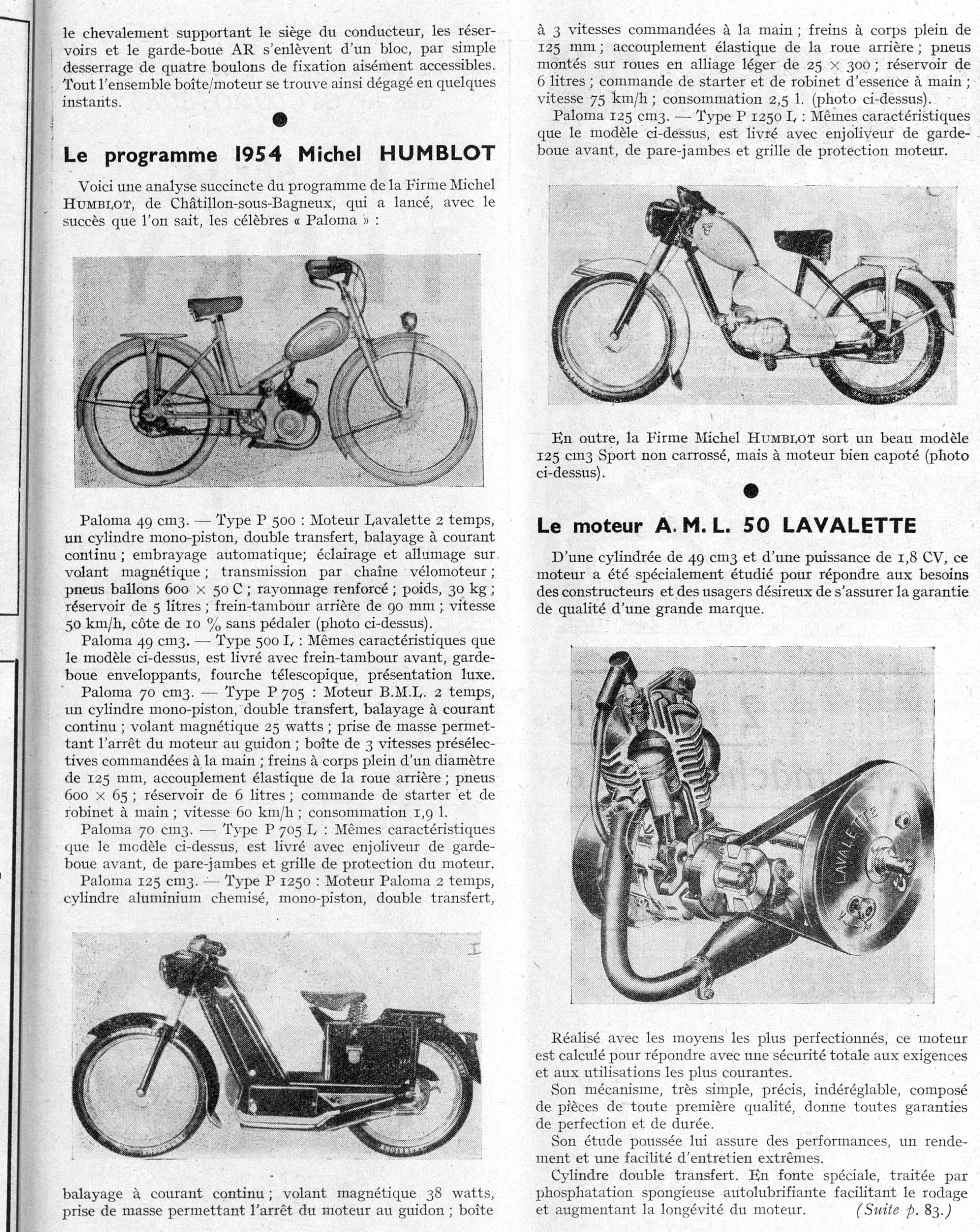
Le programme 1954 Michel HUMBLOT
[Ebykr summary, after the bullet. A short analysis of the program of the Michel Humblot firm, of Châtillon-sous-Bagneux, which launched the celebrated « Paloma » with well-known success:]
Paloma 49 cm3. — Type P 500 : Moteur Lavalette 2 temps, un cylindre mono-piston, double transfert, balayage à courant continu ; embrayage automatique; éclairage et allumage sur volant magnétique ; transmission par chaîne vélomoteur ; pneus ballons 600 × 50 C ; rayonnage renforcé ; poids, 30 kg ; réservoir de 5 litres ; frein-tambour arrière de 90 mm ; vitesse 50 km/h, côte de 10 % sans pédaler (photo ci-dessus).
Paloma 49 cm3. — Type 500 L : Mêmes caractéristiques que le modèle ci-dessus, est livré avec frein-tambour avant, garde-boue enveloppants, fourche télescopique, présentation luxe.
Paloma 70 cm3. — Type P 705 : Moteur B.M.L. 2 temps, un cylindre mono-piston, double transfert, balayage à courant continu ; volant magnétique 25 watts ; prise de masse permettant l’arrêt du moteur au guidon ; boîte de 3 vitesses présélectives commandées à la main ; freins à corps plein d’un diamètre de 125 mm, accouplement élastique de la roue arrière ; pneus 600 × 65 ; réservoir de 6 litres ; commande de starter et de robinet à main ; vitesse 60 km/h ; consommation 1,9 l.
Paloma 70 cm3. — Type P 705 L : Mêmes caractéristiques que le modèle ci-dessus, est livré avec enjoliveur de garde-boue avant, de pare-jambes et grille de protection du moteur.
Paloma 125 cm3. — Type P 1250 : Moteur Paloma 2 temps, cylindre aluminium chemisé, mono-piston, double transfert, balayage à courant continu ; volant magnétique 38 watts, prise de masse permettant l’arrêt du moteur au guidon ; boîte à 3 vitesses commandées à la main ; freins à corps plein de 125 mm ; accouplement élastique de la roue arrière ; pneus montés sur roues en alliage léger de 25 × 300 ; réservoir de 6 litres ; commande de starter et de robinet d’essence à main ; vitesse 75 km/h ; consommation 2,5 l. (photo ci-dessus).
Paloma 125 cm3. — Type P 1250 L : Mêmes caractéristiques que le modèle ci-dessus, est livré avec enjoliveur de garde-boue avant, de pare-jambes et grille de protection moteur.
[Ebykr summary, continued below the third photograph. The Michel Humblot firm also brings out a handsome 125 cm3 Sport model, not bodied but with a well-cowled engine, shown in the photograph.]
Le moteur A.M.L. 50 LAVALETTE
[Ebykr summary, after the bullet. Of 49 cm3 and 1,8 CV, this engine was designed for makers and riders who want the quality guarantee of a great make. Built with the most up-to-date means, it is said to meet ordinary demands with complete safety; its very simple, precise mechanism that cannot go out of adjustment uses first-quality parts, and its advanced design gives performance, efficiency and very easy upkeep.]
Cylindre double transfert. En fonte spéciale, traitée par phosphatation spongieuse autolubrifiante facilitant le rodage et augmentant la longévité du moteur.
(Suite p. 83.)
— Page 7 —
Piston en alliage hypersilicié à faible coefficient de dilatation.
Culasse hémisphérique.
Embiellage : tête et pied montés sur aiguilles.
Vilebrequin en acier spécial monté sur roulement à billes.
Carter en deux parties coulées, d’une grande robustesse, faisant corps avec la patte de fixation du moteur.
Carburateur avec starter automatique pour départ à froid et filtre à air.
Volant magnétique Lavalette fournissant allumage et éclairage en 10 ou 15 watts.
Lanceur embrayage automatique (breveté) : à secteurs Ferodo permettant un lancement rapide du moteur par simple pédalage à 6 km/h. et un enclenchement progressif.
L’entraînement est assuré par une poulie pédalier reliée au moteur par une courroie trapézoïdale. Un encliquetage manœuvrable à l’arrêt permet de rendre le moteur solidaire ou indépendant du cycle.
Le moteur « AML 50 » est également réalisé en version « Embrayage commandé ».
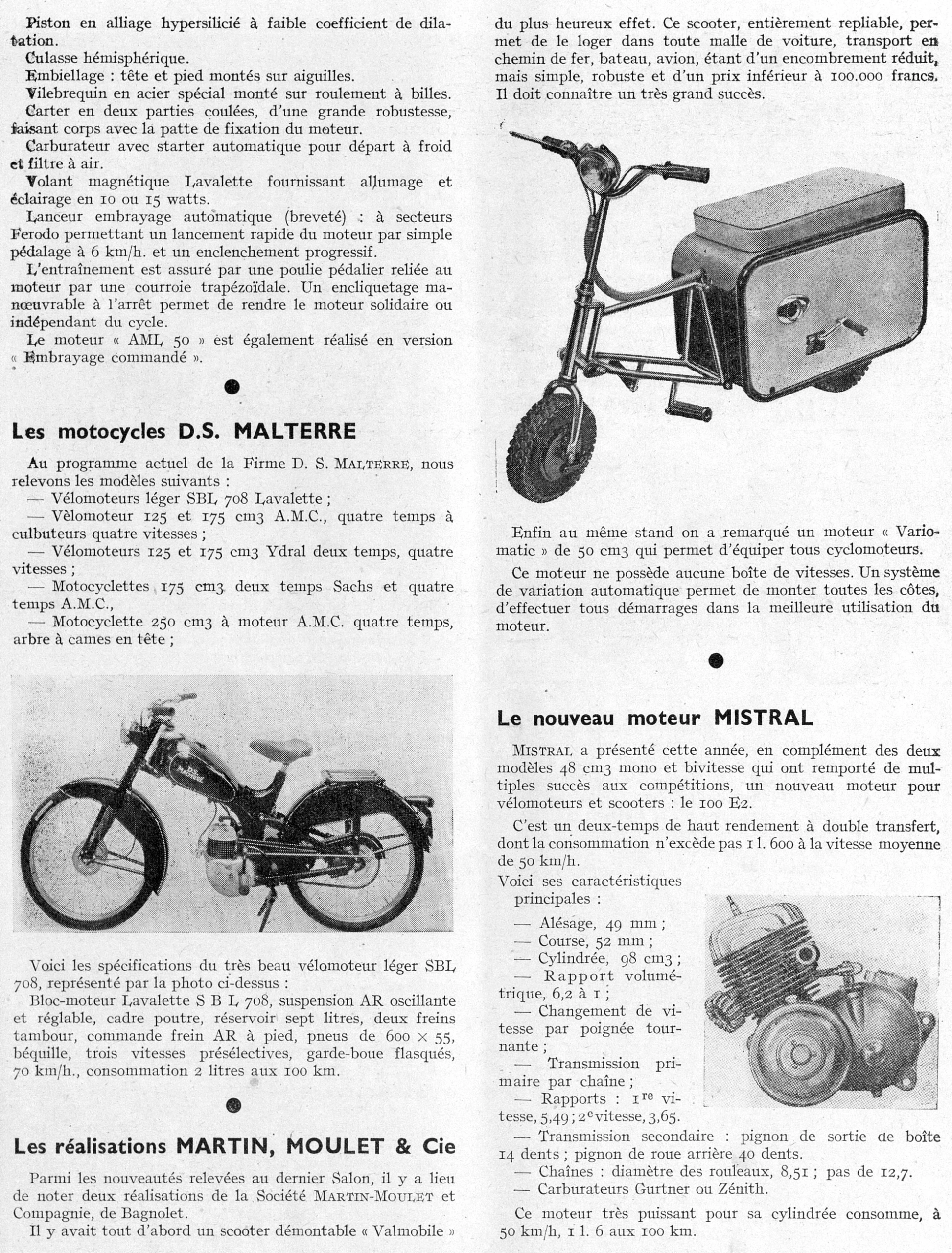
Les motocycles D.S. MALTERRE
[Ebykr summary, after the bullet. From the current program of the D. S. Malterre firm the paper notes these models:]
— Vélomoteurs léger SBL 708 Lavalette ;
— Vèlomoteur 125 et 175 cm3 A.M.C., quatre temps à culbuteurs quatre vitesses ;
— Vélomoteurs 125 et 175 cm3 Ydral deux temps, quatre vitesses ;
— Motocyclettes 175 cm3 deux temps Sachs et quatre temps A.M.C.,
— Motocyclette 250 cm3 à moteur A.M.C. quatre temps, arbre à cames en tête ;
[Ebykr summary, continued below the photograph. The specifications of the handsome SBL 708 light vélomoteur shown in the photograph:]
Bloc-moteur Lavalette S B L 708, suspension AR oscillante et réglable, cadre poutre, réservoir sept litres, deux freins tambour, commande frein AR à pied, pneus de 600 × 55, béquille, trois vitesses présélectives, garde-boue flasqués, 70 km/h., consommation 2 litres aux 100 km.
Les réalisations MARTIN, MOULET & Cie
[Ebykr summary, after the bullet. Among the novelties of the last Salon were two products of the Société Martin-Moulet et Compagnie, of Bagnolet. First, a dismountable scooter, the « Valmobile », of very happy effect: fully folding, it fits in any car trunk and travels by rail, boat or plane, being compact yet simple, sturdy and priced under 100.000 francs; the paper expects great success for it. Second, on the same stand, a 50 cm3 « Variomatic » engine able to equip any cyclomoteur; it has no gearbox, an automatic variable drive letting it climb every hill and make every start with the best use of the engine.]
Le nouveau moteur MISTRAL
[Ebykr summary, after the bullet. Besides its two 48 cm3 single- and two-speed models, which have won many competitions, Mistral this year showed a new engine for vélomoteurs and scooters, the 100 E2, a high-efficiency two-stroke with double transfer whose consumption does not exceed 1 l. 600 at an average speed of 50 km/h. Its main characteristics:]
— Alésage, 49 mm ;
— Course, 52 mm ;
— Cylindrée, 98 cm3 ;
— Rapport volumétrique, 6,2 à 1 ;
— Changement de vitesse par poignée tournante ;
— Transmission primaire par chaîne ;
— Rapports : 1re vitesse, 5,49 ; 2e vitesse, 3,65.
— Transmission secondaire : pignon de sortie de boîte 14 dents ; pignon de roue arrière 40 dents.
— Chaînes : diamètre des rouleaux, 8,51 ; pas de 12,7.
— Carburateurs Gurtner ou Zénith.
[Ebykr summary, continued. This engine, very powerful for its capacity, uses 1 l. 6 per 100 km at 50 km/h.]
— Page 8 —
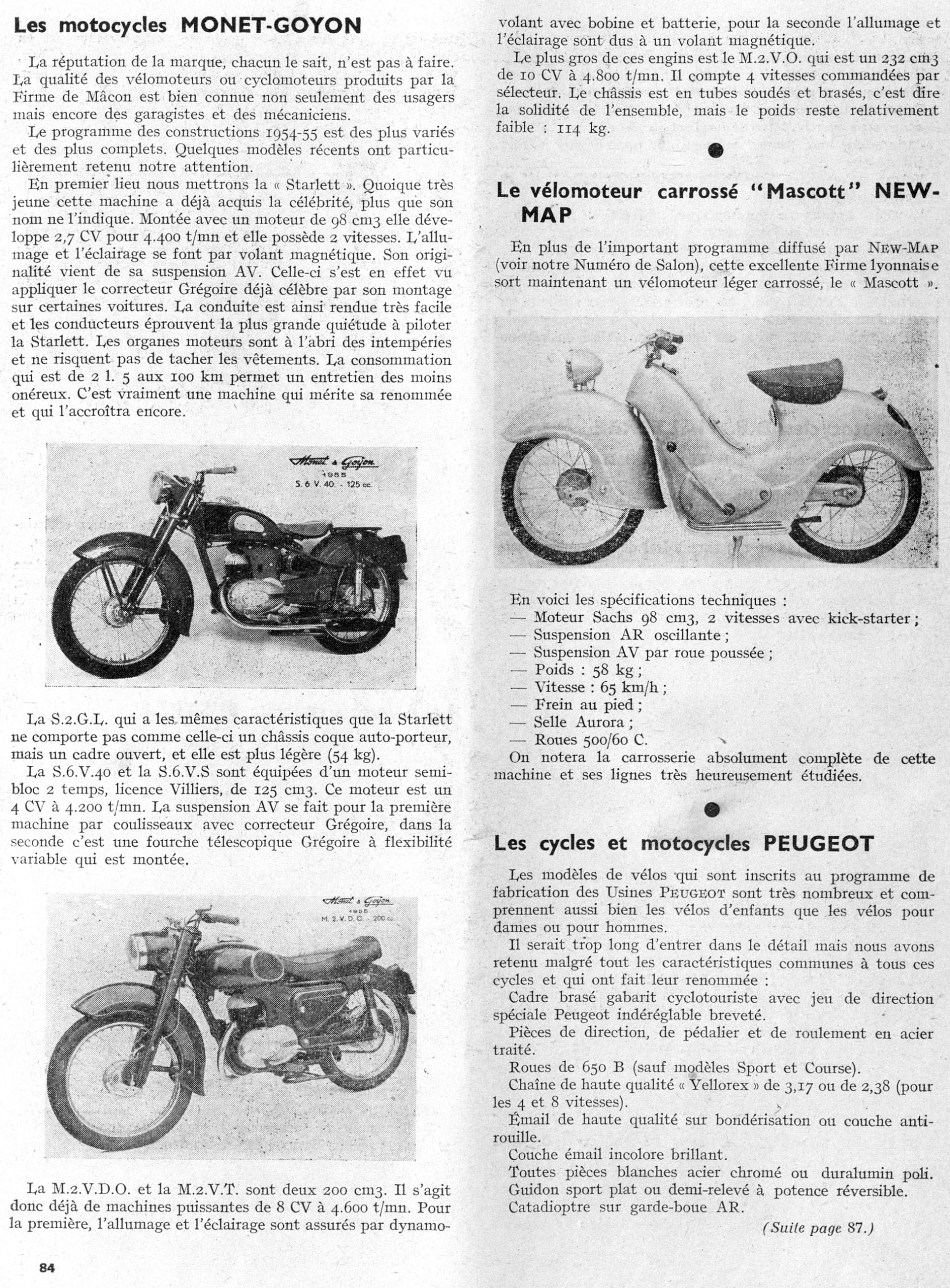
Les motocycles MONET-GOYON
[Ebykr summary; the article’s text is not reproduced. The make’s reputation needs no making: the quality of the vélomoteurs and cyclomoteurs from the Mâcon firm is known to riders, garagemen and mechanics alike, and its 1954-55 program is among the most varied and complete. First comes the « Starlett », young but already famous: a 98 cm3 engine giving 2,7 CV at 4.400 t/mn, two speeds, ignition and lighting by flywheel magneto. Its originality is the front suspension, which uses the Grégoire corrector already famous on certain motorcars, making it very easy to ride; the mechanism is sheltered from the weather and will not stain clothes, and consumption of 2 l. 5 per 100 km makes it cheap to run.]
Monet & Goyon
1955
S. 6 V. 40. – 125 cc.
[Ebykr summary, continued below the first photograph. The S.2.G.L. has the Starlett’s characteristics but an open frame in place of the self-supporting monocoque chassis, and is lighter (54 kg). The S.6.V.40 and the S.6.V.S have a 125 cm3 two-stroke semi-unit engine built under Villiers license, giving 4 CV at 4.200 t/mn; the first has sliding front suspension with the Grégoire corrector, the second a variable-rate Grégoire telescopic fork.]
Monet & Goyon
1955
M. 2. V. D. O. – 200 cc.
[Ebykr summary, continued below the second photograph. The M.2.V.D.O. and M.2.V.T. are both 200 cm3 machines of 8 CV at 4.600 t/mn; on the first, ignition and lighting come from a dynamo-flywheel with coil and battery, on the second from a flywheel magneto. The largest is the M.2.V.O., 232 cm3, 10 CV at 4.800 t/mn, with four selector-controlled speeds and a chassis of welded and brazed tubes, yet weighing only 114 kg.]
Le vélomoteur carrossé “Mascott” NEW-MAP
[Ebykr summary, after the bullet. Besides the large program of New-Map, given in the paper’s Salon number, the excellent Lyon firm now brings out a light faired vélomoteur, the « Mascott ». Its technical specifications:]
— Moteur Sachs 98 cm3, 2 vitesses avec kick-starter ;
— Suspension AR oscillante ;
— Suspension AV par roue poussée ;
— Poids : 58 kg ;
— Vitesse : 65 km/h ;
— Frein au pied ;
— Selle Aurora ;
— Roues 500/60 C.
[Ebykr summary, continued. The paper points to the machine’s fully complete fairing and its very happily studied lines.]
Les cycles et motocycles PEUGEOT
[Ebykr summary, after the bullet. The bicycle models in the Peugeot works’ manufacturing program are very numerous, covering children’s bicycles as well as ladies’ and men’s; too many to detail, but the paper lists the features common to all of them on which their reputation rests:]
Cadre brasé gabarit cyclotouriste avec jeu de direction spéciale Peugeot indéréglable breveté.
Pièces de direction, de pédalier et de roulement en acier traité.
Roues de 650 B (sauf modèles Sport et Course).
Chaîne de haute qualité « Yellorex » de 3,17 ou de 2,38 (pour les 4 et 8 vitesses).
Émail de haute qualité sur bondérisation ou couche anti-rouille.
Couche émail incolore brillant.
Toutes pièces blanches acier chromé ou duralumin poli.
Guidon sport plat ou demi-relevé à potence réversible.
Catadioptre sur garde-boue AR.
(Suite page 87.)
84
— Page 9 —
[Ebykr summary, continuing Peugeot from page 84. For motor machines the range is no less complete than for bicycles, running from the cyclomoteur to the triporteur by way of the scooter and the ordinary motorcycle. The « Bima » are cyclomoteurs with a 49 cm3 two-stroke Peugeot engine unit, its cylinder horizontal under the bottom bracket (a blot partly covers « horizontal » and « est réalisé » in this sentence); the rear wheel is driven by a constant-pressure roller, which removes jerks, clutch and decompressor are synchronized and worked by twist grip, and hills are climbed without pedaling thanks to an internal reduction gear in a sealed case and the roller’s gearing. The text says the Bima exists in three models but names only two, the Bima Standard and the Bima Luxe. The 125 cm3 Peugeot vélomoteurs have long been liked by riders: in three speeds there are the type 55 T.A. with single exhaust, the type 55 T.C. with double exhaust and foot selector, and the type 57 TCL, also with foot selector and full protection by deep-pressed mudguards. The type 56 TL 4 is also a 125 cm3 vélomoteur but with four speeds, telescopic fork and rear suspension. The types 176 (AS or TC4 Grand Luxe, or GS Grand Sport) are 175 cm3 machines, all with four speeds. The 250 cm3 (type TC4) has a high-efficiency two-cylinder two-stroke engine of 13 CV. The Peugeot scooter, long known to the public, is called a true little two-seat car on two wheels of particularly careful elegance and finish. The 125 cm3 triporteur, very practical and indispensable to the shopkeeper, is built in three models: without body, with a front-opening box and with a lidded box.]
Les productions ROCHER
[Ebykr summary, after the bullet. Readers know the program of the Établissements Rocher, whose cyclomoteurs with the excellent Cucciolo four-stroke 48 cm3 two-speed engine have a fine competition record. The Eriac cyclomoteurs, built by the same firm, have a deserved reputation for toughness and mechanical efficiency. The Rocher works are bringing out a new folding scooter in a model for the army, which drew keen interest from Salon visitors.]
Les nouveaux motorisés RAVAT
[Ebykr summary, after the bullet. Ravat, one of the great names of the cycle, had entered the motor market only timidly after the war, though not for want of experience: the Établissements Ravat had had their motor branch since 1924 and had made their own engines since 1930, and specialists rated the Ravat two-strokes an industrial success. The house had stayed too sentimentally attached to the bicycle that made its name, a name still synonymous with quality; the cycle crisis and the public’s turn to motor machines spurred its reconversion. In three years it has brought out two 125 cm3 engine units, the latter among the purest and most aerodynamic on the market, a 175 cm3 unit of the same inspiration and a 50 cm3 with cone clutch already well spoken of. The effort should bear full fruit in 1954-1955, the firm now showing a complete range equal to the largest. A brief list:]
En cyclomoteurs :
Six modèles partant de moins de 40.000 fr. Trois (dont un 2 vitesses) sont équipés avec moteur Vap et trois avec le moteur Ravat produit aux usines de Monthieu.
En vélomoteurs et motos :
— Une première série d’usage courant (avec bloc 125 cm3 Ravat sélecteur et volant enfermés) livrée en deux versions (avec et sans suspension AR).
(Suite page 89.)
— Page 10 —
— Deux échelons de modèles luxe (toujours avec bloc 125 cm3 Ravat) l’un sans suspension, l’autre avec suspension, mais présentés tous deux avec un goût et un modernisme qui ont frappé les visiteurs du Salon. Leurs roues de 16 pouces et leurs moyeux-tambour centraux ont particulièrement retenu l’attention.
— Une 175 cm3 (avec bloc Ravat et présentation chromée).
— Deux versions (une en 125 cm3, une en 175 cm3) d’un élégant modèle Grand Sport, avec cadre AR oscillant, carénage et roues de 16 pouces, dont on dit que les performances valent la ligne.
[Ebykr summary, continued below the photograph. The paper understands that Ravat is determined to follow the market closely and no longer fall behind the leading group, in which its 1954-1955 program places it brilliantly again. The new policy has meant a deep reorganization of the firm’s services; on the technical side an industrial agreement with two very important houses will ensure the best use of each one’s means of production.]
Les motocycles SAROLEA
[Ebykr summary, after the bullet. Imported into France by the Paris Établissements F. Delaunay, Saroléa motorcycles come as 350 and 600 cm3 singles and a 500 cm3 twin. The photograph shows the 350 cm3 overhead-valve single, which reaches 110-115 km/h and uses 3 l. 1/4 of petrol per 100 km.]
Les cycles et motocycles TENDIL
[Ebykr summary, after the bullet. The Nîmes firm Tendil shows a production marked by variety and high quality. In plain bicycles its program has no fewer than eight series: Utilitaire, Luxe, Grand-Luxe, Grand Tourisme, Course, Porteur parisien, Enfants and Baby-Tendil, with more than twenty models among them; the paper singles out the Utilitaire model (men’s or ladies’), with demi-ballon tires, at under 15.000 francs. In cyclomoteurs Tendil brings out eight very carefully studied and impeccably made models with Junior and Vap 55 or Vap B engines, the paper insisting on the Tendilet Vap 55 grand luxe with automatic clutch and a special reinforced cradle frame, entirely soudo-brasé (bronze-welded). The firm also builds a light faired vélomoteur, the Tendil Comet 98 cm3, called one of the finest machines of the moment. Among true vélomoteurs come the types V.M.T. 3 and V.M.T.L. 3, with a 125 cm3 two-stroke Aubier-Dunne engine and three speeds by foot selector; the photograph shows the V.M.T. 3. In motorcycles Tendil builds a 175 cm3 with a two-stroke Aubier-Dunne engine, three foot-selector speeds and a luxury telescopic fork.]
Les moteurs VAP 55
[Ebykr summary, after the bullet. The Vap 55 engine draws on the long experience of the Société A.B.G., pioneer of the cycle engine. Its « self-drive » automatic clutch is independent of the cycle’s speed, that is of pedaling effort, and acts only on engine speed, so that it obeys the throttle alone: without pedaling and without the least jerk the rider can pass from walking pace to top speeds of 40 an hour and more. The Vap 55 is ridden with a single lever, the throttle. Anyone can try a remarkable experiment: start the Vap 55 by hand by pushing the bicycle one meter, then walk beside it, and it will follow its rider at walking pace; this proves the great smoothness of the automatic clutch and guarantees effortless hill starts. Many other improvements are said to make it a sensational engine.]
Attention : Ne manquez pas de consulter, à partir de la page 107, le second Chapitre des “2-Roues” aux programmes 1955.
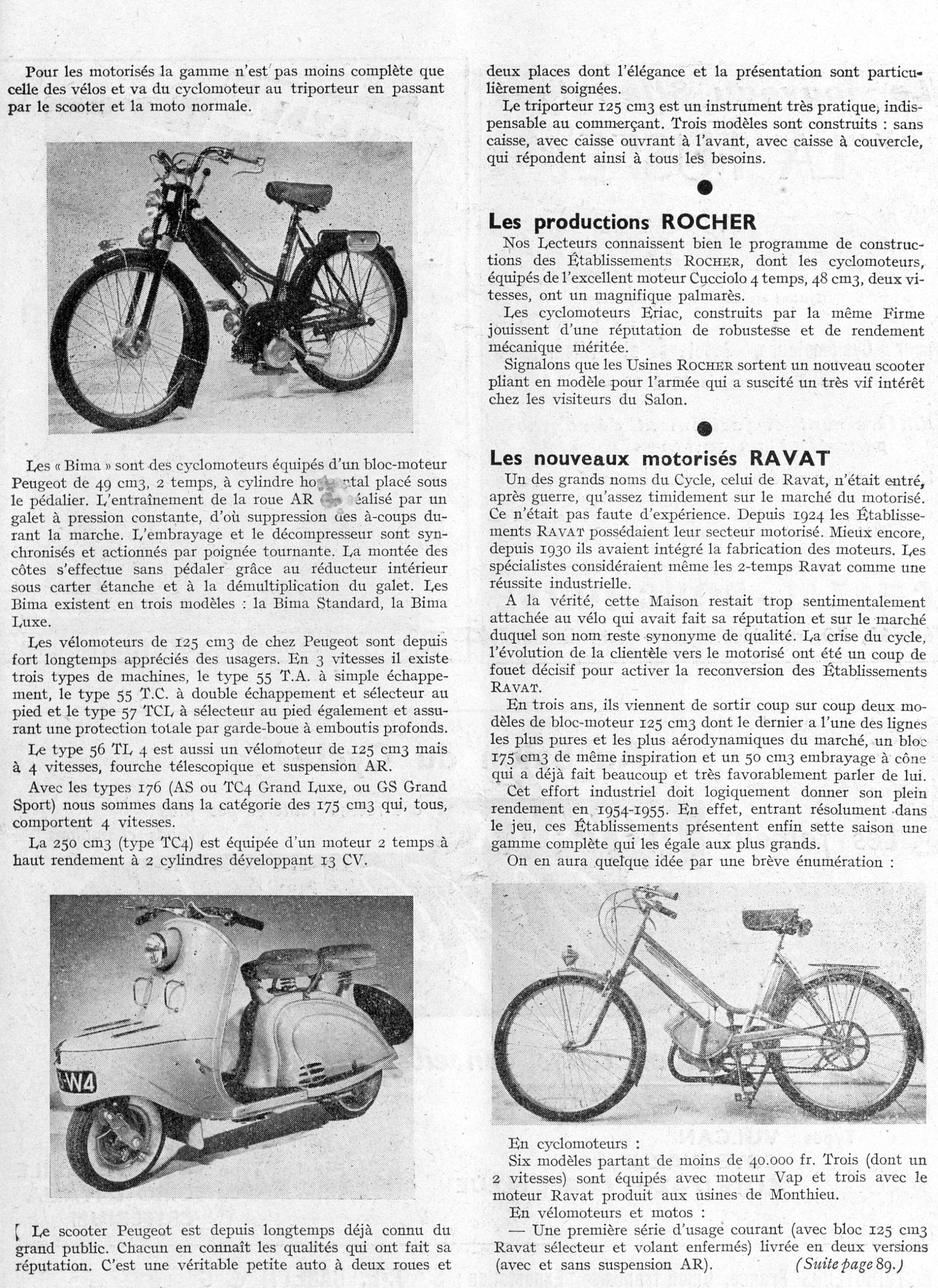
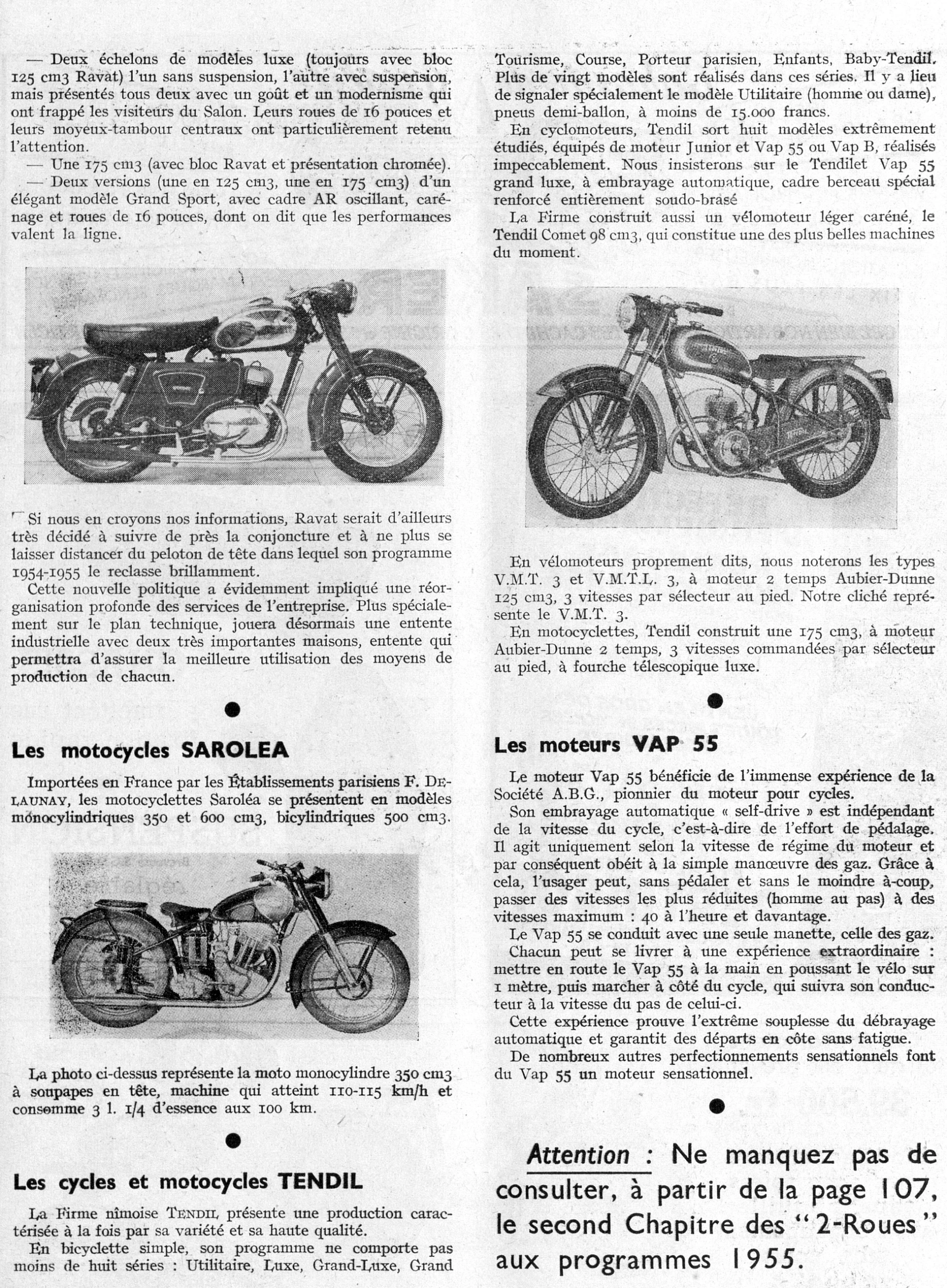
[Ten text pages of an editorial survey set in two columns of roman text, each firm’s section opened by a heading in heavy sans-serif type (“Les cycles et motocycles PEUGEOT”, “Les motocycles FAVOR” and so on) and separated from the next by a solid black bullet; specification lists run as dashed rows, and each page ends with a “(Suite page …)” turn line to the next editorial page. Page 1 opens the chapter under a three-line display headline in large capitals, “QUELQUES NOTATIONS / TECHNIQUES INTERNATIONALES / SUR LES “2-ROUES” AU SALON”, with “Chapitre premier” set at the foot, and carries a halftone photograph of the faired Arliguie “Javelin” cyclomoteur. Pages 2 and 3 are mostly text with halftone photographs set in the columns (page 3 among them the F.M.L. “Myster” engine); the lower half of page 3 holds two line drawings, labeled “1ère application” and “2ème application” with underlined titles, of a cyclomoteur’s rear half on a single-tube F.T.K. frame, with arrows to captions “porte-bagage”, “cadre adapté”, “Attache moteur” with “3 vis de fixation” or “4 vis de fixation”, and “moteur “HIMO 53″ avec ou sans débrayage” or “moteur HIMO 55/2 vitesses pédalier séparé”; the engine cases read “FTK” and no artist’s signature appears on either drawing, while a strip of green from the facing advertisement shows at the right edge of that page. Pages 4 to 10 each carry two or three halftone photographs set within the columns: the René Gillet and Humblot “Coronès” machines, the G.I.M.A. 250, the René Guiller RG 200, the Helyett VMHL 22 and the Juéry J 10 three-wheeled van, three Humblot “Paloma” machines and a close view of the Lavalette A.M.L. 50 engine with “LAVALETTE” on its case, the D.S. Malterre SBL 708, the folding Martin-Moulet “Valmobile” scooter and the Mistral 100 E2 engine, two Monet-Goyon motorcycles with “Monet & Goyon / 1955” and the model designations “S. 6 V. 40. – 125 cc.” and “M. 2. V. D. O. – 200 cc.” lettered in the upper right of each photograph, the faired New-Map “Mascott”, a Peugeot “Bima” cyclomoteur and the Peugeot scooter with a partial number plate ending “W4”, a Ravat ladies’-frame cyclomoteur and a Ravat motorcycle, a Saroléa 350 single, and the Tendil V.M.T. 3. Page 10 closes with a notice in large sans-serif type, its first word “Attention” underlined, referring to the second chapter from page 107. The photographs are coarse halftones, and no “Rebour”, “DR” or “G. GEDO” signature appears on any drawing or photograph; no author’s byline was found on these ten pages.]
Ebykr presents this material for research and education. If you hold rights to it or notice an ownership issue, please contact us and we will respond promptly.
The Ebykr Digest
New articles, timelines, catalog finds and registry activity — assembled from the archive once a month. Your address is never shared.
Double opt-in. One email per month. Unsubscribe at any time with one click.