About Ebykr
Ebykr celebrates classic and vintage lightweight bicycles through provocative imagery and opinion. Ride along with us.
About Ebykr
Ebykr celebrates classic and vintage lightweight bicycles through provocative imagery and opinion. Ride along with us.

Source: Gallica (Bibliothèque nationale de France), L'Officiel du cycle, du motocycle et du camping, November 1954, N° 46, page 7; ark:/12148/bd6t54196207z. Source gallica.bnf.fr / BnF.
| Type | Review |
|---|---|
| Year | 1954 |
| Publisher | L'Officiel du cycle |
| Country | France |
| Language | French |
| Pages | 1 |
| Source | Gallica (Bibliothèque nationale de France), L'Officiel du cycle, du motocycle et du camping, November 1954, N° 46, page 7; ark:/12148/bd6t54196207z. Source gallica.bnf.fr / BnF. |
| Credit | Ebykr archive; Bibliothèque nationale de France |
| Identifier | Gallica (BnF) ark:/12148/bd6t54196207z/f7 |
| Transcription | Headings and specifications transcribed; article text summarized |
JUSTICE POUR LA FAMILLE DU VÉLOCISTE-MOTOCISTE ! * Cotisations Caisse allocations familiales sur les bases actuelles — 16.800 Cotisations à la Caisse vieillesse (régime le plus bas) — 12.720 Soit un total de — 29.520 — L'Artisan touchera, avec trois enfants, 9.485 francs par mois de prestations familiales. Il aura droit à sa retraite, après …
This is a magazine article, so its running text is summarized here rather than reproduced; the headline, byline, specifications and scores are transcribed as printed.
From L’Officiel du cycle, du motocycle et du camping, November 1954, the paper’s number reporting the 1954 Paris Salon du Cycle et du Motocycle, page 7: Marcel Guignebourg, vice-president of the federation of cycle and motorcycle dealers, on the social and fiscal treatment of the dealer’s family. The title, headings, captions and lists are transcribed as printed; the text is summarized in Ebykr’s words, and the page images carry it in full.
— Page 1 —
JUSTICE POUR LA FAMILLE
DU VÉLOCISTE-MOTOCISTE !
[Ebykr summary; the article’s text is not reproduced. The writer recalls that until 1939 the Artisanat had no social benefit; the Code de la Famille (« loi Pernod ») then let it draw family benefits like wage earners under the general scheme. Despite reduced contributions, and thanks to state aid (a subsidy equal to 50 % of expenditure until June 1947), the artisans’ allowances, apart from the single-wage allowance, matched those of wage earners in value, until a finance law ordering economies withdrew the state aid. The artisans then carried the whole system on their own contributions, which he counts to their honor; but he declares it absolutely impossible, and believes every Vélociste-Motociste will agree, to accept a further rise in their direct contribution.]
*
[Ebykr summary, after the first star. He asks whether the artisan’s family, professional or fiscal, is condemned to the « portion congrue », and answers critics in advance, starting with contributions. Comparing like with like: the artisans’ contributions to the family-allowance and old-age funds are direct, as are the 6 % deducted from wages. On the Sécurité sociale ceiling wage of 456.000 francs a year, or 38.000 francs a month, the wage earner pays a direct contribution of 27.360 francs a year. An artisan with the same income pays each year:]
Cotisations Caisse allocations familiales sur les bases actuelles — 16.800
Cotisations à la Caisse vieillesse (régime le plus bas) — 12.720
Soit un total de — 29.520
[Ebykr summary, continued. Since in more than 90 % of cases the artisan must hold a patente, a sixth-category one adds twelve thousand francs more: in the article’s italic words « quarante et un mille cinq cent vingt francs » of direct outlay for the artisan, against « vingt-sept mille trois cent soixante francs » for the wage earner on equal income. In return the article sets out these figures (bold as printed):]
— L’Artisan touchera, avec trois enfants, 9.485 francs par mois de prestations familiales.
Il aura droit à sa retraite, après 30 années de versement, pour lui et sa femme, à 152.100 francs par an.
Le Salarié du régime général aura droit avec trois enfants à 21.925 francs par mois soit, de plus que l’Artisan, 12.440 francs par mois ou 149.280 francs par an !
Pour sa retraite, le Salarié aura droit à une allocation beaucoup plus substantielle.
*
[Ebykr summary, after the second star. On directly paid contributions the artisan is therefore at a heavy disadvantage, and to insure himself and his family against illness he must again pay directly, while for the wage earner some 36 % of charges are paid by the employer, built into selling prices and borne in the end by consumers; he says this without acrimony, as simple logic. In the parliamentary debate on the « budget annexe de l’Agriculture », which led Parliament to bring the agricultural wage earners’ scheme into the « surcompensation », the decisive argument was the rural exodus of the young toward towns and industry. He holds that no one is born an artisan: most become one after contributing to the Sécurité sociale as wage earners with few or no family charges, and only when family charges arrive; he is convinced many of their children will in turn serve big industry.]
*
[Ebykr summary, after the third star. Given these facts, he asks whether equal benefits, through the surcompensation, can still be refused to the Artisanat, and says this is no longer possible. The Artisanat is the framework of the French countryside and provinces and a form of working-class advancement; highly skilled workers and excellent foremen with several children hesitate to take the step because of the social inequality artisans suffer. Proof is the return to wage work of young people who had dared to leave it, with these figures for 1953: 4.756 artisans returned to wage work, while that same year there were 6.827 new employers, 10.906 new liberal professionals and 6.799 new shopkeepers. He believes this return is the result of the social policy that Parliament imposes on artisans.]
*
[Ebykr summary, after the fourth star. Social laws in France, a country always in the vanguard, should serve all French families of the metropole and not one category, for how can equal sacrifice be demanded once inequality has been created in social justice? Quoting Montesquieu, « Une injustice faite à un seul est une menace faite à tous », he assures the « Amis Vélocistes-Motocistes de familles artisanes » of his full support, asks for their help in their just claims, and ends with the ancients’ precept « Vivre d’abord, philosopher ensuite »: not beggars but independent workers, they demand equality for their families.]
Marcel GUIGNEBOURG,
Vice-Président
de la Fédération Nationale
des Vélocistes et Motocistes.
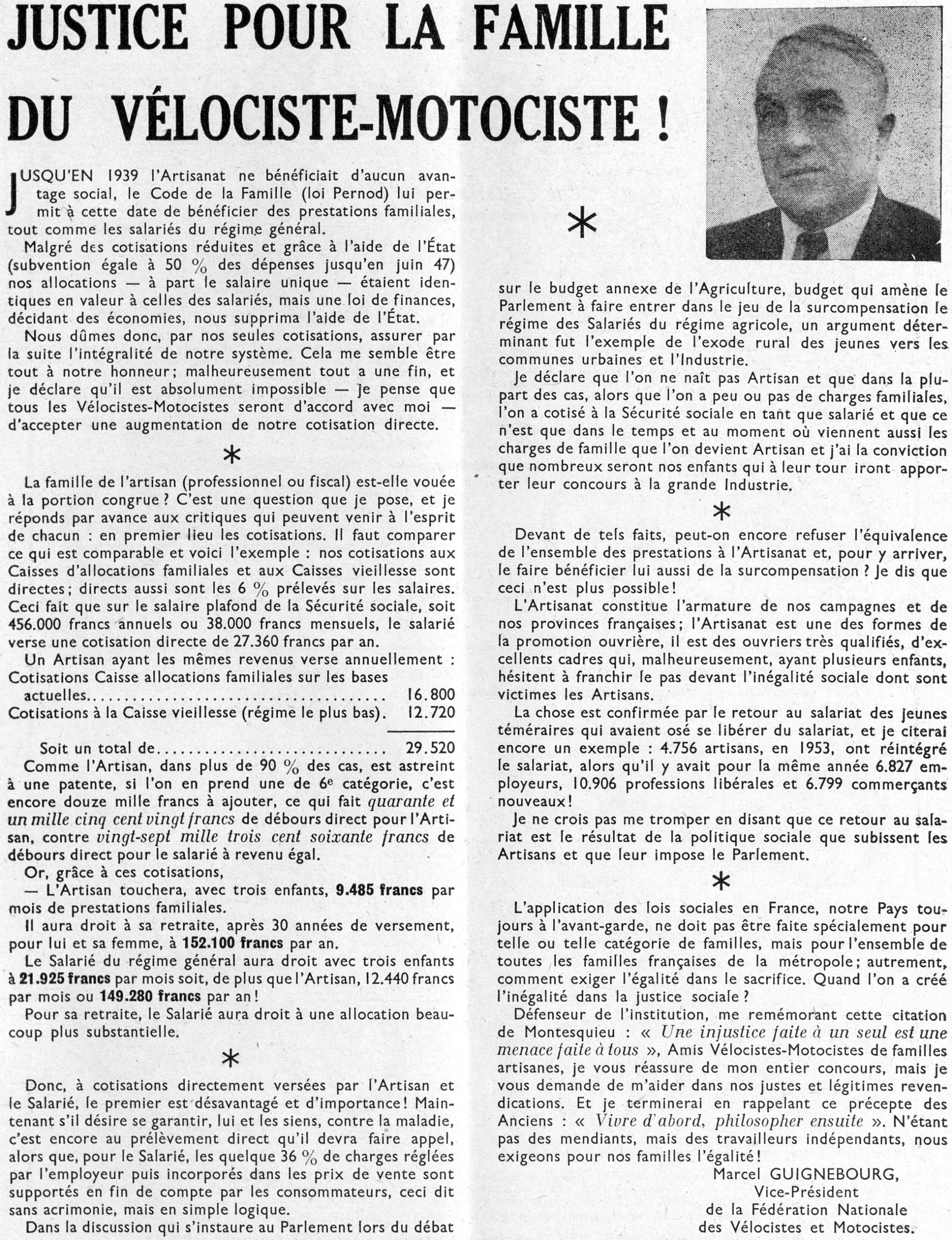
[A full page of text in two columns under a two-line headline in heavy condensed roman capitals, “JUSTICE POUR LA FAMILLE” over “DU VÉLOCISTE-MOTOCISTE !”. The body is set in a light sans-serif with a large initial “J”; sections are divided by single asterisks centered in the column, and the left column carries a small table of contributions with dotted leaders and a rule above its total, followed by benefit figures in bold. At the upper right a squared halftone portrait shows a balding, heavy-set man in a dark suit, white shirt and tie, facing slightly left; it has no caption and no photographer’s credit. The signature block of Marcel Guignebourg, vice-president of the Fédération Nationale des Vélocistes et Motocistes, closes the right column.]
Ebykr presents this material for research and education. If you hold rights to it or notice an ownership issue, please contact us and we will respond promptly.
The Ebykr Digest
New articles, timelines, catalog finds and registry activity — assembled from the archive once a month. Your address is never shared.
Double opt-in. One email per month. Unsubscribe at any time with one click.