About Ebykr
Ebykr celebrates classic and vintage lightweight bicycles through provocative imagery and opinion. Ride along with us.
About Ebykr
Ebykr celebrates classic and vintage lightweight bicycles through provocative imagery and opinion. Ride along with us.

Source: Gallica (Bibliothèque nationale de France), L'Officiel du cycle, du motocycle et du camping, November 1954, N° 46, pages 29, 31, 32, 37, 39, 41 and 43; ark:/12148/bd6t54196207z. Source gallica.bnf.fr / BnF.
| Type | Review |
|---|---|
| Year | 1954 |
| Publisher | L'Officiel du cycle |
| Artist | G. Gédovius |
| Country | France |
| Language | French |
| Pages | 7 |
| Source | Gallica (Bibliothèque nationale de France), L'Officiel du cycle, du motocycle et du camping, November 1954, N° 46, pages 29, 31, 32, 37, 39, 41 and 43; ark:/12148/bd6t54196207z. Source gallica.bnf.fr / BnF. |
| Credit | Ebykr archive; Bibliothèque nationale de France |
| Identifier | Gallica (BnF) ark:/12148/bd6t54196207z/f29 |
| Transcription | Headings and specifications transcribed; article text summarized |
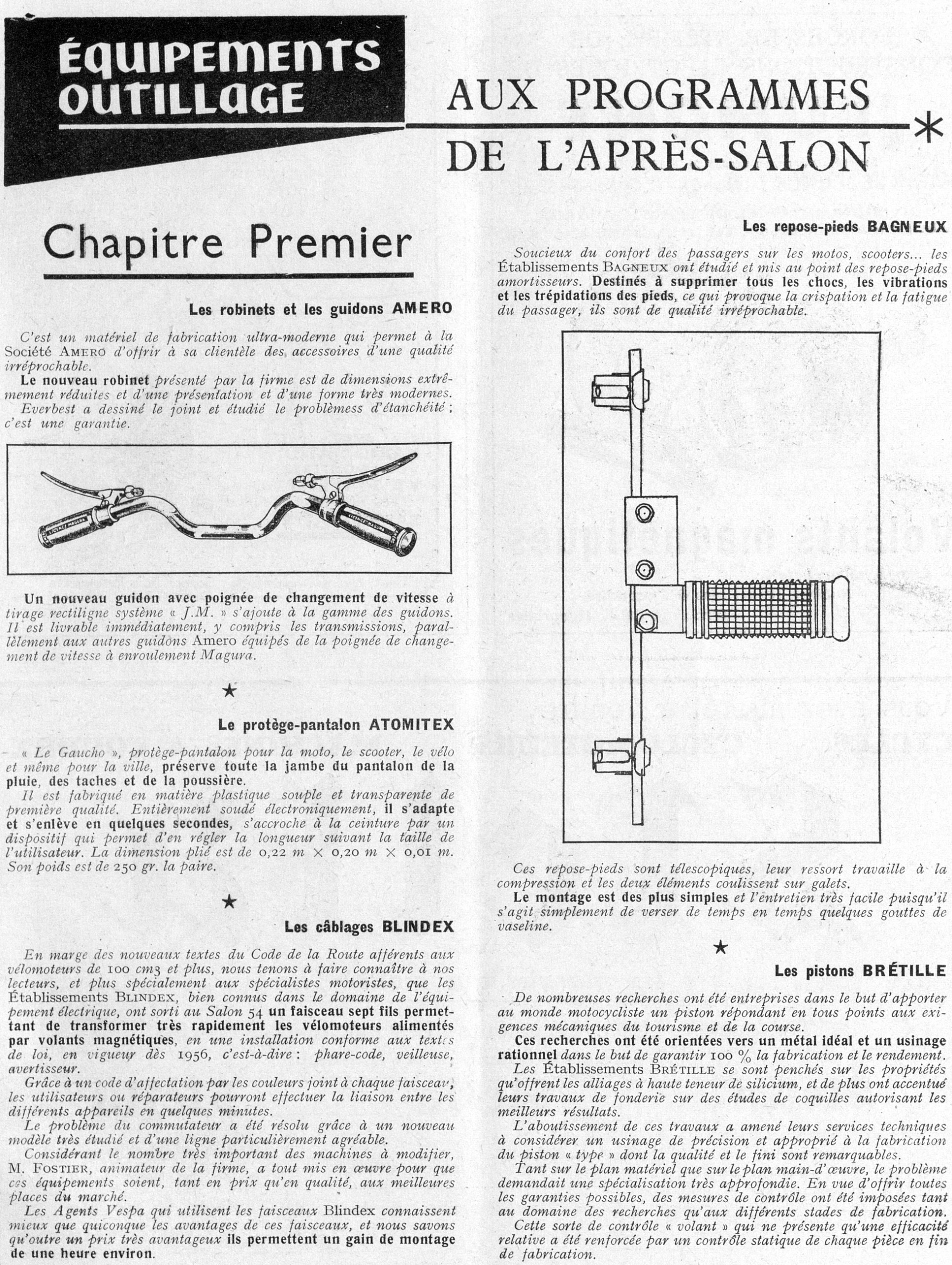
ÉQUIPEMENTS OUTILLAGE AUX PROGRAMMES DE L'APRÈS-SALON Chapitre Premier Les robinets et les guidons AMERO ★ Le protège-pantalon ATOMITEX ★ Les câblages BLINDEX Les repose-pieds BAGNEUX ★ Les pistons BRÉTILLE ★ Les importations CANETTI ★ Les freins C.L.B. — Freins cyclomoteurs ; — Poignées inversées cyclomoteur et scooter ; — Poignées de débrayage ; — Béquilles …
This is a magazine article, so its running text is summarized here rather than reproduced; the headline, byline, specifications and scores are transcribed as printed.
From L’Officiel du cycle, du motocycle et du camping, November 1954, the paper’s number reporting the 1954 Paris Salon du Cycle et du Motocycle, pages 29 to 43: the magazine’s survey of components, accessories and tools after the Salon, chapter one, firm by firm. The title, headings, captions and lists are transcribed as printed; the text is summarized in Ebykr’s words, and the page images carry it in full.
— Page 1 —
ÉQUIPEMENTS
OUTILLAGE
AUX PROGRAMMES
DE L’APRÈS-SALON
Chapitre Premier
Les robinets et les guidons AMERO
[Ebykr summary; the article’s text is not reproduced. Ultra-modern plant lets the Société AMERO offer accessories of irreproachable quality. Its new fuel tap (“Le nouveau robinet”) is of very small dimensions and modern form; Everbest designed its seal and studied its sealing (printed “problèmess d’étanchéité”), which the writer calls a guarantee. A new handlebar with a straight-pull gear-change grip, « J.M. » system, joins the range of bars; it is deliverable at once with its cables, alongside the other Amero bars fitted with the Magura twist-grip gear change.]
[Drawing in a ruled frame: a raised moped handlebar with a brake lever and cable adjuster at each end and long ribbed grips lettered “LICENCE MAGURA”.]
★
Le protège-pantalon ATOMITEX
[Ebykr summary. « Le Gaucho », a trouser protector for the motorcycle, the scooter, the bicycle (« le vélo ») and even for town, keeps the whole trouser leg free of rain, stains and dust. It is made of supple, transparent, first-quality plastic, entirely electronically welded, goes on and off in a few seconds and hooks to the belt by a device that adjusts its length to the wearer’s height. Folded size 0,22 m × 0,20 m × 0,01 m; weight 250 gr. the pair.]
★
Les câblages BLINDEX
[Ebykr summary. In view of the new Code de la Route texts on vélomoteurs of 100 cm3 and over, the Établissements BLINDEX, known for electrical equipment, brought out at the Salon 54 a seven-wire harness that quickly converts vélomoteurs fed by flywheel magnetos into an installation conforming to the law in force from 1956: dipping headlamp (« phare-code »), parking light (« veilleuse ») and horn. A color code supplied with each harness lets users or repairers connect the units in a few minutes; the switch problem is solved by a new, carefully studied model of pleasing line. Given the very large number of machines to be modified, M. FOSTIER, head of the firm, has worked to place the equipment among the best on the market in price and quality. Vespa agents who use Blindex harnesses know their advantages: besides a very good price, they save about an hour of fitting time.]
Les repose-pieds BAGNEUX
[Ebykr summary. Mindful of the comfort of pillion passengers on motorcycles and scooters, the Établissements BAGNEUX have developed shock-absorbing footrests meant to suppress all shocks, vibration and trembling of the feet, which cause the passenger tension and fatigue. They are telescopic, the spring works in compression and the two elements slide on rollers; fitting is very simple and upkeep needs only a few drops of vaseline from time to time.]
[Line drawing in a tall ruled frame: a vertical bar with a clamp at top and bottom and a bolted block from which projects a footrest with a cross-hatched rubber and a rounded end.]
★
Les pistons BRÉTILLE
[Ebykr summary. Much research has sought a piston meeting every mechanical demand of touring and racing; it has aimed at an ideal metal and rational machining, so as to guarantee manufacture and efficiency “100 %”. The Établissements BRÉTILLE studied high-silicon alloys and pressed their foundry work on die (« coquilles ») studies, which led their technical services to precision machining for the « type » piston, of remarkable quality and finish. The problem demanded deep specialization in material and labor; control measures were imposed on research and on each stage of production, and the « volant » (roving) inspection, of only relative efficacy, was reinforced by a static check of every piece at the end of manufacture.]
— Page 2 —
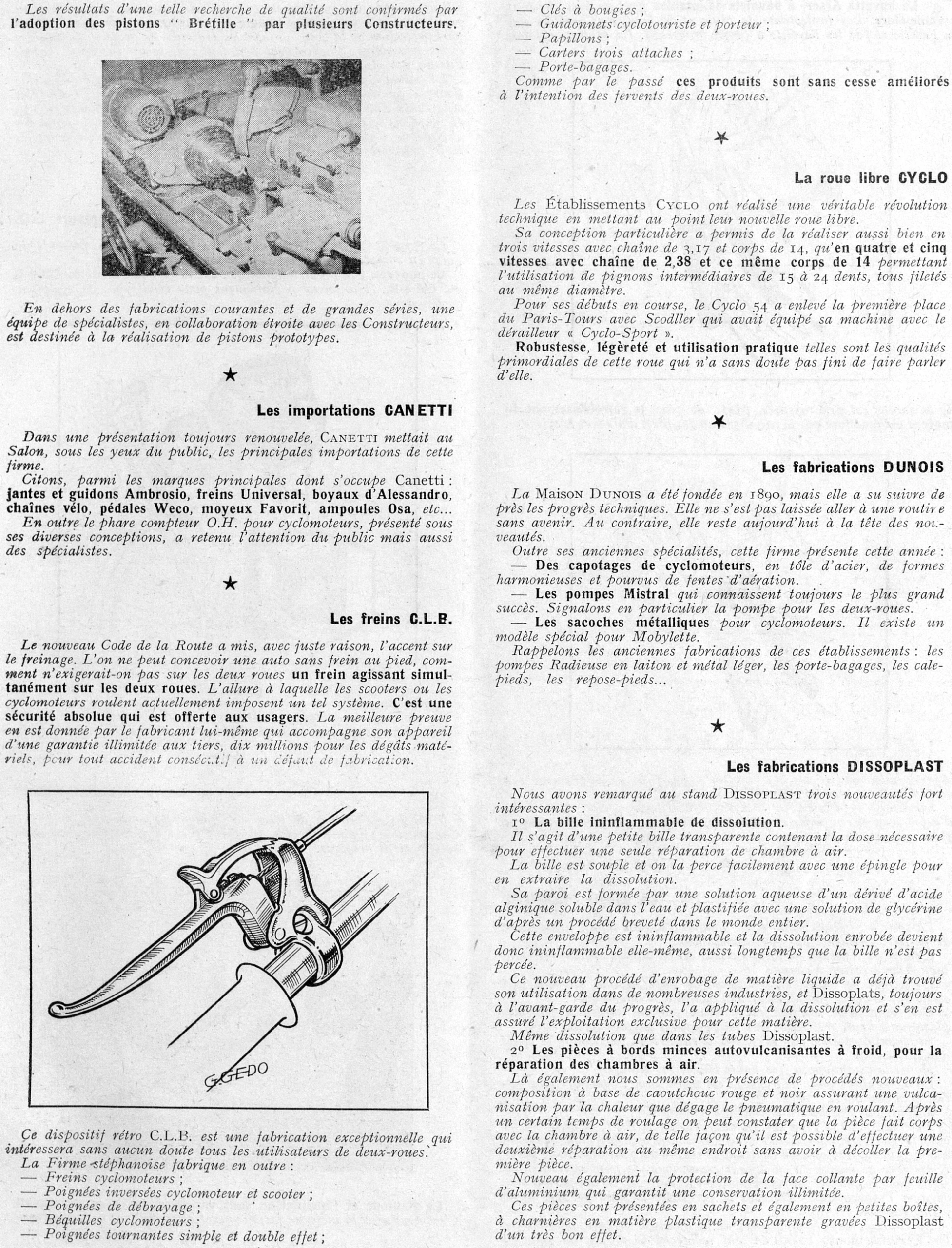
[Ebykr summary, continuing Brétille from page 29. The results of this pursuit of quality are confirmed by the adoption of « Brétille » pistons by several makers. Beyond current and long-run production, a team of specialists works closely with the makers on prototype pistons.]
[Halftone photograph, squared, dark and coarse: machined parts and a ribbed round component on a workbench or machine, too dim to identify further; no caption.]
★
Les importations CANETTI
[Ebykr summary. In an ever-renewed display Canetti showed its principal imports at the Salon. The article names, among the main brands Canetti handles: « jantes et guidons Ambrosio, freins Universal, boyaux d’Alessandro, chaînes vélo, pédales Weco, moyeux Favorit, ampoules Osa, etc… » (bold as printed). The O.H. headlamp with built-in speedometer (« phare compteur ») for cyclomoteurs, shown in its several versions, drew the attention of the public and of specialists.]
★
Les freins C.L.B.
[Ebykr summary. The new Code de la Route rightly stresses braking: since no one can imagine a car without a foot brake, a brake acting simultaneously on both wheels should be required on two-wheelers, as the speeds of scooters and cyclomoteurs now demand. It is offered as absolute safety, and the maker backs it with an unlimited third-party guarantee, ten million for material damage, for any accident caused by a manufacturing defect. This C.L.B. « rétro » device is called an exceptional piece of work that will interest every two-wheel user. The Saint-Étienne firm (« La Firme stéphanoise ») also makes:]
— Freins cyclomoteurs ;
— Poignées inversées cyclomoteur et scooter ;
— Poignées de débrayage ;
— Béquilles cyclomoteurs ;
— Poignées tournantes simple et double effet ;
— Clés à bougies ;
— Guidonnets cyclotouriste et porteur ;
— Papillons ;
— Carters trois attaches ;
— Porte-bagages.
[Ebykr summary, continued. As in the past, these products are constantly improved for two-wheel enthusiasts.]
[Line drawing in a ruled frame, signed “G.GEDO” at lower center: a cast brake lever with its cable, clamped to a handlebar beside the rubber grip, drawn in close hatching.]
La roue libre CYCLO
[Ebykr summary. The Établissements CYCLO have made a true technical revolution with their new freewheel. Its particular design allows it to be built with three speeds for chain of 3,17 and body of 14, and with four and five speeds for chain of 2,38 and the same body of 14, taking intermediate sprockets of 15 to 24 teeth, all threaded to the same diameter. In its first race the Cyclo 54 took first place in Paris-Tours with « Scodller », who had fitted his machine with the « Cyclo-Sport » derailleur. Strength, lightness and practical use are the essential qualities of this freewheel, which, the writer says, will surely go on being talked about.]
Les fabrications DUNOIS
[Ebykr summary. The Maison DUNOIS was founded in 1890 but has kept close to technical progress and remains at the head of novelties. Besides its old specialties it shows this year: steel-sheet cowlings for cyclomoteurs (« Des capotages de cyclomoteurs »), of harmonious form with ventilation slots; the Mistral pumps (« Les pompes Mistral »), still very successful, notably the pump for two-wheelers; and metal panniers (« Les sacoches métalliques ») for cyclomoteurs, with a special model for Mobylette. Its older lines are recalled: the Radieuse pumps in brass and light metal, luggage carriers, toe clips (« cale-pieds ») and footrests.]
★
Les fabrications DISSOPLAST
[Ebykr summary. Three very interesting novelties were seen on the DISSOPLAST stand.]
1o La bille ininflammable de dissolution.
[Ebykr summary. A small transparent capsule holds the dose of rubber solution for one inner-tube repair; it is supple and pierced with a pin to release the solution. Its wall is formed from an aqueous solution of a water-soluble alginic acid derivative, plasticized with glycerine, by a process patented worldwide; the envelope is non-flammable, so the solution inside stays non-flammable until the capsule is pierced. This coating process for liquids is already used in many industries, and « Dissoplats » (as printed), always in the vanguard, has applied it to rubber solution and secured exclusive rights for that material. The solution is the same as in Dissoplast tubes.]
2o Les pièces à bords minces autovulcanisantes à froid, pour la réparation des chambres à air.
[Ebykr summary. These thin-edged, cold self-vulcanizing patches use a red and black rubber compound vulcanized by the heat the tire generates while running; after some riding the patch becomes one with the tube, so that a second repair can be made at the same spot without lifting the first patch. The sticky face is protected by aluminum foil for unlimited keeping, and the patches come in packets and in small hinged boxes of transparent plastic engraved Dissoplast.]
— Page 3 —
3o La bavette Arsor, à bavolets adaptables
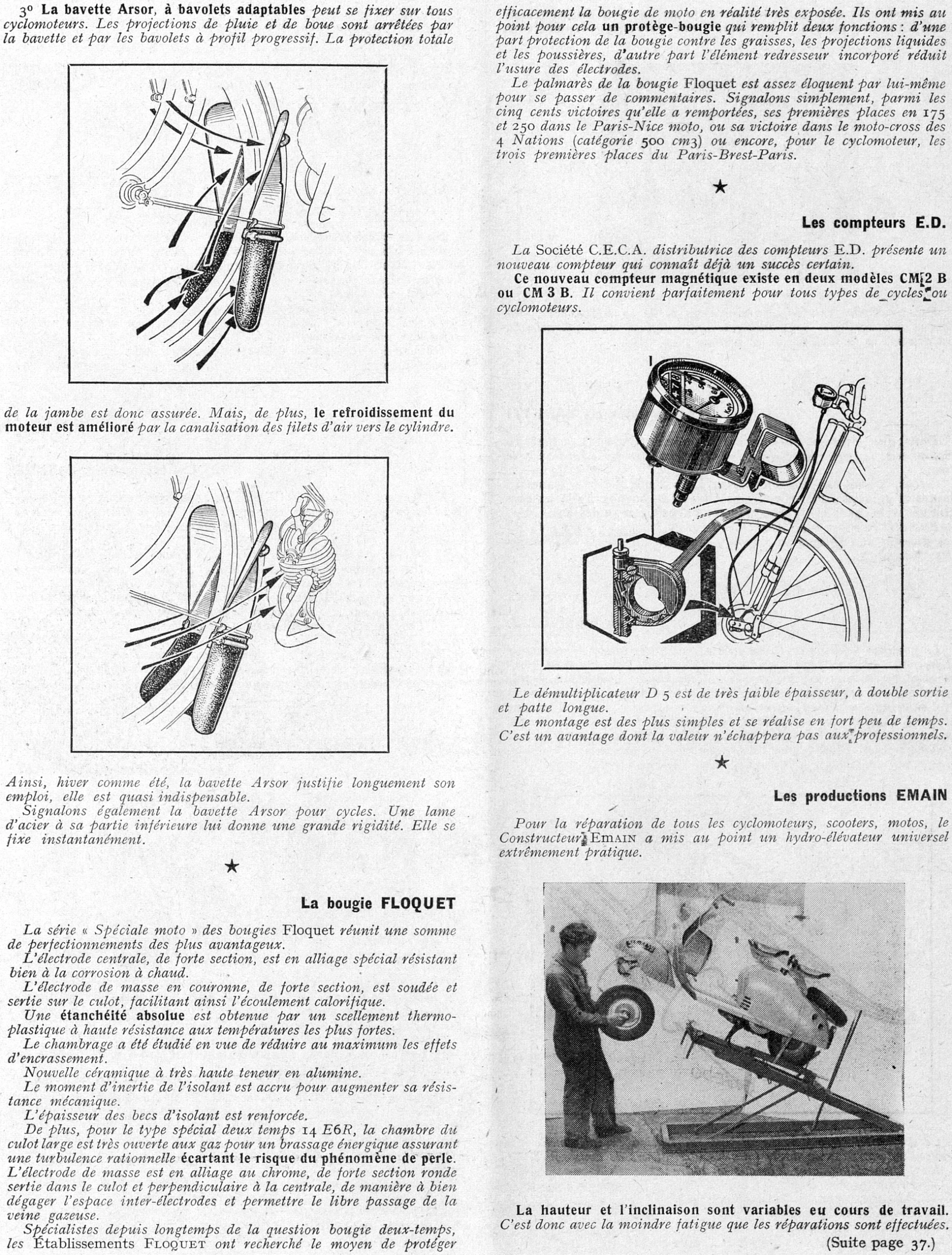
[Ebykr summary, continuing Dissoplast. The Arsor mudflap with adaptable side flaps fits all cyclomoteurs; spray of rain and mud is stopped by the flap and by side flaps of progressive profile, so the leg is fully protected, and engine cooling is also improved by channeling streams of air toward the cylinder. Winter and summer, the writer says, the Arsor flap earns its keep and is almost indispensable. Also noted: the Arsor mudflap for bicycles (« la bavette Arsor pour cycles »), stiffened by a steel blade in its lower part, which fits instantly.]
[Two line drawings in ruled frames, one above the other: a cyclomoteur front fork and wheel with a stippled mudflap hung below the mudguard and arrows showing spray turned aside; then the same flap seen nearer the engine, with arrows carrying air to a finned cylinder.]
★
La bougie FLOQUET
[Ebykr summary. The « Spéciale moto » series of Floquet spark plugs gathers many improvements: a heavy-section center electrode in a special alloy resisting hot corrosion; a heavy-section crown ground electrode welded and crimped to the shell for heat flow; absolute sealing by a thermoplastic seal resisting the highest temperatures; a chamber designed to reduce fouling; a new ceramic very high in alumina; an insulator of increased moment of inertia for mechanical strength; and thicker insulator noses. The special two-stroke type 14 E6R has a wide, open shell chamber for vigorous mixing and turbulence that rules out « perle » (bead fouling), with a chrome-alloy ground electrode of heavy round section crimped in the shell and perpendicular to the center one, leaving the gap clear. Long specialists in the two-stroke plug, the Établissements FLOQUET have also made a plug protector (« un protège-bougie ») that shields the plug from grease, liquid spray and dust while a built-in rectifier element reduces electrode wear. Among its five hundred victories the article cites first places in 175 and 250 in the Paris-Nice moto, the win in the 4 Nations moto-cross (500 cm3 class) and, for the cyclomoteur, the first three places in Paris-Brest-Paris.]
★
Les compteurs E.D.
[Ebykr summary. The Société C.E.C.A., distributor of E.D. meters, shows a new magnetic speedometer, already a success, in two models, CM 2 B or CM 3 B, suited to all types of cycles or cyclomoteurs (« pour tous types de cycles ou cyclomoteurs »). The D 5 reduction drive is very thin, with a double outlet and a long tab; fitting is very simple and quick, an advantage professionals will value.]
[Line engraving in a ruled frame: a round speedometer marked “Km/h” on its clamp above a cyclomoteur front fork, a cable running down to a drive at the wheel hub, with an inset cutaway of the drive housing and an arrow pointing to its place.]
★
Les productions EMAIN
[Ebykr summary. For repairing all cyclomoteurs, scooters and motorcycles the maker EMAIN has developed a very practical universal hydraulic lift (« hydro-élévateur universel »); its height and tilt can be changed during work (« eu cours de travail », as printed), so repairs are done with the least fatigue.]
[Halftone photograph, squared: a mechanic in overalls holding a small wheel beside a scooter tipped steeply on a scissor lift over a tray.]
(Suite page 37.)
— Page 4 —
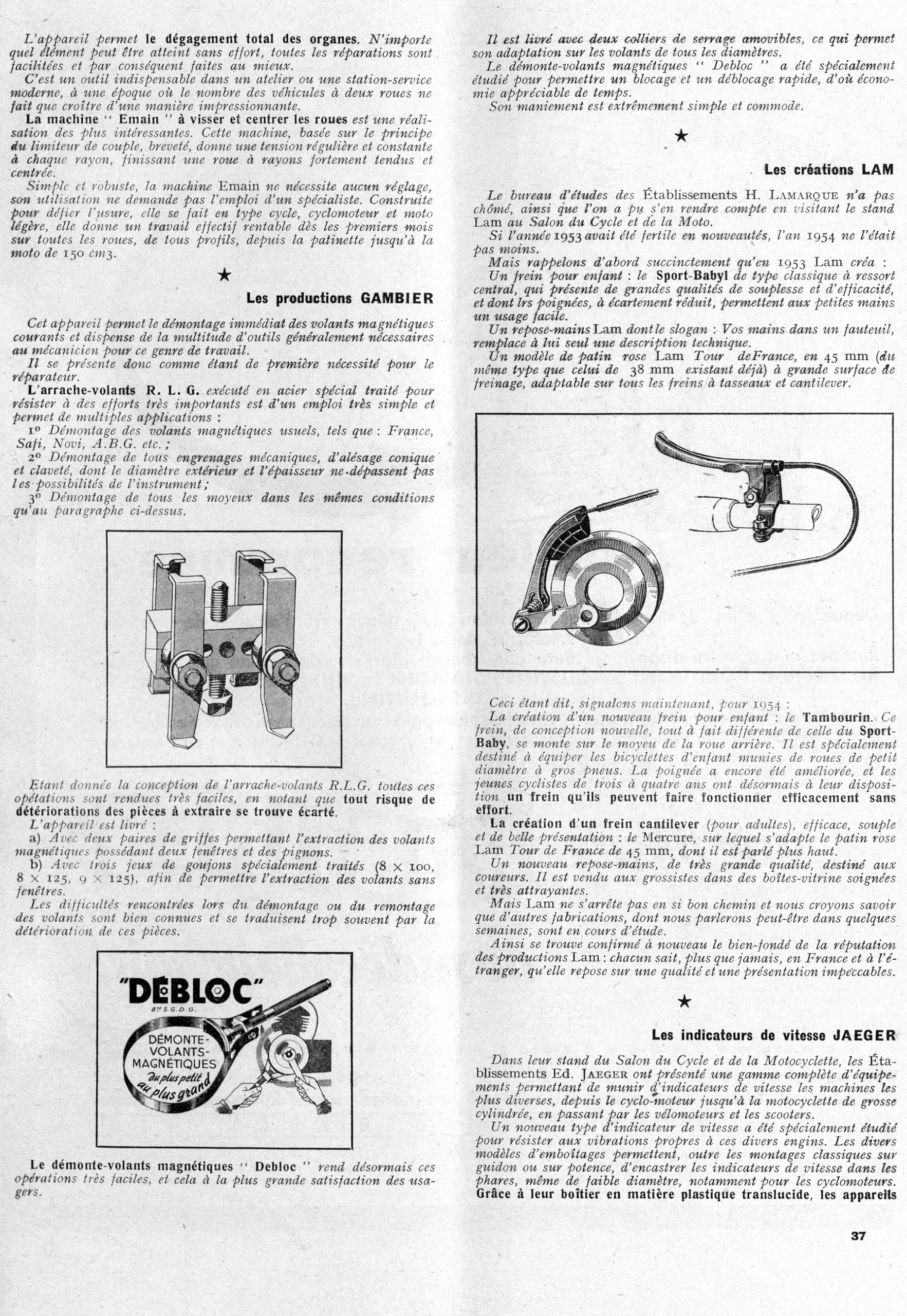
[Ebykr summary, continuing Emain from page 32. The lift frees every component, so any part can be reached without effort and repairs are made easier and better; the writer calls it indispensable in a modern workshop or service station when two-wheelers are multiplying so impressively. The « Emain » wheel-lacing and truing machine (« La machine ” Emain ” à visser et centrer les roues ») is based on a patented torque-limiter principle and gives each spoke an even, constant tension, finishing a trued wheel with tightly tensioned spokes. Simple and robust, it needs no adjustment and no specialist; built to defy wear, it is made in bicycle (« type cycle »), cyclomoteur and light-motorcycle types and pays for itself within months on wheels of every profile, from the scooter-toy (« la patinette ») to the 150 cm3 motorcycle.]
★
Les productions GAMBIER
[Ebykr summary. The R. L. G. flywheel puller (« L’arrache-volants R. L. G. »), in special steel treated to withstand very great force, removes the usual flywheel magnetos at once and spares the mechanic the many tools generally needed, so it is presented as a first necessity for the repairer. Its uses: 1o removing usual flywheel magnetos such as France, Safi, Novi, A.B.G. etc.; 2o removing all mechanical gears with a tapered and keyed bore within the tool’s diameter and thickness; 3o removing all hubs (« tous les moyeux ») under the same conditions. Its design makes all these operations easy and removes any risk of damaging the parts extracted. It comes a) with two pairs of claws for magnetos with two windows and for sprockets, and b) with three sets of specially treated studs (8 × 100, 8 × 125, 9 × 125) for magnetos without windows. The difficulties of removing and refitting flywheels are well known and too often damage the parts; the « Debloc » magneto flywheel remover now makes these operations very easy. It comes with two removable clamping collars, so it fits flywheels of every diameter; it was designed for rapid locking and unlocking, a real saving of time, and is very simple and handy to use.]
[Line drawing in a ruled frame: a two-legged puller with hooked claws, a central threaded spindle and nuts, drawn in hatched line. Below it a small ruled advertising cut, set as printed:]
“DÉBLOC”
Bté S.G.D.G.
DÉMONTE-
VOLANTS-
MAGNÉTIQUES
du plus petit
au plus grand
★
Les créations LAM
[Ebykr summary. The design office of the Établissements H. LAMARQUE has been busy, as the Lam stand at the Salon du Cycle et de la Moto showed; 1954 was no less fertile in novelties than 1953. In 1953 Lam created: a child’s brake, the Sport-Babyl (spelled so here, and « Sport-Baby » below), of classic central-spring type, supple and effective, whose levers have a reduced reach for small hands; a Lam hand rest whose slogan, « Vos mains dans un fauteuil », the writer says replaces any technical description; and a Lam Tour de France pink brake block (« patin rose ») in 45 mm, of the same type as the existing 38 mm one, with a large braking surface, adaptable to all « freins à tasseaux » and cantilever brakes. For 1954: a new child’s brake, the Tambourin, of new design quite different from the Sport-Baby, mounted on the rear-wheel hub and meant for children’s bicycles with small-diameter wheels and fat tires; its lever is further improved, so that young riders of three to four years now have a brake they can work effectively without effort. A cantilever brake for adults, the Mercure, effective, supple and well finished, which takes the 45 mm Lam Tour de France pink block mentioned above. A new hand rest of very high quality for racing cyclists (« destiné aux coureurs »), sold to wholesalers in neat, attractive display boxes. Lam does not stop there: other products, perhaps to be described in a few weeks, are under study, confirming the firm’s reputation in France and abroad for impeccable quality and presentation.]
[Line engraving in a ruled frame: a small drum brake with its arm and cable on a hub shell at left, and at right a brake lever clamped to a handlebar beside the grip, its cable looping down.]
★
Les indicateurs de vitesse JAEGER
[Ebykr summary. On their stand at the Salon du Cycle et de la Motocyclette the Établissements Ed. JAEGER showed a complete range of equipment to fit speedometers to the most varied machines, from the cyclomoteur to the large motorcycle, by way of vélomoteurs and scooters. A new speedometer was designed to resist the vibration of these machines; its various housings allow, besides the usual mounting on handlebar or stem, building the speedometer into headlamps, even small ones, notably for cyclomoteurs. Thanks to their translucent plastic case, the instruments (text continues on page 39).]
37
— Page 5 —
[Ebykr summary, continuing Jaeger from page 37. Instruments built into headlamps are lit with diffuse, non-dazzling light. For machines with no speedometer drive provided by the maker, the Établissements JAEGER designed the « Comot » drive, which sits on a wheel hub with its driving dog engaged between two spokes; it is made in four types for rollouts of 1,20 m, 1,40 m, 1,60 m and 1,90 m, is strictly water- and mud-tight, needs only periodic greasing, and its thin case and large cup covering the hub flanges make it almost universal. With various machine and engine makers Jaeger has also built drives that incorporate the take-off in the engine unit (the primary chain sprocket, for example), in a central-drum-brake hub or in another transmission part, so that fitting a speedometer and flexible drive later is simple and cheap. The writer expects these products, by their technique and elegance, to win the same favor with two-wheel users that motorists give Jaeger dashboard instruments.]
★
Les équipements LUCAS
[Ebykr summary. The Lucas standard equipment for alternating-current motorcycles comprises six main elements, listed:]
Un alternateur avec rotor magnétique (modèle R.M. 13) ;
Un redresseur branché en pont ;
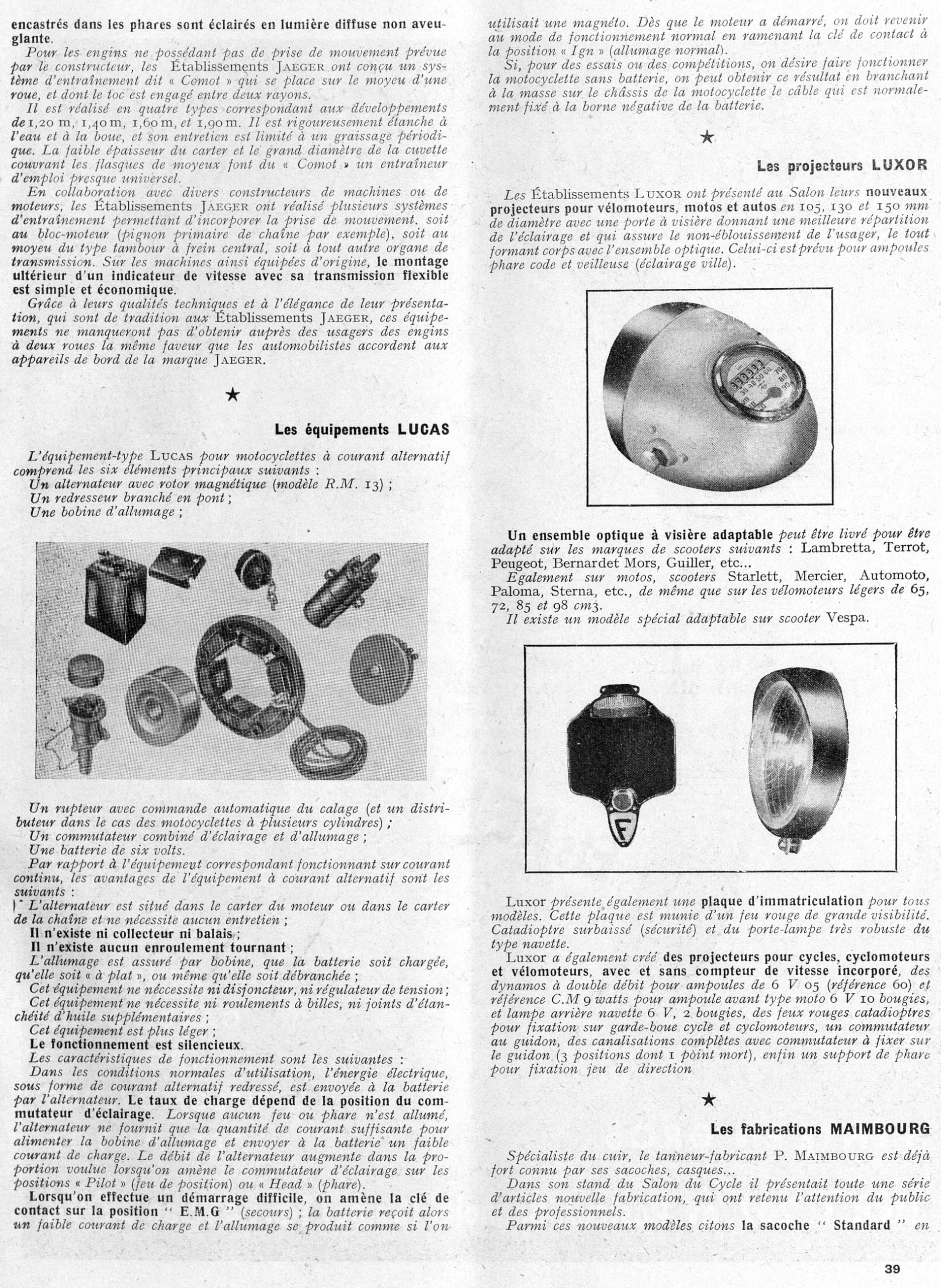
Une bobine d’allumage ;
Un rupteur avec commande automatique du calage (et un distributeur dans le cas des motocyclettes à plusieurs cylindres) ;
Un commutateur combiné d’éclairage et d’allumage ;
Une batterie de six volts.
[Ebykr summary, continued. Compared with the direct-current equivalent, the advantages are listed: the alternator sits in the engine or chain case and needs no upkeep; there is no commutator or brushes and no rotating winding; ignition is by coil whether the battery is charged, flat or even disconnected; no cut-out or voltage regulator is needed (printed « néccessite »), nor extra ball bearings or oil seals; the outfit is lighter and runs silently. In use, rectified alternating current goes to the battery and the charge rate depends on the lighting switch: with no lamp lit the alternator feeds only the coil and a small charge, rising as the switch moves to « Pilot » (parking light) or « Head » (headlamp). For a difficult start the key is turned to « E.M.G » (emergency), the battery receives a small charge and ignition works as with a magneto; once started, the key returns to « Ign » (normal ignition). For tests or competition the motorcycle can run without a battery by grounding to the frame the cable normally fixed to the battery’s negative terminal.]
[Halftone photograph, squared: the Lucas components laid out flat, a battery, rectifier, ignition coil, contact breaker, stator ring with its lead, rotor and switch.]
★
Les projecteurs LUXOR
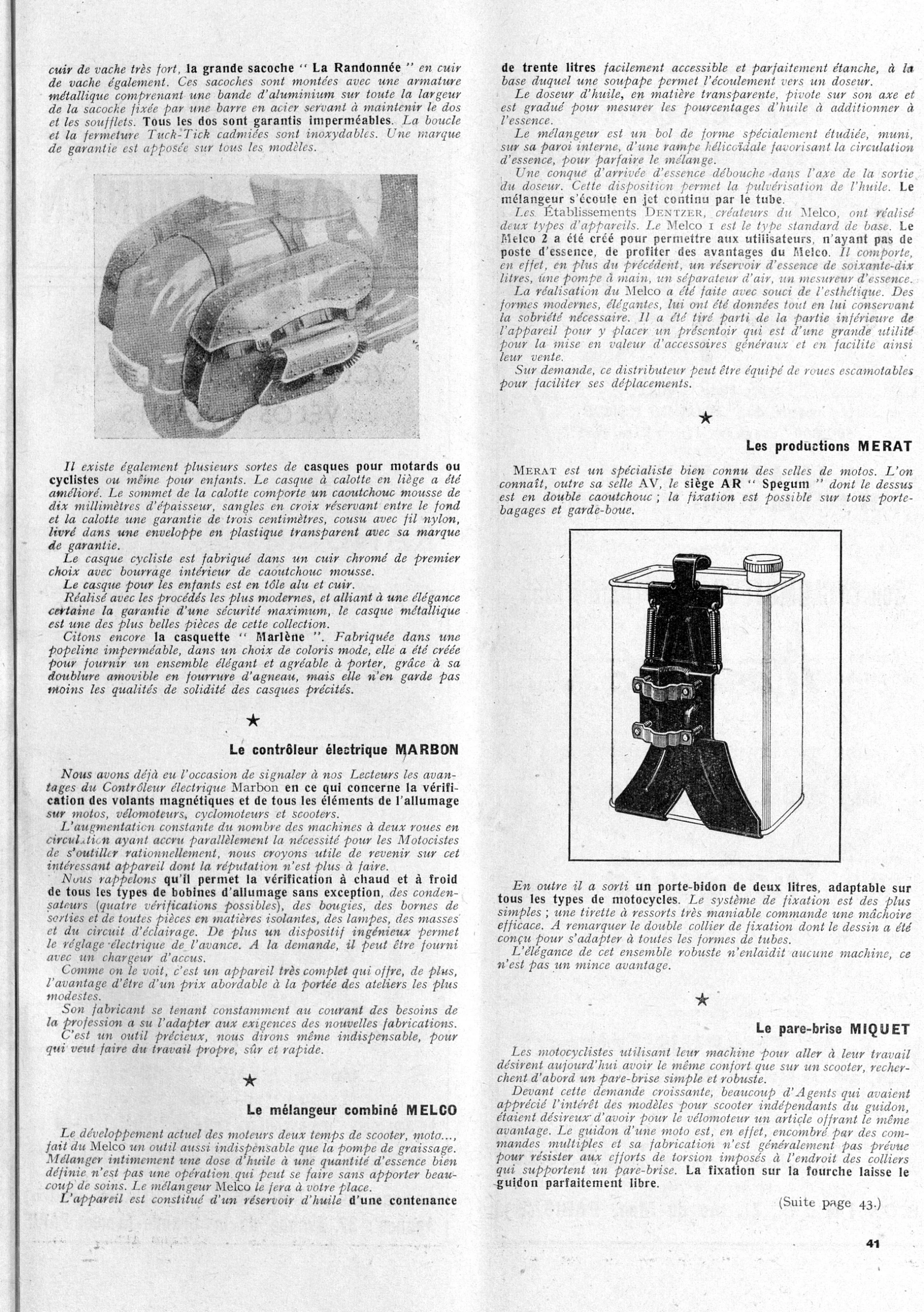
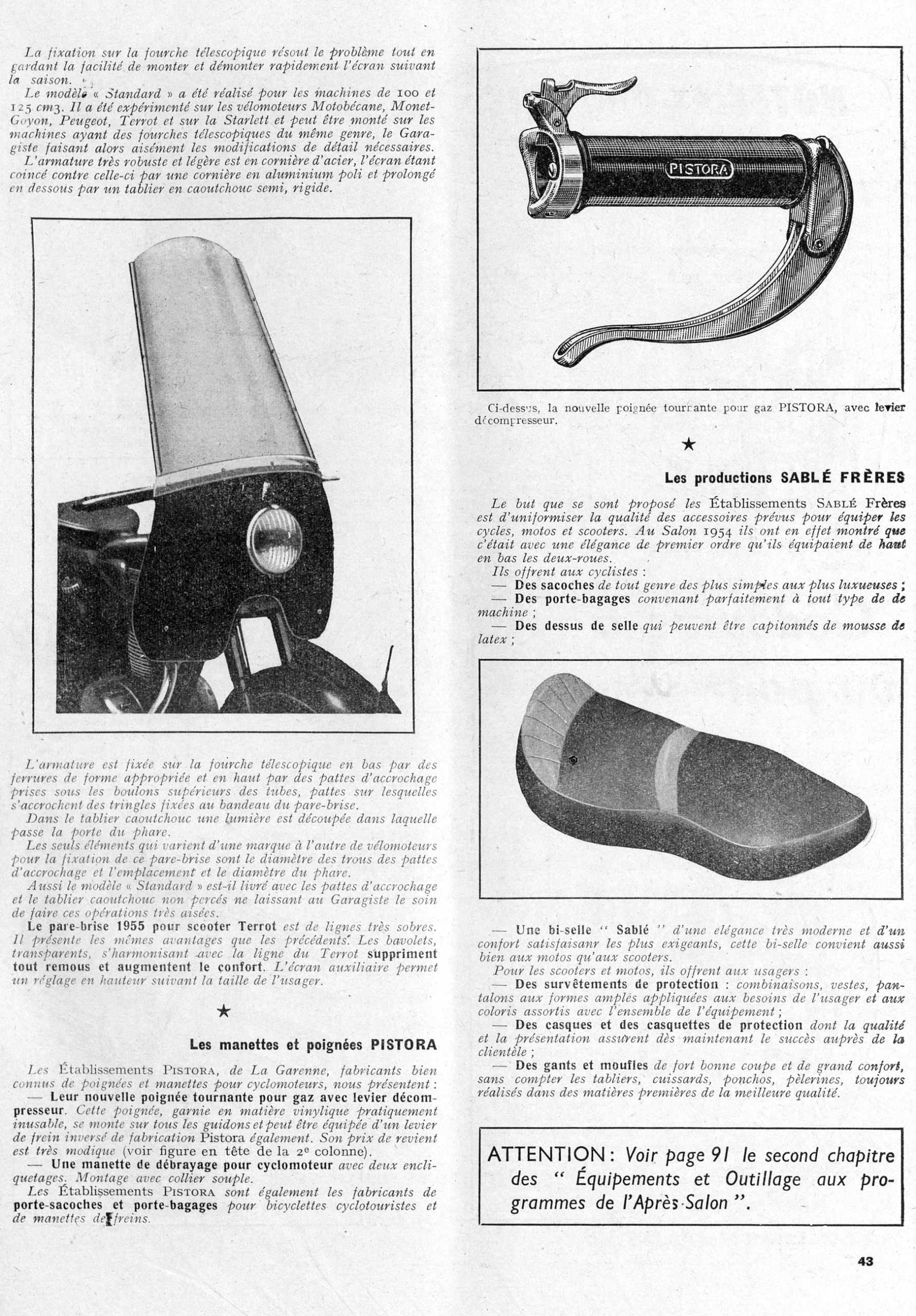
[Ebykr summary. The Établissements LUXOR showed new headlamps for vélomoteurs, motorcycles and cars in 105, 130 and 150 mm diameter, with a visored rim that spreads the light better and avoids dazzling, all forming one body with the optical unit, made for « phare code » and parking-light (« veilleuse », town lighting) bulbs. An optical unit with adaptable visor can be supplied for these scooter makes: Lambretta, Terrot, Peugeot, Bernardet Mors, Guiller, etc…, also for motorcycles and scooters Starlett, Mercier, Automoto, Paloma, Sterna, etc., and for light vélomoteurs of 65, 72, 85 and 98 cm3; a special model fits the Vespa scooter. Luxor also shows a number plate for all models, with a highly visible red lamp, a low-set reflector (« Catadioptre surbaissé ») for safety and a very robust shuttle-type (« navette ») bulb holder. Luxor has also created headlamps for cycles, cyclomoteurs and vélomoteurs with and without built-in speedometer; double-output dynamos for 6 V 05 bulbs (reference 60) and reference C.M 9 watts for a motorcycle-type front bulb of 6 V 10 bougies and a 6 V, 2 bougies navette rear lamp; red reflector lamps for fixing to cycle and cyclomoteur mudguards; a handlebar switch; complete wiring with a handlebar switch (3 positions including 1 neutral); and a headlamp bracket fixed at the headset (« pour fixation jeu de direction »).]
[Two halftone photographs in ruled frames: a round headlamp shell with a speedometer dial set in its top, the dial lettered “JAEGER”; then a dark number plate with a small lamp above and a reflector badge lettered “F” below, beside a deep headlamp seen from the side.]
★
Les fabrications MAIMBOURG
[Ebykr summary. The leather specialist and tanner-maker P. MAIMBOURG, already well known for his panniers and helmets, showed on his Salon du Cycle stand a whole series of newly made articles that drew public and trade attention; among the new models, the « Standard » pannier (text continues on page 41).]
39
— Page 6 —
[Ebykr summary, continuing Maimbourg from page 39. The « Standard » pannier is in very strong cowhide and the large pannier « La Randonnée » also in cowhide; both are built on a metal frame with an aluminum strip across the full width, fixed by a steel bar that holds the back and the gussets. All backs are guaranteed waterproof; the cadmium-plated buckle and Tuck-Tick fastener are rustproof, and every model bears a guarantee mark. There are also several kinds of helmets for motorcyclists or cyclists (« casques pour motards ou cyclistes ») or even for children. The cork-shell helmet has been improved: the top of the shell has ten millimeters of foam rubber, crossed straps leaving a three-centimeter clearance between the crown and the shell, nylon stitching, and it comes in a transparent plastic envelope with its guarantee mark. The cyclist’s helmet (« Le casque cycliste ») is made of first-choice chrome leather padded inside with foam rubber; the children’s helmet is of aluminum sheet and leather; the metal helmet, made by the most modern methods and combining elegance with maximum safety, is called one of the finest pieces of the collection. Also cited: the « Marlène » cap, in waterproof poplin in fashion colors, with a removable lambskin lining, as strong as the helmets above.]
[Halftone photograph, squared: a leather pannier with a rounded flap and strap fastener, seen close up and somewhat dim.]
★
Le contrôleur électrique MARBON
[Ebykr summary. The journal returns to the Marbon electrical tester, already reported, because the growing number of two-wheelers has increased the need for Motocistes to equip themselves rationally. It checks flywheel magnetos and all ignition parts on motorcycles, vélomoteurs, cyclomoteurs and scooters: hot and cold testing of every type of ignition coil without exception, condensers (four possible checks), spark plugs, output terminals and all insulating parts, lamps, grounds and the lighting circuit, and an ingenious device permits electrical setting of the ignition advance; on request it comes with a battery charger. It is very complete yet affordable for the most modest workshops; its maker keeps it adapted to new manufactures, and the writer calls it precious, even indispensable, for clean, sure, quick work.]
★
Le mélangeur combiné MELCO
[Ebykr summary. The spread of two-stroke engines on scooters and motorcycles makes the Melco as indispensable as the grease pump, since mixing a dose of oil intimately into a defined quantity of petrol needs great care. The unit has an oil tank of thirty liters, easily reached and fully sealed, with a valve at its base feeding a doser; the oil doser, of transparent material, pivots on its axis and is graduated for the percentage of oil to add; the mixer is a specially shaped bowl with a helical ramp on its inner wall to circulate the petrol, and a petrol inlet cone opens in line with the doser outlet, atomizing the oil; the mixture flows in a continuous jet through the tube. The Établissements DENTZER, creators of the Melco, make two types: the Melco 1, the standard base type, and the Melco 2, for users without a petrol pump, which adds a seventy-liter petrol tank, a hand pump, an air separator and a petrol meter. The design is modern, elegant and sober, with a display stand in its lower part for general accessories; on request it can have retractable wheels.]
★
Les productions MERAT
[Ebykr summary. MERAT is a well-known specialist in motorcycle saddles. Besides its front saddle (« selle AV ») there is the « Spegum » rear seat (« siège AR “Spegum” ») with a double-rubber top, which fixes to any luggage carrier and mudguard. It has also brought out a two-liter can carrier (« un porte-bidon de deux litres ») adaptable to all types of motorcycles: a handy spring pull-rod works an effective jaw, and a double clamping collar is designed to fit tubes of every shape; the writer adds that its elegance spoils no machine.]
[Line engraving in a ruled frame: a rectangular can with a screw cap held in a dark sprung bracket with a hooked top and two ribbed tube clamps.]
★
Le pare-brise MIQUET
[Ebykr summary. Motorcyclists who ride to work now want scooter comfort and look first for a simple, robust windscreen. Many agents, having seen the merit of scooter screens independent of the handlebar, wanted the same for the vélomoteur, since a motorcycle bar is crowded with controls and not made for the twisting loads of screen clamps; the fork mounting leaves the bar entirely free.]
(Suite page 43.)
41
— Page 7 —
[Ebykr summary, continuing Miquet from page 41. Mounting on the telescopic fork solves the problem while the screen can still be fitted and removed quickly with the season. The « Standard » model was made for 100 and 125 cm3 machines, tried on Motobécane, Monet-Goyon, Peugeot and Terrot vélomoteurs and on the Starlett, and fits machines with similar telescopic forks, the garage man making minor changes. The light, very strong frame is of steel angle, with the screen clamped against it by a polished aluminum angle and extended below by a semi-rigid rubber apron; the frame is fixed to the fork at the bottom by shaped fittings and at the top by hanging tabs under the upper tube bolts, on which rods fixed to the screen’s band hook. A slot cut in the rubber apron lets the headlamp rim through. Since only the hole diameter of the tabs and the headlamp’s position and diameter vary from make to make, the « Standard » is delivered with tabs and apron undrilled for the garage man to finish. The 1955 windscreen for the Terrot scooter is of very sober line, with the same advantages; its transparent side flaps, matching the Terrot’s line, suppress all eddies and add comfort, and an auxiliary screen adjusts in height to the rider’s size.]
[Halftone photograph in a ruled frame: a tall curved windscreen with a dark lower apron mounted on a vélomoteur front fork, a round headlamp set in a cutout of the apron.]
★
Les manettes et poignées PISTORA
[Ebykr summary. The Établissements PISTORA, of La Garenne, known makers of grips and levers for cyclomoteurs, present their new twist-grip throttle with decompressor lever, covered in practically everlasting vinyl, fitting all handlebars and able to take an inverted brake lever also made by Pistora, at a very modest cost price (« voir figure en tête de la 2e colonne »); and a clutch lever for cyclomoteurs with two ratchets, mounted with a flexible collar. Pistora also makes pannier carriers and luggage carriers for touring bicycles (« porte-sacoches et porte-bagages pour bicyclettes cyclotouristes ») and brake levers (« manettes de freins »).]
[Line engraving in a ruled frame: a twist grip lettered “PISTORA” on its knurled sleeve, with a small decompressor lever at its inner end and a long curved inverted brake lever hanging below.]
Ci-dessus, la nouvelle poignée tourrante pour gaz PISTORA, avec levier décompresseur.
★
Les productions SABLÉ FRÈRES
[Ebykr summary. The Établissements SABLÉ Frères aim to make uniform the quality of accessories for cycles, motorcycles and scooters, and at the 1954 Salon showed that they equip the two-wheeler from top to bottom with first-rate elegance. For cyclists (« Ils offrent aux cyclistes ») they offer panniers of every kind from the simplest to the most luxurious; luggage carriers suited to every type of machine (« à tout type de de machine », as printed); saddle covers that can be padded with latex foam; and a « Sablé » twin saddle (« bi-selle »), very modern and comfortable, suited to motorcycles and scooters alike. For scooter and motorcycle users: protective overgarments (overalls, jackets and full-cut trousers in colors matching the equipment); protective helmets and caps; and gloves and mittens of good cut and great comfort, besides aprons, « cuissards », ponchos and capes, all in first-quality materials.]
[Halftone photograph in a ruled frame: a long padded twin saddle with a pale stitched rear hump and a pale band across the dark seat.]
ATTENTION : Voir page 91 le second chapitre des ” Équipements et Outillage aux programmes de l’Après-Salon “.
43
[Seven pages of an illustrated trade survey (pages 29, 31, 32, 37, 39, 41 and 43), each in two columns of italic text with key phrases in bold sans-serif, firms introduced by right-aligned bold headings with the firm’s name in capitals and sections divided by centered black stars. Page 29 opens with the headline “ÉQUIPEMENTS OUTILLAGE AUX PROGRAMMES DE L’APRÈS-SALON” in large heavy capitals with “Chapitre Premier” beneath; no byline appears on any of the seven pages. The illustrations are maker’s cuts in ruled frames: line drawings of an Amero handlebar with grips lettered “LICENCE MAGURA”, a Bagneux shock-absorbing footrest, two views of the Arsor mudflap with arrows, an E.D. speedometer and hub drive, a Lam hub drum brake and lever, a Gambier R.L.G. puller, a Merat can carrier and a Pistora twist grip; halftone photographs of a Brétille workbench, an Emain scooter lift with a mechanic, the Lucas alternator set, a Jaeger speedometer built into a headlamp, a Luxor number plate and headlamp, a Maimbourg pannier, a Miquet windscreen and a Sablé twin saddle; and a small “DÉBLOC” advertising cut with two hands working a flywheel remover. On page 31 the C.L.B. brake lever, clamped to a handlebar beside its grip, is signed “G.GEDO” in hand-drawn capitals at the lower center of its frame, the signature of G. Gédovius; no other drawing carries a signature, and neither “Rebour” nor “DR” appears. Page 43 closes with a ruled box in sans-serif and italic referring readers to the second chapter on page 91. Folios 37, 39, 41 and 43 stand at the lower right of their pages.]
Ebykr presents this material for research and education. If you hold rights to it or notice an ownership issue, please contact us and we will respond promptly.
The Ebykr Digest
New articles, timelines, catalog finds and registry activity — assembled from the archive once a month. Your address is never shared.
Double opt-in. One email per month. Unsubscribe at any time with one click.