About Ebykr
Ebykr celebrates classic and vintage lightweight bicycles through provocative imagery and opinion. Ride along with us.
About Ebykr
Ebykr celebrates classic and vintage lightweight bicycles through provocative imagery and opinion. Ride along with us.

Source: Gallica (Bibliothèque nationale de France), L'Officiel du cycle, du motocycle et du camping, November 1954, N° 46, page 129; ark:/12148/bd6t54196207z. Source gallica.bnf.fr / BnF.
| Type | Review |
|---|---|
| Year | 1954 |
| Publisher | L'Officiel du cycle |
| Country | France |
| Language | French |
| Pages | 1 |
| Source | Gallica (Bibliothèque nationale de France), L'Officiel du cycle, du motocycle et du camping, November 1954, N° 46, page 129; ark:/12148/bd6t54196207z. Source gallica.bnf.fr / BnF. |
| Credit | Ebykr archive; Bibliothèque nationale de France |
| Identifier | Gallica (BnF) ark:/12148/bd6t54196207z/f128 |
| Transcription | Headings and specifications transcribed; article text summarized |
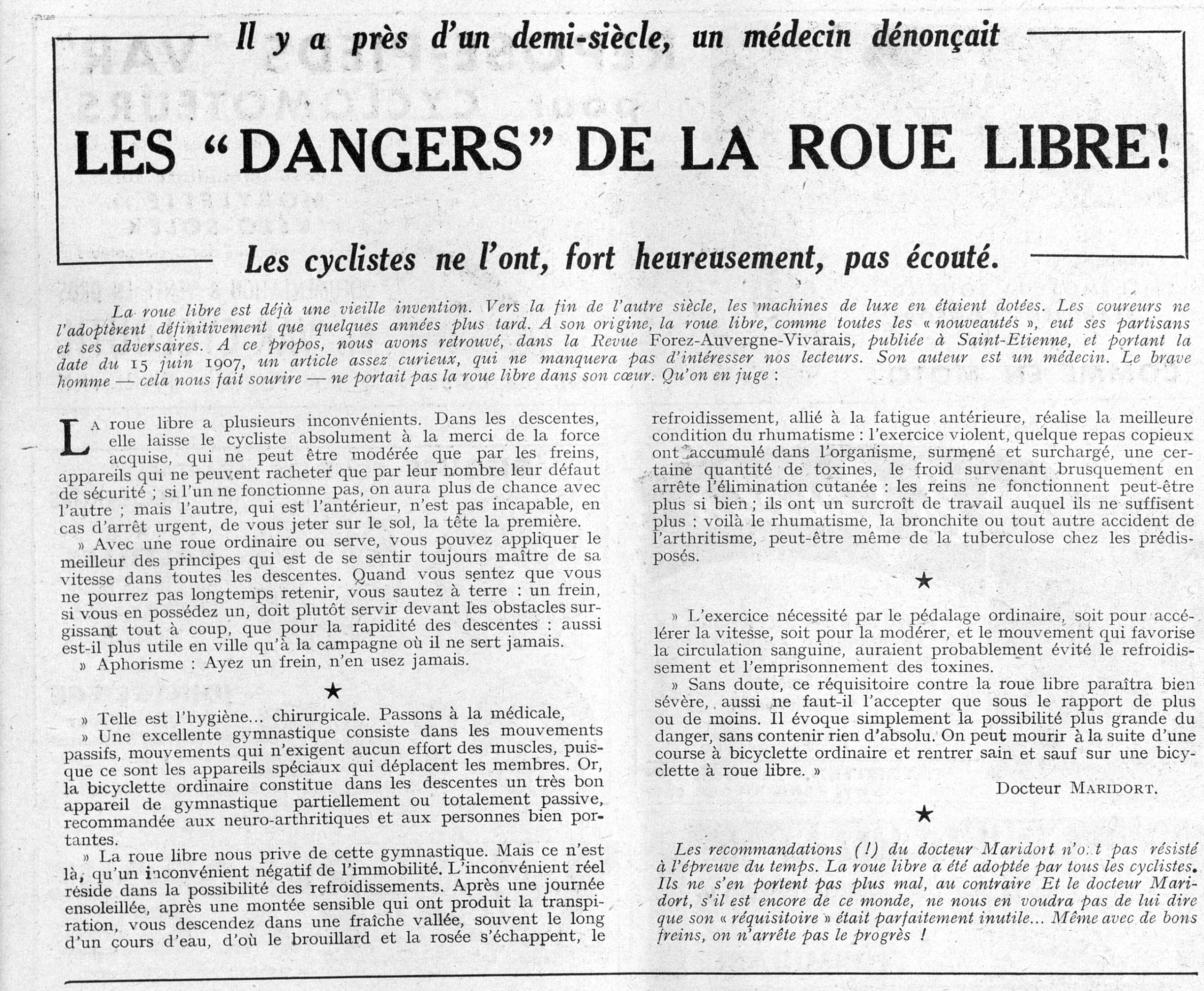
Il y a près d'un demi-siècle, un médecin dénonçait LES "DANGERS" DE LA ROUE LIBRE! Les cyclistes ne l'ont, fort heureusement, pas écouté. ★ ★ Docteur MARIDORT. ★
This is a magazine article, so its running text is summarized here rather than reproduced; the headline, byline, specifications and scores are transcribed as printed.
From L’Officiel du cycle, du motocycle et du camping, November 1954, the paper’s number reporting the 1954 Paris Salon du Cycle et du Motocycle, page 129: a physician’s warning, a half-century earlier, against the “dangers” of the freewheel, retold as a curiosity. The title, headings, captions and lists are transcribed as printed; the text is summarized in Ebykr’s words, and the page images carry it in full.
— Page 1 —
Il y a près d’un demi-siècle, un médecin dénonçait
LES “DANGERS” DE LA ROUE LIBRE!
Les cyclistes ne l’ont, fort heureusement, pas écouté.
[Ebykr summary; the article’s text is not reproduced. The italic introduction says the freewheel is already an old invention: toward the end of the previous century luxury machines had it, though racers adopted it for good only some years later, and like every « nouveauté » it had partisans and opponents. The journal has found in the Revue Forez-Auvergne-Vivarais, published at Saint-Etienne and dated 15 juin 1907, a curious article by a doctor who, it says with a smile, did not carry the freewheel in his heart, and it quotes him.]
[Ebykr summary of the quoted article. The doctor argues that the freewheel leaves the rider on descents at the mercy of momentum, checked only by brakes that make up for their unreliability only by their number, and the front brake can throw the rider head first in an emergency stop. With an ordinary fixed wheel (« roue ordinaire ou serve ») the rider stays master of his speed on every descent and, when he can no longer hold back, jumps down; a brake should serve for sudden obstacles rather than for speed on descents, and is thus more useful in town than in the country, where it never serves. He quotes the aphorism « Ayez un frein, n’en usez jamais ».]
★
[Ebykr summary, after the first star. Turning from surgical to medical hygiene, he holds that passive movement is excellent exercise and that the ordinary bicycle on descents is a good apparatus of partly or wholly passive gymnastics, recommended for neuro-arthritics and healthy people alike; the freewheel deprives the rider of it. The real harm is chill: after a sunny day or a climb that brings on sweating, the rider descends into a cool valley along a stream where fog and dew rise, and the chill, added to fatigue, makes the best condition for rheumatism, since toxins built up by violent exercise and a heavy meal are trapped when cold stops their elimination through the skin, and the overloaded kidneys cannot cope: hence rheumatism, bronchitis or another accident of arthritism, perhaps even tuberculosis in the predisposed.]
★
[Ebykr summary, after the second star. Ordinary pedaling, to speed up or slow down, and the movement that favors circulation would probably have avoided the chill and the trapping of toxins. He grants that his indictment (« réquisitoire ») may seem severe and should be taken only as a matter of more or less: it evokes a greater possibility of danger, nothing absolute, for one can die after a ride on an ordinary bicycle and come home safe and sound on a freewheel bicycle.]
Docteur MARIDORT.
★
[Ebykr summary, after the third star. The italic coda says Doctor Maridort’s recommendations, with an ironic « (!) », have not stood the test of time: the freewheel has been adopted by all cyclists, who are none the worse for it, and the doctor, if still alive, will not mind hearing that his « réquisitoire » was perfectly useless; even with good brakes, it ends, progress cannot be stopped.]
[A text-only panel set across the full width of the page between heavy rules. The headline “LES “DANGERS” DE LA ROUE LIBRE!” runs in very large roman capitals inside an open bracket frame, with a bold italic kicker above, “Il y a près d’un demi-siècle, un médecin dénonçait”, and a bold italic deck below, “Les cyclistes ne l’ont, fort heureusement, pas écouté.” The editorial introduction is set in italic across the full measure; the doctor’s quoted text follows in two columns of roman type with a large initial “L”, each paragraph opened by a closing guillemet as quotation marks of the period, divided by black stars and signed “Docteur MARIDORT.” in small capitals; the italic coda closes the right column. There is no illustration and no artist’s signature. Heavy show-through from the reverse of the leaf is visible behind the headline, ghost capitals that appear to read “VAR” and “CYCLOMOTEURS”.]
Ebykr presents this material for research and education. If you hold rights to it or notice an ownership issue, please contact us and we will respond promptly.
The Ebykr Digest
New articles, timelines, catalog finds and registry activity — assembled from the archive once a month. Your address is never shared.
Double opt-in. One email per month. Unsubscribe at any time with one click.