About Ebykr
Ebykr celebrates classic and vintage lightweight bicycles through provocative imagery and opinion. Ride along with us.
About Ebykr
Ebykr celebrates classic and vintage lightweight bicycles through provocative imagery and opinion. Ride along with us.

Source: Gallica (Bibliothèque nationale de France), L'Officiel du cycle, du motocycle et du camping, November 1954, N° 46, pages 47, 49, 51, 53, 54, 57, 59, 61, 63, 64 and 67; ark:/12148/bd6t54196207z. Source gallica.bnf.fr / BnF.
| Type | Review |
|---|---|
| Year | 1954 |
| Publisher | L'Officiel du cycle |
| Country | France |
| Language | French |
| Pages | 12 |
| Source | Gallica (Bibliothèque nationale de France), L'Officiel du cycle, du motocycle et du camping, November 1954, N° 46, pages 47, 49, 51, 53, 54, 57, 59, 61, 63, 64 and 67; ark:/12148/bd6t54196207z. Source gallica.bnf.fr / BnF. |
| Credit | Ebykr archive; Bibliothèque nationale de France |
| Identifier | Gallica (BnF) ark:/12148/bd6t54196207z/f46 |
| Transcription | Headings and specifications transcribed; article text summarized |
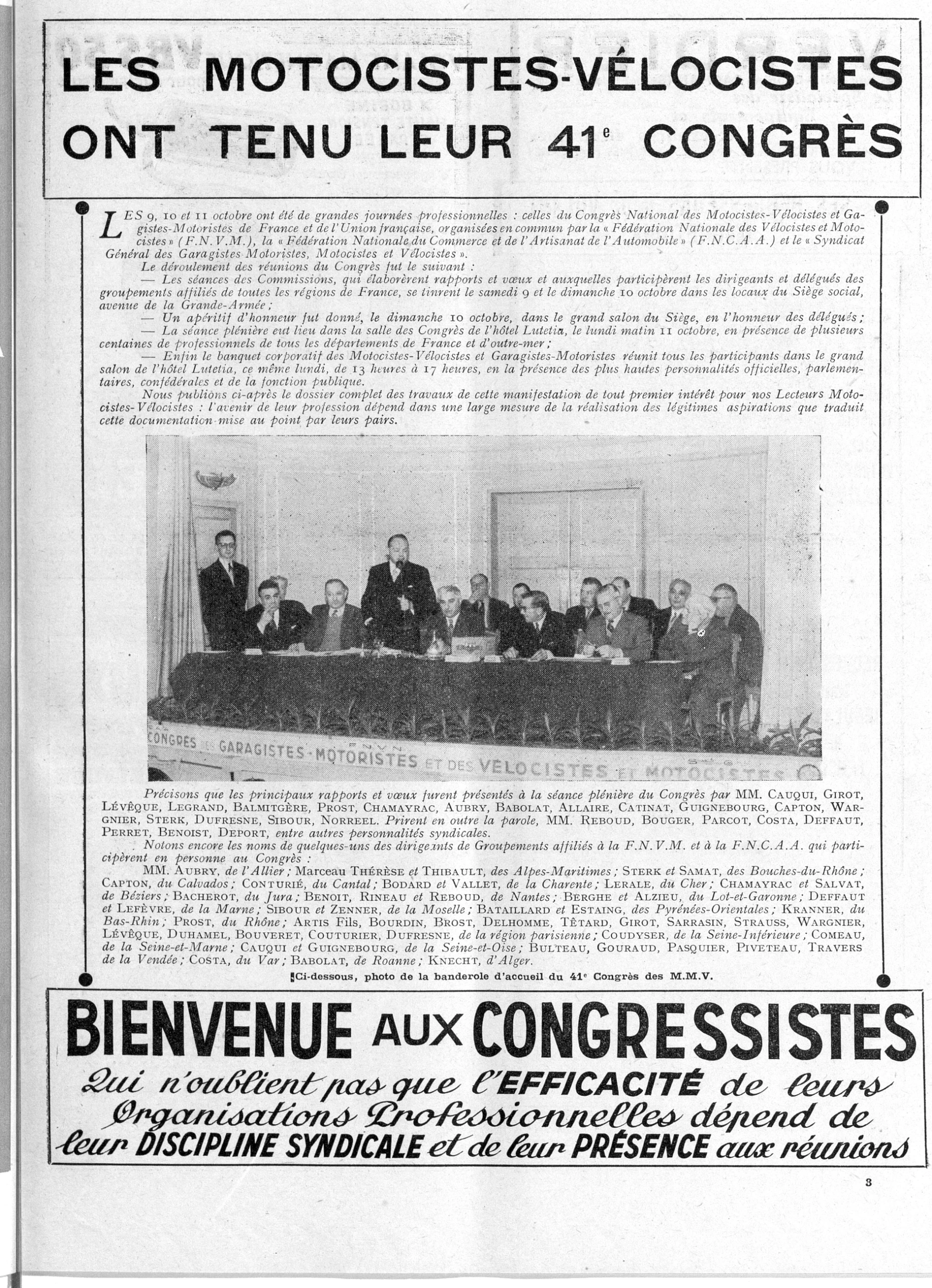
LES MOTOCISTES-VÉLOCISTES ONT TENU LEUR 41e CONGRÈS Notons encore les noms de quelques-uns des dirigeants de Groupements affiliés à la F.N.V.M. et à la F.N.C.A.A. qui participèrent en personne au Congrès : MM. AUBRY, de l'Allier ; Marceau THÉRÈSE et THIBAULT, des Alpes-Maritimes ; STERK et SAMAT, des Bouches-du-Rhône ; CAPTON, du Calvados ; CONTURIÉ, …
This is a magazine article, so its running text is summarized here rather than reproduced; the headline, byline, specifications and scores are transcribed as printed.
From L’Officiel du cycle, du motocycle et du camping, November 1954, the paper’s number reporting the 1954 Paris Salon du Cycle et du Motocycle, pages 47 to 67: the paper’s report of the 41st national congress of the cycle and motorcycle dealers: its reports and resolutions, President Cauqui’s address, the banquet, the tombola and the speeches. The title, headings, captions and lists are transcribed as printed; the text is summarized in Ebykr’s words, and the page images carry it in full.
— Page 1 —
LES MOTOCISTES-VÉLOCISTES
ONT TENU LEUR 41e CONGRÈS
[Ebykr summary; the article’s text is not reproduced. An italic standfirst records that 9, 10 and 11 October were great professional days: the Congrès National des Motocistes-Vélocistes et Garagistes-Motoristes de France et de l’Union française, organized jointly by the « Fédération Nationale des Vélocistes et Motocistes » (F.N.V.M.), the « Fédération Nationale du Commerce et de l’Artisanat de l’Automobile » (F.N.C.A.A.) and the « Syndicat Général des Garagistes Motoristes, Motocistes et Vélocistes ». It sets out the program: the commission sessions, which drew up the reports and resolutions with the leaders and delegates of affiliated groups from every region of France, on Saturday 9 and Sunday 10 October at the head office, avenue de la Grande-Armée; an aperitif in honor of the delegates in the head office’s grand salon on Sunday 10 October; the plenary session in the salle des Congrès of the hôtel Lutetia on Monday morning 11 October, before several hundred trade members from every department of France and from overseas; and the trade banquet of the Motocistes-Vélocistes and Garagistes-Motoristes in the hotel’s grand salon the same Monday, from 13 to 17 heures, in the presence of the highest official, parliamentary, confederal and civil-service figures. The paper announces that it publishes the complete file of the proceedings for its motociste-vélociste readers, whose professional future depends largely on the aims this documentation sets out.]
[Photograph, no caption of its own: the officers’ table at the congress, a dozen men in dark suits seated and standing behind a draped table, with a banner across its front reading « CONGRÈS … GARAGISTES-MOTORISTES ET DES VÉLOCISTES ET MOTOCISTES ».]
[Ebykr summary, continued. The principal reports and resolutions were presented at the plenary session by MM. Cauqui, Girot, Lévêque, Legrand, Balmitgère, Prost, Chamayrac, Aubry, Babolat, Allaire, Catinat, Guignebourg, Capton, Wargnier, Sterk, Dufresne, Sibour and Norreel; MM. Reboud, Bouger, Parcot, Costa, Deffaut, Perret, Benoist and Deport also spoke, among other union figures.]
Notons encore les noms de quelques-uns des dirigeants de Groupements affiliés à la F.N.V.M. et à la F.N.C.A.A. qui participèrent en personne au Congrès :
MM. AUBRY, de l’Allier ; Marceau THÉRÈSE et THIBAULT, des Alpes-Maritimes ; STERK et SAMAT, des Bouches-du-Rhône ; CAPTON, du Calvados ; CONTURIÉ, du Cantal ; BODARD et VALLET, de la Charente ; LERALE, du Cher ; CHAMAYRAC et SALVAT, de Béziers ; BACHEROT, du Jura ; BENOIT, RINEAU et REBOUD, de Nantes ; BERGHE et ALZIEU, du Lot-et-Garonne ; DEFFAUT et LEFÈVRE, de la Marne ; SIBOUR et ZENNER, de la Moselle ; BATAILLARD et ESTAING, des Pyrénées-Orientales ; KRANNER, du Bas-Rhin ; PROST, du Rhône ; ARTIS Fils, BOURDIN, BROST, DELHOMME, TÊTARD, GIROT, SARRASIN, STRAUSS, WARGNIER, LÉVÊQUE, DUHAMEL, BOUVERET, COUTURIER, DUFRESNE, de la région parisienne ; COUDYSER, de la Seine-Inférieure ; COMEAU, de la Seine-et-Marne ; CAUQUI et GUIGNEBOURG, de la Seine-et-Oise ; BULTEAU, GOURAUD, PASQUIER, PIVETEAU, TRAVERS de la Vendée ; COSTA, du Var ; BABOLAT, de Roanne ; KNECHT, d’Alger.
Ci-dessous, photo de la banderole d’accueil du 41e Congrès des M.M.V.
BIENVENUE AUX CONGRESSISTES
Qui n’oublient pas que l’EFFICACITÉ de leurs
Organisations Professionnelles dépend de
leur DISCIPLINE SYNDICALE et de leur PRÉSENCE aux réunions
3
— Page 2 —
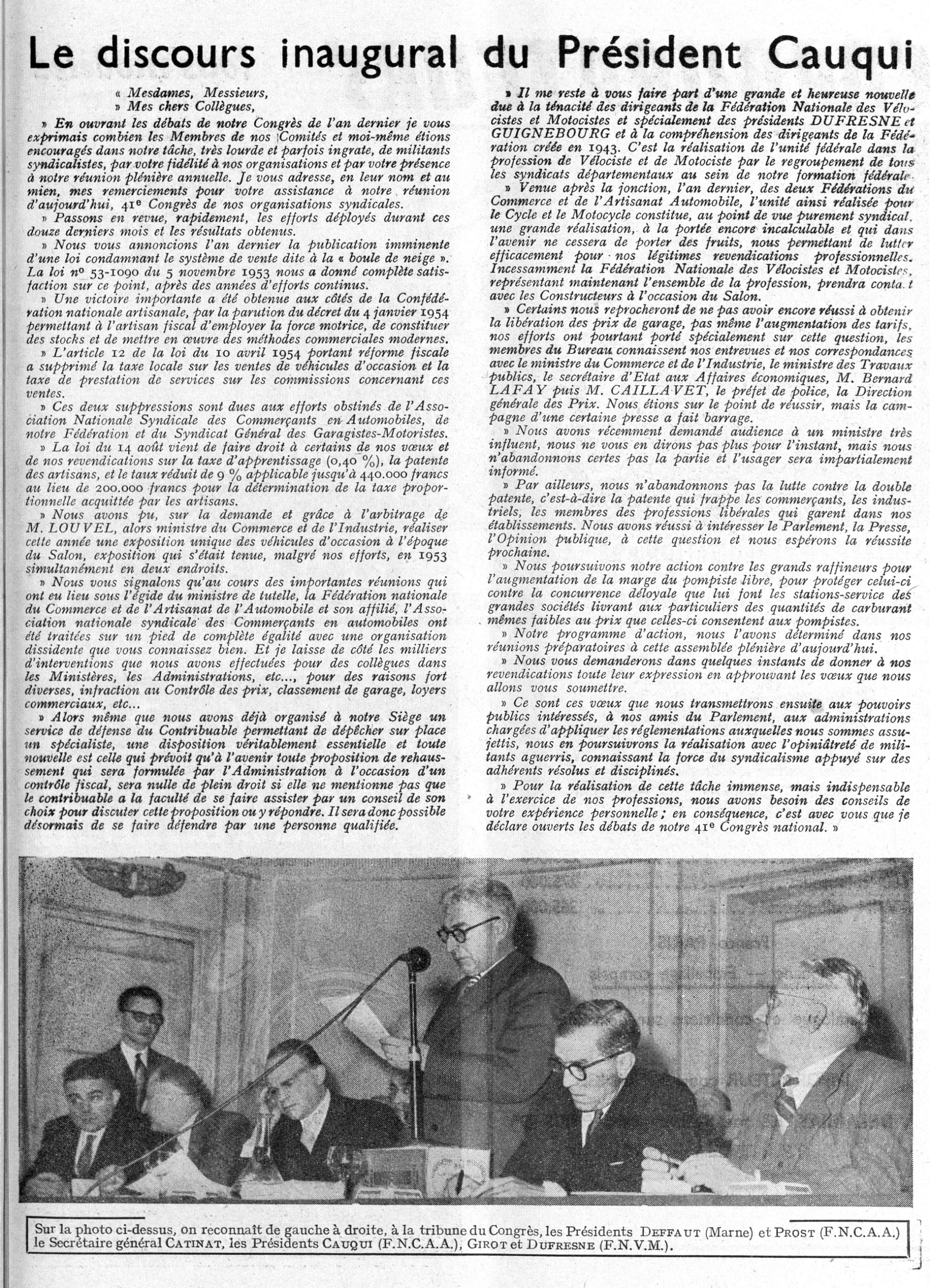
Le discours inaugural du Président Cauqui
[Ebykr summary; the address is not reproduced. Opening with « Mesdames, Messieurs, Mes chers Collègues », Président Cauqui thanks the members for their loyalty and their attendance at the 41st congress of the trade unions, as he had at the previous year’s opening, and reviews the past twelve months. The law n° 53-1090 of 5 November 1953 has at last outlawed « boule de neige » (snowball) selling, as announced a year earlier. Alongside the Confédération nationale artisanale, the decree of 4 January 1954 lets the fiscal artisan use motive power, hold stocks and adopt modern selling methods. Article 12 of the fiscal reform law of 10 April 1954 abolished the local tax on used-vehicle sales and the services tax on commissions from those sales, thanks to the Association Nationale Syndicale des Commerçants en Automobiles, the Federation and the Syndicat Général des Garagistes-Motoristes. The law of 14 August meets some of their claims on the apprenticeship tax (0,40 %), the artisans’ patente and the reduced 9 % rate, now applicable up to 440.000 francs instead of 200.000 francs, for the proportional tax paid by artisans. Through the arbitration of M. Louvel, then minister of Commerce and Industry, a single used-vehicle show was held this year at Salon time, where in 1953 it had been held in two places at once. In meetings under their supervising minister the F.N.C.A.A. and its affiliate the Association nationale syndicale des Commerçants en automobiles were treated as full equals of a dissident organization, and he passes over the thousands of interventions for members with ministries and administrations (price-control offenses, garage classification, commercial rents). Beside the head office’s existing taxpayer-defense service, which can send a specialist on the spot, a new provision makes any reassessment proposed after a tax inspection void unless it states that the taxpayer may be assisted by an adviser of his choice.]
[Ebykr summary, second column. He announces « une grande et heureuse nouvelle »: through the persistence of the leaders of the Fédération Nationale des Vélocistes et Motocistes, especially Presidents Dufresne and Guignebourg, and the understanding of the leaders of the federation founded in 1943, federal unity has been achieved in the vélociste and motociste trade by bringing every departmental union into the one federation. Following last year’s merger of the two federations of the automobile trade and craft, this unity for the cycle and motorcycle is called a great achievement of incalculable reach for their professional claims, and the F.N.V.M., now representing the whole trade, will shortly meet the manufacturers at the Salon. On garage charges he admits that neither freedom of prices nor an increase in rates has been won, despite meetings and letters to the ministers of Commerce and Industry and of Public Works, the secretaries of state for Economic Affairs M. Bernard Lafay and then M. Caillavet, the préfet de police and the Direction générale des Prix; success was near when the campaign of a certain press blocked it, and an audience has been requested of a very influential minister. The fight goes on against the « double patente » charged to traders, industrialists and professionals who garage their cars in members’ premises, with Parliament, press and public opinion now interested. Action continues against the big refiners to raise the independent pump attendant’s margin and to protect him from oil-company service stations selling even small quantities of fuel to private customers at the price they charge the attendants. The program of action was settled in the preparatory meetings; the resolutions to be voted will go to the public authorities, friends in Parliament and the administrations, and be pursued by disciplined members. He declares open the debates of the 41st national congress.]
[Photograph across the foot of the page: the speaker standing at a microphone with a sheet of paper, three men seated at the table beside him and one standing behind them.]
Sur la photo ci-dessus, on reconnaît de gauche à droite, à la tribune du Congrès, les Présidents DEFFAUT (Marne) et PROST (F.N.C.A.A.)
le Secrétaire général CATINAT, les Présidents CAUQUI (F.N.C.A.A.), GIROT et DUFRESNE (F.N.V.M.).
— Page 3 —
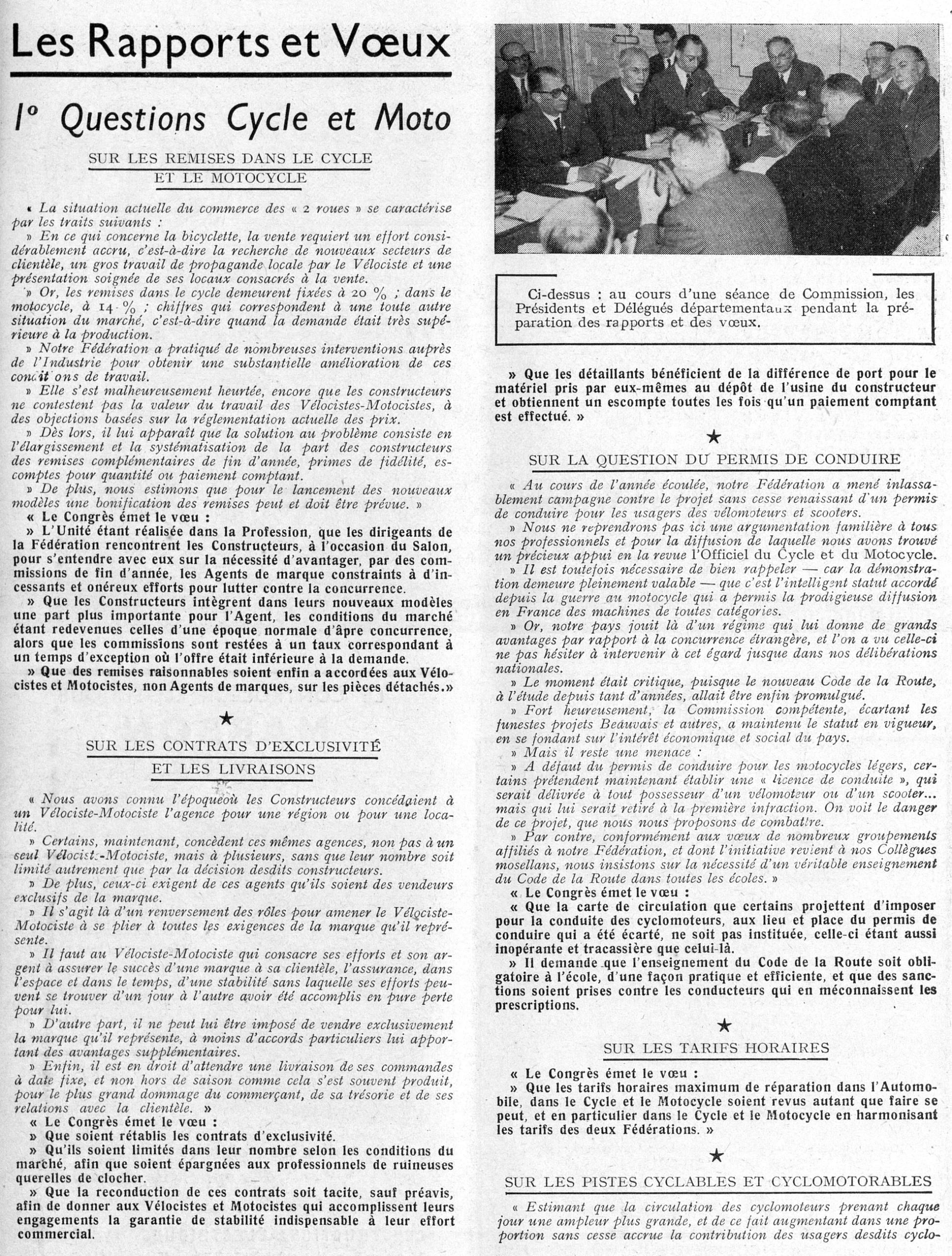
Les Rapports et Vœux
1° Questions Cycle et Moto
SUR LES REMISES DANS LE CYCLE
ET LE MOTOCYCLE
[Ebykr summary; the report is not reproduced. The « 2 roues » trade is described as follows: selling the bicycle now demands a far greater effort, meaning new groups of customers, heavy local publicity by the vélociste and a carefully presented showroom. Yet the discounts remain fixed at 20 % on the cycle and 14 % on the motorcycle, figures set when demand far exceeded production. The Federation has made many approaches to the industry for a substantial improvement; the manufacturers do not dispute the value of the vélocistes-motocistes’ work but object on the grounds of the present price regulations. The Federation therefore sees the answer in wider and systematic year-end supplementary discounts, loyalty bonuses and discounts for quantity or cash payment from the manufacturers, and holds that the launch of new models can and should carry an extra discount.]
« Le Congrès émet le vœu :
» L’Unité étant réalisée dans la Profession, que les dirigeants de la Fédération rencontrent les Constructeurs, à l’occasion du Salon, pour s’entendre avec eux sur la nécessité d’avantager, par des commissions de fin d’année, les Agents de marque constraints à d’incessants et onéreux efforts pour lutter contre la concurrence.
» Que les Constructeurs intègrent dans leurs nouveaux modèles une part plus importante pour l’Agent, les conditions du marché étant redevenues celles d’une époque normale d’âpre concurrence, alors que les commissions sont restées à un taux correspondant à un temps d’exception où l’offre était inférieure à la demande.
» Que des remises raisonnables soient enfin a accordées aux Vélocistes et Motocistes, non Agents de marques, sur les pièces détachés. »
★
SUR LES CONTRATS D’EXCLUSIVITÉ
ET LES LIVRAISONS
[Ebykr summary; the report is not reproduced. Manufacturers once granted a vélociste-motociste the agency for a region or a town; some now grant the same agency to several dealers, their number limited only by the manufacturer, while requiring each agent to sell the make exclusively. The report calls this a reversal of roles. A dealer who spends effort and money establishing a make with his customers needs stability in place and time, or his work may be lost overnight; he cannot be required to sell only one make without special agreements bringing extra advantages; and he is entitled to delivery of his orders on a fixed date, not out of season as has often happened, to the harm of his business, his cash and his customers.]
« Le Congrès émet le vœu :
» Que soient rétablis les contrats d’exclusivité.
» Qu’ils soient limités dans leur nombre selon les conditions du marché, afin que soient épargnées aux professionnels de ruineuses querelles de clocher.
» Que la reconduction de ces contrats soit tacite, sauf préavis, afin de donner aux Vélocistes et Motocistes qui accomplissent leurs engagements la garantie de stabilité indispensable à leur effort commercial.
» Que les détaillants bénéficient de la différence de port pour le matériel pris par eux-mêmes au dépôt de l’usine du constructeur et obtiennent un escompte toutes les fois qu’un paiement comptant est effectué. »
[Photograph at the head of the right-hand column: a commission session, a dozen men in suits seated and leaning round a table strewn with papers.]
Ci-dessus : au cours d’une séance de Commission, les Présidents et Délégués départementaux pendant la préparation des rapports et des vœux.
★
SUR LA QUESTION DU PERMIS DE CONDUIRE
[Ebykr summary; the report is not reproduced. Over the year the Federation campaigned tirelessly against the recurring plan for a driving license for vélomoteur and scooter riders, finding valuable support for its arguments in l’Officiel du Cycle et du Motocycle. It recalls that the sensible status granted to the motorcycle since the war made possible the enormous spread of machines of every class in France, a regime that gives the country an advantage over foreign competition, which has not hesitated to intervene even in national deliberations. The moment was critical as the new Code de la Route was at last to be promulgated, but the competent commission set aside « les funestes projets Beauvais et autres » and kept the existing status on economic and social grounds. A threat remains: some now propose a « licence de conduite » issued to every owner of a vélomoteur or scooter and withdrawn at the first offense, which the Federation will fight. In line with the wishes of many affiliated groups, on the initiative of the Moselle members, it insists on real teaching of the Code de la Route in all schools.]
« Le Congrès émet le vœu :
« Que la carte de circulation que certains projettent d’imposer pour la conduite des cyclomoteurs, aux lieu et place du permis de conduire qui a été écarté, ne soit pas instituée, celle-ci étant aussi inopérante et tracassière que celui-là.
» Il demande que l’enseignement du Code de la Route soit obligatoire à l’école, d’une façon pratique et efficiente, et que des sanctions soient prises contre les conducteurs qui en méconnaissent les prescriptions.
★
SUR LES TARIFS HORAIRES
« Le Congrès émet le vœu :
» Que les tarifs horaires maximum de réparation dans l’Automobile, dans le Cycle et le Motocycle soient revus autant que faire se peut, et en particulier dans le Cycle et le Motocycle en harmonisant les tarifs des deux Fédérations. »
★
SUR LES PISTES CYCLABLES ET CYCLOMOTORABLES
[Ebykr summary; the report begins here and runs on to the next sheet. It opens by noting that cyclomotor traffic grows daily and that the contribution of the riders of these machines rises in an ever larger proportion …]
— Page 4 —
[Ebykr summary; the cycle-path report continues from the previous sheet. Cyclomotor riders pay a growing share into the Fonds d’investissement routier, while their very numbers make the cyclomoteur the motorist’s « bête noire »; and in the interest of every road user a faster building of cycle paths would ease motor traffic considerably.]
» Le Congrès émet le vœu :
» Que le Fonds d’investissement routier, alimenté d’une façon toujours croissante par les usagers de cyclomoteurs, consacre des sommes suffisantes pour l’aménagement de plus en plus accéléré de pistes cyclables indispensables à la sécurité des routes, en particulier aux abords des grandes villes. »
★
SUR LA 4e ANNEE D’APPRENTISSAGE
[Ebykr summary; the report is not reproduced. Over the last ten years the trade has been transformed by motorized machines, which have risen from half a million before the war to two and a half million. Yet the C.A.P. of the ouvrier vélociste-motociste crowns only three years of apprenticeship, usually served from 14 to 17. The report doubts that a young man of average ability can master the whole technique of present machines in three years: he is only roughed out, and a final year, if the youth takes to mechanics, would make him a real workman earning an adult’s wage. The present regime harms the employer, who must pay as a young workman someone who is still an apprentice and cannot be trusted with precision work; it harms the apprentices, who find it ever harder to get work at the end of their three-year contract because motocistes-vélocistes prefer fully skilled journeymen at a higher wage for the good name of the house; and it harms the customer, since it does not train good workmen to succeed their elders and do safe work. Engine tuning, carburation and the correct fitting of electrical equipment would alone justify the fourth year, which the « F.N.V.N. » (so printed) asks of the public authorities.]
« Le Congrès émet le vœu :
» Qu’une quatrième année d’apprentissage soit instituée dans la profession d’ouvrier mécanicien réparateur de motocycles (Motociste) en raison de la diversité et de la complexité toujours croissante des modèles nouveaux. »
★
SUR LE PROBLÈME DE LA GARANTIE
« Le Congrès émet le vœu :
» Que les constructeurs accordent une prime spéciale de 2.000 fr. destinée à couvrir les frais de la main-d’œuvre nécessaire pour effectuer cette garantie. »
★
2° Questions générales
SUR LE STATUT PROFESSIONNEL
« Le Congrès émet le vœu :
» Que le projet de statut mis en harmonie avec le statut artisanal, actuellement à l’étude, fasse, grâce à la diligence de nos Organisations syndicales, l’objet d’une nouvelle proposition de loi qui soit prochainement déposée, par un de nos amis parlementaires, sur le bureau de l’Assemblée nationale avec des chances déterminantes d’être enfin mis en discussion par le Parlement. »
★
SUR LES IMPOTS
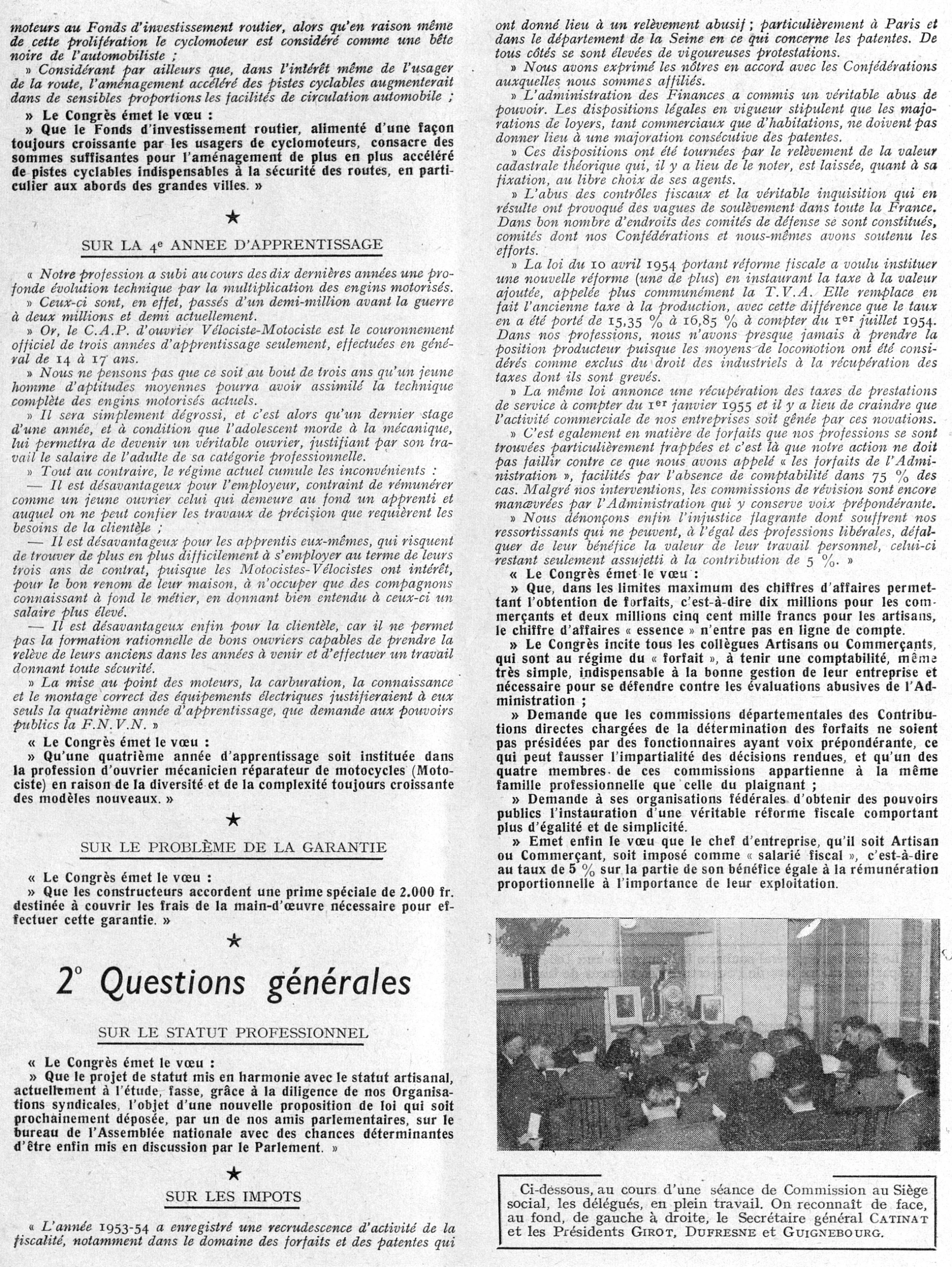
[Ebykr summary; the report is not reproduced. The year 1953-54 saw a surge of tax activity, above all in forfaits and patentes, with abusive increases in the patentes in Paris and the Seine department and vigorous protests everywhere, which the Federation joined with its confederations. The Finance administration is accused of an abuse of power: the law says rent increases, commercial or residential, must not raise the patentes, but this was evaded by raising the theoretical cadastral value, which its agents fix as they please. Abusive tax inspections, « une véritable inquisition », have provoked unrest across France and defense committees, supported by the confederations and the Federation. The fiscal reform law of 10 April 1954 introduced the taxe à la valeur ajoutée, the T.V.A., which in effect replaces the old production tax, with the rate raised from 15,35 % to 16,85 % from 1 July 1954; the trades seldom act as producers, since means of transport are excluded from the industrialists’ right to recover the taxes charged on them. The same law announces recovery of the services taxes from 1 January 1955, which may hamper business. The trades have been hit hardest by « les forfaits de l’Administration », made easier by the absence of bookkeeping in 75 % of cases, and the revision commissions are still steered by the administration, which keeps the casting vote. Finally the report denounces the injustice that members, unlike the liberal professions, cannot deduct the value of their own work from their profit, that work otherwise being liable only to the 5 % contribution.]
« Le Congrès émet le vœu :
» Que, dans les limites maximum des chiffres d’affaires permettant l’obtention de forfaits, c’est-à-dire dix millions pour les commerçants et deux millions cinq cent mille francs pour les artisans, le chiffre d’affaires « essence » n’entre pas en ligne de compte.
» Le Congrès incite tous les collègues Artisans ou Commerçants, qui sont au régime du « forfait », à tenir une comptabilité, même très simple, indispensable à la bonne gestion de leur entreprise et nécessaire pour se défendre contre les évaluations abusives de l’Administration ;
» Demande que les commissions départementales des Contributions directes chargées de la détermination des forfaits ne soient pas présidées par des fonctionnaires ayant voix prépondérante, ce qui peut fausser l’impartialité des décisions rendues, et qu’un des quatre membres de ces commissions appartienne à la même famille professionnelle que celle du plaignant ;
» Demande à ses organisations fédérales d’obtenir des pouvoirs publics l’instauration d’une véritable réforme fiscale comportant plus d’égalité et de simplicité.
» Emet enfin le vœu que le chef d’entreprise, qu’il soit Artisan ou Commerçant, soit imposé comme « salarié fiscal », c’est-à-dire au taux de 5 % sur la partie de son bénéfice égale à la rémunération proportionnelle à l’importance de leur exploitation.
[Photograph at the foot of the right-hand column: a commission session seen from the back of the room, rows of delegates bent over papers at long tables, a fireplace and framed pictures behind the officers at the far end.]
Ci-dessous, au cours d’une séance de Commission au Siège social, les délégués, en plein travail. On reconnaît de face, au fond, de gauche à droite, le Secrétaire général CATINAT et les Présidents GIROT, DUFRESNE et GUIGNEBOURG.
— Page 5 —
SUR LE BLOCAGE DES PRIX
[Ebykr summary; the preamble is not reproduced. It holds the price freeze at the level of 8 February 1954 unacceptable for the trades when neither the tax authorities nor the legislature set the example: patentes and forfaits on one side and free rents on the other keep rising, fixed practically at the discretion of the administration and the experts, and these continual « revalorisations » cut deeply into the firms’ real profits.]
» Le Congrès émet le vœu :
» Que soit poursuivie sans relâche l’action entreprise sur les plans fédéral et confédéral, pour que les patentes, forfaits et loyers commerciaux ne puissent subir d’augmentation tant que les prix resteront bloqués à ce qu’ils étaient le 8 février 1954 ou à défaut qu’une véritable échelle mobile des frais généraux et des tarifs soit instituée.
» Demande aux pouvoirs publics de faire cesser par le Contrôle des Prix la pratique de verbaliser contre les professionnels des départements économiquement faibles, qui ont été contraints, pour subsister, de pratiquer pendant une période des prix au-dessous des tarifs conseillés, et qui se sont ensuite alignés sur les prix généralement en vigueur. »
★
SUR LA CONCURRENCE ILLICITE
ET LES COOPERATIVES
[Ebykr summary; the preamble is not reproduced. Its considérants: business morals have slackened since the last war and the honest trader needs protecting as much as the consumer; the line between lawful and unfair trading has blurred with speculators entering trade and even craft; cooperatives, especially those of public administrations, enjoy « scandaleux privilèges » and are a particularly unfair form of competition; some manufacturers sell vehicles or parts under a sub-brand after pledging, under their main brand, to sell only to the trade; and purchase books issued by many bodies and even trade journals, giving their holders discounts of 5 to 20 %, spread the legend that suppliers’ discounts are more than sufficient and lead to a disastrous « gâchage » of prices.]
« Le Congrès émet le vœu :
» Que soit remise au jour la proposition de loi que MM. KLOCK, BOISDE et six de leurs collègues avaient déposée sur le bureau de l’Assemblée nationale, et qui tendait à la répression de la concurrence déloyale.
» Que soit exhumée des cartons de la Commission du Travail, où elle dort depuis le mois de mars, la proposition de loi de M. MARCELLIN concernant le statut des coopératives des administrations publiques et des entreprises nationalisées ou privées et que cette utile proposition soit au plus tôt adoptée par le Parlement.
» Que les Fabricants livrant à des coopératives directement ou par sociétés interposées soient alertés sur le préjudice grave qu’ils font à leurs propres agents ;
» Demande à l’Union interfédérale d’Action commune pour l’Egalité, à laquelle nos organisations sont affiliées, que son action auprès des pouvoirs publics soit plus impérative pour rétablir l’égalité des charges entre les coopératives de vente et les entreprises commerciales ;
» Qu’aucun de nos professionnels ne consente une remise aux porteurs de carnets d’achat. »
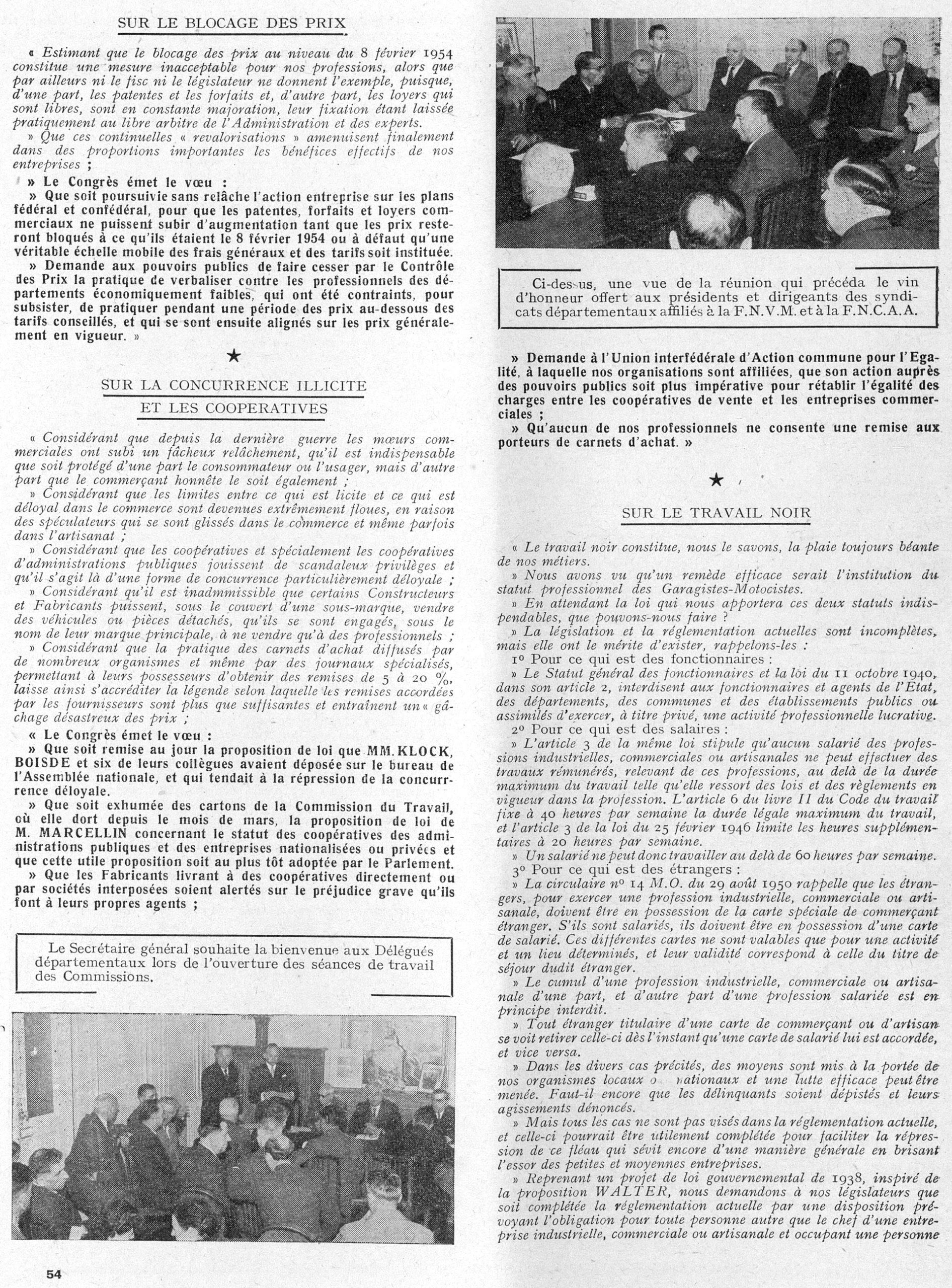
[Photograph at the foot of the left-hand column: delegates seen from behind, seated in rows, facing two standing officers before a fireplace.]
Le Secrétaire général souhaite la bienvenue aux Délégués départementaux lors de l’ouverture des séances de travail des Commissions.
[Photograph at the head of the right-hand column: a crowded meeting room, men in suits round a table, some seen from behind in the foreground.]
Ci-dessus, une vue de la réunion qui précéda le vin d’honneur offert aux présidents et dirigeants des syndicats départementaux affiliés à la F.N.V.M. et à la F.N.C.A.A.
★
SUR LE TRAVAIL NOIR
[Ebykr summary; the report is not reproduced. Moonlighting (« travail noir ») is called the ever-open wound of the trades; the remedy would be the professional statute of the garagistes-motocistes, and until that law comes the report recalls the existing, incomplete rules under three numbered heads.]
1° Pour ce qui est des fonctionnaires :
[Ebykr summary. The Statut général des fonctionnaires and article 2 of the law of 11 October 1940 forbid officials and employees of the state, departments, communes and public bodies to carry on a paid professional activity privately.]
2° Pour ce qui est des salaires :
[Ebykr summary. Article 3 of the same law forbids any wage earner in industry, trade or craft to do paid work in those trades beyond the legal maximum working time; article 6 of book II of the Code du travail fixes that at 40 hours a week and article 3 of the law of 25 February 1946 limits overtime to 20 hours a week, so a wage earner may not work beyond 60 hours a week.]
3° Pour ce qui est des étrangers :
[Ebykr summary. Circular n° 14 M.O. of 29 August 1950 requires foreigners in industry, trade or craft to hold the special foreign trader’s card, or a wage earner’s card if employed; each card is valid for one activity and place and lasts as long as the residence permit; holding a trade and a salaried occupation together is forbidden in principle, and a trader’s or artisan’s card is withdrawn once a wage earner’s card is granted, and vice versa. Local and national bodies can fight these cases if offenders are found and reported, but not every case is covered and the rules should be completed to curb this scourge, which stunts small and medium firms. Taking up a government bill of 1938 inspired by the WALTER proposal, the report asks legislators to require any person other than the head of an industrial, commercial or craft firm employing a person …]
54
— Page 6 —
[Ebykr summary; the travail noir report concludes. The person employing a paid worker on jobs normally done by industrial, commercial or craft firms would be bound, for the whole duration of the work, by all the social and fiscal obligations of those firms; in particular he would have to notify the labor inspector before the work began, give its length and observe the collective agreement of the trade concerned. Workmen are also to be warned of the risks of clandestine work.]
« Le Congrès émet le vœu :
» Que nos Collègues ayant connaissance de cas de travail noir considèrent comme un devoir d’alerter sans retard, en leur donnant le maximum de renseignements, leurs organisations syndicales ou fédérales, faisant confiance à celles-ci pour obtenir des autorités compétentes que les cas soient signalés et poursuivis avec vigueur.
» Qu’en attendant le vote des statuts professionnels de nos professions, une proposition de loi soit déposée au Parlement assimilant les particuliers employant des ouvriers à des chefs d’entreprise, pendant toute la durée des travaux effectués.
» Que, dans un autre ordre d’idées, la loi rende obligatoire, pour toute personne non chef d’entreprise faisant appel aux services d’un ouvrier, sous quelque forme que ce soit, l’inscription au registre du commerce ou des métiers, même temporairement avec assujettissement à toutes les charges fiscales et sociales afférentes à la qualité de chef d’entreprise.
» Que les grossistes s’engagent à mettre en œuvre tous les moyens de dépister les faux bons de commande, et en particulier se refusent à accepter un paiement comptant pour les bons émanant de l’Administration.
» Qu’aucune pièce détachée et qu’aucun équipement ne soient vendus à des individus non juridiquement établis, qu’aucun bon de complaisance ne soit remis à des usagers.
» Que les centres publics d’apprentissage ne se livrent pas à des opérations de réparation pour le compte de particuliers.
» Qu’une propagande intense soit organisée, si possible par voie d’affiches, pour mettre en garde, d’une part les usagers de la route sur les risques d’un travail effectué par des personnes non établies, d’autre part les ouvriers de nos propres ateliers sur les peines qu’ils peuvent encourir et le dommage direct ou indirect qu’ils font à leur entreprise et à eux-mêmes.
» Que le Ministère puisse rappeler aux préfectures les dispositions de loi de 1940 sur les interdictions aux fonctionnaires de se livrer au travail noir.
» Que, en attendant le vote par le Parlement du Statut professionnel, une amende d’un montant élevé soit infligée à toute personne surprise à faire du travail noir. »
★
SUR LES CRÉDITS A L’ÉQUIPEMENT
[Ebykr summary; the preamble is not reproduced. The firms’ growing difficulties prevent them paying cash for ever more numerous and specialized machine tools and equipment, costly but plainly useful; loans for equipping traders’ and artisans’ businesses exist in theory, but apart from very rare exceptions they are almost impossible to obtain, because of the « conditions draconienes » (so printed) and the small capital set aside.]
» Le Congrès émet le vœu :
» Que le Parlement décide la création d’un Fonds spécial de prêts artisanaux et commerciaux, alimenté chaque année par des crédits suffisants afin de permettre aux artisans et aux commerçants de posséder un équipement moderne répondant aux tâches qui leur sont confiées. »
★
SUR L’APPRENTISSAGE
« Le Congrès émet le vœu :
» Que les charges d’apprentissage ne soient pas plus lourdes pour nos professions que pour les autres.
» Que les épreuves soient, autant que possible, identiques sur l’ensemble des territoires.
» Que les centres techniques de l’Etat constituent des sections propres à nos professions dans les grands centres.
» Qu’un contrôle soit organisé sur le plan départemental pour que la formation des apprentis soit régulièrement assurée, et que ne soit pas découragé le recrutement des jeunes mécaniciens.
» Que le placement familial soit organisé pour permettre aux fils de professionnels de faire leurs preuves et compléter leur formation ailleurs que dans l’atelier paternel.
» Que les cours par correspondance, très utiles en raison de l’éparpillement de nos entreprises, soient organisés avec soin et leur fonctionnement contrôlé. »
★
SUR LE RASSEMBLEMENT FÉDÉRAL
[Ebykr summary. The congress welcomes the achievement of federal unity among vélocistes and motocistes within the Fédération Nationale des Vélocistes et Motocistes de France et de l’Union française.]
» Emet le vœu que la F.N.V.M., représentant maintenant l’ensemble de la Corporation, attire l’attention des pouvoirs publics, des Constructeurs, des Fabricants d’accessoires et des Grossistes sur les graves problèmes qui se posent actuellement aux professionnels et fait confiance aux dirigeants de la Fédération pour parvenir à les résoudres. »
★
SUR LES CONVENTIONS COLLECTIVES
[Ebykr summary; the report is not reproduced. By an agreement of 16 July last between the Groupe des Industries métallurgiques de la région parisienne and the main workers’ unions, a collective agreement made certain new provisions compulsory for all metal-working industries of the Paris region. It does not apply to the cycle and motor trades, whose unions took no part in the talks, but it may affect their workmen as an example or reference. Its main changes to the 1936 agreement are listed, though the Federation will not join the metal unions in urging them on its members:]
— Heures supplémentaires effectuées un jour férié majorées uniformément de 50 % ;
— Calcul du salaire de l’accidenté devant tenir compte désormais des heures supplémentaires ;
— Congé d’allaitement sans solde de 12 mois au maximum à compter de l’accouchement pour l’employée ou l’ouvrière, de même congé non payé pour soigner un enfant gravement malade, etc. ;
— Cinq jours fériés par an payés sur la même base que le 1er mai si l’ouvrier a plus de 3 mois d’ancienneté et s’il est présent au travail la veille et le lendemain du jour férié ;
— Diminution des abattements d’âge pour les jeunes ouvriers, en fonction des années de pratique dans l’entreprise, ils oscillent maintenant entre 10 et 50 % ;
— Service militaire ne constituant qu’une simple suspension du contrat de travail, après un an d’ancienneté ;
— Absences pour cause de maladie ou d’accident ne constituant pas pendant 6 mois une rupture du contrat de travail, à condition qu’elles aient été justifiées par l’intéressé dans les 3 jours ; le délai
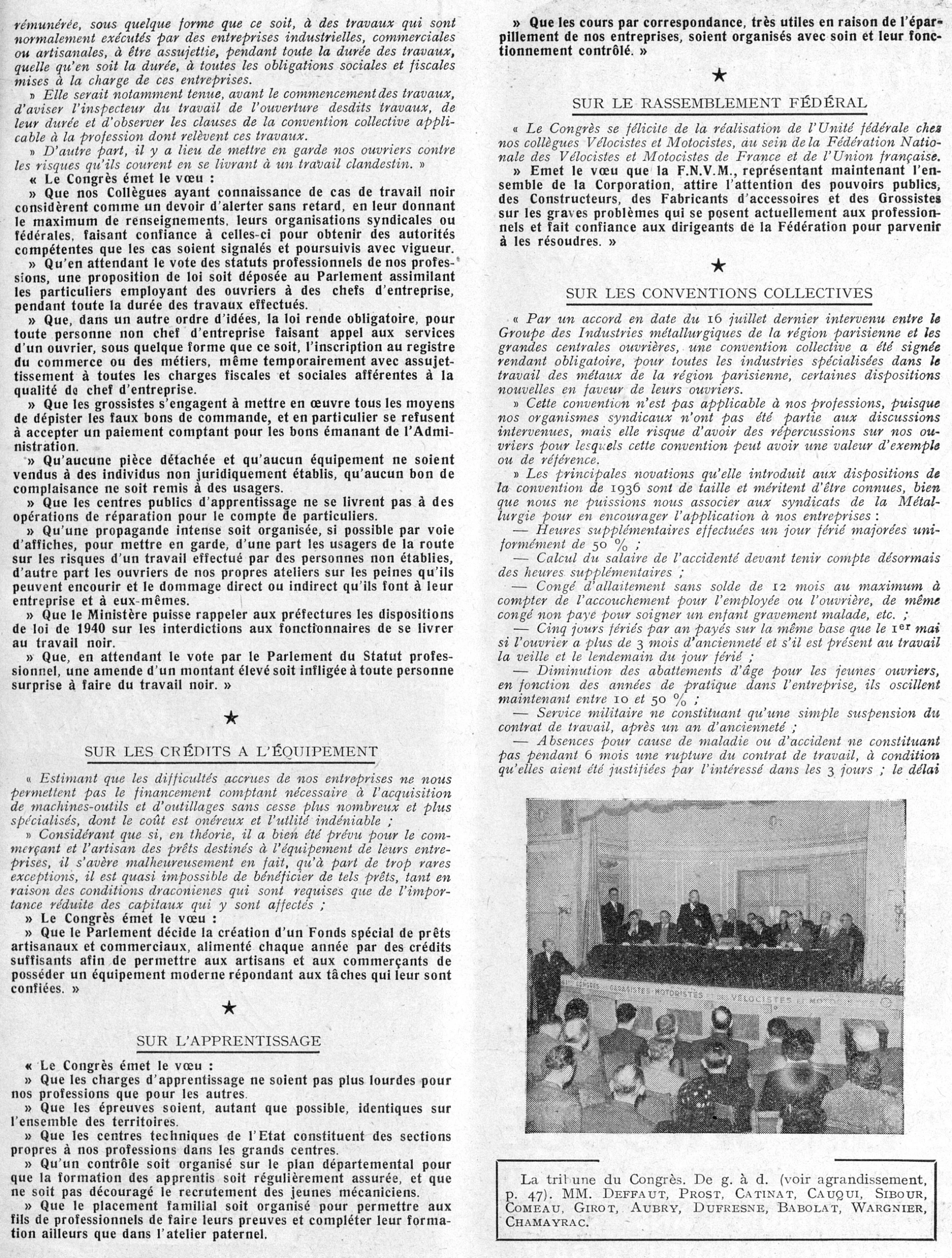
[Photograph at the foot of the right-hand column: the plenary session, the officers seated and standing at a long draped table on a platform whose front carries the « GARAGISTES-MOTORISTES … VÉLOCISTES ET MOTOCISTES » banner, the audience seen from behind in the foreground.]
La tribune du Congrès. De g. à d. (voir agrandissement, p. 47). MM. DEFFAUT, PROST, CATINAT, CAUQUI, SIBOUR, COMEAU, GIROT, AUBRY, DUFRESNE, BABOLAT, WARGNIER, CHAMAYRAC.
— Page 7 —
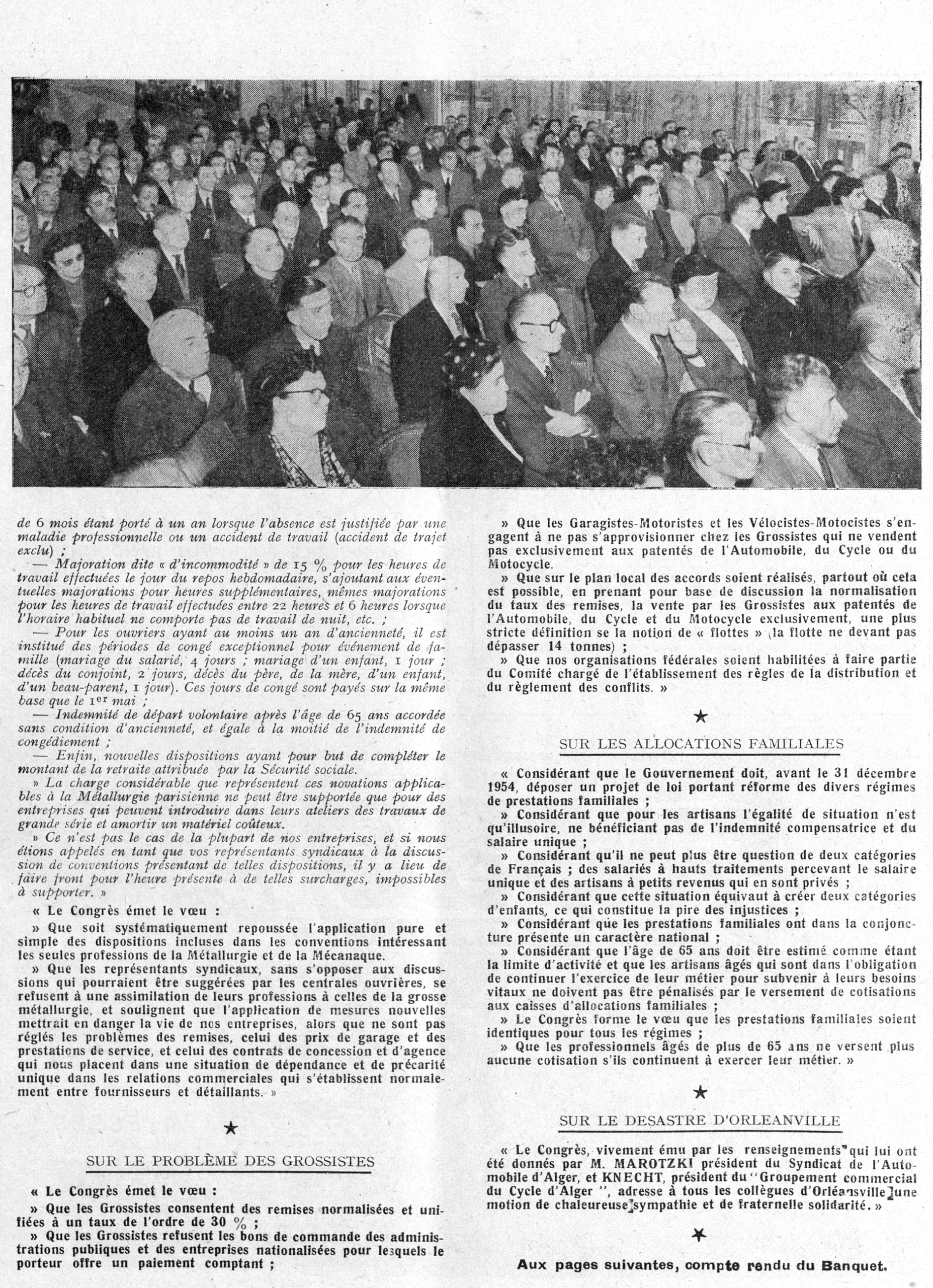
[Photograph across the full width of the head of the page, without a caption: the audience of the plenary session, rows of seated men and a few women in dark coats, facing the platform.]
[Ebykr summary; the list of changes in the 1954 Paris metal-trades agreement continues from the previous sheet. The six-month period becomes a year when the absence is due to an occupational disease or a work accident (accidents on the way to work excluded); an « incommodité » premium of 15 % for hours worked on the weekly rest day, on top of any overtime premium, and the same for hours worked between 22 heures and 6 heures where the usual schedule has no night work; for workmen with at least a year’s service, special family leave (marriage of the employee 4 days, of a child 1 day, death of a spouse 2 days, of a father, mother, child or parent-in-law 1 day), paid on the same basis as 1 May; a voluntary retirement allowance after 65 without any service condition, equal to half the dismissal allowance; and new provisions to top up the Sécurité sociale pension. Such a burden can be carried only by firms doing long series work and able to amortize costly plant, which is not the case of most of the Federation’s firms; their union representatives, if called to discuss agreements containing such clauses, must for the present resist these unbearable charges.]
« Le Congrès émet le vœu :
» Que soit systématiquement repoussée l’application pure et simple des dispositions incluses dans les conventions intéressant les seules professions de la Métallurgie et de la Mécanaque.
» Que les représentants syndicaux, sans s’opposer aux discussions qui pourraient être suggérées par les centrales ouvrières, se refusent à une assimilation de leurs professions à celles de la grosse métallurgie, et soulignent que l’application de mesures nouvelles mettrait en danger la vie de nos entreprises, alors que ne sont pas réglés les problèmes des remises, celui des prix de garage et des prestations de service, et celui des contrats de concession et d’agence qui nous placent dans une situation de dépendance et de précarité unique dans les relations commerciales qui s’établissent normalement entre fournisseurs et détaillants. »
★
SUR LE PROBLÈME DES GROSSISTES
« Le Congrès émet le vœu :
» Que les Grossistes consentent des remises normalisées et unifiées à un taux de l’ordre de 30 % ;
» Que les Grossistes refusent les bons de commande des administrations publiques et des entreprises nationalisées pour lesquels le porteur offre un paiement comptant ;
» Que les Garagistes-Motoristes et les Vélocistes-Motocistes s’engagent à ne pas s’approvisionner chez les Grossistes qui ne vendent pas exclusivement aux patentés de l’Automobile, du Cycle ou du Motocycle.
» Que sur le plan local des accords soient réalisés, partout où cela est possible, en prenant pour base de discussion la normalisation du taux des remises, la vente par les Grossistes aux patentés de l’Automobile, du Cycle et du Motocycle exclusivement, une plus stricte définition se la notion de « flottes » (la flotte ne devant pas dépasser 14 tonnes) ;
» Que nos organisations fédérales soient habilitées à faire partie du Comité chargé de l’établissement des règles de la distribution et du règlement des conflits. »
★
SUR LES ALLOCATIONS FAMILIALES
« Considérant que le Gouvernement doit, avant le 31 décembre 1954, déposer un projet de loi portant réforme des divers régimes de prestations familiales ;
» Considérant que pour les artisans l’égalité de situation n’est qu’illusoire, ne bénéficiant pas de l’indemnité compensatrice et du salaire unique ;
» Considérant qu’il ne peut plus être question de deux catégories de Français ; des salariés à hauts traitements percevant le salaire unique et des artisans à petits revenus qui en sont privés ;
» Considérant que cette situation équivaut à créer deux catégories d’enfants, ce qui constitue la pire des injustices ;
» Considérant que les prestations familiales ont dans la conjoncture présente un caractère national ;
» Considérant que l’âge de 65 ans doit être estimé comme étant la limite d’activité et que les artisans âgés qui sont dans l’obligation de continuer l’exercice de leur métier pour subvenir à leurs besoins vitaux ne doivent pas être pénalisés par le versement de cotisations aux caisses d’allocations familiales ;
» Le Congrès forme le vœu que les prestations familiales soient identiques pour tous les régimes ;
» Que les professionnels âgés de plus de 65 ans ne versent plus aucune cotisation s’ils continuent à exercer leur métier. »
★
SUR LE DESASTRE D’ORLEANVILLE
« Le Congrès, vivement ému par les renseignements qui lui ont été donnés par M. MAROTZKI président du Syndicat de l’Automobile d’Alger, et KNECHT, président du “Groupement commercial du Cycle d’Alger”, adresse à tous les collègues d’Orléansville une motion de chaleureuse sympathie et de fraternelle solidarité. »
★
Aux pages suivantes, compte rendu du Banquet.
— Page 8 —
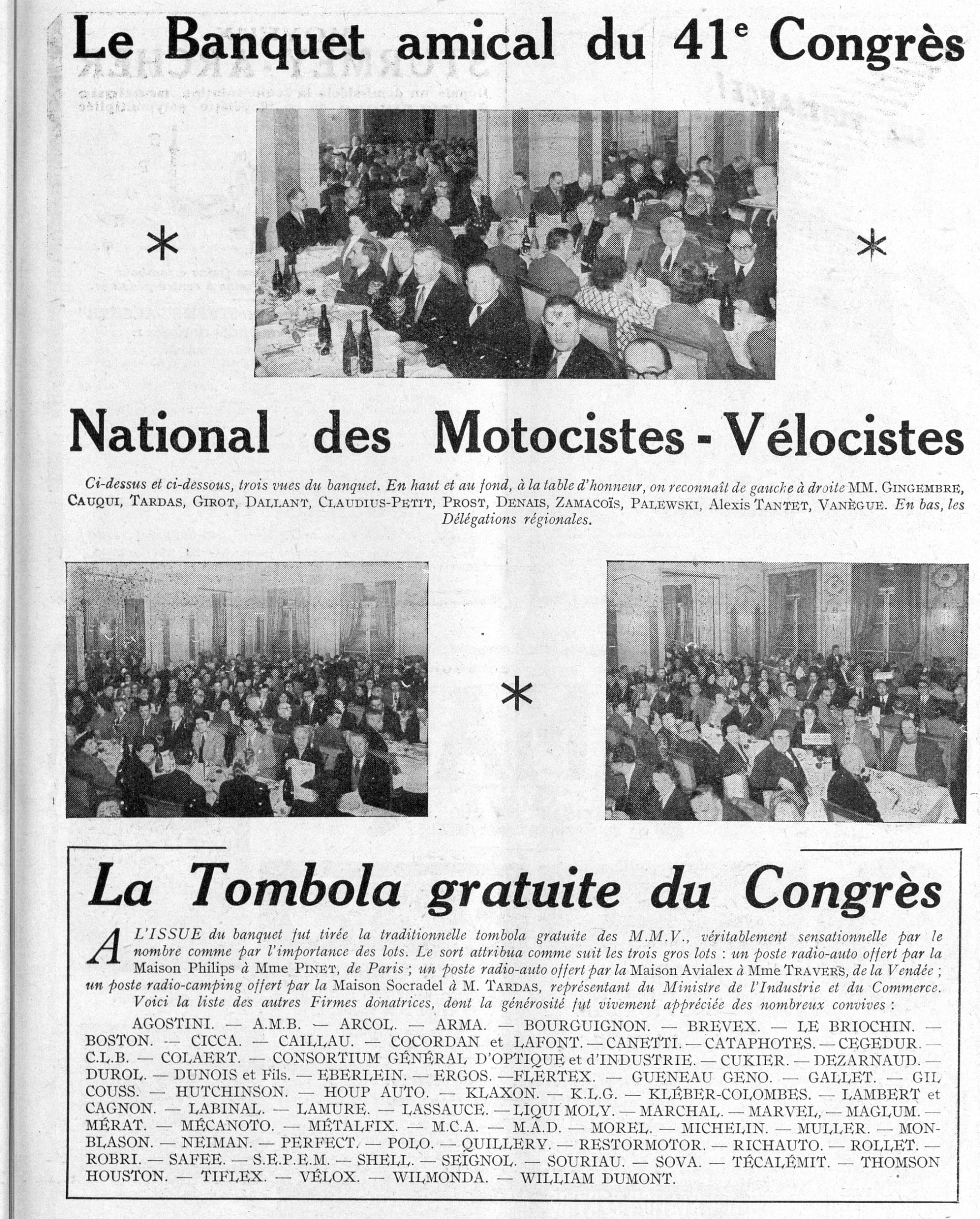
Le Banquet amical du 41e Congrès
National des Motocistes – Vélocistes
[Three photographs of the banquet in the Lutetia’s grand salon: at the top, the table of honor seen close, men in dark suits behind wine bottles and white cloths; below left and below right, wide views of the crowded hall, long tables running back to tall paneled walls.]
Ci-dessus et ci-dessous, trois vues du banquet. En haut et au fond, à la table d’honneur, on reconnaît de gauche à droite MM. GINGEMBRE, CAUQUI, TARDAS, GIROT, DALLANT, CLAUDIUS-PETIT, PROST, DENAIS, ZAMACOÏS, PALEWSKI, Alexis TANTET, VANÈGUE. En bas, les Délégations régionales.
La Tombola gratuite du Congrès
A L’ISSUE du banquet fut tirée la traditionnelle tombola gratuite des M.M.V., véritablement sensationnelle par le nombre comme par l’importance des lots. Le sort attribua comme suit les trois gros lots : un poste radio-auto offert par la Maison Philips à Mme PINET, de Paris ; un poste radio-auto offert par la Maison Avialex à Mme TRAVERS, de la Vendée ; un poste radio-camping offert par la Maison Socradel à M. TARDAS, représentant du Ministre de l’Industrie et du Commerce.
Voici la liste des autres Firmes donatrices, dont la générosité fut vivement appréciée des nombreux convives :
AGOSTINI. — A.M.B. — ARCOL. — ARMA. — BOURGUIGNON. — BREVEX. — LE BRIOCHIN. — BOSTON. — CICCA. — CAILLAU. — COCORDAN et LAFONT. — CANETTI. — CATAPHOTES. — CEGEDUR. — C.L.B. — COLAERT. — CONSORTIUM GÉNÉRAL D’OPTIQUE et d’INDUSTRIE. — CUKIER. — DEZARNAUD. — DUROL. — DUNOIS et Fils. — EBERLEIN. — ERGOS. — FLERTEX. — GUENEAU GENO. — GALLET. — GILCOUSS. — HUTCHINSON. — HOUP AUTO. — KLAXON. — K.L.G. — KLÉBER-COLOMBES. — LAMBERT et CAGNON. — LABINAL. — LAMURE. — LASSAUCE. — LIQUI MOLY. — MARCHAL. — MARVEL. — MAGLUM. — MÉRAT. — MÉCANOTO. — MÉTALFIX. — M.C.A. — M.A.D. — MOREL. — MICHELIN. — MULLER. — MONBLASON. — NEIMAN. — PERFECT. — POLO. — QUILLERY. — RESTORMOTOR. — RICHAUTO. — ROLLET. — ROBRI. — SAFEE. — S.E.P.E.M. — SHELL. — SEIGNOL. — SOURIAU. — SOVA. — TÉCALÉMIT. — THOMSON HOUSTON. — TIFLEX. — VÉLOX. — WILMONDA. — WILLIAM DUMONT.
— Page 9 —
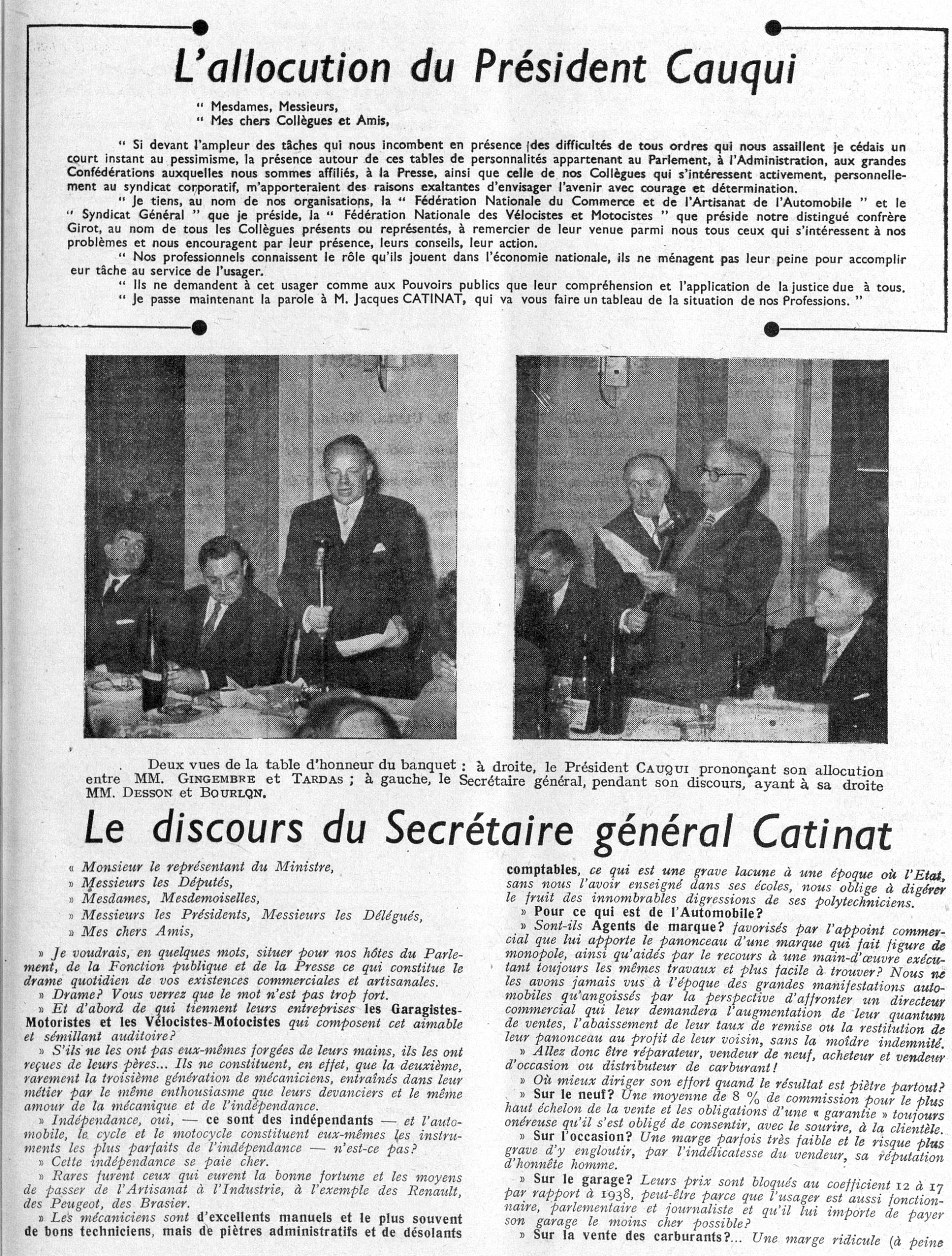
L’allocution du Président Cauqui
[Ebykr summary; the address is not reproduced. Opening « Mesdames, Messieurs, Mes chers Collègues et Amis », Président Cauqui says that if the scale of the tasks and difficulties ever tempted him to pessimism, the presence at the tables of figures from Parliament, the administration, the major confederations and the press, and of colleagues active in the trade union, would give him stirring reasons to face the future with courage. In the name of the « Fédération Nationale du Commerce et de l’Artisanat de l’Automobile », of the « Syndicat Général » he chairs and of the « Fédération Nationale des Vélocistes et Motocistes » chaired by his colleague Girot, he thanks all who take an interest in their problems. The trade’s members know their part in the national economy and spare no effort in serving the user; they ask of the user and the public authorities only understanding and justice. He then hands over to M. Jacques CATINAT for a survey of the state of the trades.]
[Two photographs side by side: at left, a tall man standing at a microphone at the table of honor between two seated men, bottles on the cloth; at right, a white-haired man reading from a sheet beside a man in spectacles, another seated at right.]
Deux vues de la table d’honneur du banquet : à droite, le Président CAUQUI prononçant son allocution entre MM. GINGEMBRE et TARDAS ; à gauche, le Secrétaire général, pendant son discours, ayant à sa droite MM. DESSON et BOURLON.
Le discours du Secrétaire général Catinat
[Ebykr summary; the speech is not reproduced. Addressing the minister’s representative, the deputies, ladies, presidents, delegates and friends, Catinat sets out for the guests from Parliament, the civil service and the press the « drame quotidien » of the members’ trading and craft lives. The garagistes-motoristes and vélocistes-motocistes are mostly the second, rarely the third, generation of mechanics, driven by love of mechanics and of independence; they are independents, and the automobile, the cycle and the motorcycle are themselves the perfect instruments of independence, but that independence is dearly paid. Few, like the Renault, Peugeot and Brasier, rose from craft to industry. Mechanics are excellent with their hands and often good technicians but poor administrators and « désolants comptables », a grave gap when the state, without teaching it in its schools, makes them digest the endless digressions of its polytechniciens. In the motor trade the brand agent, apparently favored by his make’s sign, dreads each motor show: the commercial director may demand higher sales quotas, cut his discount or hand the sign to a neighbor without the least compensation. On new cars the average commission is 8 % at the top level of sale, with a costly « garantie » to honor; on used cars the margin is often very slim and his reputation is at risk from a dishonest seller; garage charges are frozen at coefficient 12 to 17 against 1938, perhaps because the user is also an official, a member of Parliament and a journalist; and on fuel sales the margin is ridiculous …]
— Page 10 —
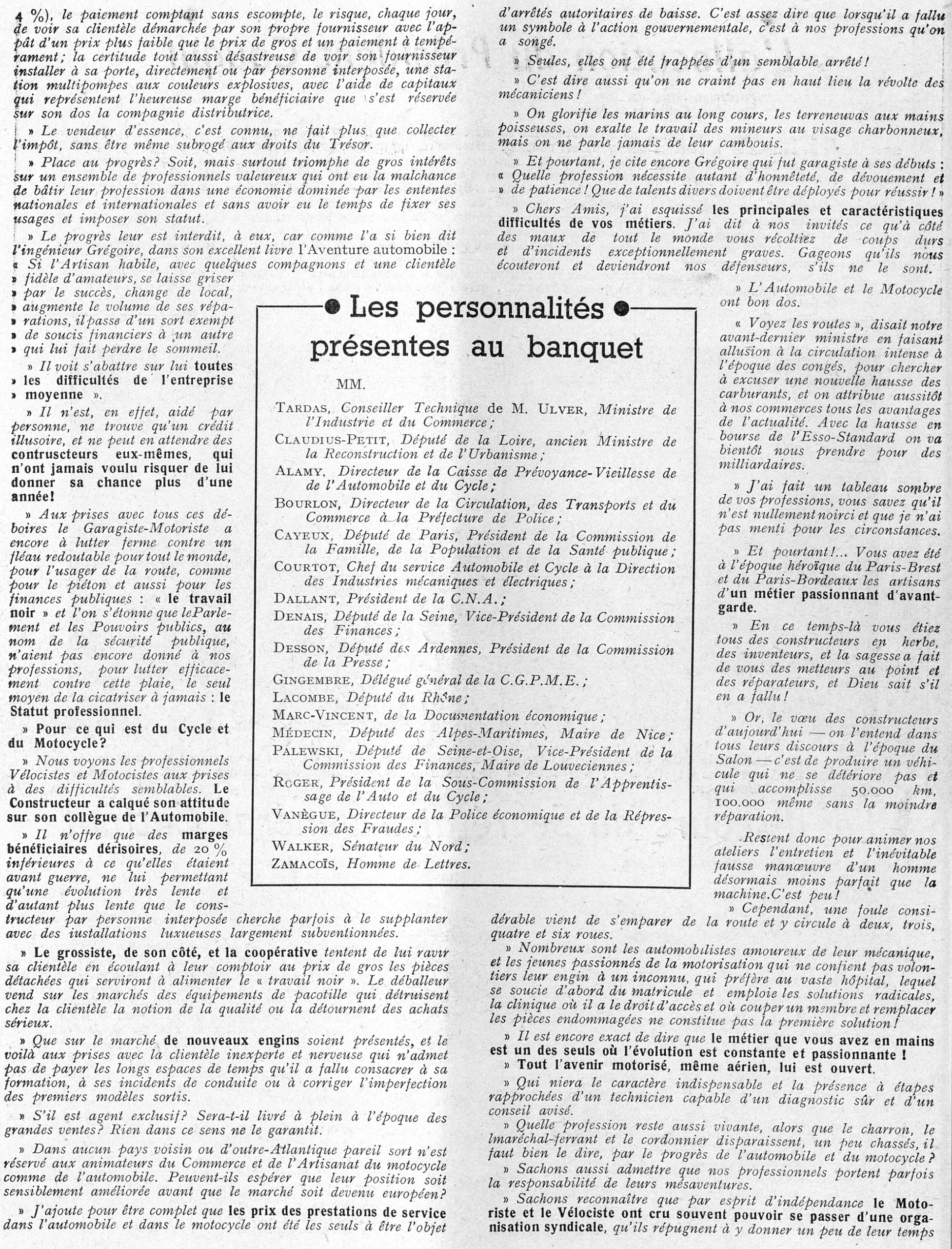
[Ebykr summary; Catinat’s speech continues from the previous sheet. The fuel margin is barely 4 %, with cash payment and no discount, the daily risk of the supplier canvassing the dealer’s own customers at below wholesale price on easy terms, and the certainty of the supplier setting up, directly or through a front, a gaudy multi-pump station at his door with capital drawn from the margin the distributing company kept at his expense; the petrol seller is now a mere tax collector without even the Treasury’s rights. Progress, he says, has meant the triumph of big interests over worthy professionals who built their trade in an economy ruled by national and international cartels, without time to fix their customs or win their statute. He quotes the engineer Grégoire’s book l’Aventure automobile on the skilled artisan who, grown with success, passes from a carefree life to one that costs him his sleep and meets « toutes les difficultés de l’entreprise moyenne »; he finds only illusory credit and nothing from the manufacturers, who have never risked giving him his chance for more than a year. The garagiste-motoriste must also fight « le travail noir », and the speaker wonders that Parliament and the authorities have not yet given the trades the only cure, the professional statute.]
[Ebykr summary, the cycle and motorcycle passage. The vélocistes and motocistes face similar troubles: the manufacturer has modeled his attitude on his motor-trade colleague and offers only « marges bénéficiaires dérisoires », 20 % lower than before the war, allowing only very slow progress, the slower as the manufacturer, through a front, sometimes tries to supplant him with luxurious, heavily subsidized premises. The wholesaler and the cooperative take his customers by selling spare parts over the counter at wholesale price to feed the « travail noir », and the market trader sells shoddy equipment that destroys the customer’s sense of quality. When new machines appear he must deal with inexpert, nervous customers who will not pay for the long hours spent learning them, for their handling incidents or for correcting the flaws of the first models. As exclusive agent nothing guarantees him full deliveries in the selling season. No neighboring country nor any across the Atlantic treats its motorcycle and motor traders so, and he asks whether things will improve before the market becomes European. Service charges in the automobile and motorcycle trades alone have been subject to authoritarian price-cut orders, a symbol of government action, showing that no revolt of mechanics is feared in high places; sailors, Newfoundland fishermen and miners are glorified, never the mechanics’ grease. He quotes Grégoire again, who began as a garagiste, on the honesty, devotion and patience the trade demands, and hopes the guests will become the trades’ defenders.]
[Ebykr summary, right-hand column. The automobile and motorcycle « ont bon dos »: the minister before last, excusing a new fuel price rise, pointed to the crowded holiday roads, and with Esso-Standard’s rise on the Bourse the trade will soon be taken for billionaires. He insists his dark picture is not exaggerated. Yet in the heroic days of Paris-Brest and Paris-Bordeaux they were the craftsmen of a passionate pioneering trade, budding constructors and inventors, later tuners and repairers. Today’s manufacturers, in every Salon speech, want a vehicle that goes 50.000 km, even 100.000, without the least repair, leaving the workshops only maintenance and human error. Yet a huge crowd now takes the road on two, three, four and six wheels; many motorists and young enthusiasts prefer a known clinic to a vast hospital that amputates and replaces parts. Their trade is one of the few in constant and exciting evolution, open to the whole motorized future, even the air, needing a technician for sure diagnosis at close intervals, while the wheelwright, the farrier and the cobbler disappear. He admits the members sometimes share the blame, and that from a spirit of independence the motoriste and the vélociste have often thought they could do without a union and are loath to give it a little of their time …]
● Les personnalités présentes au banquet ●
MM.
TARDAS, Conseiller Technique de M. ULVER, Ministre de l’Industrie et du Commerce ;
CLAUDIUS-PETIT, Député de la Loire, ancien Ministre de la Reconstruction et de l’Urbanisme ;
ALAMY, Directeur de la Caisse de Prévoyance-Vieillesse de l’Automobile et du Cycle ;
BOURLON, Directeur de la Circulation, des Transports et du Commerce à la Préfecture de Police ;
CAYEUX, Député de Paris, Président de la Commission de la Famille, de la Population et de la Santé publique ;
COURTOT, Chef du service Automobile et Cycle à la Direction des Industries mécaniques et électriques ;
DALLANT, Président de la C.N.A. ;
DENAIS, Député de la Seine, Vice-Président de la Commission des Finances ;
DESSON, Député des Ardennes, Président de la Commission de la Presse ;
GINGEMBRE, Délégué général de la C.G.P.M.E. ;
LACOMBE, Député du Rhône ;
MARC-VINCENT, de la Documentation économique ;
MÉDECIN, Député des Alpes-Maritimes, Maire de Nice ;
PALEWSKI, Député de Seine-et-Oise, Vice-Président de la Commission des Finances, Maire de Louveciennes ;
ROGER, Président de la Sous-Commission de l’Apprentissage de l’Auto et du Cycle ;
VANÈGUE, Directeur de la Police économique et de la Répression des Fraudes ;
WALKER, Sénateur du Nord ;
ZAMACOÏS, Homme de Lettres.
— Page 11 —
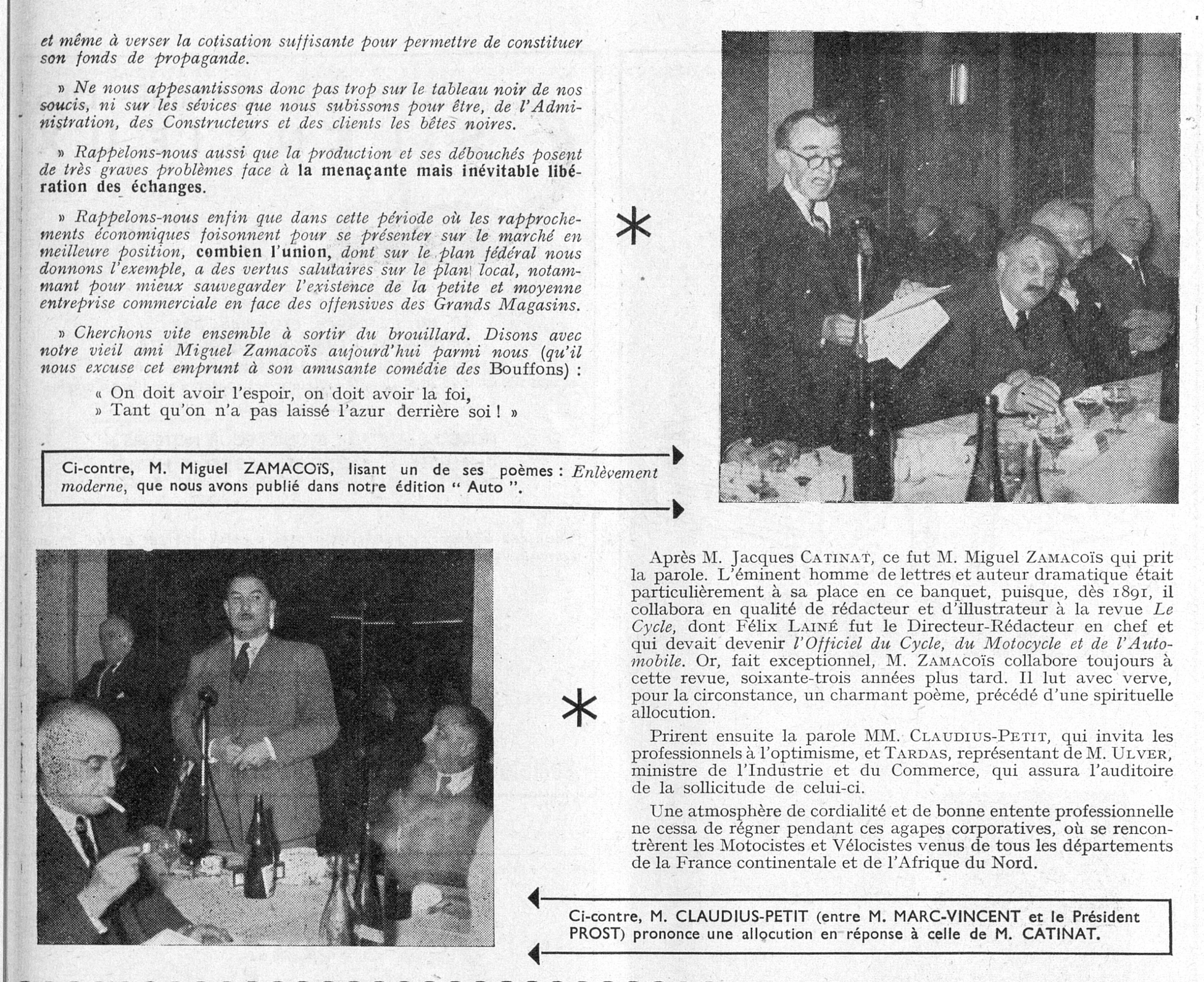
[Ebykr summary; Catinat’s speech concludes. The members are loath even to pay a subscription large enough to build the union’s propaganda fund. He urges them not to dwell on their troubles or on being the « bêtes noires » of the administration, the manufacturers and the customers; production and its outlets face very grave problems with « la menaçante mais inévitable libération des échanges »; and in a time of economic groupings union, of which the federation sets the example, has salutary virtues locally, above all to protect the small and medium trading firm against the offensives of the department stores. He calls on them to find a way out of the fog together and ends by borrowing from his old friend Miguel Zamacoïs, present at the banquet, a couplet from his comedy the Bouffons:]
« On doit avoir l’espoir, on doit avoir la foi,
» Tant qu’on n’a pas laissé l’azur derrière soi ! »
Ci-contre, M. Miguel ZAMACOÏS, lisant un de ses poèmes : Enlèvement moderne, que nous avons publié dans notre édition ” Auto “.
[Two photographs: at upper right, a man in round spectacles standing at a microphone reading from a sheet, a white-haired man seated beside him; at lower left, a man standing at a microphone between two seated men, the one in the foreground in spectacles with a cigarette in his mouth, bottles on the table.]
Après M. Jacques CATINAT, ce fut M. Miguel ZAMACOÏS qui prit la parole. L’éminent homme de lettres et auteur dramatique était particulièrement à sa place en ce banquet, puisque, dès 1891, il collabora en qualité de rédacteur et d’illustrateur à la revue Le Cycle, dont Félix LAINÉ fut le Directeur-Rédacteur en chef et qui devait devenir l’Officiel du Cycle, du Motocycle et de l’Automobile. Or, fait exceptionnel, M. ZAMACOÏS collabore toujours à cette revue, soixante-trois années plus tard. Il lut avec verve, pour la circonstance, un charmant poème, précédé d’une spirituelle allocution.
Prirent ensuite la parole MM. CLAUDIUS-PETIT, qui invita les professionnels à l’optimisme, et TARDAS, représentant de M. ULVER, ministre de l’Industrie et du Commerce, qui assura l’auditoire de la sollicitude de celui-ci.
Une atmosphère de cordialité et de bonne entente professionnelle ne cessa de régner pendant ces agapes corporatives, où se rencontrèrent les Motocistes et Vélocistes venus de tous les départements de la France continentale et de l’Afrique du Nord.
Ci-contre, M. CLAUDIUS-PETIT (entre M. MARC-VINCENT et le Président PROST) prononce une allocution en réponse à celle de M. CATINAT.
— Page 12 —
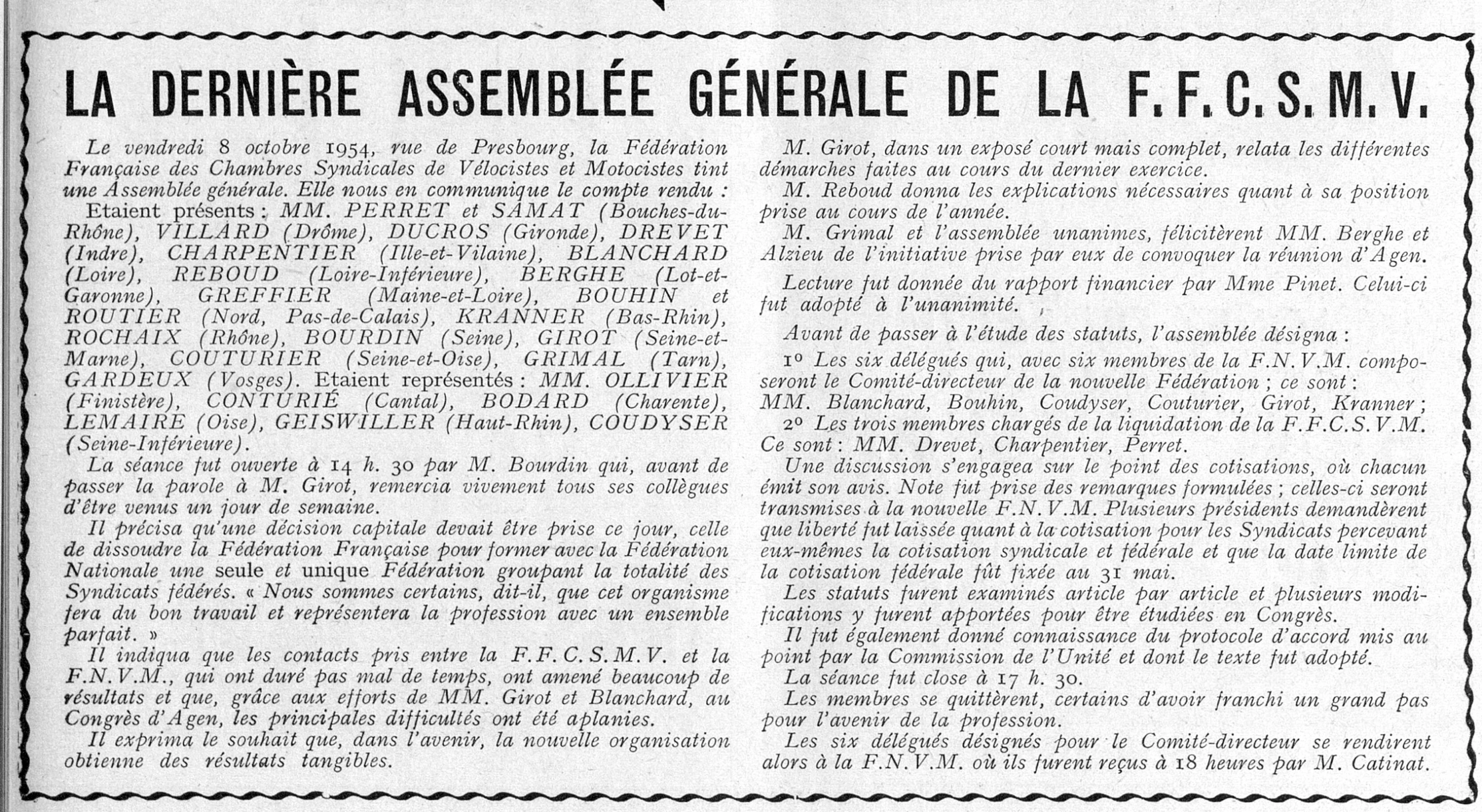
LA DERNIÈRE ASSEMBLÉE GÉNÉRALE DE LA F.F.C.S.M.V.
[Ebykr summary; the report is not reproduced. On Friday 8 October 1954, rue de Presbourg, the Fédération Française des Chambres Syndicales de Vélocistes et Motocistes held a general assembly, whose report it sent to the paper.]
Etaient présents : MM. PERRET et SAMAT (Bouches-du-Rhône), VILLARD (Drôme), DUCROS (Gironde), DREVET (Indre), CHARPENTIER (Ille-et-Vilaine), BLANCHARD (Loire), REBOUD (Loire-Inférieure), BERGHE (Lot-et-Garonne), GREFFIER (Maine-et-Loire), BOUHIN et ROUTIER (Nord, Pas-de-Calais), KRANNER (Bas-Rhin), ROCHAIX (Rhône), BOURDIN (Seine), GIROT (Seine-et-Marne), COUTURIER (Seine-et-Oise), GRIMAL (Tarn), GARDEUX (Vosges). Etaient représentés : MM. OLLIVIER (Finistère), CONTURIÉ (Cantal), BODARD (Charente), LEMAIRE (Oise), GEISWILLER (Haut-Rhin), COUDYSER (Seine-Inférieure).
[Ebykr summary, continued. M. Bourdin opened the meeting at 14 h. 30, thanking colleagues for coming on a weekday, and announced the capital decision of the day: to dissolve the Fédération Française and form with the Fédération Nationale one single federation of all the federated unions, which he was sure would represent the trade « avec un ensemble parfait ». Contacts between the F.F.C.S.M.V. and the F.N.V.M. had been long but fruitful, and through MM. Girot and Blanchard the main difficulties were smoothed out at the Congrès d’Agen. M. Girot reported on the year’s approaches; M. Reboud explained the position he had taken during the year; M. Grimal and the whole assembly congratulated MM. Berghe and Alzieu on convening the Agen meeting. Mme Pinet read the financial report, adopted unanimously.]
Avant de passer à l’étude des statuts, l’assemblée désigna :
1° Les six délégués qui, avec six membres de la F.N.V.M. composeront le Comité-directeur de la nouvelle Fédération ; ce sont : MM. Blanchard, Bouhin, Coudyser, Couturier, Girot, Kranner ;
2° Les trois membres chargés de la liquidation de la F.F.C.S.V.M. Ce sont : MM. Drevet, Charpentier, Perret.
[Ebykr summary, concluded. In a discussion of subscriptions, remarks were noted for the new F.N.V.M.; several presidents asked for freedom on the subscription for unions that collect the union and federal dues themselves, and for the federal subscription deadline to be set at 31 May. The statutes were examined article by article and several amendments put forward for study in congress; the protocol of agreement drawn up by the Commission de l’Unité was read and adopted. The meeting closed at 17 h. 30, the members certain they had taken a great step for the trade, and the six delegates named to the Comité-directeur went on to the F.N.V.M., where M. Catinat received them at 18 heures.]
[Twelve full pages of trade-journal reporting, text and halftone photographs only, with no drawing, no advertisement and no signature or monogram anywhere. Image 1 opens under a heavy roman headline over an italic standfirst, with a wide photograph of the officers’ table on a draped platform, a list of delegates set in roman with names in capitals, and at the foot a reproduction of the welcome banner in display capitals; a bare “3” stands at the foot as a folio. Images 2 to 7 are set in two justified columns, the presidential address and the reports in italic and the resolutions in a bolder grotesque, each section under a centered small-capital heading with a rule beneath and divided by single stars; boxed or plain captions sit beneath halftone photographs of the commission sessions, the platform and the audience, and image 5 carries the folio “54”. Image 8 is a spread built on a two-line heavy roman headline running across both halves, three halftone views of the banquet hall staggered between asterisk ornaments, an italic caption naming the table of honor, and a ruled box headed “La Tombola gratuite du Congrès” in large italic with its list of donor firms in roman capitals. Image 9 frames Cauqui’s banquet address in a bracketed box with dot terminals, sets two halftone portraits of speakers at the microphone side by side, and runs Catinat’s speech in italic beneath a sans-serif italic headline. Image 10 continues the speech around a framed panel, “Les personnalités présentes au banquet”, in which the guests’ names stand in small capitals with their offices in italic. Image 11 closes the speech, quotes a rhymed couplet, and pairs two halftone photographs of speakers with boxed sans-serif captions and arrow rules, followed by a roman account of the remaining speeches. Image 12 is a single panel inside a wavy rule, its condensed sans-serif capital headline over an all-italic report. No folio “4” appears in the tiles read for images 11 and 12.]
Ebykr presents this material for research and education. If you hold rights to it or notice an ownership issue, please contact us and we will respond promptly.
The Ebykr Digest
New articles, timelines, catalog finds and registry activity — assembled from the archive once a month. Your address is never shared.
Double opt-in. One email per month. Unsubscribe at any time with one click.