About Ebykr
Ebykr celebrates classic and vintage lightweight bicycles through provocative imagery and opinion. Ride along with us.
About Ebykr
Ebykr celebrates classic and vintage lightweight bicycles through provocative imagery and opinion. Ride along with us.

Source: Gallica (Bibliothèque nationale de France), L'Officiel du cycle, du motocycle et du camping, 2 October 1954, N° 40, page 60; ark:/12148/bd6t54206310j. Source gallica.bnf.fr / BnF.
| Type | Review |
|---|---|
| Year | 1954 |
| Publisher | L'Officiel du cycle |
| Country | France |
| Language | French |
| Pages | 1 |
| Source | Gallica (Bibliothèque nationale de France), L'Officiel du cycle, du motocycle et du camping, 2 October 1954, N° 40, page 60; ark:/12148/bd6t54206310j. Source gallica.bnf.fr / BnF. |
| Credit | Ebykr archive; Bibliothèque nationale de France |
| Identifier | Gallica (BnF) ark:/12148/bd6t54206310j/f59 |
| Transcription | Headings and specifications transcribed; article text summarized |
Daniel Gousseau interroge : POURQUOI PÉDALER ? 6 personnalités répondent. ★ ★ « AH! SI VOUS AVIEZ UNE X..! » « AH ! SI VOUS AVIEZ DES PÉDALES..!» En résumé : Pourquoi pédaler ? Mais pour son bien-être et sa tranquillité, ...avec ou sans moteur ! La Bicyclette simple et le Cyclomoteur ont leur rubrique …
This is a magazine article, so its running text is summarized here rather than reproduced; the headline, byline, specifications and scores are transcribed as printed.
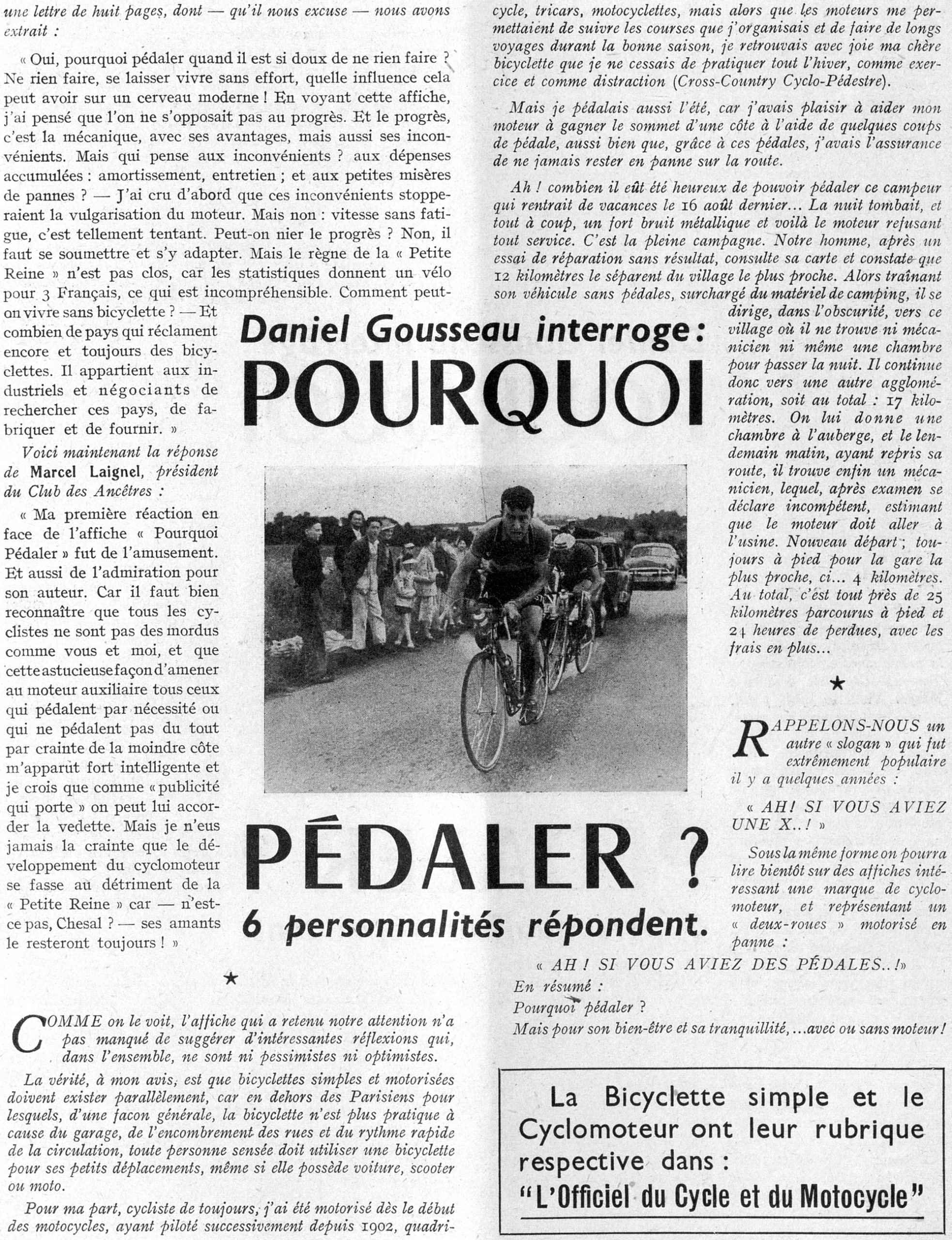
From L’Officiel du cycle, du motocycle et du camping, 2 October 1954, the paper’s special number before the 1954 Paris Salon du Cycle et du Motocycle, page 60: the second part of Daniel Gousseau’s inquiry “Pourquoi pédaler ?”, with the reply of Alphonse Steinès on progress and the reign of the “petite reine”, that of Marcel Laignel of the Club des Ancêtres and the other replies from the pure cyclists, under a photograph of a racing cyclist. The title, headings, captions and lists are transcribed as printed; the text is summarized in Ebykr’s words, and the page images carry it in full.
— Page 1 —
[Ebykr summary; the article’s text is not reproduced. The page opens in the middle of the introduction to the reply from Alphonse Steinès, a letter of eight pages from which the editors, with his apology, have taken an extract. In it he asks why one should pedal when it is so sweet to do nothing, and what influence doing nothing and living without effort can have on a modern brain. On seeing the poster he thought that one does not oppose progress, and that progress is machinery with its advantages but also its drawbacks. But who thinks of the drawbacks, he asks, such as the accumulated costs of depreciation and upkeep and the small miseries of breakdowns? He first believed these drawbacks would stop the spread of the motor, but no: speed without fatigue is too tempting. Progress cannot be denied; one must submit and adapt. Yet the reign of the “Petite Reine” is not over, since the statistics give one bicycle for every 3 French people, which he finds incomprehensible, for how can one live without a bicycle? How many countries, he adds, still ask for more and more bicycles, and it is for manufacturers and dealers to seek out those countries and to make and supply them.]
[Ebykr summary, continued. The next reply is from Marcel Laignel, president of the Club des Ancêtres. His first reaction to the poster “Pourquoi Pédaler” was amusement and also admiration for its author, because, as he puts it, not every cyclist is a fanatic like “you and me”, and this clever way of leading to the auxiliary motor all those who pedal from necessity, or who do not pedal at all for fear of the slightest hill, struck him as very intelligent; as “publicité qui porte” it deserves top billing. But he never feared that the development of the cyclomoteur would come at the expense of the “Petite Reine”, for, he asks, addressing someone he calls Chesal, are not its lovers always going to remain so?]
Daniel Gousseau interroge :
POURQUOI
PÉDALER ?
6 personnalités répondent.
★
[Ebykr summary, after a star break. In the closing section the author, writing as “I” and “we”, says that the poster that held the editors’ attention has not failed to suggest interesting reflections that on the whole are neither pessimistic nor optimistic. In his view the plain and the motorized bicycle must exist side by side, because apart from Parisians, for whom the bicycle is generally no longer practical because of garaging, crowded streets and the fast pace of traffic, every sensible person ought to use a bicycle for short trips even if he owns a car, scooter or motorcycle. He himself, a cyclist all his life, was motorized from the start of motorcycling, having ridden in turn since 1902 a quadricycle, tricars and motorcycles; but when the motors let him follow the races he organized and make long journeys in the good season, he gladly went back to his dear bicycle, which he rode all winter for exercise and distraction (Cross-Country Cyclo-Pédestre). He also pedaled in summer, because he liked helping his motor to the top of a hill with a few strokes of the pedals and because, thanks to the pedals, he was assured of never being stranded on the road.]
[Ebykr summary, continued. He then tells of a camper returning from vacation on 16 August last who would have been glad to be able to pedal. Night was falling when a loud metallic noise came from the motor, which then refused all service in open country. After a fruitless repair attempt the man checked his map and found 12 kilometers to the nearest village. Dragging his machine, which had no pedals and was overloaded with camping gear, he walked in the dark to that village, where he found neither mechanic nor a room for the night, and so went on to another town, 17 kilometers in all. He was given a room at an inn, and next morning on resuming his way he at last found a mechanic, who after examining the machine declared himself incompetent and judged that the motor must go to the factory. The man set off again, on foot once more for the nearest station, 4 kilometers away. In all it was close to 25 kilometers covered on foot and 24 hours lost, with the expenses on top.]
★
[Ebykr summary, after a star break. The author recalls another slogan, extremely popular a few years earlier, given as printed.]
« AH! SI VOUS AVIEZ
UNE X..! »
[Ebykr summary, continued. In the same form, he says, one will soon be able to read on posters for a make of cyclomoteur, showing a broken-down motorized “deux-roues”, the line below.]
« AH ! SI VOUS AVIEZ DES PÉDALES..!»
En résumé :
Pourquoi pédaler ?
Mais pour son bien-être et sa tranquillité, …avec ou sans moteur !
La Bicyclette simple et le Cyclomoteur ont leur rubrique respective dans :
“L’Officiel du Cycle et du Motocycle”
[A text page set in italic and roman serif type around a repeated headline and one halftone photograph. The roman text of the Steinès extract opens the page at the upper left, in a wide block above the headline, and carries on in a narrow column at the left beside it, followed by the Laignel reply in the same narrow column under an italic introduction. A block of italic text fills the wide top of the right half, and an italic column runs down the right side beside the headline. Across the middle of the sheet the headline from the previous page stands again: “Daniel Gousseau interroge :” in a heavy slanted sans-serif face, then “POURQUOI PÉDALER ?” in very large heavy upright capitals on two lines, and “6 personnalités répondent.” in heavy slanted lowercase. The two lines of the question are split by one halftone photograph, which has no caption. At the left of it a small group of onlookers in jackets, among them a woman in a hat and skirt, stand on the grass verge of a paved road, and at the right a racing cyclist in a dark jersey leans forward over the drops of his handlebars on a road bicycle, with a second rider close behind him and a sedan automobile following at the center. Under the headline the italic closing section runs across the full width, with a large italic drop capital C. Small star ornaments separate the sections, and a second italic drop capital R opens the paragraph on the earlier slogan. The name Marcel Laignel is picked out in a heavier type. The two slogans “AH! SI VOUS AVIEZ UNE X..! ” and “AH ! SI VOUS AVIEZ DES PÉDALES..!” are set in spaced italic capitals, and the three closing lines in italic. At the foot of the page a thin-ruled rectangular box holds a plain announcement in large sans-serif type, with the periodical’s title in heavy condensed type inside quotation marks and underlined. No artist signature or agency mark appears.]
Ebykr presents this material for research and education. If you hold rights to it or notice an ownership issue, please contact us and we will respond promptly.
The Ebykr Digest
New articles, timelines, catalog finds and registry activity — assembled from the archive once a month. Your address is never shared.
Double opt-in. One email per month. Unsubscribe at any time with one click.