About Ebykr
Ebykr celebrates classic and vintage lightweight bicycles through provocative imagery and opinion. Ride along with us.
About Ebykr
Ebykr celebrates classic and vintage lightweight bicycles through provocative imagery and opinion. Ride along with us.

Source: Gallica (Bibliothèque nationale de France), L'Officiel du cycle, du motocycle et du camping, 2 October 1954, N° 40, page 59; ark:/12148/bd6t54206310j. Source gallica.bnf.fr / BnF.
| Type | Review |
|---|---|
| Year | 1954 |
| Publisher | L'Officiel du cycle |
| Country | France |
| Language | French |
| Pages | 1 |
| Source | Gallica (Bibliothèque nationale de France), L'Officiel du cycle, du motocycle et du camping, 2 October 1954, N° 40, page 59; ark:/12148/bd6t54206310j. Source gallica.bnf.fr / BnF. |
| Credit | Ebykr archive; Bibliothèque nationale de France |
| Identifier | Gallica (BnF) ark:/12148/bd6t54206310j/f58 |
| Transcription | Headings and specifications transcribed; article text summarized |
Daniel Gousseau interroge : POURQUOI PÉDALER ? 6 personnalités répondent. ★ ★ ★ ★ ★
This is a magazine article, so its running text is summarized here rather than reproduced; the headline, byline, specifications and scores are transcribed as printed.
From L’Officiel du cycle, du motocycle et du camping, 2 October 1954, the paper’s special number before the 1954 Paris Salon du Cycle et du Motocycle, page 59: Daniel Gousseau’s inquiry “Pourquoi pédaler ?”, in which six personalities of cycling answer the slogan that a maker of small motors posted on the walls of Paris at the 1947 Salon; this first part tells how the trade received the slogan and opens the replies. The title, headings, captions and lists are transcribed as printed; the text is summarized in Ebykr’s words, and the page images carry it in full.
— Page 1 —
[Ebykr summary; the article’s text is not reproduced. The author, writing in the first person, says that in 1945 a leading make of small motors had the ingenious idea of launching by prospectus a clever slogan, the “Pourquoi pédaler ?” of the headline, which held the attention of every Vélociste. The dealers reacted in different ways: they thought at once that something was about to change in their commercial existence, since the question was bound to make their customers, the cyclists, think and draw them toward motorization, which would require a transformation of the dealers’ own business. But the great crowd of cyclists would learn of this “appeal to reflection” only through the trade professionals, who could either promote it or bury it. Then came the 1947 Salon, and the walls and hoardings of Paris and the large towns were covered with tempting posters showing a motorized bicycle and carrying the famous slogan in enormous letters; the masses were alerted. For his part the author found the question rather insidious but saw no harm in it, for reasons he sets out further on. Certain convinced pedalers, lovers of exercise, were on the other hand unpleasantly surprised by this call to the least effort, and so he thought it interesting to ask the most qualified representatives of these pure cyclists what their first reaction had been on reading the famous poster.]
Daniel Gousseau interroge :
POURQUOI
PÉDALER ?
6 personnalités répondent.
★
[Ebykr summary, after a star break. Very kindly, the friends he questioned have told him their state of mind. The first reply was made by the dean of the sporting press and founder of the Touring-Club de France, Marcel Viollette, who still pedals though more than ninety. In quotation marks he says that it is precisely because one is one’s own motor that one can enjoy to the full the joy of an outing, exercising the muscles and tasting the scents of the woods and the flowers without being choked by gasoline odors or deafened by exhaust and scrap-metal noise. That was his first reaction on reading the question. But perhaps, he adds, he might have foreseen that a day would come, and alas it has come, when the popping machines would drive the poor devils of cyclists off the tracks reserved for them.]
★
[Ebykr summary, after a star break. The author notes that Marcel Viollette now heads the regional office of the Touring in Tours, and gives next the reaction of a Parisian “técéfiste”, M. Camille Durand, who chairs the cycling group of the T.C.F. with M. Dodé. His first impression is that the century of idleness has truly arrived, since being carried by a motor is no pleasure, while pedaling is touring by one’s own means: seeing, contemplating, knowing how to stop, setting every muscle to work and forgetting everything while thinking only of the beauties offered free, namely the rustling of leaves, the song of birds and the murmur of streams. The popping motor kills all of this. A means of transport, he grants, but a touring machine, no, a thousand times no, and that is why one must pedal; it is his answer on behalf of the true tourists. There are still convinced pedalers, he says, and he has just come back from the Galibier where, high up at the foot of the Desgrange monument, about a thousand of them celebrated the fiftieth anniversary of the Audax Français that Desgrange had founded. His reply ends with the phrase “Bicyclette pas morte…”.]
★
[Ebykr summary, after a star break. Next comes the most assiduous participant in the cycling rallies the author organized over more than twenty years, the Prix Alcyon in winter in the woods and the Prix Peugeot in summer toward the interesting sites of the Paris region: M. Paul Dugelay. He says that strictly speaking there was no reaction, or very little, on seeing the first poster, no more than an old angler used to the banks of the Seine would have on reading a decree regulating salmon fishing in the Pyrenean gaves. For old riders like himself who love effort and the physical expenditure of their outings, the motorized bicycle was so far from their tastes, ideas and conceptions that it could hardly touch them. He then offers reflections. First, that the author of the slogan was a shrewd psychologist, who knew where he was going in praising laziness in a tired world whose chief concern is to obey the law of least effort. Second, that it would probably not last, in which he admits he was badly mistaken, because the small motors have held up, which in part explains the great vogue of motorized “deux roues”. Yet the main reason for their success remains the possibility they offer of sparing oneself all fatigue.]
★
[Ebykr summary, after a star break. The author turns to the man who was for many years president of the Paris tandemists, organizers of many outings throughout France. This man says he understood at once that a poster offering the tired from birth, who are numerous, a way to travel with no effort would largely destroy half a century of propaganda for the benefits and irreplaceable joys of the plain bicycle and of the tandem. No name is printed for this respondent on this page.]
★
[Ebykr summary, after a star break. The author introduces Alphonse Steinès, who devoted his whole life to the defense of cycling, of the old “Vélo”, of the “Auto” and of the Touring Club de France, and who was carried away by the question. The page ends mid-sentence at the words “nous a adressé”, and the piece continues on the next page.]
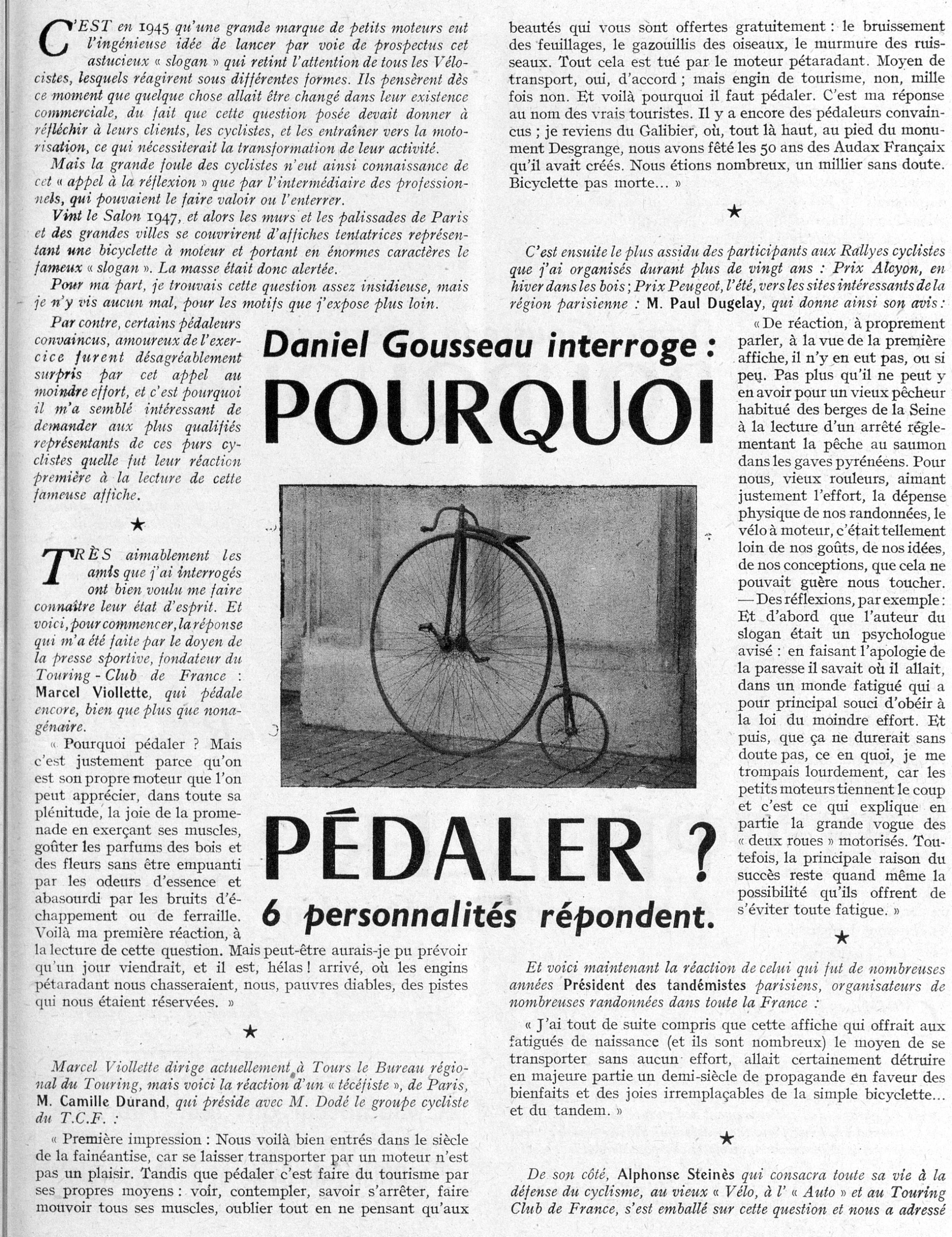
[A text page set in italic and roman serif type around a headline and one photograph. The upper third is a wide block of italic text across the full width, opening with a large italic drop capital C. Below it the page splits in three: a narrow column at the left carries italic text, with a large italic drop capital T opening the reply section, and then roman quotation text; the center is taken by the headline and photograph; and a narrow roman column at the right carries a quotation. The headline stands in three parts: “Daniel Gousseau interroge :” in a heavy slanted sans-serif face, then “POURQUOI PÉDALER ?” in very large heavy upright capitals on two lines, and “6 personnalités répondent.” in heavy slanted lowercase. The two lines of the question are split by the photograph, a halftone of a high-wheel bicycle standing alone in front of a plain pale wall, shown whole in side view with a very large front wheel, a small rear wheel, a curved handlebar and a saddle on the backbone, on a bare plank floor; it has no caption. Under the headline the roman quotations and italic introductions run again across the full width. Small five-pointed star ornaments separate each reply. The names Marcel Viollette, M. Camille Durand, M. Paul Dugelay, Président des tandémistes and Alphonse Steinès are picked out in a heavier type. No artist signature or agency mark appears. A thin vertical rule runs down the left edge of the sheet.]
Ebykr presents this material for research and education. If you hold rights to it or notice an ownership issue, please contact us and we will respond promptly.
The Ebykr Digest
New articles, timelines, catalog finds and registry activity — assembled from the archive once a month. Your address is never shared.
Double opt-in. One email per month. Unsubscribe at any time with one click.