About Ebykr
Ebykr celebrates classic and vintage lightweight bicycles through provocative imagery and opinion. Ride along with us.
About Ebykr
Ebykr celebrates classic and vintage lightweight bicycles through provocative imagery and opinion. Ride along with us.

Source: Gallica (Bibliothèque nationale de France), L'Officiel du cycle, du motocycle et du camping, 2 October 1954, N° 40, page 15; ark:/12148/bd6t54206310j. Source gallica.bnf.fr / BnF.
| Type | Review |
|---|---|
| Year | 1954 |
| Publisher | L'Officiel du cycle |
| Country | France |
| Language | French |
| Pages | 1 |
| Source | Gallica (Bibliothèque nationale de France), L'Officiel du cycle, du motocycle et du camping, 2 October 1954, N° 40, page 15; ark:/12148/bd6t54206310j. Source gallica.bnf.fr / BnF. |
| Credit | Ebykr archive; Bibliothèque nationale de France |
| Identifier | Gallica (BnF) ark:/12148/bd6t54206310j/f15 |
| Transcription | Headings and specifications transcribed; article text summarized |
1) Le permis de conduire A (à partir de 16 ans) donne droit au pilotage d'une moto 1.000 cm3 avec sidecar biplace ou d'un tricycle à moteur de 350 cm3. Un tricycle de 351 cm3 est une voiture et nécessite le permis B (à partir de 18 ans). 2) Les feux de la moto. vus …
This is a magazine article, so its running text is summarized here rather than reproduced; the headline, byline, specifications and scores are transcribed as printed.
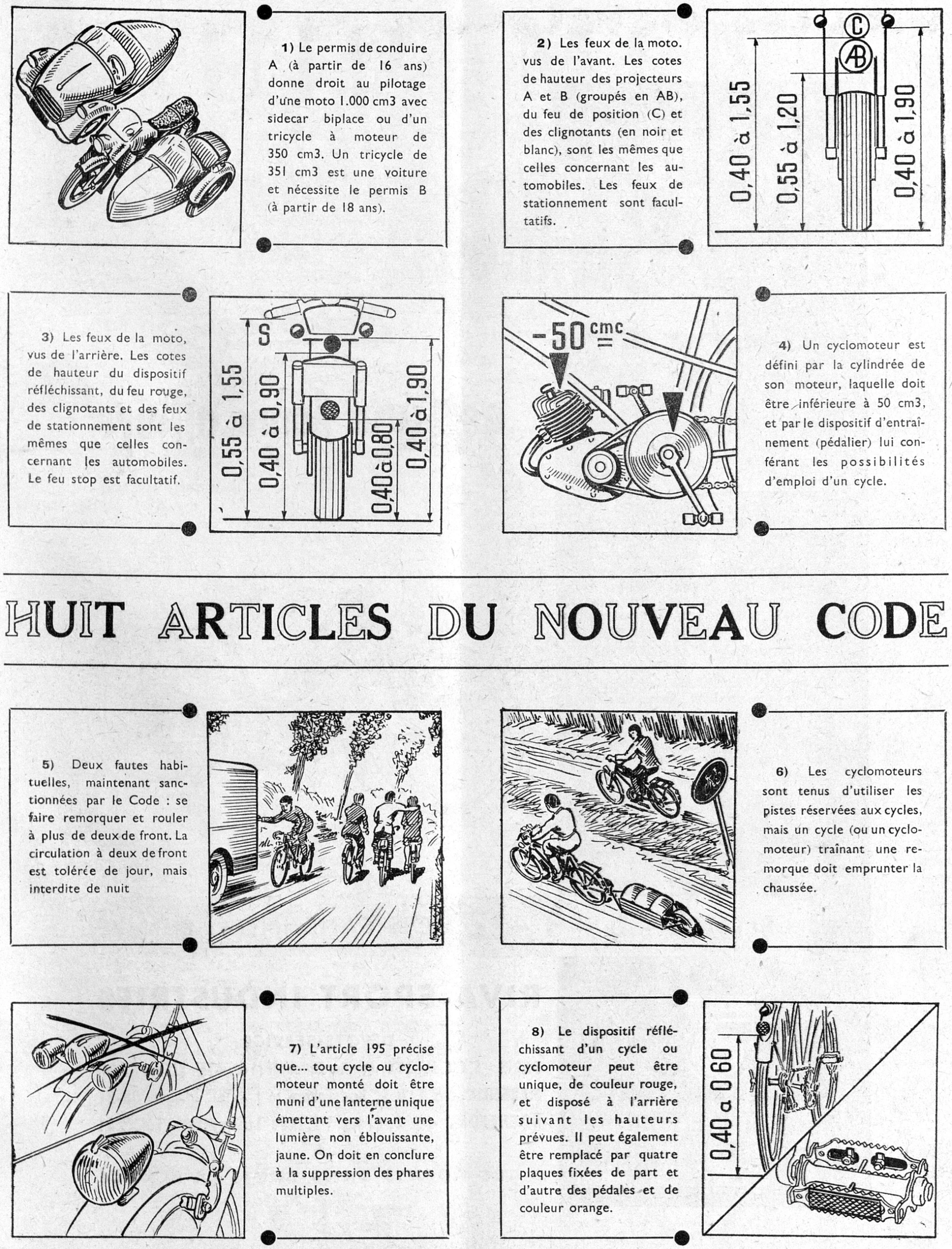
From L’Officiel du cycle, du motocycle et du camping, 2 October 1954, the paper’s special number before the 1954 Paris Salon du Cycle et du Motocycle, page 15: eight small illustrated panels on the new road code, with the license classes, the lamp heights of motorcycles, the definition of the cyclomoteur, the rules for cyclists riding two abreast or being towed, the single yellow lamp and the rear and pedal reflectors of cycles. The title, headings, captions and lists are transcribed as printed; the text is summarized in Ebykr’s words, and the page images carry it in full.
— Page 1 —
1) Le permis de conduire A (à partir de 16 ans) donne droit au pilotage d’une moto 1.000 cm3 avec sidecar biplace ou d’un tricycle à moteur de 350 cm3. Un tricycle de 351 cm3 est une voiture et nécessite le permis B (à partir de 18 ans).
2) Les feux de la moto. vus de l’avant. Les cotes de hauteur des projecteurs A et B (groupés en AB), du feu de position (C) et des clignotants (en noir et blanc), sont les mêmes que celles concernant les automobiles. Les feux de stationnement sont facultatifs.
C — AB — 0,40 à 1,55 — 0,55 à 1,20 — 0,40 à 1,90
3) Les feux de la moto, vus de l’arrière. Les cotes de hauteur du dispositif réfléchissant, du feu rouge, des clignotants et des feux de stationnement sont les mêmes que celles concernant les automobiles. Le feu stop est facultatif.
S — 0,55 à 1,55 — 0,40 à 0,90 — 0,40 à 0,80 — 0,40 à 1,90
4) Un cyclomoteur est défini par la cylindrée de son moteur, laquelle doit être inférieure à 50 cm3, et par le dispositif d’entraînement (pédalier) lui conférant les possibilités d’emploi d’un cycle.
-50 cmc
HUIT ARTICLES DU NOUVEAU CODE
5) Deux fautes habituelles, maintenant sanctionnées par le Code : se faire remorquer et rouler à plus de deux de front. La circulation à deux de front est tolérée de jour, mais interdite de nuit
6) Les cyclomoteurs sont tenus d’utiliser les pistes réservées aux cycles, mais un cycle (ou un cyclomoteur) traînant une remorque doit emprunter la chaussée.
7) L’article 195 précise que… tout cycle ou cyclomoteur monté doit être muni d’une lanterne unique émettant vers l’avant une lumière non éblouissante, jaune. On doit en conclure à la suppression des phares multiples.
8) Le dispositif réfléchissant d’un cycle ou cyclomoteur peut être unique, de couleur rouge, et disposé à l’arrière suivant les hauteurs prévues. Il peut également être remplacé par quatre plaques fixées de part et d’autre des pédales et de couleur orange.
0,40 à 0,60
[A full page of eight framed panels in black and white, each a line drawing paired with a numbered caption in plain sans-serif type. The panels are arranged in four rows of two, with the picture on the left and the caption on the right in some and the reverse in others. Each caption sits in a ruled box with a heavy black dot at the end of its upper and lower rule. The headline “HUIT ARTICLES DU NOUVEAU CODE” runs across the full width in a single line of widely spaced serif capitals between two thin horizontal rules, set between the second and third rows, with the letters alternating between solid black and outline forms. In the first panel a sidecar motorcycle and a small car are drawn from above in hatched line work. The second panel is a front view of a motorcycle front wheel and fork with two small lamps at the top, a circled C and a circled AB, and three vertical dimension lines with arrowheads lettered with heights. The third is a rear view of a motorcycle with a small round reflector, lamps and a rider’s handlebars, the letter S and four vertical dimension lines lettered with heights. The fourth is a close drawing of a small engine mounted beside a pedal crank and a large wheel with a chain, with two heavy black arrowheads and the mark “-50 cmc” above. The fifth is a road scene in which a cyclist at the left holds on to the side of a truck while three riders seen from behind ride abreast ahead. The sixth shows a rider on a cycle path beside a round road sign bearing a cycle and a second rider on the road pulling a small trailer loaded with a bundle. The seventh is split by a diagonal line into two views, with three lamps on a cycle crossed out by two heavy lines in the upper part and a single large lamp mounted on a front fork in the lower part. The eighth is split by a diagonal line into a rear wheel with a small reflector and a vertical dimension line in the upper part and a pedal drawn in the lower right. No signature, monogram or agency mark can be found in any panel.]
Ebykr presents this material for research and education. If you hold rights to it or notice an ownership issue, please contact us and we will respond promptly.
The Ebykr Digest
New articles, timelines, catalog finds and registry activity — assembled from the archive once a month. Your address is never shared.
Double opt-in. One email per month. Unsubscribe at any time with one click.