About Ebykr
Ebykr celebrates classic and vintage lightweight bicycles through provocative imagery and opinion. Ride along with us.
About Ebykr
Ebykr celebrates classic and vintage lightweight bicycles through provocative imagery and opinion. Ride along with us.

Source: Gallica (Bibliothèque nationale de France), L'Officiel du cycle, du motocycle et du camping, 2 October 1954, N° 40, page 172; ark:/12148/bd6t54206310j. Source gallica.bnf.fr / BnF.
| Type | Review |
|---|---|
| Year | 1954 |
| Publisher | L'Officiel du cycle |
| Country | France |
| Language | French |
| Pages | 1 |
| Source | Gallica (Bibliothèque nationale de France), L'Officiel du cycle, du motocycle et du camping, 2 October 1954, N° 40, page 172; ark:/12148/bd6t54206310j. Source gallica.bnf.fr / BnF. |
| Credit | Ebykr archive; Bibliothèque nationale de France |
| Identifier | Gallica (BnF) ark:/12148/bd6t54206310j/f171 |
| Transcription | Headings and specifications transcribed; article text summarized |
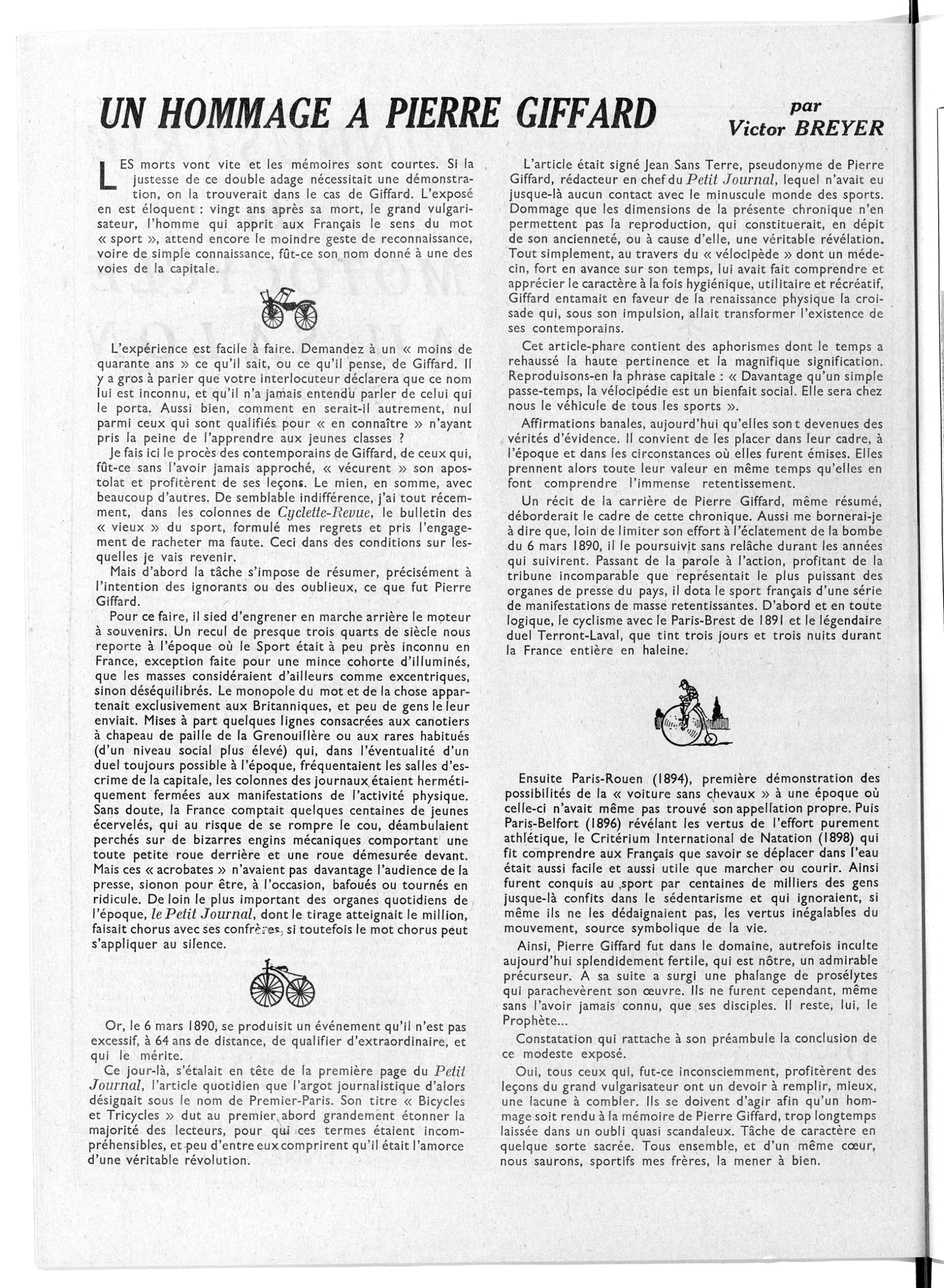
UN HOMMAGE A PIERRE GIFFARD par Victor BREYER
This is a magazine article, so its running text is summarized here rather than reproduced; the headline, byline, specifications and scores are transcribed as printed.
From L’Officiel du cycle, du motocycle et du camping, 2 October 1954, the paper’s special number before the 1954 Paris Salon du Cycle et du Motocycle, page 172: Victor Breyer’s tribute to Pierre Giffard, the Petit Journal editor who taught the French the meaning of the word sport, with his Paris-Brest of 1891 and Paris-Rouen of 1894. The title, headings, captions and lists are transcribed as printed; the text is summarized in Ebykr’s words, and the page images carry it in full.
— Page 1 —
UN HOMMAGE A PIERRE GIFFARD
par
Victor BREYER
[Ebykr summary; the article’s text is not reproduced. Breyer opens by saying that the dead go fast and memories are short, and that the case of Giffard would prove it. Twenty years after his death, he writes, the great popularizer, the man who taught the French the meaning of the word “sport”, still waits for the least gesture of recognition, or even simple knowledge of his name, such as having it given to one of the streets of the capital.]
[Ebykr summary, after the first ornament. Breyer says the test is easy: ask someone under forty what he knows of Giffard, and he will most likely say the name means nothing to him, since none of the people qualified to know about it took the trouble to teach it to the young. Breyer puts on trial the contemporaries of Giffard who “lived” his apostolate and profited from his lessons without ever approaching him, himself included. Quite recently, in the columns of Cyclette-Revue, the bulletin of the “old hands” of sport, he voiced his regrets and pledged to make amends, on terms he promises to explain. First he must summarize, for the ignorant and the forgetful, who Pierre Giffard was. Going back almost three quarters of a century, he describes a time when sport was nearly unknown in France apart from a thin band of enthusiasts whom the masses took for eccentrics if not for unbalanced men. The word and the thing belonged exclusively to the British, and few envied them. Except for a few lines on the straw-hatted boaters of La Grenouillère or on the rare fencing-hall regulars of higher social standing who feared a duel, the columns of the newspapers were tightly closed to physical activity. A few hundred young madcaps did ride odd machines with a tiny rear wheel and an enormous front wheel, at the risk of their necks, but the press gave these “acrobats” no hearing except to jeer at them or make them ridiculous. The Petit Journal, by far the largest daily of the time, with a circulation reaching a million, joined the chorus of its colleagues, if silence can be called a chorus.]
[Ebykr summary, after the second ornament. Breyer then turns to 6 March 1890, an event that he says is not excessive to call extraordinary 64 years later. On that day the front page of the Petit Journal carried the daily lead article, known in journalists’ slang as the Premier-Paris, under the title « Bicycles et Tricycles ». The title must at first have astonished most readers, for whom the terms were incomprehensible, and few of them understood that it opened a true revolution.]
[Ebykr summary, continuing in the right-hand column. The article was signed Jean Sans Terre, the pen name of Pierre Giffard, editor in chief of the Petit Journal, who until then had had no contact with the tiny world of sport. Breyer regrets that the length of his column does not allow it to be reproduced, since in spite of its age, or because of it, it would be a real revelation. Through the “vélocipède”, whose hygienic, useful and recreational character a doctor well ahead of his time had made him understand and value, Giffard began a crusade for physical renewal that was to transform the lives of his contemporaries. The article held aphorisms whose pertinence time has only heightened, and Breyer gives its key sentence, which says that velocipedy is more than a simple pastime, that it is a social benefit, and that it will be in France the vehicle of all sports. These claims are commonplace now that they have become self-evident truths, and they have to be set in their period to be understood. A full account of Giffard’s career would overflow the column, so Breyer says only that Giffard did not limit his effort to the bombshell of 6 March 1890 but pursued it tirelessly in the following years. Moving from words to action and using the unmatched platform of the country’s most powerful newspaper, he gave French sport a series of resounding mass events. First, and logically, came cycling with the Paris-Brest of 1891 and the legendary Terront-Laval duel, which for three days and nights kept the whole of France in suspense.]
[Ebykr summary, after the third ornament. Next came Paris-Rouen in 1894, the first demonstration of what the “voiture sans chevaux” could do, at a time when the machine had not yet found its own name. Then came Paris-Belfort in 1896, which revealed the virtues of purely athletic effort, and the Critérium International de Natation in 1898, which taught the French that knowing how to move in water was as easy and as useful as walking or running. In this way hundreds of thousands of people who had been shut up in a sedentary life, and who knew nothing of the unequaled virtues of movement as a symbol of life, if they did not scorn them, were won to sport. In the field that was once uncultivated and is now splendidly fertile, Breyer concludes, Pierre Giffard was an admirable precursor. A phalanx of proselytes followed him and completed his work, but even those who never knew him were only his disciples, and he remains the Prophet. This ties the conclusion to the opening: all those who profited from the great popularizer’s lessons, even unwittingly, have a duty to fulfill, or rather a gap to fill. They owe it to themselves to act so that homage is paid to the memory of Pierre Giffard, left too long in an almost scandalous oblivion. Breyer calls it a task of a nearly sacred kind and says that together, and with one heart, “sportifs mes frères” will know how to carry it through.]
[A page of text only, set in two columns with no ruled panel. The title “UN HOMMAGE A PIERRE GIFFARD” runs across the head in heavy, slanted, condensed capitals, and at its right the byline “par Victor BREYER” is set on two lines in bold italic, with “par” smaller above the name and the surname in capitals. The text is in a sans-serif roman face, with an italic or old-style face used for the titles Petit Journal and Cyclette-Revue. The first paragraph opens with a large sans-serif drop capital L. Three small line drawings serve as dividers between sections. The first, at the upper left, shows a draisienne-type machine with two spoked wheels and a padded seat and a curved rest. The second, in the lower left column, shows an early pedal bicycle with two spoked wheels of nearly equal size, a front fork and handlebar and a saddle. The third, in the right column, shows a rider in a striped jersey and cap seated high on a large-wheeled ordinary bicycle with a tiny rear wheel, with a low fence and trees drawn behind him. All are drawn in simple black line work. The sheet has a wide blank foot, and a dark binding strip shows along the right edge. No printed page number, signature or agency mark is visible.]
Ebykr presents this material for research and education. If you hold rights to it or notice an ownership issue, please contact us and we will respond promptly.
The Ebykr Digest
New articles, timelines, catalog finds and registry activity — assembled from the archive once a month. Your address is never shared.
Double opt-in. One email per month. Unsubscribe at any time with one click.