About Ebykr
Ebykr celebrates classic and vintage lightweight bicycles through provocative imagery and opinion. Ride along with us.
About Ebykr
Ebykr celebrates classic and vintage lightweight bicycles through provocative imagery and opinion. Ride along with us.

Source: Gallica (Bibliothèque nationale de France), L'Officiel du cycle, du motocycle et du camping, 2 October 1954, N° 40, page 57; ark:/12148/bd6t54206310j. Source gallica.bnf.fr / BnF.
| Type | Review |
|---|---|
| Year | 1954 |
| Publisher | L'Officiel du cycle |
| Country | France |
| Language | French |
| Pages | 1 |
| Source | Gallica (Bibliothèque nationale de France), L'Officiel du cycle, du motocycle et du camping, 2 October 1954, N° 40, page 57; ark:/12148/bd6t54206310j. Source gallica.bnf.fr / BnF. |
| Credit | Ebykr archive; Bibliothèque nationale de France |
| Identifier | Gallica (BnF) ark:/12148/bd6t54206310j/f56 |
| Transcription | Headings and specifications transcribed; article text summarized |
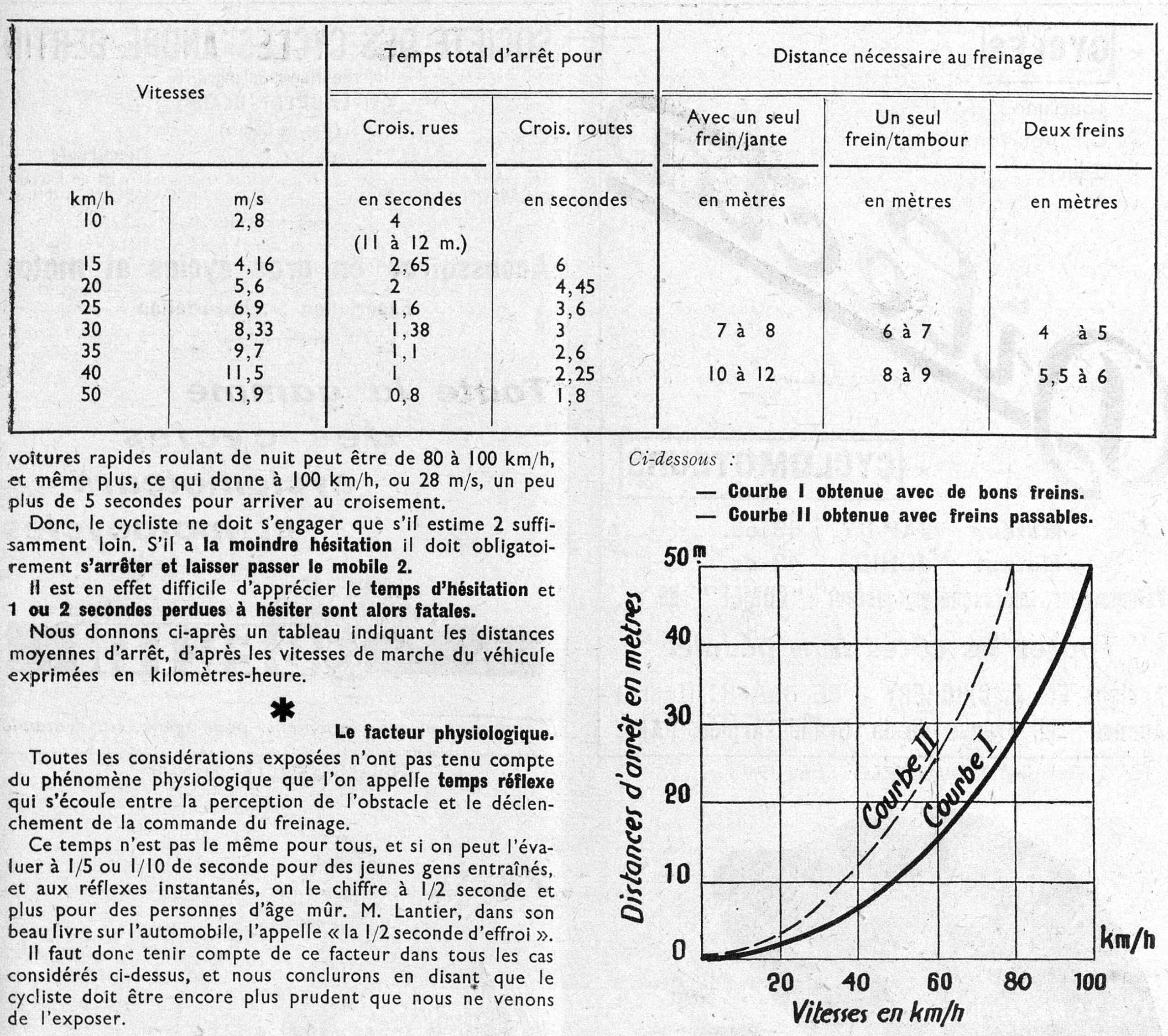
Vitesses — Temps total d'arrêt pour — Distance nécessaire au freinage km/h — m/s — Crois. rues — Crois. routes — Avec un seul frein/jante — Un seul frein/tambour — Deux freins km/h — m/s — en secondes — en secondes — en mètres — en mètres — en mètres 10 — 2,8 — 4 …
This is a magazine article, so its running text is summarized here rather than reproduced; the headline, byline, specifications and scores are transcribed as printed.
From L’Officiel du cycle, du motocycle et du camping, 2 October 1954, the paper’s special number before the 1954 Paris Salon du Cycle et du Motocycle, page 57: the second part of Paul Masson’s study of braking the bicycle, with its table of stopping times and braking distances for one rim brake, one drum brake or two brakes, the graph of stopping distances and a paragraph on the reflex time of the rider. The table and the headings are transcribed as printed; the text is summarized in Ebykr’s words, and the page image carries it in full.
— Page 1 —
Vitesses — Temps total d’arrêt pour — Distance nécessaire au freinage
km/h — m/s — Crois. rues — Crois. routes — Avec un seul frein/jante — Un seul frein/tambour — Deux freins
km/h — m/s — en secondes — en secondes — en mètres — en mètres — en mètres
10 — 2,8 — 4 (11 à 12 m.) — — — —
15 — 4,16 — 2,65 — 6 — — —
20 — 5,6 — 2 — 4,45 — — —
25 — 6,9 — 1,6 — 3,6 — — —
30 — 8,33 — 1,38 — 3 — 7 à 8 — 6 à 7 — 4 à 5
35 — 9,7 — 1,1 — 2,6 — — —
40 — 11,5 — 1 — 2,25 — 10 à 12 — 8 à 9 — 5,5 à 6
50 — 13,9 — 0,8 — 1,8 — — —
[Ebykr summary; the article’s text is not reproduced. The text under the table continues the open-road crossing from the previous page. The author says that the speed of fast cars running at night can be 80 to 100 km/h and even more, which at 100 km/h, or 28 m/s, leaves a little more than 5 seconds to reach the crossing. The cyclist must therefore commit himself only if he judges moving body 2 far enough away. At the least hesitation he must stop and let moving body 2 pass, since it is hard to judge the hesitation time and 1 or 2 seconds lost in hesitating are then fatal. He then announces a table of the average stopping distances according to the running speeds of the vehicle in kilometers an hour, which is the graph printed beside it.]
Ci-dessous :
— Courbe I obtenue avec de bons freins.
— Courbe II obtenue avec freins passables.
50 m
Distances d’arrêt en mètres
Vitesses en km/h
km/h
*
Le facteur physiologique.
[Ebykr summary, after a star break. The author says the considerations set out above did not take account of the physiological phenomenon called reflex time, which elapses between the perception of the obstacle and the start of the braking command. It is not the same for everyone: it can be put at 1/5 or 1/10 of a second for trained young people with instant reflexes, and at 1/2 second or more for people of mature age. M. Lantier, in his fine book on the automobile, calls it “la 1/2 seconde d’effroi”. This factor must therefore be allowed for in every case considered above, and the author concludes that the cyclist must be even more prudent than he has just set out.]
[A page made of a ruled table, a line graph and a block of text, in black and white. The table runs across the full width at the top in a heavy ruled frame with vertical dividing rules. It has a left block headed “Vitesses” with two columns, kilometers per hour and meters per second; a middle block headed “Temps total d’arrêt pour” with two columns for street crossings and road crossings; and a right block headed “Distance nécessaire au freinage” with three columns, one for a single rim brake, one for a single drum brake and one for two brakes. The figures are set in plain sans-serif type in eight rows, and the three braking-distance columns are filled in only on the rows for 30 and 40 km/h. The text below the table is set in plain sans-serif type across the full width, with a few phrases in heavy bold type: “la moindre hésitation”, “s’arrêter et laisser passer le mobile 2.”, “temps d’hésitation” and “1 ou 2 secondes perdues à hésiter sont alors fatales.” A small asterisk ornament and the bold right-aligned subhead “Le facteur physiologique.” open the last section, whose first paragraph runs in the same type, with “temps réflexe” in bold. At the right, under an italic “Ci-dessous :” and two bold key lines, a line graph is drawn in a ruled grid. The vertical axis is lettered in a slanted hand “Distances d’arrêt en mètres” and carries 0 to 50 in steps of 10, and the horizontal axis is lettered “Vitesses en km/h” and carries 20 to 100 in steps of 20. Two curves rise from the lower left toward the upper right: a heavy solid one lettered “Courbe I” along the lower side and a lighter dashed one lettered “Courbe II” above and to the left of it. There is no signature or agency mark. Faint reversed lettering from the back of the leaf shows through behind the table and graph.]
Ebykr presents this material for research and education. If you hold rights to it or notice an ownership issue, please contact us and we will respond promptly.
The Ebykr Digest
New articles, timelines, catalog finds and registry activity — assembled from the archive once a month. Your address is never shared.
Double opt-in. One email per month. Unsubscribe at any time with one click.