About Ebykr
Ebykr celebrates classic and vintage lightweight bicycles through provocative imagery and opinion. Ride along with us.
About Ebykr
Ebykr celebrates classic and vintage lightweight bicycles through provocative imagery and opinion. Ride along with us.

Source: Gallica (Bibliothèque nationale de France), L'Officiel du cycle, du motocycle et du camping, 2 October 1954, N° 40, page 55; ark:/12148/bd6t54206310j. Source gallica.bnf.fr / BnF.
| Type | Review |
|---|---|
| Year | 1954 |
| Publisher | L'Officiel du cycle |
| Country | France |
| Language | French |
| Pages | 1 |
| Source | Gallica (Bibliothèque nationale de France), L'Officiel du cycle, du motocycle et du camping, 2 October 1954, N° 40, page 55; ark:/12148/bd6t54206310j. Source gallica.bnf.fr / BnF. |
| Credit | Ebykr archive; Bibliothèque nationale de France |
| Identifier | Gallica (BnF) ark:/12148/bd6t54206310j/f54 |
| Transcription | Headings and specifications transcribed; article text summarized |
Un problème actuel QUELQUES CONSIDÉRATIONS SUR LE FREINAGE DES BICYCLETTES Une étude théorique * Croisement de rues. — A 60 km/h, il faut 16 à 18 m.; — A 50 km/h, — 11 à 12 m.; — A 40 km/h, — 8 à 9 m. * Croisement de deux routes en campagne. par Paul MASSON
This is a magazine article, so its running text is summarized here rather than reproduced; the headline, byline, specifications and scores are transcribed as printed.
From L’Officiel du cycle, du motocycle et du camping, 2 October 1954, the paper’s special number before the 1954 Paris Salon du Cycle et du Motocycle, page 55: the first part of Paul Masson’s theoretical study of braking the bicycle: the unsignaled street crossings and the open-road crossings where the cyclist must stop, with the diagrams of the three positions in which he meets a vehicle coming from the right. The title, headings, captions and lists are transcribed as printed; the text is summarized in Ebykr’s words, and the page images carry it in full.
— Page 1 —
Un problème actuel
QUELQUES CONSIDÉRATIONS
SUR LE
FREINAGE DES BICYCLETTES
Une étude théorique
[Ebykr summary; the article’s text is not reproduced. The author opens by saying that the question of braking is always burning, and that the press, the radio and the public authorities urge road users to respect the Code de la route and to take care in every dangerous place. For cyclists he does not think it useful to recommend never overtaking without absolute visibility, since in practice they can overtake only another cyclist, races aside. The danger that cannot be avoided for them, he says, is that of every kind of crossing. He then distinguishes the crossings of streets from those on the road. In the large arteries with signals one waits for the green light and there is no accident; the unsignaled street crossings, which are the most numerous, and the crossings on the open road remain.]
*
Croisement de rues.
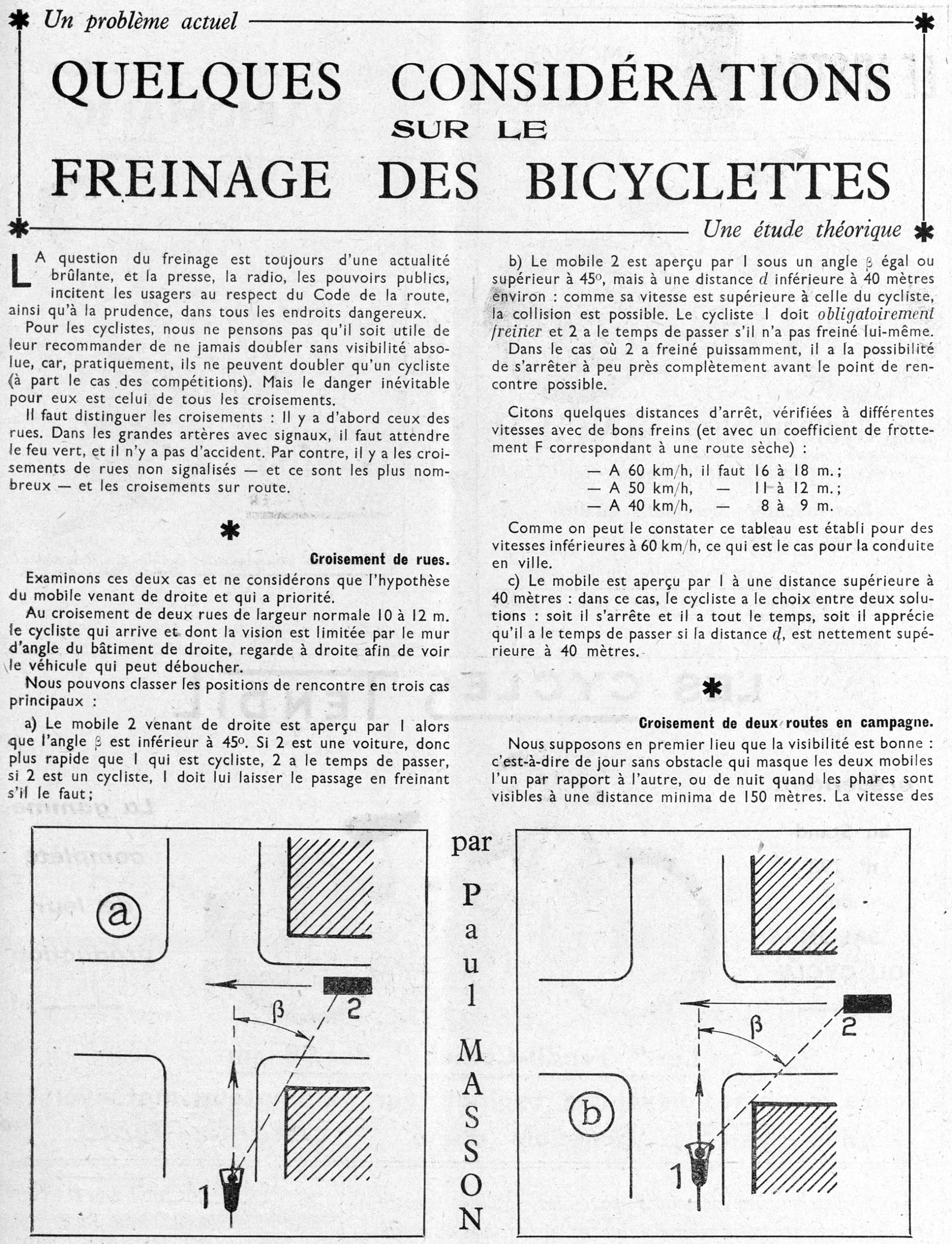
[Ebykr summary, after a star break. He proposes to examine these two cases and to consider only the vehicle that comes from the right and has priority. At the crossing of two streets of normal width, 10 to 12 m., the cyclist who arrives has his view limited by the corner wall of the building on his right and looks right to see any vehicle that may emerge. He sorts the positions of meeting into three principal cases. In case a, the moving body 2 coming from the right is seen by 1 while the angle β is under 45 degrees: if 2 is a car, and so faster than 1, a cyclist, it has time to pass; if 2 is a cyclist, 1 must give it the way, braking if necessary. In case b, 2 is seen by 1 at an angle β equal to or greater than 45 degrees but at a distance d under about 40 meters: since its speed is higher than the cyclist’s, a collision is possible, so cyclist 1 must brake without fail and 2 has time to pass if it has not braked itself. If 2 has braked hard, it can stop almost completely before the possible point of meeting.]
[Ebykr summary, continued. The author goes on to cite some stopping distances verified at different speeds with good brakes and a friction coefficient F corresponding to a dry road, which are given here as printed.]
— A 60 km/h, il faut 16 à 18 m.;
— A 50 km/h, — 11 à 12 m.;
— A 40 km/h, — 8 à 9 m.
[Ebykr summary, continued. He notes that the table holds for speeds under 60 km/h, as in town driving. In case c the moving body is seen by 1 at a distance above 40 meters: the cyclist then has the choice of two solutions, either he stops and has all the time, or he judges that he has time to cross if the distance d is clearly above 40 meters.]
*
Croisement de deux routes en campagne.
[Ebykr summary, after a second star break. The author supposes first that visibility is good, meaning by day with no obstacle hiding the two moving bodies from each other, or by night when the headlamps can be seen from a minimum distance of 150 meters. The column breaks off at the foot with the words “La vitesse des”, and the study continues on a later page.]
par
Paul MASSON
[A page of text with two diagrams, in black and white. A thin ruled frame with a small asterisk ornament at each corner runs across the full width at the top, with the italic kicker “Un problème actuel” set into the upper rule at the left and the italic line “Une étude théorique” set into the lower rule at the right. Inside the frame the headline stands in large light serif capitals: “QUELQUES CONSIDÉRATIONS” on the first line and “FREINAGE DES BICYCLETTES” on the third, with a short line “SUR LE” in heavy widely spaced sans-serif capitals between them toward the right. Below the frame the text is set in two columns of plain sans-serif type, and the first paragraph opens with a large drop capital L. The subheads “Croisement de rues.” and “Croisement de deux routes en campagne.” are set in heavy condensed type, aligned to the right of each column, the first under a small asterisk ornament. Across the lower part of the page two square line diagrams stand side by side in ruled boxes, one under each column. Each is a plan view of a street crossing, with the roads drawn as outlines, two blocks of buildings shown in diagonal hatching at the right, a small cyclist figure marked 1 seen from above coming up the street from the foot, a black rectangle marked 2 at the right for the vehicle arriving from the right with a long arrow pointing left, a dashed sight line from the cyclist toward the rectangle and the angle β marked by an arc against the line of the street. The left diagram carries a circled a, with a steep sight line that passes the corner of the lower block at a narrow angle. The right one carries a circled b, with the sight line at about 45 degrees. At the left of the right-hand diagram the author’s credit “par Paul MASSON” is set vertically, one letter to a line, in serif type. No artist signature appears in the diagrams. Faint reversed lettering from the back of the leaf shows through in places.]
Ebykr presents this material for research and education. If you hold rights to it or notice an ownership issue, please contact us and we will respond promptly.
The Ebykr Digest
New articles, timelines, catalog finds and registry activity — assembled from the archive once a month. Your address is never shared.
Double opt-in. One email per month. Unsubscribe at any time with one click.