About Ebykr
Ebykr celebrates classic and vintage lightweight bicycles through provocative imagery and opinion. Ride along with us.
About Ebykr
Ebykr celebrates classic and vintage lightweight bicycles through provocative imagery and opinion. Ride along with us.

Source: Gallica (Bibliothèque nationale de France), L'Officiel du cycle, du motocycle et du camping, 2 October 1954, N° 40, pages 89, 91, 92, 95, 99, 101, 102, 105, 107 and 109; ark:/12148/bd6t54206310j. Source gallica.bnf.fr / BnF.
| Type | Review |
|---|---|
| Year | 1954 |
| Publisher | L'Officiel du cycle |
| Country | France |
| Language | French |
| Pages | 10 |
| Source | Gallica (Bibliothèque nationale de France), L'Officiel du cycle, du motocycle et du camping, 2 October 1954, N° 40, pages 89, 91, 92, 95, 99, 101, 102, 105, 107 and 109; ark:/12148/bd6t54206310j. Source gallica.bnf.fr / BnF. |
| Credit | Ebykr archive; Bibliothèque nationale de France |
| Identifier | Gallica (BnF) ark:/12148/bd6t54206310j/f88 |
| Transcription | Headings and specifications transcribed; article text summarized |
Les carburateurs GURTNER Les fabrications GUTTACOLL — Le carter guide-chaîne caoutchouc Olux ; — Le patin de frein zébré ; — La gaine Olux pour guidon — Les tresses pour guidons, Tressolux et Guideol ; — Le ruban Boyeol ; — Les bouchons de guidons et capuchons de molettes de dynamos, — et la dissolution …
This is a magazine article, so its running text is summarized here rather than reproduced; the headline, byline, specifications and scores are transcribed as printed.
From L’Officiel du cycle, du motocycle et du camping, 2 October 1954, the paper’s special number before the 1954 Paris Salon du Cycle et du Motocycle, pages 89, 91, 92, 95, 99, 101, 102, 105, 107 and 109: the second part of chapter two of Gilbert Victor’s survey of equipment and tools shown at the Salon, firm by firm, from cycling shoes, clocks and wrenches to handlebars, rims, mudguards and hubs. The title, headings, captions and lists are transcribed as printed; the text is summarized in Ebykr’s words, and the page images carry it in full.
— Page 1 —
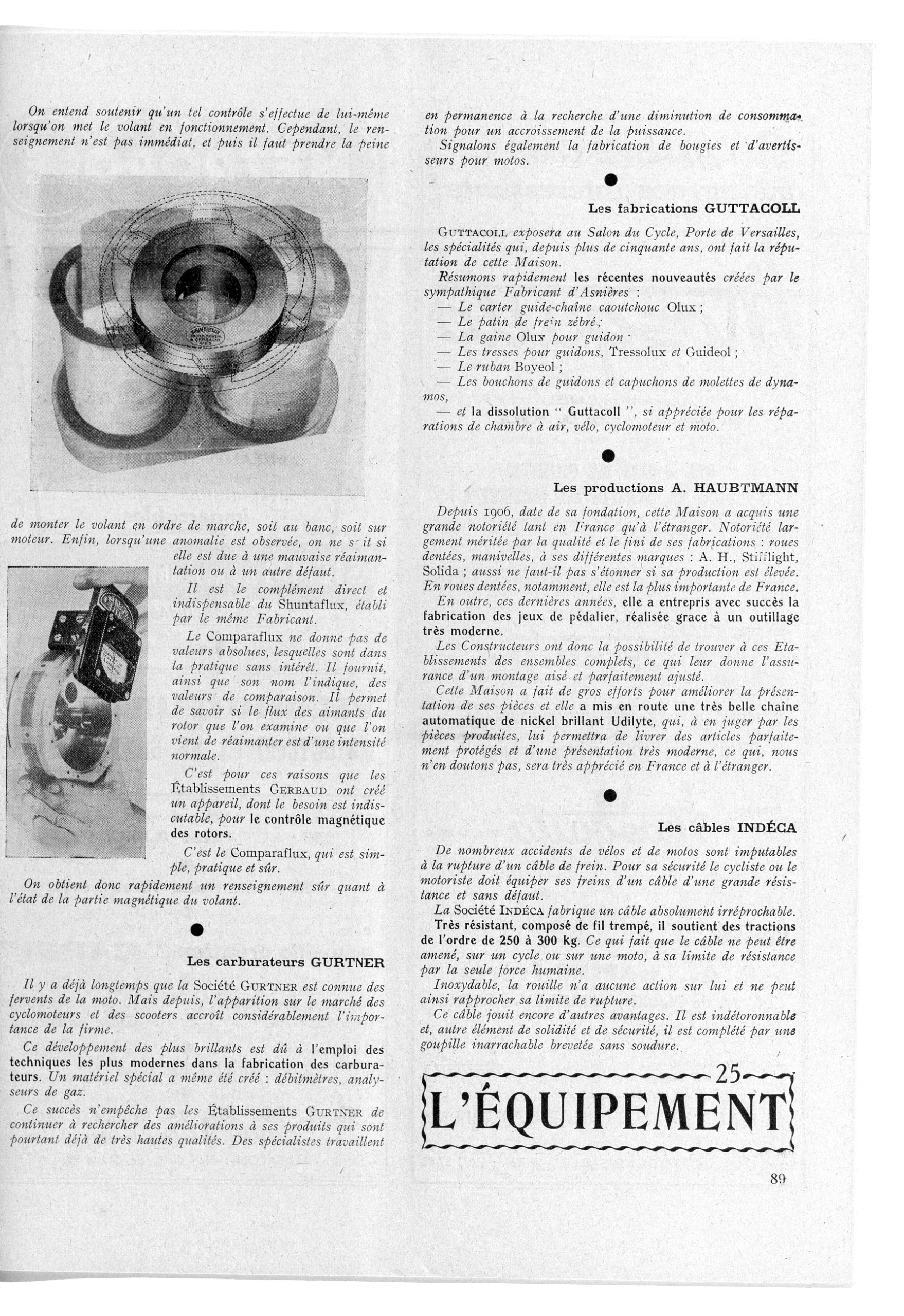
[Ebykr summary; the article’s text is not reproduced. The opening lines continue the Gerbaud section begun on the previous page, on the control of flywheel magnetization. The author notes the claim that such a control happens by itself when the flywheel is put to work, but says the information is not immediate: one must take the trouble to mount the flywheel in running order, either on a bench or on an engine. When an anomaly is then observed, one does not know whether it comes from a poor remagnetization or from another fault.]
[Ebykr summary, after the first photograph. The Comparaflux is the direct and indispensable complement of the Shuntaflux, made by the same maker. It gives no absolute values, which are of no interest in practice, but values of comparison, as its name says, and tells whether the flux of the magnets of the rotor under examination, or just remagnetized, is of normal intensity. For these reasons the Établissements Gerbaud have created an apparatus, of indisputable need, for the magnetic control of rotors: the Comparaflux, described as simple, practical and sure. A reliable report on the state of the magnetic part of the flywheel is thus obtained quickly.]
Les carburateurs GURTNER
[Ebykr summary; the article’s text is not reproduced. The Société Gurtner has long been known to motorcycle enthusiasts, and its appearance since then on the market of cyclomoteurs and scooters greatly increases the importance of the firm. The author attributes this brilliant development to the use of the most modern techniques in carburetor manufacture, for which special equipment has even been created: flowmeters and gas analyzers. The success does not stop the Établissements Gurtner from seeking improvements to products that are already of very high quality; specialists work permanently in search of a reduction in consumption for an increase in power. The firm also makes spark plugs and horns for motorcycles.]
Les fabrications GUTTACOLL
[Ebykr summary; the article’s text is not reproduced. Guttacoll will exhibit at the Salon du Cycle, Porte de Versailles, the specialties that have made the reputation of the house for more than fifty years. The author then sums up the recent novelties created by the maker, of Asnières:]
— Le carter guide-chaîne caoutchouc Olux ;
— Le patin de frein zébré ;
— La gaine Olux pour guidon
— Les tresses pour guidons, Tressolux et Guideol ;
— Le ruban Boyeol ;
— Les bouchons de guidons et capuchons de molettes de dynamos,
— et la dissolution ” Guttacoll “, si appréciée pour les réparations de chambre à air, vélo, cyclomoteur et moto.
Les productions A. HAUBTMANN
[Ebykr summary; the article’s text is not reproduced. Since its founding in 1906 the house has gained a great reputation in France and abroad, largely earned by the quality and finish of its products: chainwheels and cranks under its various marques A. H., Stifflight and Solida. Its output is therefore high, and in chainwheels in particular it is the largest in France. In recent years it has also successfully begun making bottom bracket sets, with very modern tooling, so that constructors can find complete sets there and be sure of easy, perfectly fitted assembly. The house has made great efforts to improve the presentation of its parts and has started up a fine automatic bright nickel line, Udilyte, which should let it deliver well-protected articles of a very modern appearance, something the author expects to be much appreciated in France and abroad.]
Les câbles INDÉCA
[Ebykr summary; the article’s text is not reproduced. Many bicycle and motorcycle accidents are due to the breaking of a brake cable, so the cyclist or motorist should fit his brakes with a cable of great strength and free of faults. The Société Indéca makes a cable it calls absolutely irreproachable. Made of hardened wire, it withstands pulls of the order of 250 to 300 kg, which means it cannot be brought to its limit on a cycle or motorcycle by human force alone. It is stainless, so rust has no action on it and cannot bring it closer to breaking. It is also described as non-fraying (“indétoronnable”) and is completed by a patented non-removable pin made without solder.]
L’ÉQUIPEMENT
25
89
[A full page of text in two columns, set in italic and roman book type with bold passages, with no advertisement. The left column begins in the middle of a sentence carried over from the previous leaf. Under its first lines stands a wide halftone photograph, with no caption, of a round ring-shaped rotor lying in a circular base with two raised curved pole pieces, a broken-line drawing laid over it to trace the arrangement of its parts, and a small oval label on the rotor rim that reads in part “SHUNTAFLUX” and “A. GERBAUD” with a place name too small to make out. Lower down a narrow halftone photograph, also without a caption, shows a hand holding a black rectangular meter with a curved scale above a pale round rotor; the text wraps to the right of it. The left column ends with the Gurtner section, which carries over to the top of the right column. Each section opens with a bold sans-serif heading aligned to the right, and round black bullets divide the sections; the Guttacoll novelties are set as a dashed list in italic. The title “L’ÉQUIPEMENT” stands in large roman capitals inside a wavy-edged ruled frame at the foot of the right column, with the number 25 above the frame at its right, and the printed page number 89 sits below it. No signature or artist mark appears, and no text from the reverse of the leaf shows through.]
— Page 2 —
Les chaussures cyclistes HUNGARIA
[Ebykr summary; the article’s text is not reproduced. The author says followers of cycling know that a pair of good shoes is indispensable for long tours by bicycle, and that not only professional champions but also amateurs who ride for pleasure will agree.]
[Ebykr summary, after the engraving. The Société Hungaria presents a cycling shoe called “spécial-course”, a name that indicates the qualities expected of it, solidity and suppleness among them. The shoe is made with ventilation holes, as shown by model 107 pictured above, and is said to boast sensational performances: it is called the fastest shoe in the world. José Meiffret was wearing the model 107 with ventilation holes when he broke the world speed record at 175 km 609 per hour. The author asks whether better references could be given.]
Les pédales ISO
[Ebykr summary; the article’s text is not reproduced. The magazine promises to return to this remarkable equipment under the “Bicyclette” heading of one of its next issues, and here gives only a few indications about the improvement it brings to the bicycle.]
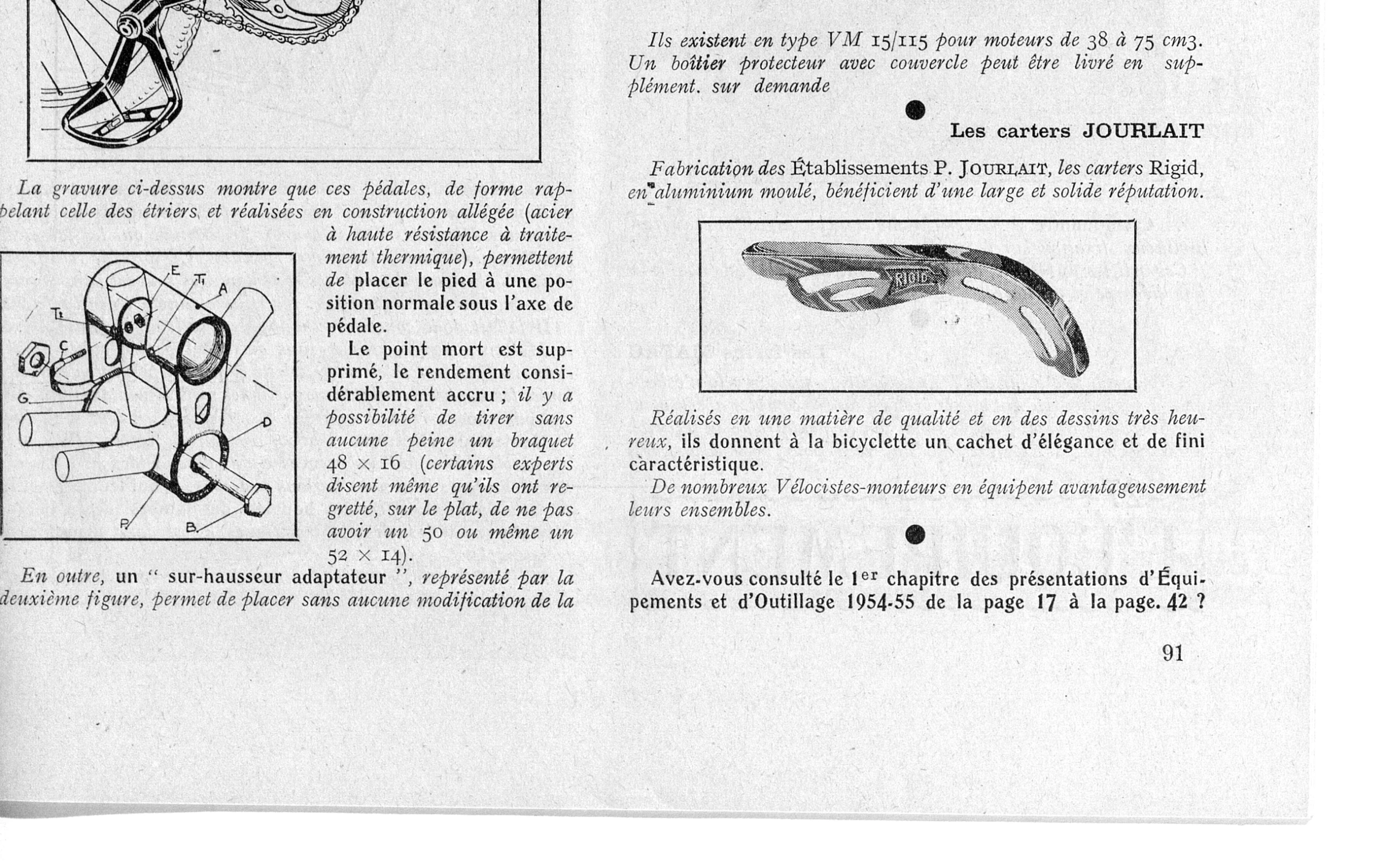
[Ebykr summary, after the first engraving. The engraving shows that these pedals, shaped like stirrups and built light (high-strength heat-treated steel), allow the foot to be placed in a normal position under the pedal axis. The dead point is removed and the efficiency greatly increased; one can pull without any trouble a gear of 48 x 16, and some experts say that they privately regretted not having a 50 or even a 52 x 14. In addition, a “sur-hausseur adaptateur”, shown in the second figure, allows the old bottom bracket bearing to be placed, with no change to the existing bicycle, at the greatest height, which gives standing pedaling the full measure of its exceptional efficiency. The author adds that the maker of the Iso pedal has also developed a frame and fork of a special type. Their advantages are essentially a large reduction in the surface of the frame and therefore in the length of its tubes, hence great rigidity even with reduced wall thickness; a notable lightening of the frame; and an astonishing suspension provided by the new fork, strongly inclined and curved, which makes use of the overall shape of the frame, whose tubes are laid much farther toward the rear.]
L’ÉQUIPEMENT
26
Les volants magnétiques JEUMONT
[Ebykr summary; the article’s text is not reproduced. These flywheels are made at Arnage (Sarthe), in large modern workshops by a highly specialized staff. They exist in type VM 15/115 for engines of 38 to 75 cm3. A protective housing with a cover can be supplied as an extra on request.]
Les carters JOURLAIT
[Ebykr summary; the article’s text is not reproduced. The Rigid chain guards made by the Établissements P. Jourlait, in cast aluminum, enjoy a wide and solid reputation.]
[Ebykr summary, after the engraving. Made of a quality material and in very pleasing designs, they give the bicycle a characteristic stamp of elegance and finish. Many dealer-assemblers fit them to advantage on their bicycles.]
Avez-vous consulté le 1er chapitre des présentations d’Équipements et d’Outillage 1954-55 de la page 17 à la page 42 ?
91
[A full page of text in two columns, set in italic and roman book type with bold passages, with no advertisement. Each section opens with a bold sans-serif heading aligned to the right, and round black bullets divide the sections. The left column opens with the Hungaria heading and a line engraving in a ruled rectangle of a low lace-up cycling shoe in black with a pale perforated quarter, white stitching and a thin heel block. Under the Iso heading come two illustrations. The first is a line engraving in a ruled rectangle of a crank and chainwheel behind a chain guard that carries the name “RHONSON”, with a stirrup-shaped pedal at each crank; this is a second brand name apart from Iso. The second is a smaller line drawing in a ruled square, set at the left with the text wrapped beside it, of a bracket joining tube stubs to a bottom bracket shell, with a bolt and a nut and the reference letters E, T1, T2, A, C, G, D, P and B. The left column breaks off in the middle of a sentence, which continues at the top of the right column beneath the title “L’ÉQUIPEMENT” in large roman capitals inside a wavy-edged ruled frame, with the number 26 below the frame at its right. In the right column a wide halftone photograph, with no caption, shows a magnetic flywheel rotor lying open to the left of a round stator plate fitted with a coil, a condenser and a cable ending in a plug cap. A ruled line engraving of a pierced, curved aluminum chain guard with the word “RIGID” on its side follows the Jourlait lines. The page closes with a bold sans-serif question set across the foot of the right column, above the printed page number 91. No signature or artist mark appears, and no text from the reverse of the leaf shows through.]
— Page 3 —
La MANUFACTURE d’HORLOGERIE de BÉTHUNE
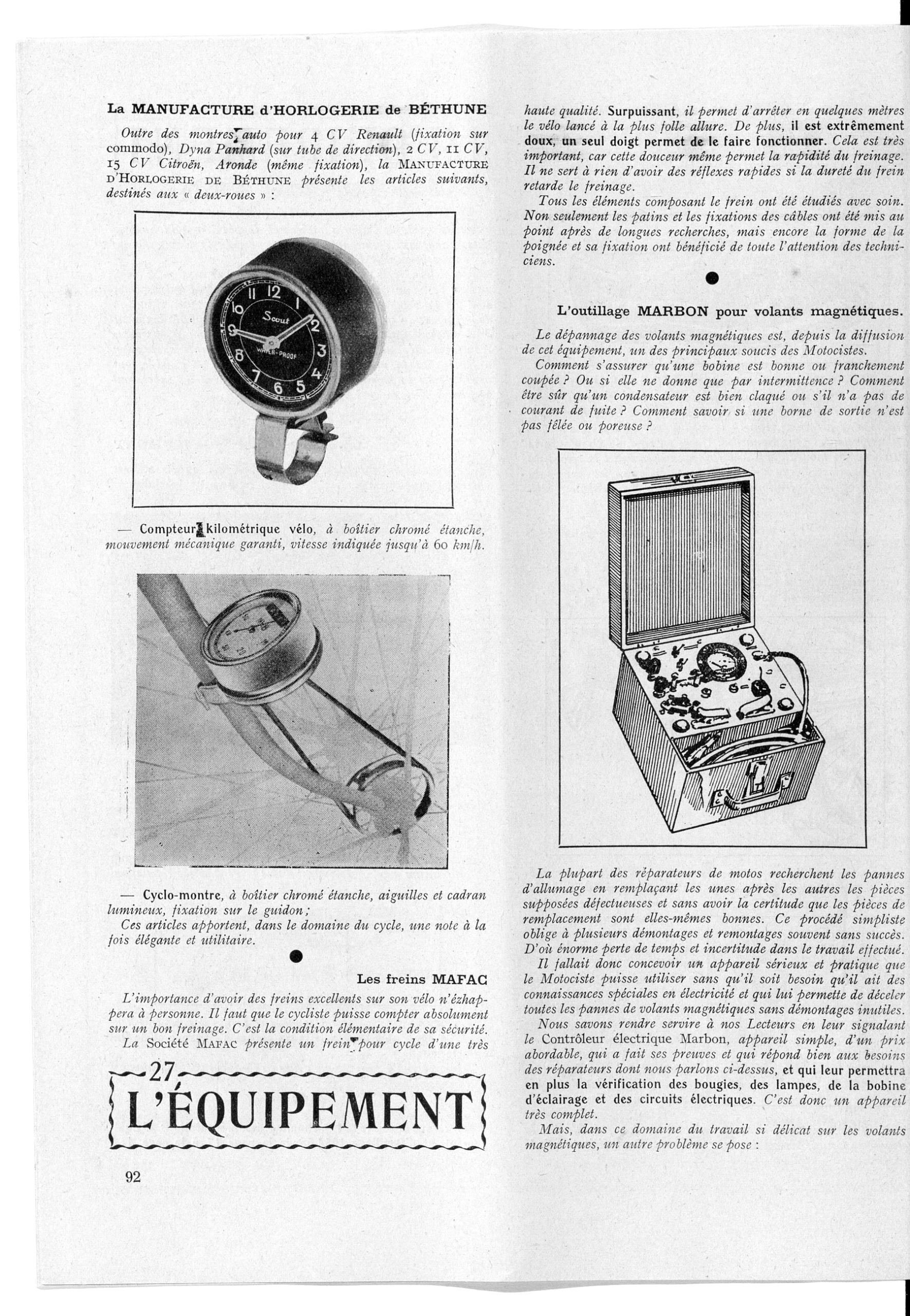
[Ebykr summary; the article’s text is not reproduced. Besides automobile clocks for the 4 CV Renault (fixed on the commodo, the steering-column switch stalk), the Dyna Panhard (on the steering tube), the 2 CV, the 11 CV and the 15 CV Citroën and the Aronde (same fixing), the Manufacture d’Horlogerie de Béthune presents the following articles intended for “deux-roues” (two-wheelers).]
— Compteur kilométrique vélo, à boîtier chromé étanche, mouvement mécanique garanti, vitesse indiquée jusqu’à 60 km/h.
— Cyclo-montre, à boîtier chromé étanche, aiguilles et cadran lumineux, fixation sur le guidon;
[Ebykr summary; the article’s text is not reproduced. The author closes the Béthune item by saying that these articles bring to the field of the bicycle a note that is both elegant and utilitarian.]
Les freins MAFAC
[Ebykr summary; the article’s text is not reproduced. The importance of having excellent brakes on one’s bicycle escapes no one; the cyclist must be able to count absolutely on good braking, which is the elementary condition of his safety. The Société Mafac presents a bicycle brake of very high quality. It is powerful and can stop a bicycle launched at the wildest speed in a few meters. It is also extremely gentle: a single finger operates it, and the author stresses that this gentleness is what makes the braking quick, since quick reflexes are of no use if the hardness of the brake delays the braking. All the elements of the brake were studied with care: not only the shoes (patins) and the cable fixings were perfected after long research, but also the shape of the lever grip (poignée) and its fixing received the full attention of the technicians. No model name, price or weight is given.]
L’outillage MARBON pour volants magnétiques.
[Ebykr summary; the article’s text is not reproduced. Servicing magnetic flywheels has been, since the spread of this equipment, one of the main worries of motorcycle dealers (Motocistes). The text asks how to be sure that a coil is good, or cut outright, or gives current only intermittently; how to be sure that a condenser is truly blown, or has no leakage current; and how to know whether an output terminal is cracked or porous.]
[Ebykr summary; the article’s text is not reproduced. Most motorcycle repairers look for ignition faults by replacing the suspected parts one after another, without certainty that the replacement parts are themselves good; this simplistic method forces several dismantlings and reassemblings, often without success, with an enormous loss of time and uncertainty in the work done. A serious and practical apparatus was therefore needed that the motorcycle dealer can use without special knowledge of electricity and that lets him find all magnetic-flywheel faults without needless dismantling. The author says he is serving readers by pointing out the Marbon electrical tester (Contrôleur électrique Marbon): a simple apparatus at an affordable price, proven, which answers the needs of the repairers described, and which in addition lets them check spark plugs, bulbs, the lighting coil and the electrical circuits, which makes it a very complete apparatus. The text then begins a new thought, saying that in this delicate field of work on magnetic flywheels another problem arises, and the column ends on that colon with no continuation on the page. The author’s wording at one point reads “rendre servire” as printed.]
27
L’ÉQUIPEMENT
92
[A full text page of a trade survey, set in two columns of French type, mostly italic with some bold roman lines and bold roman firm headings; the left column begins lower than the right. At the upper left the bold heading of the Béthune item runs across the top of the left column above an italic paragraph. Below it a large framed halftone photograph shows a round handlebar-mounted clock with a dark case, a dark dial with white numerals 1 to 12, two pointed hands and the words “Scout” and “WATER-PROOF” on the face, held by a bright metal clamp strap below. Under its caption, in which a dash precedes the bold item name, a second framed halftone photograph, coarser in screen, shows a chromed round meter case with a pale dial clamped on a slanting handlebar tube, with a small band fitting at the lower right. A third caption follows, then a short closing paragraph, a solid black bullet, and the heading “Les freins MAFAC” in small bold roman, right-aligned, with its italic text running on into the right column. In the right column a bold heading “L’outillage MARBON pour volants magnétiques.” is right-aligned above italic text, and a large framed line engraving in black hatching shows an open portable test case: the lid stands upright with a lined lining, and the case holds a panel with a round dial meter, toggle switches, knobs and terminals, a flexible cable leading out to the right and a handle and latch on the front. At the foot of the left column a wavy-bordered panel carries the number 27 above the large roman capitals L’ÉQUIPEMENT, with the printed page number 92 beneath it. The lower half of the right column is blank. A solid black bullet separates the items. No artist signature or monogram is visible.]
— Page 4 —
[Ebykr summary; the article’s text is not reproduced. The page opens mid-item with the end of a piece on a flywheel-removal tool whose heading lies on the previous page. Dismantling magnetic flywheels calls for particular care: the nut that locks the flywheel on its cone is always tightened very hard and the rotor cage offers practically no outside grip, so repairers use empirical methods such as wound straps or ropes, or locking the primary transmission with a wedge pushed between the pinions. These methods, unfortunately used too much, give no safety guarantee (the rope or straps may break or slip), risk damaging the flywheel or the gearing and in any case waste precious time. The author then names a very well designed apparatus, the Armo, which locks magnetic flywheels effectively so that they can be removed and refitted easily and quickly. Other advantages: it fits all magnetic flywheels whatever their diameter, and its price, among the most accessible, lets the conscientious motorcycle dealer modernize his tooling.]
Les avertisseurs MAURY
[Ebykr summary; the article’s text is not reproduced. Under their brand “Le Coq”, the Établissements Paul Maury, well known to cycle dealers (Vélocistes), bring out a series of high-quality bicycle horns and bells (avertisseurs), listed rapidly as follows.]
— Modèles 40 C, 50 C et 60 C, respectivement de 40, 50 et 60 mm ;
— Modèle 600 C, de 60 mm, à cuvette tournante ;
— Modèle 880 MC, de 80 mm, à double sonorité ; orientable sur le guidon ;
— Modèle « Bellemarque » portant en lettres gravées et coloriées la marque du Constructeur du cycle ;
(Tous ces timbres possèdent une cloche en acier nickelé chromé) ;
— Modèle « Tartarin », également gravé, mais avec lettres en relief sur fond émail, cloche en zamak.
En timbres pour cyclomoteurs, notons le modèle « 1953 », à fonctionnement électro-mécanique.
Les moyeux MAXI et MAXI-CAR
[Ebykr summary; the article’s text is not reproduced. Founded in 1916, the Établissements E. Dépalle of Saint-Etienne (printed without the accent) have specialized for twenty years in making drum-brake hubs for bicycles and tandems. The Maxi drum brakes won the main technical-trial events held before 1939. The vogue of the cyclomoteur has allowed the firm to launch several hub models that adapt to the various combinations of the constructors. The firm, which the author calls remarkably run by MM. Bessière, father and sons, also makes the specialties of cycle touring: the Maxi-Car hubs with annular (ball) bearings, which distinguished themselves once again in the latest Paris-Brest and return by taking the first places among the randonneurs, in men’s tandems, men’s bicycles and mixed tandems.]
Les béquilles MEYRAT
[Ebykr summary; the article’s text is not reproduced. If technical progress has singularly improved the running of engines over the last few years, this progress…]
L’ÉQUIPEMENT
28
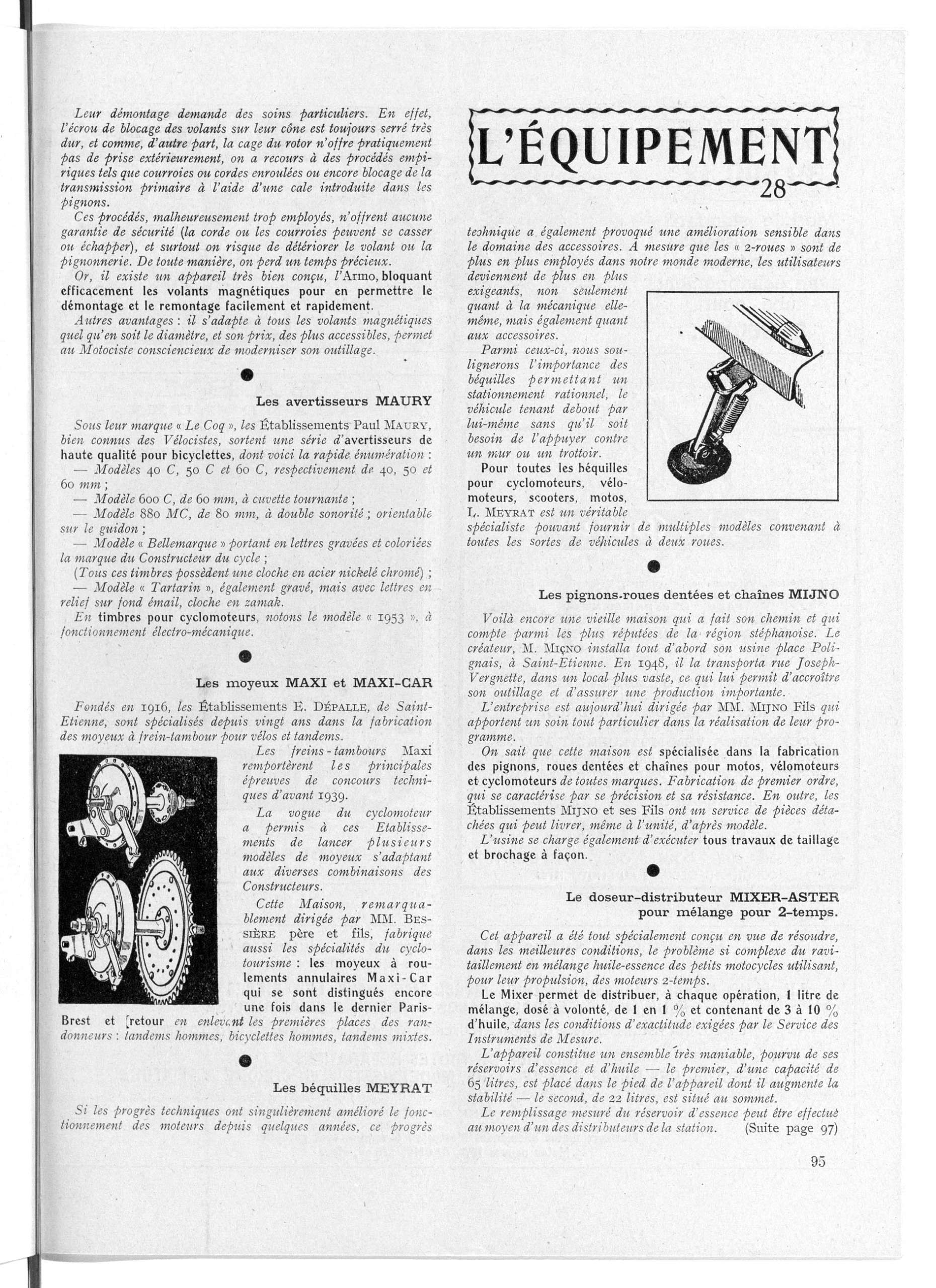
[Ebykr summary, after the running head, where the sentence continues in the right column. …technical progress has also brought a marked improvement in accessories. As two-wheelers are used more and more in the modern world, their users become more and more demanding, not only about the mechanics themselves but also about accessories. Among these the author stresses the importance of stands (béquilles) that allow rational parking, the vehicle standing up by itself with no need to lean it against a wall or a curb. For all stands for cyclomoteurs, vélomoteurs, scooters and motorcycles, L. Meyrat is a true specialist who can supply many models suited to every kind of two-wheeled vehicle.]
Les pignons-roues dentées et chaînes MIJNO
[Ebykr summary; the article’s text is not reproduced. Here is another old firm that has made its way and ranks among the most reputed of the Saint-Etienne region (région stéphanoise). The founder, M. Mijno (the first letter of the surname is damaged in print and reads like a cedilla), first set up his factory at place Polignais in Saint-Etienne; in 1948 he moved it to rue Joseph-Vergnette, into larger premises, which let him enlarge his tooling and ensure a large output. The business is now run by MM. Mijno Fils, who take particular care over carrying out their program.]
[Ebykr summary; the article’s text is not reproduced. The house is known to specialize in making sprockets, toothed wheels and chains for motorcycles, vélomoteurs and cyclomoteurs of all makes: first-rate manufacture marked by precision and strength (the text prints “se précision” for “sa précision”). The Établissements Mijno et ses Fils also run a spare-parts service that can deliver even single pieces to the model. The factory also undertakes all gear-cutting and broaching work to order.]
Le doseur-distributeur MIXER-ASTER
pour mélange pour 2-temps.
[Ebykr summary; the article’s text is not reproduced. The apparatus was designed specially to solve, under the best conditions, the complex problem of supplying small motorcycles with two-stroke engines with an oil-and-petrol mixture. The Mixer delivers, at each operation, 1 liter of mixture, dosed as desired in steps of 1 percent and containing from 3 to 10 percent oil, within the accuracy required by the Service des Instruments de Mesure (the French measuring-instruments service). The apparatus is a very handy unit with its petrol and oil tanks: the first, with a capacity of 65 liters, sits in the foot of the apparatus, whose stability it increases; the second, of 22 liters, sits at the top. The measured filling of the petrol tank can be done with one of the pumps of the filling station.]
(Suite page 97)
95
[A full text page of a trade survey, set in two columns of French type, mostly italic with bold roman runs and bold roman firm headings, each heading right-aligned and each item separated by a solid black bullet. At the top of the right column a wavy-bordered panel holds the large roman capitals L’ÉQUIPEMENT with the number 28 beneath its lower right corner, and a faint ghost of lettering from the reverse of the leaf shows behind the panel and the text beneath it. In the left column the list of Maury horn and bell models is set as dashed lines. Beside the Maxi paragraph a framed line engraving on a solid black ground shows, in white linework, a drum-brake hub with its torque arm and a spoke flange at the upper left, an axle with nuts, and below it a large toothed chainwheel pierced with round holes mounted on a hub with an axle end. In the right column, beside the Meyrat text, a framed line engraving in black hatching shows a spring-loaded stand: a leg with a coil spring and a round foot pad hinged below a flat hatched member that curves at its lower end. The left column ends with the Meyrat heading and two lines, and the right column carries on to the Mijno and Mixer-Aster items, which have no illustration. The printed page number 95 stands near the foot of the right column. The lower fifth of the leaf is blank. No artist signature or monogram is visible.]
— Page 5 —
L’ÉQUIPEMENT 30
Les sièges moto MURCIA
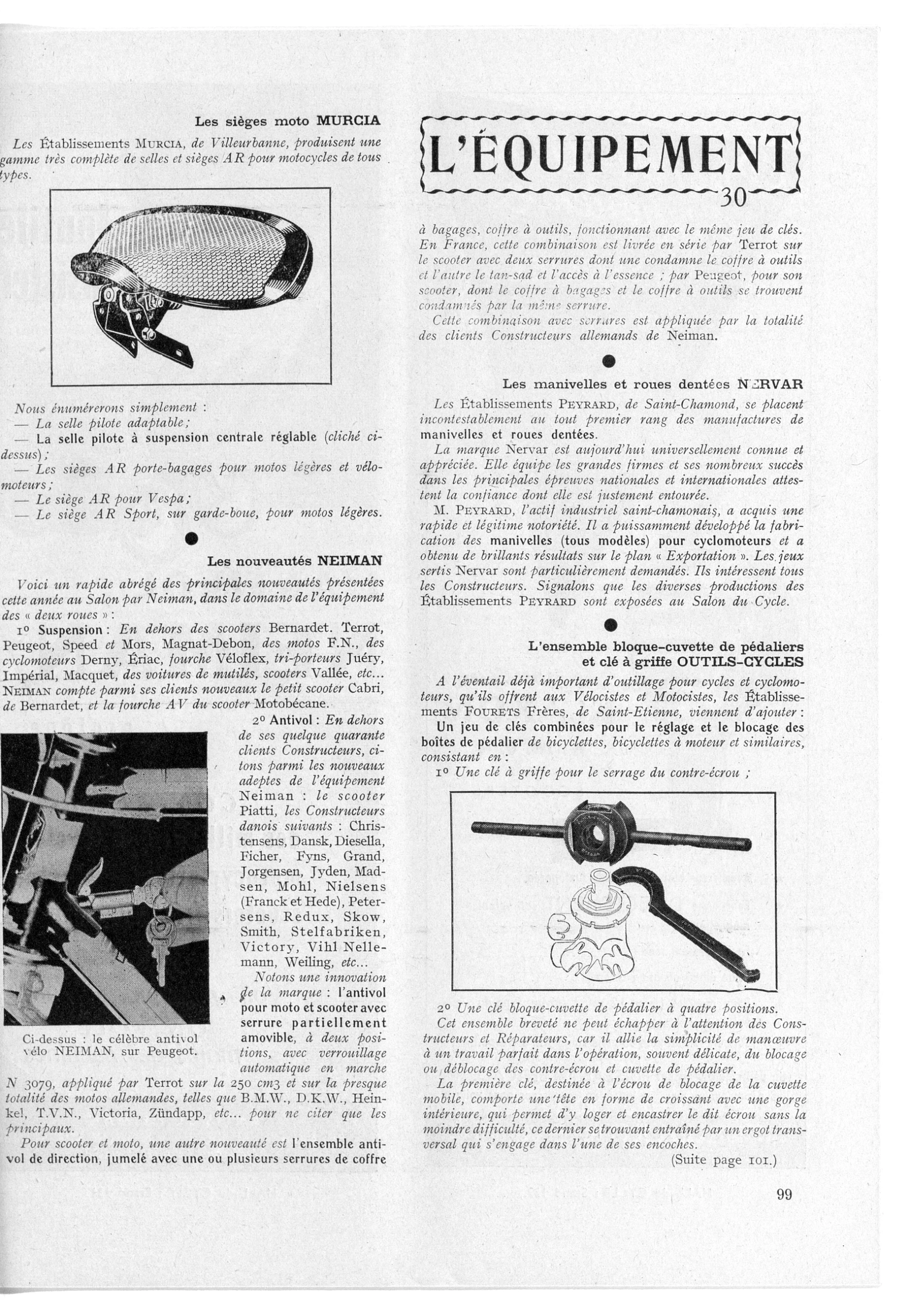
[Ebykr summary; the article’s text is not reproduced. The Établissements Murcia of Villeurbanne make a very complete range of saddles and rear seats for motorcycles of every type.]
Nous énumérerons simplement :
— La selle pilote adaptable;
— La selle pilote à suspension centrale réglable (cliché ci-dessus) ;
— Les sièges AR porte-bagages pour motos légères et vélo-moteurs ;
— Le siège AR pour Vespa;
— Le siège AR Sport, sur garde-boue, pour motos légères.
Les nouveautés NEIMAN
[Ebykr summary; the article’s text is not reproduced. A quick summary of the main novelties Neiman showed at this year’s Salon in equipment for two-wheelers. Under 1° Suspension the author lists the makers already fitted, outside the Bernardet, Terrot, Peugeot, Speed and Mors scooters: Magnat-Debon, F.N. motorcycles, Derny and Ériac cyclomotors, the Véloflex fork, the Juéry, Impérial and Macquet tricycle carriers, invalid carriages and Vallée scooters. Neiman’s new customers include the small Bernardet Cabri scooter and the front fork of the Motobécane scooter. Under 2° Antivol the author says that besides its forty or so manufacturer customers Neiman has new adherents in the Piatti scooter and the following Danish makers: Christensens, Dansk, Diesella, Ficher, Fyns, Grand, Jorgensen, Jyden, Madsen, Mohl, Nielsens (Franck et Hede), Petersens, Redux, Skow, Smith, Stelfabriken, Victory, Vihl Nellemann, Weiling, etc. He notes a novelty of the marque, an antivol for motorcycle and scooter with a partly removable lock, two positions and automatic locking when the machine is moving, number N 3079, used by Terrot on its 250 cm3 and on nearly all German motorcycles such as B.M.W., D.K.W., Heinkel, T.V.N., Victoria and Zündapp. A further novelty for scooters and motorcycles is a steering antivol combined with one or more luggage-compartment locks and toolbox locks working with the same set of keys. In France Terrot fits this combination as standard on its scooter, with two locks, one securing the toolbox and the other the tan-sad and the fuel access, and Peugeot fits it on its scooter, where one lock secures both the luggage compartment and the toolbox. The combination with locks is used by all of Neiman’s German manufacturer customers.]
Ci-dessus : le célèbre antivol vélo NEIMAN, sur Peugeot.
Les manivelles et roues dentées NERVAR
[Ebykr summary; the article’s text is not reproduced. The Établissements Peyrard of Saint-Chamond rank without dispute in the very first row of crankset and chainwheel manufacturers. The Nervar mark is universally known and appreciated, equips the great firms and has many successes in the main national and international events. M. Peyrard, the active Saint-Chamond industrialist, has gained a rapid and legitimate reputation, has greatly developed the making of cranks of all models for cyclomotors and has had brilliant results in export. Nervar sets are in particular demand and interest all manufacturers. The various products of the Établissements Peyrard are shown at the Salon du Cycle.]
L’ensemble bloque-cuvette de pédaliers
et clé à griffe OUTILS-CYCLES
[Ebykr summary; the article’s text is not reproduced. To the already large range of tools for cycles and cyclomotors that they offer to cyclists and motorcyclists, the Établissements Fourets Frères of Saint-Etienne have just added a set of combined wrenches for adjusting and locking the bottom-bracket cups of bicycles, motor bicycles and similar machines, consisting of two tools:]
1° Une clé à griffe pour le serrage du contre-écrou ;
2° Une clé bloque-cuvette de pédalier à quatre positions.
[Ebykr summary, after the illustration. This patented set cannot escape the notice of manufacturers and repairers, since it joins ease of handling to perfect work in the often delicate operation of locking or unlocking the lock nut and cup of a bottom bracket. The first wrench, meant for the locking nut of the adjustable cup, has a crescent-shaped head with an inner groove into which the nut seats without the least difficulty, being driven by a transverse lug that engages in one of its notches.]
(Suite page 101.)
99
[A full page of a trade review, printed in two columns of italic and roman text with bold run-in lines, with four articles separated by black dots. At the upper right a box with a wavy border holds the running head “L’ÉQUIPEMENT” in large roman capitals, with the section number 30 below its right edge. Under the Murcia heading a ruled illustration, drawn in line engraving with halftone shading, shows a motorcycle saddle with a cross-hatched scaled cover, a dark rolled rim and black metal brackets underneath. Under the Neiman article a halftone photograph at the left shows a key in a lock on a machine frame, with a caption beneath; the Danish list and the following text run in a narrow column beside it. At the lower right of the page a second ruled illustration, a line drawing with dark tones, shows a bar-handled wrench with a notched ring head, a cup and spindle part in outline, and a hooked spanner. The printed page number 99 sits at the lower right. No artist signature or agency mark is visible.]
— Page 6 —
[Ebykr summary, continuing the Outils-Cycles article from page 99; the article’s text is not reproduced. The second wrench, made for the adjustable cup, holds it precisely at the position wanted. It has holes for the part of the spindle that projects and exists in four positions to match the main outside dimensions of cups, whether hexagonal or with two opposed flats. The author calls such a pair of tools a serious step forward and a considerable saving of time that still gives precise work. Because lugs near the bottom-bracket shell on some machines can hinder the tool, Fourets Frères also made the same wrench with a longer body for motorcycles and motorized bicycles, for two cup sizes to each wrench, which required one wrench in 24 and 26 and another in 27.7 and 28.2. The house also makes the “Son nett” bicycle bell, a warning device whose success keeps growing. It is a simple and sturdy accessory with a guaranteed action, and its spring can be turned to any position without a mechanism.]
(Cloche en métal léger, blanc ou couleur, en bleu, vert, rouge et jaune, ressort, vis et colliers nickelés, poids 30 grammes).
La roue libre PACKSON
[Ebykr summary; the article’s text is not reproduced. The Packson-Perfection freewheel is made by the Forges du Lignon at Boën-sur-Lignon (Loire), directed by M. Paquet and helped by his two sons. It has become established by its unequaled quality and its results in the great international competitions. It has won victories in all the road classics, including the World Championship, won in 1952 by Kubler. This year it added a brilliant success, the French professional road championship, won by Geminiani. Packson also makes a special freewheel for cyclomotors that equips machines of great marques.]
Les attache-fils P.C.
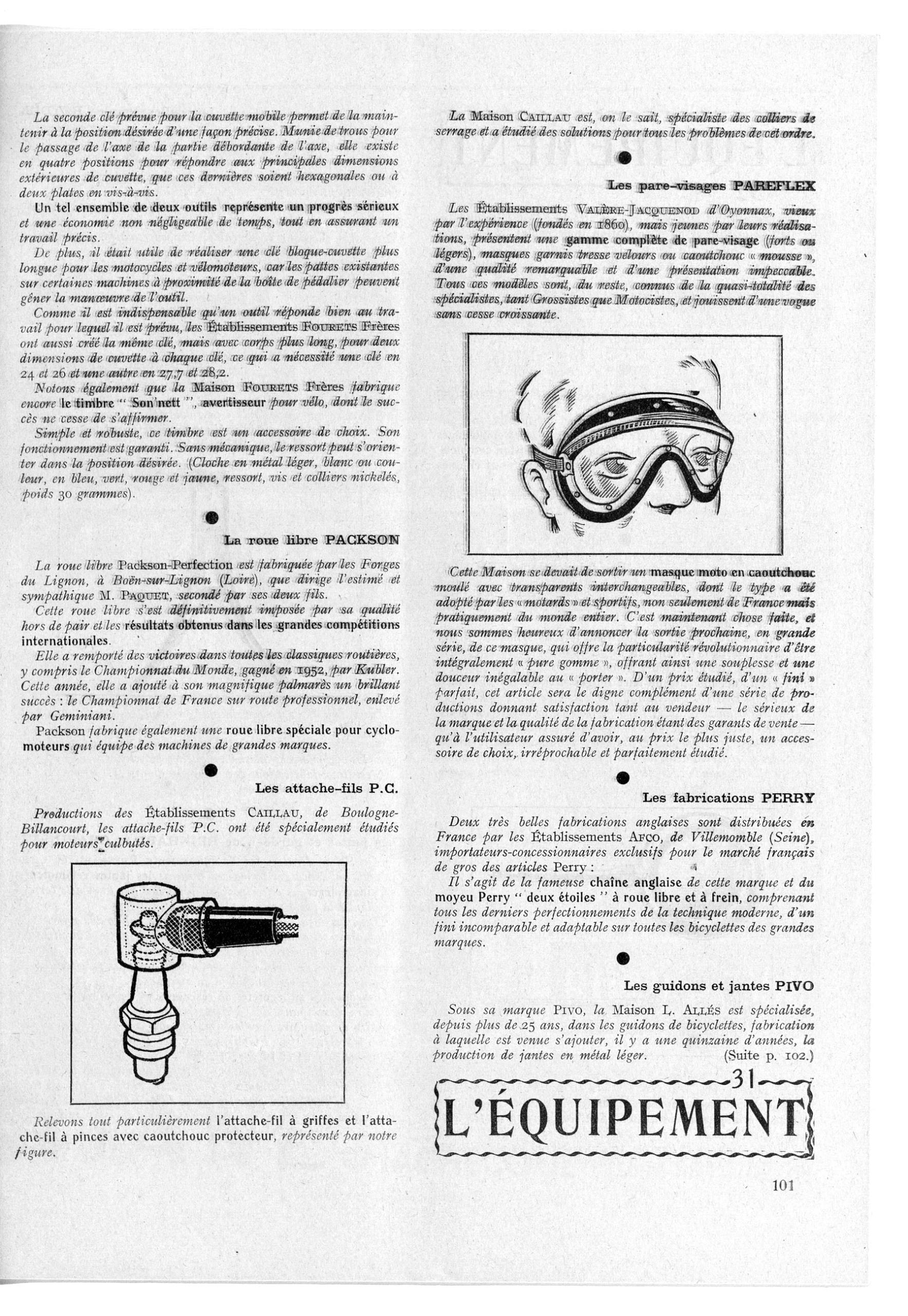
[Ebykr summary; the article’s text is not reproduced. The P.C. wire clips are products of the Établissements Caillau of Boulogne-Billancourt, designed specially for overhead-valve engines. The author singles out the claw-type wire clip and the clamp-type wire clip with protective rubber, shown in the figure. The house Caillau, it is said, is known as a specialist in clamping collars and has studied solutions for every problem of that kind.]
Les pare-visages PAREFLEX
[Ebykr summary; the article’s text is not reproduced. The Établissements Valère-Jacquenod of Oyonnax, founded in 1860, present a complete range of face guards, strong or light, with masks lined with velvet braid or foam rubber, of remarkable quality and impeccable presentation. All the models are known to nearly all specialists, wholesalers as well as motorcycle dealers, and enjoy a growing vogue. The firm also had to produce a molded rubber motorcycle mask with interchangeable lenses, a type adopted by riders and sportsmen not only in France but almost worldwide. The author announces the coming large-series release of this mask, whose revolutionary feature is that it is entirely pure rubber, giving unequaled softness in wear, at a studied price and with a perfect finish.]
Les fabrications PERRY
[Ebykr summary; the article’s text is not reproduced. Two fine English products are distributed in France by the Établissements Afco of Villemomble (Seine), sole importers and concessionaires for the French wholesale market of Perry articles: the famous English Perry chain and the Perry “deux étoiles” hub with freewheel and brake, which includes all the latest refinements of modern technique, has an incomparable finish and fits the bicycles of all the great marques.]
Les guidons et jantes PIVO
[Ebykr summary; the article’s text is not reproduced. Under its Pivo mark the house L. Allés has specialized for more than 25 years in bicycle handlebars, to which the production of light-metal rims was added about fifteen years ago.]
(Suite p. 102.)
31
L’ÉQUIPEMENT
101
[A full page of a trade review, printed in two columns of italic and roman text with bold phrases and bold headings set at the right, five articles divided by black dots. The type shows a doubled, ghosted impression, and large letters from the reverse of the leaf show faintly through at the upper right. A ruled illustration in the upper right column, drawn in fine pen hatching, shows a head in profile with a close-fitting cap band and a large rubber face mask with S-shaped nose cut-out and rivets over the eyes. In the lower left a ruled line drawing shows a right-angled spark-plug connector with a threaded post, a braided and rubber-sheathed wire entering it at the side, and a spark plug with a hexagonal body below. At the lower right a box with a wavy border holds the running head “L’ÉQUIPEMENT” in large roman capitals with the section number 31 above its right edge, and the printed page number 101 sits beneath. No artist signature or agency mark is visible.]
— Page 7 —
L’EQUIPEMENT
32
[Ebykr summary; the article’s text is not reproduced. The page opens with the end of the Pivo item (handlebars and rims of the Maison L. Allés), continued from page 101. From its creation the house has set out to make only articles of impeccable quality and presentation, and the author says, without fear of contradiction from its customers, that the handlebars and rims bearing its brand offer every desirable guarantee. It turns out all categories in these two parts and has distinguished itself by taking part in the great sporting events. Its champions, as printed: Bobet, Barbotin, Lévêque, Bluson, Paillard, Jodet, Verdeun, Varnajo, Carrara, etc…]
Les spécialités PERTUISOT
[Ebykr summary; the article’s text is not reproduced. All motorcycle dealers (Motocistes) should know that the Maison Pertuisot, of Paris, specializes in repairing connecting-rod assemblies (embiellages) and in reboring cylinders with supply of complete pistons. It also supplies all spare parts, accessories and chains for motorcycles and vélomoteurs. It is, besides, the general agent for Staub, and sends on request its latest catalog of gearboxes and clutches.]
Les fabrications REIDUOR
[Ebykr summary; the article’s text is not reproduced. The Établissements Reiduor, founded by M. Alfred Roudier in 1902, a family business par excellence, have always worked with concern for quality. Among the products that best justify their reputation the author cites the dynamo 28, of impeccable appearance, silent and reliable; the Reiduor headlamps, fitted with glass lenses; a series of ten models of red rear lamps; and combined units that allow the most varied lighting sets to be assembled. An important specialty of the house is the grease and oil can (burette de graissage) for cycles, motorcycles and sewing machines, made in eight models in tinplate, brass and plastic, meeting every requirement. Among the latest of these cans the author names the flat large-capacity type, in polished brass, entirely soldered, with turned (décolletés) fittings, for motorcycles.]
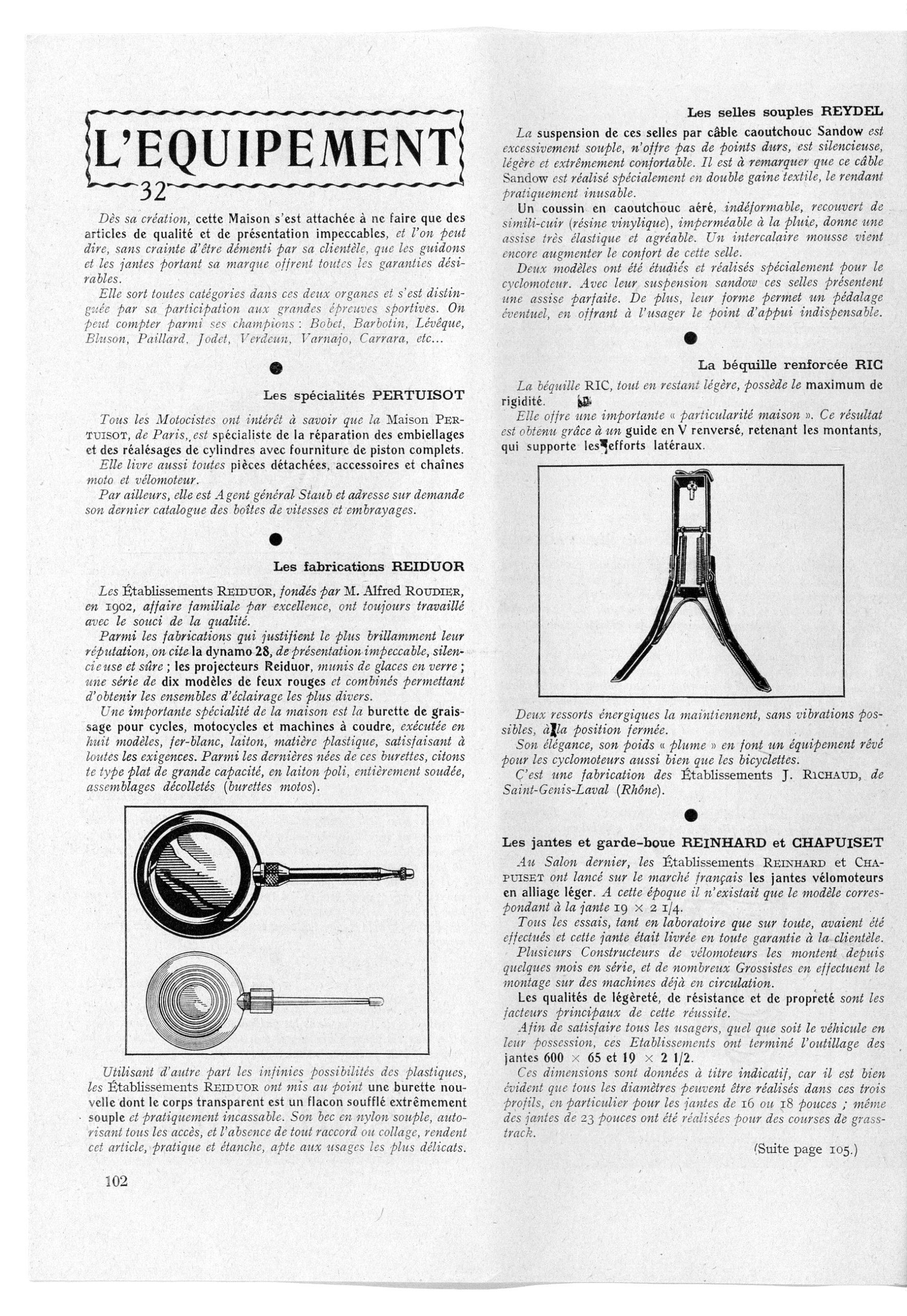
[Ebykr summary; the article’s text is not reproduced. Using the endless possibilities of plastics, the Établissements Reiduor have also perfected a new oil can whose transparent body is a blown bottle, extremely supple and practically unbreakable. Its supple nylon spout, which allows access everywhere, and the absence of any joint or gluing make the article practical and leak-tight, suited to the most delicate uses.]
102
Les selles souples REYDEL
[Ebykr summary; the article’s text is not reproduced. The suspension of these saddles by Sandow rubber cable is extremely supple, has no hard points, and is silent, light and extremely comfortable. The Sandow cable is made specially with a double textile sheath, which makes it practically unwearable. A cushion of aerated rubber, undeformable and covered with imitation leather (vinyl resin), waterproof against rain, gives a very elastic and pleasant seat, and a foam interlayer adds to the comfort. Two models were designed and made specially for the cyclomoteur; with their Sandow suspension these saddles give a perfect seat, and their shape also allows occasional pedaling by giving the user the indispensable support point.]
La béquille renforcée RIC
[Ebykr summary; the article’s text is not reproduced. The Ric stand, while staying light, has the maximum of rigidity. It offers an important “house peculiarity” (particularité maison): this result comes from an inverted-V guide, holding the uprights, which takes the lateral loads.]
[Ebykr summary; the article’s text is not reproduced. Below the figure: two strong springs hold the stand, with no possible vibration, in the closed position. Its elegance and its “feather” weight make it a dream equipment for cyclomoteurs as well as for bicycles. It is a product of the Établissements J. Richaud, of Saint-Genis-Laval (Rhône).]
Les jantes et garde-boue REINHARD et CHAPUISET
[Ebykr summary; the article’s text is not reproduced. At the last Salon the Établissements Reinhard et Chapuiset launched on the French market light-alloy rims for vélomoteurs. At that time only the model for the 19 x 2 1/4 rim existed. All tests, both in the laboratory and on the road, had been carried out and the rim was delivered to customers with full guarantee. Several vélomoteur constructors have fitted them in series for some months, and many wholesalers (Grossistes) fit them to machines already on the road. Lightness, strength and cleanliness are the main factors of this success.]
[Ebykr summary; the article’s text is not reproduced. To satisfy all users, whatever vehicle they own, the firm has completed the tooling for rims 600 x 65 and 19 x 2 1/2. These dimensions are given as a guide, since all diameters can obviously be made in these three profiles, in particular for 16-inch or 18-inch rims; even 23-inch rims have been made for grass-track races. The text on this page speaks only of rims; the mudguards (garde-boue) named in the heading are not mentioned here.]
(Suite page 105.)
[A full text page of a trade survey, set in two columns of French type, mostly italic with bold roman runs and bold roman firm headings, each heading right-aligned and each item separated by a solid black bullet. At the upper left a wavy-bordered panel holds the large roman capitals L’EQUIPEMENT with the number 32 below its lower left edge. In the left column a framed line engraving shows two oil cans, one above the other: the upper a round flat can with a thick ring rim, a hatched shaded interior and a long straight spout with a knurled collar and a small cap; the lower a round ribbed can seen from above with concentric rings and a short thin spout. In the right column a framed drawing in solid black and fine lines shows a two-legged stand: a tall narrow frame with a bolt at the top, two coil springs hung side by side between crosspieces, and two splayed legs ending in flat feet, with a bow-shaped brace between them. The printed page number 102 stands at the foot of the left column, and the text ends in the right column with the line “(Suite page 105.)”. The lower fifth of the leaf is blank. No artist signature or monogram is visible.]
— Page 8 —
[Ebykr summary, closing the Reinhard et Chapuiset article that begins on an earlier page; the article’s text is not reproduced. The manufacture of fenders for motorized bicycles and motorcycles is also being modernized, and the firm can supply deep round-form fenders made in one piece of steel. They can also be made at different centers and fit wheels of 16, 18 or 19 inches. In conclusion the Établissements Reinhard et Chapuiset can satisfy their customers whatever machine is under construction or repair, as regards both rims and fenders.]
La lunetterie ROD
[Ebykr summary; the article’s text is not reproduced. The Lunetterie Rod, a firm established at Colombes, brings out in particular its type 88, with a single screen set in a rubber frame, which offers a wide field of vision, carefully studied ventilation, no fogging of the screen and facial protection in a fall. This motorcyclist’s goggle is approved by the F.F.S., the Ministries of the Air and of the Navy and the great international motorcycle clubs.]
Les productions ROTORSON
[Ebykr summary; the article’s text is not reproduced. The ban on warning horns is in force only in a few towns and cannot be extended to the open road, where horns are one of the best ways of avoiding accidents. Every rider, of motorcycles, scooters and also cyclomotors, which run at ever higher speeds, should for his own sake have a high-quality road horn so that it does not fail him when he needs it most. The Établissements Rotorson have perfected road horns for motorcycles, scooters and cyclomotors that will satisfy the most demanding. The horn has a molded bell of very small bulk that fits the various machines well. It is entirely independent of the engine, so the town horn can be kept, and it lets these small machines ride in full safety. Its tone, without being intolerable in town, makes it possible to signal when passing any road vehicle. Fitted to Vespa and Lambretta scooters, it also allows the signal to be used on descents with the engine at dead point, because the air pump works by friction on the tire. A mounting is designed for each principal marque, which allows an impeccable and rapid installation.]
L’auto-mélangeur S.A.T.A.M.
[Ebykr summary; the article’s text is not reproduced. The “Société pour tous Appareillages Mécaniques” makes a fuel dispenser special to two-stroke engines. It dispenses by the half-liter one or two qualities of oil at 4 to 10 percent, or pure fuel if wanted. Service stations and garages can no longer do without such an apparatus, given the ever greater use of two-wheelers and so of two-strokes. The Auto-Mélangeur, hallmarked by the State, is fitted with partial and total counters and is therefore a very modern and practical apparatus. Models exist for this dispenser both fixed and mobile, at the choice of the user. It will be shown to the public at stand 3, sous-sol C, of the Salon de l’Automobile.]
Les freins SOVA
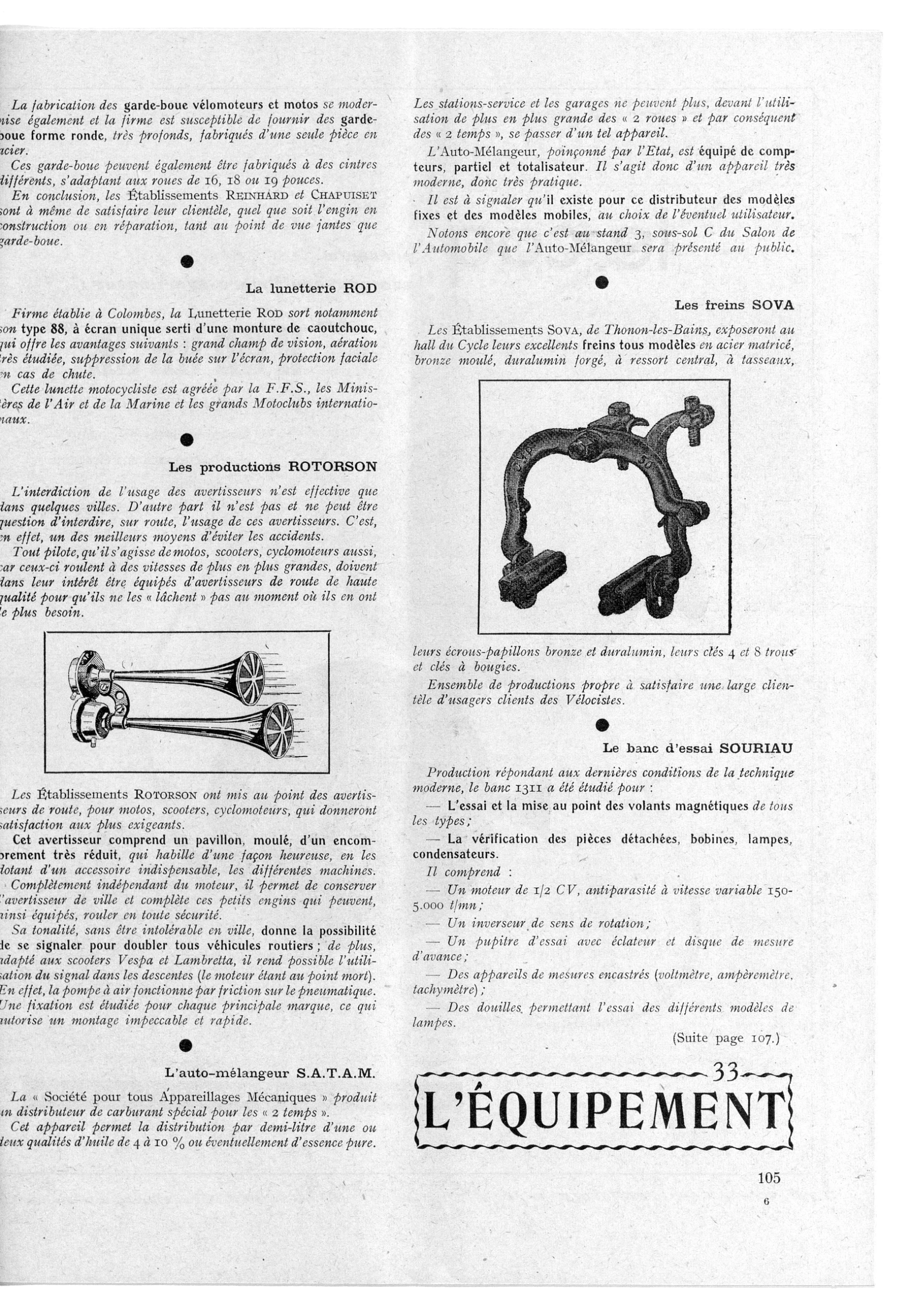
[Ebykr summary; the article’s text is not reproduced. The Établissements Sova of Thonon-les-Bains will show in the Cycle hall their brakes in all models, in die-stamped steel, cast bronze and forged duralumin, with central spring and with shoes, their bronze and duralumin wing nuts, their 4- and 8-hole wrenches and spark-plug wrenches. The author calls it a set of products fit to satisfy a wide clientele of users who are customers of the cycle dealers.]
Le banc d’essai SOURIAU
[Ebykr summary; the article’s text is not reproduced. Meeting the latest conditions of modern technique, the bench 1311 was designed for:]
— L’essai et la mise au point des volants magnétiques de tous les types;
— La vérification des pièces détachées, bobines, lampes, condensateurs.
Il comprend :
— Un moteur de 1/2 CV, antiparasité à vitesse variable 150-5.000 t/mn;
— Un inverseur de sens de rotation;
— Un pupitre d’essai avec éclateur et disque de mesure d’avance;
— Des appareils de mesures encastrés (voltmètre, ampèremètre, tachymètre);
— Des douilles permettant l’essai des différents modèles de lampes.
(Suite page 107.)
33
L’ÉQUIPEMENT
105
6
[A full page of a trade review, printed in two columns of italic and roman text with bold phrases and bold headings set at the right, six articles divided by black dots. In the middle of the left column a ruled illustration, drawn in line engraving, shows a pair of twin horns, each a long flared trumpet ending in a round grille with radiating ribs, joined to two round bodies on a curved bracket. In the right column a ruled halftone photograph shows a caliper brake, a heavy curved arm with two shoes and bolts, split by the text before and after. In the lower right a box with a wavy border holds the running head “L’ÉQUIPEMENT” in large roman capitals with the section number 33 above its right edge, and the printed page number 105 sits beneath it, with a small “6” below that. Faint large letters from the reverse of the leaf show through at the upper right of the page. No artist signature or agency mark is visible.]
— Page 9 —
[Ebykr summary, closing the Souriau test-bench article from page 105; the article’s text is not reproduced. A safety cover protects the user against any risk of accident. A range of shafts and intermediate pieces with quick mounting allows the testing of all the usual types of flywheels, and shafts and intermediate shaft ends for special flywheels can be supplied on request. The bench is wired for 110 volts, or 220 volts on request.]
Les moyeux STURMEY-ARCHER
[Ebykr summary; the article’s text is not reproduced. The Société G.I.P. is the French importer of these hubs of international class. The first type, with 3 speeds, was brought to the market nearly fifty years ago and made a technical revolution in the bicycle; with it the cyclist could lengthen his tours while tiring less, and hills and headwinds lost their frightening name. Since then the range of hubs made by the British Sturmey-Archer company has kept growing, so that today there is a hub of the marque for every category of user. The main current types are the AW standard, successor to the original model; the AM and AC for sporting cyclists, and the ABC with drum brake, all with 3 speeds; the FW, which meets the demands of the most advanced cycling; the FM, similar to the FW but meant for sporting cyclists who want closer gearing; and the FC, designed for road racing, these last three with 4 speeds. The author adds the BFC, a front hub with cable-operated drum brake, and the BCR, a rear hub with a brake of the same system.]
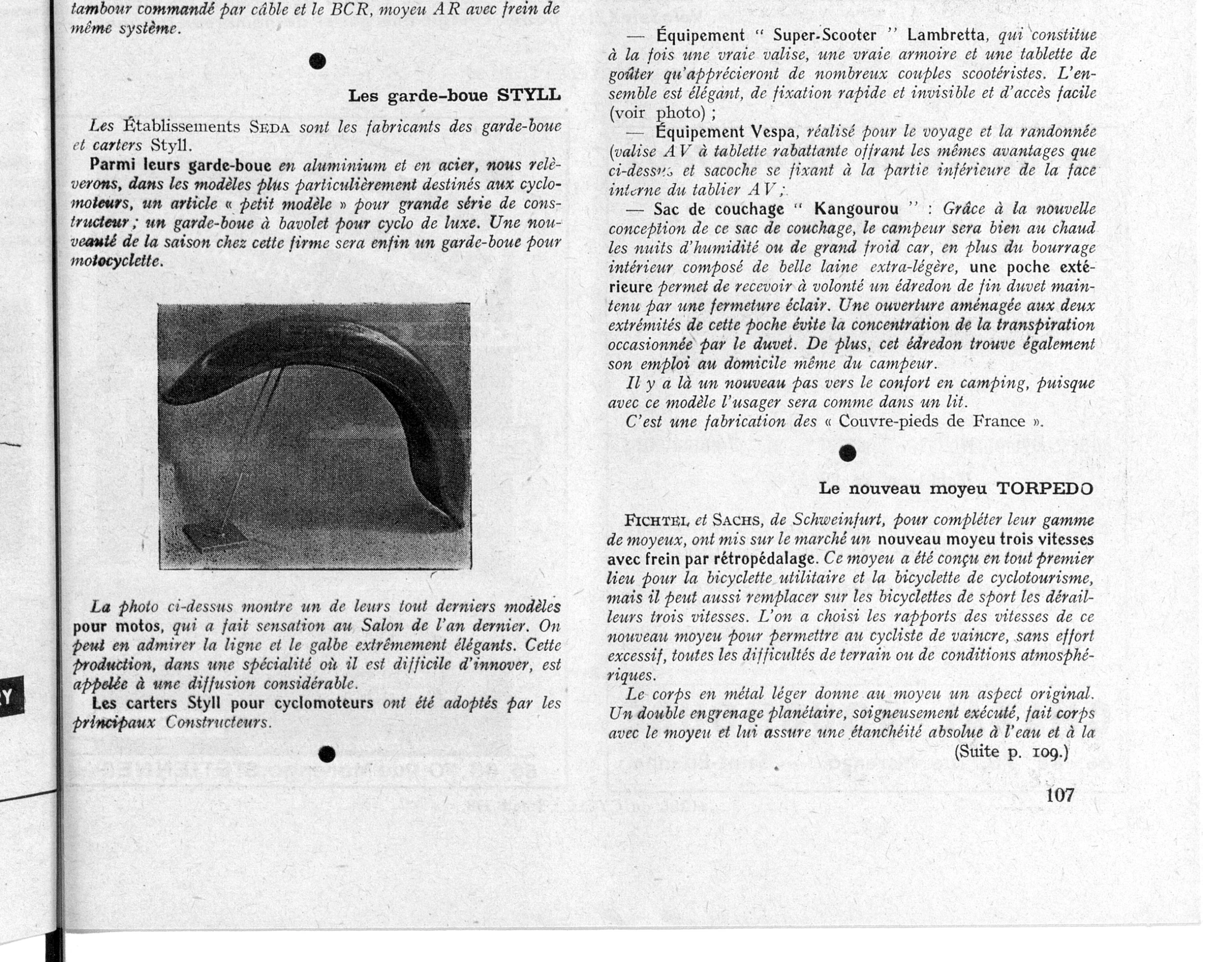
Les garde-boue STYLL
[Ebykr summary; the article’s text is not reproduced. The Établissements Seda make the Styll fenders and chain guards. Among their aluminum and steel fenders the author singles out, in the models meant more particularly for cyclomotors, a “small model” article for large-series manufacturers and a fender with mudflap for a luxury moped. A novelty of the season at this firm will be a fender for a motorcycle.]
[Ebykr summary, after the photograph. The photograph above shows one of their very latest models for motorcycles, which made a sensation at last year’s Salon, and the author admires its extremely elegant line and shape. This product, in a specialty where it is hard to innovate, is called to a considerable circulation. The Styll chain guards for cyclomotors have been adopted by the principal manufacturers.]
L’ÉQUIPEMENT 34
Les productions TAILLANDIER
[Ebykr summary; the article’s text is not reproduced. The Établissements Taillandier present, under their well-known Kangourou mark, the following equipment:]
— Équipement “Super-Scooter” Lambretta
— Équipement Vespa
— Sac de couchage “Kangourou”
[Ebykr summary, under the photograph; the article’s text is not reproduced. The “Super-Scooter” Lambretta equipment is at once a true suitcase, a true wardrobe and a snack table that many scooter couples will appreciate; the whole is elegant, quickly and invisibly fixed and easy to reach (see photo). The Vespa equipment is made for travel and touring, with a front suitcase with a folding table offering the same advantages and a bag fixed to the lower part of the inner face of the front apron. The “Kangourou” sleeping bag has a new design: besides its inner filling of fine extra-light wool, an outer pocket closed by a zipper takes a quilt of fine down at will, and an opening at both ends of the pocket avoids the buildup of perspiration caused by the down. The quilt can also be used at the camper’s home. The author calls it a new step toward comfort in camping, since the user will be as in a bed with this model. It is made by the “Couvre-pieds de France”.]
Le nouveau moyeu TORPEDO
[Ebykr summary; the article’s text is not reproduced. Fichtel et Sachs of Schweinfurt, to complete their range of hubs, have put on the market a new three-speed hub with coaster brake. It was designed first of all for the utility bicycle and the touring bicycle, but it can also replace three-speed derailleurs on sporting bicycles. Its gear ratios were chosen to let the cyclist overcome, without excessive effort, all difficulties of terrain or weather. The light-metal body gives the hub an original look, and a carefully made double planetary gear forms one piece with the hub and gives it absolute sealing against water and dust (the last word falls at the head of page 109)].
(Suite p. 109.)
107
[A full page of a trade review, printed in two columns of italic and roman text with bold phrases and bold headings set at the right, five articles divided by black dots. At the upper right a box with a wavy border holds the running head “L’ÉQUIPEMENT” in large roman capitals with the section number 34 below its right edge. Two halftone photographs fill the page. The first, at the upper right under the Taillandier heading, shows a scooter with a rounded luggage case on its front and a leg shield, with a tool or handle at the top. The second, in the lower part of the left column, shows a smooth curved motorcycle fender or shell, dark gray, with a small plate lying at its foot. Both photographs are ruled in thin black frames. The printed page number 107 sits at the lower right. The binding fold and a strip of the facing page show at the left edge, and faint large letters from the reverse of the leaf show through at the bottom of the left column. No artist signature or agency mark is visible.]
— Page 10 —
[Ebykr summary, closing the Torpedo article from page 107; the article’s text is not reproduced. The planetary reduction gear turning in an oil bath needs little upkeep. The gear change is worked either by a lever rod fixed to the top tube of the frame or by a Bowden cable fixed directly to the handlebar. The middle speed, direct drive, is used on the flat; the low speed against a headwind or on climbs and also on bad roads (snow, ice); the high speed with a tailwind or on slight slopes. The particular advantages named are an elegant and modern form; a low speed with a 25 percent reduction and a high speed with a 33 1/3 percent step-up; for each of the three speeds, starting, freewheel and powerful braking by back pedaling; a particularly solid planetary reduction in an oil bath, meaning smooth running and very long life; and fitting to any bicycle, man’s or lady’s, new or in service. The parts are made of high-quality raw materials on special machines under the strictest control. For the middle speed, direct drive, the author gives with 28-inch wheels and 46 teeth at the chainwheel a 19-tooth sprocket for a man’s bicycle and a 20-tooth one for a lady’s, and with 26-inch wheels sprockets of 18 and 19 teeth. The importer in France is the Maison William Dumont.]
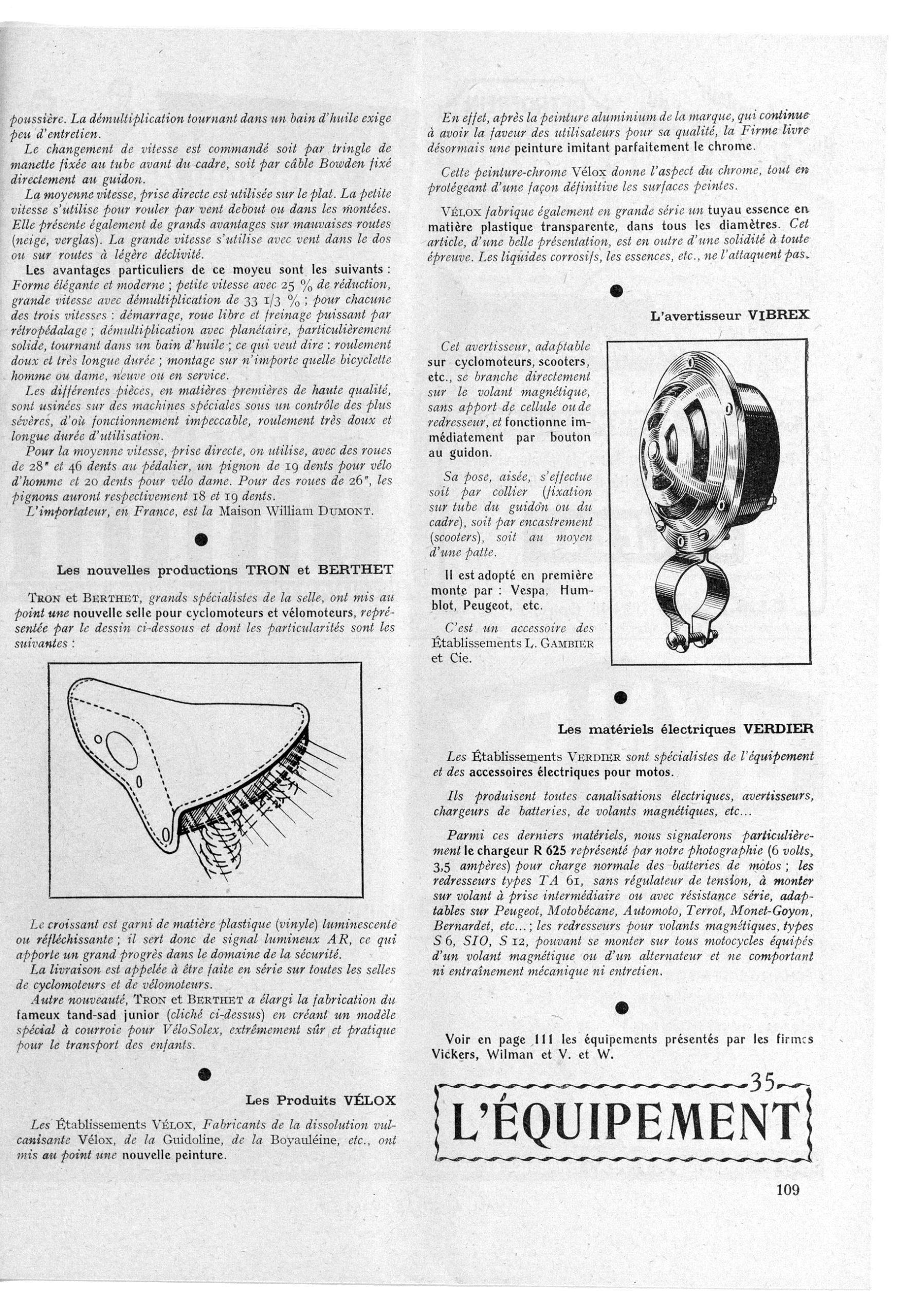
Les nouvelles productions TRON et BERTHET
[Ebykr summary; the article’s text is not reproduced. Tron et Berthet, great saddle specialists, have perfected a new saddle for cyclomotors and motorized bicycles, shown in the drawing, whose particulars follow. The rear crescent is trimmed with luminescent or reflecting plastic (vinyl) and so serves as a rear light signal, which the author calls a great step forward in safety. Delivery is expected to be in series on all saddles of cyclomotors and motorized bicycles. As another novelty, Tron et Berthet has widened the making of the famous “tand-sad junior” (picture above) by creating a special belt-type model for the VéloSolex, extremely safe and practical for carrying children.]
Les Produits VÉLOX
[Ebykr summary; the article’s text is not reproduced. The Établissements Vélox, makers of the Vélox vulcanizing solution, of Guidoline, of Boyauléine and so on, have perfected a new paint. After the firm’s aluminum paint, which keeps the favor of users for its quality, the firm now supplies a paint that imitates chrome perfectly; this Vélox chrome paint gives the look of chrome while protecting the painted surfaces for good. Vélox also makes in large series a transparent plastic fuel hose in all diameters, of fine appearance and of great strength, which corrosive liquids and fuels do not attack.]
L’avertisseur VIBREX
[Ebykr summary; the article’s text is not reproduced. This horn, which can be fitted to cyclomotors, scooters and the like, connects directly to the magnetic flywheel, with no cell or rectifier added, and works at once by a button on the handlebar. Its easy fitting is done by a clamp (fixing on the handlebar tube or on the frame), by recessing (scooters) or by a bracket. It is adopted as original equipment by Vespa, Humblot, Peugeot and others. It is an accessory of the Établissements L. Gambier et Cie.]
Les matériels électriques VERDIER
[Ebykr summary; the article’s text is not reproduced. The Établissements Verdier specialize in electrical equipment and accessories for motorcycles. They make all wiring, horns and chargers for batteries and for magnetic flywheels. Among the chargers the author singles out the R 625 charger, said to be shown by “our photograph” (6 volts, 3.5 amperes), for normal charging of motorcycle batteries. The rectifiers type TA 61, without voltage regulator, to be mounted on a flywheel with intermediate tap or with a series resistance, are fitted to Peugeot, Motobécane, Automoto, Terrot, Monet-Goyon, Bernardet and others. The rectifiers for magnetic flywheels, types S 6, SIO and S 12, can be mounted on any motorcycle equipped with a magnetic flywheel or an alternator and need no mechanical drive and no upkeep.]
Voir en page 111 les équipements présentés par les firmes Vickers, Wilman et V. et W.
35
L’ÉQUIPEMENT
109
[A full page of a trade review, printed in two columns of italic and roman text with bold phrases and bold headings set at the right, five articles divided by black dots. In the left column a ruled line drawing shows a saddle in a three-quarter view, with dashed stitching, two small holes and an oval opening at the nose and a rear crescent edge drawn in dense hatching, with thin lines radiating from it. In the right column, beside the Vibrex text, a ruled engraving with fine hatching shows a round horn body with ribbed grille and a split clamp collar with a bolt beneath it. In the lower right a box with a wavy border holds the running head “L’ÉQUIPEMENT” in large roman capitals with the section number 35 above its right edge, and the printed page number 109 sits beneath it. Faint large lettering from the reverse of the leaf shows through at the top of the right column. No artist signature or agency mark is visible. The Verdier text refers to a photograph of the R 625 charger, but no such photograph appears on the page.]
Ebykr presents this material for research and education. If you hold rights to it or notice an ownership issue, please contact us and we will respond promptly.
The Ebykr Digest
New articles, timelines, catalog finds and registry activity — assembled from the archive once a month. Your address is never shared.
Double opt-in. One email per month. Unsubscribe at any time with one click.