About Ebykr
Ebykr celebrates classic and vintage lightweight bicycles through provocative imagery and opinion. Ride along with us.
About Ebykr
Ebykr celebrates classic and vintage lightweight bicycles through provocative imagery and opinion. Ride along with us.

Source: Gallica (Bibliothèque nationale de France), L'Officiel du cycle, du motocycle et du camping, 2 October 1954, N° 40, pages 67, 69, 70, 75, 77, 79, 81, 82, 85 and 87; ark:/12148/bd6t54206310j. Source gallica.bnf.fr / BnF.
| Type | Review |
|---|---|
| Year | 1954 |
| Publisher | L'Officiel du cycle |
| Country | France |
| Language | French |
| Pages | 10 |
| Source | Gallica (Bibliothèque nationale de France), L'Officiel du cycle, du motocycle et du camping, 2 October 1954, N° 40, pages 67, 69, 70, 75, 77, 79, 81, 82, 85 and 87; ark:/12148/bd6t54206310j. Source gallica.bnf.fr / BnF. |
| Credit | Ebykr archive; Bibliothèque nationale de France |
| Identifier | Gallica (BnF) ark:/12148/bd6t54206310j/f66 |
| Transcription | Headings and specifications transcribed; article text summarized |
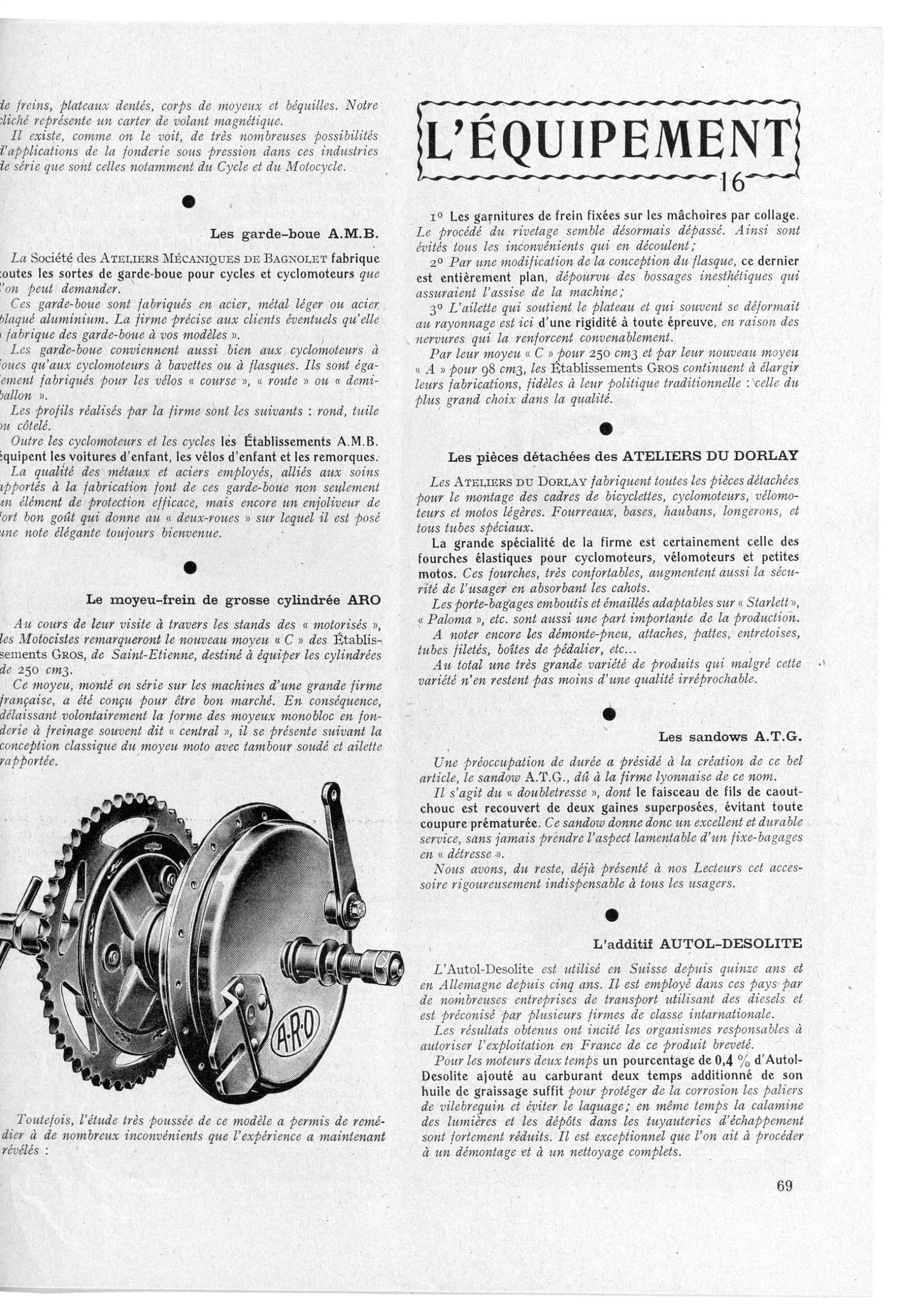
EQUIPEMENTS second Les volants magnétiques A.B.G. Les gants ALDIAS Les moulages sous pression ALUVAC chapitre & OUTILLAGES 67 Les garde-boue A.M.B. Le moyeu-frein de grosse cylindrée ARO 1° Les garnitures de frein fixées sur les mâchoires par collage. Le procédé du rivetage semble désormais dépassé. Ainsi sont évités tous les inconvénients qui en découlent; 2° …
This is a magazine article, so its running text is summarized here rather than reproduced; the headline, byline, specifications and scores are transcribed as printed.
From L’Officiel du cycle, du motocycle et du camping, 2 October 1954, the paper’s special number before the 1954 Paris Salon du Cycle et du Motocycle, pages 67, 69, 70, 75, 77, 79, 81, 82, 85 and 87: the first part of chapter two of Gilbert Victor’s survey of equipment and tools shown at the Salon, from flywheel magnetos, die castings, tires and light alloys to electrical equipment, saddlebags and mudguards. The title, headings, captions and lists are transcribed as printed; the text is summarized in Ebykr’s words, and the page images carry it in full.
— Page 1 —
EQUIPEMENTS
second
Les volants magnétiques A.B.G.
[Ebykr summary; the article’s text is not reproduced. Flywheel magnetos used for ignition and lighting on motorcycles, velomoteurs, scooters, cyclomotors and even moto-cars have simplified engine construction: they replace the dynamos or alternators with their drive and the inertia flywheel, whose job passes to the magneto rotor fixed directly on the end of the crankshaft with no intermediate drive. Thanks to the experience of the Société A.B.G. in aircraft-engine ignition, its flywheels give ignition as strong as the best magnetos and lighting that meets the Code de la Route. The rotor is made of four magnets and four pole masses joined by a light alloy cast in a chill mold, which the writer calls very strong and undeformable. The coils, condenser and contact breaker sit on the stator, are interchangeable and are easy to remove; the coils are not machined after mounting on the stator, so the user can replace them easily, and coils and condensers are made with the materials and methods of aircraft magnetos. The primary-current break system, often sensitive to wear, is carefully done: the heat-treated steel cam is ground to a profile that keeps the opening point nearly the same as the contact gap varies, so the breaker setting stays near the optimum, and the primary current and the material of the heel were chosen to keep the gap about constant over the life of the flywheel, with contact wear proportional to heel wear. A flywheel set at the factory can run several hundred hours without the breaker being reset. To approach an ideal ignition, in which the parasitic tail of the spark that wears plugs would be removed, A.B.G. made the energy of the high-tension, high-frequency discharge as large as possible with a short, well-laminated magnetic circuit, chose the primary winding so that the flux change at the opening of the contacts is very large even at idle and almost independent of speed, and cut the spark tail to a minimum with a secondary winding of few turns.]
[Ebykr summary, continuing in the right-hand column; the article’s text is not reproduced. The A.B.G. flywheel gives without a miss sparks of 8 mm, measured on BNA spark gaps at a speed of 130 rpm, with or without the lighting running. Because the spark length that can be had without a miss depends little on speed, it lights engines and gives easy starting in the worst conditions: highly compressed engines, plugs that leak and plugs whose electrodes are too far apart. The Société A.B.G. makes three lighting arrangements: one for operation without a battery, alternating 12 V lighting; and two for operation with a battery, either alternating 12 V lighting or direct-current lighting with the engine running and stopped.]
Les gants ALDIAS
[Ebykr summary; the article’s text is not reproduced. For motorcycling to be a pleasure the rider must be perfectly equipped, and gloves are certainly the most indispensable item, because for safety he needs his fingers to keep full agility on the controls and good reflexes in danger. The weather need not be at its worst for gloves to prove essential: the least cold with the wind numbs the fingers and so slows the reflexes. The Société ALDIAS presents a special motorcycle glove that covers and protects not only the hands but also the wrists. The writer says the renown of the Société de Millau guarantees the glove’s efficiency and so the rider’s safety. ALDIAS states that it sells exclusively to the wholesalers of the Chambre Syndicale du Cycle et de la Moto.]
Les moulages sous pression ALUVAC
[Ebykr summary; the article’s text is not reproduced. The Fonderie de précision of Nanterre (Seine), perhaps better known under its mark Aluvac, produces in its works more than half of the die-cast parts made in France. Die casting, as the firm practices it, forces molten metal (an alloy of aluminum, magnesium or zinc) into a steel mold, and the metal, apart from shrinkage, takes the mold’s impression in its smallest details; very precise parts can be had this way, with 1/10 of a millimeter routinely held. Among the foundry’s products for cycles, cyclomotors and various motorcycles the writer singles out crankcases, cylinder heads, cylinders and flywheel magnetos, handgrips and bodies; the list breaks off at the foot of the column.]
chapitre
& OUTILLAGES
67
[Page 67, a full page of text in two wide columns, opening a chapter. At the head, “EQUIPEMENTS” stands in very large, widely spaced, heavy sans-serif capitals across the full width, with the word “second” in large italic below it at the right and a wavy rule running to its left and again to its right. At the foot, a second wavy rule runs to the left of the italic word “chapitre” and below it, in equally large spaced capitals, stands “& OUTILLAGES”. The columns are set mostly in italic roman type with some phrases in a heavier upright face. Each firm heading is right-aligned in bold roman with the firm name in capitals, and a solid round black bullet stands above each heading. The folio 67 sits at the lower right below the chapter title. No drawing, no photograph, no signature and no advertiser mark appear. Faint ghost shapes from the reverse of the leaf, including a framed block of reversed capitals, show through in the lower half.]
— Page 2 —
[Ebykr summary, continuing the ALUVAC notice that breaks off at the foot of page 67; the article’s text is not reproduced. The foundry’s list of castings goes on with brake bodies, toothed chainwheels, hub bodies and stands, and the writer notes that the firm’s illustration shows a flywheel-magneto casing (the illustration itself is not on this page). He concludes that, as can be seen, die casting has very many possible applications in such series industries as those of the cycle and the motorcycle.]
Les garde-boue A.M.B.
[Ebykr summary; the article’s text is not reproduced. The Société des ATELIERS MÉCANIQUES DE BAGNOLET makes every kind of mudguard wanted for cycles and cyclomotors, in steel, light metal or aluminum-clad steel, and tells prospective customers that it makes mudguards to their own patterns. They suit cyclomotors with cheeks (à joues) as well as those with flaps (à bavettes) or side plates (à flasques), and are also made for “course”, “route” and “demi-ballon” bicycles. The profiles the firm makes are round, tile-shaped (tuile) or ribbed (côtelé). Besides cyclomotors and cycles the Établissements A.M.B. fit children’s carriages, children’s bicycles and trailers. The writer says the quality of the metals and steels and the care in manufacture make these mudguards both an effective protection and an embellishment in very good taste that gives the two-wheeler it is fitted to an elegant note.]
Le moyeu-frein de grosse cylindrée ARO
[Ebykr summary; the article’s text is not reproduced. Motorcyclists visiting the stands of the motorized makes will notice the new “C” hub of the Établissements GROS of Saint-Etienne, meant to equip 250 cm3 machines. It is fitted as standard on the machines of a large French firm and was designed to be cheap. The makers therefore deliberately dropped the form of one-piece cast hubs with the braking often called “central” and followed the classic motorcycle hub with a welded drum and an attached flange (ailette rapportée). A line illustration follows. The writer then says that the thorough study of this model has made it possible to remedy many drawbacks that experience has since shown, and the corrections are listed as follows.]
1° Les garnitures de frein fixées sur les mâchoires par collage. Le procédé du rivetage semble désormais dépassé. Ainsi sont évités tous les inconvénients qui en découlent;
2° Par une modification de la conception du flasque, ce dernier est entièrement plan, dépourvu des bossages inesthétiques qui assuraient l’assise de la machine;
3° L’ailette qui soutient le plateau et qui souvent se déformait au rayonnage est ici d’une rigidité à toute épreuve, en raison des nervures qui la renforcent convenablement.
[Ebykr summary; the article’s text is not reproduced. With their “C” hub for 250 cm3 and their new “A” hub for 98 cm3, the Établissements GROS keep widening their range, true to their traditional policy of the widest choice in quality.]
L’ÉQUIPEMENT
16
Les pièces détachées des ATELIERS DU DORLAY
[Ebykr summary; the article’s text is not reproduced. The Ateliers du Dorlay make all the spare parts for building the frames of bicycles, cyclomotors, velomoteurs and light motorcycles: fork blades (fourreaux), bases, seat stays (haubans), side members (longerons) and all special tubes. The writer calls the firm’s great specialty certainly its sprung forks for cyclomotors, velomoteurs and small motorcycles, which are very comfortable and also add to the rider’s safety by absorbing bumps. Pressed and enameled luggage carriers that fit the “Starlett”, the “Paloma” and the like are also an important part of output. He adds tire levers, clips, lugs, spacers, threaded tubes and bottom-bracket shells, and sums up a very great variety of products of irreproachable quality.]
Les sandows A.T.G.
[Ebykr summary; the article’s text is not reproduced. Concern for durability governed the creation of the A.T.G. sandow (luggage cord), made by the Lyon firm of that name. It is the “doubletresse” type, in which the bundle of rubber threads is covered with two superposed sheaths that prevent any early cutting, so that it gives excellent and lasting service and never takes on the sorry look of a luggage strap in distress. The writer adds that the magazine has already presented this accessory, which he calls strictly indispensable to all users, to its readers.]
L’additif AUTOL-DESOLITE
[Ebykr summary; the article’s text is not reproduced. Autol-Desolite has been used in Switzerland for fifteen years and in Germany for five, by many transport firms with diesels in those countries, and is recommended by several firms of international standing. The results led the responsible bodies to authorize the sale of this patented product in France. For two-stroke engines a proportion of 0.4 % of Autol-Desolite added to the two-stroke fuel, already mixed with its lubricating oil, is enough to protect the crankshaft bearings from corrosion and to prevent lacquering; at the same time the carbon in the ports and the deposits in the exhaust pipework are greatly reduced, and a complete dismantling and cleaning is seldom needed.]
69
[Page 69 of the survey, a full page of text in two wide columns with one engraved illustration in the left column. Most of the text is in italic roman type with some phrases in a heavier upright face. Each firm heading is right-aligned in bold roman with the firm name in capitals, and a solid round black bullet stands above each heading. The illustration, drawn in fine line engraving with cross-hatched shading and with no caption, shows a motorcycle hub with a drum brake seen from the brake side: a large toothed chainwheel at the left with a T-shaped pin or handle at its rim, a ribbed flange behind it, a deep drum with a ring of small holes round its rim, an oval plate lettered “A·R·O” on the drum face, a brake lever arm with a bolt at the upper right, a notched bracket in the lower middle and an axle with nuts projecting at the right. The tip of the T-shaped pin at the far left touches the edge of the crop and may be cut by a few pixels. At the head of the right-hand column, the running head “L’ÉQUIPEMENT” stands in large roman capitals inside a wavy-ruled box, with the section number 16 set on the bottom rule; the folio 69 sits at the lower right. No signature and no advertiser mark appear.]
— Page 3 —
Les pneus moto AVON
[Ebykr summary; the article’s text is not reproduced. Avon is the great English specialist in motorcycle tires and has set up ranges for the track, the trial ground (terrain d’épreuves) and touring. The general agent for France and the French Union is the Maison Crunelle-Pneumatique, of Alfortville (Seine).]
Les spécialités L. BARRAL
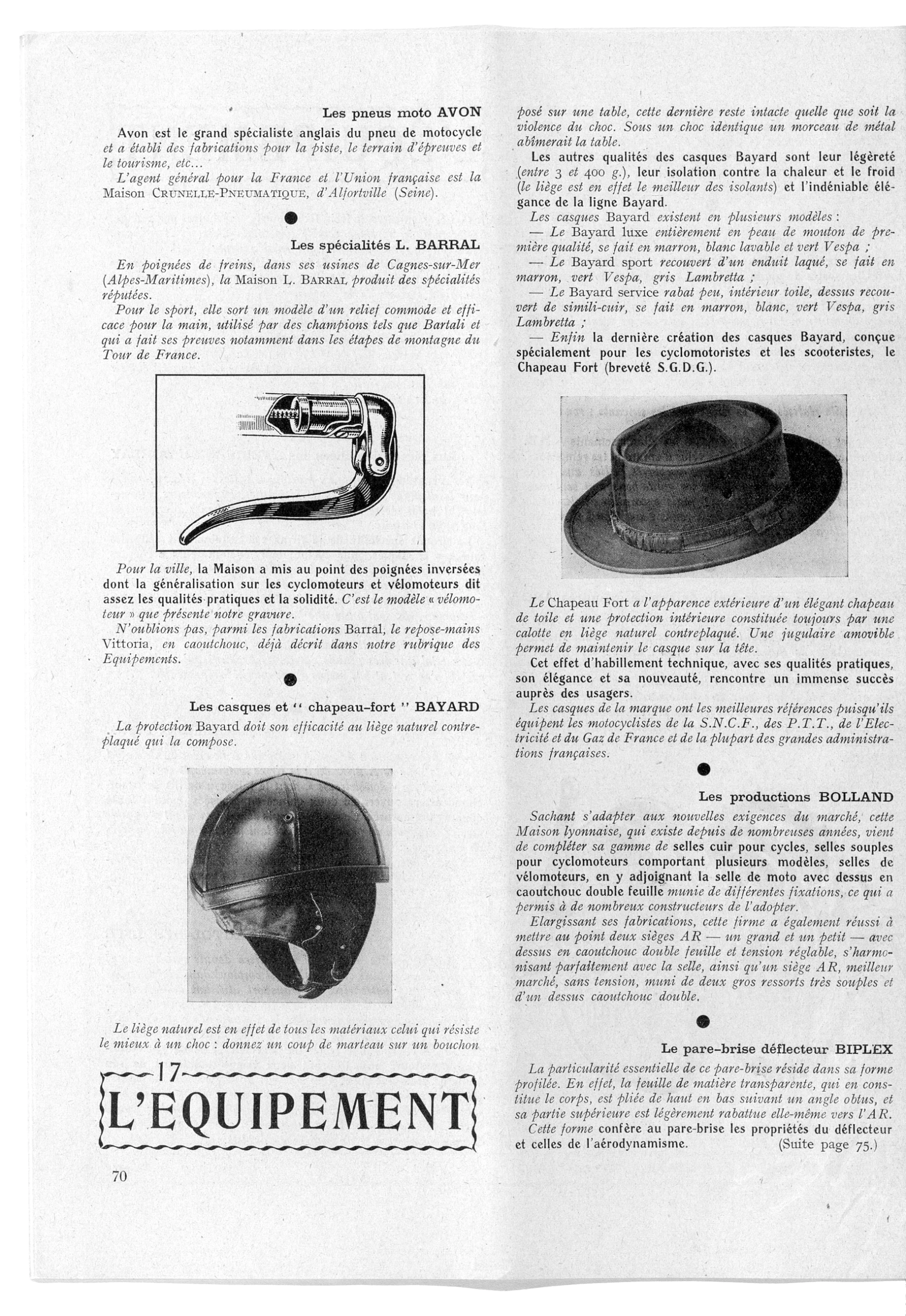
[Ebykr summary; the article’s text is not reproduced. In brake grips, at its works in Cagnes-sur-Mer (Alpes-Maritimes), the Maison L. Barral makes specialties of high reputation. For sport it turns out a model whose relief is comfortable and effective for the hand, used by champions such as Bartali and (the sentence breaks off after “et”, with no second name printed) which has proved itself notably in the mountain stages of the Tour de France. For town use the firm has developed reversed grips (poignées inversées), whose spread over cyclomoteurs and vélomoteurs shows their practical qualities and strength enough; the vélomoteur model is the one shown in the engraving. The author reminds readers that among Barral’s products there is also the rubber Vittoria hand rest (repose-mains Vittoria), already described in the Équipements column.]
Les casques et “ chapeau-fort ” BAYARD
[Ebykr summary; the article’s text is not reproduced. The Bayard protection owes its effectiveness to the natural plywood cork of which it is made. Cork is, of all materials, the one that best resists a blow: strike a cork stopper with a hammer while it stands on a table and the stopper stays intact however violent the blow, whereas under the same blow a piece of metal would damage the table. The other qualities of the Bayard helmets are their lightness (printed “entre 3 et 400 g.”, the first figure lacking its unit and zeros), their insulation against heat and cold (cork being the best of insulators) and the undeniable elegance of the Bayard line.]
Les casques Bayard existent en plusieurs modèles :
— Le Bayard luxe entièrement en peau de mouton de première qualité, se fait en marron, blanc lavable et vert Vespa ;
— Le Bayard sport recouvert d’un enduit laqué, se fait en marron, vert Vespa, gris Lambretta ;
— Le Bayard service rabat peu, intérieur toile, dessus recouvert de simili-cuir, se fait en marron, blanc, vert Vespa, gris Lambretta ;
— Enfin la dernière création des casques Bayard, conçue spécialement pour les cyclomotoristes et les scooteristes, le Chapeau Fort (breveté S.G.D.G.).
[Ebykr summary, closing the Bayard item; the article’s text is not reproduced. The Chapeau Fort looks outwardly like an elegant cloth hat, with an inner protection that is always a shell of natural plywood cork; a removable chin strap keeps the helmet on the head. The author says this technical disguise, with its practical qualities, its elegance and its novelty, meets with immense success among users. The helmets of the brand have the best references, since they equip the motorcyclists of the S.N.C.F., the P.T.T., Électricité et Gaz de France and most of the large French public administrations.]
Les productions BOLLAND
[Ebykr summary; the article’s text is not reproduced. This Lyon house, which has existed for many years and knows how to adapt to the new demands of the market, has just completed its range of leather saddles for cycles and soft saddles for cyclomoteurs (several models) and for vélomoteurs by adding a motorcycle saddle with a double-sheet rubber top fitted with different fixings, which has allowed many makers to adopt it. Widening its output, the firm has also developed two rear seats (“sièges AR”), one large and one small, with a double-sheet rubber top and adjustable tension, matching the saddle perfectly, as well as a cheaper rear seat without tension, fitted with two large, very supple springs and a double rubber top.]
Le pare-brise déflecteur BIPLEX
[Ebykr summary; the article’s text is not reproduced. The essential feature of this windscreen lies in its profiled shape: the sheet of transparent material that forms its body is folded from top to bottom at an obtuse angle, and its upper part is itself folded slightly back toward the rear. This shape gives the windscreen the properties of a deflector together with those of aerodynamics.] (Suite page 75.)
17
L’EQUIPEMENT
70
[Printed page 70, a full text page of the Salon equipment survey set in two columns of italic roman with some lines in heavier upright roman. Each item opens with a right-aligned heading in bold roman with the firm or brand name in capitals, and a heavy black round dot separates the items in the second column and the Avon and Barral items in the first. Three pictures are printed, each centered in its column: two in the first column and one in the second. Under the Barral text a square ruled frame holds a black-and-white line engraving of a brake lever of the reversed type: a cylindrical handlebar grip lies across the top, a short upright barrel with a pivot hole leads down from it, and a long blade curves down and away to a slender tip, shaded with fine hatching. Under the Bayard heading a halftone photograph shows a rounded dark helmet seen from the front and above, built of stitched panels with a leather edging and a side flap with a rivet. In the second column, below the list of Bayard models, a second halftone photograph in a thin screened rectangle shows the Chapeau Fort: a dark hat with a stitched brim, a raised crown and a plain band, seen in three-quarter view. None of the pictures has a caption, and no signature or monogram is visible. The Bayard text under the helmet photograph breaks off at the foot of the first column and finishes at the head of the second. At the foot of the first column a wavy-ruled box holds the running head L’EQUIPEMENT in large roman capitals, with the section number 17 set above its upper edge; the page number 70 stands below it at the left margin. A line at the foot of the second column refers the reader to page 75. No text from the reverse of the leaf shows through.]
— Page 4 —
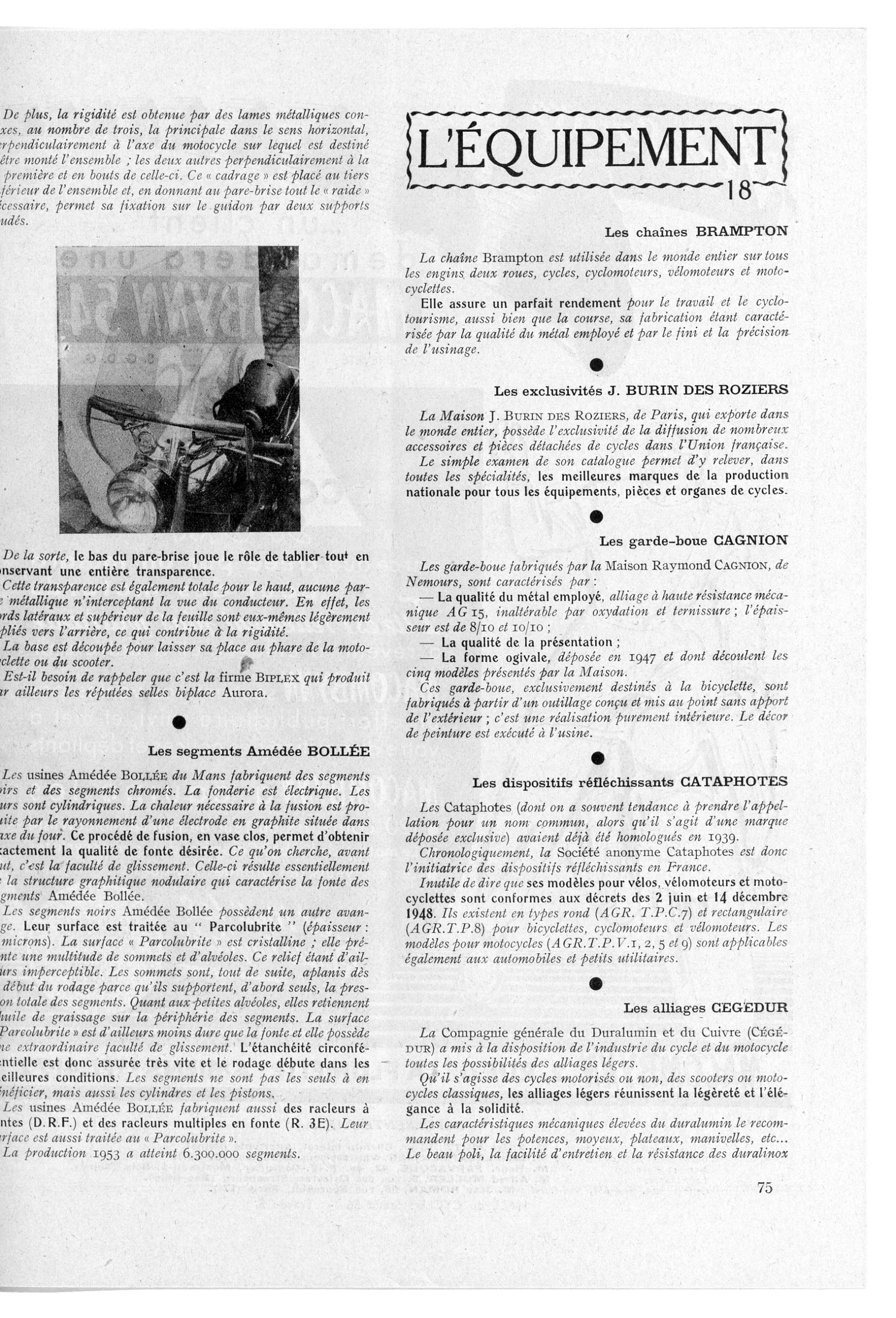
[Ebykr summary; the article’s text is not reproduced. The opening paragraph continues a description of a windshield for motorcycles and scooters begun on the previous page. Its rigidity comes from three convex metal blades: the main one runs horizontally, perpendicular to the axis of the motorcycle, and the other two stand perpendicular to the first at its ends. This “cadrage” sits in the lower third of the windshield, gives the sheet all the stiffness it needs and allows it to be fixed to the handlebar by two bent supports.]
[Ebykr summary, after the photograph. The lower part of the windshield serves as an apron while remaining fully transparent. The top is just as clear, since no metal part crosses the driver’s view; the side and upper edges of the sheet are bent slightly backward, which adds to the rigidity. The base is cut away to leave room for the headlamp of the motorcycle or scooter. The author adds that the maker is the firm Biplex, which also produces the Aurora double saddles.]
Les segments Amédée BOLLÉE
[Ebykr summary; the article’s text is not reproduced. The Amédée Bollée works at Le Mans make black and chromed piston rings. The foundry is electric, with cylindrical furnaces heated by the radiation of a graphite electrode on the furnace axis; this closed-vessel melting gives exactly the cast iron wanted. What is sought above all is the ability to slide, which comes from the nodular graphite structure of the iron. The black rings carry a “Parcolubrite” surface treatment 3 microns thick: its crystalline surface has many peaks and small pockets, the peaks flatten at once during running-in while the pockets hold the lubricating oil on the ring periphery, so that circumferential sealing is reached very quickly. Cylinders and pistons benefit from the same treatment. The works also make slotted oil rings (D.R.F.) and multiple cast-iron rings (R. 3E), likewise treated with “Parcolubrite”. Production in 1953 reached 6,300,000 rings.]
L’ÉQUIPEMENT
18
Les chaînes BRAMPTON
[Ebykr summary; the article’s text is not reproduced. The Brampton chain is used all over the world on every two-wheeled machine: cycles, cyclomoteurs, vélomoteurs and motorcycles. It is said to give perfect efficiency for work and cyclotouring as well as for racing, its manufacture being marked by the quality of the metal and by the finish and precision of the machining.]
Les exclusivités J. BURIN DES ROZIERS
[Ebykr summary; the article’s text is not reproduced. The Paris house of J. Burin des Roziers, which exports worldwide, holds the exclusive distribution in the Union française of many cycle accessories and spare parts. A simple look at its catalog shows, in every specialty, the best marques of national production for all cycle equipment, parts and components.]
Les garde-boue CAGNION
[Ebykr summary; the article’s text is not reproduced. The fenders made by the house of Raymond Cagnion of Nemours are characterized by three points:]
— La qualité du métal employé, alliage à haute résistance mécanique AG 15, inaltérable par oxydation et ternissure ; l’épaisseur est de 8/10 et 10/10 ;
— La qualité de la présentation ;
— La forme ogivale, déposée en 1947 et dont découlent les cinq modèles présentés par la Maison.
[Ebykr summary, after the list. These fenders are made only for the bicycle, from tooling designed and developed with no outside help, a purely in-house achievement. The paint decoration is carried out at the works.]
Les dispositifs réfléchissants CATAPHOTES
[Ebykr summary; the article’s text is not reproduced. The author notes that the name Cataphotes, often taken for a common noun, is a registered exclusive trademark, and that the devices had already been approved in 1939. In order of dates the Société anonyme Cataphotes is therefore the originator of reflecting devices in France. Its models for bicycles, vélomoteurs and motorcycles comply with the decrees of 2 June and 14 December 1948. They exist in a round type (AGR. T.P.C.7) and a rectangular type (AGR.T.P.8) for bicycles, cyclomoteurs and vélomoteurs; the models for motorcycles (AGR.T.P.V.1, 2, 5 and 9) also apply to automobiles and small utility vehicles.]
Les alliages CEGEDUR
[Ebykr summary; the article’s text is not reproduced. The Compagnie générale du Duralumin et du Cuivre (Cégédur) has put all the possibilities of light alloys at the disposal of the cycle and motorcycle industry. Whether for motorized or plain cycles, scooters or conventional motorcycles, light alloys combine lightness and elegance with strength. The high mechanical properties of duralumin recommend it for stems, hubs, chainwheels, cranks and similar parts. The text then turns to the fine polish, ease of upkeep and resistance of the duralinox alloys, and breaks off at the foot of the page in the middle of that sentence.]
75
[A full page of text in two columns, set in italic and roman book type with bold passages, with no advertisement. The left column opens with a paragraph that continues from the previous leaf, then holds a halftone photograph: a close view of a clear windshield mounted on handlebars, its lower edge cut in a rounded notch around a round white headlamp, a dark figure in a jacket at the right and a blurred lettered banner behind; no caption is printed. Below the photograph the left column carries the rest of the windshield text, a round black bullet and the Amédée Bollée section under a bold sans-serif heading aligned to the right. The right column begins with the section title “L’ÉQUIPEMENT” in large roman capitals inside a wavy-edged ruled frame, with the number 18 hanging beneath the frame at its right. Under it follow the bold right-aligned headings for Brampton, Burin des Roziers, Cagnion, Cataphotes and Cegedur, each paragraph block separated by a round black bullet; the Cagnion points are set as a dashed list with bold lead phrases. The printed page number 75 stands at the foot of the right column. No signature or artist mark appears, and no text from the reverse of the leaf shows through apart from a faint ghost of lettering behind the left column.]
— Page 5 —
[Ebykr summary; the article’s text is not reproduced. The opening lines finish the Cegedur section begun on the previous page: the beautiful polish, easy upkeep and resistance of the duralinox alloys make them the choice for handlebars, rims, fenders, crankcases, fairings, tanks and all accessories (caps, lighting, horns, pumps, luggage carriers and the like).]
Les équipements électriques C.E.V.
[Ebykr summary; the article’s text is not reproduced. The Établissements Pagani of Milan have long specialized in electrical equipment for cycles and motorcycles, sold under the marque C.E.V. The range is very wide and includes:]
— Des projecteurs pour motocyclettes de tous types;
— Des compteurs kilométriques pour motos et cyclomoteurs.
— Des encadrements de plaques moto et auto ;
— Des volants magnétiques ;
— Des feux arrière ;
— Des avertisseurs ;
— Des commutateurs interrupteurs ;
— Des dynamos et des phares pour cycle,
— et enfin des boîtiers lampes torches et de poche.
[Ebykr summary, within and after the list. The author notes that some headlamps are made to take a speedometer built into them so that the two instruments form one block, and closes by saying that the C.E.V. products are very varied and that the renown of the marque guarantees their quality.]
Les fabrications CHOLAIN
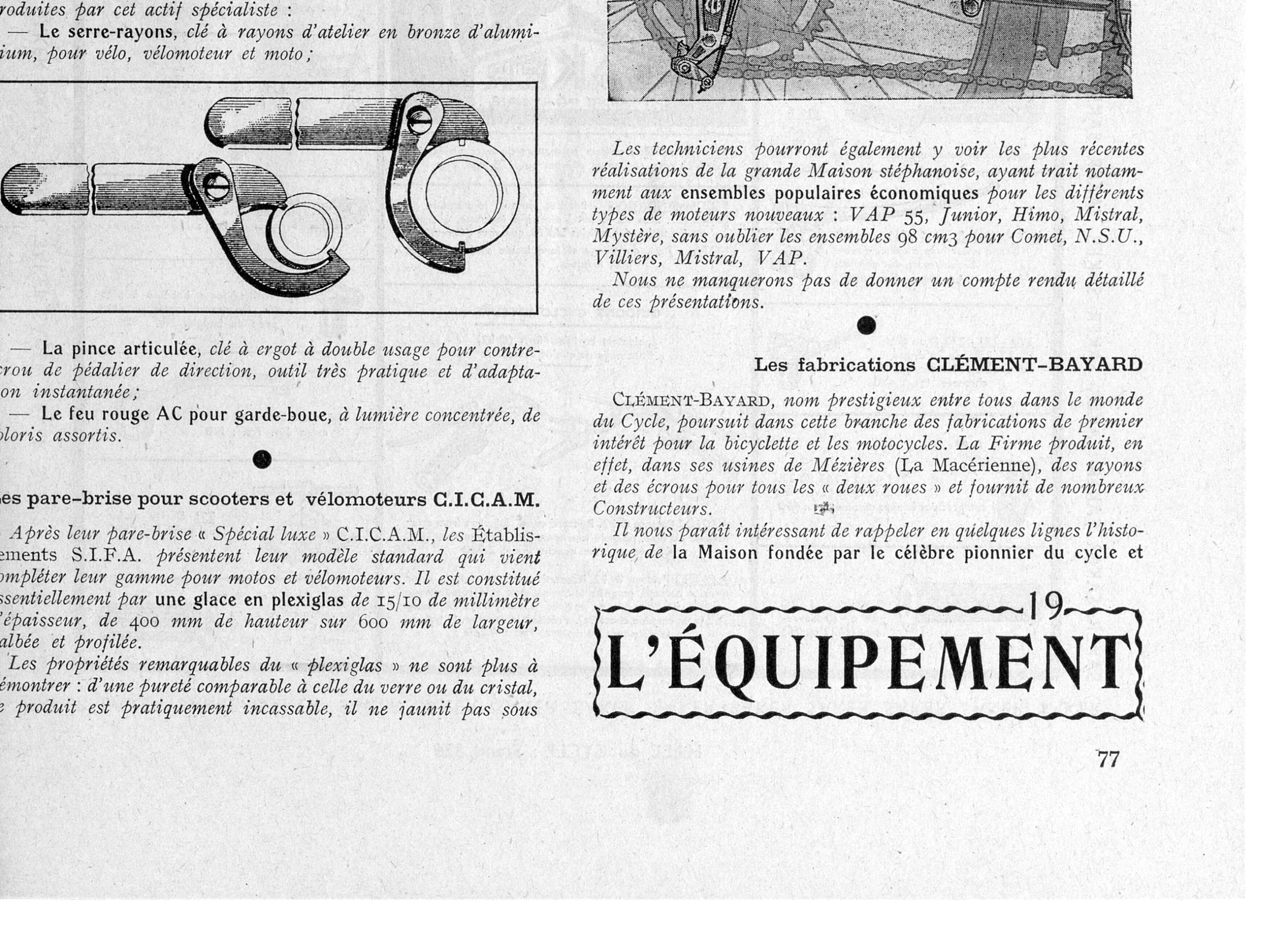
[Ebykr summary; the article’s text is not reproduced. The house of Cholain of Paris is known to every cycle dealer for the variety of its cycling products. The author only recalls briefly its toe clips and straps with the Gérardin quick buckle, its antitheft padlocks, its Quick pedal fixers, its freewheel removers for satchels and for workshops, and its general tooling for the dealer, and then dwells on the novelties of this active specialist:]
— Le serre-rayons, clé à rayons d’atelier en bronze d’aluminium, pour vélo, vélomoteur et moto ;
— La pince articulée, clé à ergot à double usage pour contre-écrou de pédalier de direction, outil très pratique et d’adaptation instantanée ;
— Le feu rouge AC pour garde-boue, à lumière concentrée, de coloris assortis.
Les pare-brise pour scooters et vélomoteurs C.I.C.A.M.
[Ebykr summary; the article’s text is not reproduced. After their “Spécial luxe” C.I.C.A.M. windshield, the Établissements S.I.F.A. present a standard model that completes their range for motorcycles and vélomoteurs. It consists essentially of a plexiglas pane 15/10 of a millimeter thick, 400 mm high by 600 mm wide, curved and profiled. The author says the properties of plexiglas need no demonstration: a clarity comparable to glass or crystal, practically unbreakable, no yellowing under weather or sunshine, and all its properties kept in every climate, which makes it particularly suited to windshields. The firm has fitted its new model with an apron of cordoual. The new fixing consists of two steel rods, comes in clamps of 22 mm and 25 mm and offers a maximum guarantee against vibration. Once fixed, the windshield is adjusted in height by tightening the two uprights with a simple wrench. The author credits the success of these windshields to their handsome presentation: well studied, harmonious proportions, a sober fixing and a finished manufacture, which together answer the demands of customers.]
Les équipements C.L.B.
[Ebykr summary; the article’s text is not reproduced. At stand 4, occupied at the Parc des Expositions de la Porte de Versailles by the well-known C.L.B. cycle specialties, dealers and motorcycle dealers can see the firm’s back-pedaling brake (rétro-frein), already described in the magazine and to be the subject of many demonstrations and reports.]
[Ebykr summary, after the photograph. Technicians can also see there the latest products of the large Saint-Étienne house, notably popular economical sets for the new engine types VAP 55, Junior, Himo, Mistral and Mystère, without forgetting the 98 cm3 sets for Comet, N.S.U., Villiers, Mistral and VAP. The author promises a detailed report on these presentations.]
Les fabrications CLÉMENT-BAYARD
[Ebykr summary; the article’s text is not reproduced. Clément-Bayard, a name of the highest prestige in the cycle world, pursues this branch of manufacture, of prime interest for the bicycle and the motorcycle. At its works at Mézières (La Macérienne) the firm makes spokes and nuts for all “deux roues” and supplies many constructors. The author then proposes to recall in a few lines the history of the house founded by the famous pioneer of the cycle, and the text breaks off at the foot of the column in the middle of that sentence.]
L’ÉQUIPEMENT
19
77
[A full page of text in two columns, set in italic and roman book type with bold passages, with no advertisement. Each section opens with a bold sans-serif heading aligned to the right, and round black bullets divide the sections. The left column begins in the middle of a sentence carried over from the previous leaf and runs through the C.E.V. section, whose products are set as a dashed list with bold lead phrases, to the Cholain section. There a line engraving in a ruled rectangle shows two views of a spoke wrench in black outline with fine hatched shading: in each a rounded handle is cut in two by a break line, and a hinged lever with a slotted screw carries a hooked ring-shaped jaw. Two further dashed items follow below, then the C.I.C.A.M. windshield section, which carries over to the top of the right column. In the right column a halftone photograph, with no caption, shows a close view of a rear wheel with spokes, a chainwheel and chain, a long spring-loaded brake rod running back along the chainstay and a curved cable ending at a pivoting brake arm that bears a small emblem too small to read. The column closes with the C.L.B. and Clément-Bayard sections. The title “L’ÉQUIPEMENT” stands in large roman capitals inside a wavy-edged ruled frame at the foot of the right column, with the number 19 above the frame at its right, and the printed page number 77 sits below it. No signature or artist mark appears, and no text from the reverse of the leaf shows through.]
— Page 6 —
[Ebykr summary, continued from the preceding page; the article’s text is not reproduced. The closing lines of a history of the automobile pioneer Clément-Bayard state that the first Société Bayard was founded by him in 1879 and that its first factory rose in 1886 in the rue Brunel in Paris, in the middle of what was to become the cycle quarter, where a riding school for velocipedes served beginners. The Levallois factory for airplanes and dirigibles, now owned by Citroën, was built in 1896. The first Clément car was built under Panhard license in 1898. Car production was interrupted by the war, resumed in 1919 and continued until 1921, when Clément-Bayard leased the factory to Citroën. As a point of history, the author adds that Clément-Bayard crossed the Channel by dirigible in 1910 and set a distance record by airplane from Biarritz to Kollum in 1913. The company is now directed by M. Dumont, grandson of Clément-Bayard, and also builds the Mabec motor cultivators.]
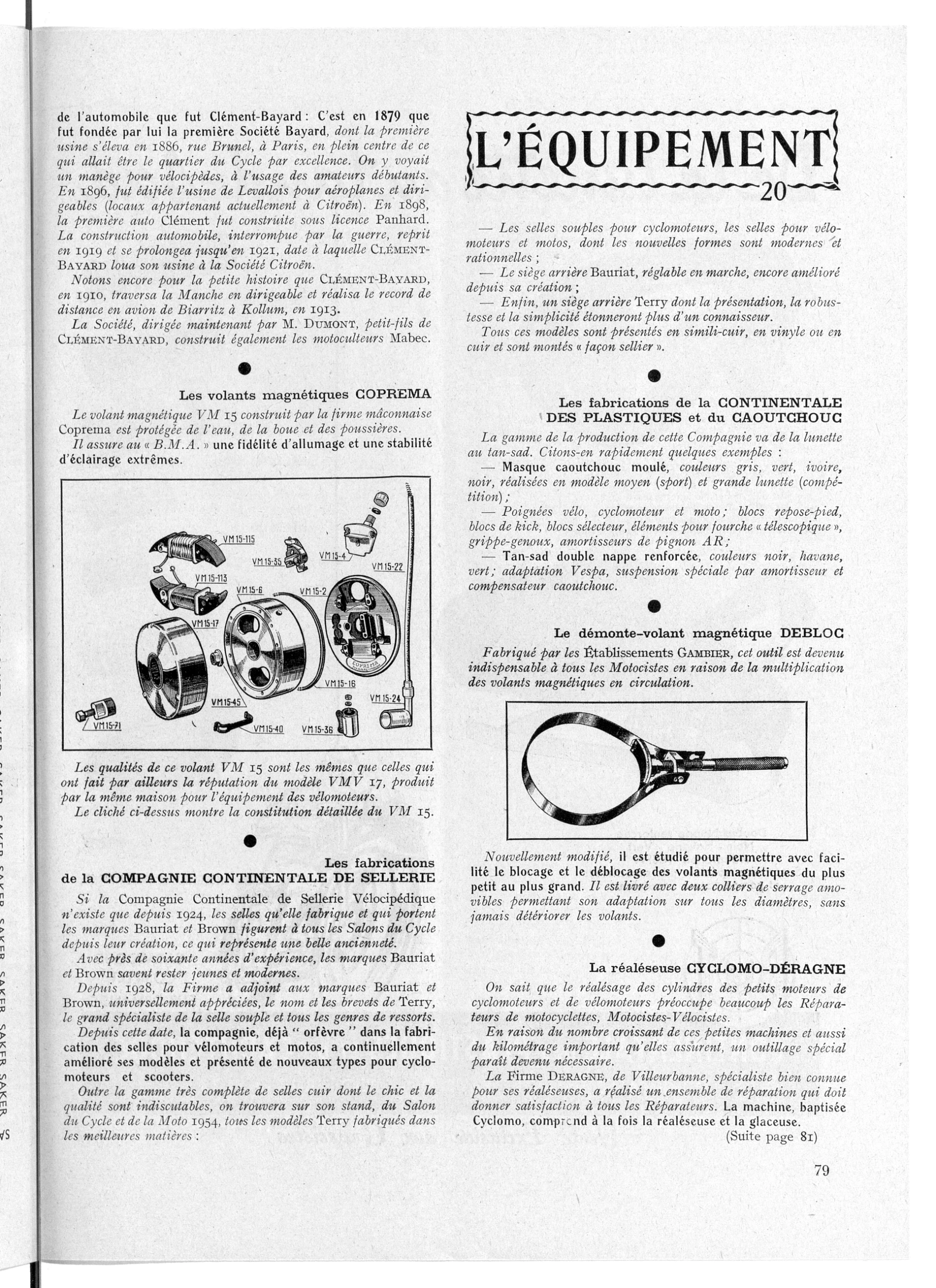
Les volants magnétiques COPREMA
[Ebykr summary; the article’s text is not reproduced. The VM 15 magnetic flywheel, built by the Mâcon firm Coprema, is protected against water, mud and dust. It gives the “B.M.A.” extreme reliability of ignition and steadiness of lighting.]
VM 15-115
VM 15-35
VM 15-4
VM 15-22
VM 15-113
VM 15-6
VM 15-2
VM 15-17
VM 15-45
VM 15-16
VM 15-71
VM 15-40
VM 15-36
VM 15-24
[Ebykr summary; the article’s text is not reproduced. The qualities of the VM 15 flywheel are the same as those that built the reputation of the VMV 17 model, made by the same firm to equip motorized bicycles. The illustration above shows the detailed make-up of the VM 15.]
Les fabrications
de la COMPAGNIE CONTINENTALE DE SELLERIE
[Ebykr summary; the article’s text is not reproduced. The Compagnie Continentale de Sellerie Vélocipédique has existed only since 1924, but the saddles it makes under the Bauriat and Brown marques have appeared at every Cycle Salon since their creation. With nearly sixty years of experience, the two marques stay young and modern. In 1928 the firm added the name and patents of Terry, the great specialist in the sprung saddle and all kinds of springs. Since then the company, already a craftsman of saddles for motorized bicycles and motorcycles, has steadily improved its models and shown new types for cyclomotors and scooters. Besides a very complete range of leather saddles, its stand at the 1954 Cycle and Motorcycle Salon shows every Terry model, made in the best materials:]
L’ÉQUIPEMENT
20
— Les selles souples pour cyclomoteurs, les selles pour vélo-
moteurs et motos, dont les nouvelles formes sont modernes et
rationnelles ;
— Le siège arrière Bauriat, réglable en marche, encore amélioré
depuis sa création ;
— Enfin, un siège arrière Terry dont la présentation, la robus-
tesse et la simplicité étonneront plus d’un connaisseur.
Tous ces modèles sont présentés en simili-cuir, en vinyle ou en
cuir et sont montés « façon sellier ».
Les fabrications de la CONTINENTALE
DES PLASTIQUES et du CAOUTCHOUC
[Ebykr summary; the article’s text is not reproduced. The range of this company runs from the goggle to the pillion seat, and a few examples follow.]
— Masque caoutchouc moulé, couleurs gris, vert, ivoire,
noir, réalisées en modèle moyen (sport) et grande lunette (compé-
tition) ;
— Poignées vélo, cyclomoteur et moto ; blocs repose-pied,
blocs de kick, blocs sélecteur, éléments pour fourche « télescopique »,
grippe-genoux, amortisseurs de pignon AR ;
— Tan-sad double nappe renforcée, couleurs noir, havane,
vert ; adaptation Vespa, suspension spéciale par amortisseur et
compensateur caoutchouc.
Le démonte-volant magnétique DEBLOC
[Ebykr summary; the article’s text is not reproduced. Made by the Établissements Gambier, this tool has become indispensable to all motorcycle mechanics because of the growing number of magnetic flywheels in service. Newly modified, it is designed to lock and unlock magnetic flywheels easily from the smallest to the largest. It comes with two removable clamping collars that fit all diameters without ever damaging the flywheels.]
La réaléseuse CYCLOMO-DÉRAGNE
[Ebykr summary; the article’s text is not reproduced. The author notes that reboring the cylinders of small cyclomotor and motorized-bicycle engines is a growing concern for motorcycle repairers and motorcycle-bicycle dealers, given the rising number of these small machines and the heavy mileage they cover, so that special tooling seems to have become necessary. The Déragne firm of Villeurbanne, a specialist well known for its boring machines, has produced a repair set meant to satisfy all repairers. The machine, named Cyclomo, combines the boring machine and the honing machine.]
(Suite page 81)
79
[A full page of text in two columns, printed page 79, with a mixed-weight type: italic roman for most of the body, a bolder upright face for some passages, and heavy right-aligned bold headings that name each firm in capitals. Short round black bullets separate the items. At the head of the right column a wavy-ruled rectangular banner holds the large roman capitals “L’ÉQUIPEMENT” with the section number “20” printed small against its lower edge. In the left column a ruled rectangular panel shows a line engraving of an exploded view of a magnetic flywheel ignition set: a large ribbed flywheel drum, a rear plate with coils and contacts, two wound coils, a contact breaker, a terminal block and a high-tension lead with a cap, each part tagged with a leader line and a part number in the form “VM 15” followed by a hyphenated figure. A small oval name plate on the rear plate reads “COPREMA” with a place name that includes “MACON” in tiny type. In the right column a second ruled panel holds a line engraving of a tool with a wide oval strap loop and a screw clamp on a knurled handle, set on a plain ground. No signature, artist monogram or agency mark appears. Faint ghosting from the reverse of the leaf shows in the right column beside the Debloc item.]
— Page 7 —
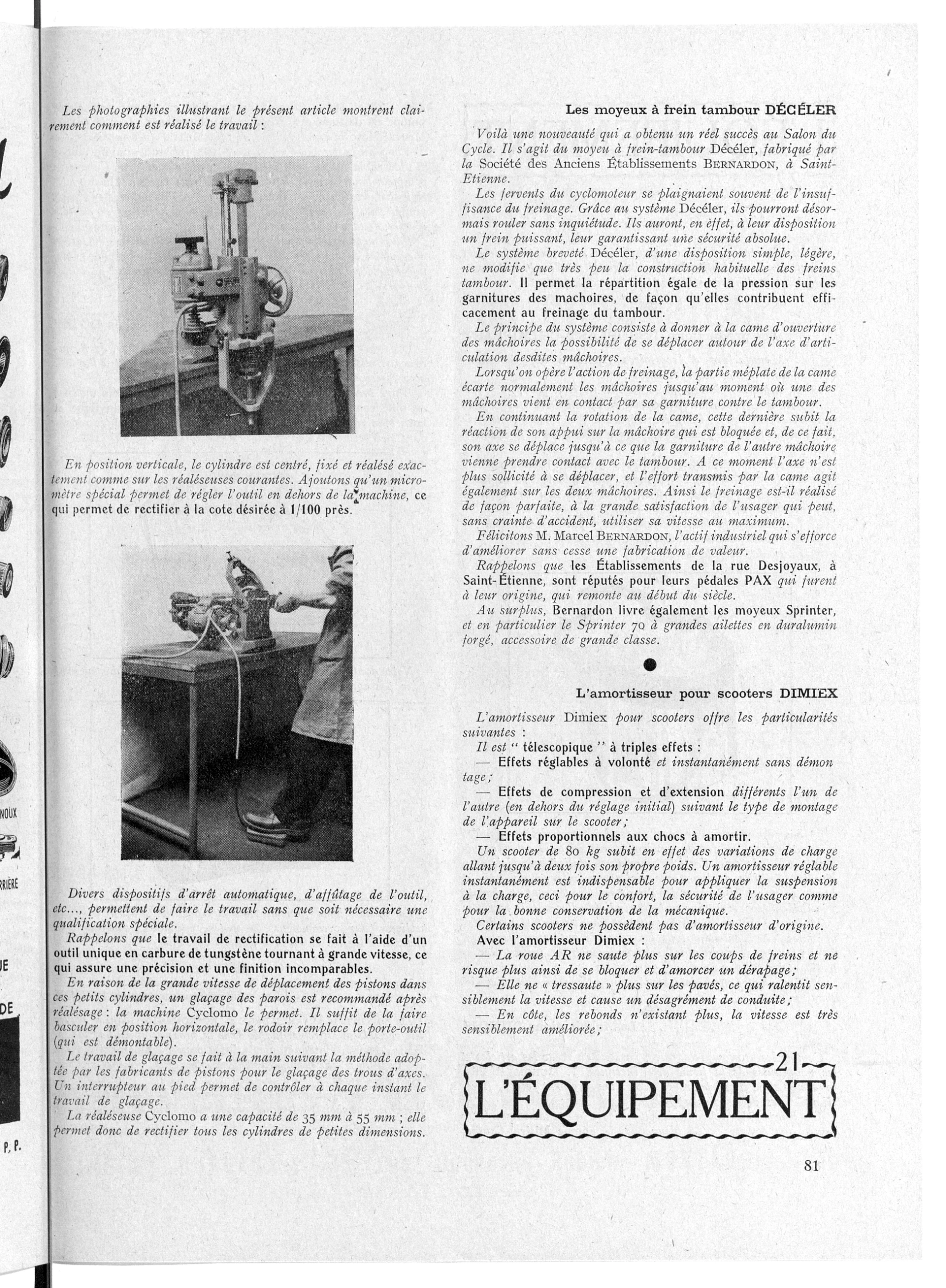
[Ebykr summary, continued from the preceding page; the article’s text is not reproduced. The Cyclo-Déragne item continues: the photographs illustrating the article show clearly how the work is done. In vertical position the cylinder is centered, clamped and bored exactly as on ordinary boring machines. A special micrometer lets the tool be set outside the machine, so that the bore can be rectified to the desired size to within 1/100.]
[Ebykr summary, after the two photographs; the article’s text is not reproduced. Several devices, among them automatic stops and tool sharpening aids, allow the work to be done without any special qualification. The rectifying is done with a single tungsten carbide tool turning at high speed, which gives incomparable precision and finish. Because pistons travel fast in these small cylinders, glazing of the walls is recommended after boring, and the Cyclo machine allows it: the machine is tipped to the horizontal position and the honing tool replaces the removable tool holder. The glazing is done by hand, following the method piston makers use for the wrist-pin holes, and a foot switch lets the operator control the glazing at every moment. The Cyclo boring machine has a capacity of 35 mm to 55 mm, so it can rectify all small cylinders.]
Les moyeux à frein tambour DÉCÉLER
[Ebykr summary; the article’s text is not reproduced. The Décéler drum-brake hub, made by the Société des Anciens Établissements Bernardon of Saint-Étienne, was a novelty that met real success at the Cycle Salon. Cyclomotor riders often complained of weak braking, and the patented Décéler system, simple and light and changing the usual drum-brake construction very little, gives them a powerful brake. It spreads the pressure equally over the shoe linings so that both contribute effectively to braking the drum. The principle is to let the cam that opens the shoes move around the pivot axis of those shoes. When the brake is applied the flat part of the cam spreads the shoes normally until one lining touches the drum. As the cam keeps turning it takes the reaction of its bearing on the blocked shoe and its axis shifts until the lining of the other shoe also touches the drum. The axis is then no longer urged to move and the cam force acts equally on both shoes, so braking is perfect and the user can ride at top speed without fear of accident. The author congratulates M. Marcel Bernardon, an active manufacturer who keeps improving a fine product. He recalls that the works in the rue Desjoyaux at Saint-Étienne are known for their PAX pedals, whose origin goes back to the beginning of the century. Bernardon also supplies the Sprinter hubs, in particular the Sprinter 70 with large forged duralumin flanges, described as a first-class accessory.]
L’amortisseur pour scooters DIMIEX
[Ebykr summary; the article’s text is not reproduced. The Dimiex shock absorber for scooters has the following features. It is “telescopic” with triple effects:]
— Effets réglables à volonté et instantanément sans démon-
tage ;
— Effets de compression et d’extension différents l’un de
l’autre (en dehors du réglage initial) suivant le type de montage
de l’appareil sur le scooter ;
— Effets proportionnels aux chocs à amortir.
[Ebykr summary; the article’s text is not reproduced. A scooter weighing 80 kg undergoes load variations of up to twice its own weight, so an instantly adjustable shock absorber is indispensable to match the suspension to the load, for comfort and safety as well as for the upkeep of the machine. Some scooters have no shock absorber as original equipment.]
Avec l’amortisseur Dimiex :
— La roue AR ne saute plus sur les coups de freins et ne
risque plus ainsi de se bloquer et d’amorcer un dérapage ;
— Elle ne « tressaute » plus sur les pavés, ce qui ralentit sen-
siblement la vitesse et cause un désagrément de conduite ;
— En côte, les rebonds n’existant plus, la vitesse est très
sensiblement améliorée ;
L’ÉQUIPEMENT
21
81
[A full page of text in two columns, printed page 81, set mostly in italic roman with some passages in a bolder upright face and with heavy right-aligned bold headings that name each firm in capitals. A short round black bullet separates the items. The left column opens with a short italic line and then holds two halftone photographs of the same boring-machine work. The upper photograph shows a vertical machine head with a column, a hand wheel at the right, a cylinder clamped below the spindle and a cable at the left. The lower photograph, taller and framed in a thin edge, shows a worker in an apron at the right standing at a bench and holding a machine that rests on a bench top with a flexible tube looping down to the floor. Neither photograph carries a caption or a signature. In the right column a wavy-ruled rectangular banner near the foot holds the large roman capitals “L’ÉQUIPEMENT” with the section number “21” printed small on its upper edge. The firms’ names appear only in the headings and the running text; no address block, signature, artist monogram or agency mark appears on the page.]
— Page 8 —
L’ÉQUIPEMENT
22
[Ebykr summary, continued from the preceding page; the article’s text is not reproduced. The Dimiex list ends: in bends the skids caused by uneven ground become nil. The shock absorber is of robust construction and fully guaranteed for eighteen months with no mileage limit. Its selling price is moderate and its exchange at the standard rate is inexpensive.]
Les productions DISSOPLAST-CHIMIPLAST
[Ebykr summary; the article’s text is not reproduced. This cycle accessories maker has exhibited, as every year, all its specialties:]
1° Sa super-dissolution Dissoplast en tubes et pots ;
2° Son étui-réparation Dissoplast en aluminium contenant le
tube de dissolution et les pièces réparation et dont le couvercle
forme une râpe facile à employer pour la réparation de la chambre
à air ;
3° Sa série complète de rubans pour guidons : rubans adhésifs
en coton (trois qualités) : Véloplast, Guidoplast, Tressoplast ;
rubans matière plastique (nylon), adhésif ou non Plastoplast.
Sur le guidon, ce ruban ne colle pas ;
4° Le ruban et la colle spéciale pour boyaux Boyauplast ;
5° Le ruban isolant caoutchouté Chatterplast ;
6° Le fil de lin pour boyaux ;
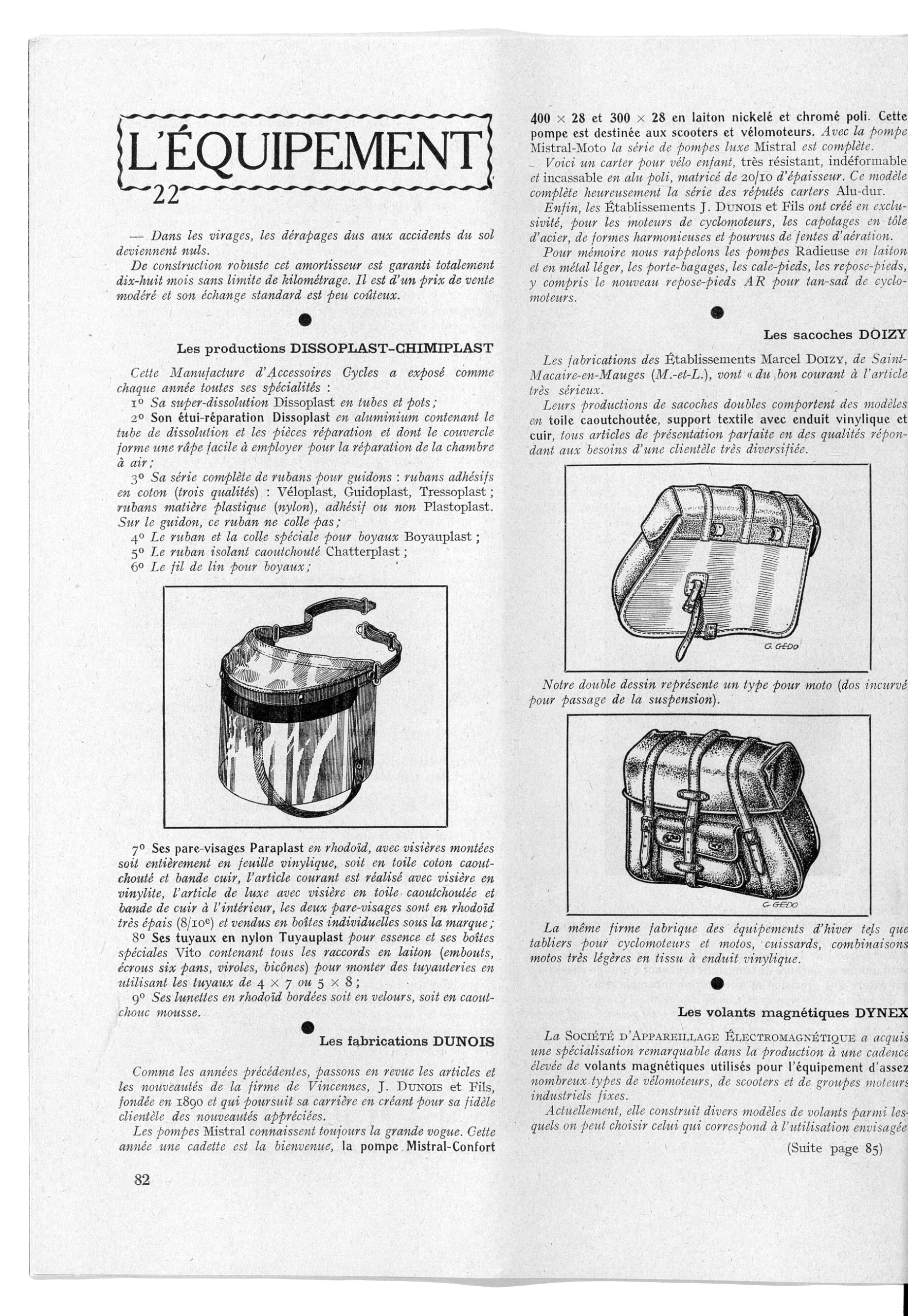
7° Ses pare-visages Paraplast en rhodoïd, avec visières montées
soit entièrement en feuille vinylique, soit en toile coton caout-
chouté et bande cuir, l’article courant est réalisé avec visière en
vinylite, l’article de luxe avec visière en toile caoutchoutée et
bande de cuir à l’intérieur, les deux pare-visages sont en rhodoïd
très épais (8/10e) et vendus en boîtes individuelles sous la marque ;
8° Ses tuyaux en nylon Tuyauplast pour essence et ses boîtes
spéciales Vito contenant tous les raccords en laiton (embouts,
écrous six pans, viroles, bicônes) pour monter des tuyauteries en
utilisant les tuyaux de 4 × 7 ou 5 × 8 ;
9° Ses lunettes en rhodoïd bordées soit en velours, soit en caout-
chouc mousse.
Les fabrications DUNOIS
[Ebykr summary; the article’s text is not reproduced. As in earlier years the author reviews the articles and new products of the Vincennes firm J. Dunois et Fils, founded in 1890, which keeps up its career by creating appreciated novelties for its faithful clientele. The Mistral pumps still enjoy great popularity. This year a junior member is welcome, the Mistral-Confort pump,]
82
[Ebykr summary, continued at the head of the right column; the article’s text is not reproduced. The Mistral-Confort pump comes in 400 × 28 and 300 × 28 sizes in polished nickeled and chromed brass and is meant for scooters and motorized bicycles. With the Mistral-Moto pump the Mistral series of deluxe pumps is complete. The firm also offers a child’s bicycle chain guard in polished aluminum, die-formed at 20/10 thickness, very strong, undeformable and unbreakable, which completes the series of the well-known Alu-dur guards. Finally the Établissements J. Dunois et Fils have created exclusively, for cyclomotor engines, harmoniously shaped steel-sheet cowlings with ventilation slots. For the record the author recalls the Radieuse pumps in brass and light metal, the carriers, the toe clips, the footrests, including the new rear footrest for the pillion seat of cyclomotors.]
Les sacoches DOIZY
[Ebykr summary; the article’s text is not reproduced. The products of the Établissements Marcel Doizy of Saint-Macaire-en-Mauges (M.-et-L.) range from ordinary goods to very serious articles. Their double saddlebags include models in rubberized canvas, a textile base with a vinyl coating, and in leather, all of perfect appearance and in qualities that answer a very varied clientele.]
Notre double dessin représente un type pour moto (dos incurvé
pour passage de la suspension).
La même firme fabrique des équipements d’hiver tels que
tabliers pour cyclomoteurs et motos, cuissards, combinaisons
motos très légères en tissu à enduit vinylique.
Les volants magnétiques DYNEX
[Ebykr summary; the article’s text is not reproduced. The Société d’Appareillage Électromagnétique has acquired a remarkable specialty in producing, at a high rate, magnetic flywheels used to equip quite a number of types of motorized bicycles, scooters and fixed industrial engine sets. It now builds several flywheel models from which the buyer can choose the one that fits the intended use.]
(Suite page 85)
[A full page of text in two columns, printed page 82 at the foot of the left column, set in italic roman with some passages in a bolder upright face and with heavy right-aligned bold headings that name each firm in capitals. Short round black bullets separate the items. At the head of the left column a wavy-ruled rectangular banner holds the large roman capitals “L’ÉQUIPEMENT” with the section number “22” printed small on its lower edge. A ruled square panel in the left column holds a line engraving of a face shield: a curved visor with a stitched peak and a band at the brow, a tall clear shield below, and elastic straps with buckles and rings looping behind. In the right column two ruled panels hold line and stipple engravings of motorcycle saddlebags drawn in three-quarter view. The upper bag has a long curved flap with three buckled straps, a ribbed lower panel and one strap with a buckle; the lower bag has a deep flap with three straps and two front pockets with turn latches. Each bag drawing is signed “G. GEDO” in small script capitals at the lower right inside its frame, the first near the edge of the bag and the second at the foot of the frame. No address block, agency mark or text from the reverse of the leaf shows. The right edge of the printed area runs close to the edge of the leaf.]
— Page 9 —
[Ebykr summary; the article’s text is not reproduced. The opening paragraphs finish the Dynex section begun on the previous page. The author says the construction shows an interesting homogeneity, since the same layouts and the same basic parts are found on every model, and that such a methodical development lets the maker produce quickly and with excellent quality. He then stresses the very modern equipment of the Dynex works. The winding shop has a large series of well-chosen semi-automatic coil lathes that give a high output and an even quality of work. An impregnation room and a testing shop are attached; the testing shop has quick-reading instruments, and every winding without exception goes through a series of tests before and after impregnation. The balancing machine shows instantly on a dial the position and the weight of the unbalance. The condenser shop is placed, as such work requires, in a spot entirely apart from the traffic inside the works. The sum of these details of care is said to assure the quality of Dynex manufacture.]
Les bougies EYQUEM
[Ebykr summary; the article’s text is not reproduced. The author says the good running of an engine often depends on a spark plug in good condition and of good quality. The Eyquem company, seeking the highest quality, has developed a particular plug for each type of cyclomoteur or scooter, since the plug must be made with the characteristics of the engine in mind for the output to be at its maximum. The plugs are said to be perfectly sealed and not to overheat, and many constructors have chosen them as original equipment, so that no other references are needed. At the Salon the Eyquem stand is number 251.]
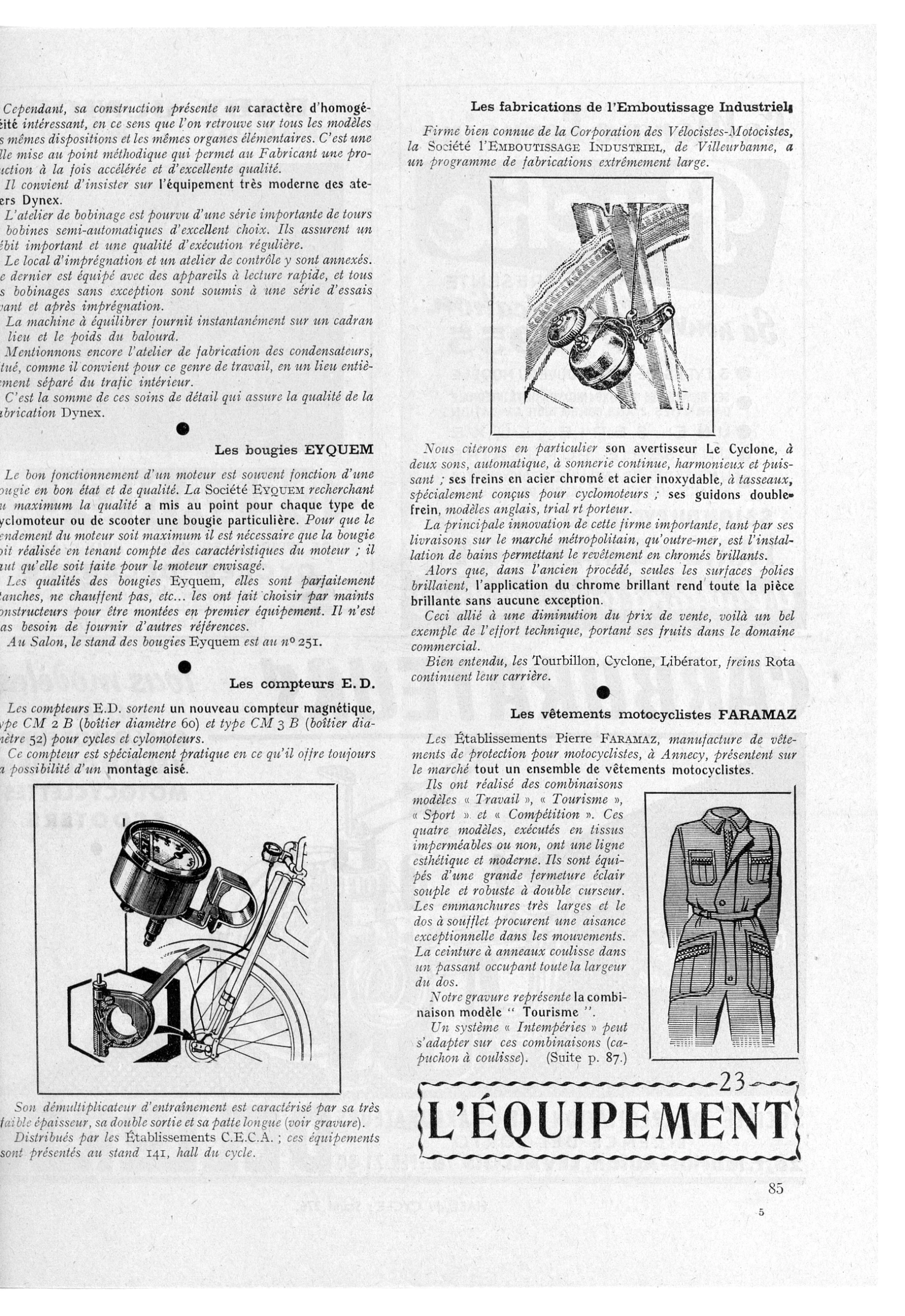
Les compteurs E.D.
[Ebykr summary; the article’s text is not reproduced. E.D. brings out a new magnetic speedometer in two types: CM 2 B (case diameter 60) and CM 3 B (case diameter 52), for cycles and cyclomoteurs. It is described as especially practical because it always allows easy mounting.]
[Ebykr summary, after the engraving. Its drive reducer is characterized by its very small thickness, its double outlet and its long lug (see the engraving). The equipment is distributed by the Établissements C.E.C.A. and is shown at stand 141, hall du cycle.]
Les fabrications de l’Emboutissage Industriel
[Ebykr summary; the article’s text is not reproduced. The Société l’Emboutissage Industriel of Villeurbanne, a firm well known to the trade of cycle and motorcycle dealers, has an extremely broad manufacturing program.]
[Ebykr summary, after the engraving. The author cites in particular its two-tone automatic horn Le Cyclone, with a continuous ring that is harmonious and powerful; its shoe brakes (freins à tasseaux) in chromed steel and stainless steel, designed especially for cyclomoteurs; and its double-brake handlebars in English models, trial and carrier types. The main innovation of this important firm, in its deliveries both to the home market and overseas, is the installation of baths allowing coating in bright chrome. Where the old process left only the polished surfaces shining, bright chrome makes the whole piece shine without exception. Together with a lower selling price, the author calls this a fine example of technical effort bearing fruit in the commercial field. The Tourbillon, Cyclone and Libérator products and the Rota brakes naturally continue their careers.]
Les vêtements motocyclistes FARAMAZ
[Ebykr summary; the article’s text is not reproduced. The Établissements Pierre Faramaz, a manufacturer of protective clothing for motorcyclists at Annecy, offer on the market a complete range of motorcycle clothing. They have made combinations (coveralls) in four models, “Travail”, “Tourisme”, “Sport” and “Compétition”, cut in waterproof or non-waterproof fabrics, with a handsome modern line. Each has a large, supple and strong zipper with a double slider. The very wide armholes and the bellows back give exceptional freedom of movement, and the belt with rings slides in a loop covering the whole width of the back. The engraving shows the “Tourisme” combination. An “Intempéries” weather system, with a drawstring hood, can be fitted to these combinations.]
(Suite p. 87.)
L’ÉQUIPEMENT
23
85
[A full page of text in two columns, set in italic and roman book type with bold passages, with no advertisement. Each section opens with a bold sans-serif heading aligned to the right and round black bullets divide the left column. The left column begins in the middle of a sentence carried over from the previous leaf and holds the Dynex end, the Eyquem section and the E.D. speedometer section. That section has a line engraving in a ruled rectangle: a round speedometer with a dial and a spark-plug-like fitting hangs above a small bracket, and below it a hexagonal inset gives an enlarged view of a thin drive housing with a long arm and a clamp ring, with an arrow pointing to the front hub of a spoked wheel and fork. The right column holds a line engraving in a ruled rectangle of a round bell-shaped horn clamped to a fork leg beside a tire, with cables, and a second ruled engraving at the right of the Faramaz text: a one-piece coverall with turned collar, front fastening, belt, four patch pockets with chevron trim and horizontal hatching for the cloth. None of the three engravings has a printed caption. The page ends with the “(Suite p. 87.)” line at the foot of the right text, then the title “L’ÉQUIPEMENT” in large roman capitals inside a wavy-edged ruled frame with the number 23 above the frame at its right, and the printed page number 85 below it with a very small numeral 5 beneath that. No signature or artist mark appears, and no text from the reverse of the leaf shows through.]
— Page 10 —
[Ebykr summary; the article’s text is not reproduced. The opening lines finish the Faramaz section from the previous page: the “Intempéries” system, a drawstring hood, can be fitted to the combinations. The firm also makes waterproof anoraks, trousers, coats and cycling shorts. For some days its combinations can be fitted with a luminous strip placed on the back and along the sleeves, which signals the motorcyclist to vehicles about to overtake. The strip begins to shine when lit by the headlamps of vehicles, is visible at several hundred meters and is not damaged at all by the weather. The author says this system should help avoid many accidents.]
Les freins et embrayages motocyclistes FLERTEX
[Ebykr summary; the article’s text is not reproduced. Flertex, the great specialist in brake and clutch linings, has not neglected the motorcycle field. For motorcycle dealers the firm has prepared a documentation on the brake and clutch equipment of vélomoteurs, scooters and motorcycles. Interested parties need only ask for it from the Établissements Flertex at Neuilly-sur-Seine to be fully informed about the marque’s products for motorized “deux roues”.]
Le caoutchouc manufacturé
des Établissements FOUGERAT
[Ebykr summary; the article’s text is not reproduced. The author calls the role of rubber in the cycle, the motorcycle and the scooter undeniably important. The Établissements Fougerat of Neuvy-sur-Loire are at present in the front rank of manufactured rubber goods, and the renown they have earned is the best guarantee of the quality of what is delivered to customers. They naturally make all the classic articles, too many to list, but prospective customers have every interest in consulting them for new products. Among the classic articles the author notes the rubber solution sold under the marque “Remember” and the brake blocks under the marque “Sphinx”.]
Le ” Limitvolt ” GAMBIER
[Ebykr summary; the article’s text is not reproduced. The Limitvolt is a lighting regulator that, inserted in an ignition circuit, radically prevents the blowing of bulbs, which are constantly subject to voltage variations. The device allows the engine to be started without risk of burning the bulbs and the rider to travel at speed at night without fearing the sudden “trou noir”.]
[Ebykr summary, after the engraving. It is no bulkier than a condenser, is easily fitted and is said never to wear out. This regulator, at a very modest price, exists in a model for the bicycle and cyclomoteur and in a model for the vélomoteur, scooter and motorcycle.]
L’ÉQUIPEMENT
24
L’antivol pour VéloSolex GAM
[Ebykr summary; the article’s text is not reproduced. This antitheft lock, designed especially for the popular VéloSolex cyclomoteur, is of an entirely new type. It cannot be tampered with because no part of it can be taken off while it is in service, and the rod that might be sheared is of case-hardened steel; the barrel of the four-groove lock is of the universally known Ronis marque.]
[Ebykr summary, after the engraving. The author calls it practical and mechanical, since a single turn of the handlebar to the right is enough to immobilize the bicycle, locking the heaviest part of the cycle, which cannot be carried off in that position. It is not cumbersome, cannot be lost and does not catch in the spokes. Fitting takes only a few minutes.]
Les casques GÉNO
[Ebykr summary; the article’s text is not reproduced. The author says the speed at which “2-roues” run today makes a helmet necessary: for a motorcycle, scooter or even a cyclomoteur, wearing a protective helmet can prevent very serious and even fatal accidents, provided the helmet is strong enough to stand every test. The Société Gueneau-Géno has put on the market various helmets that have just these qualities. They stand up to the hardest blows and are also very becoming, which matters because many pretty scooter riders would not accept a headgear that harmed their elegance even if it protected perfectly. The firm has also not been content with a standard helmet: it has defined a model for each use, whether cyclomoteur, scooter, motorcycle or even car.]
Les appareils GERBAUD
[Ebykr summary; the article’s text is not reproduced. To remagnetize flywheel magnets an apparatus has been developed, the Shuntaflux, which restores to the flywheels a magnetization equal to or greater than the original. The accompanying figure is said to show the apparatus mounted on a two-coil magnetizing stand, but no figure appears on this page. The author adds that while the problem of magnetizing flywheel magnets has found its solution, the “control” of the magnetization raises another problem of great interest to the motorcycle dealer.]
(Suite page 89)
87
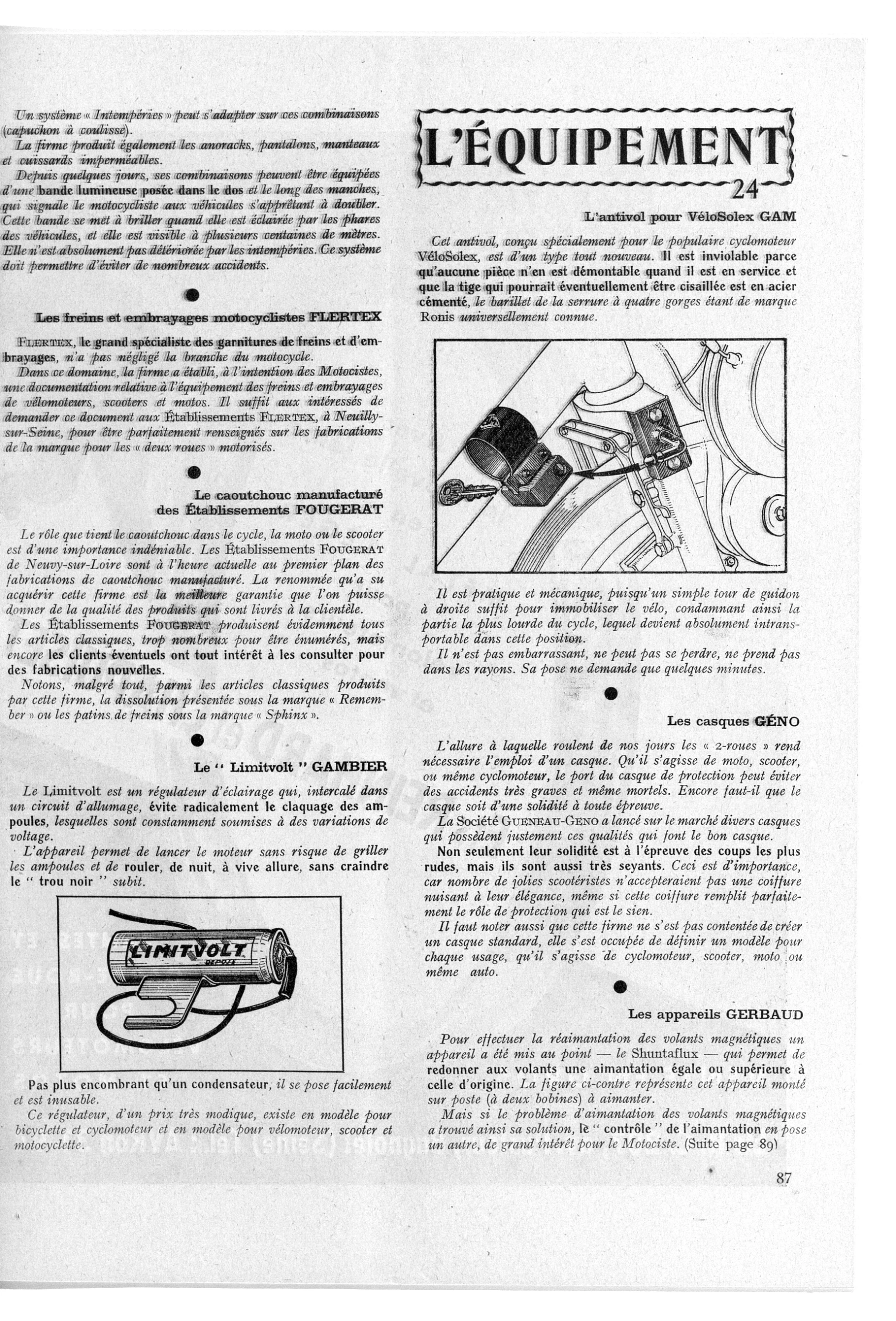
[A full page of text in two columns, set in italic and roman book type with bold passages, with no advertisement. Each section opens with a bold sans-serif heading aligned to the right, and round black bullets divide the sections. The left column begins in the middle of a sentence carried over from the previous leaf and holds the Flertex, Fougerat and Gambier sections. The Gambier section carries a line engraving in a ruled rectangle of a cylindrical regulator with a label reading “LIMITVOLT” and “DÉPOSÉ” in heavy italic capitals, a flat L-shaped mounting bracket and two looped wires. The title “L’ÉQUIPEMENT” stands in large roman capitals inside a wavy-edged ruled frame at the top of the right column, with the number 24 hanging below the frame at its right. Beneath the heading for the VéloSolex antitheft lock a large line engraving in a ruled rectangle shows a black cylindrical clamp with a small lozenge-shaped mark too small to read, a key at the lower left, a bracket and rod beside a spoked front wheel and fork, and an arrow from the clamp to the rod. The right column then carries the Géno and Gerbaud sections, ending with the line “(Suite page 89)”. The printed page number 87 stands at the foot of the right column. None of the engravings has a printed caption. No signature or artist mark appears, and no text from the reverse of the leaf shows through.]
Ebykr presents this material for research and education. If you hold rights to it or notice an ownership issue, please contact us and we will respond promptly.
The Ebykr Digest
New articles, timelines, catalog finds and registry activity — assembled from the archive once a month. Your address is never shared.
Double opt-in. One email per month. Unsubscribe at any time with one click.