About Ebykr
Ebykr celebrates classic and vintage lightweight bicycles through provocative imagery and opinion. Ride along with us.
About Ebykr
Ebykr celebrates classic and vintage lightweight bicycles through provocative imagery and opinion. Ride along with us.

Source: Gallica (Bibliothèque nationale de France), L'Officiel du cycle, du motocycle et du camping, 2 October 1954, N° 40, pages 31, 32, 35, 37, 39, 41 and 42; ark:/12148/bd6t54206310j. Source gallica.bnf.fr / BnF.
| Type | Review |
|---|---|
| Year | 1954 |
| Publisher | L'Officiel du cycle |
| Country | France |
| Language | French |
| Pages | 7 |
| Source | Gallica (Bibliothèque nationale de France), L'Officiel du cycle, du motocycle et du camping, 2 October 1954, N° 40, pages 31, 32, 35, 37, 39, 41 and 42; ark:/12148/bd6t54206310j. Source gallica.bnf.fr / BnF. |
| Credit | Ebykr archive; Bibliothèque nationale de France |
| Identifier | Gallica (BnF) ark:/12148/bd6t54206310j/f31 |
| Transcription | Headings and specifications transcribed; article text summarized |
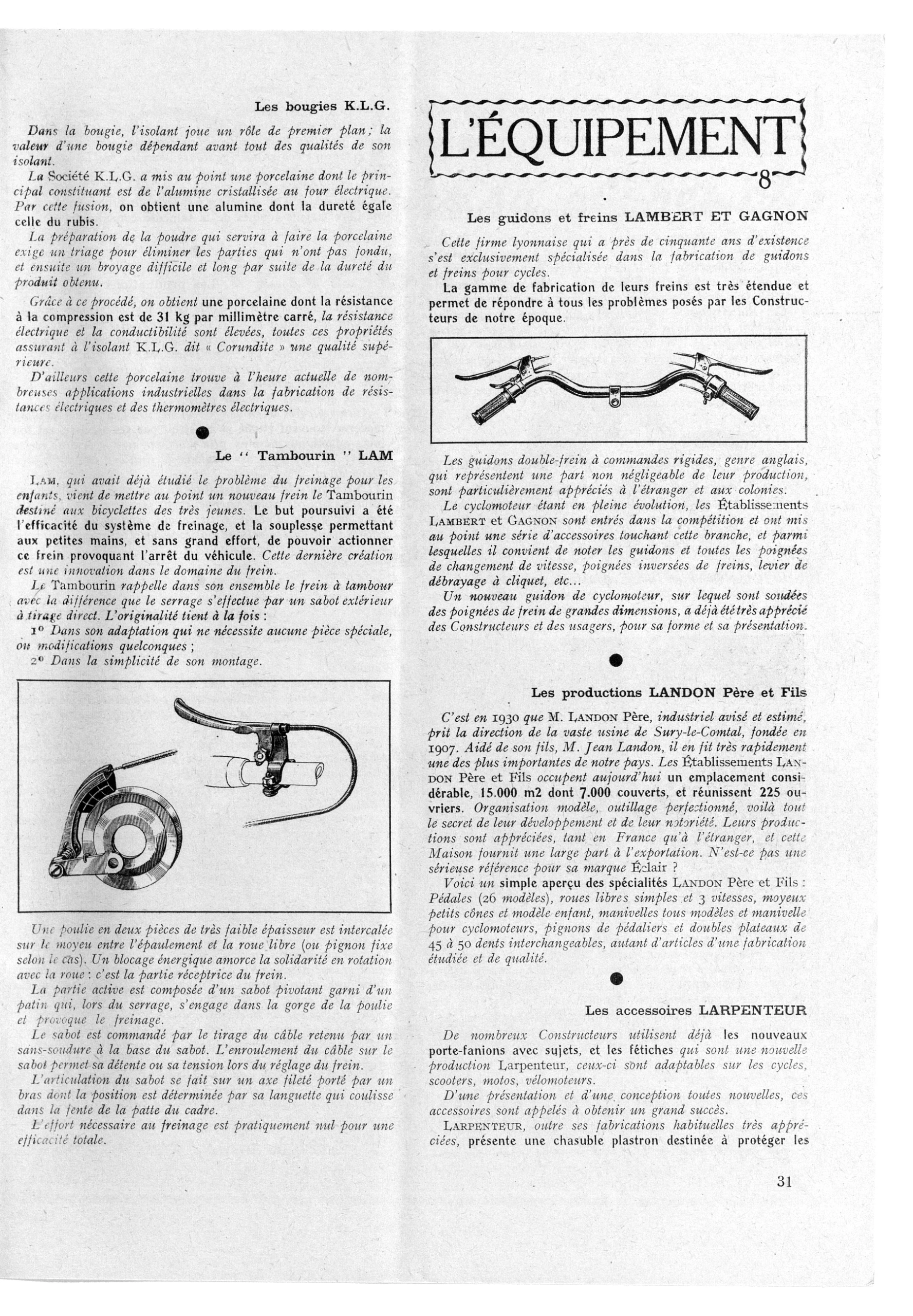
Les bougies K.L.G. Le " Tambourin " LAM L'ÉQUIPEMENT 8 Les guidons et freins LAMBERT ET GAGNON Les productions LANDON Père et Fils Les accessoires LARPENTEUR 31 Jeux de direction LIGHTRACE et LELÉGÉ Les vêtements de protection MACOMBYN 9 L'ÉQUIPEMENT 32 Les productions Aimé LEDIN Les fabrications MAGNÉTO-FRANCE Les sujets MARVEL Les productions MONTCOUDIOL Fils …
This is a magazine article, so its running text is summarized here rather than reproduced; the headline, byline, specifications and scores are transcribed as printed.
From L’Officiel du cycle, du motocycle et du camping, 2 October 1954, the paper’s special number before the 1954 Paris Salon du Cycle et du Motocycle, pages 31, 32, 35, 37, 39, 41 and 42: the continuation of Gilbert Victor’s survey of equipment shown at the Salon, a roundup of firms from spark plugs and mascots to lighting, clothing, cables and spokes, with their drawings and photographs. The title, headings, captions and lists are transcribed as printed; the text is summarized in Ebykr’s words, and the page images carry it in full.
— Page 1 —
Les bougies K.L.G.
[Ebykr summary; the article’s text is not reproduced. The note says the insulator plays the leading part in a spark plug, since a plug’s value depends above all on the quality of its insulator. The Société K.L.G. has developed a porcelain whose main constituent is alumina crystallized in the electric furnace; this fusion yields an alumina whose hardness equals that of ruby. Preparing the powder for the porcelain requires a sorting step to remove the parts that did not melt, then a long and difficult grinding because of the hardness of the product. The resulting porcelain has a compression strength of 31 kg per square millimeter, with high electrical resistance and conductivity, all of which give the K.L.G. insulator, called “Corundite”, a superior quality. The author adds that this porcelain also finds many industrial uses at present, in the making of electrical resistors and electric thermometers.]
Le ” Tambourin ” LAM
[Ebykr summary; the article’s text is not reproduced. LAM, which had already studied the braking problem for children, has just perfected a new brake, the Tambourin, intended for the bicycles of very young riders. The aims were braking efficiency and an easy action that lets small hands operate the brake without great effort to stop the vehicle; the author calls this latest creation an innovation in the field of brakes. The Tambourin recalls a drum brake in its general form, except that the clamping is done by an external shoe on a direct pull. Its originality lies in two things, which the article numbers: 1° its adaptation, which needs no special part or modification of any kind; 2° the simplicity of its fitting.]
[Ebykr summary, after the drawing. A two-piece pulley of very small thickness is placed on the hub between the shoulder and the freewheel (or fixed sprocket, as the case may be). A firm tightening begins the rotational lock with the wheel; this is the receiving part of the brake. The active part is a pivoting shoe fitted with a pad that, on clamping, engages in the groove of the pulley and causes the braking. The shoe is operated by the pull of the cable, held by a seamless ferrule at the base of the shoe; winding the cable on the shoe allows it to be slackened or tightened when the brake is adjusted. The shoe pivots on a threaded axle carried by an arm whose position is set by its tongue, which slides in the slot of the frame’s dropout. The effort needed for braking is practically nil, for a total efficiency.]
L’ÉQUIPEMENT
8
Les guidons et freins LAMBERT ET GAGNON
[Ebykr summary; the article’s text is not reproduced. This Lyon firm, nearly fifty years old, has specialized exclusively in making handlebars and brakes for cycles. Its range of brakes is very wide and lets it answer every problem set by the makers of the day.]
[Ebykr summary, after the drawing. The double-brake handlebars with rigid levers, English style, which make up a considerable share of the firm’s output, are particularly valued abroad and in the colonies. With the moped in full development, Établissements Lambert et Gagnon have entered the competition and perfected a series of accessories for that branch, among them handlebars and every kind of twist grip for gear change, reversed brake grips and a ratchet clutch lever, and so on. A new moped handlebar, with large brake grips welded to it, has already been much appreciated by makers and users for its shape and appearance.]
Les productions LANDON Père et Fils
[Ebykr summary; the article’s text is not reproduced. In 1930 M. Landon senior, described as a shrewd and respected industrialist, took over the direction of the large factory at Sury-le-Comtal, founded in 1907. Helped by his son M. Jean Landon, he quickly made it one of the most important in the country. Établissements Landon Père et Fils now occupy a considerable site, 15.000 m2 of which 7.000 are covered, and employ 225 workers. The author credits a model organization and perfected tooling for the firm’s growth and reputation. Its products are appreciated in France and abroad, and the house supplies a large share to export; the author asks whether that is not a serious reference for its Éclair brand. He then gives a brief survey of the specialties: pedals (26 models), single and 3-speed freewheels, small-cone hubs and a children’s model, cranks of every model and a crank for mopeds, pedal-gear sprockets and double chainrings of 45 to 50 teeth that are interchangeable, all described as articles of studied and quality manufacture.]
Les accessoires LARPENTEUR
[Ebykr summary; the article’s text is not reproduced. Many makers already use the new pennant holders with figures and the mascots, which are a new Larpenteur production and can be fitted on cycles, scooters, motorcycles and mopeds. Of an entirely new look and design, these accessories are expected to be a great success. Besides its usual and much appreciated lines, Larpenteur presents a plastron chasuble intended to protect the (the sentence breaks off at the foot of the column and continues on the next page).]
31
[A full text page set in two printed columns under a wavy-framed section heading. A centered black bullet separates each firm’s note. The firm headings stand in bold roman type aligned to the right edge of each column, with the firm names in capitals, and the notes are set mostly in italic with bold lines mixed in. At the head of the right-hand column a wavy-bordered banner holds the word “L’ÉQUIPEMENT” in large thin roman capitals, with a large numeral 8 hanging below its right end. In the right-hand column a ruled rectangular panel holds a line engraving of a bicycle handlebar seen from above with a brake lever and a twist grip at each end; no caption is printed apart from the running text. In the left column a ruled rectangular panel holds a line and hatched engraving of a small brake: a cable-operated curved shoe pivots beside a grooved pulley at the left while a brake lever with a clamp, fixed round a short length of handlebar tube, sits at the upper right with its cable looping down and ending at the lower edge. No signature or agency mark is visible. The printed page number 31 stands at the foot of the right-hand column. The lower left quarter of the page is empty.]
— Page 2 —
[Ebykr summary, continuing a firm’s notice from the previous page; the article’s text is not reproduced. The garment described there protects scooter riders and cyclomotor riders from the cold on the shoulders, the back and the chest while leaving the legs free; the legs are covered by the shield that fits on the handlebar, which the writer says has long been known as a product of that firm. The firm’s name stands on the previous page.]
Jeux de direction LIGHTRACE et LELÉGÉ
[Ebykr summary; the article’s text is not reproduced. For more than thirty years, which the writer calls a reference in itself, the Établissements GOURGAUD et Cie of Saint-Etienne have made the Lightrace and Lelégé headsets (jeux de direction). Their success keeps growing, and the principal makes equip their machines with these headsets, which he calls of absolutely irreproachable quality. The firm has come to the very first ranks of French production and the writer says its reputation is fully earned. M. Gourgaud is described as a shrewd industrialist with only one aim, work that defies all criticism, and he has succeeded: many constructors anxious to present machines of class have adopted the Lightrace and Lelégé headsets.]
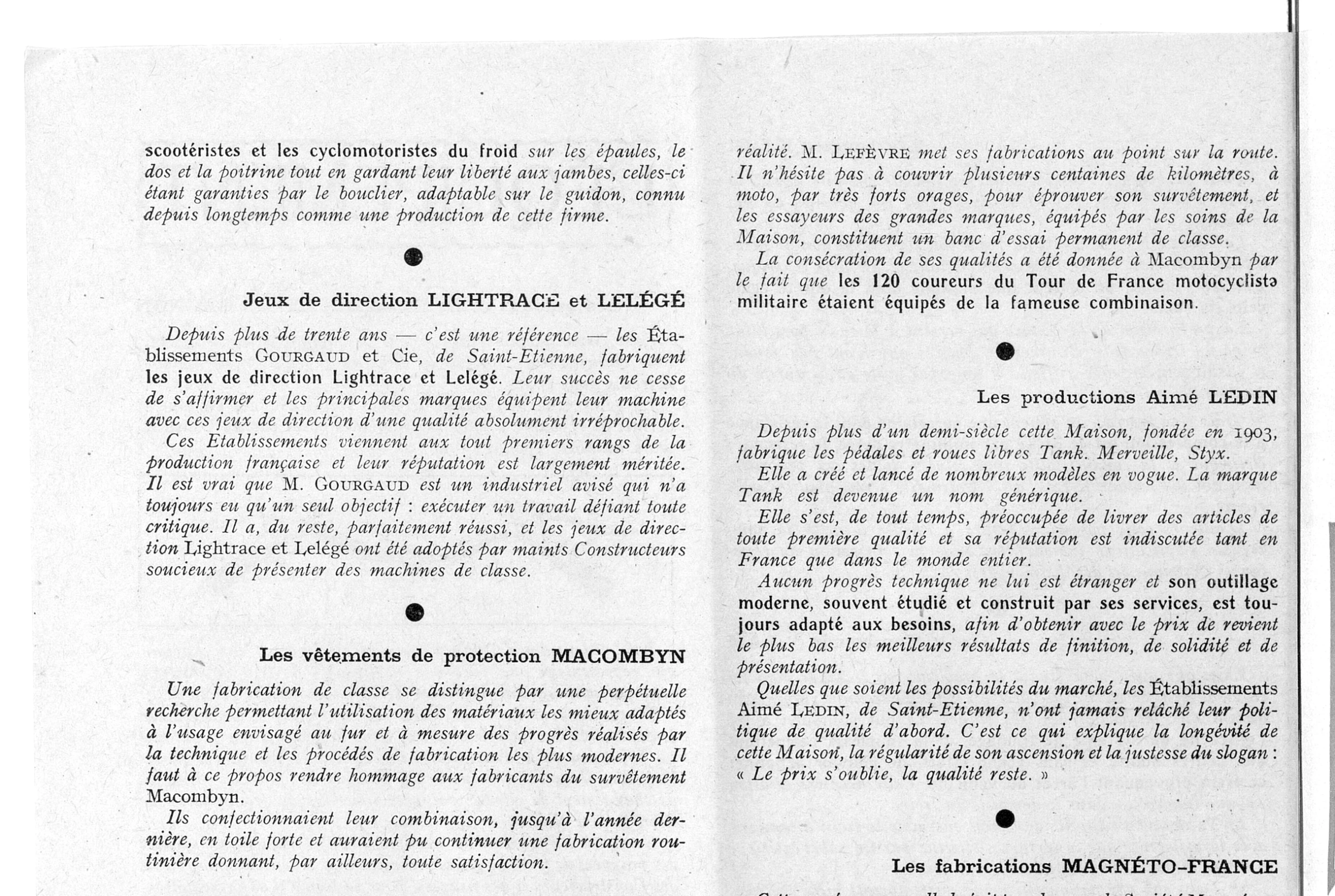
Les vêtements de protection MACOMBYN
[Ebykr summary; the article’s text is not reproduced. A first-class manufacture is marked by perpetual research, using the materials best suited to the intended use as technique and the most modern processes advance, and the writer pays tribute on that account to the makers of the Macombyn suit (survêtement). Until last year they made their one-piece suit (combinaison) in heavy canvas and could have gone on with a routine manufacture that gave full satisfaction.]
[Ebykr summary, after the photograph; the article’s text is not reproduced. Constant research brought the makers face to face with an absolutely new material, “Cordoual Sport”, and they did not hesitate to convert all their workshops to work only Cordoual, whose combined qualities of resistance, washability and indifference to chemical products the writer calls extraordinary. Macombyn advertising carries the line “Conçue par un motard pour des motards”, and the writer says it is no mere slogan but a fact; the account continues in the right-hand column.]
9
L’ÉQUIPEMENT
32
[Ebykr summary, continuing the Macombyn notice at the head of the right-hand column; the article’s text is not reproduced. M. Lefèvre proves his products on the road: he does not hesitate to cover several hundred kilometers by motorcycle in very heavy storms to test his suit, and the test riders of the big makes, kitted out by the firm, form a permanent test bench of class. The recognition of the suit’s qualities came from the fact that all 120 riders of the military motorcycle Tour de France were wearing the famous suit.]
Les productions Aimé LEDIN
[Ebykr summary; the article’s text is not reproduced. The house, founded in 1903, has made pedals and freewheels for more than half a century under the names Tank, Merveille and Styx; it has created and launched many models in vogue, and the writer says the Tank name has become a generic term. It has always aimed to deliver articles of first quality, with a reputation he calls undisputed in France and across the world. No technical advance is foreign to it, and its modern tooling, often designed and built by its own staff, is kept suited to its needs so as to reach the best finish, strength and presentation at the lowest cost price. Whatever the state of the market, the Établissements Aimé LEDIN of Saint-Etienne have never relaxed their policy of quality first, which the writer says explains the long life of the house, the steadiness of its rise and the truth of its slogan: « Le prix s’oublie, la qualité reste. »]
Les fabrications MAGNÉTO-FRANCE
[Ebykr summary; the article’s text is not reproduced. As every year the Société MAGNÉTO-FRANCE keeps the first showing of its new products for the Salon, and the writer lists what is on view in hall Renand, stand 131. First come flywheel magnetos for cyclomotors, now delivered either with an ignition coil, built in or external, or oil-bath. Next are new flywheel magnetos of types AP and AS in diameters of 140 and 130 mm, with a built-in ignition coil and also a separate oil-filled coil; these fit all 2-stroke or 4-stroke engines from 90 to 300 cm3. The writer finds these flywheels simple and evidently sturdy, with a high ignition and lighting curve that meets the new Code de la route, and says they satisfy the most demanding users. The range of DR dynamos, mounted at the end of the crankshaft, has gained new models for the 250 cm3 Terrot, the 250 cm3 René Gillet, the 250 cm3 twin-cylinder Radior and the 175 cm3 S.N.E.C.M.A. engines, and this equipment has the benefit of more than 100,000 units in service. The great novelty on show is electric starters for engines of cyclomotors, scooters and motorcycles up to 250 cm3, in two types. One is the classic starter with a pinion engaging a toothed ring gear, universally known from automobile use, with a dynamo at the end of the shaft, optionally with a ventilation turbine, for mounting on a scooter engine together with the full set of equipment: regulator-cutout, high-tension oil-insulated coil, headlamp changeover switch, battery ignition key and wiring harness. The other is a dynamo-starter, and the page breaks off in the middle of the sentence that begins to say how it is mounted.]
[Page 32 of the survey, a full page of text in two wide columns with one photograph; the section number 9 and the running head “L’ÉQUIPEMENT” stand in a framed block at the foot of the left-hand column and the folio 32 below it at the left. Most of the text is in italic roman type with a few phrases in a heavier upright face. Each firm heading is set right-aligned in bold roman with the firm name in capitals, and a solid round black bullet stands before each heading. In the left column a halftone photograph, with no caption and no credit, shows a street in front of a large stone building with trees: a row of helmeted riders in dark coats stands beside parked motorcycles carrying round numbered plates (212, 267, 259 and 205) and small sign boards on folding stands, while a man in a dark suit walks along the line, followed by a second man in a suit and an officer in uniform and kepi. The framed block at the foot of the left column holds “L’ÉQUIPEMENT” in large roman capitals inside a wavy-ruled box, with a numeral 9 breaking the top rule. No drawing, no signature and no advertiser mark appear. The right-hand column ends mid-sentence above a blank foot. A strip of the neighboring leaf with orange and dark marks shows at the far right beyond the page edge but cuts no text.]
— Page 3 —
[Ebykr summary, the close of a note whose heading is on an earlier page; the article’s text is not reproduced. The item described is fitted directly on the end of the crankshaft and, in a general way, adapts much more easily to all current engines. A complement of equipment has also been provided for this type.]
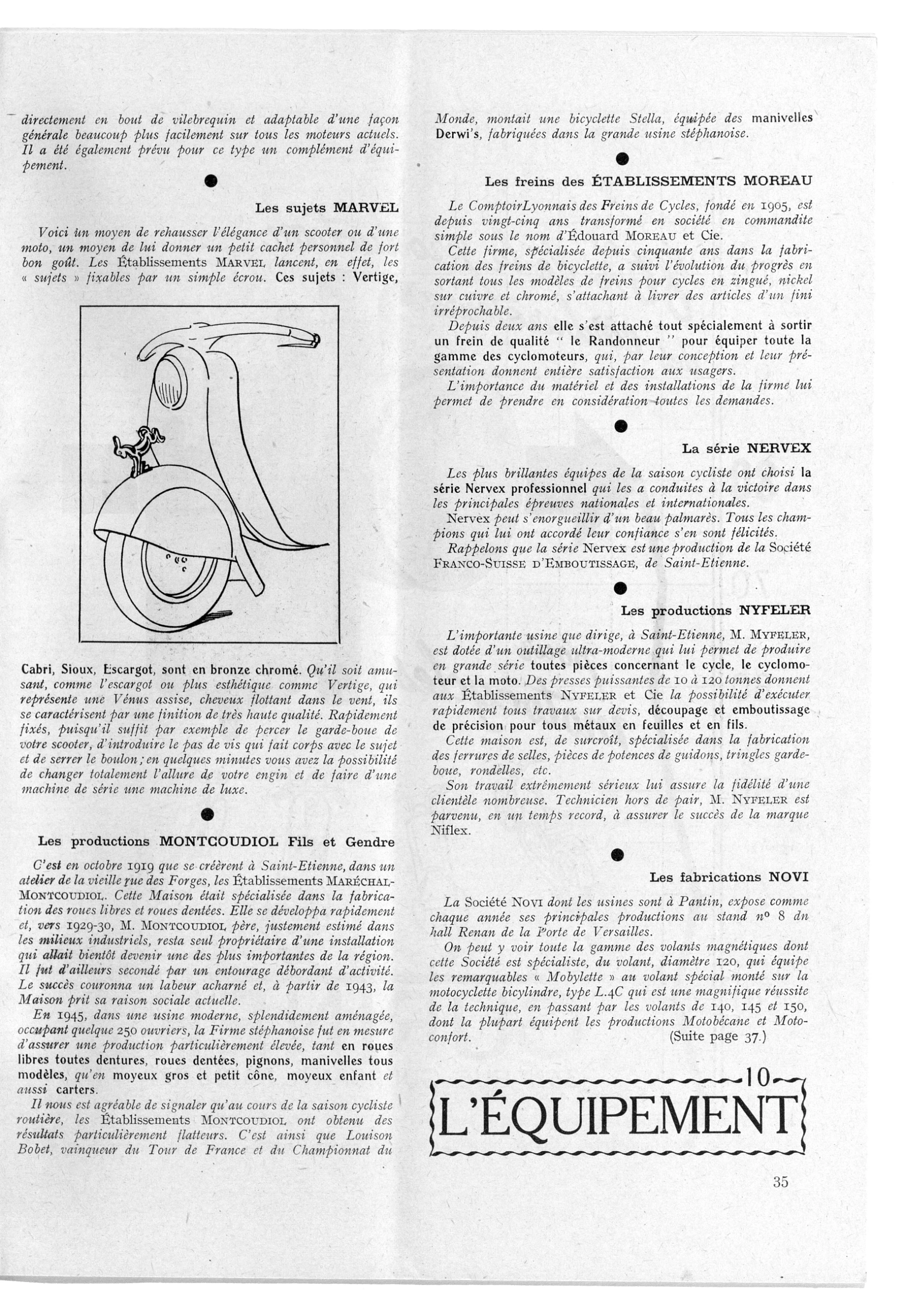
Les sujets MARVEL
[Ebykr summary; the article’s text is not reproduced. The note offers a way to raise the elegance of a scooter or a motorcycle and to give it a small personal touch of good taste. The Établissements Marvel are launching “sujets” (figurine mascots) that fix with a single nut. The sujets are named Vertige, Cabri, Sioux and Escargot, and all are in chromed bronze.]
[Ebykr summary, after the drawing. Whether amusing, like the snail, or more aesthetic, like Vertige, which shows a seated Venus with her hair flying in the wind, they are marked by a very high quality of finish. They fix quickly: it is enough, for example, to drill the mudguard of the scooter, pass in the threaded stud that is part of the figure and tighten the bolt. In a few minutes the owner can change the look of the machine completely and turn a series-built machine into a luxury one.]
Les productions MONTCOUDIOL Fils et Gendre
[Ebykr summary; the article’s text is not reproduced. In October 1919 the Établissements Maréchal-Montcoudiol were set up at Saint-Etienne in a workshop in the old rue des Forges, specialized in making freewheels and sprocket wheels. The house grew quickly and, about 1929-30, M. Montcoudiol senior, well esteemed in industrial circles, became sole owner of a plant that soon became one of the largest in the region, helped by a highly active circle around him. Success rewarded hard work and from 1943 the house took its present company name. In 1945, in a modern and splendidly fitted factory of some 250 workers, the Saint-Etienne firm could ensure a particularly high output of freewheels of every tooth count, sprocket wheels, sprockets, cranks of every model, large hubs and small-cone hubs, children’s hubs and also chain cases. The author is pleased to note that during the road racing season the Établissements Montcoudiol obtained particularly flattering results: Louison Bobet, winner of the Tour de France and of the World Championship, rode a Stella bicycle fitted with Derwi’s cranks, made in the great Saint-Etienne works.]
Les freins des ÉTABLISSEMENTS MOREAU
[Ebykr summary; the article’s text is not reproduced. The Comptoir Lyonnais des Freins de Cycles, founded in 1905, was transformed twenty-five years ago into a limited partnership (société en commandite simple) under the name Édouard Moreau et Cie. The firm, specialized for fifty years in making bicycle brakes, has followed progress by turning out every model of cycle brake in galvanized zinc, nickel on copper and chrome, taking care to deliver articles of irreproachable finish. For two years it has applied itself especially to a quality brake, “le Randonneur”, to equip the whole range of mopeds, which in design and presentation give users complete satisfaction. The size of the firm’s plant and installations lets it take up every request.]
La série NERVEX
[Ebykr summary; the article’s text is not reproduced. The most brilliant teams of the cycling season chose the Nervex professionnel series, which led them to victory in the principal national and international events. Nervex can be proud of a fine record, and all the champions who trusted it have been pleased. The series is a production of the Société Franco-Suisse d’Emboutissage of Saint-Etienne.]
Les productions NYFELER
[Ebykr summary; the article’s text is not reproduced. The large factory directed at Saint-Etienne by M. Myfeler (so printed here, though the heading reads Nyfeler) has ultra-modern tooling that lets it make in large series every part for the cycle, the moped and the motorcycle. Powerful presses of 10 to 120 tons let the Établissements Nyfeler et Cie carry out all work to quotation quickly, precision blanking and drawing for all metals in sheet and wire. The house also specializes in saddle fittings, handlebar stem parts, mudguard stays, washers and so on. Its extremely serious work keeps the loyalty of a large clientele, and M. Nyfeler, an outstanding technician, has in record time secured the success of the Niflex brand.]
Les fabrications NOVI
[Ebykr summary; the article’s text is not reproduced. The Société Novi, whose works are at Pantin, shows its main products as every year at stand no. 8 of the Renan hall at the Porte de Versailles. There can be seen the whole range of magnetic flywheels in which the company specializes, from the 120 flywheel that equips the “Mobylette” and the special flywheel fitted on the twin-cylinder motorcycle type L.4C, described as a magnificent technical success, through the 140, 145 and 150 flywheels, most of which equip Motobécane and Motoconfort products.]
(Suite page 37.)
L’ÉQUIPEMENT
10
35
[A full text page in two printed columns with no advertising. Each firm’s note opens with a bold roman heading set flush right, the firm name in capitals, and the notes are set mostly in italic roman type with some bold lines mixed in; a black bullet separates one note from the next. In the left column a ruled square panel holds a line drawing of the front of a scooter in profile: a long curved fender arches over the wheel, a shaped leg shield rises behind it and a thin handlebar line crosses the top; a small hare-like figure with long ears stands on top of the fender. No caption is printed beneath it other than the running text. At the foot of the right column a wavy-bordered banner holds the word “L’ÉQUIPEMENT” in large thin roman capitals, with the numeral 10 set into the upper rule at the right, and it introduces no text on this page. The printed page number 35 stands below it. The foot of the left column and the area under the banner are empty. No signature or agency mark is visible. The first note at the head of the left column opens in mid-sentence, its heading being on an earlier page.]
— Page 4 —
[Ebykr summary, the close of the Novi note begun on page 35 (its heading is on that page); the article’s text is not reproduced. One of the 140 mm flywheels, the 140 UD, gives an original solution to the ignition of scooter engines and is at present fitted as standard on the Mors Speed Paris-Nice scooter. All the traditional ignition apparatus will be shown: magnetos, combined magneto-dynamos, dynamos and so on. The company does not forget the cycle branch and presents a bicycle dynamo, the “Novi 55”, which gives users the benefit of the very latest technical improvements. All technicians will certainly be interested in the firm’s work, as will all those not indifferent to the ignition problems of “deux-roues”, whose solutions are offered to the eyes of visitors.]
Les moyeux PÉLISSIER et Fils
[Ebykr summary; the article’s text is not reproduced. The Plume, Plume-Sports and C.P. hubs are models of technical perfection used by very many makers anxious to equip their machines well. The Établissements Pélissier et ses Fils of Saint-Etienne, who make them, are one of the oldest French houses specialized in hubs for bicycles. The brand was founded in 1909 and has kept growing since; it now stands in the very first ranks and its various steel and dural products enjoy a brilliant success.]
Les moyeux PORTHOR
[Ebykr summary; the article’s text is not reproduced. “High-quality hubs” is the motto of the Établissements Porthor of Saint-Etienne. This Saint-Etienne brand offers every cyclist a complete output for the road, for racing and for touring, and it also makes hubs for mopeds that are particularly appreciated. The firm can invoke the best of references: for thirty years it has devoted itself exclusively to making the hub. Precision, strength and elegance are the first qualities of the various Porthor models, which the great firms have adopted.]
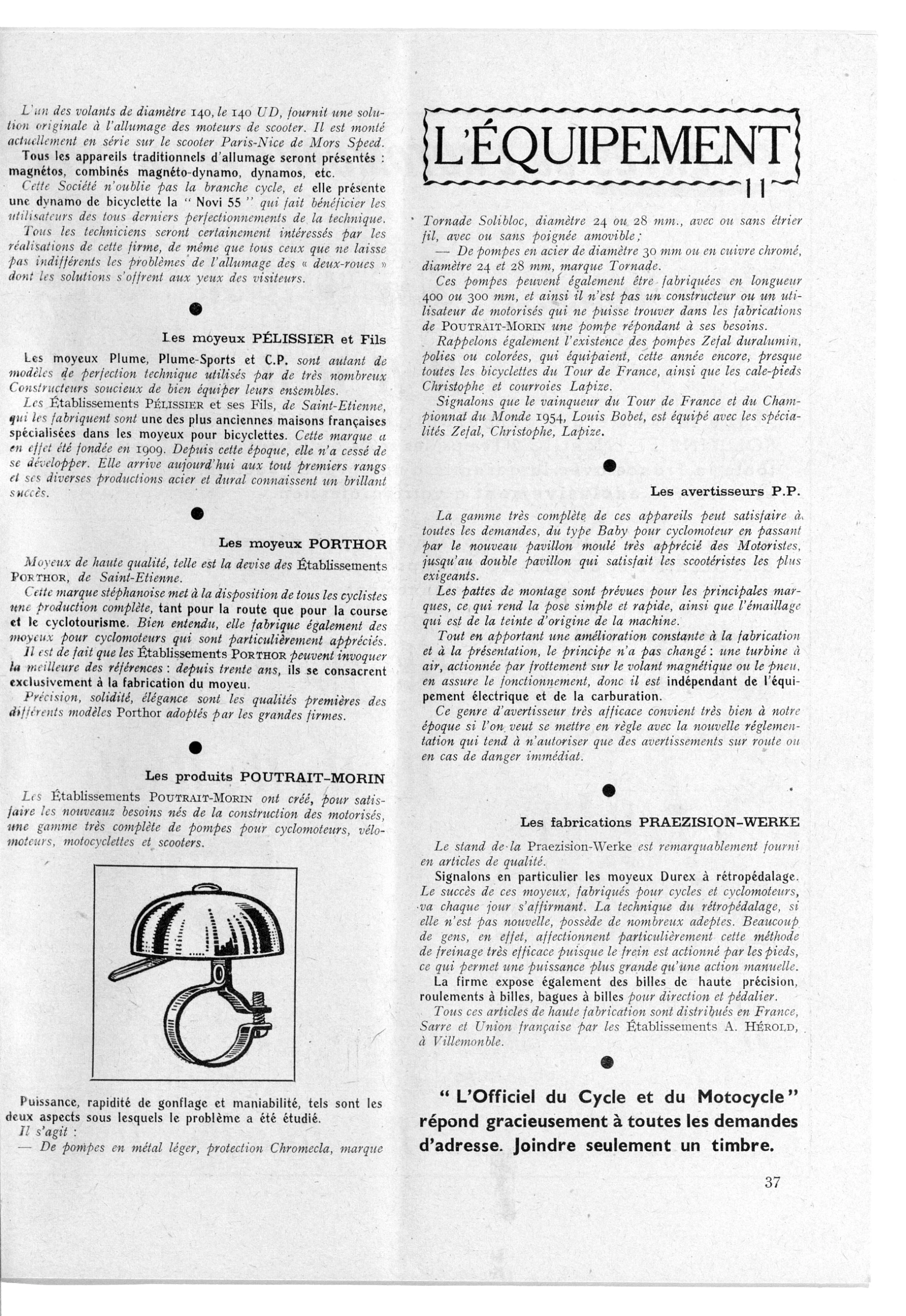
Les produits POUTRAIT-MORIN
[Ebykr summary; the article’s text is not reproduced. To meet the new needs born of the building of motorized machines, the Établissements Poutrait-Morin have created a very complete range of pumps for mopeds, motor-assisted bicycles, motorcycles and scooters.]
Puissance, rapidité de gonflage et maniabilité, tels sont les deux aspects sous lesquels le problème a été étudié.
Il s’agit :
— De pompes en métal léger, protection Chromecla, marque Tornade Solibloc, diamètre 24 ou 28 mm., avec ou sans étrier fil, avec ou sans poignée amovible ;
— De pompes en acier de diamètre 30 mm ou en cuivre chromé, diamètre 24 et 28 mm, marque Tornade.
[Ebykr summary, continuing at the head of the right-hand column. The pumps can also be made in lengths of 400 or 300 mm, so that no maker or user of motorized machines should fail to find in the Poutrait-Morin range a pump that meets his needs. The author also recalls the Zefal duralumin pumps, polished or colored, which this year again equipped nearly all the bicycles of the Tour de France, along with the Christophe toe clips and Lapize straps. He points out that Louis Bobet, winner of the 1954 Tour de France and World Championship, is equipped with the Zefal, Christophe and Lapize specialties.]
Les avertisseurs P.P.
[Ebykr summary; the article’s text is not reproduced. The very complete range of these warning devices can meet every demand, from the Baby type for mopeds, by way of the new molded horn bell much appreciated by motorcyclists, to the double horn bell that satisfies the most demanding scooter riders. Mounting lugs are provided for the principal makes, which makes fitting simple and quick, and the enamel is the original color of the machine. While construction and presentation keep improving, the principle has not changed: an air turbine driven by friction on the magnetic flywheel or on the tire provides the sound, so the device is independent of the electrical equipment and of carburetion. The author finds this very effective kind of warning well suited to the present day, for anyone wishing to comply with the new regulation that tends to allow only warnings on the open road or in case of immediate danger.]
Les fabrications PRAEZISION-WERKE
[Ebykr summary; the article’s text is not reproduced. The Praezision-Werke stand is remarkably well stocked with quality articles. The author singles out the Durex coaster-brake hubs (hubs with back-pedaling brake), whose success, in versions made for cycles and mopeds, grows every day; the back-pedaling technique, though not new, has many followers, and many people particularly like this very efficient braking method since the brake is worked by the feet, which allows more power than manual action. The firm also shows high-precision balls, ball bearings and ball rings for headset and bottom bracket. All these articles of high manufacture are distributed in France, the Sarre and the Union française by the Établissements A. Hérold, Villemonble.]
” L’Officiel du Cycle et du Motocycle ”
répond gracieusement à toutes les demandes
d’adresse. Joindre seulement un timbre.
37
[A full text page in two printed columns with no advertising. Each firm’s note opens with a bold roman heading set flush right, the firm name in capitals, and the notes are set mostly in italic roman type with some bold lines mixed in; a black bullet separates one note from the next. At the head of the right column a wavy-bordered banner holds the word “L’ÉQUIPEMENT” in large thin roman capitals, with the numeral 11 set into the lower rule at the right. In the left column a ruled square panel holds an engraving in line and stipple of a bell: a domed, ribbed cap with a small knob on top and a striker lever pointing out at the left, carried on a short neck above an open clamp ring with a tightening bolt. No caption is printed beneath it other than the running text. Near the foot of the right column a block of three lines in heavy bold sans-serif type, set apart by a bullet, carries the magazine’s offer to supply addresses on request. The printed page number 37 stands below. The foot of the left column is empty. No signature or agency mark is visible.]
— Page 5 —
Dites à vos amis qui ne sont pas abonnés à
” l’Officiel ” de nous demander un spécimen
gratuit…
ou demandez-nous-le pour eux !
Les éclairages électriques RADIOS
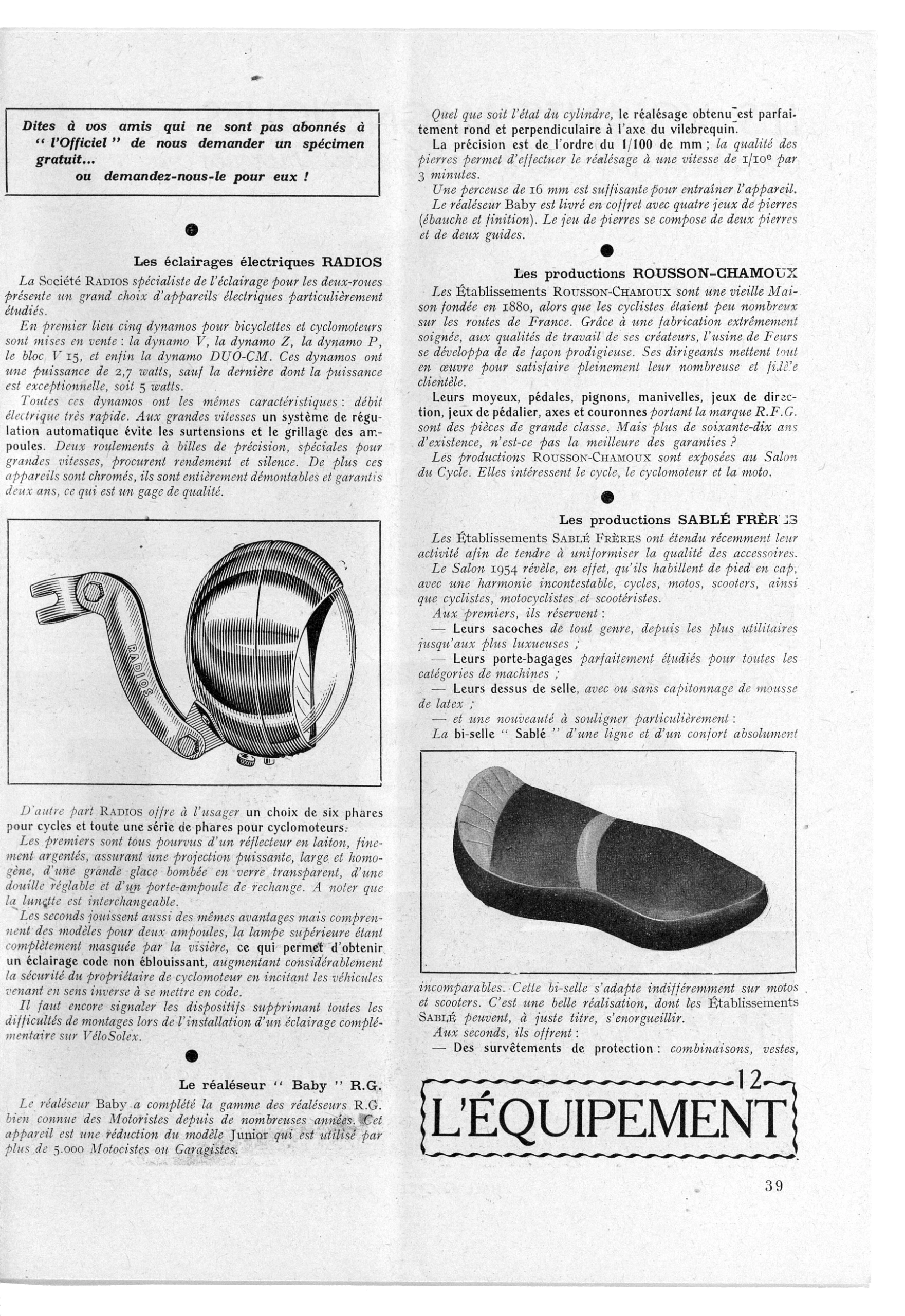
[Ebykr summary; the article’s text is not reproduced. The Société Radios, a lighting specialist for two-wheelers, presents a large choice of especially studied electrical apparatus. First, five dynamos for bicycles and mopeds are on sale: the V dynamo, the Z dynamo, the P dynamo, the V 15 block and finally the DUO-CM dynamo. These dynamos have an output of 2.7 watts, except the last, whose output is exceptional at 5 watts. All share the same characteristics: a very quick electrical output; at high speeds an automatic regulation system prevents overvoltage and burnt-out bulbs; two precision ball bearings, special for high speeds, give efficiency and silence. The units are also chromed, fully demountable and guaranteed two years, which the author calls a mark of quality.]
[Ebykr summary, after the drawing. In addition Radios offers the user a choice of six headlamps for cycles and a whole series of headlamps for mopeds. The cycle lamps all have a finely silvered brass reflector giving a powerful, wide and even beam, a large domed clear glass, an adjustable socket and a spare bulb holder, and the bezel is interchangeable. The moped lamps enjoy the same advantages but include models for two bulbs, the upper lamp being completely hidden by the visor, which gives a non-dazzling dipped beam and considerably raises the moped owner’s safety by prompting oncoming vehicles to dip. The author also points out devices that remove all the difficulties of fitting when a supplementary light is installed on a VéloSolex.]
Le réaléseur ” Baby ” R.G.
[Ebykr summary; the article’s text is not reproduced. The Baby reboring tool completes the range of R.G. reboring tools, long well known to motorcyclists. The device is a reduction of the Junior model, which is used by more than 5.000 motorcycle dealers or garage owners.]
[Ebykr summary, continuing at the head of the right-hand column. Whatever the state of the cylinder, the rebore obtained is perfectly round and square to the crankshaft axis. The accuracy is of the order of 1/100 mm, and the quality of the stones allows the reboring to proceed at a rate of 1/10 per 3 minutes. A 16 mm drill is enough to drive the device. The Baby is delivered in a case with four sets of stones (roughing and finishing); a set is made up of two stones and two guides.]
Les productions ROUSSON-CHAMOUX
[Ebykr summary; the article’s text is not reproduced. The Établissements Rousson-Chamoux are an old house founded in 1880, when cyclists were few on the roads of France. Thanks to extremely careful manufacture and the working qualities of its founders, the Feurs factory grew prodigiously, and its managers do everything to satisfy their numerous and loyal clientele. Their hubs, pedals, sprockets, cranks, headsets, bottom bracket sets, axles and chainrings bearing the R.F.G. brand are parts of great class; the author asks whether more than seventy years of existence are not the best of guarantees. The Rousson-Chamoux products are shown at the Salon du Cycle and are of interest to the cycle, the moped and the motorcycle.]
Les productions SABLÉ FRÈRES
[Ebykr summary; the article’s text is not reproduced. The Établissements Sablé Frères have recently extended their activity so as to even out the quality of accessories. The 1954 Salon shows that they dress cycles, motorcycles and scooters from head to foot, with unquestionable harmony, as well as cyclists, motorcyclists and scooter riders. For the first group they reserve: their saddlebags of every kind, from the most utilitarian to the most luxurious; their luggage carriers, perfectly studied for every category of machine; their saddle covers, with or without foam latex padding; and a novelty the author stresses in particular, the “Sablé” dual seat (bi-selle), of an incomparable line and comfort.]
[Ebykr summary, after the photograph. This dual seat fits motorcycles and scooters alike and is a fine achievement of which the Établissements Sablé may rightly be proud. For the second group they offer protective clothing: overalls, jackets, (the list breaks off at the foot of the column and continues on the next page).]
L’ÉQUIPEMENT
12
39
[A full text page in two printed columns. A ruled rectangular box at the head of the left column holds four lines of bold italic sans-serif type inviting readers to ask for a free specimen of the magazine, set flush left with the last line indented. Each firm’s note opens with a bold roman heading set flush right, the firm name in capitals, and the notes are set mostly in italic roman type with some bold lines mixed in; a black bullet separates one note from the next. In the left column a wide ruled rectangular panel holds a line engraving with fine hatching of a headlamp seen from the front left: a round lamp body with a bezel at the right is carried on a curved, forked bracket, and the word “RADIOS” is lettered along the bracket. In the right column a ruled rectangular panel holds a halftone photograph of a motorcycle dual seat in three-quarter view, with a dark top, pale side panels and a pale cross band, set on a plain ground. No caption is printed beneath either picture other than the running text. At the foot of the right column a wavy-bordered banner holds the word “L’ÉQUIPEMENT” in large thin roman capitals, with the numeral 12 set into the upper rule at the right. The printed page number 39 stands below. The lower left quarter of the page is empty. No signature or agency mark is visible.]
— Page 6 —
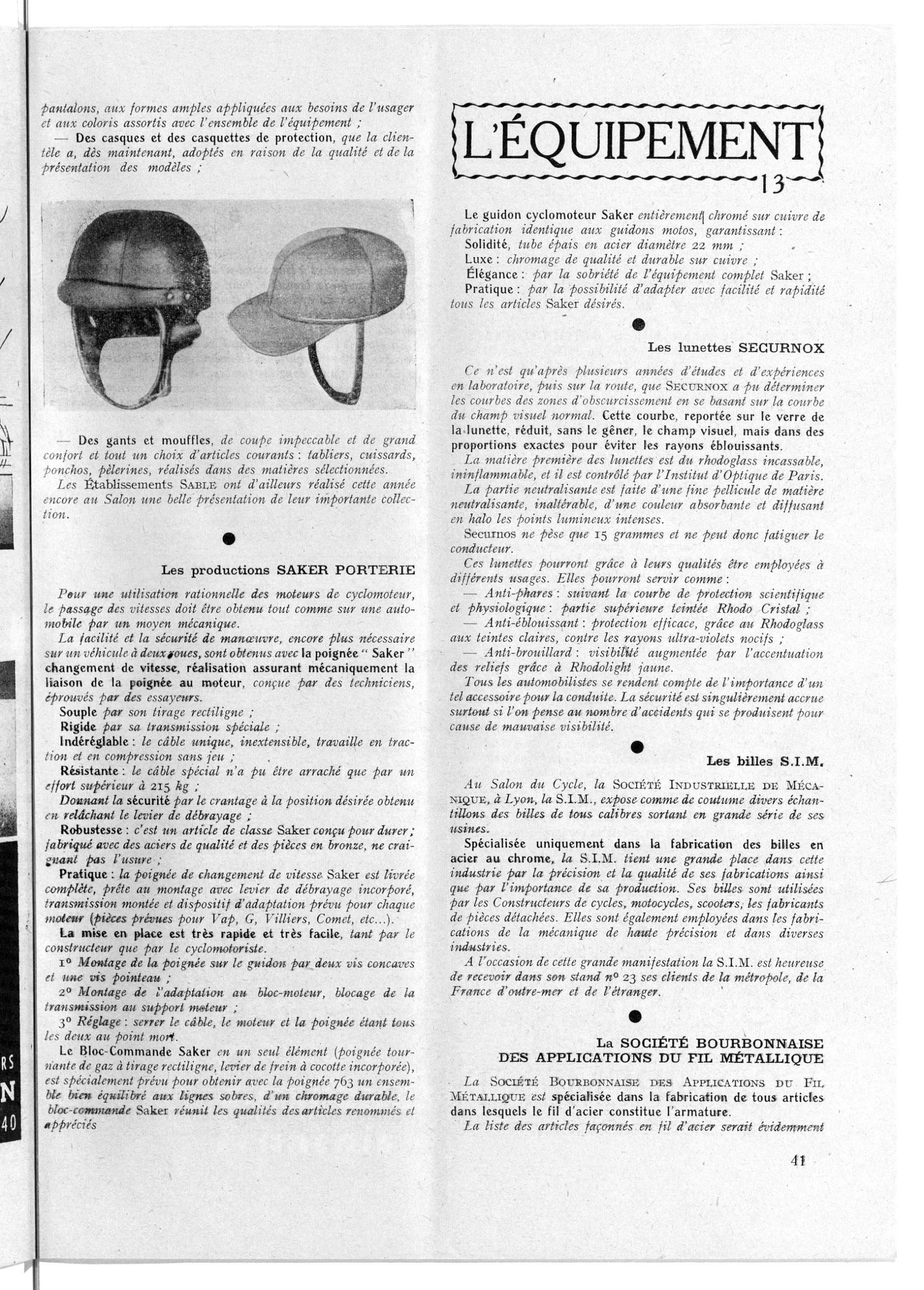
[Ebykr summary, continuing the Sablé Frères note from the foot of the previous page. The list of protective clothing goes on with trousers of ample cut applied to the user’s needs, in colors matched with the whole of the equipment. The firm also offers protective helmets and peaked caps, which customers have already adopted because of the quality and presentation of the models. It further offers gloves and mittens of impeccable cut and great comfort and a whole choice of everyday articles: aprons, cycling shorts, ponchos and capes, made in selected materials. The Établissements Sablé again made a fine display of their large collection at the Salon this year.]
Les productions SAKER PORTERIE
[Ebykr summary; the article’s text is not reproduced. For a rational use of moped engines the change of gear should be obtained by a mechanical means, as on a car. Ease and safety of operation, even more necessary on a two-wheeler, are obtained with the “Saker” gear-change grip, which links the grip to the engine mechanically; it was designed by technicians and proved by test riders. The article then lists its qualities, which are transcribed here as printed.]
Souple par son tirage rectiligne ;
Rigide par sa transmission spéciale ;
Indéréglable : le câble unique, inextensible, travaille en traction et en compression sans jeu ;
Résistante : le câble spécial n’a pu être arraché que par un effort supérieur à 215 kg ;
Donnant la sécurité par le crantage à la position désirée obtenu en relâchant le levier de débrayage ;
Robustesse : c’est un article de classe Saker conçu pour durer ; fabriqué avec des aciers de qualité et des pièces en bronze, ne craignant pas l’usure ;
Pratique : la poignée de changement de vitesse Saker est livrée complète, prête au montage avec levier de débrayage incorporé, transmission montée et dispositif d’adaptation prévu pour chaque moteur (pièces prévues pour Vap, G, Villiers, Comet, etc…).
La mise en place est très rapide et très facile, tant par le constructeur que par le cyclomotoriste.
1° Montage de la poignée sur le guidon par deux vis concaves et une vis pointeau ;
2° Montage de l’adaptation au bloc-moteur, blocage de la transmission au support moteur ;
3° Réglage : serrer le câble, le moteur et la poignée étant tous les deux au point mort.
[Ebykr summary. The Bloc-Commande Saker, in a single element (a twist throttle grip with straight pull and a brake lever with a built-in ball end), is designed specially to give, with the 763 grip, a well-balanced set with sober lines and a durable chrome finish; the author says the block brings together the qualities of the renowned and appreciated articles. The sentence breaks off at the word “appréciés” at the foot of the column.]
L’ÉQUIPEMENT
13
Le guidon cyclomoteur Saker entièrement chromé sur cuivre de fabrication identique aux guidons motos, garantissant :
Solidité, tube épais en acier diamètre 22 mm ;
Luxe : chromage de qualité et durable sur cuivre ;
Élégance : par la sobriété de l’équipement complet Saker ;
Pratique : par la possibilité d’adapter avec facilité et rapidité tous les articles Saker désirés.
Les lunettes SECURNOX
[Ebykr summary; the article’s text is not reproduced. Only after several years of study and experiments in the laboratory and then on the road was Securnox able to determine the curves of the darkened zones, basing them on the curve of the normal visual field. Carried onto the lens, this curve reduces the visual field without hindering it, but in exact proportions so as to avoid dazzling rays. The raw material of the goggles is unbreakable, non-flammable rhodoglass, checked by the Institut d’Optique de Paris. The neutralizing part is a thin film of unalterable neutralizing material, of an absorbing color, that diffuses intense points of light as a halo. The goggles weigh only 15 grams (the text prints the name as “Securnos” here) and so cannot tire the driver. The author then gives the uses they can serve, listed here as printed.]
Anti-phares : suivant la courbe de protection scientifique et physiologique : partie supérieure teintée Rhodo Cristal ;
Anti-éblouissant : protection efficace, grâce au Rhodoglass aux teintes claires, contre les rayons ultra-violets nocifs ;
Anti-brouillard : visibilité augmentée par l’accentuation des reliefs grâce à Rhodolight jaune.
[Ebykr summary. Every motorist realizes the importance of such an accessory for driving, and safety is singularly increased, above all when one thinks of the number of accidents caused by poor visibility.]
Les billes S.I.M.
[Ebykr summary; the article’s text is not reproduced. At the Salon du Cycle the Société Industrielle de Mécanique of Lyon, the S.I.M., shows as usual various samples of balls of every caliber leaving its works in large series. Specialized solely in making chrome-steel balls, the S.I.M. holds a large place in the industry through the precision and quality of its products and the size of its output. Its balls are used by makers of cycles, motorcycles and scooters and by makers of spare parts, and also in high-precision mechanical work and various industries. On the occasion of the Salon the S.I.M. is glad to receive at its stand no. 23 its customers from the mother country, from overseas France and from abroad.]
La SOCIÉTÉ BOURBONNAISE
DES APPLICATIONS DU FIL MÉTALLIQUE
[Ebykr summary; the article’s text is not reproduced. The Société Bourbonnaise des Applications du Fil Métallique specializes in making every article in which steel wire forms the framework. The note goes on to say that the list of articles shaped from steel wire would obviously be (the sentence breaks off at the foot of the page and continues on a later page).]
41
[A full text page in two printed columns with no drawings. Each firm’s note opens with a bold roman heading set flush right, the firm name in capitals, and the notes are set mostly in italic roman type with some bold lines mixed in; a black bullet separates one note from the next. In the left column, near the head, a halftone photograph with no frame line shows two pieces of protective headgear side by side on a plain pale ground: at the left a dark rounded helmet with a padded roll round its brim, ear flaps and a chin strap; at the right a lighter peaked cap with a stiff visor, panels sewn in segments and a chin strap. No caption is printed beneath it other than the running text. At the head of the right column a wavy-bordered banner holds the word “L’ÉQUIPEMENT” in large thin roman capitals, with the numeral 13 hanging below its lower rule at the right. The printed page number 41 stands below the right column. A strip of the facing leaf, with a vertical rule, a dark block and part of a printed number, shows along the left edge. Both columns end above a blank foot, the left column stopping in mid-sentence. No signature or agency mark is visible.]
— Page 7 —
— Câbles de freins;
— Câbles de dérailleurs;
— Câbles sous enrobage nylon (résistant à la corrosion et à l’usure par frottement);
— Gaines pour freins et dérailleurs;
— Transmissions montées;
— Rayons;
— Ressorts;
— Rondelles Grower.
[Ebykr summary, the page opening in the middle of an item begun on the previous page; the article’s text is not reproduced. The first two printed lines, cut off from their sentence, say that a list is very long and that extracts follow to give an idea of the production usable by cycles and cyclomoteurs (motorized bicycles); the list of eight products is given above as printed. A closing sentence adds that this is a whole lot of articles of which only a few can be named among the great number produced.]
Le tendeur double de la SOCIÉTÉ LYONNAISE
de TRESSES et LACETS
[Ebykr summary; the article’s text is not reproduced. Users of the luggage strap (fixe-bagages) have often complained that it is easily unhooked and stolen when the bicycle must be left parked. To prevent this frequent loss a luggage-strap maker created the “tendeur double”, which stays on the wheel axle by its method of fixing, making unhooking very difficult and so avoiding losses, thefts and accidents. The patented double strap consists of two parallel sandows (elastic cords) joined at their ends by a crimped lug that fixes on the wheel axle, where it is bolted by the wheel nut. The length of each sandow gives very great extensibility under almost constant tension, so that it holds luggage of very small or large volume firmly. Its price, little different from that of two ordinary sandows, should help ensure its success. It is a product of the Société Lyonnaise de Tresses et Lacets, of Lyon.]
Les appareils SOUBITEZ
[Ebykr summary; the article’s text is not reproduced. The Société Soubitez, a specialist in electrical equipment for cars, motorcycles and cycles, shows several novelties this year. First, a new headlamp for the cyclomoteur, aerodynamic in shape, fixed at the side and carrying one or two bulbs, with a switch either on the headlamp itself or on the handlebar; a speedometer of curved triangular shape, no more than 45 mm wide, is recessed in its housing. Second, license plates for the vélomoteur and the motorcycle, coated with the approved “Scotchlite” covering, together with special lanterns, also coated with “Scotchlite” and designed for the scooter. Third, the resumption, after several years of abandonment, of the 55-watt direct-current dynamo with contact breaker and coil for the vélomoteur or the single- or twin-cylinder motorcycle.]
Lebanc d’essai TELMACO
[Ebykr summary; the article’s text is not reproduced. The author recalls that the special Salon number (Auto edition) gave the features of the Telmaco test benches for automobiles, so he only notes here that a test bench exists for scooters and motorcycles. Like the car model, this apparatus uses a Telma brake, though of smaller size, and permits the same measurements as the bench for cars. It is built to take up as little room as possible and can be installed in the smallest workshop; the author calls it the working tool indispensable to motorcycle and scooter makers and to service stations.]
Les repose-pieds V.A.R.
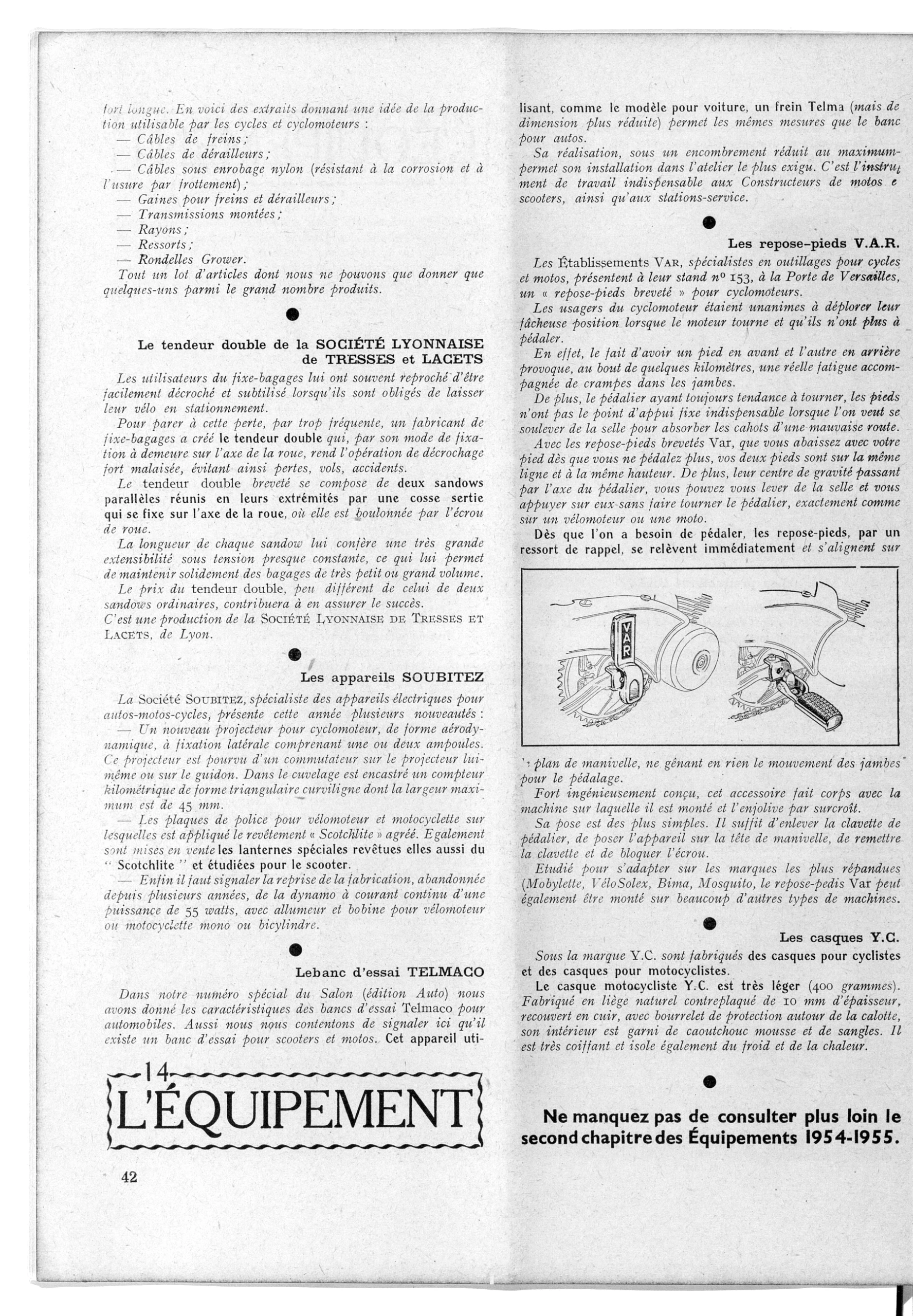
[Ebykr summary; the article’s text is not reproduced. The Établissements Var, specialists in tools for cycles and motorcycles, show at their stand no. 153 at the Porte de Versailles a “repose-pieds breveté” (patented footrest) for cyclomoteurs. Cyclomoteur riders, the author says, were unanimous in deploring their awkward position when the engine runs and they no longer have to pedal: with one foot forward and the other back, a real fatigue with leg cramps sets in after a few kilometers. Because the crank also tends to turn, the feet lack the fixed support needed to rise from the saddle and absorb the bumps of a bad road. With the patented Var footrests, lowered with the foot as soon as pedaling stops, both feet are on the same line and at the same height; their center of gravity passes through the bottom bracket axle, so the rider can stand and bear on them without turning the crank, exactly as on a vélomoteur or motorcycle. As soon as pedaling is needed, a return spring lifts the footrests at once and aligns them with the plane of the crank, so they do not hinder the movement of the legs. The author calls the accessory ingeniously designed, made one with the machine and an embellishment to it. Fitting is very simple: remove the pedal cotter, place the device on the crank head, replace the cotter and tighten the nut. Designed to suit the most widespread makes (Mobylette, VéloSolex, Bima, Mosquito), the Var footrest can also be fitted to many other types of machine.]
Les casques Y.C.
[Ebykr summary; the article’s text is not reproduced. Helmets for cyclists and for motorcyclists are made under the Y.C. brand. The motorcyclist model is very light (400 grams), made of natural plywood cork 10 mm thick covered in leather, with a protective roll around the crown; its interior is lined with foam rubber and fitted with straps. The author says it is very becoming and insulates against cold and heat.]
Ne manquez pas de consulter plus loin le
second chapitre des Équipements 1954-1955.
14
L’ÉQUIPEMENT
42
[Printed page 42, a full text page of the equipment survey in two columns, set in italic roman with some lines in a heavier upright roman, headed by no title of its own because it continues from the page before. Five items are separated by heavy black round dots centered between them; each item opens with a short heading in bold roman, set right-aligned, with the firm name in capitals. The left column holds the end of a list of eight products introduced by dashes, the Société Lyonnaise de Tresses et Lacets item and the Soubitez item, then the heading and first lines of the Telmaco item; the right column carries the rest of the Telmaco item, the V.A.R. footrest item with its picture, and the Y.C. helmet item. In the right column a ruled rectangular frame holds one line drawing in two views, set side by side. At the left a rigid footrest arm stands upright against a crank at the chainring, with the word VAR lettered vertically in a dark panel on its face, beside a rounded motor housing and a stretch of chain. At the right the same kind of arm is swung down and outward, ending in a flat pad with a ridged, grooved surface, again beside the chainring and chain. The drawing carries no caption and no signature or monogram is visible. Below the Y.C. item a final line in heavy sans-serif type, set right-aligned, refers the reader to the second chapter of the 1954-1955 equipment survey. At the foot of the left column a wavy-ruled box holds the running head L’ÉQUIPEMENT in large roman capitals with the section number 14 set above its upper edge, and the page number 42 stands below it at the left margin. No text shows through from the reverse of the leaf.]
Ebykr presents this material for research and education. If you hold rights to it or notice an ownership issue, please contact us and we will respond promptly.
The Ebykr Digest
New articles, timelines, catalog finds and registry activity — assembled from the archive once a month. Your address is never shared.
Double opt-in. One email per month. Unsubscribe at any time with one click.