About Ebykr
Ebykr celebrates classic and vintage lightweight bicycles through provocative imagery and opinion. Ride along with us.
About Ebykr
Ebykr celebrates classic and vintage lightweight bicycles through provocative imagery and opinion. Ride along with us.

Source: Gallica (Bibliothèque nationale de France), L'Officiel du cycle, du motocycle et du camping, 2 October 1954, N° 40, pages 119, 121, 122, 125, 127, 137, 139, 142 and 145; ark:/12148/bd6t54206310j. Source gallica.bnf.fr / BnF.
| Type | Review |
|---|---|
| Year | 1954 |
| Publisher | L'Officiel du cycle |
| Country | France |
| Language | French |
| Pages | 9 |
| Source | Gallica (Bibliothèque nationale de France), L'Officiel du cycle, du motocycle et du camping, 2 October 1954, N° 40, pages 119, 121, 122, 125, 127, 137, 139, 142 and 145; ark:/12148/bd6t54206310j. Source gallica.bnf.fr / BnF. |
| Credit | Ebykr archive; Bibliothèque nationale de France |
| Identifier | Gallica (BnF) ark:/12148/bd6t54206310j/f118 |
| Transcription | Headings and specifications transcribed; article text summarized |
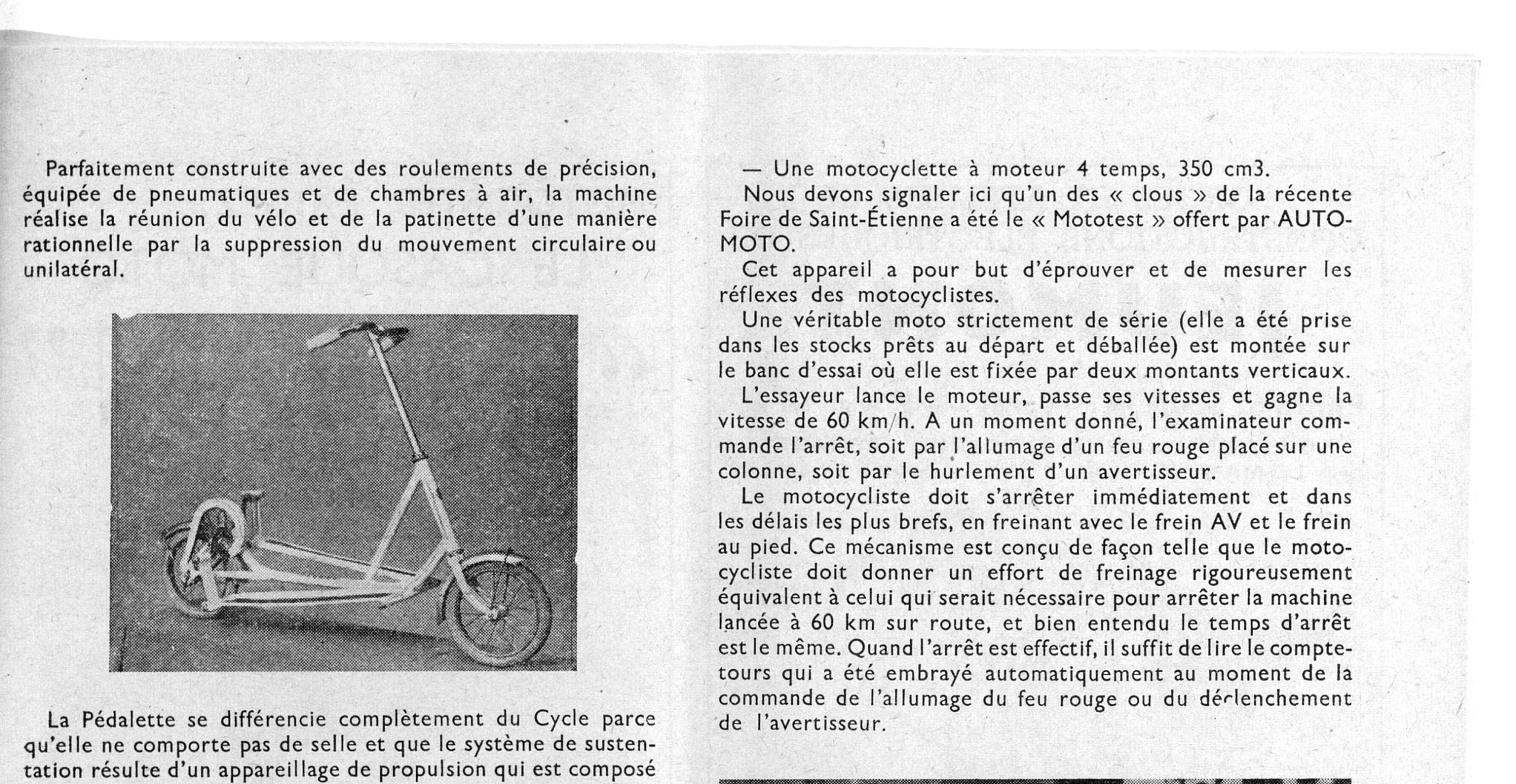
La Pédalette se différencie complètement du Cycle parce qu'elle ne comporte pas de selle et que le système de sustentation résulte d'un appareillage de propulsion qui est composé essentiellement de deux pédales, d'où le nom « Pédalette ». ★ Les productions AUTOMOTO — Cinq cyclomoteurs, dont quatre à moteur Vap 49 cm3 et un à …
This is a magazine article, so its running text is summarized here rather than reproduced; the headline, byline, specifications and scores are transcribed as printed.
From L’Officiel du cycle, du motocycle et du camping, 2 October 1954, the paper’s special number before the 1954 Paris Salon du Cycle et du Motocycle, pages 119, 121, 122, 125, 127, 137, 139, 142 and 145: R. Ducoudray’s survey of the machines and makers of the 1955 season, firm by firm, from the Pédalette and the Cazenave cycles to Cizeron’s special frames, the Favor program and the Chemineau cycles, with the scooters, sidecars, vélomoteurs and engines that share the pages. The title, headings, captions and lists are transcribed as printed; the text is summarized in Ebykr’s words, and the page images carry it in full.
— Page 1 —
[Ebykr summary, continuing the Pédalette item from an earlier page; the article’s text is not reproduced. The machine is perfectly built with precision bearings and fitted with tires and inner tubes, and it joins the bicycle and the kick scooter in a rational way by doing away with circular or one-sided motion.]
La Pédalette se différencie complètement du Cycle parce qu’elle ne comporte pas de selle et que le système de sustentation résulte d’un appareillage de propulsion qui est composé essentiellement de deux pédales, d’où le nom « Pédalette ».
[Ebykr summary, after the photograph; the article’s text is not reproduced. The author says the Pédalette is a sporting toy, the most amusing and the least dangerous, because its center of gravity is very low and because of the rational mounting of a pedaling system unknown until now. It has an enameled frame, chromed handlebar, handlebar grips and a precision chain, and is expected to make a great stir in the toy trade. It is the latest creation of the Ateliers du Dorlay, a powerful firm of parts for bicycles, motorized bicycles and cyclomotors, which makes among other specialties the famous elastic fork with pressed sides.]
★ Les productions AUTOMOTO
[Ebykr summary; the article’s text is not reproduced. Promising to return in more detail to the remarkable program of the great Saint-Étienne firm, the author says only that it includes the following numerous models:]
— Cinq cyclomoteurs, dont quatre à moteur Vap 49 cm3 et un à moteur licence Marquet 48 cm3;
— Cinq vélomoteurs à moteur 2 temps, 125 cm3;
— Un vélomoteur à moteur 4 temps, 125 cm3;
— Deux motocyclettes à moteur 2 temps, 200 et 232 cm3;
— Une motocyclette à moteur 4 temps, 350 cm3.
[Ebykr summary; the article’s text is not reproduced. The author notes that one of the “hits” of the recent Saint-Étienne Fair was the “Mototest” offered by AUTOMOTO, an apparatus made to test and measure the reflexes of motorcyclists. A genuine production motorcycle, taken from the stocks ready for dispatch and unpacked, is mounted on the test bench and held by two vertical uprights. The tester starts the engine, changes gear and reaches 60 km/h. At a given moment the examiner orders a stop, either by lighting a red lamp on a column or by sounding a horn. The rider must stop at once and in the shortest time, braking with the front brake and the foot brake. The mechanism is designed so that the rider must give a braking effort exactly equal to what would be needed to stop the machine at 60 km on the road, and the stopping time is of course the same. When the stop is made, one reads the rev counter, which was engaged automatically at the moment the red lamp was lit or the horn sounded.]
Le nombre de tours de disque effectué traduit la distance qui aurait été nécessaire au freinage. Le motocycliste qui obtient l’arrêt sur la distance la plus courte est celui qui possède les meilleurs réflexes.
★ Les “2 roues” BALLANDRAS
[Ebykr summary; the article’s text is not reproduced. The V.B.F. cycles, the Cyclorev cyclomotors and the Ambassador motorized bicycles are fine products of an old Saint-Étienne house with 46 years of experience, founded in 1908. Its reputation no longer needs to be made, and its owner, M. Georges Ballandras, can be proud of his work, since sustained effort has given him a network of numerous loyal customers. The slogan “Vélos Bien Faits, Vélos Bien Finis, Vélos Bien Français” confirms the quality of a construction that has made its place on the French market. For the motorized line M. Georges Ballandras has chosen a happy formula, new models and new prices, and the “Cyclorev” range, with the very latest creations, is truly of first rank, the sentence breaking off at the foot of the page.]
119
[A full page of a trade review set in a sans-serif type in two columns, with bold headings each marked by a star. At the upper left a halftone photograph, ruled by its edges, shows a low pedal-driven scooter-like machine in gray tones, with a long low frame, a small wheel at the front under a fender, a tall steering column carrying a handlebar and a chain guard at the rear wheel. In the lower left a second halftone photograph shows a lightweight motorcycle from the front left, with a rounded tank, a dark saddle, a finned engine, a front wheel with spokes and a rear fender. In the right column a third halftone photograph shows a man in a white coat seated on a motorcycle fixed on a test stand, framed by two tall dark boards lettered vertically “AUTOMOTO” and a sign above him reading “Au…” over “CYCLES”, cropped at the top edge. The printed page number 119 sits at the lower right. Faint large letters from the reverse of the leaf show through in the upper right. No artist signature or agency mark is visible.]
— Page 2 —
[Ebykr summary, continued from the previous page; the article’s text is not reproduced. The opening lines, which begin in mid-sentence, finish a passage on a maker’s range of machines: the author calls it “séduisante par sa variété et son luxe” and says that at the Salon du Cycle these machines will earn the admiration of connoisseurs. He adds that the same will be true of the “Ambassador” vélomoteurs, also made by the firm from Saint-Étienne. He closes the item by noting that the V.B.F. marque also shows the “Babyrev” toys, whose success he calls well deserved.]
★ Le cyclo-scooter “Cabri” BERNARDET
[Ebykr summary; the article’s text is not reproduced. Bernardet, which first drew a friendly reception for its Cabri, a rather surprising little machine, at the Lyon Fair, launches a new formula, the cyclo-scooter. The author explains that it is in fact a cyclomoteur, both in its single-seat use and in its administrative class (49 cm3), but that it carries a well-studied fairing with a footrest. Bernardet has naturally brought to it the experience gained in making scooters, its specialty, in the service of this lighter product, which the author expects to find a certain popular success.]
[Ebykr summary of the characteristics list that follows the photograph; the printed list is not reproduced. The machine has 300 x 8 wheels with a spare wheel, and rims that open in two parts. The tubular frame passes above the engine and the fork is tubular. The brakes measure 110 x 20, the front worked by a hand grip and the rear by a pedal. General dimensions are 1 m. 30 in length, 1 m. 03 in height and 0 m. 92 in wheelbase. The engine block is a two-stroke with double transfer, a horizontal cast-iron cylinder, an aluminum-alloy head and a hemispherical combustion chamber, with the carburetor worked by a twist grip. Ignition and lighting come from a powerful flywheel magneto. The kick-starter pedal locks itself automatically in the horizontal position. A two-speed gearbox is worked by a twist grip on the left, and the secondary transmission is by chain in a molded case running in an oil bath. For the cycle part the author lists a swinging rear suspension by a rubber block of progressive flexibility with Neiman rings working in reaction, and a front suspension on a trailing wheel with long travel, also with Neiman rings. He adds that the machine weighs only 35 kg. and takes up very little room, so that it can be stored easily (even in a car trunk, he says) and shipped under convenient conditions, and that a handle placed at the center of balance allows a particularly easy carrying.]
★ Les cycles André BERTIN
[Ebykr summary; the article’s text is not reproduced. The Société des Établissements André BERTIN, based at Saint-Laurent-Blangy in the Pas-de-Calais, distributes its machines throughout the world and has a well-organized export service for that purpose. The author adds that it does not neglect French customers, in the North as much as in the Center and the West of France. Founded in 1937, the house has grown considerably by specializing in a range of bicycles that meets every need, including those of foreign buyers. Its racing machines are much sought after and it counts the finest cycling events among its credits. It also makes a small child’s bicycle called the Bambino-Confort, which delights many children from three to six years old.]
★ Les blocs-moteurs BRIBAN
[Ebykr summary; the article’s text is not reproduced. This year the Établissements BRIBAN et Cie, of Pantin, present their engine blocks to the constructors. The author gives two types. The Type M, 49 cm3, is very quiet because of its primary transmission by chain; it is a two-stroke with a cylinder in a special cast alloy, a piston in hypersilicon light alloy, two sealing rings and a hemispherical head in light alloy. The Type S.A.B.B. is a two-stroke with scavenging by two opposed ports, made in a model 100, with 2 and 3 speeds and 4.3 CV, and a model 125, with 3 speeds and an adaptable selector or special handlebar, at 5.2 CV.]
★ Les motocyclettes B.S.A.
[Ebykr summary; the article’s text is not reproduced. Among the current B.S.A. program, presented in France by the Société MOVÉA, the author recalls some of the eleven models of the reputed British firm: the Type C 11 G, 250 cm3, developing 11 CV at 5,400 rpm; the Type Golden Star B 32, 350 cm3, with overhead valves; and the Type Shooting Star, 500 cm3, developing 32 CV at 6,000 rpm, a special machine for fast escorts that has been adopted by the French Gendarmerie nationale. He says that after the Salon he intends to return to the technical details of these splendid machines of international class and distribution.]
★ Les sidecars BUFFLIER
[Ebykr summary, continuing at the foot of the page; the article’s text is not reproduced. At one of the last Salons the Anciens Établissements BUFFLIER, of Villeurbanne, showed for the first time in France a light sidecar, the Mistral, with a chassis designed specially for the Vespa scooter. Since then the sidecar has been developed to be attached to several other scooters, such as Lambretta, Bernardet, Motobécane and Terrot. The list of main characteristics begins with a paint finish and a wheel matching the scooter, and breaks off at the foot of the page.]
121
[Page 121 of the survey, a full page of text in two justified columns in a roman face, with each firm heading in a bold sans-serif type preceded by a solid star. A halftone photograph in the left column, framed by a thin rule, shows a young woman in a light short-sleeved dress seated on a small scooter with a rounded front fender, a luggage rack on the front panel and a round headlamp, holding a young goat upright in her arms and looking up at it; behind her stand a building front with a gridded window and dark shrubs and foliage. No caption is printed with it. The printed page number 121 sits at the foot of the right column. No artist signature or agency mark is visible, and no text from the reverse of the leaf shows through.]
— Page 3 —
[Ebykr summary, continued from the previous page; the article’s text is not reproduced. The list of main characteristics of the BUFFLIER sidecars, which begins in mid-sentence at the top of the page, continues: paint and wheel matching the scooter, a body suspension by “sandow” rings under a BUFFLIER patent, chromed trim, a spacious rear trunk, side lights, and deluxe upholstery with a side pocket and armrests.]
[Ebykr summary; the article’s text is not reproduced. A second model, the Rafale, of modern line, is described as the ideal sidecar for vélomoteurs and small-displacement motorcycles; it has a spacious rear trunk and a front wide enough for one seated person to sit comfortably. To these two models, both remarkable for lightness, the author adds the series of sidecars for motorcycles: the Sirocco, with one seat, a spoked-hub wheel and a rear windshield; the Simoun, with one and a half seats in tandem; and the Tornado, with one and a half seats side by side. The Hurricane is called one of the most luxurious models now on the market, supplied only in the one-and-a-half-seat side-by-side form and suited to any powerful machine.]
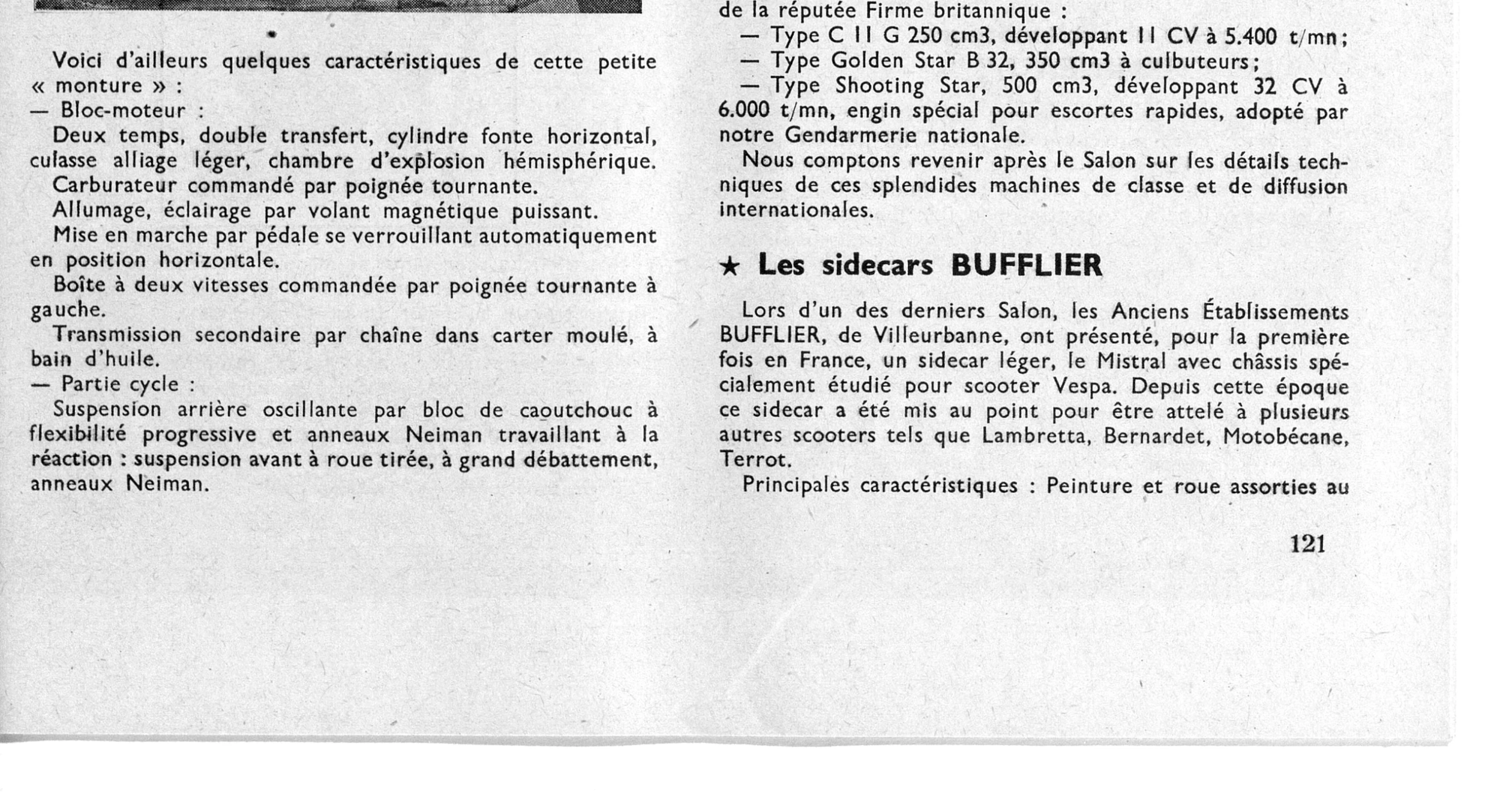
[Ebykr summary; the article’s text is not reproduced. Because the demand for a quick coupling has kept rising, the Établissements BUFFLIER have just brought out a ball-joint coupling that allows their sidecars to be mounted or removed in four minutes. The system is provided with four ball-joint attachment points, which the author says gives very great safety. All BUFFLIER sidecars can be fitted with this coupling except the Mistral model for scooters.]
★ Les cycles et cyclomoteurs
“LE CHEMINEAU”
[Ebykr summary; the article’s text is not reproduced. Forty-three years of experience have made the reputation of this excellent Saint-Étienne marque. The author says LE CHEMINEAU has done good work for the cycle industry, since its director, Joanny PANEL, is the “père du dérailleur”, a title of which he may be legitimately proud. The author pays homage to him in connection with the Tour de France of 1912 and says that he continues to set an example in the great cyclotouring events; the classic Journée Chemineau is, moreover, among the great national events. M. Joanny PANEL also builds the “La Cheminette” cyclomoteurs, fitted with the Le Poulain and Junior engines, not forgetting the new 98 cm3 Comet. The author finds these machines perfectly elegant and worthy of attention, and says that the many Salon visitors will meet at the LE CHEMINEAU stand and will be able to admire the models specially designed for the 1955 season.]
122
★ Les productions CAZENAVE
[Ebykr summary; the article’s text is not reproduced. This very large firm from the Gironde, which occupies vast factories at Belin, presents an extraordinarily developed catalog. The author lists four series of cyclomoteurs, with roller or chain drive, comprising eight variants; two series of vélomoteurs, with two-stroke 3-speed blocks or four-stroke 3-speed and 4-speed blocks; and three series of 200 cm3 motorcycles, two-stroke, 3-speed. He adds that all the motorcycle models are now fitted with a mudguard with wide flanges, that the firm’s presentation is impeccable and worthy of its mechanics, and that the CAZENAVE stand will once more be one of the centers of attraction of the Parc des Expositions, recalling that a superb 1867 Michaux bicycle was seen there the previous year.]
★ Le moteur auxiliaire CUCCIOLO
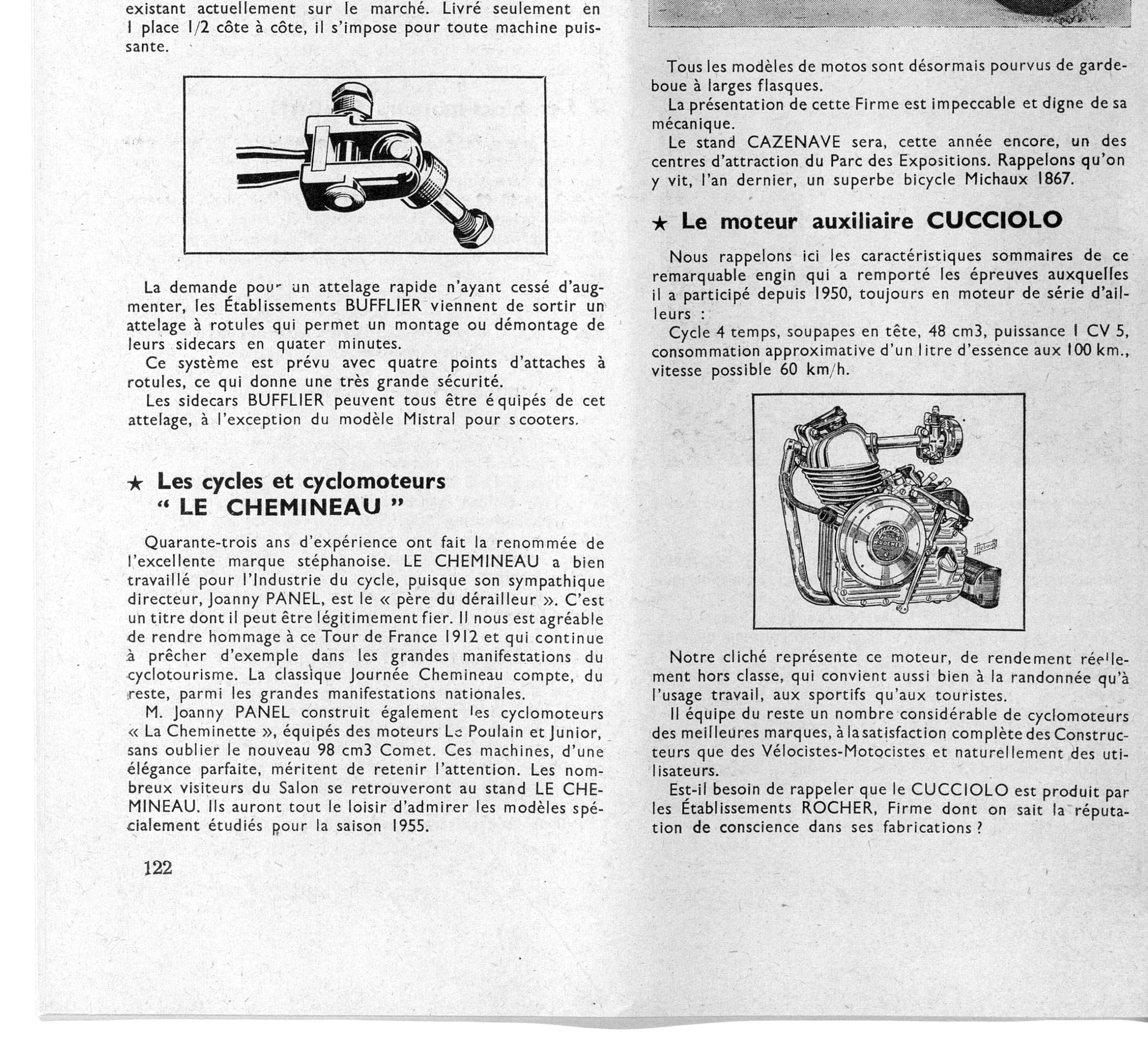
[Ebykr summary; the article’s text is not reproduced. The author recalls the summary characteristics of this remarkable engine, which has won the events it has entered since 1950, always as a production engine: four-stroke cycle, overhead valves, 48 cm3, power 1 CV 5, approximate consumption of one liter of gasoline per 100 km. and a possible speed of 60 km/h. He says the illustration shows this engine, of truly exceptional output, suited as well to touring as to work use and to sportsmen as to tourists. It also equips a considerable number of cyclomoteurs of the best marques, to the complete satisfaction of the constructors, of the Vélocistes-Motocistes and naturally of the users. He closes by recalling that the CUCCIOLO is produced by the Établissements ROCHER, a firm with a known reputation for conscientious manufacture.]
[Page 122 of the survey, a full page of text in a roman face with each firm heading in bold sans-serif type preceded by a solid star, the text block set in from the left edge and ending well above the foot of the page. Four illustrations are set in thin ruled frames. At the upper left a halftone photograph shows a dark streamlined sidecar body seen from the front quarter, with a spoked wheel at its side and a small fitting on top, with fine horizontal flutes along its rear flank. Below it a black line drawing in the manner of an engraving shows a ball-joint coupling with a forked bracket and a threaded stud and nut. At the upper right a halftone photograph shows a motorcycle in profile with a dark tank bearing a round badge, a large rear mudguard with wide flanks, a telescopic fork and a swept exhaust pipe, set against a pale mottled ground. Lower down a detailed line engraving shows a small overhead-valve engine with finned cylinder and head, a carburetor on a long inlet pipe and a round flywheel cover bearing the lettering “CUCCIOLO” and “M. ROCHER”. The engine drawing carries a signature at its lower right inside a small ruled box, read as “Rebour” (Daniel Rebour). The printed page number 122 sits at the lower left. No agency mark is visible, and no text from the reverse of the leaf shows through.]
— Page 4 —
★ Les cadres spéciaux et vélos d’enfants
CIZERON
[Ebykr summary; the article’s text is not reproduced. M. CIZERON, the “sympathique industriel stéphanois”, has made his factory a model factory. The special frames built by his Établissements are of outstanding quality, the fruit of a truly modern installation with a highly qualified staff. The frames for cyclotourists and racing men, like the CIZERON children’s frames, are remarkably elegant and resist every test, which the author says explains their success as the brilliant reward of work done with taste. The house is also specialized in building children’s bicycles, and all its models, perfectly studied, give full and complete satisfaction.]
★ Les bicyclettes DELANGLE
[Ebykr summary; the article’s text is not reproduced. The author calls DELANGLE “la marque des records” and says the 1952 cyclotourist model is certainly the finest production of the firm, since it carries the latest improvements and the most luxurious equipment. The summary list of its characteristics gives a 4-speed Cyclo derailleur, a Pivo cyclotourist handlebar, Jeay brakes, handlebar grips, three-lug treated cranks, chrome Chrolux rims, rear and front carriers in steel tubing and lighting, with two saddlebags and all parts stainless or in duralumin. The machine is enameled over a rust-proofing coat in green, ivory, metallic blue and transparent red, and is made in a man’s frame, a lady’s frame (cradle type) and a mixte. Although it has a fairly large factory, the house stays faithful to the exclusive manufacture of bicycles. It now builds about forty models of cycles in fifteen different colors, and the size of its stock lets it deliver the numerous orders from its agents on demand. Its activity extends to export as well.]
★ Les motorisés DILECTA
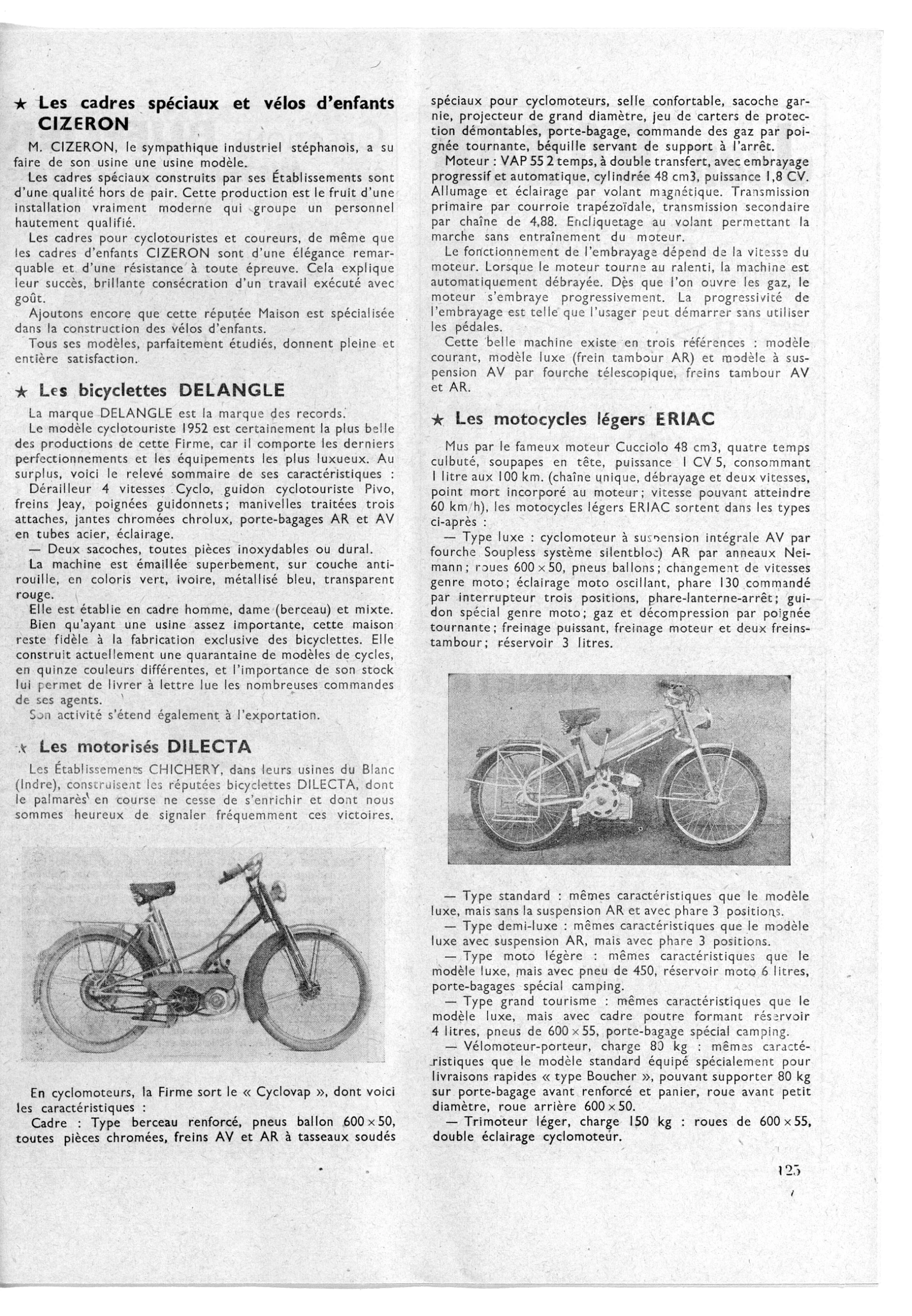
[Ebykr summary; the article’s text is not reproduced. The Établissements CHICHERY, in their factories at Le Blanc (Indre), build the reputed DILECTA bicycles, whose racing record keeps growing and whose victories the author is glad to report often. Below a photograph the author turns to the firm’s cyclomoteur, the “Cyclovap”, and lists its characteristics. The frame is a reinforced cradle type with 600 x 50 balloon tires, all parts chromed, and front and rear brakes with welded shoes. Special cyclomoteur equipment includes a comfortable saddle, a fitted saddlebag, a large-diameter headlamp, a set of removable protective guards, a luggage carrier, throttle control by twist grip and a stand that serves as a support when stopped. The engine is the VAP 55, a two-stroke with double transfer and a progressive automatic clutch, displacement 48 cm3, power 1.8 CV, with ignition and lighting by flywheel magneto. The primary transmission is by V-belt and the secondary by chain of 4.88, with a ratchet at the flywheel allowing riding without driving the engine. The clutch works according to engine speed: when the engine idles the machine is automatically disengaged, and as soon as the throttle is opened the engine engages progressively, so smoothly that the user can start without using the pedals. The machine exists in three versions: the standard model, the deluxe model (rear drum brake) and a model with front suspension by telescopic fork and front and rear drum brakes.]
★ Les motocycles légers ERIAC
[Ebykr summary; the article’s text is not reproduced. Driven by the famous Cucciolo engine of 48 cm3, four-stroke with overhead valves, power 1 CV 5, consuming one liter per 100 km. (single chain, clutch and two speeds, neutral built into the engine, speed able to reach 60 km/h), the ERIAC light motorcycles come in the following types. The Type luxe is a cyclomoteur with full suspension: front by a Soupless fork of the silentbloc system, rear by Neimann rings; 600 x 50 wheels with balloon tires; motorcycle-style gear change; oscillating motorcycle lighting with a 130 headlamp worked by a three-position switch (headlamp, lantern, off); a special motorcycle-style handlebar; throttle and decompression by twist grip; powerful braking, engine braking and two drum brakes; and a 3-liter tank. The Type standard has the same characteristics as the deluxe model but without the rear suspension and with a 3-position headlamp. The Type demi-luxe has the same characteristics as the deluxe model with rear suspension but with a 3-position headlamp. The Type moto légère has the same characteristics as the deluxe model but with a 450 tire, a 6-liter motorcycle tank and a special camping luggage carrier. The Type grand tourisme has the same characteristics as the deluxe model but with a beam frame forming a 4-liter tank, 600 x 55 tires and a special camping luggage carrier. The Vélomoteur-porteur, load 80 kg, has the same characteristics as the standard model but is equipped specially for fast deliveries of the “type Boucher”, able to carry 80 kg on a reinforced front carrier and basket, with a small-diameter front wheel and a 600 x 50 rear wheel. The Trimoteur léger, load 150 kg, has 600 x 55 wheels and double cyclomoteur lighting.]
125
[Page 125 of the survey, a full page of text in two justified columns in a roman face, with each firm heading in bold sans-serif type preceded by a solid star; the first heading runs to two lines. Two halftone photographs sit unframed in the lower half of the page, each printed as a screened rectangle without a rule. The one in the left column shows a step-through cyclomoteur in side view with a small engine unit and belt cover at the rear wheel, a luggage carrier over the rear mudguard, a deep front mudguard, a saddle and a short handlebar. The one in the right column shows a similar light cyclomoteur in side view with a round engine casing low between the wheels, a rear carrier, a saddle and a front headlamp. Neither photograph carries a caption. The printed page number 125 sits at the lower right, its last digit worn. No artist signature or agency mark is visible, and no text from the reverse of the leaf shows through.]
— Page 5 —
★ Le programme FAVOR
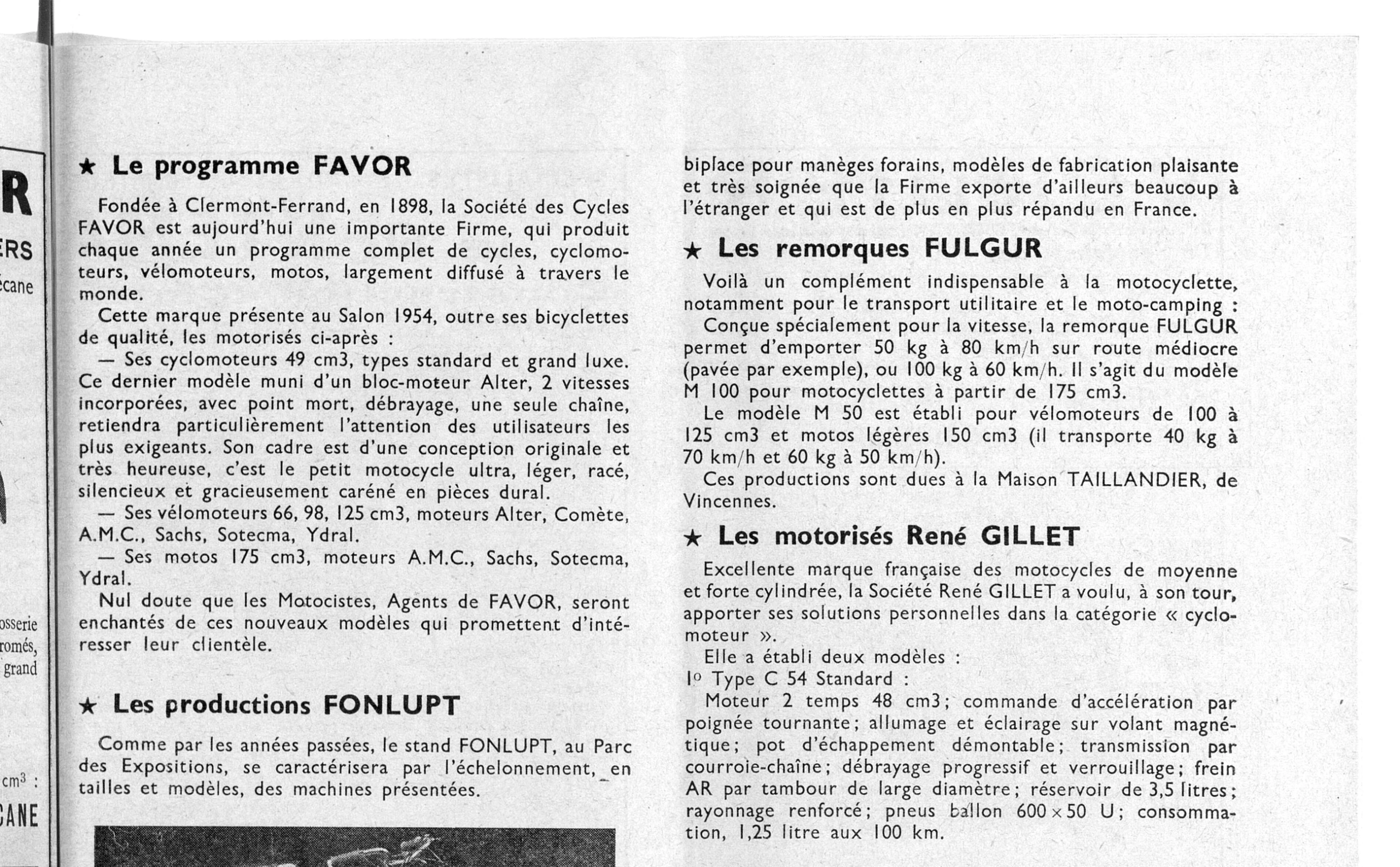
[Ebykr summary; the article’s text is not reproduced. Founded at Clermont-Ferrand in 1898, the Société des Cycles FAVOR is now an important firm that each year produces a complete program of cycles, cyclomoteurs, vélomoteurs and motorcycles, widely distributed throughout the world. At the 1954 Salon the marque shows, besides its quality bicycles, the following motorized machines. Its 49 cm3 cyclomoteurs come in standard and grand luxe types; the latter has an Alter engine block with two built-in speeds, neutral, clutch and a single chain, which the author expects to draw the attention of the most demanding users. Its frame is of an original and very happy conception: a small ultra-light, racy, quiet motorcycle gracefully faired in duralumin parts. The vélomoteurs are of 66, 98 and 125 cm3 with Alter, Comète, A.M.C., Sachs, Sotecma and Ydral engines. The motorcycles are of 175 cm3 with A.M.C., Sachs, Sotecma and Ydral engines. The author has no doubt that the motorcycle dealers who are FAVOR agents will be delighted with these new models, which promise to interest their customers.]
★ Les productions FONLUPT
[Ebykr summary; the article’s text is not reproduced. As in past years, the FONLUPT stand at the Parc des Expositions will be marked by the graduated sizes and models of the machines shown. The author lists a complete range of bicycles, from the child’s cycle to the adult’s machine, “usagers” and “cyclotouristes” types remarkably equipped, and cyclomoteurs, whose quite distinct look he shows according to whether they carry the Vap engine (first photo) or the Poulain (second photo). He recalls that a very interesting specialty of the house is made up of the “motos” and “scooters”, two-seat models for fairground rides of pleasant and very careful manufacture, which the firm exports a great deal abroad and which are more and more widespread in France.]
★ Les remorques FULGUR
[Ebykr summary; the article’s text is not reproduced. The author calls the trailer an indispensable complement to the motorcycle, notably for utility transport and moto-camping. Designed especially for speed, the FULGUR trailer can carry 50 kg at 80 km/h on a poor road (cobbles, for example) or 100 kg at 60 km/h; this is the model M 100, for motorcycles of 175 cm3 and up. The model M 50 is made for vélomoteurs of 100 to 125 cm3 and 150 cm3 light motorcycles, and carries 40 kg at 70 km/h and 60 kg at 50 km/h. These products are made by the Maison TAILLANDIER, of Vincennes.]
★ Les motorisés René GILLET
[Ebykr summary; the article’s text is not reproduced. An excellent French marque of medium and large motorcycles, the Société René GILLET has in turn wished to bring its own solutions to the “cyclomoteur” category, and has established two models. The Type C 54 Standard has a two-stroke 48 cm3 engine with twist-grip throttle, ignition and lighting from a flywheel magneto, a removable exhaust pot, belt-chain transmission, progressive clutch with locking, a large-diameter rear drum brake, a 3.5-liter tank, reinforced spoking, 600 x 50 U balloon tires and consumption of 1.25 liter per 100 km. The Type C 54 Luxe has the same engine and the same list of features but with front and rear drum brakes, a 6-liter tank, a telescopic fork, enveloping mudguards and the same consumption. The author calls the two cyclomoteurs powerful, quiet, clean and robust, and notes the particular elegance of the deluxe type and its excellent fairing. In the vélomoteur category René GILLET brings out the V.I.S. 125 cm3, a machine very modern in its technique as in its structure, with an original fairing (see the photograph). The principal specifications begin with the engine: 125 cm3, an aluminum cylinder sleeved in special cast iron, double transfer, double exhaust, a flat piston with two pegged rings, power of 4 CV at 4,000 rpm and a needle-roller bearing. The list breaks off at the foot of the page.]
(Suite page 129.)
127
[Page 127 of the survey, a full page of text in two justified columns in a roman face, with each firm heading in bold sans-serif type preceded by a solid star. Three halftone photographs are screened as rectangles without a rule. In the left column an upper photograph, on a dark ground, shows a light-colored cyclomoteur in side view with a rear carrier, a saddle, a deep front mudguard with a headlamp and a small engine unit low in the frame; below it a second photograph, on a pale ground, shows a step-through cyclomoteur in side view with a dark tank, a rear carrier, a saddle and a round engine casing low between the wheels. In the right column a halftone photograph shows a cyclomoteur in side view with a dark oval tank carrying a round badge, a telescopic fork, deep mudguards and a dark panel enclosing the engine; none of the photographs carries a caption. The printed page number 127 sits at the lower right and the cross-reference “(Suite page 129.)”, in italic, closes the right column. A strip of the neighboring leaf, with the ends of lines from an advertisement set in a condensed face, shows along the left edge. No artist signature or agency mark is visible.]
— Page 6 —
— Joints de panneaux AR en caoutchouc synthétique, indéformable;
— Renforcement des panneaux AR démontables par mesure inférieure en relief, plus de vibrations;
— Support de batterie livré en série, soit 14 ampères, soit 20 ampères (pour démarreur). Ce support orientable ne gêne pas le démontage de la roue AR;
— Projecteur réglable instantanément par vis.
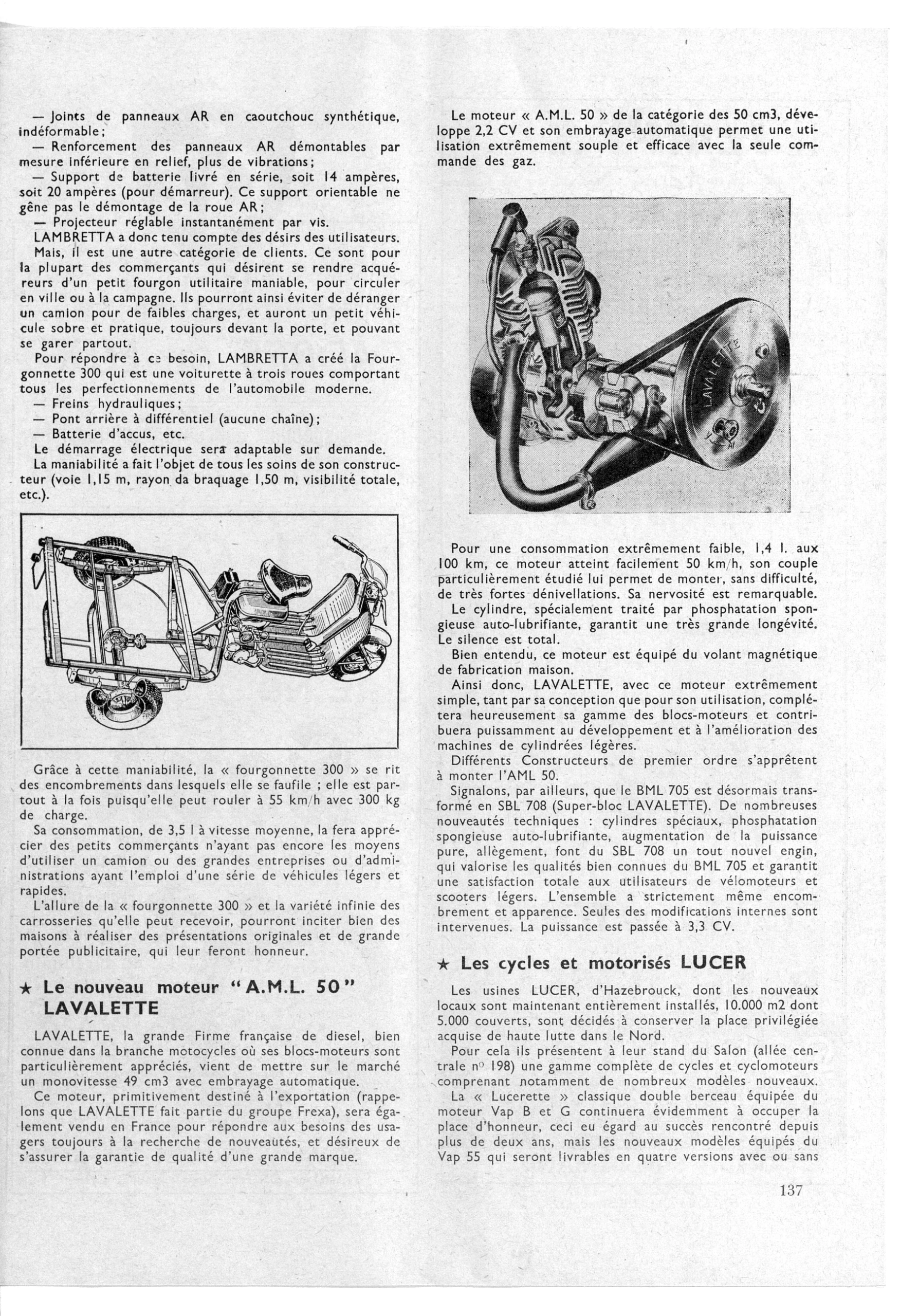
[Ebykr summary; the article’s text is not reproduced. The page opens in the middle of the Lambretta item, whose heading is on the previous page. The author concludes that Lambretta has therefore taken account of the wishes of its users. He then turns to another category of customer, mostly tradesmen who want to buy a handy small utility van to move about town or country, sparing them from calling out a truck for light loads and giving them a sober, practical small vehicle always at the door and able to park anywhere. To meet this need Lambretta has created the Fourgonnette 300, a three-wheeled light car with all the refinements of the modern automobile:]
— Freins hydrauliques;
— Pont arrière à différentiel (aucune chaîne);
— Batterie d’accus, etc.
[Ebykr summary, after the list. Electric starting will be fitted on request. The maker has taken every care over handling: track 1.15 m, turning radius 1.50 m, total visibility and so on. A line drawing follows.]
[Ebykr summary, after the drawing. Thanks to this handiness the “fourgonnette 300” laughs at traffic jams, slipping through them; it is everywhere at once, since it can run at 55 km/h with a 300 kg load. Its consumption of 3.5 liters at medium speed will be appreciated by small tradesmen who cannot yet afford a truck, and by large firms or administrations that use a series of light, fast vehicles. The look of the “fourgonnette 300” and the endless variety of bodies it can take could, the author says, encourage many firms to create original presentations of wide advertising reach that will do them credit.]
Le nouveau moteur “A.M.L. 50”
LAVALETTE
[Ebykr summary; the article’s text is not reproduced. Lavalette, the large French diesel firm, well known in the motorcycle branch where its engine units are particularly valued, has just put on the market a 49 cc single-speed engine with automatic clutch. Originally meant for export (the author reminds the reader that Lavalette belongs to the Frexa group), it will also be sold in France to meet the needs of users always looking for novelties and wanting the quality guarantee of a great make.]
[Ebykr summary, at the head of the right column. The “A.M.L. 50” engine, of the 50 cc category, develops 2.2 CV, and its automatic clutch allows extremely flexible and efficient use with only the throttle control. A halftone photograph of the engine follows. For an extremely low consumption of 1.4 liter per 100 km, the engine easily reaches 50 km/h; its specially studied torque lets it climb very steep gradients without difficulty, and its liveliness is remarkable. The cylinder, specially treated by self-lubricating spongy phosphating, is said to guarantee very great longevity, and running is totally silent. The engine naturally carries a magneto flywheel of the maker’s own manufacture. With this extremely simple engine, simple in design and in use, Lavalette will happily complete its range of engine units and contribute strongly to the development and improvement of light-capacity machines; several leading constructors are preparing to fit the AML 50. The author adds that the BML 705 is now transformed into the SBL 708 (Super-bloc Lavalette): many technical novelties, namely special cylinders, self-lubricating spongy phosphating, an increase in pure power and a saving in weight, make the SBL 708 an entirely new engine that enhances the well-known qualities of the BML 705 and guarantees total satisfaction to users of vélomoteurs and light scooters. The unit has strictly the same bulk and appearance, only internal changes have been made, and the power has risen to 3.3 CV.]
Les cycles et motorisés LUCER
[Ebykr summary; the article’s text is not reproduced. The Lucer works at Hazebrouck, whose new premises (10,000 square meters, of which 5,000 are covered) are now fully installed, are determined to keep the privileged place they have won in the North through hard struggle. To that end they show at their Salon stand (central aisle no. 198) a complete range of cycles and cyclomoteurs that includes many new models. The classic double-cradle “Lucerette” with the Vap B and G engine will naturally keep its place of honor, given its success for more than two years, but the new models fitted with the Vap 55, to be delivered in four versions with or without a clutch, will compete for the favor of the Lucer clientele (the sentence ends at the head of the next page).]
[Page 137 of the survey, set in two columns of justified sans-serif type with three illustrations. Firm headings are in bold sans-serif type with a small star before each: the Lavalette heading runs over two lines in the left column and the Lucer heading stands in the right column near the foot. In the left column, below the opening list, a framed line engraving fills the column width and shows a cutaway or chassis view of a three-wheeled light delivery vehicle seen from above and in front, with a tubular frame, a handlebar and pan seat at the right, a spare wheel and rear axle with differential at the left and a rectangular load platform; no caption is printed. At the top of the right column a halftone photograph shows a small air-cooled engine with finned cylinder, a large round belt-driven cover on which the word LAVALETTE is embossed, and a curved exhaust pipe. The page begins in mid-article without a heading and ends in mid-sentence. No signature or agency mark is visible. The printed page number 137 stands at the lower right.]
— Page 7 —
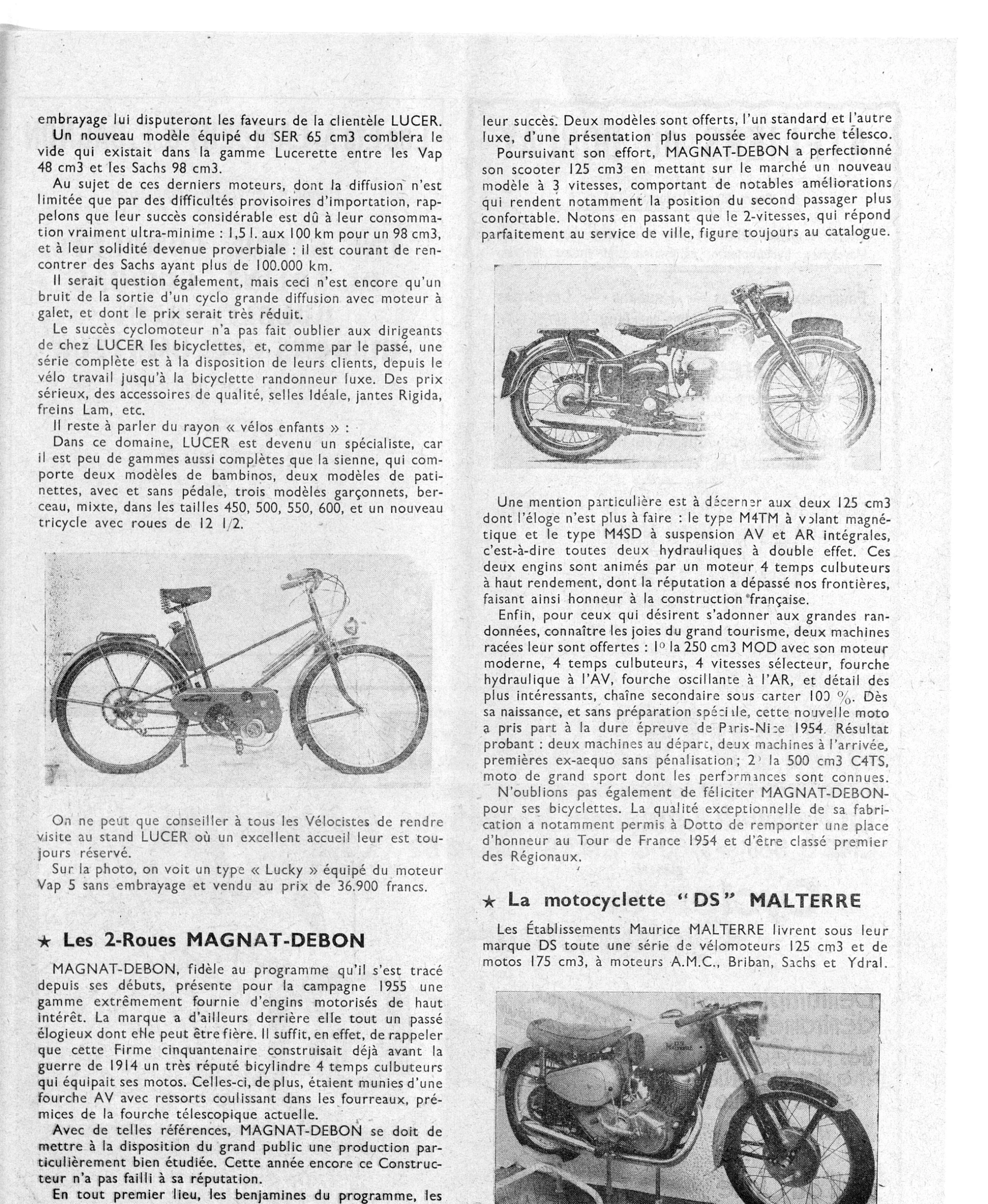
[Ebykr summary, continued from the previous page; the article’s text is not reproduced. The opening line, which begins in mid-sentence, says that the clutch models “lui disputeront les faveurs de la clientèle LUCER”. A new model fitted with the SER 65 cm3 engine will fill the gap that existed in the Lucerette range between the Vap 48 cm3 and the Sachs 98 cm3. On the Sachs engines, whose distribution is limited only by temporary import difficulties, the author recalls that their considerable success is due to a truly ultra-low consumption, 1.5 l. per 100 km for a 98 cm3, and to a proverbial solidity: it is common to meet Sachs engines with more than 100,000 km. A rumor, still only a rumor, speaks of the release of a mass-market cyclo with a roller-drive engine at a very low price. The success of the cyclomoteur has not made LUCER’s directors forget bicycles: as in the past a complete series is available, from the work cycle to the deluxe touring bicycle, at serious prices with quality accessories such as Idéale saddles, Rigida rims and Lam brakes. The “vélos enfants” department remains: LUCER has become a specialist, since few ranges are as complete, with two models of bambinos, two models of “patinettes” (kick scooters, with and without pedal), three boys’ models, cradle and mixte frames in sizes 450, 500, 550 and 600, and a new tricycle with 12 1/2 wheels. The author can only advise all cycle dealers to visit the LUCER stand, where an excellent welcome is always waiting. The photograph shows a “Lucky” type fitted with the Vap 5 engine without clutch, sold at the price of 36,900 francs.]
★ Les 2-Roues MAGNAT-DEBON
[Ebykr summary; the article’s text is not reproduced. MAGNAT-DEBON, faithful to the program it has set itself since its beginnings, presents for the 1955 season an extremely full range of motorized machines of high interest. The marque has behind it a laudable past: the author recalls that this fifty-year-old firm was already building, before the war of 1914, a much-reputed four-stroke overhead-valve twin that equipped its motorcycles, which also had a front fork with springs sliding in the tubes, forerunners of the present telescopic fork. With such references the firm owes it to itself to give the public a particularly well-studied production, and this year again it has not failed its reputation. First come the “benjamines” of the program, the “Vélorettes 50 cm3”, fitted with a new over-powerful engine whose regularity and spirit are a sure guarantee of their success; two models are offered, a standard and a deluxe with a more elaborate finish and a telescopic fork. Continuing its effort, MAGNAT-DEBON has improved its 125 cm3 scooter by putting on the market a new 3-speed model with notable improvements that make the second passenger’s position more comfortable; the author notes that the 2-speed, which suits city service perfectly, is still in the catalog. A particular mention goes to the two 125 cm3 machines whose praise no longer needs to be made: the type M4TM with flywheel magneto and the type M4SD with full front and rear suspension, both hydraulic and double-acting. Both are driven by a high-output four-stroke overhead-valve engine whose reputation has crossed the frontiers, honoring French construction. Finally, for those who wish to take up long tours and know the joys of grand touring, two thoroughbred machines are offered. The first is the 250 cm3 MOD with its modern four-stroke overhead-valve engine, four-speed selector, hydraulic front fork, swinging rear fork and, a most interesting detail, a 100 % enclosed secondary chain; from its birth, without special preparation, this new motorcycle took part in the hard Paris-Nice of 1954 with a convincing result of two machines at the start, two at the finish, first ex-aequo without penalty. The second is the 500 cm3 C4TS, a grand-sport motorcycle whose performances are known. The author also congratulates MAGNAT-DEBON for its bicycles, whose exceptional quality of manufacture notably allowed Dotto to win a place of honor in the Tour de France of 1954 and to be classed first of the “Régionaux”.]
★ La motocyclette “DS” MALTERRE
[Ebykr summary; the article’s text is not reproduced. The Établissements Maurice MALTERRE deliver under their DS marque a whole series of 125 cm3 vélomoteurs and 175 cm3 motorcycles with A.M.C., Briban, Sachs and Ydral engines.]
139
[Page 139 of the survey, a full page of text in two justified columns in a roman face, with each firm heading in bold sans-serif type preceded by a solid star. Three halftone photographs are shown, none with a caption. In the left column a photograph set in a pale screened rectangle shows a step-through cyclomoteur in side view with a saddle, a rear carrier, a tall handlebar, a chain case enclosing a small engine low between the wheels and a slim front mudguard. At the top of the right column a faded halftone photograph, framed by thin corner marks, shows a motorcycle in side view with a dark tank, a long saddle, a telescopic fork, a headlamp and a tail mudguard. Below it, at the foot of the right column, a halftone photograph in a thin ruled frame shows a close view of a motorcycle from the front quarter, with a tank, a finned engine, an exhaust pipe, a pale front mudguard and a spoked front wheel, standing on a display stand. The printed page number 139 sits at the lower right. No artist signature or agency mark is visible, and no text from the reverse of the leaf shows through.]
— Page 8 —
4 vitesses, suspension AV Monet-Goyon, AR à coulisseaux;
— Le S4CC, 125 cm3, 4 temps.
3° Motocyclettes :
— La M2VT, 197 cm3, 3 vitesses, sélecteur, suspension AV Monet-Goyon, AR coulisseaux Grégoire;
— La M2VDO, 197 cm3, 4 vitesses, sélecteur, suspension AV Grégoire, AR bras socillant corrigé Grégoire;
— La M2VO, 232 cm3, 4 vitesses, sélecteur, même système de suspension que la précédente.
Les voiturettes MOCHET
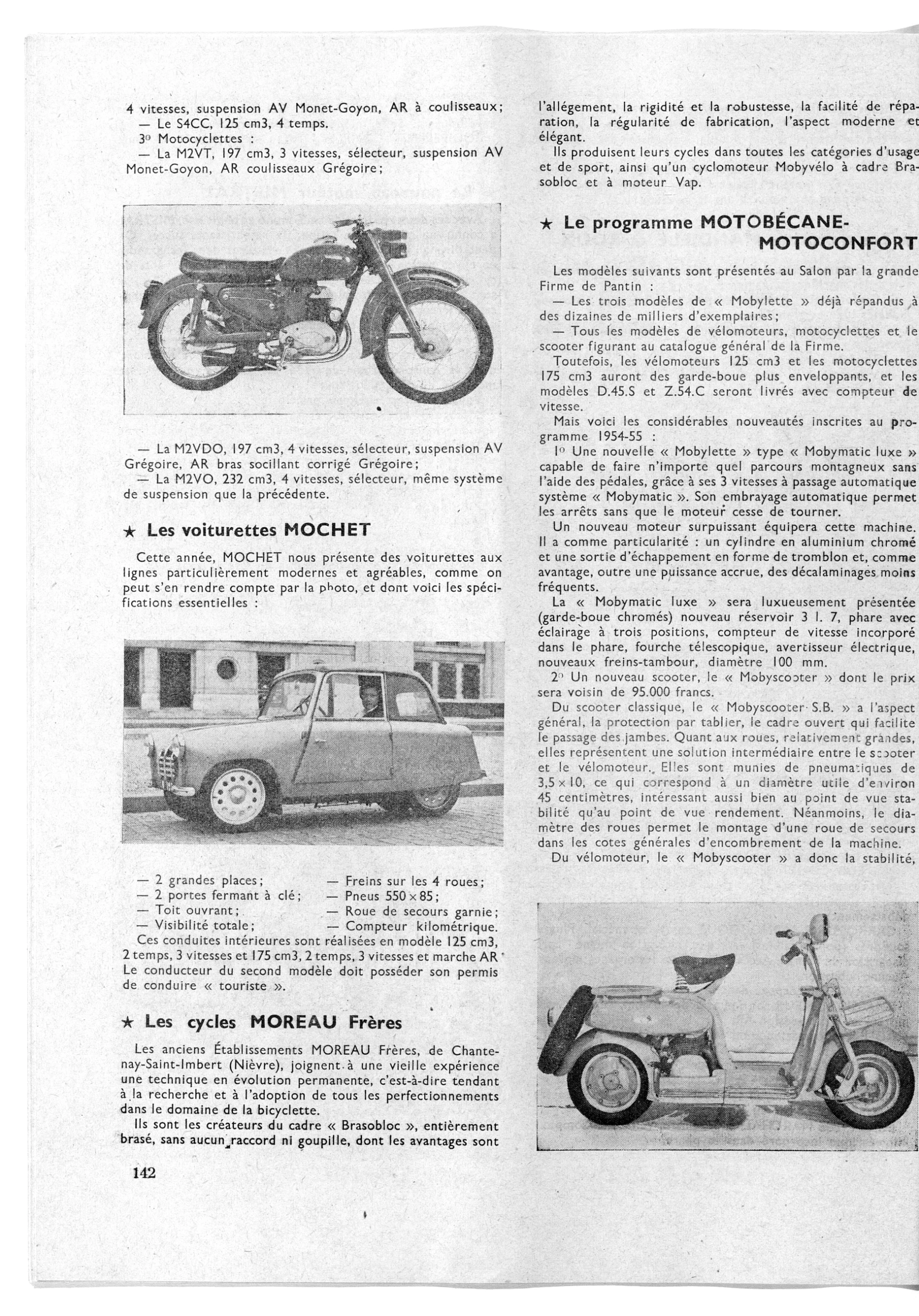
[Ebykr summary; the article’s text is not reproduced. This year Mochet presents small cars of particularly modern and pleasing lines, as the photograph shows, and the author lists their essential specifications.]
— 2 grandes places; — Freins sur les 4 roues;
— 2 portes fermant à clé; — Pneus 550 × 85;
— Toit ouvrant; — Roue de secours garnie;
— Visibilité totale; — Compteur kilométrique.
[Ebykr summary, after the list. These closed cars are built in a 125 cc model, two-stroke with three speeds, and a 175 cc model, two-stroke with three speeds and reverse. The driver of the second model must hold his “touriste” driving license.]
Les cycles MOREAU Frères
[Ebykr summary; the article’s text is not reproduced. The former Établissements Moreau Frères, of Chantenay-Saint-Imbert (Nièvre), join long experience to a technique in permanent evolution, that is, one aiming at the search for and adoption of every improvement in the field of the bicycle. They are the creators of the “Brasobloc” frame, entirely brazed, without any joint or pin, whose advantages the author gives as lightness, rigidity and robustness, ease of repair, regularity of manufacture and a modern, elegant look (the sentence carries over to the head of the right column). They produce their cycles in all categories of use and sport, as well as a Mobyvélo cyclomoteur with a Brasobloc frame and a Vap engine.]
Le programme MOTOBÉCANE-
MOTOCONFORT
[Ebykr summary; the article’s text is not reproduced. The author lists the models shown at the Salon by the great Pantin firm:]
— Les trois modèles de « Mobylette » déjà répandus à des dizaines de milliers d’exemplaires;
— Tous les modèles de vélomoteurs, motocyclettes et le scooter figurant au catalogue général de la Firme.
[Ebykr summary, after the list. The 125 cc vélomoteurs and 175 cc motorcycles will have more enveloping mudguards, and models D.45.S and Z.54.C will be delivered with a speedometer. He then gives the considerable novelties of the 1954-55 program. First, a new “Mobylette” of the “Mobymatic luxe” type, able to cover any mountain route without help from the pedals thanks to its three speeds with automatic change, the “Mobymatic” system; its automatic clutch allows stops without the engine ceasing to turn. A new over-powerful engine equips this machine, with a chromed aluminum cylinder and a trumpet-shaped exhaust outlet, giving besides increased power less frequent decarbonizing. The “Mobymatic luxe” will be luxuriously presented, with chromed mudguards, a new 3.7-liter tank, a headlamp with three-position lighting, a speedometer built into the headlamp, a telescopic fork, an electric horn and new drum brakes of 100 mm diameter. Second, a new scooter, the “Mobyscooter”, whose price will be close to 95,000 francs. The “Mobyscooter S.B.” has the general look of the classic scooter, with apron protection and an open frame that eases the passage of the legs. Its relatively large wheels are an intermediate solution between the scooter and the vélomoteur, fitted with 3.5 x 10 tires, which correspond to a useful diameter of about 45 centimeters, favorable to stability as much as to efficiency; nevertheless the wheel diameter allows a spare wheel to be mounted within the overall dimensions of the machine. The sentence “Du vélomoteur, le « Mobyscooter » a donc la stabilité,” breaks off at this point and a halftone photograph of the scooter follows.]
[Page 142 of the survey, text in two columns of justified sans-serif type with three halftone photographs, none with a printed caption. Firm headings are in bold sans-serif type with a small star before each: Mochet and Moreau Frères in the left column, and the Motobécane-Motoconfort heading on two lines in the right column, its second line set to the right. The page opens in the middle of a list. In the left column an upper halftone shows a motorcycle with a dual seat, a tank, a telescopic fork and a drum-braked front wheel. A second wide halftone, under the Mochet paragraph, shows a small two-door closed car seen from the front and side, with a roof, an open window with a figure inside, a plain disc wheel and a front bumper, standing in a street before a building. The Mochet specifications stand beneath it in two short columns of dashed rows. In the right column a third halftone, below the Motobécane text, shows a scooter in side view, with a pan seat, a small rectangular headlamp on a tubular handlebar, a flat footboard, a leg apron and a spare wheel at the rear. No signature or agency mark is visible. The printed page number 142 stands at the lower left.]
— Page 9 —
non seulement par le diamètre des roues, mais aussi par l’emplacement du moteur, dans l’axe de la machine et le plus avancé possible. Il a également emprunté au vélomoteur sa facile accessibilité des organes moteurs, bougie et carburateur immédiatement démontables. D’autre part, le moteur, non caréné, bénéficie d’avantages de refroidissement dont il aurait été regrettable de se priver.
[Ebykr summary; the article’s text is not reproduced. The page opens in the middle of the Motobécane item. The Mobyscooter takes from the vélomoteur its stability, not only through its wheel diameter but also through the placing of the engine, on the axis of the machine and as far forward as possible, and it also borrows the easy accessibility of the engine parts, with spark plug and carburetor immediately removable; the engine, not enclosed, enjoys cooling advantages that it would have been a pity to give up. The engine is a 125 cc two-stroke with flat piston and double transfer, with a hard-chromed aluminum cylinder. It is mounted on a swinging arm with enclosed chain transmission, chain tension being adjusted by an eccentric in the rear hub. The front fork, of the trailing-wheel rocker type, is damped. The rear suspension is made of Hutchinson “Evidgon” units, blocks of hollow rubber in the shape of two truncated cones joined at their large base: one upper element absorbs the outward shock and two smaller lower elements absorb the return shock, again with the self-damping effect of rubber.]
Les présentations NEW-MAP
[Ebykr summary; the article’s text is not reproduced. The Lyon firm of solid renown, New-Map, presents the following, which the author lists:]
— Ses 2-temps à moteur Ydral et Sachs 125 cm3;
— Ses 4-temps à moteur A.M.C. 125 cm3;
— Ses nouveaux modèles, série « Leader » à moteur A.M.C., 125 ou 175 cm3, Ydral ou Sachs 175 cm3, à châssis spécial NEW-MAP semi-berceau, suspension AR réglable « maison » par fourche oscillante monobloc indéformable et amortisseurs télesco, fourche AV télescopique;
— Son véhicule utilitaire 3 roues « Solyto », 125 cm3, engin de livraisons par excellence.
[Ebykr summary, after the list. The author says this program reflects a concern to touch the “clientele” reality closely by meeting several of its major wishes.]
Les cycles et motorisés ONOTO
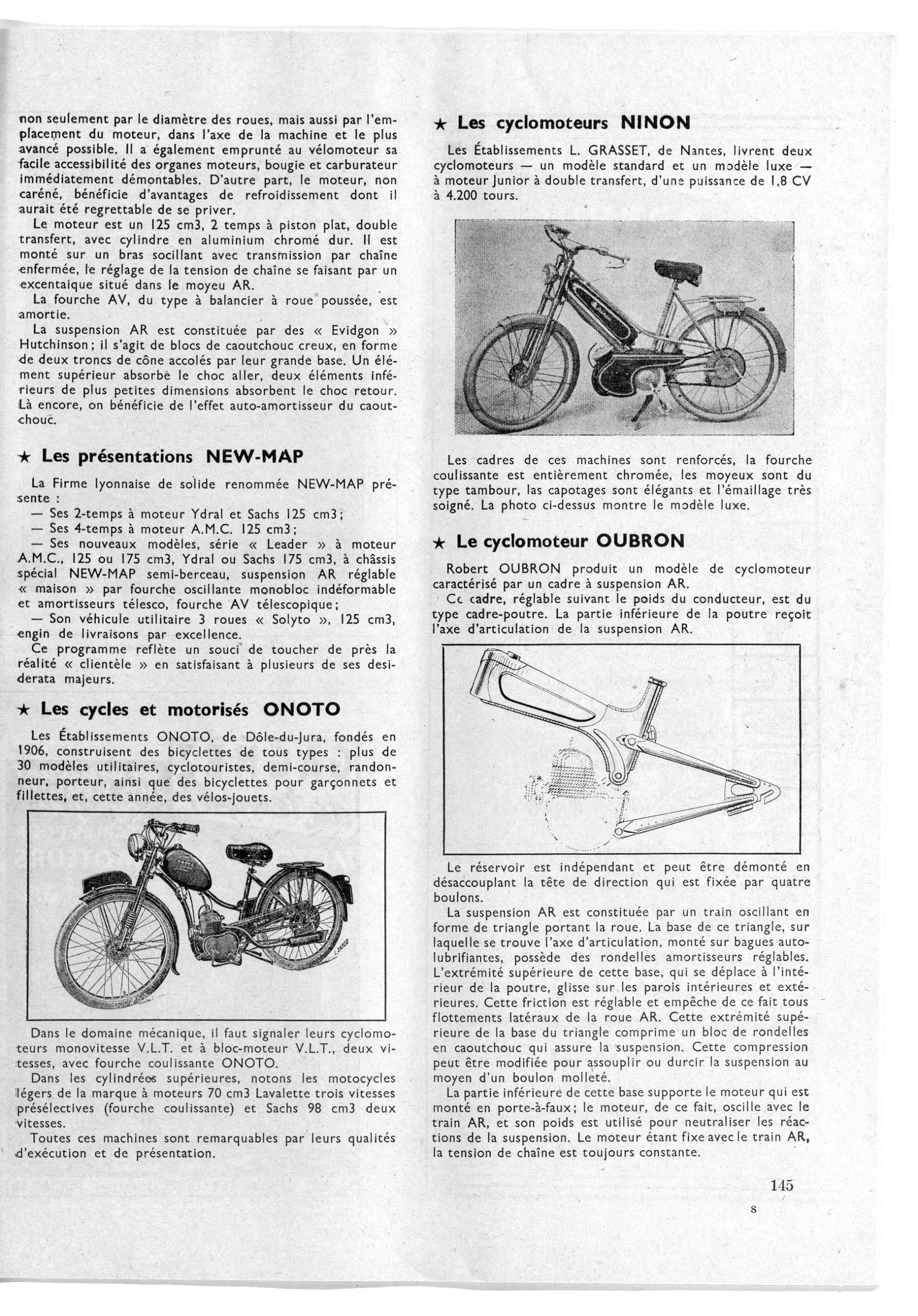
[Ebykr summary; the article’s text is not reproduced. The Établissements Onoto, of Dole in the Jura, founded in 1906, build bicycles of every type: more than 30 models, utility, cyclo-touring, semi-racing, randonneur and carrier, as well as bicycles for boys and girls and, this year, toy bicycles (“vélos-jouets”). A line drawing of an Onoto cyclomoteur follows. In mechanical matters the author singles out the firm’s single-speed V.L.T. cyclomoteurs and its V.L.T. engine-block cyclomoteurs with two speeds, with the Onoto sliding fork. In the larger capacities he notes the make’s light motorcycles with a 70 cc Lavalette engine, three preselector speeds (sliding fork), and a 98 cc Sachs, two speeds. All these machines are remarkable for the quality of their execution and presentation.]
Les cyclomoteurs NINON
[Ebykr summary; the article’s text is not reproduced. The Établissements L. Grasset, of Nantes, deliver two cyclomoteurs, a standard model and a luxe model, with the Junior double-transfer engine of 1.8 CV at 4,200 rpm. A halftone photograph follows. The frames of these machines are reinforced, the sliding fork is entirely chromed, the hubs are of the drum type, the cowlings are elegant and the enameling very careful. The photograph above shows the luxe model.]
Le cyclomoteur OUBRON
[Ebykr summary; the article’s text is not reproduced. Robert Oubron produces a cyclomoteur model characterized by a frame with rear suspension. This frame, adjustable to the rider’s weight, is of the beam-frame type, and the lower part of the beam receives the pivot axis of the rear suspension. A line drawing follows, showing the frame. The tank is independent and can be removed by uncoupling the steering head, which is fixed by four bolts. The rear suspension is an oscillating triangle carrying the wheel. The base of this triangle, bearing the pivot axis mounted on self-lubricating bushes, has adjustable damping washers. The upper end of this base, which moves inside the beam, slides on the inner and outer walls; this friction is adjustable and so prevents any lateral play of the rear wheel. That upper end compresses a block of rubber washers that provides the suspension, and the compression can be altered to soften or stiffen the suspension by means of a knurled bolt. The lower part of the base carries the engine, which is overhung and therefore swings with the rear assembly, its weight being used to neutralize the reactions of the suspension. Since the engine is fixed to the rear assembly, the chain tension is always constant.]
[Page 145 of the survey, set in two columns of justified sans-serif type with four illustrations. Firm headings are in bold sans-serif type with a small star before each: New-Map and Onoto in the left column, Ninon and Oubron in the right. The page opens in the middle of a sentence. In the left column a framed line engraving, drawn with fine hatching and stipple, shows a cyclomoteur in three-quarter view from the front: a tank lettered ONOTO, a saddle, a rear carrier, a sprung fork, a small engine with finned cylinder low in the frame, spoked wheels and a frame tube lettered ONOTO. The signature “L. SAMSO” is printed in small italic letters in the lower right corner of this engraving. At the head of the right column a halftone photograph, set between the Ninon heading and its second paragraph, shows a step-through cyclomoteur with a slim tank, a drum-covered engine and a chain case, a rear carrier, a saddle and a side stand; no caption is printed. Below the Oubron paragraph a second framed line engraving shows the frame with its rear swinging triangle in outline, the beam in hatched shading and the engine in dotted lines. The printed page number 145 stands at the lower right with a small numeral 8 below it. No other signature or agency mark is visible.]
Ebykr presents this material for research and education. If you hold rights to it or notice an ownership issue, please contact us and we will respond promptly.
The Ebykr Digest
New articles, timelines, catalog finds and registry activity — assembled from the archive once a month. Your address is never shared.
Double opt-in. One email per month. Unsubscribe at any time with one click.