About Ebykr
Ebykr celebrates classic and vintage lightweight bicycles through provocative imagery and opinion. Ride along with us.
About Ebykr
Ebykr celebrates classic and vintage lightweight bicycles through provocative imagery and opinion. Ride along with us.

Source: Gallica (Bibliothèque nationale de France), L'Officiel du cycle, du motocycle et du camping, 1 May 1954, special number, pages 95 and 97; ark:/12148/bd6t54182459v. Source gallica.bnf.fr / BnF.
| Type | Review |
|---|---|
| Year | 1954 |
| Publisher | L'Officiel du cycle |
| Country | France |
| Language | French |
| Pages | 3 |
| Source | Gallica (Bibliothèque nationale de France), L'Officiel du cycle, du motocycle et du camping, 1 May 1954, special number, pages 95 and 97; ark:/12148/bd6t54182459v. Source gallica.bnf.fr / BnF. |
| Credit | Ebykr archive; Bibliothèque nationale de France |
| Identifier | Gallica (BnF) ark:/12148/bd6t54182459v/f95 |
| Transcription | Headings and specifications transcribed; article text summarized |
Reference
"Le Pari Singulier." L'Officiel du cycle, 1 May 1954. Ebykr, https://ebykr.com/library/lofficiel-du-cycle-1954-05-pari-singulier-zamacois/.
Wikipedia
{{cite magazine |title=Le Pari Singulier |magazine=L'Officiel du cycle |date=1 May 1954 |language=French |url=https://ebykr.com/library/lofficiel-du-cycle-1954-05-pari-singulier-zamacois/ |via=Ebykr |access-date=}}....... Le Pari Singulier ....... NOUVELLE INÉDITE PAR Miguel Zamacoïs Miguel Zamacoïs.
This is a magazine article, so its running text is summarized here rather than reproduced; the headline, byline, specifications and scores are transcribed as printed.
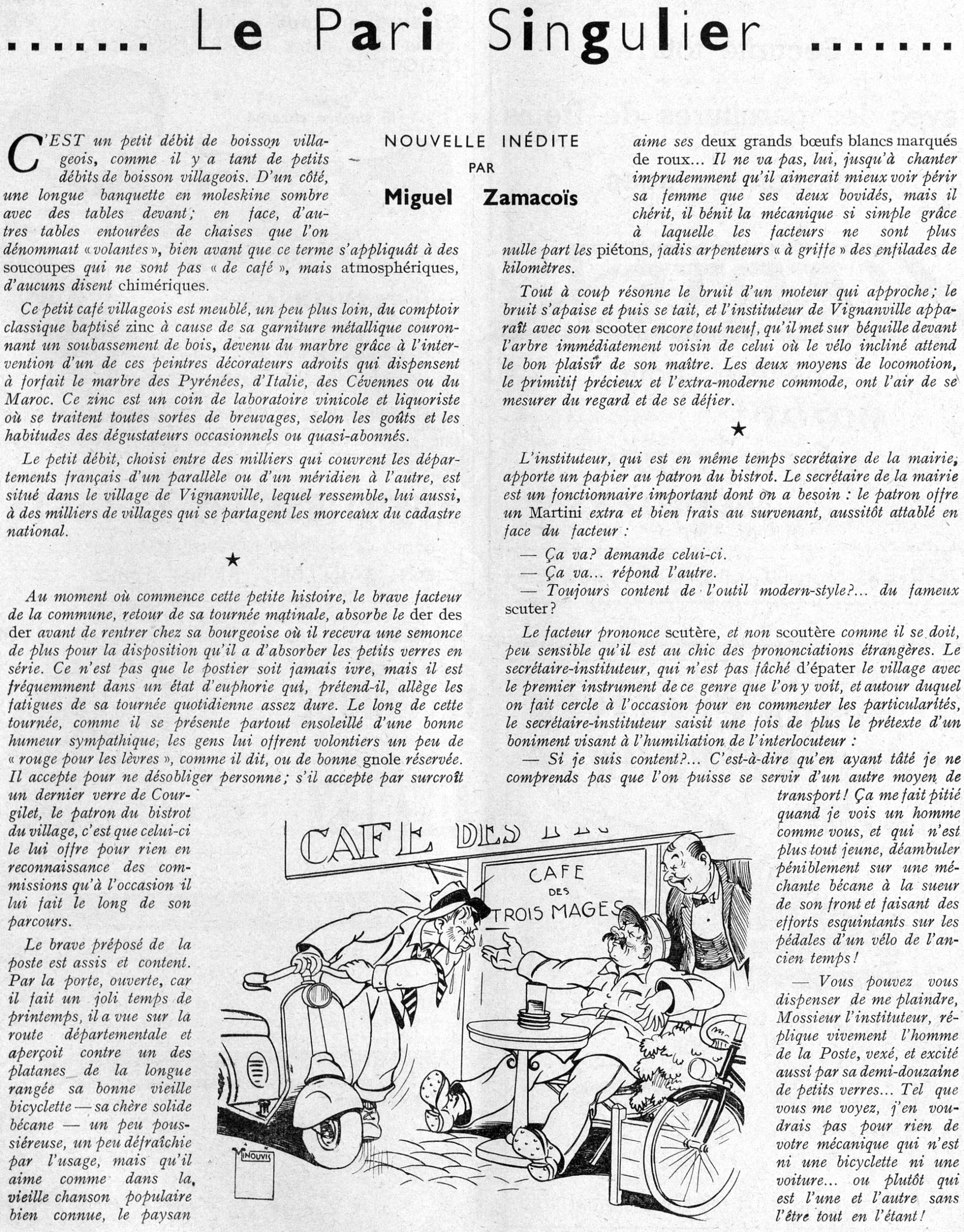
From L’Officiel du cycle, du motocycle et du camping, 1 May 1954, the paper’s special export number, printed in French, English, Spanish and German, pages 95 and 97: le Pari Singulier, a short story by Miguel Zamacois: a postman on his old bicycle bets a schoolmaster on a scooter over a 26 km ride; illustration of a cafe scene with a scooter and a bicycle. The title, headings, captions and lists are transcribed as printed; the text is summarized in Ebykr’s words, and the page images carry it in full.
— Page 1 —
……. Le Pari Singulier …….
NOUVELLE INÉDITE
PAR
Miguel Zamacoïs
[Ebykr summary; the story’s text is not reproduced. The story opens in a small village drinking place in Vignanville, one of thousands like it across the French départements: a long banquette in dark leatherette with tables in front of it, facing other tables with the movable chairs once called “volantes”, and a classic counter, called the zinc for its metal trim, whose wooden base has been painted to pass for marble of the Pyrenees, Italy, the Cévennes or Morocco, a corner where all sorts of drinks are mixed for regulars and occasional customers. After a star break, the story proper begins: the village postman, back from his morning round, takes a last glass before going home to a wife who will scold him for his habit of drinking small glasses in series. He is never drunk but often in an euphoria that, he says, lightens a hard daily round, since people along the way gladly offer him red wine or spirits and he accepts so as not to offend anyone; if he takes a last glass of Courgilet, it is because the café owner offers it free in thanks for the errands the postman runs for him. Sitting content, he sees through the open door, on the departmental road, his good old bicycle leaning against one of the plane trees, a little dusty and worn but loved like the peasant in the old song who loves his two big white oxen. He blesses the simple machine thanks to which postmen are no longer the pedestrians who once walked endless kilometers. Suddenly a motor is heard coming, then stopping, and the village schoolmaster appears on his brand-new scooter, which he stands on its prop against the tree next to the bicycle’s; the two means of travel, the precious primitive one and the convenient ultra-modern one, seem to size each other up and defy each other. After a second star break, the schoolmaster, who is also the town hall secretary, brings the owner a paper and is treated to an extra-cold Martini at the postman’s table. Asked whether he is still pleased with the fashionable tool, the famous “scuter” (the postman says it that way, not “scooter”, caring little for foreign chic), the schoolmaster, glad to impress the village with the first such machine seen there, takes one more chance to humiliate his listener: having tried it, he cannot see how anyone can use another means of travel, and he pities a man no longer young who sweats over an old-time bicycle. The postman, nettled and heated by his half-dozen small glasses, answers that the schoolmaster may spare his pity and that he would not trade places for anything with the owner of a machine that is neither a bicycle nor a car, or rather is both without being either. The story continues on the next page.]
[A page opening a short story, set in italic type in two wide columns with a comic line drawing in black ink across the lower middle. The drawing, a café scene, sits between the foot of the two text columns: a red-faced man in a soft hat and a loosely knotted striped tie leans far forward over the handlebars of a small scooter, scowling and almost nose to nose with a stout mustached man in a uniform cap who sprawls back in a chair at a round café table, one arm stretched out in protest and the other arm hanging, a glass standing on a stack of saucers on the table; behind the chair a bald, grinning man in a waistcoat and bow tie leans over to watch, and at the lower right the front wheel and handlebars of an upright bicycle lean against the chair. Above them a shop sign reads “CAFE DES” in outlined capitals, and in the glass door “CAFE DES TROIS MAGES” is lettered. The drawing is signed at its lower left inside a small ruled box in capitals that read as “MINOUVIS”. The title “Le Pari Singulier” is set in spaced sans-serif capitals and lowercase of mixed weight between two rows of dots; the byline “NOUVELLE INÉDITE PAR Miguel Zamacoïs” stands centered between the columns beside a large italic drop capital C, and the story is set in italic type with star ornaments between sections.]
— Page 2 —
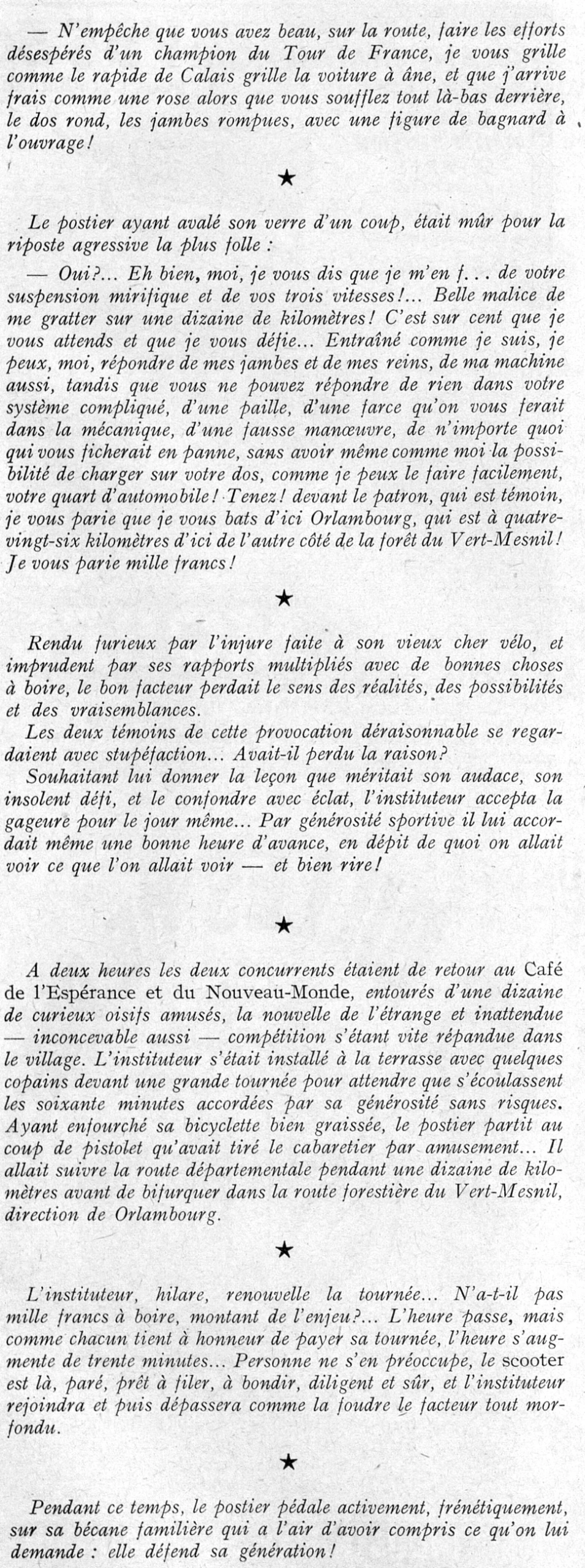
[Ebykr summary; the story’s text is not reproduced. This page continues “Le Pari Singulier” by Miguel Zamacoïs, which is printed in French only. The schoolmaster goes on with his boast: however desperately the postman strains like a Tour de France champion, he will outrun him as the Calais express outruns a donkey cart and arrive fresh as a rose while the postman wheezes far behind, back rounded, legs broken, with a convict’s face. After a star break, the postman, who has swallowed his glass in one gulp, is ripe for the wildest answer: he scorns the schoolmaster’s wonderful suspension and three speeds, says that scratching along ten kilometers is no feat, and challenges him over a hundred, since a trained man can answer for his legs, his back and his machine while the schoolmaster can answer for nothing in so complicated a system, which any trifle or trick in the works could stop, and who cannot even shoulder his quarter of a car as the postman easily could. Before the owner as witness he bets a thousand francs that he will beat the schoolmaster from the village to Orlambourg, eighty-six kilometers away on the other side of the forest of Vert-Mesnil. After a star break, the narrator says the postman, furious at the insult to his dear old bicycle and made reckless by his many dealings with good things to drink, has lost his sense of reality; the two witnesses look at each other in astonishment, wondering whether he has lost his reason. Wishing to teach him a lesson, the schoolmaster accepts the wager for that very day and, out of sporting generosity, even gives him a good hour’s start, so that everyone expects to see something and to laugh. After another star break, at two o’clock both contestants are back at the Café de l’Espérance et du Nouveau-Monde, surrounded by about ten amused idlers, the news of the strange contest having spread through the village. The schoolmaster settles on the terrace with a few friends before a big round of drinks to wait out the sixty minutes his generosity allows; the postman mounts his well-greased bicycle and sets off at a pistol shot fired by the owner for fun, meaning to follow the departmental road for about ten kilometers before turning onto the forest road of Vert-Mesnil toward Orlambourg. After another star break, the schoolmaster, hilarious, orders another round, since he has a thousand francs of winnings to drink; the hour passes, and as each man insists on paying for a round the hour stretches by thirty minutes, but nobody worries, the scooter being ready to dart off and pass the soaked postman like lightning. After a last star break, the page ends with the postman pedaling hard and frantically on his familiar machine, which seems to have understood what is asked of it and defends its generation. The story continues on the next page.]
[A text-only page of the story, set in italic roman type in a single wide column, with a dash opening each reply of the dialogue and a small black star ornament centered between sections. There is no drawing, photograph, signature or artist mark on this page, and no heading.]
— Page 3 —
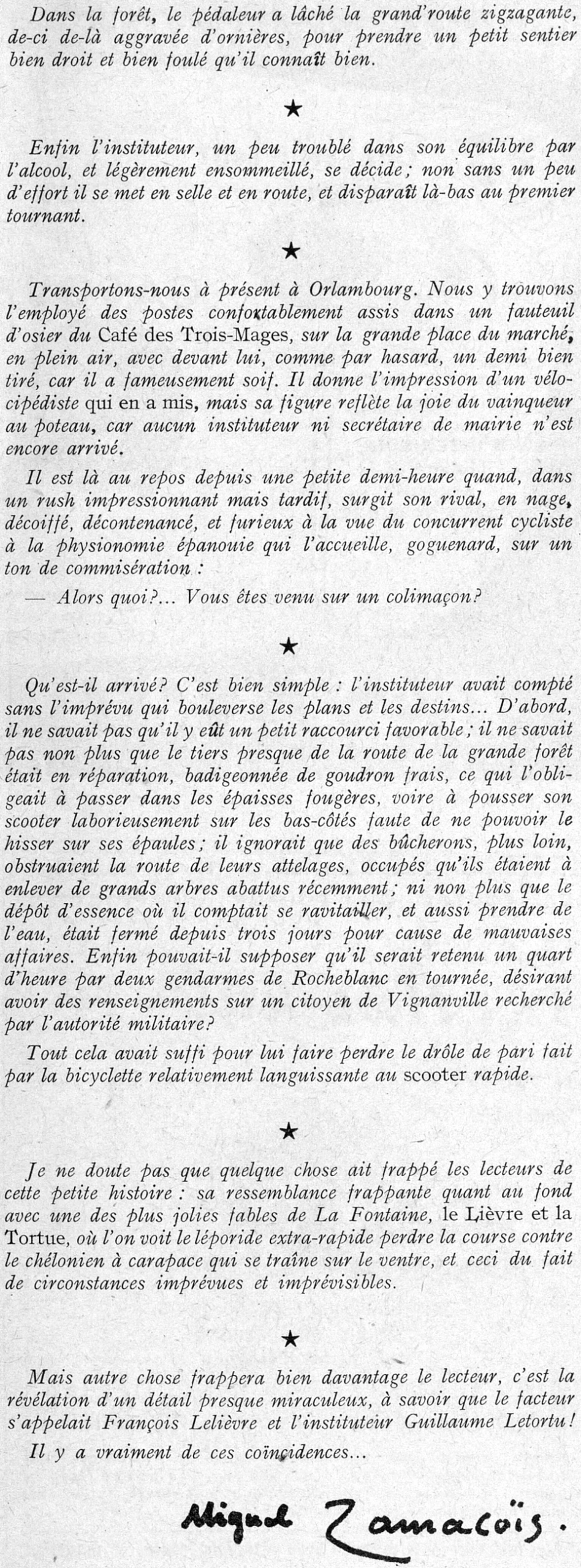
[Ebykr summary; the story’s text is not reproduced. This page ends “Le Pari Singulier” by Miguel Zamacoïs, which is printed in French only. In the forest the pedaler leaves the winding main road, rutted here and there, for a small, straight, well-trodden path that he knows well. After a star break, the schoolmaster, a little unsteady from the alcohol and slightly drowsy, finally makes up his mind, climbs on with some effort and disappears around the first bend. After another star break, the narrator moves to Orlambourg, where the postal employee sits comfortably in a wicker armchair at the Café des Trois-Mages on the big market square, in the open air, with a well-drawn half-pint before him, since he is famously thirsty; he looks like a cyclist who has put in an effort, but his face shows the joy of the winner at the post, because no schoolmaster or town hall secretary has yet arrived. He has been resting for a good half hour when his rival bursts in on an impressive but late rush, drenched in sweat, disheveled, disconcerted and furious to see the cyclist’s relaxed face, and is greeted with mock sympathy and a gibe asking whether he came on a snail. After a star break, the narrator explains what happened: the schoolmaster had not counted on the unforeseen. He did not know of the helpful short cut; he did not know that nearly a third of the great forest road was under repair and smeared with fresh tar, which forced him through thick ferns and to push his scooter laboriously along the verges, since he could not lift it on his shoulders; he did not know that woodcutters farther on were blocking the road with their teams while hauling away big trees recently felled, nor that the fuel depot where he counted on filling up and taking water had been shut for three days over bad business; and he could not have supposed that two gendarmes from Rocheblanc, on their rounds, would keep him a quarter of an hour asking about a citizen of Vignanville wanted by the military authority. All this was enough to make him lose the odd wager the relatively languid bicycle had made against the swift scooter. After a star break, the narrator says readers will have noticed how closely the story matches La Fontaine’s fable of the hare and the tortoise, in which the extra-fast hare loses the race to the shelled creature crawling on its belly through unforeseen and unforeseeable circumstances. After a last star break, he adds that something will strike the reader even more, a nearly miraculous detail: the postman was named François Lelièvre and the schoolmaster Guillaume Letortu, and there are really such coincidences.]
Miguel Zamacoïs.
[A text-only page of the story’s ending, set in italic roman type in a single wide column with a small black star ornament centered between sections. The page closes with the author’s name signed by hand in a loose brush script, “Miguel Zamacoïs”, followed by a full stop; it is the writer’s signature, not an illustrator’s, and no drawing, photograph or agency mark appears on the page. The type is clean, with no text from the reverse of the leaf showing through.]
Ebykr presents this material for research and education. If you hold rights to it or notice an ownership issue, please contact us and we will respond promptly.
The Ebykr Digest
New articles, timelines, catalog finds and registry activity — assembled from the archive once a month. Your address is never shared.
Double opt-in. One email per month. Unsubscribe at any time with one click.