About Ebykr
Ebykr celebrates classic and vintage lightweight bicycles through provocative imagery and opinion. Ride along with us.
About Ebykr
Ebykr celebrates classic and vintage lightweight bicycles through provocative imagery and opinion. Ride along with us.

Source: Gallica (Bibliothèque nationale de France), L'Officiel du cycle, du motocycle et du camping, 1 May 1954, special number, page 19; ark:/12148/bd6t54182459v. Source gallica.bnf.fr / BnF.
| Type | Review |
|---|---|
| Year | 1954 |
| Publisher | L'Officiel du cycle |
| Country | France |
| Language | French |
| Pages | 1 |
| Source | Gallica (Bibliothèque nationale de France), L'Officiel du cycle, du motocycle et du camping, 1 May 1954, special number, page 19; ark:/12148/bd6t54182459v. Source gallica.bnf.fr / BnF. |
| Credit | Ebykr archive; Bibliothèque nationale de France |
| Identifier | Gallica (BnF) ark:/12148/bd6t54182459v/f19 |
| Transcription | Headings and specifications transcribed; article text summarized |
Reference
"Voici les types principaux de bicyclettes présentés par la France." L'Officiel du cycle, 1 May 1954. Ebykr, https://ebykr.com/library/lofficiel-du-cycle-1954-05-panorama-types-de-bicyclettes/.
Wikipedia
{{cite magazine |title=Voici les types principaux de bicyclettes présentés par la France |magazine=L'Officiel du cycle |date=1 May 1954 |language=French |url=https://ebykr.com/library/lofficiel-du-cycle-1954-05-panorama-types-de-bicyclettes/ |via=Ebykr |access-date=}}♥ Voici les types principaux de bicyclettes présentés par la France : ♠ 1º Bicyclettes-jouets et bicyclettes d'enfants, en toutes dimensions, offrant tous les perfectionnements des modèles pour adultes et même des particularités luxueuses : émail de toutes les couleurs, pneus ballon gonflables, nickelages, etc. ; 2º Bicyclettes utilitaires, en modèles à l'usage des travailleurs …
This is a magazine article, so its running text is summarized here rather than reproduced; the headline, byline, specifications and scores are transcribed as printed.
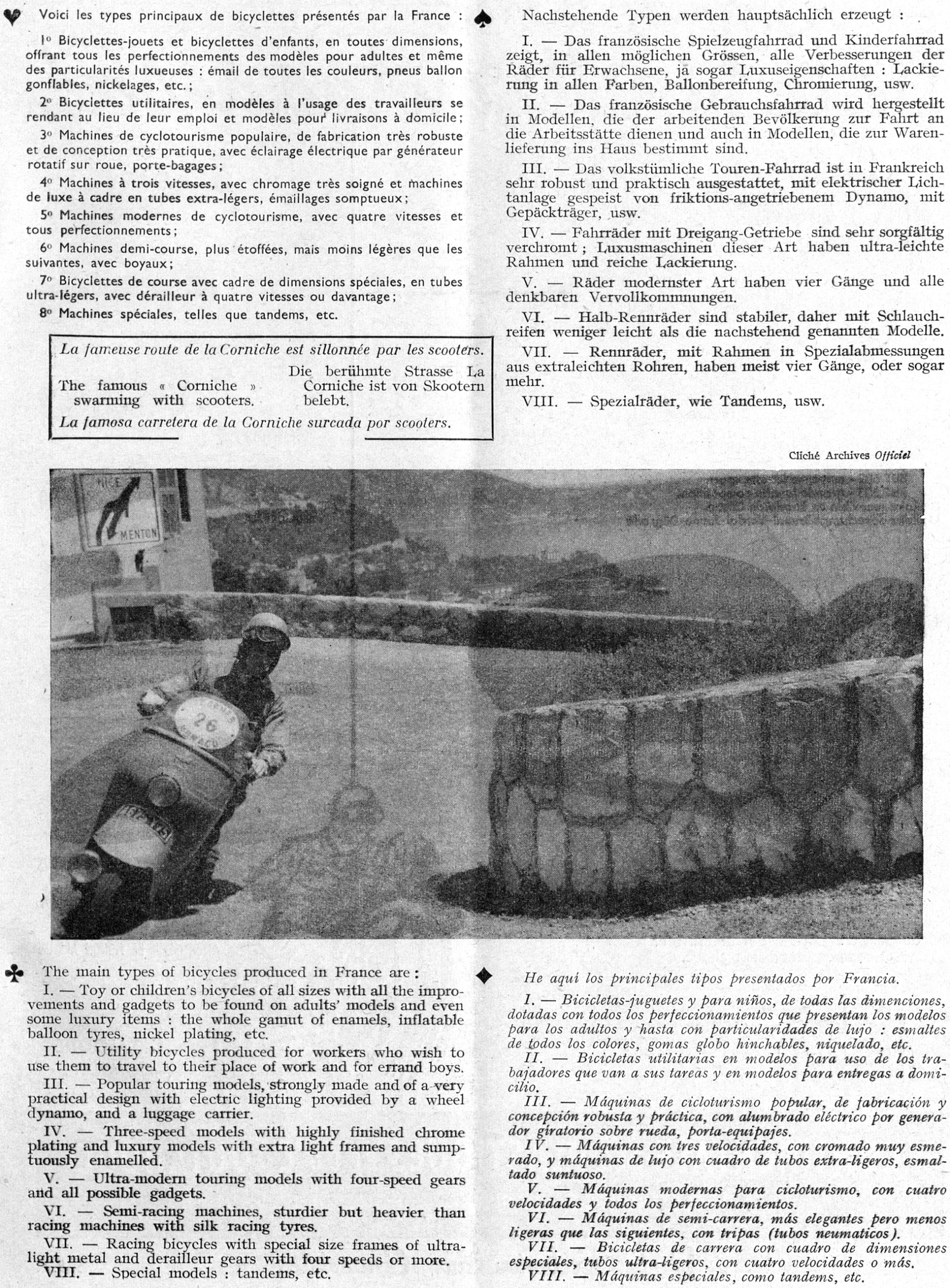
From L’Officiel du cycle, du motocycle et du camping, 1 May 1954, the paper’s special export number, printed in French, English, Spanish and German, page 19: panorama continued: the eight main types of French bicycle, from toy and utility machines to touring, three-speed, semi-racing and racing frames with four-speed gears, and tandems, in French, German, English and Spanish; photograph of a scooter rider on the Corniche (Cliché Archives Officiel). The title, headings, captions and lists are transcribed as printed; the text is summarized in Ebykr’s words, and the page images carry it in full.
— Page 1 —
♥ Voici les types principaux de bicyclettes présentés par la France : ♠
1º Bicyclettes-jouets et bicyclettes d’enfants, en toutes dimensions, offrant tous les perfectionnements des modèles pour adultes et même des particularités luxueuses : émail de toutes les couleurs, pneus ballon gonflables, nickelages, etc. ;
2º Bicyclettes utilitaires, en modèles à l’usage des travailleurs se rendant au lieu de leur emploi et modèles pour livraisons à domicile ;
3º Machines de cyclotourisme populaire, de fabrication très robuste et de conception très pratique, avec éclairage électrique par générateur rotatif sur roue, porte-bagages ;
4º Machines à trois vitesses, avec chromage très soigné et machines de luxe à cadre en tubes extra-légers, émaillages somptueux ;
5º Machines modernes de cyclotourisme, avec quatre vitesses et tous perfectionnements ;
6º Machines demi-course, plus étoffées, mais moins légères que les suivantes, avec boyaux ;
7º Bicyclettes de course avec cadre de dimensions spéciales, en tubes ultra-légers, avec dérailleur à quatre vitesses ou davantage ;
8º Machines spéciales, telles que tandems, etc.
La fameuse route de la Corniche est sillonnée par les scooters.
The famous « Corniche » swarming with scooters.
Die berühmte Strasse La Corniche ist von Skootern belebt.
La famosa carretera de la Corniche surcada por scooters.
♠ Nachstehende Typen werden hauptsächlich erzeugt :
I. — Das französische Spielzeugfahrrad und Kinderfahrrad zeigt, in allen möglichen Grössen, alle Verbesserungen der Räder für Erwachsene, ja sogar Luxuseigenschaften : Lackierung in allen Farben, Ballonbereifung, Chromierung, usw.
II. — Das französische Gebrauchsfahrrad wird hergestellt in Modellen, die der arbeitenden Bevölkerung zur Fahrt an die Arbeitsstätte dienen und auch in Modellen, die zur Warenlieferung ins Haus bestimmt sind.
III. — Das volkstümliche Touren-Fahrrad ist in Frankreich sehr robust und praktisch ausgestattet, mit elektrischer Lichtanlage gespeist von friktions-angetriebenem Dynamo, mit Gepäckträger, usw.
IV. — Fahrräder mit Dreigang-Getriebe sind sehr sorgfältig verchromt ; Luxusmaschinen dieser Art haben ultra-leichte Rahmen und reiche Lackierung.
V. — Räder modernster Art haben vier Gänge und alle denkbaren Vervollkommnungen.
VI. — Halb-Rennräder sind stabiler, daher mit Schlauchreifen weniger leicht als die nachstehend genannten Modelle.
VII. — Rennräder, mit Rahmen in Spezialabmessungen aus extraleichten Rohren, haben meist vier Gänge, oder sogar mehr.
VIII. — Spezialräder, wie Tandems, usw.
Cliché Archives Officiel
♣ The main types of bicycles produced in France are : ♦
I. — Toy or children’s bicycles of all sizes with all the improvements and gadgets to be found on adults’ models and even some luxury items : the whole gamut of enamels, inflatable balloon tyres, nickel plating, etc.
II. — Utility bicycles produced for workers who wish to use them to travel to their place of work and for errand boys.
III. — Popular touring models, strongly made and of a very practical design with electric lighting provided by a wheel dynamo, and a luggage carrier.
IV. — Three-speed models with highly finished chrome plating and luxury models with extra light frames and sumptuously enamelled.
V. — Ultra-modern touring models with four-speed gears and all possible gadgets.
VI. — Semi-racing machines, sturdier but heavier than racing machines with silk racing tyres.
VII. — Racing bicycles with special size frames of ultra-light metal and derailleur gears with four speeds or more.
VIII. — Special models : tandems, etc.
♦ He aquí los principales tipos presentados por Francia.
I. — Bicicletas-juguetes y para niños, de todas las dimenciones, dotadas con todos los perfeccionamientos que presentan los modelos para los adultos y hasta con particularidades de lujo : esmaltes de todos los colores, gomas globo hinchables, niquelado, etc.
II. — Bicicletas utilitarias en modelos para uso de los trabajadores que van a sus tareas y en modelos para entregas a domicilio.
III. — Máquinas de cicloturismo popular, de fabricación y concepción robusta y práctica, con alumbrado eléctrico por generador giratorio sobre rueda, porta-equipajes.
IV. — Máquinas con tres velocidades, con cromado muy esmerado, y máquinas de lujo con cuadro de tubos extra-ligeros, esmaltado suntuoso.
V. — Máquinas modernas para cicloturismo, con cuatro velocidades y todos los perfeccionamientos.
VI. — Máquinas de semi-carrera, más elegantes pero menos ligeras que las siguientes, con tripas (tubos neumaticos).
VII. — Bicicletas de carrera con cuadro de dimensiones especiales, tubos ultra-ligeros, con cuatro velocidades o más.
VIII. — Máquinas especiales, como tandems, etc.
[A text page with one large halftone photograph and four-language lists of bicycle types, on a plain ground with no advertiser. Across the top the French list of eight numbered types opens with a heart sign and closes the line with a spade sign; beside it the German list is numbered in roman numerals, and below the photograph the English list and the Spanish italic list follow in the same way, each headed by a playing-card suit sign. A ruled four-language caption panel with a broken bottom rule sits under the French list. Below it a wide halftone photograph, credited Cliché Archives Officiel at its upper right, shows a rider in a helmet and goggles leaning a scooter through a bend on a coastal road, with a road sign reading NICE and MENTON with an arrow on a white wall at the upper left, a round plate on the scooter reading 26 and MONACO, and a hillside and sea behind. Ghost lettering from the reverse of the leaf shows through the upper part of that photograph. No artist signature or agency mark is visible apart from the credit line.]
Ebykr presents this material for research and education. If you hold rights to it or notice an ownership issue, please contact us and we will respond promptly.
The Ebykr Digest
New articles, timelines, catalog finds and registry activity — assembled from the archive once a month. Your address is never shared.
Double opt-in. One email per month. Unsubscribe at any time with one click.