About Ebykr
Ebykr celebrates classic and vintage lightweight bicycles through provocative imagery and opinion. Ride along with us.
About Ebykr
Ebykr celebrates classic and vintage lightweight bicycles through provocative imagery and opinion. Ride along with us.

Source: Gallica (Bibliothèque nationale de France), L'Officiel du cycle, du motocycle et du camping, 1 May 1954, special number, page 12; ark:/12148/bd6t54182459v. Source gallica.bnf.fr / BnF.
| Type | Review |
|---|---|
| Year | 1954 |
| Publisher | L'Officiel du cycle |
| Country | France |
| Language | French |
| Pages | 1 |
| Source | Gallica (Bibliothèque nationale de France), L'Officiel du cycle, du motocycle et du camping, 1 May 1954, special number, page 12; ark:/12148/bd6t54182459v. Source gallica.bnf.fr / BnF. |
| Credit | Ebykr archive; Bibliothèque nationale de France |
| Identifier | Gallica (BnF) ark:/12148/bd6t54182459v/f12 |
| Transcription | Headings and specifications transcribed; article text summarized |
Reference
"Panorama du Cycle et du Motocycle Français, Définitions." L'Officiel du cycle, 1 May 1954. Ebykr, https://ebykr.com/library/lofficiel-du-cycle-1954-05-panorama-definitions/.
Wikipedia
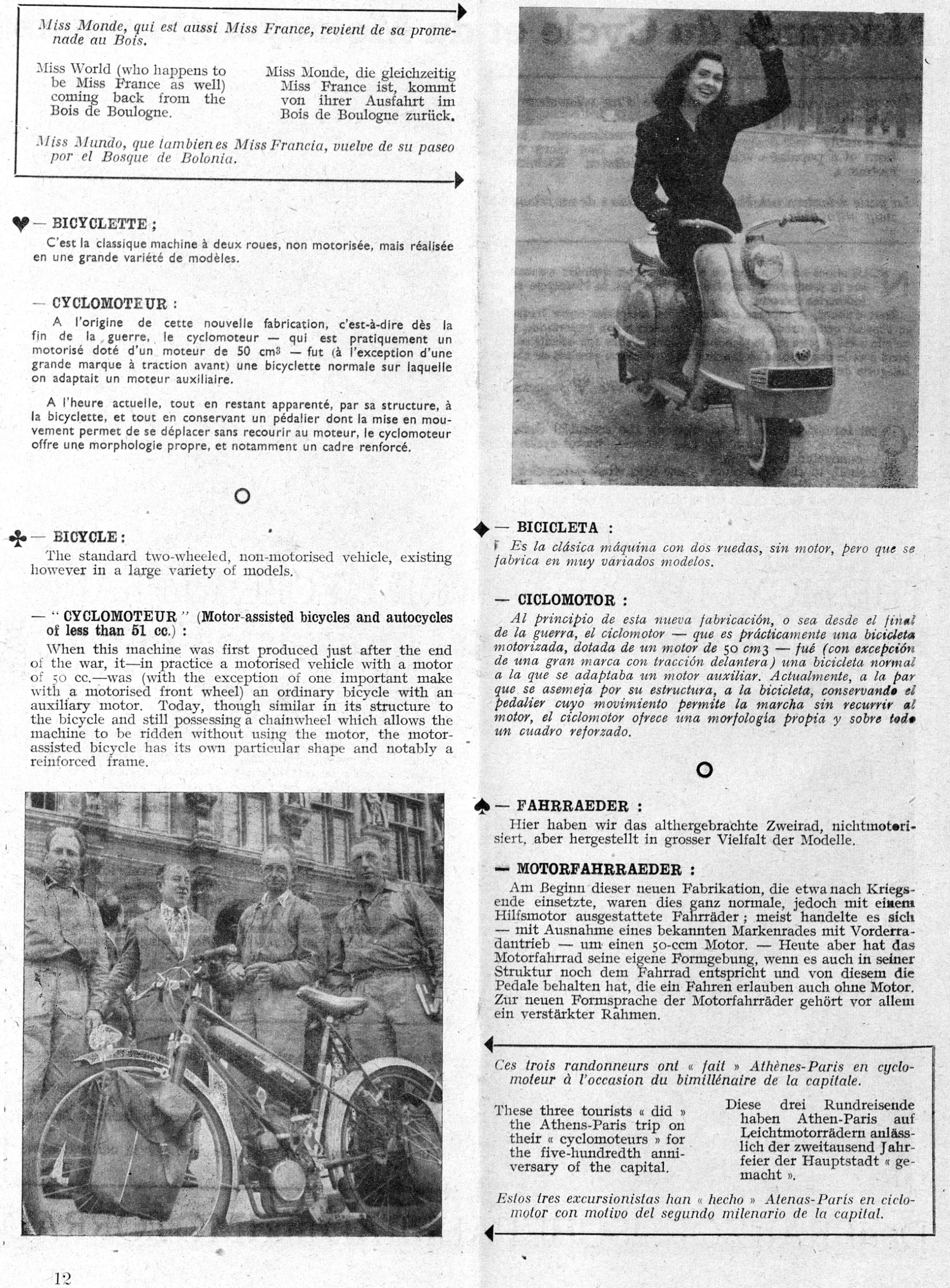
{{cite magazine |title=Panorama du Cycle et du Motocycle Français, Définitions |magazine=L'Officiel du cycle |date=1 May 1954 |language=French |url=https://ebykr.com/library/lofficiel-du-cycle-1954-05-panorama-definitions/ |via=Ebykr |access-date=}}Miss Monde, qui est aussi Miss France, revient de sa promenade au Bois. Miss World (who happens to be Miss France as well) coming back from the Bois de Boulogne. Miss Monde, die gleichzeitig Miss France ist, kommt von ihrer Ausfahrt im Bois de Boulogne zurück. Miss Mundo, que tambien es Miss Francia, vuelve de …
This is a magazine article, so its running text is summarized here rather than reproduced; the headline, byline, specifications and scores are transcribed as printed.
From L’Officiel du cycle, du motocycle et du camping, 1 May 1954, the paper’s special export number, printed in French, English, Spanish and German, page 12: panorama continued: definitions of Bicyclette, Cyclomoteur (motor-assisted bicycle under 51 cc), in French, English, Spanish and German; photographs of Miss Monde on a scooter and of three tourists on cyclomoteurs after Athens-Paris. The title, headings, captions and lists are transcribed as printed; the text is summarized in Ebykr’s words, and the page images carry it in full.
— Page 1 —
Miss Monde, qui est aussi Miss France, revient de sa promenade au Bois.
Miss World (who happens to be Miss France as well) coming back from the Bois de Boulogne.
Miss Monde, die gleichzeitig Miss France ist, kommt von ihrer Ausfahrt im Bois de Boulogne zurück.
Miss Mundo, que tambien es Miss Francia, vuelve de su paseo por el Bosque de Bolonia.
♥ — BICYCLETTE ;
C’est la classique machine à deux roues, non motorisée, mais réalisée en une grande variété de modèles.
— CYCLOMOTEUR :
A l’origine de cette nouvelle fabrication, c’est-à-dire dès la fin de la guerre, le cyclomoteur — qui est pratiquement un motorisé doté d’un moteur de 50 cm³ — fut (à l’exception d’une grande marque à traction avant) une bicyclette normale sur laquelle on adaptait un moteur auxiliaire.
A l’heure actuelle, tout en restant apparenté, par sa structure, à la bicyclette, et tout en conservant un pédalier dont la mise en mouvement permet de se déplacer sans recourir au moteur, le cyclomoteur offre une morphologie propre, et notamment un cadre renforcé.
♣ — BICYCLE :
The standard two-wheeled, non-motorised vehicle, existing however in a large variety of models.
— ” CYCLOMOTEUR ” (Motor-assisted bicycles and autocycles of less than 51 cc.) :
When this machine was first produced just after the end of the war, it—in practice a motorised vehicle with a motor of 50 cc.—was (with the exception of one important make with a motorised front wheel) an ordinary bicycle with an auxiliary motor. Today, though similar in its structure to the bicycle and still possessing a chainwheel which allows the machine to be ridden without using the motor, the motor-assisted bicycle has its own particular shape and notably a reinforced frame.
♦ — BICICLETA :
Es la clásica máquina con dos ruedas, sin motor, pero que se fabrica en muy variados modelos.
— CICLOMOTOR :
Al principio de esta nueva fabricación, o sea desde el final de la guerra, el ciclomotor — que es prácticamente una bicicleta motorizada, dotada de un motor de 50 cm3 — fué (con excepción de una gran marca con tracción delantera) una bicicleta normal a la que se adaptaba un motor auxiliar. Actualmente, a la par que se asemeja por su estructura, a la bicicleta, conservando el pedalier cuyo movimiento permite la marcha sin recurrir al motor, el ciclomotor ofrece una morfología propia y sobre todo un cuadro reforzado.
♠ — FAHRRAEDER :
Hier haben wir das althergebrachte Zweirad, nichtmotorisiert, aber hergestellt in grosser Vielfalt der Modelle.
— MOTORFAHRRAEDER :
Am Beginn dieser neuen Fabrikation, die etwa nach Kriegsende einsetzte, waren dies ganz normale, jedoch mit einem Hilfsmotor ausgestattete Fahrräder ; meist handelte es sich — mit Ausnahme eines bekannten Markenrades mit Vorderradantrieb — um einen 50-ccm Motor. — Heute aber hat das Motorfahrrad seine eigene Formgebung, wenn es auch in seiner Struktur noch dem Fahrrad entspricht und von diesem die Pedale behalten hat, die ein Fahren erlauben auch ohne Motor. Zur neuen Formsprache der Motorfahrräder gehört vor allem ein verstärkter Rahmen.
Ces trois randonneurs ont « fait » Athènes-Paris en cyclomoteur à l’occasion du bimillénaire de la capitale.
These three tourists « did » the Athens-Paris trip on their « cyclomoteurs » for the five-hundredth anniversary of the capital.
Diese drei Rundreisende haben Athen-Paris auf Leichtmotorrädern anlässlich der zweitausend Jahrfeier der Hauptstadt « gemacht ».
Estos tres excursionistas han « hecho » Atenas-Paris en ciclomotor con motivo del segundo milenario de la capital.
12
[A text page with two halftone photographs and four-language definition lists, on a plain ground with no advertiser. At the top a ruled caption panel with arrowheads at its corners holds the French, English, German and Spanish captions for the photograph beside it. At the upper right a halftone photograph shows a smiling young woman with dark wavy hair in a dark fitted jacket and skirt, seated sideways on the saddle of a scooter with one gloved hand raised in a wave, against a blurred park background. Down the left side and across the lower right, definition entries are set under bold capital headings, each opened by a playing-card suit sign (heart, club, diamond, spade) and a dash, in French roman, English roman, Spanish italic and German roman type, with small ring ornaments between the language blocks. At the lower left a second halftone photograph shows four men in work jackets and one in a tie standing in front of a stone building behind a small motor-assisted bicycle that carries a large saddlebag on its front wheel and a tank under the top tube. At the lower right a ruled four-language caption panel names that photograph. Ghost lettering from the reverse of the leaf shows through the upper photograph. The folio number 12 stands at the foot of the left column. No signature or agency mark is visible.]
Ebykr presents this material for research and education. If you hold rights to it or notice an ownership issue, please contact us and we will respond promptly.
The Ebykr Digest
New articles, timelines, catalog finds and registry activity — assembled from the archive once a month. Your address is never shared.
Double opt-in. One email per month. Unsubscribe at any time with one click.