About Ebykr
Ebykr celebrates classic and vintage lightweight bicycles through provocative imagery and opinion. Ride along with us.
About Ebykr
Ebykr celebrates classic and vintage lightweight bicycles through provocative imagery and opinion. Ride along with us.

Source: Gallica (Bibliothèque nationale de France), L'Officiel du cycle, du motocycle et du camping, 14 November 1953, N° 46, page 5; ark:/12148/bd6t54182339r. Source gallica.bnf.fr / BnF.
| Type | Review |
|---|---|
| Year | 1953 |
| Publisher | L'Officiel du cycle |
| Country | France |
| Language | French |
| Pages | 1 |
| Source | Gallica (Bibliothèque nationale de France), L'Officiel du cycle, du motocycle et du camping, 14 November 1953, N° 46, page 5; ark:/12148/bd6t54182339r. Source gallica.bnf.fr / BnF. |
| Credit | Ebykr archive; Bibliothèque nationale de France |
| Identifier | Gallica (BnF) ark:/12148/bd6t54182339r/f5 |
| Transcription | Headings and specifications transcribed; article text summarized |
Libres Propos ○ ○ ○ ★ ★ ★ ★ — D'abord le carénage des motos (concomitant avec un effort marqué et général dans la catégorie 250) ; — Ensuite l'apparition d'engins mixtes que nous baptiserons volontiers « motoscooters », combinant, panachant en quelque sorte les aspects de la moto légère et ceux du scooter : …
This is a magazine article, so its running text is summarized here rather than reproduced; the headline, byline, specifications and scores are transcribed as printed.
From L’Officiel du cycle, du motocycle et du camping, 14 November 1953, the paper’s report number on the 1953 Paris Salon du Cycle et du Motocycle, page 5: the paper’s unsigned editorial after the Salon, arguing that the bicycle is not dead, with its twelve million official users, and guessing at what plastics might do for frames, mudguards and spokes before it turns to the cyclomoteur and the scooter. The title, headings, captions and lists are transcribed as printed; the text is summarized in Ebykr’s words, and the page images carry it in full.
— Page 1 —
Libres Propos
○ ○ ○
[Ebykr summary; the article’s text is not reproduced. The unsigned editorial opens by noting that after every Salon it is customary to “draw the lesson” and try to foresee the future from present signs, a game that matters only to those who do not mind “predicting the weather of yesterday”. The writer claims the right to a favorable hearing because the magazine has proclaimed urbi et orbi for two years that the bicycle is not dead and has an unlimited career still ahead. The Salon, he says, proved this beyond dispute, so he will not repeat the reasons. Twelve million official users of the bicycle, plus 3 million clandestine ones according to well-informed whisperers, are there to refute those who despair of the bicycle before the offensive of the motorized machines.]
★
[Ebykr summary, after the first star. On technical direction, the writer finds nothing new at this Salon beyond a fair number of detail modifications, which he hesitates to call improvements. He therefore persists in believing that the renewal of the cycle’s structure will come from plastics. As hypotheses he says have been formulated nowhere else, he foresees plastic moldings replacing the old metallurgy of frames and mechanical parts, with a weight saving of two thirds; the tire and inner tube replaced by a true pneumatic ring, pre-inflated and puncture-proof; and the chain replaced by a flexible shaft reviving the old chainless system without its drawbacks. He passes over the obvious uses of plastics for parts such as the saddle and mudguards, and slides likewise past a bold conception of spoking. But all this is only for “the day after tomorrow”, and no one knows how many years and lustrums “tomorrow” may last. The permanence of current cycle technique has a thousand causes, among them the need to amortize tooling and the very adequate satisfaction of customers’ wants (quality, price, comfort, safety, efficiency).]
★
[Ebykr summary, after the second star. Turning to the cyclomoteur and the scooter, called the two kings of last year or rather the two heirs presumptive, and somewhat impatient, of the “silent queen” (the bicycle), the writer says their progress has continued and accelerated, and the figures proving it have been given. Their victory massacres no one: the clientele of both has grown and will grow much more, but data now exist to measure in advance, as for a flood, its greatest “advance”, which will not be followed by any retreat. Once their fill of customers is made, the two machines will live on the double renewal of their “subjects” and of the machines themselves.]
★
[Ebykr summary, after the third star. The multiplication of marques in these two categories, above all among cyclomoteurs, raises a problem. A foreign visitor, surprised at the number of firms in the lists, asked whether each maker had calculated what numerical clientele he could count on for his share to make his effort viable, since a few leading firms, according to good experts, account for nearly two thirds of national output. Happily the diversity is much evened out mechanically by the far smaller number of carefully designed engines that equip the machines. The multiplicity of makers also guarantees an emulation that yields progress, very noticeable from year to year, from which the user benefits. Yet the economic side escapes no rational mind, and the struggle for success could become the struggle for life.]
★
[Ebykr summary, after the fourth star. Strictly on technique, the writer stresses that while the cyclomoteur and the scooter are almost settled in form and general design (a wide review is given in this issue) and the pure vélomoteur is declining in numbers, two indications seem to announce the future.]
— D’abord le carénage des motos (concomitant avec un effort marqué et général dans la catégorie 250) ;
— Ensuite l’apparition d’engins mixtes que nous baptiserons volontiers « motoscooters », combinant, panachant en quelque sorte les aspects de la moto légère et ceux du scooter : grandes roues, « carrossage », selle et plateau marche pieds, suspensions coulissantes et réservoir AR, etc.
[Ebykr summary, closing. It is not unreasonable to see there the machine that is coming, but the classic scooter and motorcycle (the latter agreeing to be clothed) are and remain “les Princes de la Route” of today.]
○ ○ ○
d’après-Salon
5
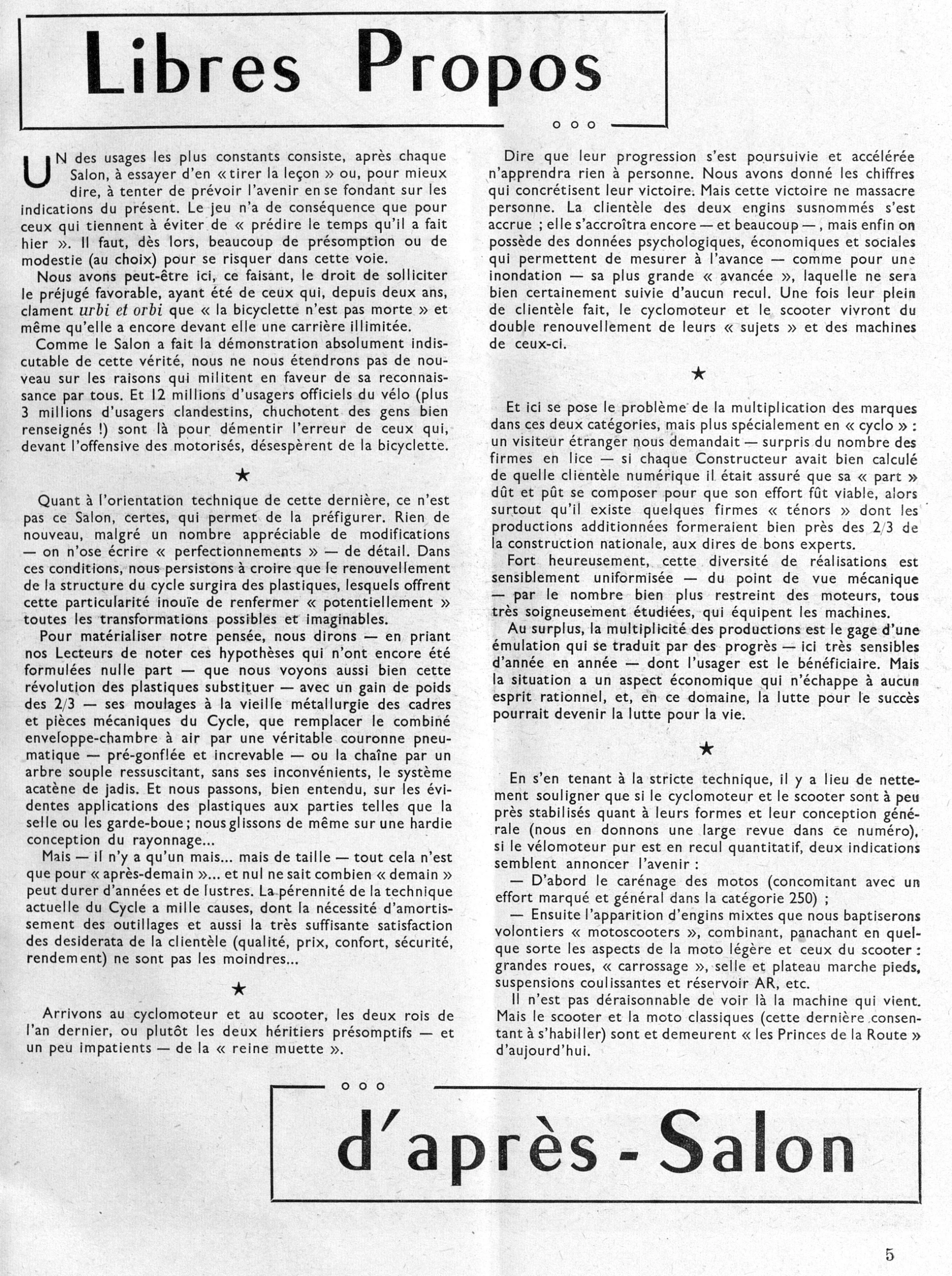
[A full page of text only, set in a humanist sans-serif in justified columns on a single measure, with no photographs or drawings. The title “Libres Propos” stands across the head in large bold sans-serif capital-and-lowercase letters inside a ruled rectangular box that is open at the lower right, with three small open circles beneath its edge. The text begins with a large drop initial U set in thin line. Short ruled star ornaments in black separate the sections, and two bulleted dash items are set indented near the end. A second ruled box at the foot of the article carries the second half of the title, “d’après-Salon”, in the same large letters, again with three small circles above its upper edge. The page number 5 sits at the lower right. No signature or agency mark is visible.]
Ebykr presents this material for research and education. If you hold rights to it or notice an ownership issue, please contact us and we will respond promptly.
The Ebykr Digest
New articles, timelines, catalog finds and registry activity — assembled from the archive once a month. Your address is never shared.
Double opt-in. One email per month. Unsubscribe at any time with one click.