About Ebykr
Ebykr celebrates classic and vintage lightweight bicycles through provocative imagery and opinion. Ride along with us.
About Ebykr
Ebykr celebrates classic and vintage lightweight bicycles through provocative imagery and opinion. Ride along with us.

Source: Gallica (Bibliothèque nationale de France), L'Officiel du cycle, du motocycle et du camping, 14 November 1953, N° 46, pages 67, 69, 71, 72, 75, 77, 79, 81, 82, 85, 87 and 89; ark:/12148/bd6t54182339r. Source gallica.bnf.fr / BnF.
| Type | Review |
|---|---|
| Year | 1953 |
| Publisher | L'Officiel du cycle |
| Artist | Daniel Rebour |
| Country | France |
| Language | French |
| Pages | 12 |
| Source | Gallica (Bibliothèque nationale de France), L'Officiel du cycle, du motocycle et du camping, 14 November 1953, N° 46, pages 67, 69, 71, 72, 75, 77, 79, 81, 82, 85, 87 and 89; ark:/12148/bd6t54182339r. Source gallica.bnf.fr / BnF. |
| Credit | Ebykr archive; Bibliothèque nationale de France |
| Identifier | Gallica (BnF) ark:/12148/bd6t54182339r/f67 |
| Transcription | Headings and specifications transcribed; article text summarized |
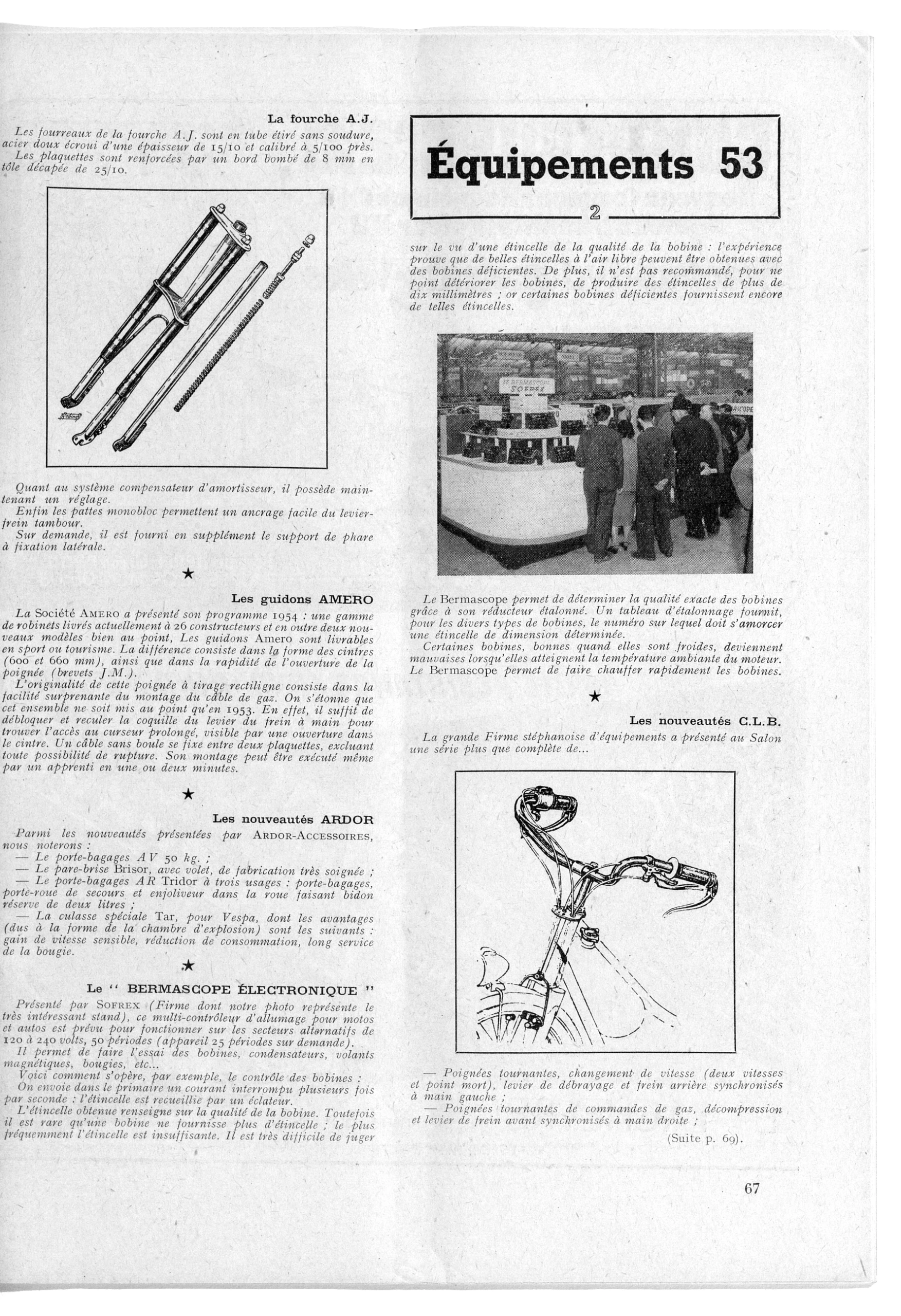
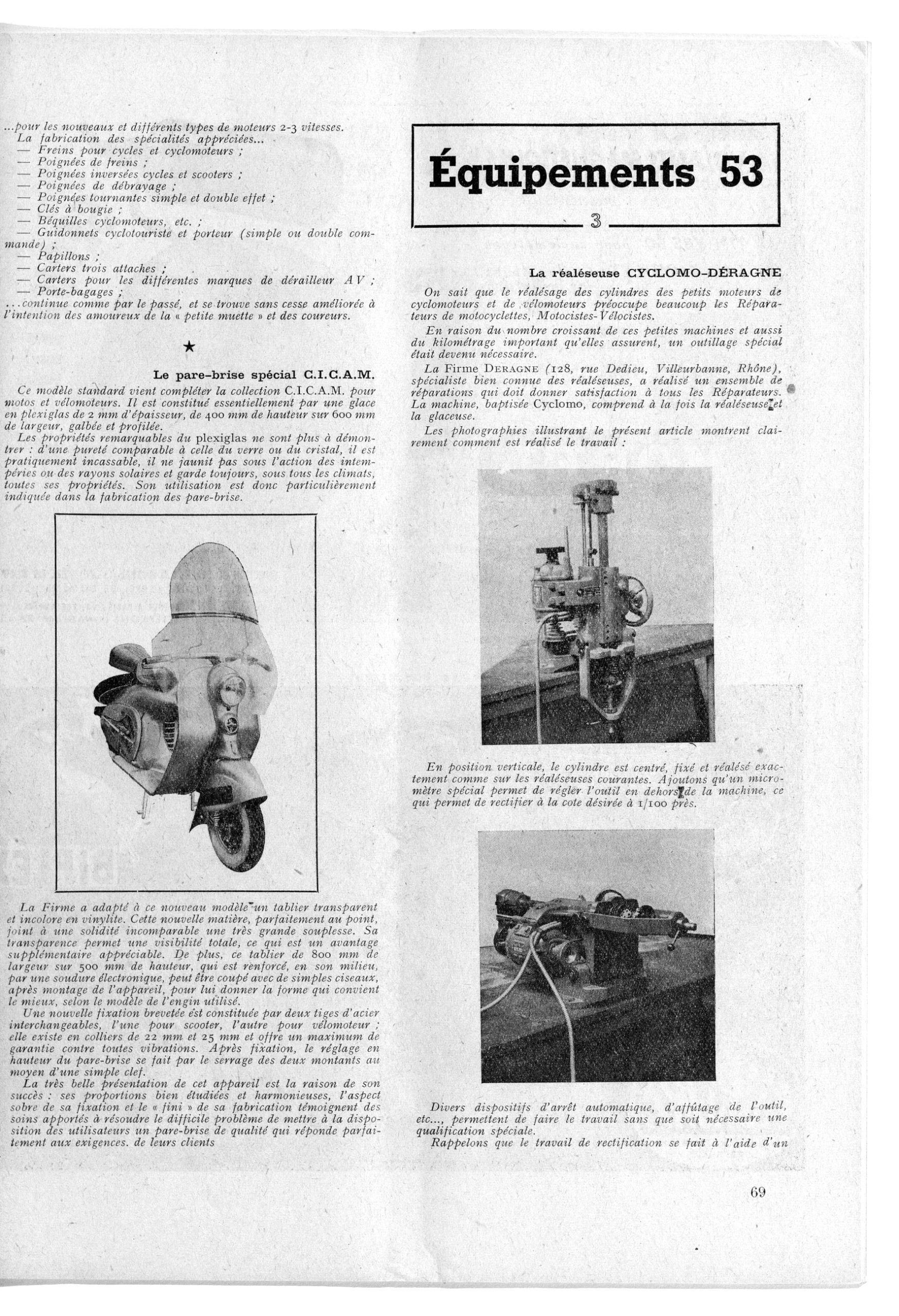
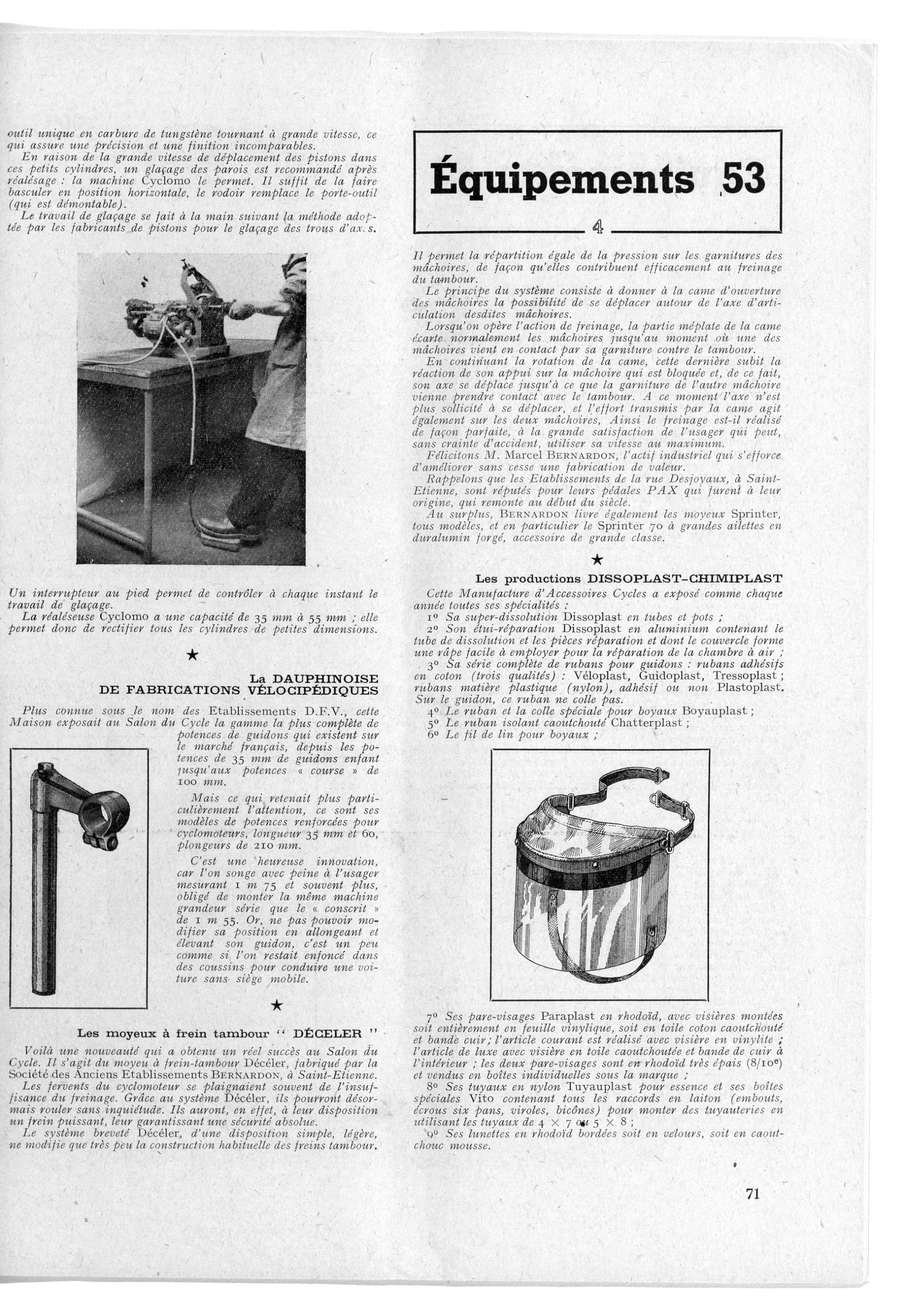
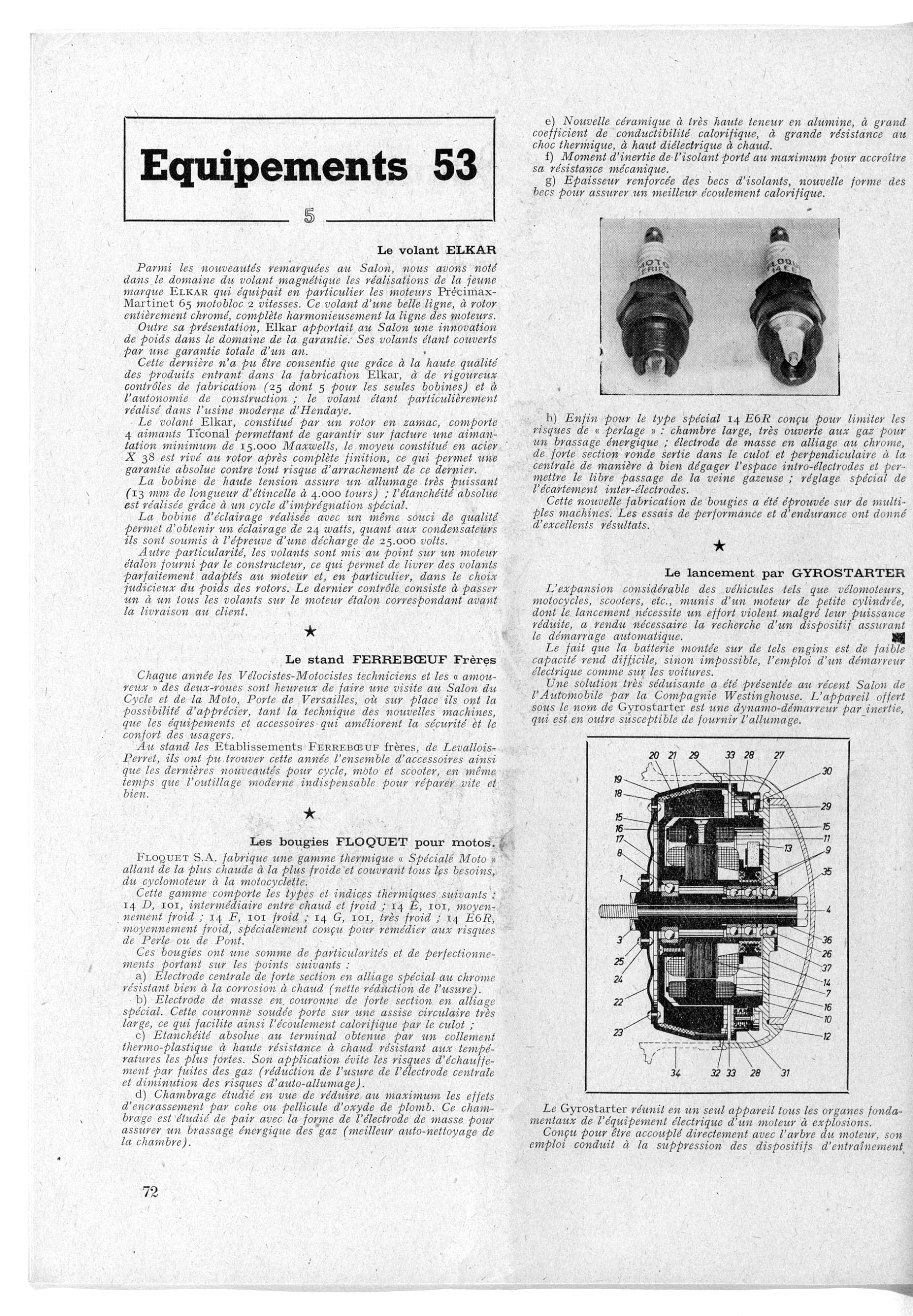
La fourche A.J. Les guidons AMERO Les nouveautés ARDOR Le « BERMASCOPE ÉLECTRONIQUE » Les nouveautés C.L.B. (Suite p. 69). 67 Le pare-brise spécial C.I.C.A.M. La réaléseuse CYCLOMO-DÉRAGNE 69 La DAUPHINOISE DE FABRICATIONS VÉLOCIPÉDIQUES Les moyeux à frein tambour « DÉCELER » Les productions DISSOPLAST-CHIMIPLAST 71 Le volant ELKAR Le stand FERREBŒUF Frères Les bougies …
This is a magazine article, so its running text is summarized here rather than reproduced; the headline, byline, specifications and scores are transcribed as printed.
From L’Officiel du cycle, du motocycle et du camping, 14 November 1953, the paper’s report number on the 1953 Paris Salon du Cycle et du Motocycle, pages 67, 69, 71, 72, 75, 77, 79, 81, 82, 85, 87 and 89: Gilbert Victor’s survey of the components and accessories shown at the Salon, firm by firm, from forks, brakes, saddles, lighting and luggage to the equipment of cyclomoteurs and scooters, with their drawings and photographs. The title, headings, captions and lists are transcribed as printed; the text is summarized in Ebykr’s words, and the page images carry it in full.
— Page 1 —
La fourche A.J.
[Ebykr summary; the article’s text is not reproduced. The fork tubes of the A.J. fork are seamless drawn tube in annealed (écroui) mild steel, 15/10 thick and calibrated to within 5/100. The dropouts (plaquettes) are reinforced by a rolled edge 8 mm wide in pickled sheet 25/10 thick. The shock-absorber compensating system now has an adjustment. The one-piece (monobloc) lugs allow easy anchoring of the drum-brake lever. A headlamp bracket with side fixing is supplied in addition on request.]
Les guidons AMERO
[Ebykr summary; the article’s text is not reproduced. The Société Amero presented its 1954 program: a range of taps (robinets) now delivered to 26 manufacturers, plus two new models described as well developed. Amero handlebars are available in sport or touring form; the difference lies in the shape of the bars (600 and 660 mm) and in how quickly the grip opens (J.M. patents). The originality of this straight-pull grip is the surprising ease of fitting the throttle cable, which the author finds it odd was only perfected in 1953: one unlocks and moves back the shell of the hand-brake lever to reach the extended slider, visible through an opening in the bar. A cable without a ball end is clamped between two plates, which rules out any breakage, and even an apprentice can fit it in one or two minutes.]
Les nouveautés ARDOR
[Ebykr summary; the article’s text is not reproduced. Among the novelties presented by Ardor-Accessoires the author notes: a front luggage carrier rated 50 kg; the Brisor windshield with flap, of very careful manufacture; the Tridor rear carrier with three uses (luggage carrier, spare-wheel carrier and a trim inside the wheel serving as a two-liter reserve can); and the special Tar cylinder head for the Vespa, whose advantages, due to the shape of the combustion chamber, are a noticeable gain in speed, lower consumption and long spark-plug life.]
Le « BERMASCOPE ÉLECTRONIQUE »
[Ebykr summary; the article’s text is not reproduced. Presented by Sofrex (whose stand is shown in the photograph), this ignition multi-tester for motorcycles and cars runs on alternating mains of 120 to 240 volts, 50 cycles (a 25-cycle apparatus on request). It tests coils, condensers, magneto flywheels, spark plugs and so on. Coil testing works by sending an interrupted current through the primary several times a second, the spark being collected by a spark gap. The spark reveals the quality of the coil; it is rare for a coil to give no spark at all, more often the spark is insufficient, and it is very difficult to judge a coil’s quality by the sight of a spark, since fine sparks in open air can come from defective coils. Coils should not be made to produce sparks longer than about ten millimeters, yet some defective coils still give such sparks.]
[Ebykr summary, continued from the photograph caption. The Bermascope determines the exact quality of coils thanks to its calibrated reducer; a calibration chart gives, for each type of coil, the number on which a spark of set size must strike. Some coils, good when cold, turn bad once they reach the ambient engine temperature, and the Bermascope can heat the coils quickly.]
Les nouveautés C.L.B.
[Ebykr summary; the article’s text is not reproduced. The large Saint-Étienne equipment firm presented at the Salon a more than complete series of… (the sentence breaks off beside the drawing and resumes on page 69). Under the drawing the author lists two sets of controls: rotating grips with gear change (two speeds and neutral), clutch lever and rear brake synchronized, on the left hand; and rotating throttle grips, decompression and front brake lever synchronized, on the right hand.]
(Suite p. 69).
67
[A full page of text in two columns set in italic roman with bold sans-serif roman side headings, under a ruled panel at the top right reading “Équipements 53” in heavy slab-serif capitals with a small outlined numeral 2 centered on its lower rule. At the upper left a ruled frame holds a line engraving of a fork exploded into its parts: two telescopic tubes with a spring, a plunger rod and a nut, drawn in fine hatching, with a signature in the lower left corner of the frame that reads “Rebour”. Beside the second column a halftone photograph shows a crowd of men in dark coats gathered round a curved white counter with display stock on it, under a sign that includes the word “SOFREX”. Lower in the second column a ruled frame holds a line drawing of a handlebar with two grips, cables, levers and a brake caliper at a fork and wheel. The page number 67 stands at the lower right. The top edge shows a pale strip of the book margin.]
— Page 2 —
[Ebykr summary, continuing the C.L.B. item from page 67; the article’s text is not reproduced. The series is “…pour les nouveaux et différents types de moteurs 2-3 vitesses”. The firm’s manufacture of appreciated specialties continues as in the past and is constantly improved for lovers of the “petite muette” (the quiet little moped) and for racers. The list printed reads: brakes for cycles and cyclomotors; brake grips; inverted grips for cycles and scooters; clutch grips; rotating grips, single and double effect; spark-plug wrenches; cyclomotor stands (béquilles), etc.; cyclotourist and carrier handlebars (single or double control); drop-bar “papillons”; three-fixing chain guards (carters); guards for the different makes of front derailleur (carters pour les différentes marques de dérailleur AV); luggage carriers.]
Le pare-brise spécial C.I.C.A.M.
[Ebykr summary; the article’s text is not reproduced. This standard model completes the C.I.C.A.M. collection for motorcycles and motor-assisted bicycles. It consists essentially of a Plexiglas pane 2 mm thick, 400 mm high by 600 mm wide, curved and profiled. The author says the remarkable properties of Plexiglas no longer need demonstrating: purity comparable to glass or crystal, practically unbreakable, no yellowing from weather or sunlight and all its properties kept in every climate, which makes it especially suited to windshields. The firm has adapted to this new model a transparent colorless apron in vinylite, a new material described as perfectly developed, of incomparable strength together with great suppleness, whose transparency gives total visibility. The apron measures 800 mm wide by 500 mm high, is reinforced in the middle by an electronic weld, and can be cut with simple scissors after fitting to suit the machine. A new patented fixing uses two interchangeable steel rods, one for scooters and one for motor-assisted bicycles; it exists for clamps of 22 mm and 25 mm and gives maximum security against vibration; after fixing, the windshield height is set by tightening the two uprights with a simple wrench. The author ascribes the success of the device to its handsome presentation, its harmonious proportions, its plain fixing and its finish.]
La réaléseuse CYCLOMO-DÉRAGNE
[Ebykr summary; the article’s text is not reproduced. The author notes that reboring the cylinders of small moped and motor-assisted bicycle engines greatly concerns motorcycle repairers (Motocistes-Vélocistes). Because of the growing number of these small machines and the high mileage they cover, special tooling had become necessary. The firm Déragne (128, rue Dedieu, Villeurbanne, Rhône), a well-known specialist in boring machines, has produced a set of equipment meant to satisfy all repairers. The machine, named Cyclomo, combines the reboring machine and the glazing (honing) machine. The photographs show how the work is done: in the vertical position the cylinder is centered, fixed and rebored exactly as on ordinary boring machines; a special micrometer allows the tool to be set outside the machine, so the bore can be ground to the desired size within 1/100. Various automatic stop and tool-sharpening devices allow the work to be done without special qualification. The text then recalls that the rectifying work is done with a single tungsten-carbide tool turning at high speed (the sentence runs over from the foot of this page), which the author says assures incomparable precision and finish.]
69
[A full page of text in two columns set in italic roman with bold sans-serif roman side headings, under a ruled panel at the top right reading “Équipements 53” in heavy slab-serif capitals with a small outlined numeral 3 centered on its lower rule. The first column opens with a bulleted list of dash-led lines, then a star ornament between items, and holds at its center a ruled frame with a halftone photograph of a scooter seen from the front with a curved clear windshield rising above its legshield, a round headlamp and a small badge on the front. The second column holds two halftone photographs, each with a caption set below: the upper shows a boring machine with a vertical spindle, a handwheel and a control box mounted over a bench, the lower shows a smaller machine with a clamped cylinder on a work table and a cord looping down. The page number 69 stands at the lower right. The right margin of the page shows a pale strip beside the edge.]
— Page 3 —
[Ebykr summary, continuing the Cyclomo-Déragne item from page 69; the article’s text is not reproduced. The rectifying work is done with a single tungsten-carbide tool turning at high speed, which assures incomparable precision and finish. Because pistons travel fast in these small cylinders, glazing of the walls is recommended after reboring, and the Cyclomo machine allows it: it is tipped to the horizontal position and the hone (rodoir) replaces the removable tool holder. The glazing is done by hand following the method used by piston makers for glazing the wrist-pin holes. A photograph caption states that a foot switch lets the operator control the glazing work at every moment. The Cyclomo boring machine has a capacity of 35 mm to 55 mm and so can rectify all small cylinders.]
La DAUPHINOISE
DE FABRICATIONS VÉLOCIPÉDIQUES
[Ebykr summary; the article’s text is not reproduced. Better known as the Établissements D.F.V., this house showed at the Salon du Cycle the most complete range of handlebar stems on the French market, from 35 mm stems for children’s handlebars up to 100 mm “course” (racing) stems. The feature that held attention most was its reinforced stems for cyclomotors, in lengths of 35 mm and 60, with a 210 mm plunger (quill). The author calls it a happy innovation, because it is hard to imagine a user 1 m 75 tall or more having to ride the same series-size machine as the “conscript” of 1 m 55; being unable to change his position by lengthening and raising his handlebar is, he says, rather like staying sunk in cushions to drive a car without an adjustable seat.]
Les moyeux à frein tambour « DÉCELER »
[Ebykr summary; the article’s text is not reproduced. A novelty that won real success at the Salon du Cycle: the Décéler drum-brake hub made by the Société des Anciens Établissements Bernardon of Saint-Étienne. Cyclomotor enthusiasts often complained of insufficient braking; with the Décéler system they can ride without worry, with a powerful brake giving absolute security. The patented system is simple and light and changes the usual construction of drum brakes very little. It allows equal distribution of pressure on the shoe linings so that they contribute effectively to braking of the drum. The principle is to give the shoe-opening cam the freedom to move about the pivot axis of the shoes themselves. When the brake is applied, the flat part of the cam spreads the shoes normally until one shoe’s lining touches the drum; as the cam keeps turning, it reacts against the blocked shoe and its axis moves until the other shoe’s lining also touches the drum; from then on the axis is no longer pushed to move and the force from the cam acts equally on both shoes. Braking is thus perfect, and the rider can use his speed to the full without fear of accident. The author congratulates M. Marcel Bernardon, an active industrialist who strives to improve a valuable product, and recalls that the Établissements of the rue Desjoyaux in Saint-Étienne are famed for their PAX pedals, which date from the origin of the firm at the start of the century. Bernardon also supplies Sprinter hubs in all models, in particular the Sprinter 70 with large flanges in forged duralumin, called a top-class accessory.]
Les productions DISSOPLAST-CHIMIPLAST
[Ebykr summary; the article’s text is not reproduced. This accessories manufacturer showed all its specialties as every year, numbered in the article: 1) its Dissoplast super-solution in tubes and pots; 2) its Dissoplast aluminum repair case holding the solution tube and the repair patches, whose lid forms a rasp for repairing the inner tube; 3) its complete series of handlebar tapes: adhesive cotton tapes in three qualities, Véloplast, Guidoplast and Tressoplast, and plastic (nylon) tapes, adhesive or not, Plastoplast, which on the handlebar does not stick; 4) tape and special glue for tubular tires, Boyauplast; 5) rubberized insulating tape, Chatterplast; 6) linen thread for tubulars; 7) its Paraplast face shields in Rhodoid, with visors mounted either wholly in vinyl sheet or in rubberized cotton cloth with a leather band; the standard article has a vinylite visor, the luxury article a rubberized cloth visor with a leather band inside; both shields are in very thick Rhodoid (8/10) and are sold in individual boxes under the brand; 8) its Tuyauplast nylon fuel pipes and its special Vito boxes holding all the brass fittings (nipples, hexagon nuts, ferrules, double cones) for making up piping from 4 x 7 or 5 x 8 pipe; 9) its Rhodoid goggles edged either in velvet or in foam rubber.]
71
[A full page of text in two columns set in italic roman with bold sans-serif roman side headings, under a ruled panel at the top right reading “Équipements 53” in heavy slab-serif capitals with a small outlined numeral 4 centered on its lower rule. In the left column a halftone photograph shows a machine on a table with a woman’s arm and apron beside it and a cord looping to the floor; further down a ruled frame holds a line engraving in fine hatching of a handlebar stem standing on its quill, set at the left with text wrapping to its right. In the right column, a ruled frame holds a line engraving of a face shield with a curved clear visor, a dark band and elastic straps with buckles. Star ornaments separate the items. The page number 71 stands at the lower right. No artist signature is visible.]
— Page 4 —
Le volant ELKAR
[Ebykr summary; the article’s text is not reproduced. Among the novelties noticed at the Salon, in the field of the flywheel magneto, the author names the work of the young Elkar make, which equipped in particular the Précimax-Martinet 65 two-speed motobloc engines. This handsome flywheel, with a fully chromed rotor, completes the line of the engines harmoniously. Besides its appearance, Elkar brought to the Salon a weighty innovation in warranty: its flywheels were covered by a total guarantee of one year. This was possible only through the high quality of the products entering Elkar manufacture, rigorous manufacturing checks (25, of which 5 for the coils alone) and the self-sufficiency of construction, the flywheel being made in the modern works at Hendaye. The Elkar flywheel has a zamac rotor holding 4 Ticonal magnets, which allow a minimum magnetization of 15.000 Maxwells to be guaranteed on invoice; the hub, in X 38 steel, is riveted to the rotor after complete finishing, which gives an absolute guarantee against the hub tearing out. The high-tension coil gives a very powerful ignition (13 mm of spark length at 4.000 rpm), with absolute sealing from a special impregnation cycle. The lighting coil, made with the same care over quality, gives 24 watts of lighting, and the condensers are tested with a discharge of 25.000 volts. The flywheels are also developed on a standard engine supplied by the manufacturer, which allows flywheels perfectly adapted to the engine to be delivered, notably through a judicious choice of rotor weight; the last check is to run every flywheel one by one on the matching standard engine before delivery to the customer.]
Le stand FERREBŒUF Frères
[Ebykr summary; the article’s text is not reproduced. Each year the technical Vélocistes-Motocistes and the “lovers” of two-wheelers enjoy visiting the Salon du Cycle et de la Moto at the Porte de Versailles, where they can judge both the technique of the new machines and the equipment and accessories that improve rider safety and comfort. At the stand the Établissements Ferrebœuf frères, of Levallois-Perret, offered this year the whole range of accessories and the latest novelties for cycle, motorcycle and scooter, together with the modern tooling needed to repair quickly and well.]
Les bougies FLOQUET pour motos.
[Ebykr summary; the article’s text is not reproduced. Floquet S.A. makes a “Spéciale Moto” heat range running from the hottest to the coldest, covering every need from cyclomotor to motorcycle. The range comprises these types and heat indexes: 14 D, 101, intermediate between hot and cold; 14 E, 101, moderately cold; 14 F, 101, cold; 14 G, 101, very cold; 14 E6R, moderately cold, specially designed against the risks of pearling (Perle) or bridging (Pont). The plugs have a number of features and refinements. a) A heavy-section center electrode in special chromium alloy that resists hot corrosion well (clear reduction in wear). b) A heavy-section ring ground electrode in special alloy; the welded ring sits on a very wide circular seat, which eases heat flow through the shell. c) Absolute sealing at the terminal by a thermoplastic cement of high heat resistance, which avoids overheating by gas leaks (less wear of the center electrode and less risk of pre-ignition). d) A chamber shape studied to reduce to the maximum the effects of fouling by coke or lead-oxide film, designed together with the shape of the ground electrode to give energetic stirring of the gases (better self-cleaning of the chamber). e) A new ceramic of very high alumina content, with a large coefficient of heat conductivity, great thermal-shock resistance and high dielectric strength when hot. f) Moment of inertia of the insulator raised to the maximum to increase its mechanical strength. g) Reinforced thickness of the insulator noses, with a new nose shape for better heat flow. h) Finally the special type 14 E6R, designed to limit the risks of “perlage”: a wide chamber, very open to the gases for energetic stirring; a ground electrode in chromium alloy, of heavy round section, set into the shell and perpendicular to the center electrode so as to clear the gap between electrodes and let the gas stream pass freely; and a special setting of the gap between electrodes. This new plug manufacture has been tried on many machines, and performance and endurance tests gave excellent results.]
Le lancement par GYROSTARTER
[Ebykr summary; the article’s text is not reproduced. The considerable growth of vehicles such as motor-assisted bicycles, motorcycles and scooters with small engines, which need a violent effort to start despite their low power, has made it necessary to look for a device giving automatic starting. The small battery on such machines makes an electric starter as on cars difficult, if not impossible. A very attractive solution was presented at the recent Salon de l’Automobile by the Compagnie Westinghouse: the apparatus offered under the name Gyrostarter is an inertia dynamo-starter that can also supply the ignition. The caption to the numbered section drawing states that the Gyrostarter brings together in one apparatus all the fundamental parts of the electrical equipment of an internal-combustion engine, and that, designed to be coupled directly to the engine shaft, its use does away with the drive devices (the sentence continues on the next page of the survey).]
72
[A full page of text in two columns set in italic roman with bold sans-serif roman side headings, under a ruled panel at the upper left reading “Equipements 53” in heavy slab-serif capitals with a small outlined numeral 5 centered on its lower rule; the page is a left-hand leaf, so the panel and the text block sit toward the right of the sheet and the binding margin is on the left. In the right column a halftone photograph shows two spark plugs side by side on a plain ground, the right one seen from its firing end, with partly legible lettering on the porcelains. Near the foot of the right column a ruled frame holds a technical line drawing of a cross-section through a round electrical machine with its housing, a shaft projecting at the left and some forty numbers with leader lines around the edge. The page number 72 stands at the lower left. No artist signature is visible.]
— Page 5 —
[Ebykr summary, continuing the Gyrostarter item from page 72; the article’s text is not reproduced. Direct coupling to the engine shaft means the drive devices of the parts it replaces disappear, which offers a simplification of construction. It also allows a battery of relatively small capacity, since the battery is not asked for the considerable effort of a conventional starter. The first Gyrostarter models built are meant for small-displacement engines; the elements of an assembly designed for a 500 cm3 engine were also shown at the Salon, and other models are under study for more powerful engines. The author says there is no limit to applying the principle and that constructions suited to the hardest demands can be imagined; the magazine promises to keep its readers informed of later applications of an apparatus that seems to offer many advantages.]
Les sacs et sacoches HENRY
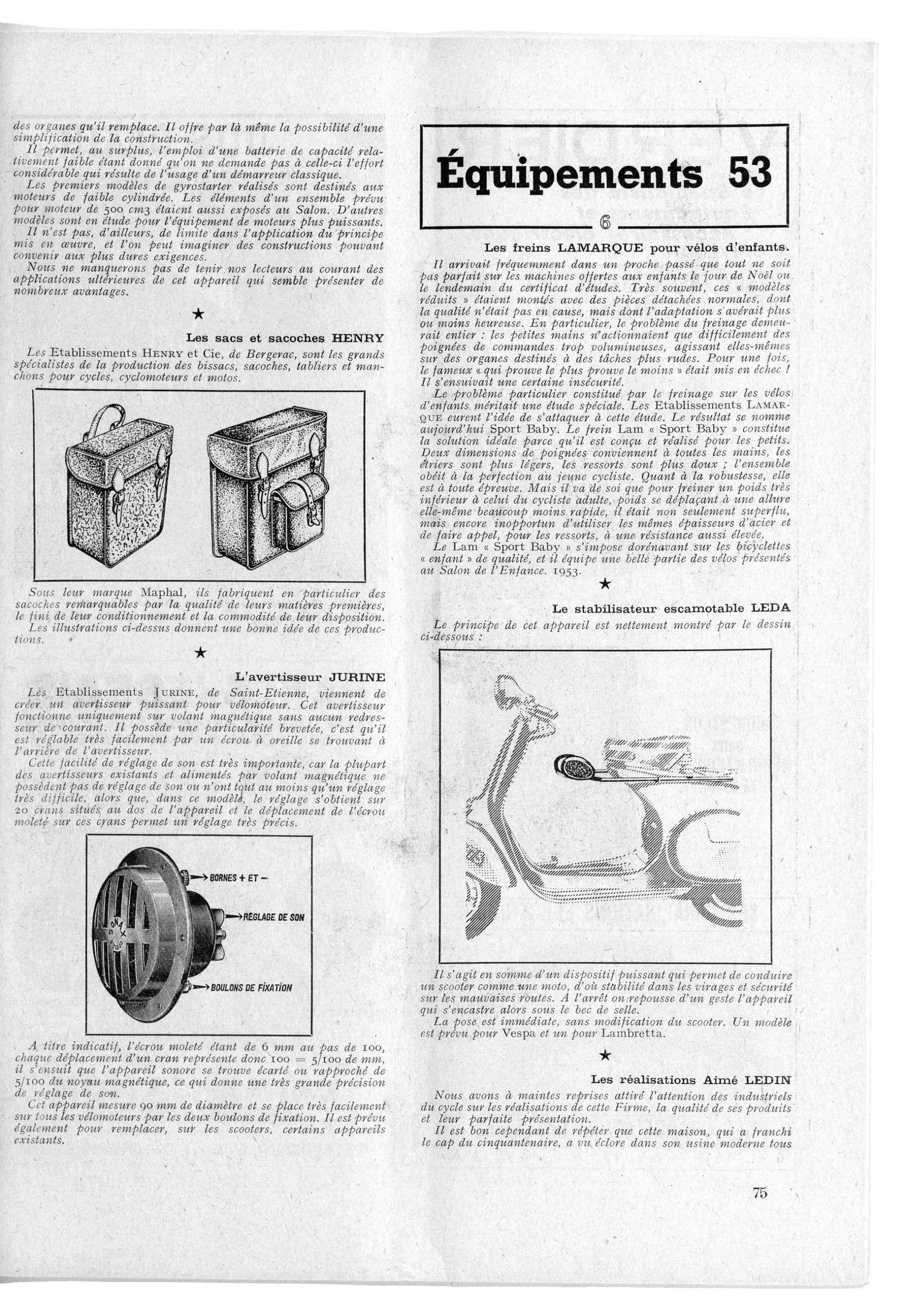
[Ebykr summary; the article’s text is not reproduced. The Établissements Henry et Cie, of Bergerac, are the great specialists in making haversacks (bissacs), saddlebags, aprons and muffs (manchons) for cycles, cyclomotors and motorcycles. Under their Maphal brand they make in particular saddlebags notable for the quality of their raw materials, the finish of their making up and the convenience of their layout; the illustrations above give a good idea of these products.]
L’avertisseur JURINE
[Ebykr summary; the article’s text is not reproduced. The Établissements Jurine, of Saint-Étienne, have just created a powerful horn for motor-assisted bicycles. It runs only on the magnetic flywheel, with no current rectifier. Its patented feature is that it is adjustable very easily by a wing nut at the rear of the horn. The author stresses that this ease of tone adjustment is very important, since most existing flywheel-powered horns have no tone adjustment or only a very difficult one, whereas in this model adjustment is made on 20 notches on the back of the apparatus, and moving the knurled nut along those notches gives a very precise setting. The drawing labels BORNES + ET -, RÉGLAGE DE SON and BOULONS DE FIXATION. As a guide, the knurled nut being 6 mm with a pitch of 100, each notch moved represents 100 = 5/100 of a mm, so the sounding device is moved away from or toward the magnetic core by 5/100, which gives very great precision of tone adjustment. The apparatus measures 90 mm in diameter and fits very easily on all motor-assisted bicycles by its two fixing bolts; it is also designed to replace certain existing horns on scooters.]
Les freins LAMARQUE pour vélos d’enfants.
[Ebykr summary; the article’s text is not reproduced. The author recalls that in the recent past things were often not perfect on the machines given to children on Christmas Day or the day after the school certificate: these “scale models” were very often built with ordinary parts whose quality was not in question but whose fit proved more or less happy. Braking in particular remained a problem: small hands could operate only with difficulty over-bulky control levers that themselves worked parts meant for harder tasks, so the saying “who proves the most proves the least” was for once defeated, with a certain insecurity as a result. The Établissements Lamarque had the idea of tackling this study, and the result is called Sport Baby. The Lam “Sport Baby” brake is described as the ideal solution because it is designed and made for the small: two sizes of lever fit all hands, the stirrups are lighter and the springs softer, and the whole obeys the young cyclist to perfection. As to strength, it is proof against anything, but since a weight far below the adult cyclist’s, moving at a much slower speed, has to be braked, it was not only superfluous but unsuitable to use the same thicknesses of steel and the same high spring strength. The Lam “Sport Baby” is now becoming standard on quality children’s bicycles and equips a good share of the cycles shown at the Salon de l’Enfance, 1953.]
Le stabilisateur escamotable LEDA
[Ebykr summary; the article’s text is not reproduced. The principle of the device is plainly shown by the drawing: it is in effect a powerful device that lets a scooter be ridden like a motorcycle, giving stability in bends and security on bad roads. At a stop the rider pushes the apparatus back with one movement and it tucks away under the saddle nose. Fitting is immediate, with no modification of the scooter; one model is made for the Vespa and one for the Lambretta.]
Les réalisations Aimé LEDIN
[Ebykr summary; the article’s text is not reproduced. The author says the magazine has repeatedly drawn cycle manufacturers’ attention to this firm’s work, the quality of its products and their perfect presentation. It is worth repeating, however, that this house, which has passed its fiftieth year, has seen born in its modern works all the models of pedals and freewheels (the author writes “deroues libres”) that enjoy the customer’s favor. All customers who wished to visit the organization expressed admiration, above all for a bright nickel-chrome plating installation described as the latest word in modern technique; the author affirms that corrosion protection is achieved in the best conditions and can stand comparison with world-class articles. By putting its experience and means at its clients’ disposal, the firm, he says, renders French industry a notable service in spreading French articles for export.]
75
[A full page of text in two columns set in italic roman with bold sans-serif roman side headings, under a ruled panel at the top right reading “Équipements 53” in heavy slab-serif capitals with a small outlined numeral 6 centered on its lower rule. In the left column a ruled frame holds a line engraving of two leather satchels drawn in fine stipple and hatching, the left one with a carrying strap and two buckles, the right one with a front pocket and a buckled flap. Below, a second ruled frame holds a line engraving of a round horn viewed from its grille side with three labeled leader arrows in condensed sans-serif capitals, the grille bearing a small roundel marked with letters. In the right column a ruled frame holds a line drawing in coarse diagonal hatching of the rear of a scooter and its rider’s leg with a folding stabilizer arm and a small wheel extended. A star ornament separates each item. The page number 75 stands at the lower right. No artist signature is visible.]
— Page 6 —
Les équipements LUXOR
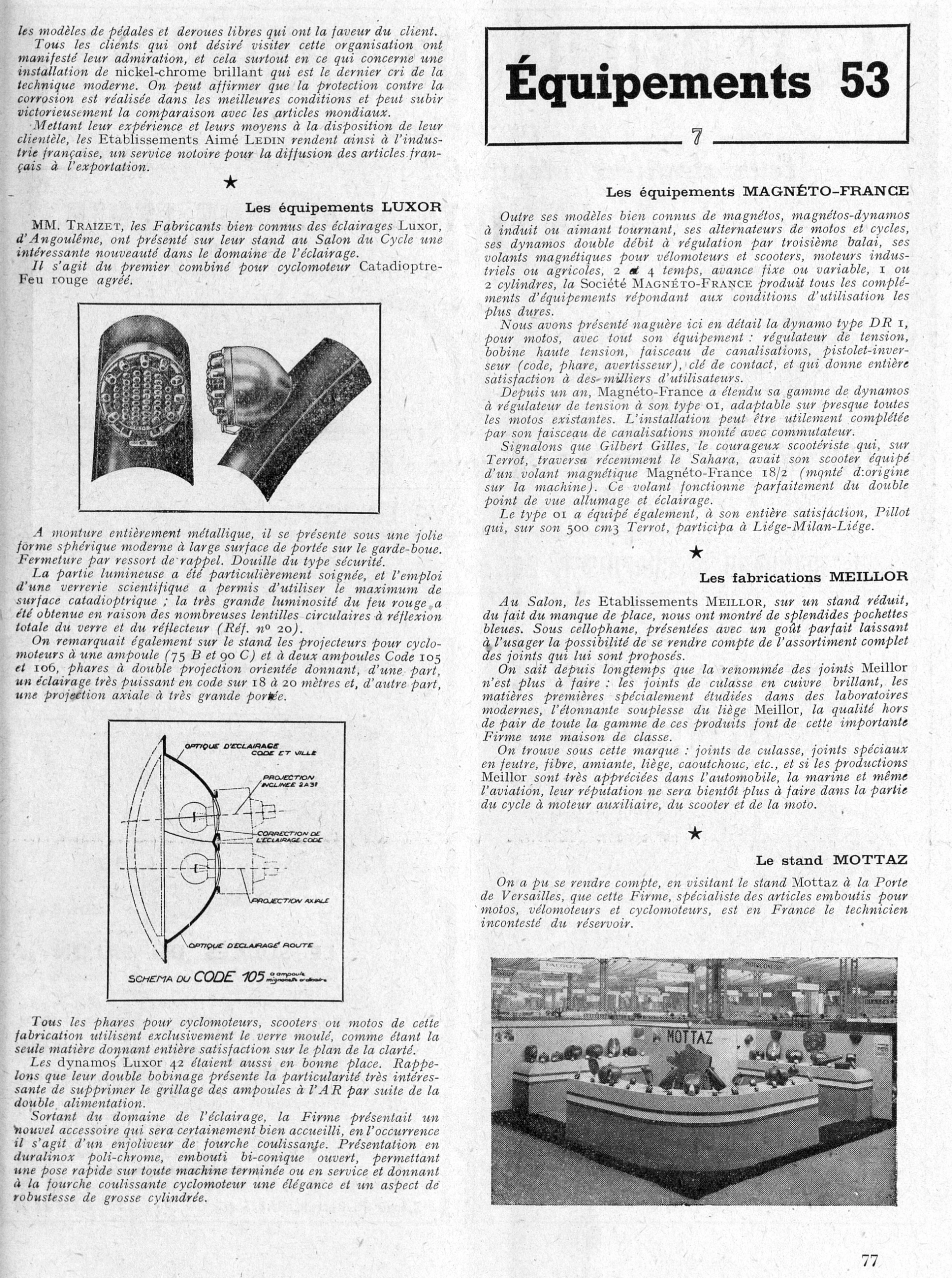
[Ebykr summary; the article’s text is not reproduced. MM. Traizet, the well-known makers of Luxor lighting, of Angoulême, showed on their stand at the Salon du Cycle an interesting novelty in lighting: the first approved combined reflector-and-red-light unit (Catadioptre-Feu rouge agréé) for cyclomotors. With an all-metal mounting, it has a handsome modern spherical shape with a wide bearing surface on the mudguard, closing by return spring, and a safety-type socket. The lit part has been particularly cared for, and the use of scientific glassware allowed the maximum catadioptric surface; the very great brightness of the red light comes from the numerous circular total-reflection lenses in the glass and the reflector (Réf. no 20). The stand also showed single-bulb cyclomotor headlamps (75 B and 90 C) and two-bulb headlamps Code 105 and 106, double oriented-projection lamps that give on the one hand very powerful dipped (code) lighting out to 18 to 20 meters and on the other a very long-range axial projection. The diagram, labeled “Schéma du Code 105 à ampoule mignonnette ordinaire”, marks the lighting optic for code and town, inclined projection 2A31, code lighting correction, axial projection and road-lighting optic. All headlamps of this make for cyclomotors, scooters or motorcycles use only molded glass, as the sole material giving full satisfaction as to clarity. The Luxor 42 dynamos were also well placed; the author recalls that their double winding has the very interesting feature of removing the need for bulb screening at the rear thanks to the double supply. Leaving lighting, the firm showed a new accessory certain to be well received: a trim for the sliding (telescopic) fork, in polished chrome Duralinox, an open bi-conical pressing that fits quickly on any finished or in-service machine and gives the cyclomotor sliding fork an elegance and the look of sturdiness of a large-displacement machine.]
Les équipements MAGNÉTO-FRANCE
[Ebykr summary; the article’s text is not reproduced. Besides its well-known models of magnetos and magneto-dynamos with rotating armature or magnet, its motorcycle and cycle alternators, its double-output dynamos with regulation by a third brush and its flywheel magnetos for motor-assisted bicycles and scooters, industrial or agricultural engines, 2 and 4 stroke, fixed or variable advance, 1 or 2 cylinders, the Société Magnéto-France produces all the equipment complements meeting the hardest conditions of use. The author recalls that the magazine recently presented in detail the DR 1 dynamo for motorcycles with its whole equipment: voltage regulator, high-tension coil, wiring harness, pistol-grip switch (dipped beam, headlamp, horn) and ignition key, which gives full satisfaction to thousands of users. For a year Magnéto-France has extended its range of voltage-regulator dynamos with its type 01, fitting almost all existing motorcycles, and the installation can usefully be completed by its wiring harness with switch. Gilbert Gilles, the courageous scooter rider who recently crossed the Sahara on a Terrot, had his scooter fitted with a Magnéto-France 18/2 flywheel magneto (original equipment), which worked perfectly for both ignition and lighting. The type 01 also equipped, to his full satisfaction, Pillot, who took part in Liège-Milan-Liège on his 500 cm3 Terrot.]
Les fabrications MEILLOR
[Ebykr summary; the article’s text is not reproduced. At the Salon the Établissements Meillor, on a reduced stand for lack of space, showed splendid blue pouches under cellophane, presented in perfect taste so the user can see the complete assortment of gaskets offered. The renown of Meillor gaskets, the author says, no longer needs making: bright copper cylinder-head gaskets, raw materials specially studied in modern laboratories, the astonishing suppleness of Meillor cork and the outstanding quality of the whole range make this important firm a house of class. Under the brand one finds cylinder-head gaskets and special gaskets in felt, fiber, asbestos, cork, rubber and so on; and if Meillor products are much appreciated in the automobile, marine and even aviation fields, their reputation will soon be established too in motor-assisted cycles, scooters and motorcycles.]
Le stand MOTTAZ
[Ebykr summary; the article’s text is not reproduced. Visiting the Mottaz stand at the Porte de Versailles showed that this firm, a specialist in pressed (stamped) articles for motorcycles, motor-assisted bicycles and cyclomotors, is in France the undisputed technician of the fuel tank.]
77
[A full page of text in two columns set in italic roman with bold sans-serif roman side headings, under a ruled panel at the top of the right column reading “Équipements 53” in heavy slab-serif capitals with a small outlined numeral 7 centered on its lower rule. In the left column a ruled frame holds a halftone photograph of a rear light and a headlamp, the light shown as a round lens set with small circular lenses in a ring on a curved mudguard, beside a lamp with a ribbed rim mounted on a wheel rim; below it another ruled frame holds a technical line diagram of a headlamp in section, with labels in slanted sans-serif capitals on leader lines and a caption beneath reading “Schéma du Code 105”. In the right column a wide halftone photograph shows a display counter in a hall, with a sign reading “MOTTAZ” above rows of tanks and lamps set out on the counter. Star ornaments separate the items. The page number 77 stands at the lower right. No artist signature is visible.]
— Page 7 —
Équipements 53
[Ebykr summary; the article’s text is not reproduced. The opening lines continue a firm’s entry begun on the preceding page, whose heading is not on this leaf. The firm makes, exclusively for wholesalers and constructors, every type of tank in shape and capacity, from the three-liter saddle or frame tank for the cyclo up to the largest models for motorcycles; the accompanying photograph, the author says, gives a fine view of the varieties of this manufacture. The firm also produces expanding tank caps and claims 40 years of experience in its branch.]
La remorque monoroue MOUGNARD
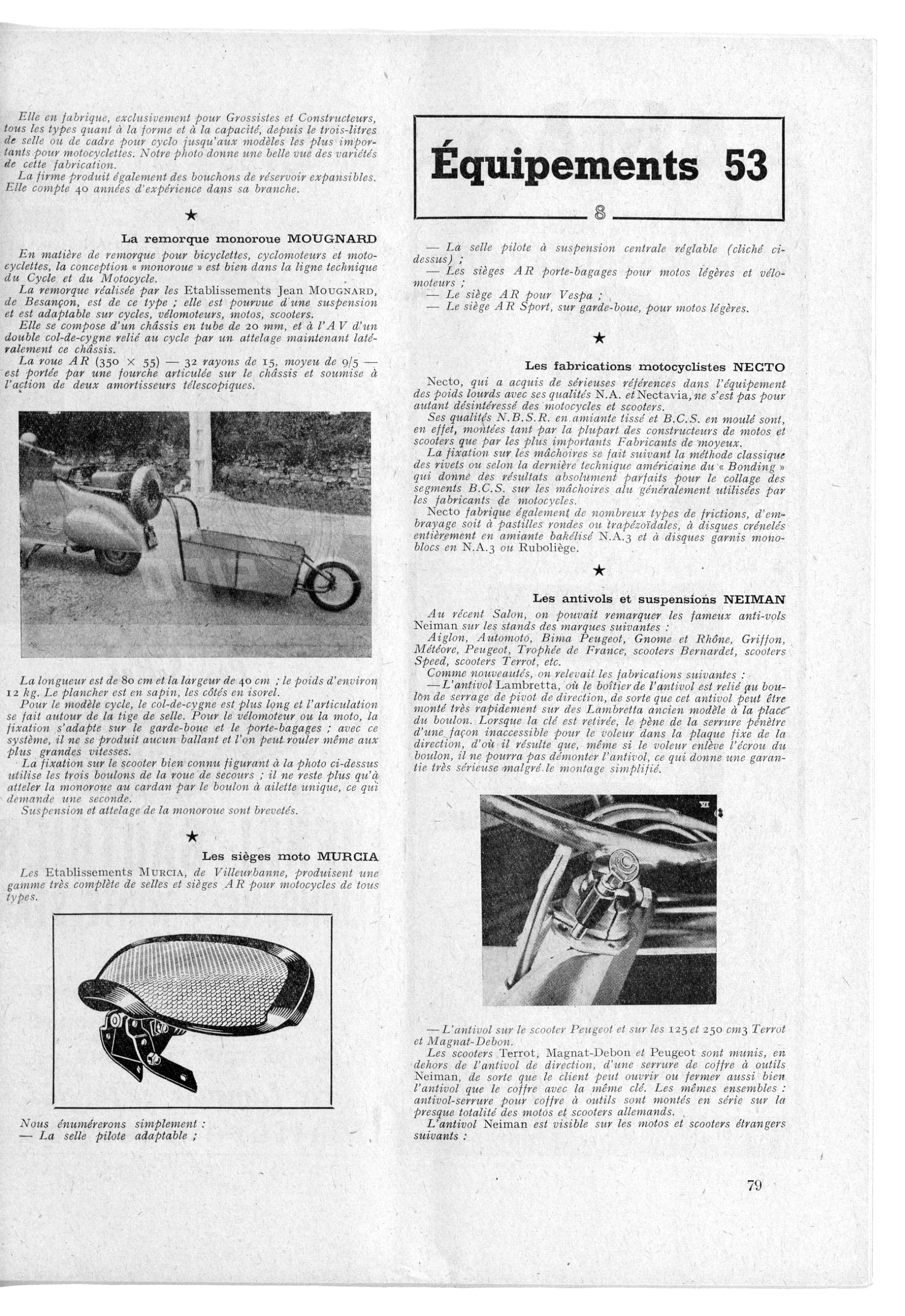
[Ebykr summary; the article’s text is not reproduced. The author holds that the single-wheel concept is well in line with the technical bent of cycle and motorcycle practice for trailers behind bicycles, cyclomoteurs and motorcycles. The trailer made by the Etablissements Jean Mougnard of Besançon is of this type; it has a suspension and fits cycles, vélomoteurs, motos and scooters. It consists of a chassis of 20 mm tube and, at the front, a double gooseneck joined to the cycle by a hitch that holds the chassis laterally. The rear wheel (350 x 55, 32 spokes of 15, hub of 9/5) is carried by a fork hinged on the chassis and subject to the action of two telescopic shock absorbers. The trailer is 80 cm long and 40 cm wide and weighs about 12 kg; the floor is fir and the sides are Isorel. For the cycle model the gooseneck is longer and the hinge works around the seat tube; for the vélomoteur or moto the fixing fits onto the mudguard and the luggage rack, and with this system there is no sway and one may ride even at the highest speeds. On the well-known scooter shown in the photograph the fixing uses the three bolts of the spare wheel, leaving only the single wing bolt to couple the monowheel to the cardan, which takes one second. The suspension and the hitch of the monowheel are patented.]
Les sièges moto MURCIA
[Ebykr summary; the article’s text is not reproduced. The Etablissements Murcia of Villeurbanne produce a very complete range of saddles and rear seats for motorcycles of all types. The author says he will simply list: the adaptable pilot saddle; the pilot saddle with adjustable central suspension (cliché above); the rear luggage-carrier seats for light motorcycles and vélomoteurs; the rear seat for Vespa; and the Sport rear seat, mounted on the mudguard, for light motorcycles.]
Les fabrications motocyclistes NECTO
[Ebykr summary; the article’s text is not reproduced. Necto, which has earned serious references in heavy-vehicle equipment with its N.A. and Nectavia qualities, has not for that reason lost interest in motorcycles and scooters. Its N.B.S.R. quality in woven asbestos and its B.C.S. in molded form are fitted both by most motorcycle and scooter constructors and by the most important hub makers. Fixing to the shoes is done by the classic method of rivets or by the latest American technique of “Bonding”, which gives absolutely perfect results for gluing the B.C.S. segments onto the aluminum shoes generally used by motorcycle makers. Necto also makes many types of friction linings and clutch parts, with round or trapezoidal pellets, with crenelated discs entirely of bakelized asbestos N.A.3, and with discs lined with single blocks in N.A.3 or Ruboliège.]
Les antivols et suspensions NEIMAN
[Ebykr summary; the article’s text is not reproduced. At the recent Salon the famous Neiman antitheft locks could be seen on the stands of these makes: Aiglon, Automoto, Bima Peugeot, Gnome et Rhône, Griffon, Météore, Peugeot, Trophée de France, Bernardet scooters, Speed scooters, Terrot scooters, etc. As novelties the author notes the Lambretta antivol, where the lock housing is joined to the steering-pivot clamp bolt, so that it can be fitted very quickly on old-model Lambrettas in place of the bolt; when the key is withdrawn the lock bolt enters the fixed plate of the steering in a way the thief cannot reach, so that even if he removes the nut from the bolt he cannot dismount the antivol, which gives a very serious guarantee in spite of the simplified fitting. Also noted is the antivol on the Peugeot scooter and on the 125 and 250 cm3 Terrot and Magnat-Debon. The Terrot, Magnat-Debon and Peugeot scooters carry, besides the steering antivol, a Neiman lock for the tool chest, so that the customer can open or close both the antivol and the chest with the same key; the same antivol and tool-chest lock sets are fitted as standard on almost all German motorcycles and scooters. The Neiman antivol is also visible on the foreign motorcycles and scooters that follow; the list is printed at the head of the next surveyed page.]
[A full page of text in two columns with three illustrations and a boxed running head. The head, a ruled box across the right column, reads “Équipements 53” in heavy slab-serif capitals and lowercase with a small ornamental numeral 8 set in the lower rule. Text is set in italic roman type with firm names in upright type, and each firm heading is a bold sans-serif line set flush right above its paragraphs; short star ornaments divide the entries. In the left column a halftone photograph spans the width and shows a small scooter with its spare wheel at the back and a one-wheeled box trailer attached behind it on pavement, with trees in the background. Below it a boxed line engraving shows a motorcycle saddle with a woven leather-like top, a studded rim and a bracketed steel mounting plate. In the right column a halftone photograph shows a close view of a steering lock fitted at the head of a scooter fork, with the metal key barrel in the center. Captions run beneath the photographs. The page number 79 stands at the foot. No artist signature is visible. The top of the page begins in the middle of a firm entry whose heading is on the previous leaf.]
— Page 8 —
Équipements 53
[Ebykr summary; the article’s text is not reproduced. The opening list continues the Neiman antivol entry from the preceding page. The antivol is seen on these foreign motorcycles and scooters, given verbatim as printed:]
Anker, Ardie, Bastert, B.M.W., Bücker, D.K.W., Dürkopp, Express, F.N., Geïer, Gillet (Belgique), Glas, Goricke, Hecker, Heinkel, Hercules, Horex, Hummel, Iso (Italie), Jyden (Danemark), Koehler, Kob, Lambretta (N.S.U.), Lutz, Maïco, Nellemann (Danemark), N.S.U., Pamag, Petersen (Danemark), Rabeneik, Rixe, Royal, Standard (Allemagne), Standard (Suisse), Steib (sidecars), Tornax, Torpédo, Triumph (T.W.N.), U.T., Victoria, Walba, Zündapp, etc.
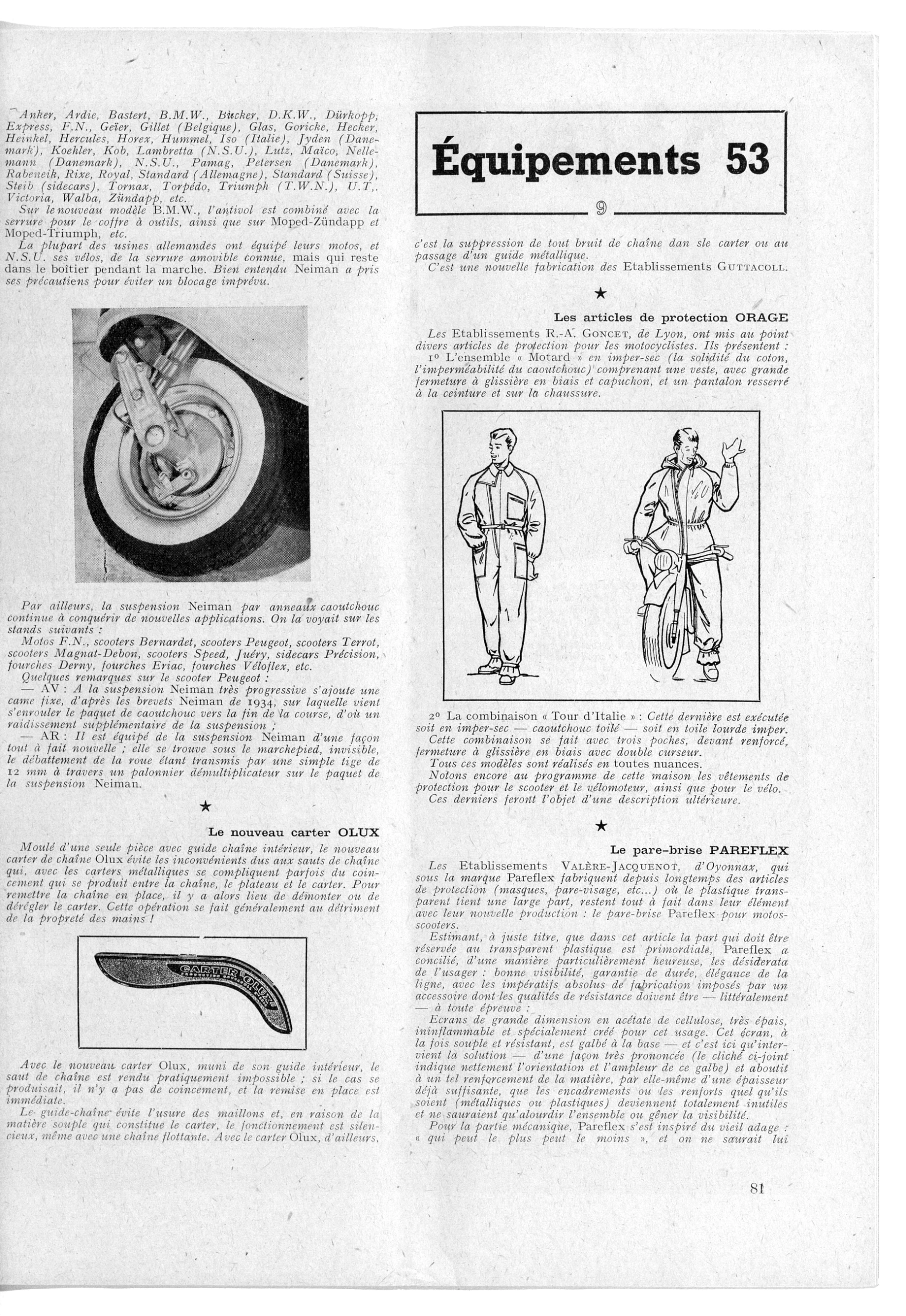
[Ebykr summary; the article’s text is not reproduced. On the new B.M.W. model the antivol is combined with the lock for the tool chest, as on the Moped-Zündapp and Moped-Triumph. Most German factories have equipped their motorcycles, and N.S.U. its bicycles, with the known removable lock, which however stays in its housing while riding; Neiman has naturally taken precautions against any unforeseen locking. The author then says that the Neiman rubber-ring suspension continues to win new applications, and it was seen on these stands, verbatim:]
Motos F.N., scooters Bernardet, scooters Peugeot, scooters Terrot, scooters Magnat-Debon, scooters Speed, Juéry, sidecars Précision, fourches Derny, fourches Eriac, fourches Véloflex, etc.
[Ebykr summary; remarks on the Peugeot scooter. Front: to the very progressive Neiman suspension is added a fixed cam, according to the Neiman patents of 1934, on which the rubber pack winds toward the end of the travel, giving an extra stiffening of the suspension. Rear: it is fitted with the Neiman suspension in an entirely new way; it sits under the footboard, invisible, the wheel movement being transmitted by a simple 12 mm rod through a reducing lever onto the Neiman suspension pack.]
Le nouveau carter OLUX
[Ebykr summary; the article’s text is not reproduced. Molded in a single piece with an internal chain guide, the new Olux chain case avoids the drawbacks of chain jumps, which with metal cases sometimes lead to jamming between chain, chainwheel and case; putting the chain back then means taking down or misadjusting the case, usually at the expense of clean hands. With the new Olux case and its inner guide the chain jump is made practically impossible; should it happen there is no jamming and the refit is immediate. The chain guide prevents wear of the links and, because of the supple material of the case, running is silent even with a floating chain. With the Olux case, moreover, the chief gain (the text carries on in the right column) is the suppression of all chain noise in the case or at the passing of a metal guide. It is a new product of the Etablissements Guttacoll.]
Les articles de protection ORAGE
[Ebykr summary; the article’s text is not reproduced. The Etablissements R.-A. Goncet of Lyon have perfected various protective articles for motorcyclists. They present: 1° the “Motard” set in imper-sec (the strength of cotton, the waterproofness of rubber), comprising a jacket with a large slanting zip fastener and a hood, and trousers gathered at the waist and at the shoe; 2° the “Tour d’Italie” overall, made either in imper-sec (rubberized cloth) or in heavy waterproof canvas, with three pockets, a reinforced front and a slanting zip fastener with double slider. All these models are made in all shades. The author adds that the firm’s program includes protective clothing for the scooter and the vélomoteur as well as for the bicycle, which will be described later.]
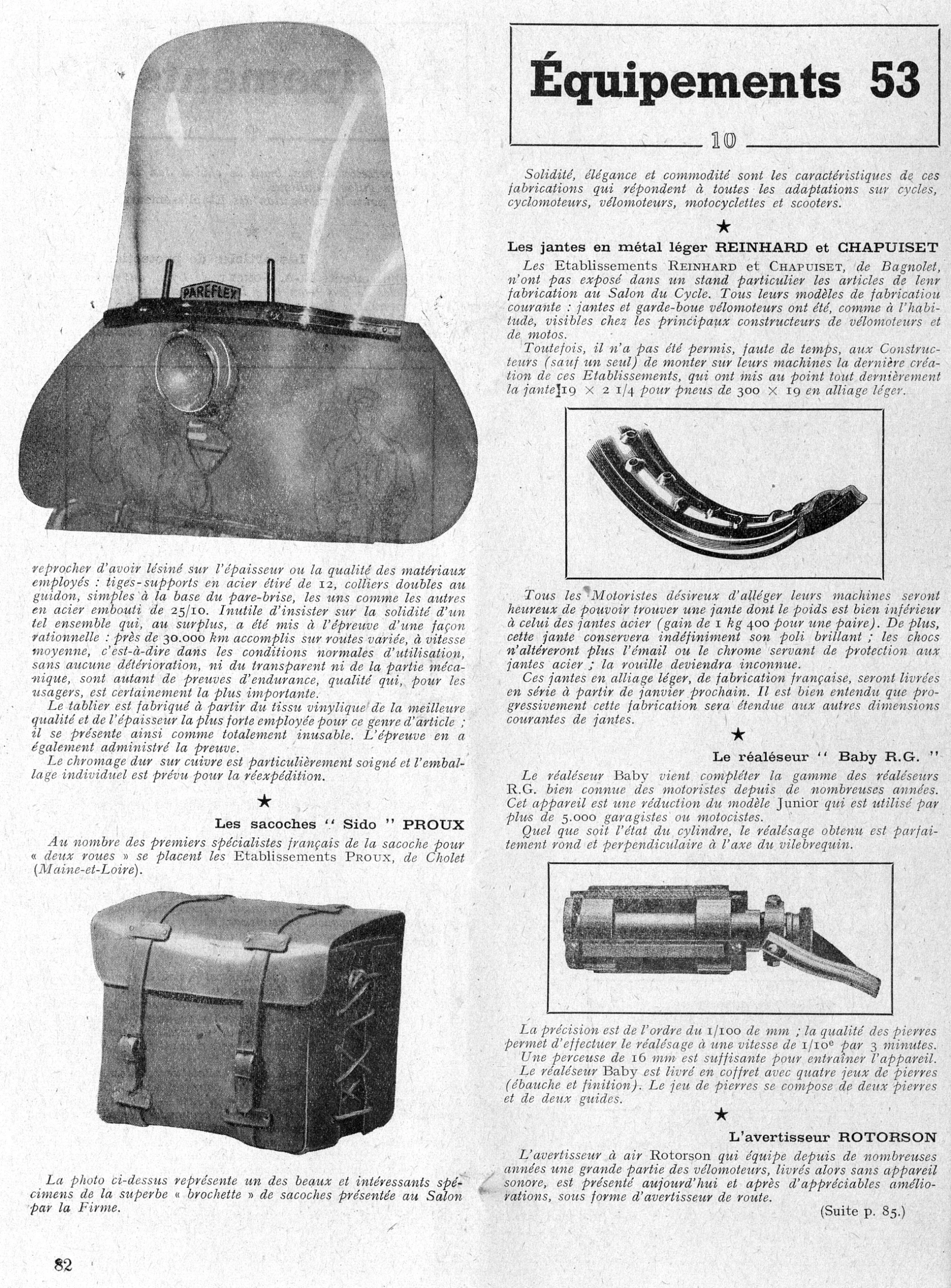
Le pare-brise PAREFLEX
[Ebykr summary; the article’s text is not reproduced. The Etablissements Valère-Jacquenot of Oyonnax, who make under the Pareflex mark protective articles (masks, face shields, etc.) in which transparent plastic plays a large part, are fully in their element with their new product, the Pareflex windshield for motorcycles and scooters. Judging that the transparent plastic must be the essential part of such an article, Pareflex has reconciled the user’s wishes (good visibility, guaranteed durability, elegance of line) with the absolute manufacturing demands of an accessory whose resistance must literally be proof against all trials. The screens are large, in very thick non-flammable cellulose acetate created for the purpose; the screen, both supple and strong, is bellied at the base, strongly so (the accompanying cliché shows the direction and extent of the curve), and this stiffens the material, itself already thick enough, so much that frames or reinforcements of any kind, metal or plastic, become wholly useless and would only weigh down the assembly or hinder visibility. For the mechanical part Pareflex followed the old adage “qui peut le plus peut le moins”; the text breaks off at the foot of the page (the entry carries over).]
[A full page of text in two columns with three illustrations and a boxed running head. The head, a ruled box across the right column, reads “Équipements 53” in heavy slab-serif type with a small ornamental numeral 9 set in the lower rule. Text is in italic roman type with firm names in upright type, each firm heading a bold sans-serif line set flush right, and star ornaments between entries. In the left column a halftone photograph shows a close view of a lock fitted at a scooter wheel with a tire around the rim. Lower in the left column a ruled box holds a line engraving of a curved, one-piece chain case with the words “CARTER OLUX” and a small line of lettering printed on its stippled surface. In the right column a ruled box holds a line drawing of two men in work garments: at left a standing man in a belted one-piece overall with chest and thigh pockets, looking aside with a hand in a pocket; at right a man in a hooded zip jacket and gathered trousers standing beside a small motorcycle with a round headlamp, raising one hand in greeting. The page number 81 stands at the foot. No artist signature is visible. The text breaks off at the foot of both columns.]
— Page 9 —
Équipements 53
[Ebykr summary, continuing the Pareflex windshield entry begun on the preceding page; the article’s text is not reproduced. On the mechanical side Pareflex has not skimped on the thickness or quality of the materials: support rods in drawn steel of 12 (mm), double clamps at the handlebar and single clamps at the base of the windshield, both in pressed steel of 25/10. The author sees no need to insist on the strength of such an assembly, which was moreover tested rationally: nearly 30,000 km covered on varied roads at average speed, that is under normal conditions of use, with no deterioration of either the transparent screen or the mechanical part, which he calls proof of endurance, the quality most important to users. The apron is made from the best-quality vinyl fabric in the heaviest thickness used for this kind of article and is presented as totally unwearable, as the test has also shown. The hard chrome plating on copper is particularly careful and individual packing is provided for reshipment.]
Les sacoches “Sido” PROUX
[Ebykr summary; the article’s text is not reproduced. The Etablissements Proux of Cholet (Maine-et-Loire) rank among the first French specialists in the bag for “deux roues”. The caption says the photograph shows one of the fine and interesting specimens of the superb “brochette” of bags the firm presented at the Salon. The following paragraph, set at the head of the right column, says that solidity, elegance and convenience are the characteristics of these products, which answer every adaptation on cycles, cyclomoteurs, vélomoteurs, motocyclettes and scooters.]
Les jantes en métal léger REINHARD et CHAPUISET
[Ebykr summary; the article’s text is not reproduced. The Etablissements Reinhard et Chapuiset of Bagnolet did not show their products on a stand of their own at the Salon du Cycle. All their regular models, rims and vélomoteur mudguards, were visible as usual at the principal makers of vélomoteurs and motorcycles. For lack of time, however, the constructors (except one) could not fit their machines with the firm’s latest creation, the light-alloy rim 19 x 2 1/4 for 300 x 19 tires, which the firm has just perfected. The caption states that all motorists wishing to lighten their machines will be glad to find a rim much lighter than the steel rim (a saving of 1 kg 400 for a pair); the rim will keep its bright polish indefinitely, knocks will no longer damage the enamel or chrome that protects steel rims, and rust will become unknown. These French-made light-alloy rims will be delivered in series from next January, and the manufacture will be extended progressively to the other usual rim sizes.]
Le réaléseur “Baby R.G.”
[Ebykr summary; the article’s text is not reproduced. The Baby reboring tool completes the R.G. range of reborers, long well known to motorists. It is a reduction of the Junior model, used by more than 5,000 garagistes or motorcycle dealers. Whatever the state of the cylinder, the rebore obtained is perfectly round and perpendicular to the crankshaft axis. Precision is of the order of 1/100 mm; the quality of the stones allows reboring at a rate of 1/10 (mm) per 3 minutes. A 16 mm drill is enough to drive the tool. The Baby reborer is supplied in a case with four sets of stones (roughing and finishing); a set is made up of two stones and two guides.]
L’avertisseur ROTORSON
[Ebykr summary; the article’s text is not reproduced. The Rotorson air horn, which for many years has equipped a large part of the vélomoteurs, then delivered without any sound device, is presented today, after appreciable improvements, in the form of a road warning horn.]
(Suite p. 85.)
[A full page of text in two columns with five illustrations and a boxed running head. The head, a ruled box across the right column, reads “Équipements 53” in heavy slab-serif type with a small ornamental numeral 10 set in the lower rule. Text is in italic roman type with firm names in upright type, each firm heading a bold sans-serif line set flush right, and star ornaments between entries. In the left column a large halftone photograph at the top shows a tall, clear curved windshield with a metal base bar and two upright rods, a small plate lettered “PAREFLEX” at the center, mounted above a rounded headlamp housing. Below the text a halftone photograph shows a soft-sided luggage bag with a flap, two straps with buckles and lacing down the visible end. In the right column a ruled box holds a line engraving of a curved section of light-alloy rim with spoke holes and ribbing, cut off at one end. Lower down a ruled box holds a halftone photograph of a cylindrical boring tool with a bent handle lever at one side. The page number 82 stands at the foot of the left column. No artist signature is visible. The “(Suite p. 85.)” line closes the last entry.]
— Page 10 —
Équipements 53
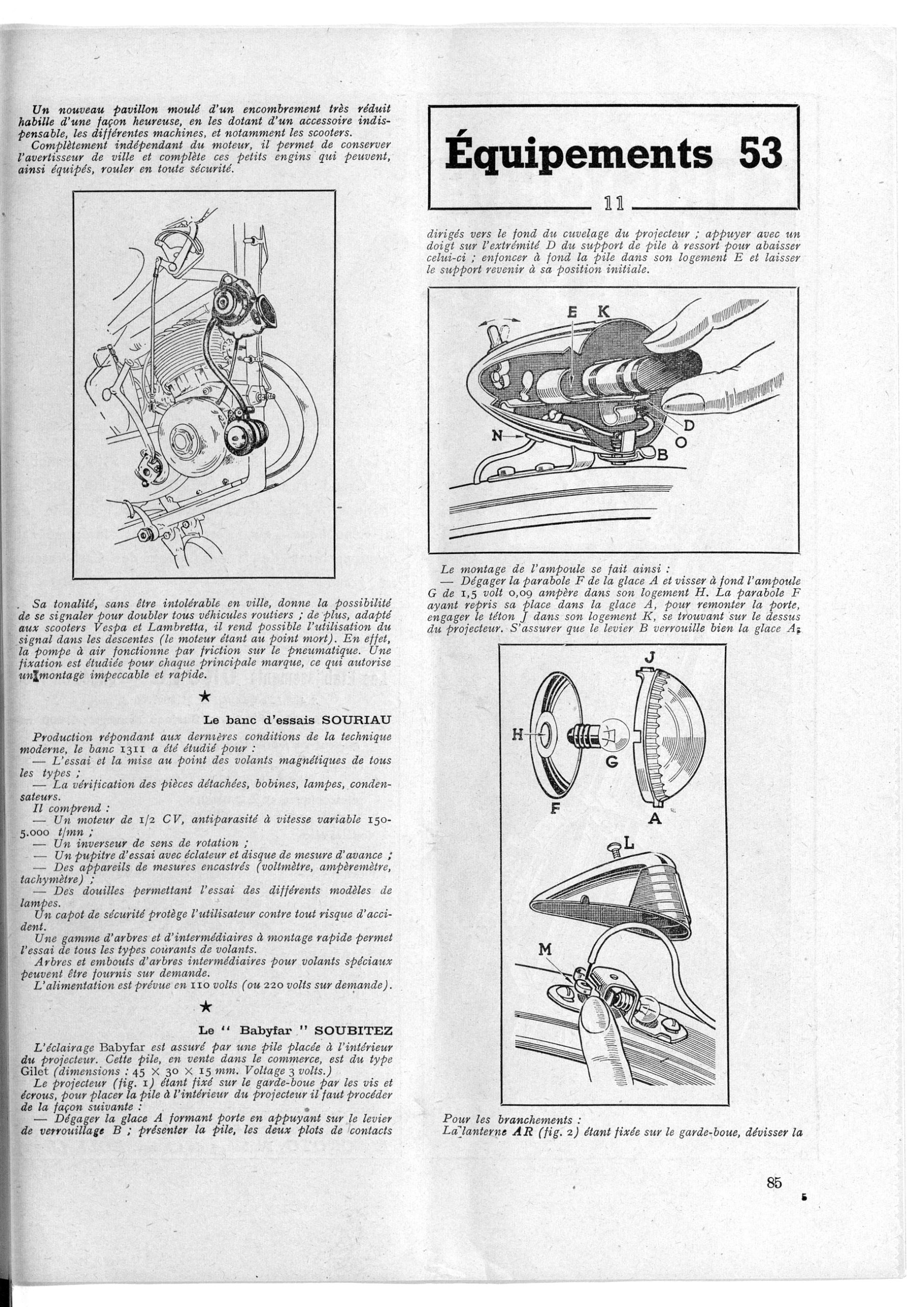
[Ebykr summary, continuing the Rotorson horn entry begun on page 82 (“Suite p. 85”); the article’s text is not reproduced. A new molded horn of very small bulk fits out the various machines, and notably the scooters, with an indispensable accessory. Completely independent of the engine, it allows the town horn to be kept and completes these small machines, which, so equipped, can run in complete safety. The caption says its tone, without being intolerable in town, gives the possibility of making oneself heard in order to pass any road vehicle; moreover, adapted to the Vespa and Lambretta scooters, it makes the use of the signal possible on descents with the engine in neutral, because the air pump works by friction on the tire. A fixing is designed for each principal make, which allows a perfect and rapid fitting.]
Le banc d’essais SOURIAU
[Ebykr summary; the article’s text is not reproduced, except the list of equipment, which is given as printed. Production answering the latest conditions of modern technique, the bench 1311 was designed for the following uses:]
— L’essai et la mise au point des volants magnétiques de tous
les types ;
— La vérification des pièces détachées, bobines, lampes, conden-
sateurs.
Il comprend :
— Un moteur de 1/2 CV, antiparasité à vitesse variable 150-
5.000 t/mn ;
— Un inverseur de sens de rotation ;
— Un pupitre d’essai avec éclateur et disque de mesure d’avance ;
— Des appareils de mesures encastrés (voltmètre, ampèremètre,
tachymètre) ;
— Des douilles permettant l’essai des différents modèles de
lampes.
[Ebykr summary, continued; a safety hood protects the user against any risk of accident. A range of shafts and intermediate pieces with quick fitting permits testing all the usual types of flywheels, and shafts and intermediate shaft ends for special flywheels can be supplied on request. The power supply is for 110 volts (or 220 volts on request).]
Le “Babyfar” SOUBITEZ
[Ebykr summary; the article’s text is not reproduced. The Babyfar lighting is supplied by a battery placed inside the headlamp. This battery, on sale in the trade, is of the Gilet type (dimensions: 45 x 30 x 15 mm; voltage 3 volts). The headlamp (fig. 1) being fixed to the mudguard by screws and nuts, the battery is placed inside by this procedure: release the glass A, which forms a door, by pressing the locking lever B; present the battery with its two contact studs directed toward the back of the headlamp casing; press with a finger on the end D of the spring battery support to lower it; push the battery fully home in its housing E and let the support return to its initial position. The bulb is fitted thus: release the parabola F from the glass A and screw the 1.5 volt 0.09 ampere bulb G fully into its housing H; the parabola F having regained its place in the glass A, to refit the door engage the stud J in its housing K on top of the headlamp, and make sure that the lever B locks the glass A. For the connections, the rear lamp (fig. 2) being fixed to the mudguard, the text breaks off at the foot of the page while describing the unscrewing of the lamp (the entry carries over).]
[A full page of text in two columns with three illustrations and a boxed running head. The head, a ruled box across the right column, reads “Équipements 53” in heavy slab-serif type with a small ornamental numeral 11 set in the lower rule. Text is in italic roman type with firm names in upright type, each firm heading a bold sans-serif line set flush right, and a star ornament between entries. At the top of the left column a large ruled panel holds a line engraving of the front of a small motorcycle, with a round horn mounted beside the cylinder and a second smaller horn fixed low near the wheel hub, joined by a flexible tube and a thin rod. In the right column a ruled panel holds a line engraving with a hatched halftone ground of the inside of a headlamp, with a hand pressing a battery down into its spring holder; the parts are marked with the capital letters E, K, N, D, O and B. Below it a second ruled panel, lettered F, G, H, J and A, shows an exploded view of a headlamp: a shallow dished reflector, a small bulb with screw base and a domed lens with a notched rim. It continues with a rear lamp lifted above a mudguard, lettered L and M, with a finger holding a small wire terminal and bulb socket. The page number 85 stands at the foot. No artist signature is visible. The text breaks off at the foot of the page.]
— Page 11 —
Équipements 53
[Ebykr summary, continuing the Soubitez Babyfar entry from page 85; the article’s text is not reproduced. For the rear lamp connection: unscrew the screw L and remove the cabochon; introduce one of the bare parts of the wire into the hole of the terminal M while pressing with a finger on the end of the blade; introduce the other end into the headlamp through the hole N (fig. 1), tie a knot 5 cm from the end, and introduce that end into the terminal O.]
Les garde-boue STYLL
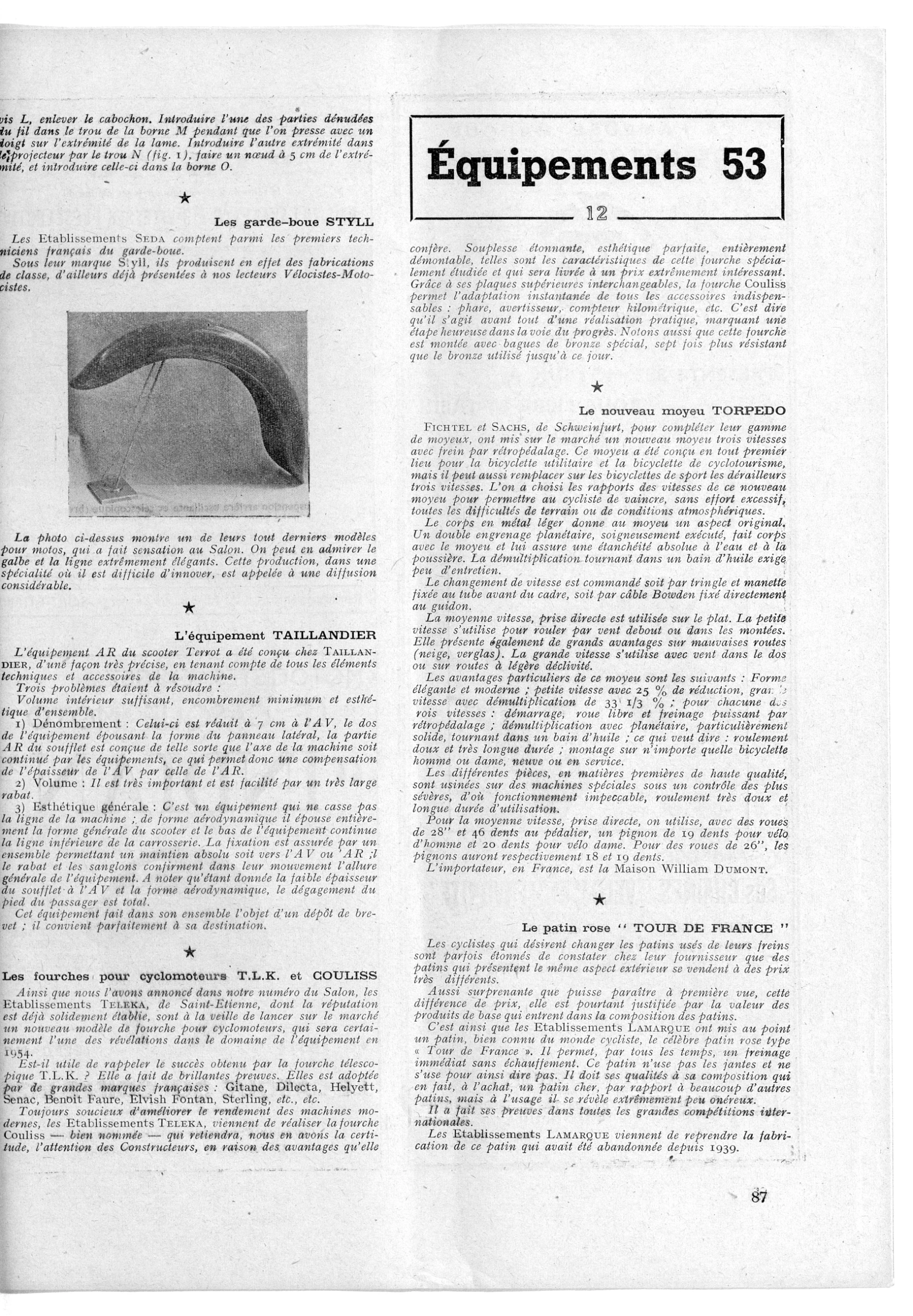
[Ebykr summary; the article’s text is not reproduced. The Etablissements Seda count among the first French technicians of the mudguard. Under their Styll mark they produce top-class products, already presented to the magazine’s readers (Vélocistes-Motocistes). The caption says the photograph shows one of their very latest models for motorcycles, which caused a sensation at the Salon; the very elegant curve and line can be admired, and this production, in a specialty where it is hard to innovate, is destined for considerable circulation.]
L’équipement TAILLANDIER
[Ebykr summary; the article’s text is not reproduced. The rear equipment of the Terrot scooter was designed at Taillandier very precisely, taking account of all the technical elements and accessories of the machine. Three problems had to be solved: sufficient interior volume, minimum bulk and overall appearance. 1) Bulk: it is reduced to 7 cm at the front, the back of the equipment hugging the shape of the side panel, the rear part of the bellows being designed so that the axis of the machine is continued by the equipment, which compensates the thickness at the front by that at the rear. 2) Volume: very large, and made easier by a very wide flap. 3) General appearance: an equipment that does not break the line of the machine; of aerodynamic shape it hugs the general form of the scooter and the bottom of the equipment continues the lower line of the bodywork. The fixing is secured by an assembly giving absolute hold toward the front or rear; the flap and the straps confirm in their movement the general look of the equipment. Given the slight thickness of the front bellows and the aerodynamic shape, clearance for the passenger’s foot is total. The equipment as a whole is the subject of a patent application and suits its purpose perfectly.]
Les fourches pour cyclomoteurs T.L.K. et COULISS
[Ebykr summary; the article’s text is not reproduced. As announced in the magazine’s Salon number, the Etablissements Teleka of Saint-Etienne, whose reputation is already solidly established, are on the eve of launching a new fork model for cyclomoteurs, which will certainly be one of the revelations in equipment in 1954. The telescopic T.L.K. fork has made brilliant proofs and is adopted by the great French makes, printed as: Gitane, Dilecta, Helyett, Senac, Benoit Faure, Elvish Fontan, Sterling, etc., etc. Always concerned to improve the performance of modern machines, Teleka has just made the Couliss fork, “well named”, which will hold the attention of constructors by the advantages it confers: astonishing suppleness, perfect appearance, entirely dismountable, a specially studied fork that will be delivered at an extremely attractive price. Thanks to its interchangeable upper plates the Couliss fork allows instant fitting of all the indispensable accessories (headlamp, horn, kilometer counter, etc.), so that it is above all a practical design marking a happy stage in progress. The fork is fitted with bushings of a special bronze seven times more resistant than the bronze used until now.]
Le nouveau moyeu TORPEDO
[Ebykr summary; the article’s text is not reproduced. Fichtel et Sachs of Schweinfurt, to complete their range of hubs, have put on the market a new three-speed hub with coaster brake. It was conceived first of all for the utility bicycle and the touring bicycle, but it can also replace derailleurs on sport bicycles. The gear ratios were chosen to let the cyclist overcome, without excessive effort, all difficulties of terrain or weather. The light-metal body gives the hub an original look; the carefully made double planetary gearing is built into the hub and makes it absolutely proof against water and dust; the reduction gear runs in an oil bath and needs little maintenance. The gear change is controlled either by rod and lever fixed to the frame’s front tube or by a Bowden cable fixed directly to the handlebar. The middle speed, direct drive, is used on the flat; the low gear for headwinds or climbs, and also on bad roads (snow, black ice); the high gear with a following wind or on roads of slight gradient. The particular advantages are given as: attractive modern shape; low gear with a 25 % reduction, high gear with a 33 1/3 % step-up; for each of the three speeds starting, free wheel and powerful braking by back-pedaling; reduction with planetary gear running in an oil bath, meaning very smooth running and very long life; fitting on any bicycle, man’s or lady’s, new or in service. The parts are made in high-quality raw materials on special machines under the strictest control, hence impeccable operation, very smooth rolling and long service life. For the middle speed, direct drive, with 28″ wheels and 46 teeth at the chainwheel, a 19-tooth sprocket is used for a man’s bicycle and 20 teeth for a lady’s; for 26″ wheels the sprockets will have 18 and 19 teeth respectively. The importer in France is the Maison William Dumont.]
Le patin rose “TOUR DE FRANCE”
[Ebykr summary; the article’s text is not reproduced. Cyclists wanting to change the worn pads of their brakes are sometimes surprised to find at their supplier that pads of the same outward look sell at very different prices; the difference is justified by the value of the basic products in the composition of the pads. The Etablissements Lamarque have perfected a pad well known to the cycling world, the celebrated pink pad of the “Tour de France” type. It gives immediate braking in all weathers without heating, does not wear the rims and hardly wears itself, owing its qualities to its composition; it is dear to buy compared with many other pads but extremely cheap in use. It has proved itself in all the great international competitions. The Etablissements Lamarque have just resumed manufacture of this pad, which had been abandoned since 1939.]
[A full page of text in two columns with one illustration and a boxed running head. The head, a ruled box across the right column, reads “Équipements 53” in heavy slab-serif type with a small ornamental numeral 12 set in the lower rule. Text is in italic roman type with firm names in upright type, each firm heading a bold sans-serif line set flush right, and star ornaments between entries. In the left column a halftone photograph shows a smooth curved motorcycle mudguard with a thin support rod and a small flat plate at its foot; a band of reversed lettering from the other side of the leaf shows through along the lower edge of the photograph. The page number 87 stands at the foot of the right column. No artist signature is visible.]
— Page 12 —
Équipements 53
Les nouvelles productions TRON et BERTHET
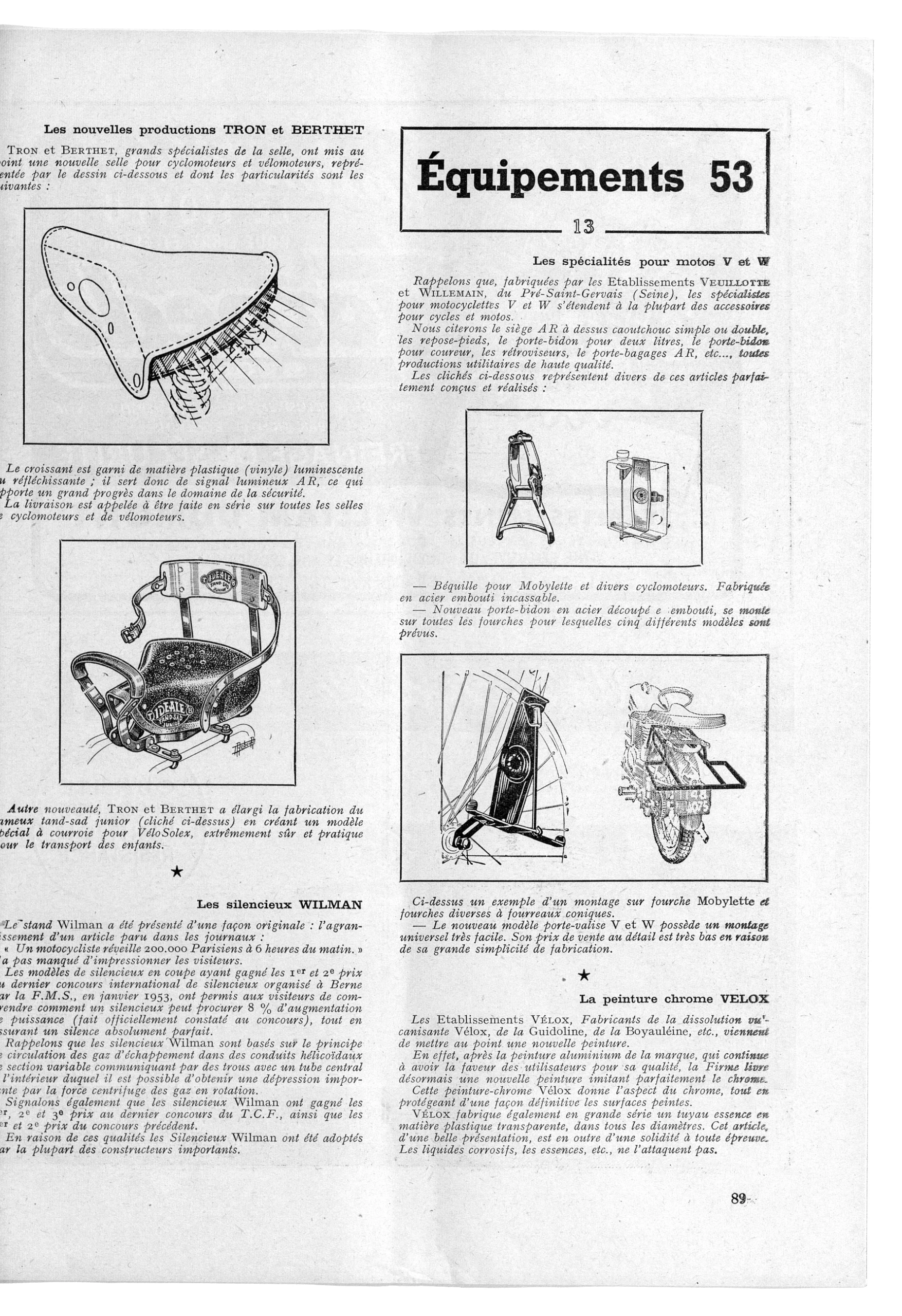
[Ebykr summary; the article’s text is not reproduced. Tron et Berthet, great saddle specialists, have perfected a new saddle for cyclomoteurs and vélomoteurs, shown in the drawing, whose particularities are given in the caption: the crescent at the rear is fitted with luminescent or reflecting plastic (vinyl) material, so that it serves as a rear light signal, which brings great progress in safety. Delivery is expected to be made in series on all cyclomoteur and vélomoteur saddles. As another novelty Tron et Berthet has widened the manufacture of the famous tand-sad junior (cliché above) by creating a special strap model for the VéloSolex, extremely safe and practical for carrying children.]
Les silencieux WILMAN
[Ebykr summary; the article’s text is not reproduced. The Wilman stand was presented in an original way: the enlargement of a newspaper article headed « Un motocycliste réveille 200.000 Parisiens à 6 heures du matin. » did not fail to impress visitors. The cutaway silencer models that won the 1st and 2nd prizes at the last international silencer competition organized at Berne by the F.M.S. in January 1953 let visitors understand how a silencer can provide an 8 % increase in power (officially noted at the competition) while ensuring perfect absolute silence. The author recalls that Wilman silencers rest on the principle of circulating the exhaust gases in helical ducts of variable section, communicating by holes with a central tube in which an important depression can be obtained through the centrifugal force of the rotating gases. Wilman silencers also won the 1st, 2nd and 3rd prizes at the last T.C.F. competition, as well as the 1st and 2nd prizes of the preceding one. Because of these qualities Wilman silencers have been adopted by most of the important constructors.]
Les spécialités pour motos V et W
[Ebykr summary; the article’s text is not reproduced. The author recalls that the specialties, made by the Etablissements Veuillotte et Willemain of Pré-Saint-Gervais (Seine), makers of the V and W motorcycles, extend to most accessories for cycles and motorcycles. He cites the rear seat with single or double rubber top, the footrests, the oil-can holder for two liters, the racing-rider can holder, the rear-view mirrors and the rear luggage carrier, all high-quality utility products; the clichés below show several of these articles. The captions read: a stand for the Mobylette and various cyclomoteurs, made of unbreakable pressed steel; a new can holder in cut and pressed steel, which fits on all forks, for which five different models are provided. Below, a second figure is captioned as an example of a fitting on the Mobylette fork and on various forks with conical legs; a new V and W suitcase carrier has a very easy universal fitting, and its retail price is very low because of the great simplicity of manufacture.]
La peinture chrome VELOX
[Ebykr summary; the article’s text is not reproduced. The Etablissements Vélox, makers of the Vélox vulcanizing solution, Guidoline, Boyauléine and others, have just perfected a new paint. After the firm’s aluminum paint, which continues to enjoy users’ favor for its quality, the firm now delivers a new paint that imitates chrome perfectly; the Vélox chrome-paint gives the look of chrome while permanently protecting the painted surfaces. Vélox also makes in large series a petrol hose in transparent plastic material in all diameters; the article, of fine appearance, is also of a strength proof against all trials, and corrosive liquids, petrol and the like do not attack it.]
[A full page of text in two columns with five line illustrations and a boxed running head. The head, a ruled box across the right column, reads “Équipements 53” in heavy slab-serif type with a small ornamental numeral 13 set in the lower rule. Text is in italic roman type with firm names in upright type, each firm heading a bold sans-serif line set flush right, and star ornaments between entries. At the top of the left column a ruled panel holds a line drawing of a saddle seen from behind and above, with stitched edges, three small holes in the nose and a crescent-shaped pad at the rear, hatched and with long thin lines running out from it. Below it a second ruled panel holds a shaded line engraving of a molded child’s seat on a rear carrier, with a high back plate and straps; the oval “IDEALE” mark with “TAND-SAD JUNIOR” appears on the back plate and on the seat. In the right column an upper ruled panel shows two small line drawings, a folding stand on the left and an oil can in a bracket on the right; a lower ruled panel shows a hatched drawing of a fork leg with a stand at the wheel hub and, at right, a luggage carrier fixed over the rear wheel of a small motorcycle. The page number 89 stands at the foot of the right column. A signature reading “Rebour” with a monogram initial is set in the lower right corner of the child’s-seat drawing. Parts of the right-hand lines are doubled by ink from the reverse of the leaf.]
Ebykr presents this material for research and education. If you hold rights to it or notice an ownership issue, please contact us and we will respond promptly.
The Ebykr Digest
New articles, timelines, catalog finds and registry activity — assembled from the archive once a month. Your address is never shared.
Double opt-in. One email per month. Unsubscribe at any time with one click.