About Ebykr
Ebykr celebrates classic and vintage lightweight bicycles through provocative imagery and opinion. Ride along with us.
About Ebykr
Ebykr celebrates classic and vintage lightweight bicycles through provocative imagery and opinion. Ride along with us.

Source: Gallica (Bibliothèque nationale de France), L'Officiel du cycle, du motocycle et du camping, 19 September 1953, N° 39, pages 13 and 15; ark:/12148/bd6t54201159j. Source gallica.bnf.fr / BnF.
| Type | Review |
|---|---|
| Year | 1953 |
| Publisher | L'Officiel du cycle |
| Artist | Miguel Zamacoïs |
| Country | France |
| Language | French |
| Pages | 5 |
| Source | Gallica (Bibliothèque nationale de France), L'Officiel du cycle, du motocycle et du camping, 19 September 1953, N° 39, pages 13 and 15; ark:/12148/bd6t54201159j. Source gallica.bnf.fr / BnF. |
| Credit | Ebykr archive; Bibliothèque nationale de France |
| Identifier | Gallica (BnF) ark:/12148/bd6t54201159j/f13 |
| Transcription | Headings and specifications transcribed; article text summarized |
MISTRAL SIROCO FUSÉE GAZELLE BORÉE ZÉPHYR HUILE DE PIEDS DE MOUTON PÉTRO VASELINE Miguel Zamacoïs AU TEMPS DE “ ou SOUVENIRS DE L Miguel ZAMACOÏS. Rappelons que notre Collaborateur et Ami a précédemment donné à nos Lecteurs les charmantes chroniques intitulées : — LE CYCLE DE MES SOUVENIRS VÉLO- CIPÉDIQUES ; — VELO, BECANE ET …
This is a magazine article, so its running text is summarized here rather than reproduced; the headline, byline, specifications and scores are transcribed as printed.
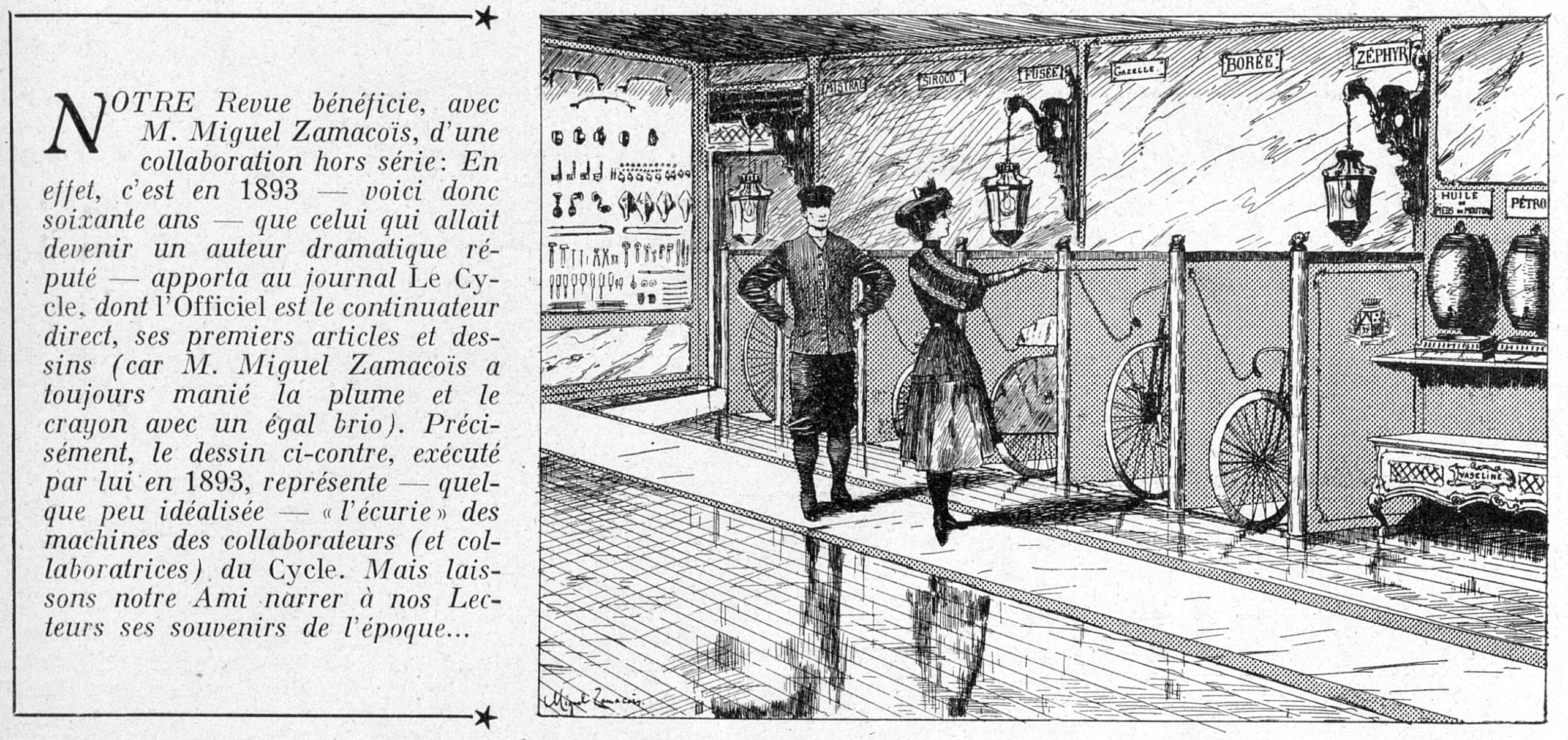
From L’Officiel du cycle, du motocycle et du camping, 19 September 1953, N° 39, the paper’s Salon number du Cycle at the Porte de Versailles, pages 13 and 15: introduction to Miguel Zamacois’s memoir of the old Le Cycle, with his 1893 drawing of an idealized stable of the contributors’ bicycles (Borde and Zephyr signs, lamps and tools on the wall). The title, headings, captions and lists are transcribed as printed; the text is summarized in Ebykr’s words, and the page images carry it in full.
— Page 1 —
[Ebykr summary; the article’s text is not reproduced. A short editorial note, set in italic type with a drop capital, tells readers that the review is fortunate to have a special contribution from M. Miguel Zamacoïs. In 1893, it says, sixty years earlier, the man who would become a well-regarded playwright brought his first articles and drawings to the journal Le Cycle, of which L’Officiel is the direct continuation. The note adds that Zamacoïs has always handled the pen and the pencil with equal verve. The drawing alongside, made by him in 1893, shows the “stable” of the machines of the contributors of Le Cycle, men and women, somewhat idealized. The note closes by leaving the author to tell readers his memories of the period.]
MISTRAL
SIROCO
FUSÉE
GAZELLE
BORÉE
ZÉPHYR
HUILE DE PIEDS DE MOUTON
PÉTRO[illisible]
VASELINE
Miguel Zamacoïs
[A ruled panel in black and white, wider than tall. At the left, a boxed text column bordered by a thin rule with a small black star at the right end of the top and bottom rules; the note is set in italic roman type with a large drop capital N, the first lines indented around it. At the right stands a line-engraved pen drawing with halftone dot tint on the walls and floor. It shows a long, tiled shop or stable interior in perspective. A young man in a cap and a long-sleeved jersey with his hands on his hips stands beside a young woman in a plumed hat, a bodice with a ruffled collar and a long flared skirt, who rests one hand on a partition rail. Behind low partitions, early bicycles with large spoked wheels are chained to the posts of the stalls. Small name plates hang above the stalls and read MISTRAL, SIROCO, FUSÉE, GAZELLE, BORÉE and ZÉPHYR, and ornate iron brackets carry glass lanterns. At the left a wall board is covered with tools, spanners, bolts and small fittings laid out in rows. At the right, shelves hold two large jars labeled HUILE DE PIEDS DE MOUTON and PÉTRO[illisible] and a small cabinet marked VASELINE. The drawing is signed “Miguel Zamacoïs” in script at the lower left corner.]
— Page 2 —
AU TEMPS DE “
ou SOUVENIRS DE L
[Ebykr summary; the article’s text is not reproduced. The author opens by asking whose birth the title means, in a publication whose first title was L’Officiel du Cycle. He answers that it is the birth of the bicycle, a machine with several baptismal names, like any person. Anyone wanting detailed information on the astonishing little rolling instrument, which is slowly turning into a pocket automobile through the general drift toward least effort, will not find it under the word cycle in a dictionary. That entry runs a column and a half on matters unrelated to the foot-powered machine that races on streets, roads and velodromes, and on which one privileged rider each year may put on a yellow jersey, the equivalent of the laurel crown of ancient heroes. The column and a half deals with astronomy, biology, history and teaching, and only after it do three lines mention, offhandedly, that a cycle can also be a bicycle. Cycle is the formal, almost scholarly name of the instrument. Bicyclette, its second name, is probably the most used and the most normal, since it keeps a middle course between the affected and the slangy. It is also the most logical, because the machine is not one cycle but two. The author adds that a third name was bound to be given by the common people, a name coined by an unknown godfather from the factory or the working-class suburb, where nobody cares much about the usages ruled on by official grammarians such as Littré or the Académie française.]
[A text-only page area in black and white. A large heading in widely spaced roman capitals runs across the head of the column, with the word “ou” in lowercase at the start of the second line, and the heading is cut off at the right edge of the crop. Below it the article runs in a single wide column of sans-serif type, with a large drop capital L at the opening and the italic words cycle and L’Officiel du Cycle set in a serif italic face. No drawing, photograph or signature appears.]
— Page 3 —
[Ebykr summary; the article’s text is not reproduced. The third name, the author continues, is vélo, which sounds short and suits the street’s marked taste for the warm O ending, as in bistro, apéro, à gogo, topo, rigolo, pipo, photo and métro. A question remains, comparable to the old dispute over the sex of angels: the various names stand for both genders. Vélo is masculine, like Tito, Hugo or Cyrano; bicyclette is feminine, like Annette, Jeannette or Antoinette. His way out is that the name one chooses decides whether one owns a boy or a girl. The register is not complete: a fourth name is bécane, a slang creation with many partisans among plain speakers, and the fifth and last is a concession to literature, la petite reine, which is precious, romantic and old-fashioned, and smells of the nineteen hundreds by a league, a league of half a century.]
[Ebykr summary, after a three-star break. With this preamble written, the author must admit that he witnessed the birth of the bicycle, adding quickly that he was then an adolescent still at the lycée who watched with curiosity, like everyone else, the passing of a few velocipedists, still regarded as acrobats of some standing for keeping their balance on two wheels placed one behind the other in the same vertical plane, a miraculous balance. The sentence continues in the next column.]
[A text-only column in black and white, set in a single wide column of sans-serif type with a few words in serif italic: vélo, Tito, Hugo, Cyrano, bicyclette, bécane and la petite reine. A small three-star ornament, one star above two, marks the break between two sections, and the second section opens with a large drop capital C. No heading, drawing, photograph or signature appears.]
— Page 4 —
[Ebykr summary; the article’s text is not reproduced. The sentence from the previous column concludes: the balance of those early riders was kept by the constant, reflexive handling of the steering handlebar. Onlookers watched the bold riders pass without suspecting that these machines, then a great luxury, would multiply by millions and millions under every latitude, and that within a few years not owning one would be a sign of sordid poverty. When a bicycle soon became something one could aim to own without showing the tax collector an outward mark of wealth, the author still could not afford one in good ringing coin: he was a student painter at the École des Beaux-Arts, lunched in the rue de Buci for twenty-two sous, and pinched on every expense, so a fine gleaming machine was for him like buying a rajah’s diamond in a shop window of the rue de la Paix. Luckily he had a good friend, the editor of a photographic review, who needed illustrations to scatter through his text. They agreed that in exchange for a bicycle of the Rochet marque, which the friend would pay for in advertising, the author would become its owner by supplying “cinq cents francs de dessins”; five hundred francs of those days was an impressive sum for a modest dauber rich only in hope and good humor. The day he took delivery, with emotion, of the varnished and nickel-plated jewel from the factory, he was barely able to use it, having only just finished the series of lessons needed before mounting the capricious steed; as he has said before in these pages, nobody was then born a velocipedist riding the sidewalks at speed at the age of four. One had to learn to stay up on two wheels at odds with each other, without falling to either side, as one learns the violin but with far more danger if not perseverance. Only when one could still weave a little as if drunk, in a special riding hall or at the end of a deserted street, did one venture into the Bois de Boulogne at one’s own risk to perfect one’s mechanical horsemanship. Riders were not proud: they did not call out to slow pedestrians on the road and were ready for every concession, even to stray dogs and the then numerous tramway rails, and would have made perfect candidates for the “prix de la semaine de politesse” had it existed.]
[Ebykr summary, after a three-star break. The author says he would have been greatly astonished, in those velocipede stammerings, when he thought only of trading his involuntary zigzags for straight lines, to be told that he would become, in the trade, a draftsman and columnist one hundred percent, yet that is what happened. Once a normal cyclist, master of his zigzags, he had the idea of writing a pamphlet whose title alone showed its fantasist’s mockery: Le vélocipède à travers les âges. In it he revealed to begin with that the velocipede must have been invented by one Sisyphus, known in mythology as king of Corinth and hardened bandit, condemned “after his death” to roll an enormous stone to the top of a mountain from which it fell back forever. Given that the details of the operation were unknown, why not suppose that, soon tired of this monotonous exercise, the perpetual laborer had thought of fixing to his rock a sort of handlebar made, for example, from a forked piece of wood, which would let him, having pushed the rock up to the summit, come back down astride it. The sentence is cut at the foot of the column and continues in the next.]
[A text-only column in black and white, set in one tall column of sans-serif type with a few words in serif italic: Ecole des Beaux-Arts, prix de la semaine de politesse, Le vélocipède à travers les âges. The first words of the opening paragraph after the second break are in bold roman type, and a small three-star ornament, one star above two, marks the break between two sections, the second opening with a large drop capital O. No heading, drawing, photograph or signature appears.]
— Page 5 —
[Ebykr summary; the article’s text is not reproduced. The sentence from the previous column concludes: Sisyphus would ride down astride the rock, somewhat like the “géants du Tour” coming down the famous Alpine or Pyrenean passes, and a sketch by the author underlined the possibility of this resourceful system. The rest of the little book was in the same vein: the velocipede of “moyenâgeux” style followed the one of Egyptian style, and he made a point of featuring the traditional, symbolic monocycle on which Fortune is usually shown going off to hand out, as a nudist goddess, the treasures of her horn of plenty. With the manuscript finished and enlivened by his sketches, he took it to a publisher on the boulevard Saint-Germain who, among other publications, issued Le Cycle, an attractive organ of the specialty. M. Boudet was a courteous man, and his accepting at once to publish the work in installments suggested that he also had real intelligence and taste. It was the start of a close and lasting collaboration. The author was hired outright, with the rather particular task of ornamenting available texts with drawings and of supplying suitable texts, in prose or verse, for other people’s drawings lacking captions, a double exercise rarely asked for in the classified advertisements.]
[Ebykr summary, after a three-star break. This modest episode of his biography would be banal, the author says, were it not for an unexpected and, for him, rather moving episode grafted onto it. Time passed. One day he had to leave his job as handyman at the Boudet bookshop, drawn by major journalism and the profession of playwright. Many years later, having nearly forgotten his laborious apprenticeship on the boulevard Saint-Germain, he received from the amiable heads of L’Officiel du Cycle et du Motocycle a summons about a possible collaboration. His astonishment and emotion were great when, shown into the offices on the avenue de la Grande-Armée, he saw hanging on the wall, carefully framed, an important series of his drawings of long ago. L’Officiel was the continuation, singularly enlarged, active and modern, of the cycle of former days, and the memory of his early youth sparkled on the wall with, as he puts it, the bygone cycle of his good years.]
Miguel ZAMACOÏS.
Rappelons que notre Collaborateur et Ami
a précédemment donné à nos Lecteurs
les charmantes chroniques intitulées :
— LE CYCLE DE MES SOUVENIRS VÉLO-
CIPÉDIQUES ;
— VELO, BECANE ET BICYCLETTE ;
— LES FANTAISISTES DE LA BICYCLETTE ;
— CYCLISME CONJUGAL….
[A text-only column in black and white, set in one tall column of sans-serif type with a few words in serif italic: le Cycle, L’Officiel du Cycle et du Motocycle, L’Officiel, cycle and le cycle. A small three-star ornament, one star above two, marks the break between two sections, the second opening with a large drop capital C. The article ends with the signature “Miguel ZAMACOÏS.” set in spaced capitals at the right. Below it a rectangular box with a thin rule border holds the reminder, set in slanted sans-serif type, with the four earlier column titles listed in slanted capitals, each introduced by a dash. No drawing or photograph appears.]
Ebykr presents this material for research and education. If you hold rights to it or notice an ownership issue, please contact us and we will respond promptly.
The Ebykr Digest
New articles, timelines, catalog finds and registry activity — assembled from the archive once a month. Your address is never shared.
Double opt-in. One email per month. Unsubscribe at any time with one click.