About Ebykr
Ebykr celebrates classic and vintage lightweight bicycles through provocative imagery and opinion. Ride along with us.
About Ebykr
Ebykr celebrates classic and vintage lightweight bicycles through provocative imagery and opinion. Ride along with us.

Source: Gallica (Bibliothèque nationale de France), L'Officiel du cycle, du motocycle et du camping, 19 September 1953, N° 39, page 89; ark:/12148/bd6t54201159j. Source gallica.bnf.fr / BnF.
| Marque | Alumag |
|---|---|
| Type | Review |
| Year | 1953 |
| Publisher | L'Officiel du cycle |
| Country | France |
| Language | French |
| Pages | 1 |
| Source | Gallica (Bibliothèque nationale de France), L'Officiel du cycle, du motocycle et du camping, 19 September 1953, N° 39, page 89; ark:/12148/bd6t54201159j. Source gallica.bnf.fr / BnF. |
| Credit | Ebykr archive; Bibliothèque nationale de France |
| Identifier | Gallica (BnF) ark:/12148/bd6t54201159j/f88 |
| Transcription | Headings and specifications transcribed; article text summarized |
This is a magazine article, so its running text is summarized here rather than reproduced; the headline, byline, specifications and scores are transcribed as printed.
From L’Officiel du cycle, du motocycle et du camping, 19 September 1953, N° 39, the paper’s Salon number du Cycle at the Porte de Versailles, page 89: superalumag T. 35, continued: heat treatment, uses in mines, wagons and aviation; employed for handlebars, luggage racks, rims, frames, mudguards and brake handles; documentation from the Havre firm. The title, headings, captions and lists are transcribed as printed; the text is summarized in Ebykr’s words, and the page images carry it in full.
— Page 1 —
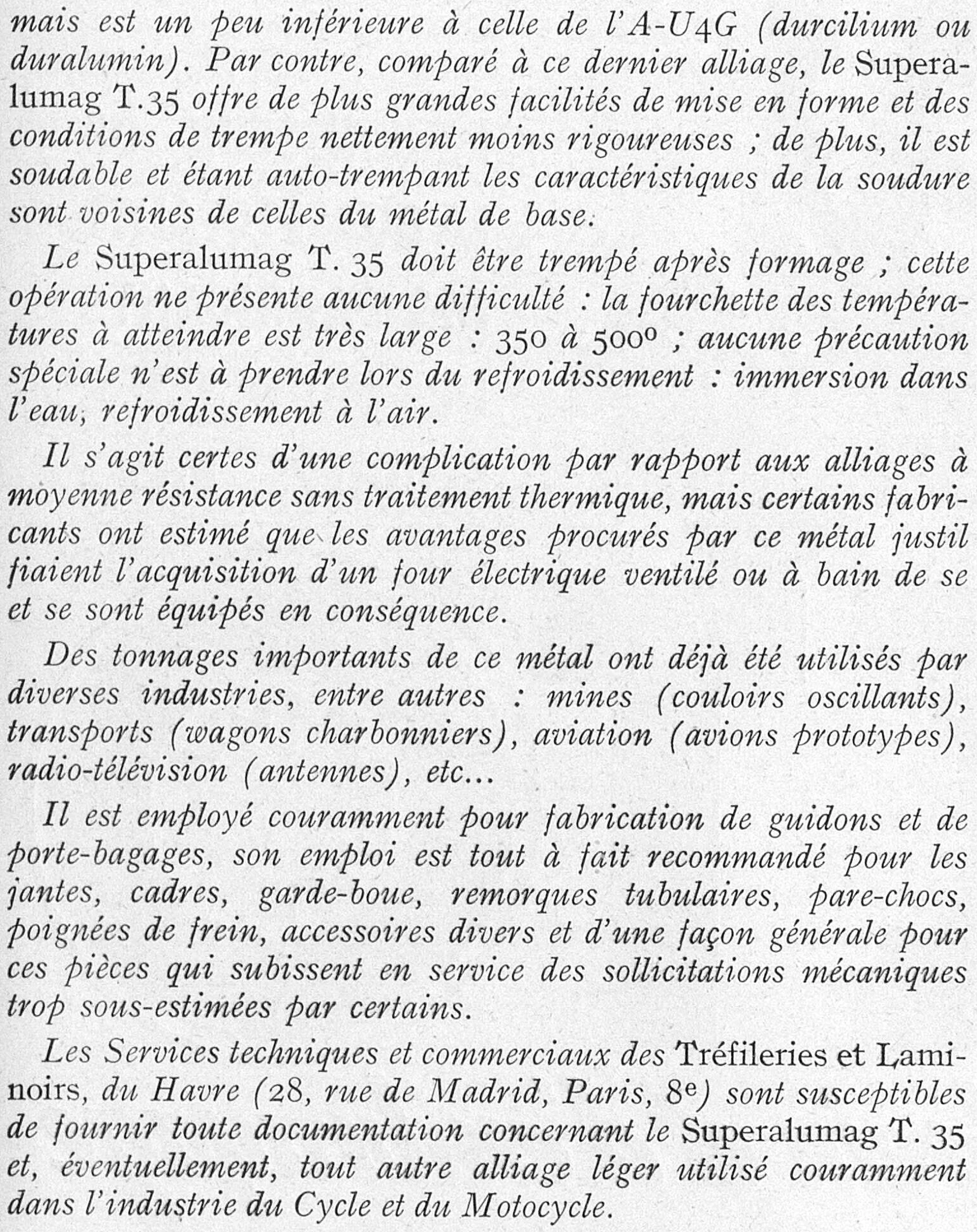
[Ebykr summary; the article’s text is not reproduced. The column opens in the middle of a sentence about Superalumag T. 35, whose strength is said to be a little below that of the A-U4G alloy (durcilium or duralumin). Compared with that alloy, the author says, Superalumag T. 35 is easier to shape, needs far less rigorous tempering conditions, is weldable and, because it is self-hardening, gives welds whose characteristics are close to those of the base metal.]
[Ebykr summary, second paragraph. The metal must be tempered after forming. The author calls the operation free of difficulty: the temperature range is very wide, 350 to 500 degrees, and no special precaution is needed on cooling, which may be done by immersion in water or in air.]
[Ebykr summary, third paragraph. The author admits that this is certainly a complication compared with medium-strength alloys that need no heat treatment, but says that certain manufacturers judged the advantages of the metal to justify buying a ventilated electric oven or a salt-bath furnace, and have equipped themselves accordingly.]
[Ebykr summary, fourth paragraph. Large tonnages of the metal have already been used by various industries, among them mines (oscillating chutes), transport (coal wagons), aviation (prototype aircraft) and radio-television (antennas).]
[Ebykr summary, fifth paragraph. The metal is commonly used to make handlebars and luggage racks, and its use is entirely recommended for rims, frames, mudguards, tubular trailers, bumpers, brake handles and miscellaneous accessories, and in general for parts that undergo mechanical stresses in service which some people underestimate.]
[Ebykr summary, closing paragraph. The technical and commercial services of the Tréfileries et Laminoirs du Havre, at 28, rue de Madrid, Paris, 8e, can supply all documentation on Superalumag T. 35 and, if required, on any other light alloy commonly used in the cycle and motorcycle industry.]
[Text only: a single column of running text with no heading, drawing or signature on this crop. The paragraphs are set in italic type with a first-line indent, the firm name Superalumag T. 35 and the words Tréfileries et Laminoirs standing out in upright roman type. The column opens in mid-sentence and closes with the firm’s Paris address.]
Ebykr presents this material for research and education. If you hold rights to it or notice an ownership issue, please contact us and we will respond promptly.
The Ebykr Digest
New articles, timelines, catalog finds and registry activity — assembled from the archive once a month. Your address is never shared.
Double opt-in. One email per month. Unsubscribe at any time with one click.