About Ebykr
Ebykr celebrates classic and vintage lightweight bicycles through provocative imagery and opinion. Ride along with us.
About Ebykr
Ebykr celebrates classic and vintage lightweight bicycles through provocative imagery and opinion. Ride along with us.

Source: Gallica (Bibliothèque nationale de France), L'Officiel du cycle, du motocycle et du camping, 19 September 1953, N° 39, pages 61 and 62; ark:/12148/bd6t54201159j. Source gallica.bnf.fr / BnF.
| Type | Review |
|---|---|
| Year | 1953 |
| Publisher | L'Officiel du cycle |
| Country | France |
| Language | French |
| Pages | 3 |
| Source | Gallica (Bibliothèque nationale de France), L'Officiel du cycle, du motocycle et du camping, 19 September 1953, N° 39, pages 61 and 62; ark:/12148/bd6t54201159j. Source gallica.bnf.fr / BnF. |
| Credit | Ebykr archive; Bibliothèque nationale de France |
| Identifier | Gallica (BnF) ark:/12148/bd6t54201159j/f60 |
| Transcription | Headings and specifications transcribed; article text summarized |
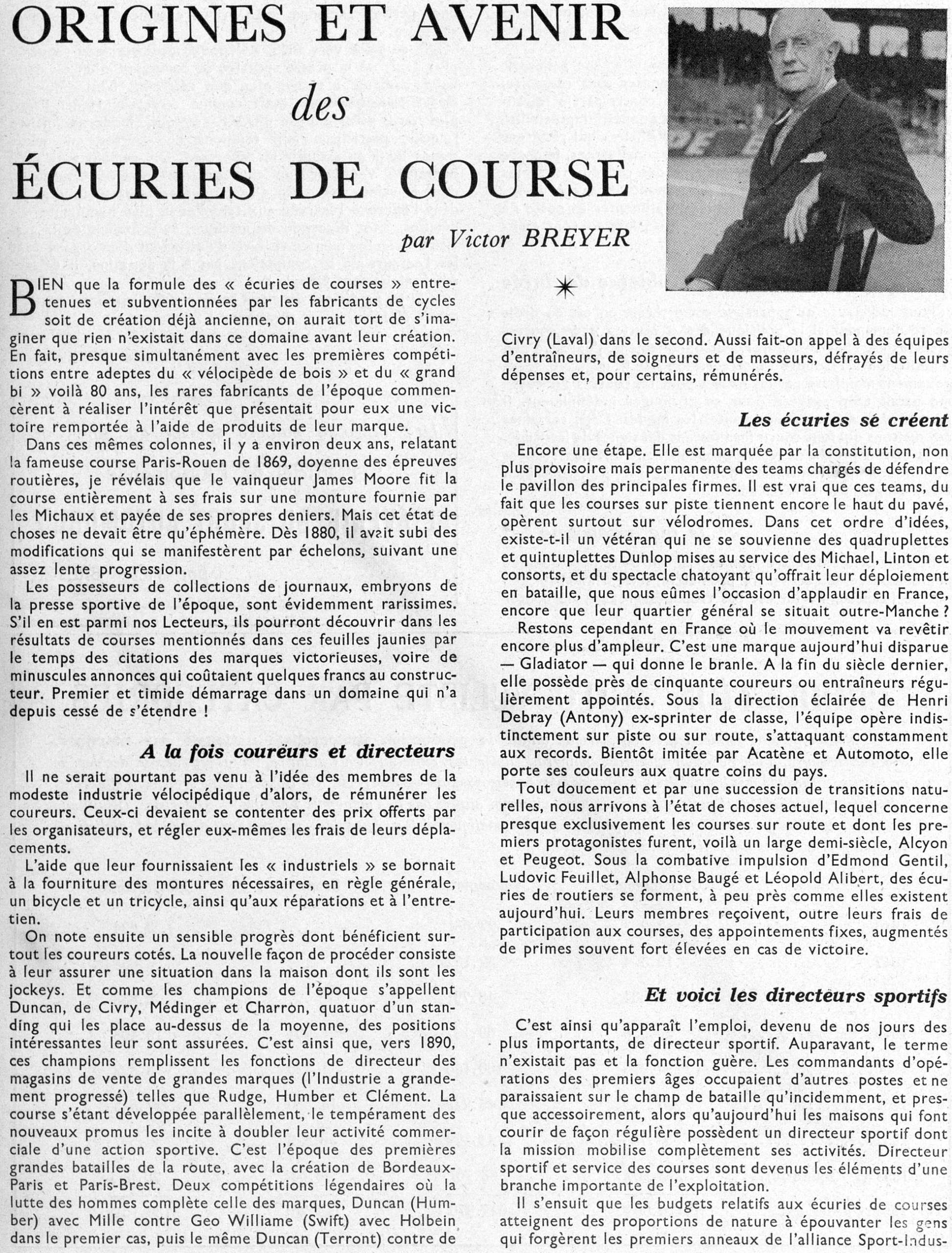
ORIGINES ET AVENIR des ÉCURIES DE COURSE par Victor BREYER A la fois coureurs et directeurs Les écuries se créent Et voici les directeurs sportifs Problème de durée " Je me désabonne ! "
This is a magazine article, so its running text is summarized here rather than reproduced; the headline, byline, specifications and scores are transcribed as printed.
From L’Officiel du cycle, du motocycle et du camping, 19 September 1953, N° 39, the paper’s Salon number du Cycle at the Porte de Versailles, pages 61 and 62: ‘Origines et avenir des écuries de course’ by Victor Breyer, part 1: history of the cycle makers’ racing teams from the 1869 Paris-Rouen and the grand bi to Gladiator, Alcyon and Peugeot teams; portrait photo of an older man. The title, headings, captions and lists are transcribed as printed; the text is summarized in Ebykr’s words, and the page images carry it in full.
— Page 1 —
ORIGINES ET AVENIR
des
ÉCURIES DE COURSE
par Victor BREYER
[Ebykr summary; the article’s text is not reproduced. Breyer opens by saying that although the formula of the “écuries de courses” kept up and subsidized by the cycle makers is already old, it would be wrong to imagine that nothing of the kind existed before. Almost at once with the first contests between riders of the “wooden velocipede” and the “grand bi” some 80 years ago, the few makers of the day began to see the value of a victory won on a machine of their marque. About two years earlier, in the same columns, writing of the Paris-Rouen race of 1869, he revealed that the winner James Moore rode entirely at his own expense on a mount supplied by the Michaux firm and paid for out of his own pocket. That state of affairs did not last: by 1880 it had changed by degrees and slowly. Holders of collections of the early sports newspapers are very rare; any reader who has one may find in the race results of those yellowed sheets the names of winning marques, or tiny advertisements that cost the maker a few francs, a first and timid start in a field that has never stopped growing.]
A la fois coureurs et directeurs
[Ebykr summary, under the first subheading. The makers of the modest cycle industry of the time would not have thought of paying riders, who had to be content with the prizes offered by the organizers and pay their own travel. The help given by the “industriels” was limited to supplying the machines needed (as a rule one bicycle and one tricycle) and to repairs and upkeep. Progress followed, chiefly for the rated riders, who were given a position in the house whose jockeys they were. Since the champions of the day were Duncan, de Civry, Médinger and Charron, a quartet ranked above the average, good positions were assured to them: around 1890 these champions served as managers of the sales shops of large marques such as Rudge, Humber and Clément. As racing grew alongside, their temperament led them to add sporting action to their commercial work. This was the time of the first great road battles, with the creation of Bordeaux-Paris and Paris-Brest, two legendary contests in which the struggle of the men completed that of the marques: Duncan (Humber) with Mille against Geo Williame (Swift) with Holbein in the first, then the same Duncan (Terront) against de Civry (Laval) in the second. For these races teams of trainers, attendants and masseurs were called on, paid their expenses and, for some, a fee.]
Les écuries se créent
[Ebykr summary, under the second subheading. A further stage was the permanent, no longer provisional, constitution of teams to defend the flag of the principal firms. Because track racing still held first place, these teams worked chiefly on velodromes. Breyer asks whether any veteran fails to remember the Dunlop quadruplets and quintuplets put at the service of Michael, Linton and their like, and the colorful sight of their deployment in battle, which was applauded in France although their headquarters lay across the Channel. He then stays in France, where the movement grew larger. A marque now vanished, Gladiator, set it going: at the end of the last century it had nearly fifty riders or pacers regularly appointed, under the direction of the ex-sprinter Henri Debray (Antony), and the team worked without distinction on track or road, constantly attacking records. Soon imitated by Acatène and Automoto, it carried its colors to the four corners of the country. By gradual transitions the author comes to the present state of things, which concerns almost only road racing and whose first protagonists were, a good half-century earlier, Alcyon and Peugeot. Under the combative lead of Edmond Gentil, Ludovic Feuillet, Alphonse Baugé and Léopold Alibert, teams of road riders were formed much as they exist today, their members receiving, besides their racing expenses, fixed salaries increased by often very high bonuses for a win.]
Et voici les directeurs sportifs
[Ebykr summary, under the third subheading. This is how the post of sporting director, now one of the most important, appeared. Earlier the term did not exist and hardly the function: the commanders of the first ages held other posts and appeared on the field of battle only incidentally, whereas today the firms that race regularly have a sporting director whose mission takes all his activity, and the director and the racing department have become parts of an important branch of the business. It follows that the budgets of the racing stables reach proportions to frighten the people who forged the first links of the Sport-Industry alliance (the sentence breaks off at the foot of the column and continues in the next image).]
[A magazine article opening in black and white. A heavy roman capital title, “ORIGINES ET AVENIR”, then “des” in a large italic, then “ÉCURIES DE COURSE” in capitals, stands across the head of the left two thirds of the page, with the byline “par Victor BREYER” in italic and capitals below it at right. At the upper right a square halftone photograph shows an elderly bald man in a dark suit and tie with a white pocket handkerchief, seated and turned a little toward the viewer, one arm laid along the back of a chair, with a blurred open stand or track fence behind him; it carries no caption. A small eight-rayed star ornament sits below the title block. The text runs in serif roman type in two columns, the left column opening with a large decorative capital B, and three bold italic subheadings set flush right: “A la fois coureurs et directeurs”, “Les écuries se créent” and “Et voici les directeurs sportifs”. The right column is indented in its upper part beside the photograph. No signature other than the byline appears. The crop ends in the middle of a word at the foot of the right column.]
— Page 2 —
[Ebykr summary, continuing the first part; the article’s text is not reproduced. The sentence from the previous column ends with the word “industrie”: the sums now devoted by the cycle houses to the racing chapter must be reckoned in tens of millions. The question therefore comes naturally to the layman whether such expense pays, that is, whether it brings a reasonable return. Breyer finds the problem hard to settle, since the volume of business that results from advertising done at the races cannot be measured exactly. His own view is that the makers who keep riders are the best judges, if not the only ones: if they continue to feed this item of their budget, it is reasonable to think that the financial results are satisfactory.]
Problème de durée
[Ebykr summary, under the subheading. However judicious that thesis appears, one may ask whether the policy of cycle racing “écuries” is meant to last. Breyer has little hesitation in answering in the negative: the craze of the masses for road racing seems to him too exaggerated to continue indefinitely, and it will pass like all fashions. Already some of the houses that field riders show signs of weariness, and the next season will probably see a few withdrawals. He adds that this is a simple impression whose accuracy he would, all things considered, take care not to guarantee.]
” Je me désabonne ! ”
[Ebykr summary, under the subheading. To avoid closing his account on a somewhat disillusioned note, the author asks the reader to allow him, following a habit he hopes is not too disagreeable, to tell a small, old but strictly authentic anecdote. The sentence breaks off at the foot of the column and continues in the next image.]
[Text only, set in serif roman type in one wide column with two bold italic subheadings set flush right, “Problème de durée” and “Je me désabonne !” in quotation marks, the second printed with its quotation marks in a decorative style. The leaf is cut at the top, where it opens with the word “trie.” that finishes a word from the previous image, and at the foot, where a ruled box of the next item begins below the last line.]
— Page 3 —
[Ebykr summary, continuing the anecdote; the article’s text is not reproduced. The story, small, old and strictly authentic, dates from about 1885, in the “prehistoric” period recalled above, when the sports press consisted of one or two weeklies of very small circulation. One of them, the Sport Vélocipédique, had as its director Henri Pagis, later president of the U.V.F., who like a modern Maître Jacques attended race meetings and reported them himself. One day at Vendôme a local rider named Coullibeuf, whose worth was far below his pretensions, suffered the most humiliating of defeats in the tricycle event. As soon as he got off his machine, aware of how serious such a threat was toward the director of a paper whose readers could not be counted by the dozen, he declared emphatically to Pagis, in a quotation set in guillemets: “Si tu ne dis pas dans ton rapport (sic) que mon tricycle pesait 30 kilos, je me désabonne !”]
[Text only, set in serif roman type in a single wide column. The title of the paper, Sport Vélocipédique, and the editorial “(sic)” are in italic. The crop opens in the middle of a sentence, so the first line completes the sentence that ends the previous image, and it closes on the final line of the anecdote, the quotation. No signature or byline shows in this image.]
Ebykr presents this material for research and education. If you hold rights to it or notice an ownership issue, please contact us and we will respond promptly.
The Ebykr Digest
New articles, timelines, catalog finds and registry activity — assembled from the archive once a month. Your address is never shared.
Double opt-in. One email per month. Unsubscribe at any time with one click.