About Ebykr
Ebykr celebrates classic and vintage lightweight bicycles through provocative imagery and opinion. Ride along with us.
About Ebykr
Ebykr celebrates classic and vintage lightweight bicycles through provocative imagery and opinion. Ride along with us.

Source: Gallica (Bibliothèque nationale de France), L'Officiel du cycle, du motocycle et du camping, 19 September 1953, N° 39, page 95; ark:/12148/bd6t54201159j. Source gallica.bnf.fr / BnF.
| Marque | CLEM |
|---|---|
| Type | Review |
| Year | 1953 |
| Publisher | L'Officiel du cycle |
| Country | France |
| Language | French |
| Pages | 1 |
| Source | Gallica (Bibliothèque nationale de France), L'Officiel du cycle, du motocycle et du camping, 19 September 1953, N° 39, page 95; ark:/12148/bd6t54201159j. Source gallica.bnf.fr / BnF. |
| Credit | Ebykr archive; Bibliothèque nationale de France |
| Identifier | Gallica (BnF) ark:/12148/bd6t54201159j/f94 |
| Transcription | Headings and specifications transcribed; article text summarized |
Les freins C.L.E.M.
This is a magazine article, so its running text is summarized here rather than reproduced; the headline, byline, specifications and scores are transcribed as printed.
From L’Officiel du cycle, du motocycle et du camping, 19 September 1953, N° 39, the paper’s Salon number du Cycle at the Porte de Versailles, page 95: les freins C.L.E.M.: the history of the firm (founded 1905) and its brakes (Randonneur, C.L.E.M. Sport, Touriste, Autocycliste) for bikes and cyclomotors; photograph of a caliper brake. The title, headings, captions and lists are transcribed as printed; the text is summarized in Ebykr’s words, and the page images carry it in full.
— Page 1 —
Les freins C.L.E.M.
[Ebykr summary; the article’s text is not reproduced. The magazine’s readers know the history of this large cycle-brake firm, created as early as 1905 and become in 1923 the Comptoir Lyonnais des Freins de Cycles Édouard Moreau (C.L.E.M.). Its manufacture has followed technical progress: nickel plating, chrome plating, duralumin and so on.]
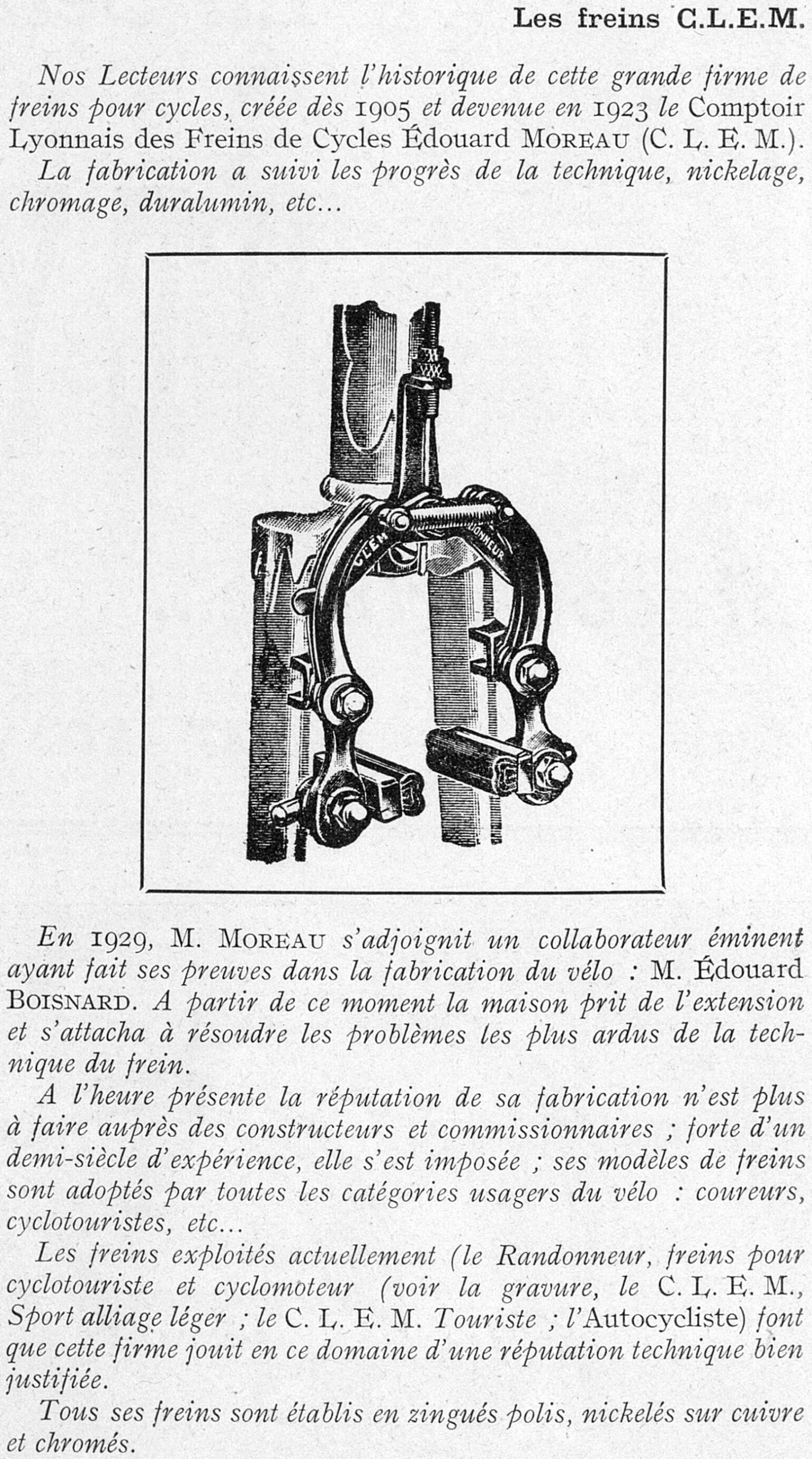
[Ebykr summary, after the illustration. In 1929 M. Moreau took on an eminent collaborator who had proved himself in bicycle manufacture, M. Édouard Boisnard. From then on the firm expanded and set about solving the hardest problems of brake technique. The author says its reputation no longer needs to be made among manufacturers and commission agents; backed by half a century of experience, it has established itself, and its brake models are adopted by every category of bicycle user, racers and touring cyclists among them. The brakes currently made are the Randonneur, a brake for touring cyclists and cyclomotors (see the engraving), the C.L.E.M. Sport in light alloy, the C.L.E.M. Touriste and the Autocycliste, which give the firm a well-justified technical reputation. All its brakes are made of polished zinc alloy castings, nickel-plated over copper and chromed.]
[A column notice with a bold roman heading set flush right and italic paragraphs, a framed illustration between them. The illustration, in a thin black rectangular frame, is a halftone engraving of a caliper brake mounted on a fork crown: the two lower legs of the fork run down the page, a rounded arch spans them, and a long cable-adjuster barrel stands above the center. The arch carries the lettering C.L.E.M. and RANDONNEUR, and the two arms end in rectangular brake blocks held by nuts and bolts. The firm name appears in small capitals in the text. No signature or agency mark is visible.]
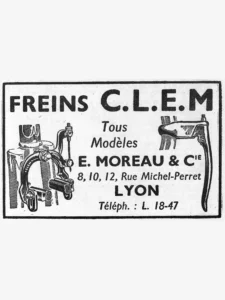 CLEM April 1951 Advertisement — C.L.E.M. Brakes, All Models
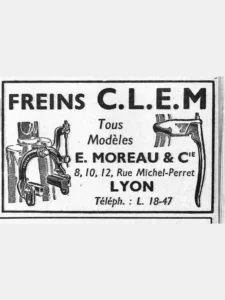 CLEM June 1951 Advertisement — C.L.E.M. Brakes in All Models
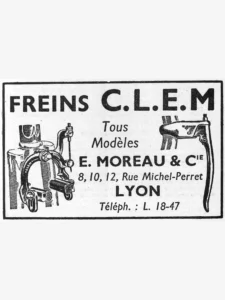 CLEM November 1951 Advertisement — C.L.E.M. Brakes, Every Model
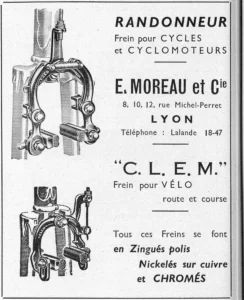 CLEM September 1953 Advertisement — C.L.E.M. brakes: the Randonneur for cycles and cyclomoteurs and a road and racing brake
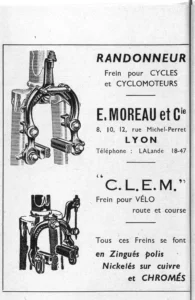 CLEM 1954 Advertisement — The Randonneur Brake and the C.L.E.M. Brake for Road and Racing Bicycles
Ebykr presents this material for research and education. If you hold rights to it or notice an ownership issue, please contact us and we will respond promptly.
The Ebykr Digest
New articles, timelines, catalog finds and registry activity — assembled from the archive once a month. Your address is never shared.
Double opt-in. One email per month. Unsubscribe at any time with one click.