About Ebykr
Ebykr celebrates classic and vintage lightweight bicycles through provocative imagery and opinion. Ride along with us.
About Ebykr
Ebykr celebrates classic and vintage lightweight bicycles through provocative imagery and opinion. Ride along with us.

Source: Gallica (Bibliothèque nationale de France), L'Officiel du cycle, du motocycle et du camping, 19 September 1953, N° 39, page 157; ark:/12148/bd6t54201159j. Source gallica.bnf.fr / BnF.
| Type | Review |
|---|---|
| Year | 1953 |
| Publisher | L'Officiel du cycle |
| Country | France |
| Language | French |
| Pages | 1 |
| Source | Gallica (Bibliothèque nationale de France), L'Officiel du cycle, du motocycle et du camping, 19 September 1953, N° 39, page 157; ark:/12148/bd6t54201159j. Source gallica.bnf.fr / BnF. |
| Credit | Ebykr archive; Bibliothèque nationale de France |
| Identifier | Gallica (BnF) ark:/12148/bd6t54201159j/f156 |
| Transcription | Headings and specifications transcribed; article text summarized |
DÉFENSE DU CYCLISME Le Sport et l'Industrie Les Courses sur Routes Les Courses de Vitesse Pour sauver le Cyclisme par Daniel GOUSSEAU * LE SPORT ET L'INDUSTRIE (Suite page 159)
This is a magazine article, so its running text is summarized here rather than reproduced; the headline, byline, specifications and scores are transcribed as printed.
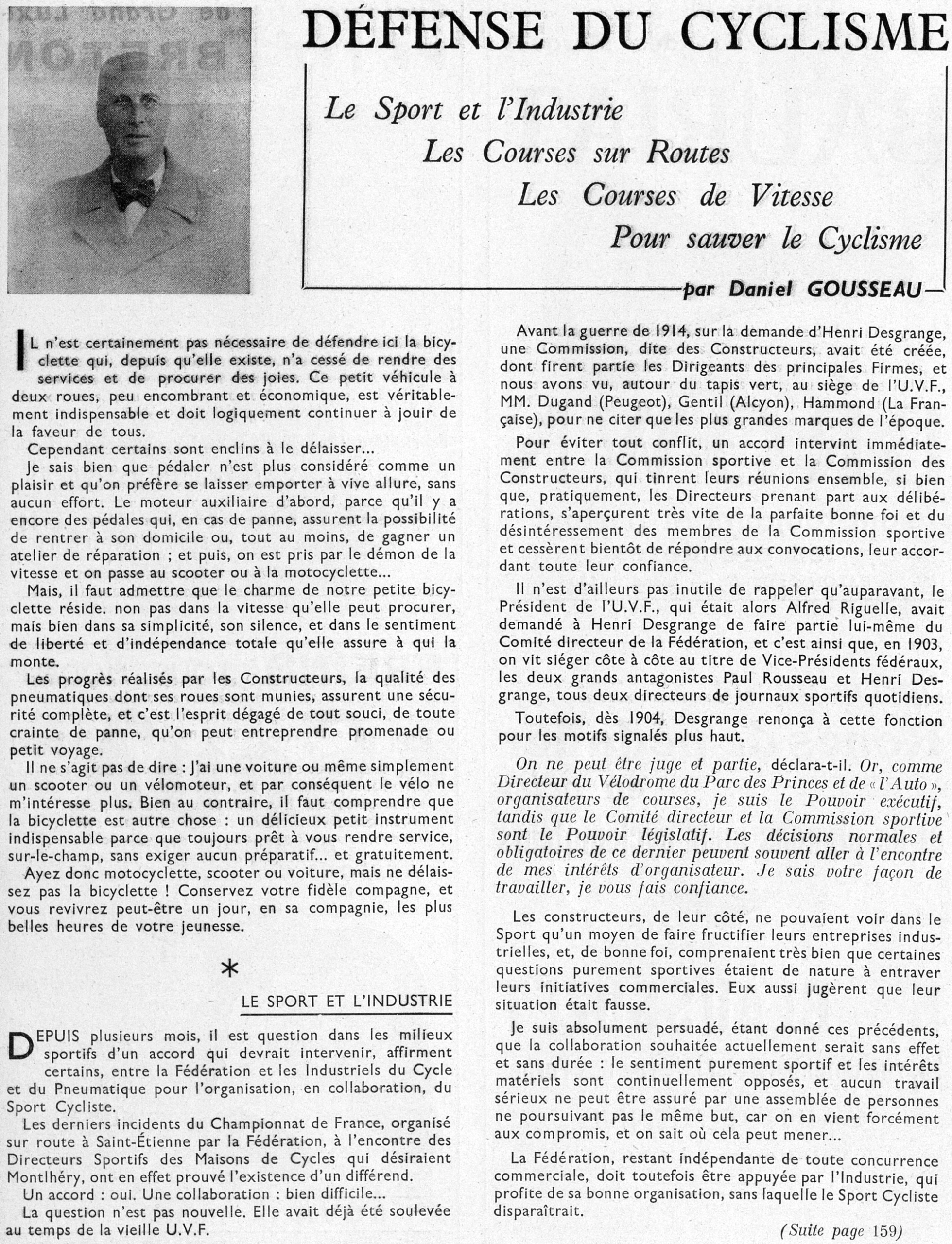
From L’Officiel du cycle, du motocycle et du camping, 19 September 1953, N° 39, the paper’s Salon number du Cycle at the Porte de Versailles, page 157: défense du cyclisme by Daniel Gousseau: the bicycle against the moped and scooter, the sport and the industry, road races, the history of the constructors’ commission before 1914 with Desgrange; portrait photo. The title, headings, captions and lists are transcribed as printed; the text is summarized in Ebykr’s words, and the page images carry it in full.
— Page 1 —
DÉFENSE DU CYCLISME
Le Sport et l’Industrie
Les Courses sur Routes
Les Courses de Vitesse
Pour sauver le Cyclisme
par Daniel GOUSSEAU
[Ebykr summary; the article’s text is not reproduced. Opening section. The author says it is surely unnecessary to defend the bicycle here, since it has always given service and pleasure; it is a small, compact, economical two-wheeled vehicle that is truly indispensable and should keep the favor of everyone, yet some are inclined to abandon it. He knows pedaling is no longer considered a pleasure and that people prefer to be carried along at speed without effort: first with the auxiliary motor, because the pedals remain to get the rider home or to a repair shop in case of breakdown, and then, gripped by the demon of speed, with the scooter or the motorcycle. He argues that the charm of the little bicycle lies not in speed but in its simplicity, its silence and the feeling of freedom and total independence it gives. The progress made by the manufacturers and the quality of the tires give complete safety, so that a ride or a short trip can be undertaken free of worry about breakdowns. One should not say “I have a car, or even a scooter or a moped, so the bicycle no longer interests me”; the bicycle is a delightful little instrument, indispensable because always ready to serve at once, without preparation and free of charge. He urges readers to keep a motorcycle, scooter or car but not to neglect the bicycle, a faithful companion with which they may relive the best hours of their youth.]
*
LE SPORT ET L’INDUSTRIE
[Ebykr summary, under the subheading. For several months sporting circles have been discussing an agreement that, some say, should be reached between the Fédération and the cycle and tire industrialists for the joint organization of cycle sport. The latest incidents of the French Championship, run on the road at Saint-Étienne by the Fédération against the wishes of the sporting directors of the cycle firms, who wanted Montlhéry, have proved that a difference exists. An agreement, yes; a collaboration, very difficult. The question is not new; it was already raised in the days of the old U.V.F. Before the war of 1914, at the request of Henri Desgrange, a so-called Commission des Constructeurs was set up, with the heads of the main firms as members; the author recalls seeing, around the green baize at the U.V.F. headquarters, MM. Dugand (Peugeot), Gentil (Alcyon) and Hammond (La Française), to name only the biggest marques of the time. To avoid any conflict an agreement was reached at once between the Sporting Commission and the Constructors’ Commission, which held their meetings together; the directors taking part soon saw the perfect good faith and disinterestedness of the Sporting Commission members and soon stopped answering the summonses, giving them their full confidence. The author also recalls that earlier the U.V.F. president, then Alfred Riguelle, had asked Henri Desgrange to sit on the Fédération’s governing committee, so that in 1903 the two great antagonists Paul Rousseau and Henri Desgrange, both directors of daily sports papers, sat side by side as federal vice-presidents. In 1904, however, Desgrange gave up the post, saying (in italics) that one cannot be judge and party: as director of the Parc des Princes velodrome and of « l’Auto », organizers of races, he is the executive power while the governing committee and the Sporting Commission are the legislative power, whose normal and binding decisions may often run against his interests as an organizer; he knows their way of working and trusts them. The constructors for their part saw in sport only a means of making their industrial concerns pay and understood in good faith that some purely sporting questions could hamper their commercial initiatives; they too judged their position false. The author is therefore absolutely convinced that the collaboration now wished for would have neither effect nor duration, because the purely sporting spirit and material interests are constantly opposed, and no serious work can be done by an assembly of people who do not pursue the same aim, since compromises are unavoidable. The Fédération, staying independent of all commercial competition, should nonetheless be supported by the industry, which profits from its good organization and without which cycle sport would disappear.]
(Suite page 159)
[An editorial page of text with a halftone portrait and a ruled headline panel, set in two columns. At the upper left a rectangular halftone portrait photograph without a caption shows an older man with thin gray hair, rimless glasses, a bow tie and a lapeled overcoat, seen to the chest and looking toward the viewer; at the top of the photograph a line of mirror-reversed lettering reads roughly “de Grand Lux” with a second line of large reversed capitals that appears to read “BRETON”, and no signature is visible. To the right the headline “DÉFENSE DU CYCLISME” stands in large black roman capitals over a ruled panel open at the upper right, whose left and lower edges are drawn as single lines; inside, four lines of large italic type, “Le Sport et l’Industrie”, “Les Courses sur Routes”, “Les Courses de Vitesse” and “Pour sauver le Cyclisme”, step to the right line by line. The byline “par Daniel GOUSSEAU” in bold italic capitals runs along the lower rule of the panel. The text below is in a light sans-serif type, with a heavy vertical bar as the initial before “IL” and a large ornamental capital D before the second section, a small centered asterisk and a right-aligned small-capital subheading between them, and a short italic quotation of Desgrange within the right column. The closing “(Suite page 159)” stands at the foot of the right column in italic.]
Ebykr presents this material for research and education. If you hold rights to it or notice an ownership issue, please contact us and we will respond promptly.
The Ebykr Digest
New articles, timelines, catalog finds and registry activity — assembled from the archive once a month. Your address is never shared.
Double opt-in. One email per month. Unsubscribe at any time with one click.