About Ebykr
Ebykr celebrates classic and vintage lightweight bicycles through provocative imagery and opinion. Ride along with us.
About Ebykr
Ebykr celebrates classic and vintage lightweight bicycles through provocative imagery and opinion. Ride along with us.

Source: Gallica (Bibliothèque nationale de France), L'Officiel du cycle, du motocycle et du camping, 19 September 1953, N° 39, page 161; ark:/12148/bd6t54201159j. Source gallica.bnf.fr / BnF.
| Type | Review |
|---|---|
| Year | 1953 |
| Publisher | L'Officiel du cycle |
| Country | France |
| Language | French |
| Pages | 2 |
| Source | Gallica (Bibliothèque nationale de France), L'Officiel du cycle, du motocycle et du camping, 19 September 1953, N° 39, page 161; ark:/12148/bd6t54201159j. Source gallica.bnf.fr / BnF. |
| Credit | Ebykr archive; Bibliothèque nationale de France |
| Identifier | Gallica (BnF) ark:/12148/bd6t54201159j/f160 |
| Transcription | Headings and specifications transcribed; article text summarized |
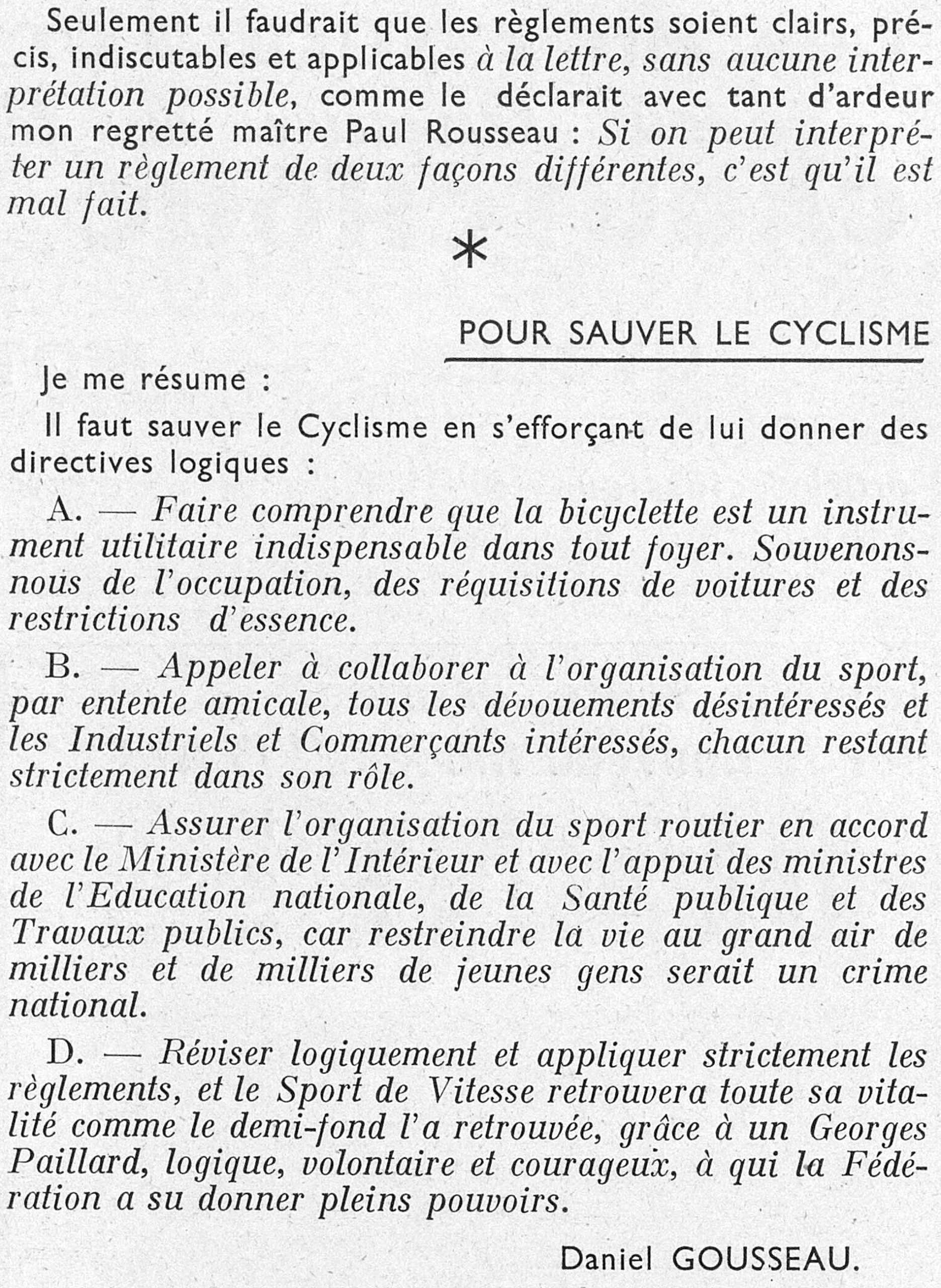
* POUR SAUVER LE CYCLISME Je me résume : Il faut sauver le Cyclisme en s'efforçant de lui donner des directives logiques : A. — Faire comprendre que la bicyclette est un instrument utilitaire indispensable dans tout foyer. Souvenons-nous de l'occupation, des réquisitions de voitures et des restrictions d'essence. B. — Appeler à collaborer à …
This is a magazine article, so its running text is summarized here rather than reproduced; the headline, byline, specifications and scores are transcribed as printed.
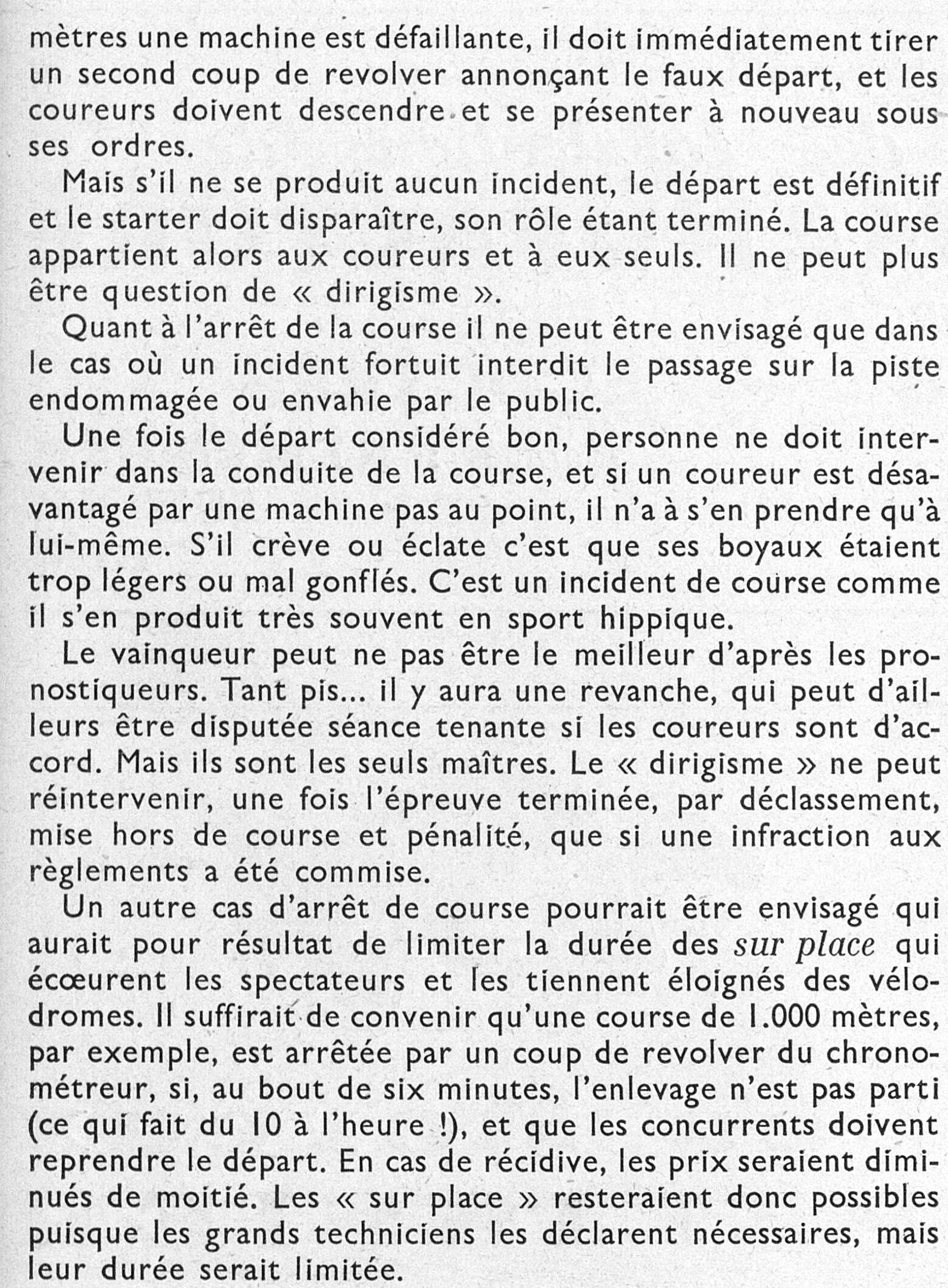
From L’Officiel du cycle, du motocycle et du camping, 19 September 1953, N° 39, the paper’s Salon number du Cycle at the Porte de Versailles, page 161: continuation of the racing editorial (false start in the sprint, stopping a race, the keep-it-clear regulations). The title, headings, captions and lists are transcribed as printed; the text is summarized in Ebykr’s words, and the page images carry it in full.
— Page 1 —
[Ebykr summary; the article’s text is not reproduced. The column continues, without a break, the sentence of the previous page about the starter and the false start: if the starter sees that, within the first meters, a machine is faulty, he must fire a second pistol shot at once to announce the false start, and the riders must dismount and present themselves again under his orders. If no incident occurs, the start is final and the starter must disappear, his role being over; the race then belongs to the riders and to them alone, and there can no longer be any talk of « dirigisme ». A stopping of the race can be envisaged only when a chance incident blocks passage on a damaged track or one invaded by the public. Once the start is judged good, nobody may intervene in the conduct of the race, and a rider handicapped by a machine that is not in order has only himself to blame: if he punctures or bursts, his tubular tires were too light or badly inflated, an incident of the race like those that very often occur in horse racing. The winner may not be the best according to the forecasters; too bad, there will be a return match, which can even be run at once if the riders agree. They alone are masters, and « dirigisme » may step back in after the event, by relegation, disqualification and penalty, only if a breach of the rules has been committed. Another case of stopping a race could be envisaged to limit the length of the « sur place » (track stands), which disgust spectators and keep them away from velodromes: it would suffice to agree that a 1,000-meter race, for example, is stopped by a pistol shot of the timekeeper if, after six minutes, the break-away has not started (which works out at 10 an hour!), and that the competitors must restart; on a repetition the prizes would be halved. The « sur place » would remain possible, since the leading technicians declare them necessary, but their length would be limited.]
[A text column in a light sans-serif type, text only, with a few words in italic (“sur place”). No drawing, heading or signature appears in this part.]
— Page 2 —
[Ebykr summary; the article’s text is not reproduced. Closing lines of the section on the sprint races: the regulations would only have to be clear, precise, indisputable and applicable to the letter with no interpretation possible, as his late master Paul Rousseau declared with such ardor: if a regulation can be interpreted in two different ways, it is badly made.]
*
POUR SAUVER LE CYCLISME
Je me résume :
Il faut sauver le Cyclisme en s’efforçant de lui donner des directives logiques :
A. — Faire comprendre que la bicyclette est un instrument utilitaire indispensable dans tout foyer. Souvenons-nous de l’occupation, des réquisitions de voitures et des restrictions d’essence.
B. — Appeler à collaborer à l’organisation du sport, par entente amicale, tous les dévouements désintéressés et les Industriels et Commerçants intéressés, chacun restant strictement dans son rôle.
C. — Assurer l’organisation du sport routier en accord avec le Ministère de l’Intérieur et avec l’appui des ministres de l’Education nationale, de la Santé publique et des Travaux publics, car restreindre la vie au grand air de milliers et de milliers de jeunes gens serait un crime national.
D. — Réviser logiquement et appliquer strictement les règlements, et le Sport de Vitesse retrouvera toute sa vitalité comme le demi-fond l’a retrouvée, grâce à un Georges Paillard, logique, volontaire et courageux, à qui la Fédération a su donner pleins pouvoirs.
Daniel GOUSSEAU.
[A text column of the article’s closing part, set in a light sans-serif type, with no drawing. A centered asterisk and a right-aligned small-capital subheading “POUR SAUVER LE CYCLISME” with a heavy rule under it open the summary; the four directives A to D are set in italic with the letter and dash in roman and the whole list is given in full above. The signature “Daniel GOUSSEAU.” in roman with the surname in capitals stands flush right at the foot.]
Ebykr presents this material for research and education. If you hold rights to it or notice an ownership issue, please contact us and we will respond promptly.
The Ebykr Digest
New articles, timelines, catalog finds and registry activity — assembled from the archive once a month. Your address is never shared.
Double opt-in. One email per month. Unsubscribe at any time with one click.