About Ebykr
Ebykr celebrates classic and vintage lightweight bicycles through provocative imagery and opinion. Ride along with us.
About Ebykr
Ebykr celebrates classic and vintage lightweight bicycles through provocative imagery and opinion. Ride along with us.

Source: Gallica (Bibliothèque nationale de France), L'Officiel du cycle, du motocycle et du camping, 19 September 1953, N° 39, page 159; ark:/12148/bd6t54201159j. Source gallica.bnf.fr / BnF.
| Type | Review |
|---|---|
| Year | 1953 |
| Publisher | L'Officiel du cycle |
| Country | France |
| Language | French |
| Pages | 2 |
| Source | Gallica (Bibliothèque nationale de France), L'Officiel du cycle, du motocycle et du camping, 19 September 1953, N° 39, page 159; ark:/12148/bd6t54201159j. Source gallica.bnf.fr / BnF. |
| Credit | Ebykr archive; Bibliothèque nationale de France |
| Identifier | Gallica (BnF) ark:/12148/bd6t54201159j/f158 |
| Transcription | Headings and specifications transcribed; article text summarized |
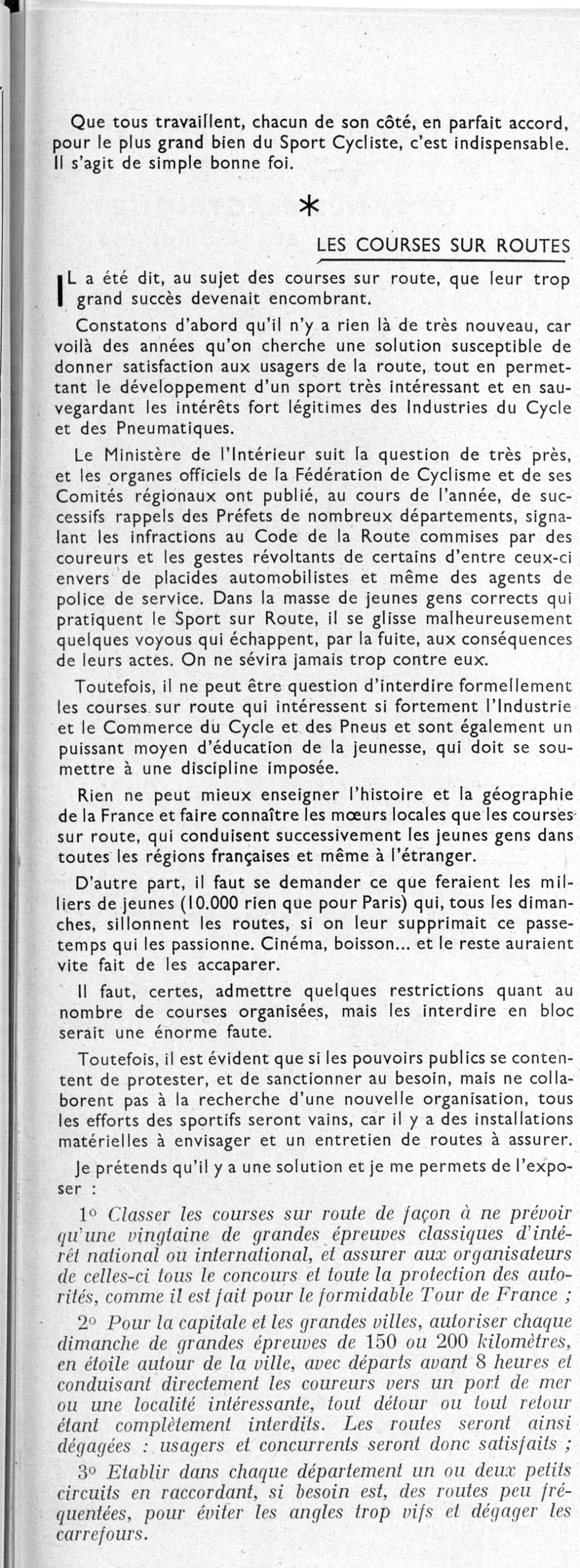
* LES COURSES SUR ROUTES 1° Classer les courses sur route de façon à ne prévoir qu'une vingtaine de grandes épreuves classiques d'intérêt national ou international, et assurer aux organisateurs de celles-ci tous le concours et toute la protection des autorités, comme il est fait pour le formidable Tour de France ; 2° Pour la …
This is a magazine article, so its running text is summarized here rather than reproduced; the headline, byline, specifications and scores are transcribed as printed.
From L’Officiel du cycle, du motocycle et du camping, 19 September 1953, N° 39, the paper’s Salon number du Cycle at the Porte de Versailles, page 159: editorial on road racing and track sprints: ‘Les courses sur routes’ (road races, proposed closed circuits shown in a diagram) then ‘Les courses de vitesse’ (the 1953 French sprint championship false-start dispute). The title, headings, captions and lists are transcribed as printed; the text is summarized in Ebykr’s words, and the page images carry it in full.
— Page 1 —
[Ebykr summary; the article’s text is not reproduced. Opening lines of the column, continuing the section “Le Sport et l’Industrie”: everyone must work in perfect agreement, each on his own side, for the greatest good of cycle sport; it is indispensable and a matter of simple good faith.]
*
LES COURSES SUR ROUTES
[Ebykr summary, under the subheading. It has been said that road racing is becoming cumbersome through its very success. The author notes that this is nothing new: for years a solution has been sought that would satisfy road users while allowing a very interesting sport to develop and safeguarding the legitimate interests of the cycle and tire industries. The Ministry of the Interior follows the question closely, and the official organs of the Fédération de Cyclisme and its regional committees have published during the year repeated reminders from the prefects of many departments about breaches of the Highway Code by riders and the revolting behavior of some toward placid motorists and even policemen on duty. Among the mass of well-behaved young men who race on the road a few hooligans slip in who escape the consequences of their acts by flight, and one can never be too severe with them. Yet a formal ban on road racing is out of the question, because the sport matters greatly to the cycle and tire industry and trade and is a powerful means of educating youth, which must accept an imposed discipline. Nothing teaches the history and geography of France and local customs better than road races, which lead young men through every French region and abroad. He asks what the thousands of young riders (10,000 for Paris alone) who roam the roads every Sunday would do if this pastime were taken from them; the cinema, drink and the rest would soon take them over. Some limits on the number of races can be admitted, but banning them outright would be an enormous mistake. If the public authorities merely protest and punish when needed without helping to find a new organization, all the sportsmen’s efforts will be in vain, because material installations must be planned and road upkeep assured. He claims there is a solution and sets it out in three points, given here as printed in italic:]
1° Classer les courses sur route de façon à ne prévoir qu’une vingtaine de grandes épreuves classiques d’intérêt national ou international, et assurer aux organisateurs de celles-ci tous le concours et toute la protection des autorités, comme il est fait pour le formidable Tour de France ;
2° Pour la capitale et les grandes villes, autoriser chaque dimanche de grandes épreuves de 150 ou 200 kilomètres, en étoile autour de la ville, avec départs avant 8 heures et conduisant directement les coureurs vers un port de mer ou une localité intéressante, tout détour ou tout retour étant complètement interdits. Les routes seront ainsi dégagées : usagers et concurrents seront donc satisfaits ;
3° Etablir dans chaque département un ou deux petits circuits en raccordant, si besoin est, des routes peu fréquentées, pour éviter les angles trop vifs et dégager les carrefours.
[A narrow column of text only, the left half of the article’s continuation, set in a light sans-serif text type with a heavy vertical bar as the initial before the first line of the section “IL a été dit”. A small centered asterisk and a right-aligned small-capital subheading with a short rule under it mark the start of the section “LES COURSES SUR ROUTES”. The three numbered proposals at the foot are set in italic with the number and the degree sign in roman. A dark shaded strip of the binding shows along the left edge of the sheet.]
— Page 2 —
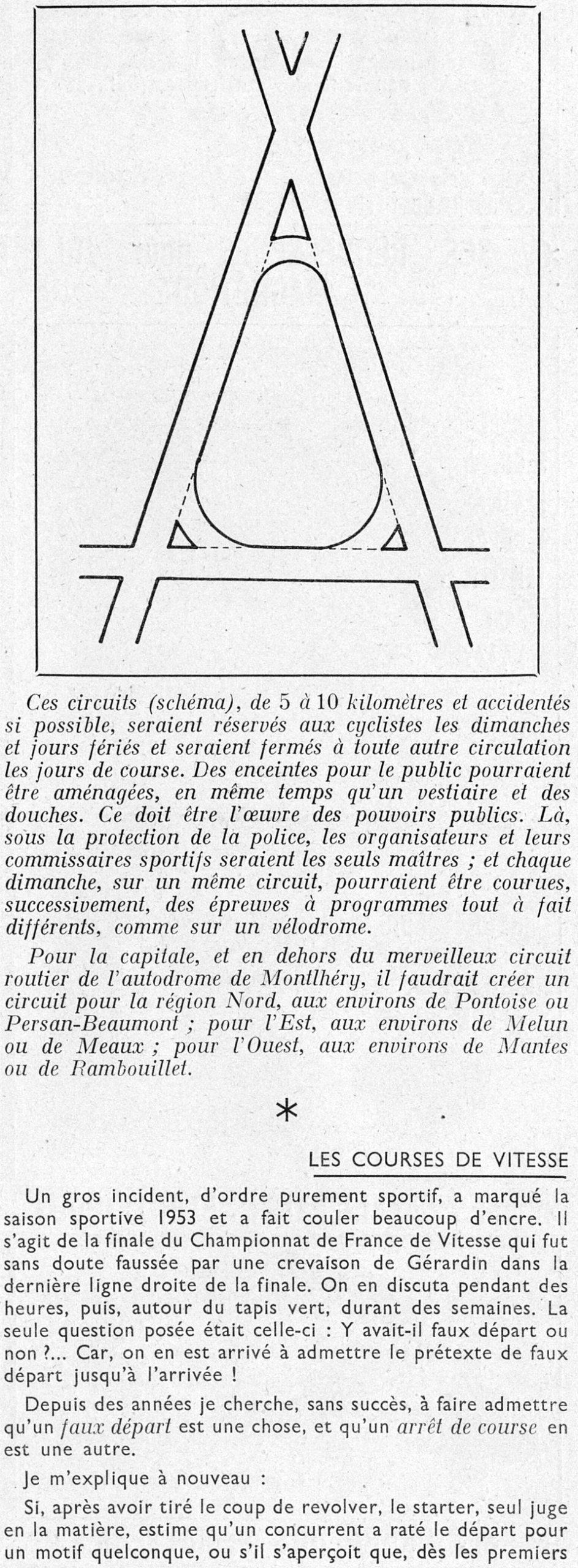
[Ebykr summary; the article’s text is not reproduced. Italic paragraphs under the schema, continuing the third proposal: these circuits (schéma), of 5 to 10 kilometers and hilly if possible, would be reserved for cyclists on Sundays and holidays and closed to all other traffic on race days. Enclosures for the public could be laid out, with a changing room and showers; this must be the work of the public authorities. There, under police protection, the organizers and their sporting commissaires would be the only masters, and each Sunday, on the same circuit, events with entirely different programs could be run one after another, as on a velodrome. For the capital, besides the road circuit of the Montlhéry autodrome, a circuit would be needed for the northern region near Pontoise or Persan-Beaumont, for the east near Melun or Meaux and for the west near Mantes or Rambouillet.]
*
LES COURSES DE VITESSE
[Ebykr summary, under the subheading. A big incident of a purely sporting kind marked the 1953 season and made much ink flow: the final of the French Sprint Championship, which was no doubt spoiled by a puncture of Gérardin in the last straight of the final. It was argued for hours and then, round the green baize, for weeks. The only question posed was whether there had been a false start or not, since the pretext of a false start has come to be accepted all the way to the finish. For years the author has tried without success to have it admitted that a false start is one thing and a stopping of the race (arrêt de course) another. He explains again: if, after the pistol shot, the starter, sole judge in the matter, believes that a competitor has missed the start for some reason, or sees that, from the first]
[A text column with a boxed line diagram at its head, set in two kinds of type. The diagram is a plain line drawing in a single heavy stroke inside a thin rectangular frame: a long triangular wedge of roads like a capital A converges at the top toward a small V-shaped mark, with a small triangular island near the apex, a large rounded triangular circuit in the middle with the three corners cut by dashed lines, two small triangular islands at the lower corners, and a horizontal road across the foot with the four short angled road ends beneath it. No lettering or signature appears in the diagram. Below it the italic paragraphs have no caption beyond them, then a centered asterisk and a right-aligned small-capital subheading “LES COURSES DE VITESSE” lead to roman text in a light sans-serif type, with a few words in italic. The last line is cut at the foot of the crop.]
Ebykr presents this material for research and education. If you hold rights to it or notice an ownership issue, please contact us and we will respond promptly.
The Ebykr Digest
New articles, timelines, catalog finds and registry activity — assembled from the archive once a month. Your address is never shared.
Double opt-in. One email per month. Unsubscribe at any time with one click.