About Ebykr
Ebykr celebrates classic and vintage lightweight bicycles through provocative imagery and opinion. Ride along with us.
About Ebykr
Ebykr celebrates classic and vintage lightweight bicycles through provocative imagery and opinion. Ride along with us.

Source: Gallica (Bibliothèque nationale de France), L'Officiel du cycle, du motocycle et du camping, 19 September 1953, N° 39, page 137; ark:/12148/bd6t54201159j. Source gallica.bnf.fr / BnF.
| Type | Review |
|---|---|
| Year | 1953 |
| Publisher | L'Officiel du cycle |
| Artist | G. Gédovius |
| Country | France |
| Language | French |
| Pages | 2 |
| Source | Gallica (Bibliothèque nationale de France), L'Officiel du cycle, du motocycle et du camping, 19 September 1953, N° 39, page 137; ark:/12148/bd6t54201159j. Source gallica.bnf.fr / BnF. |
| Credit | Ebykr archive; Bibliothèque nationale de France |
| Identifier | Gallica (BnF) ark:/12148/bd6t54201159j/f136 |
| Transcription | Headings and specifications transcribed; article text summarized |
L'AVENIR 1° La légèreté (comparativement à ce qui existe) ; 2° La belle présentation ; 3° La résistance aux agents atmosphériques ; 4° La solidité ; 5° Le prix de revient le plus bas. G. GEDO des Plastiques dans le Vélo * P. MASSON.
This is a magazine article, so its running text is summarized here rather than reproduced; the headline, byline, specifications and scores are transcribed as printed.
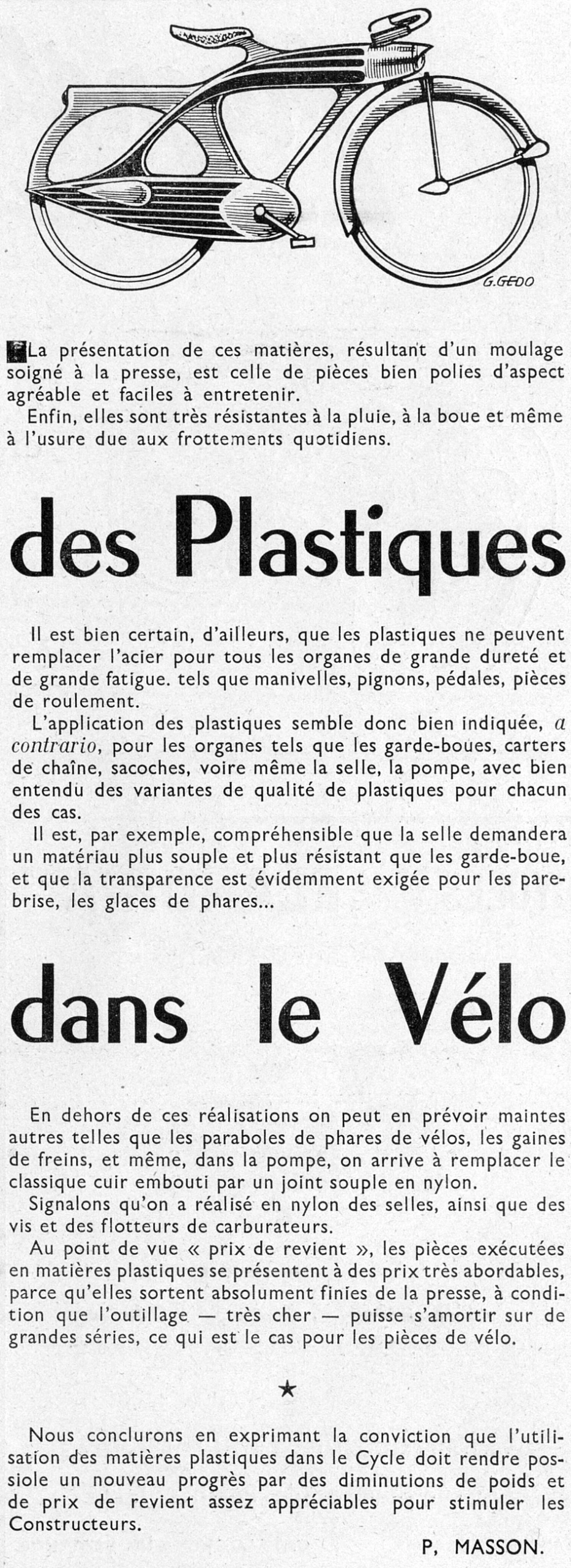
From L’Officiel du cycle, du motocycle et du camping, 19 September 1953, N° 39, the paper’s Salon number du Cycle at the Porte de Versailles, page 137: L’avenir des plastiques dans le vélo by P. Masson: study of plastics for bicycle parts (mudguards, chain cases, saddlebags, saddle, pump, brake cable sheaths, lamp parabolas); a drawing of a streamlined futuristic bicycle. The title, headings, captions and lists are transcribed as printed; the text is summarized in Ebykr’s words, and the page images carry it in full.
— Page 1 —
L’AVENIR
[Ebykr summary; the article’s text is not reproduced. An italic editorial introduction opens the column. It says that the magazine is witnessing, often without quite realizing it, the first genuine conquests of the plastics, which have long held unassailable positions in sectors such as electricity, domestic or automotive, and are now setting out to take “fortresses” until now reserved for metal or for glass and its derivatives. L’Officiel du Cycle et du Motocycle has therefore asked one of its specialist contributors, M. P. Masson, to take stock of the immediate and logical possibilities, or rather probabilities, of plastics as they concern the bicycle. The introduction says that this is not a speculative study, nor an article claiming to settle the subject at the present hour (the magazine will return to it). The opening study sets out the general technical conditions that the various parts of the bicycle impose in current construction and indicates briefly, in parallel, what may reasonably be expected of the known plastics for those same parts. The reader is warned not to expect either a hymn of praise or pessimistic conclusions about the future of plastics in the field. The introduction closes by saying that these materials seem able to bring the bicycle a last advance, after the pedal, the tire, the freewheel and the derailleur, namely a considerable reduction of its weight, besides the ease of machining that plastics offer, and adds that their look suits the style of the second half of the century and does not run against the tendencies of fashion.]
[Ebykr summary, the article proper under the heading. The author says that for some years there has been a deep evolution in every field, at an ever faster rhythm, especially in the use of new materials. Plastics found their first applications in the domestic economy (household objects, small tools, children’s toys) and are now appearing in the automobile and in the cycle. The welcome given to these new materials is often reserved and constructors and technicians are generally prudent enough not to accept a new use without many trials and guarantees.]
[Ebykr summary, after a one-star break. The author asks what qualities should be sought in this sector for the cycle and gives them as the magazine’s opinion, in this order:]
1° La légèreté (comparativement à ce qui existe) ;
2° La belle présentation ;
3° La résistance aux agents atmosphériques ;
4° La solidité ;
5° Le prix de revient le plus bas.
[Ebykr summary, continued. The author holds that the first three conditions are fairly well met by plastics. On lightness, they allow a noticeable gain in weight over current steel, aluminum or aluminum-alloy parts, and the reductions in weight can reach 50 % in many cases. The crop ends here and the article continues in the next column.]
[A text-only column of a magazine article, in three typographic parts. At the top an italic roman introduction opens with a large roman drop capital N, the following letters in small capitals. Below it the heading “L’AVENIR” stands in very large, heavy, widely spaced sans-serif capitals running to the right edge of the crop, so the rest of the heading falls outside the column. The body text then opens with a large roman drop capital D and continues in a light humanist sans-serif face. A single small star ornament is centered between two paragraphs, and the numbered list of five qualities is set indented, with each quality in a bold condensed sans-serif face and the numerals marked with a small raised letter o. No drawing, photograph or signature appears. A dark binding shadow runs down the left edge of the crop.]
— Page 2 —
G. GEDO
[Ebykr summary; the article’s text is not reproduced. The column opens by saying that the finish of these plastic parts, which come from careful molding in the press, is that of well-polished pieces with a pleasant look that are easy to keep clean. It adds that they resist rain, mud and even the wear of daily rubbing.]
des Plastiques
[Ebykr summary, under the middle of the split headline. The author states that plastics cannot replace steel for the parts that need great hardness and endure great fatigue, such as cranks, sprockets, pedals and bearing parts. He therefore sees plastics as well suited, a contrario, for mudguards, chain guards, saddlebags, even the saddle and the pump, each with its own grade of plastic. He gives as examples that the saddle will need a more supple and tougher material than the mudguards, and that transparency is plainly required for windshields and headlamp glasses.]
dans le Vélo
[Ebykr summary, under the second half of the headline. Beyond these uses the author foresees many others, such as headlamp reflectors for bicycles and brake cable housings, and in the pump a flexible nylon seal in place of the classic cupped leather. He notes that saddles, screws and carburetor floats have already been made in nylon. On cost price, he says plastic parts come at very affordable prices because they leave the press fully finished, provided that the tooling, which is very expensive, can be written off over large production runs, as is the case for bicycle parts.]
*
[Ebykr summary, after a single-star break. The author concludes that the use of plastics in the cycle should allow further progress through savings in weight and in cost price large enough to stimulate the manufacturers.]
P. MASSON.
[A text-only column of editorial matter with one line drawing at its head, set in a light sans-serif text type with a small dark square initial block before the first line. The drawing, signed “G. GEDO” in italic capitals at the lower right, is a line engraving with fine hatching of a streamlined bicycle in profile: the frame is a single swept form with open triangular and oval cut-outs, grooved fluting along the top tube and over the chain case, a teardrop-shaped opening near the rear, a curved saddle at the upper left and a small lamp housing with a tubular handlebar grip at the upper right; the wheels are thin rings and the front mudguard is a broad shaded fender with a stand or fork strut standing beside the front hub. Two large headline fragments in heavy black sans-serif type, “des Plastiques” and “dans le Vélo”, cut across the column, each set the full width of the measure. A single small star stands as a break before the closing paragraph, and the signature “P. MASSON.” sits flush right at the foot.]
Ebykr presents this material for research and education. If you hold rights to it or notice an ownership issue, please contact us and we will respond promptly.
The Ebykr Digest
New articles, timelines, catalog finds and registry activity — assembled from the archive once a month. Your address is never shared.
Double opt-in. One email per month. Unsubscribe at any time with one click.