About Ebykr
Ebykr celebrates classic and vintage lightweight bicycles through provocative imagery and opinion. Ride along with us.
About Ebykr
Ebykr celebrates classic and vintage lightweight bicycles through provocative imagery and opinion. Ride along with us.

Source: Gallica (Bibliothèque nationale de France), L'Officiel du cycle, du motocycle et du camping, 2 May 1953, N° 18, page 7; ark:/12148/bd6t541823338. Source gallica.bnf.fr / BnF.
| Type | Review |
|---|---|
| Year | 1953 |
| Publisher | L'Officiel du cycle |
| Country | France |
| Language | French |
| Pages | 1 |
| Source | Gallica (Bibliothèque nationale de France), L'Officiel du cycle, du motocycle et du camping, 2 May 1953, N° 18, page 7; ark:/12148/bd6t541823338. Source gallica.bnf.fr / BnF. |
| Credit | Ebykr archive; Bibliothèque nationale de France |
| Identifier | Gallica (BnF) ark:/12148/bd6t541823338/f7 |
| Transcription | Headings and specifications transcribed; article text summarized |
Reference
"Pérennité de la bicyclette." L'Officiel du cycle, 2 May 1953. Ebykr, https://ebykr.com/library/lofficiel-du-cycle-1953-05-perennite-bicyclette-ducoudray/.
Wikipedia
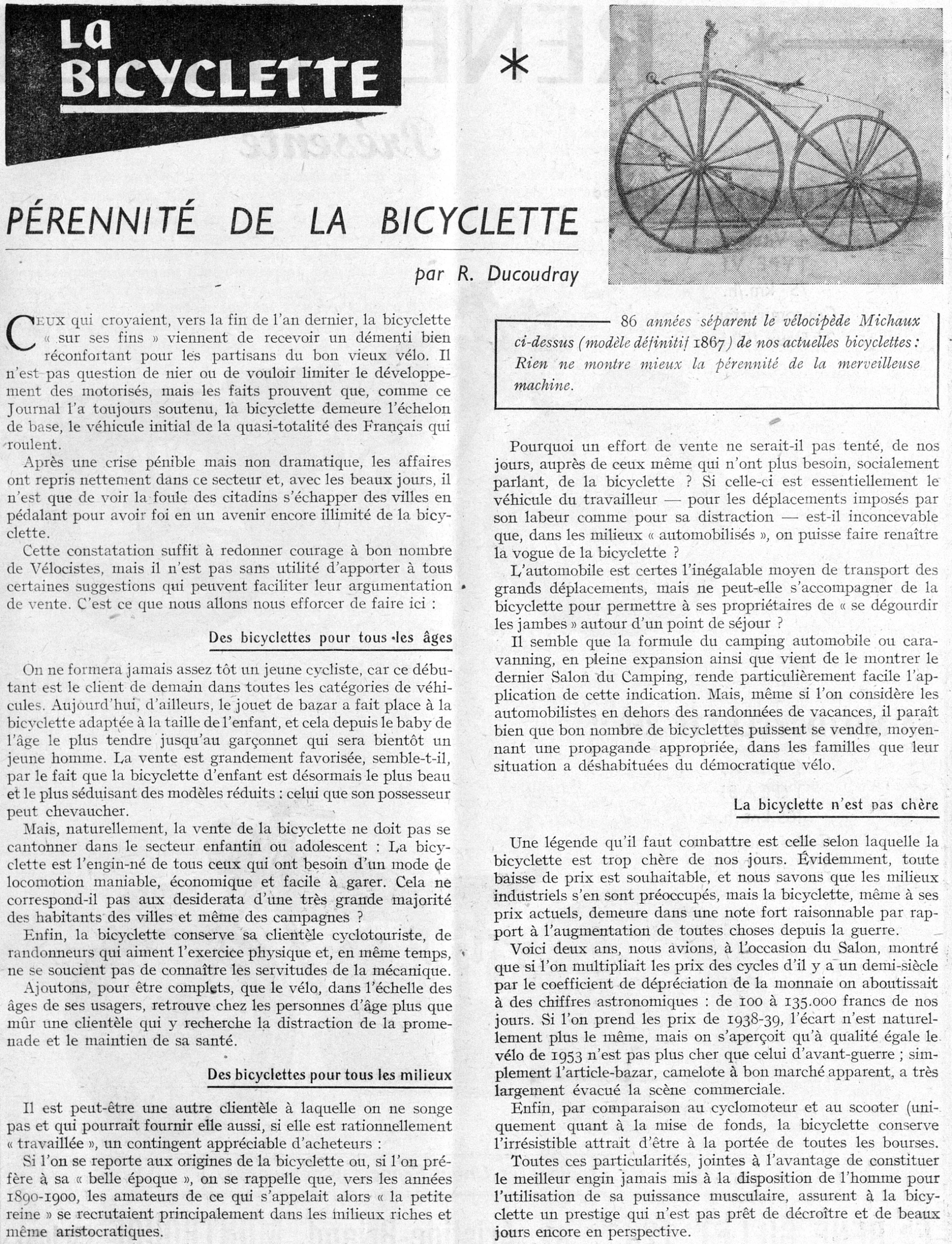
{{cite magazine |title=Pérennité de la bicyclette |magazine=L'Officiel du cycle |date=2 May 1953 |language=French |url=https://ebykr.com/library/lofficiel-du-cycle-1953-05-perennite-bicyclette-ducoudray/ |via=Ebykr |access-date=}}La BICYCLETTE PÉRENNITÉ DE LA BICYCLETTE par R. Ducoudray 86 années séparent le vélocipède Michaux ci-dessus (modèle définitif 1867) de nos actuelles bicyclettes : Rien ne montre mieux la pérennité de la merveilleuse machine. Des bicyclettes pour tous les âges Des bicyclettes pour tous les milieux La bicyclette n'est pas chère
This is a magazine article, so its running text is summarized here rather than reproduced; the headline, byline, specifications and scores are transcribed as printed.
From L’Officiel du cycle, du motocycle et du camping, 2 May 1953, N° 18, the spring number, page 7: “Pérennité de la bicyclette” by R. Ducoudray: the bicycle stays the base vehicle; a photograph of the 1867 Michaux velocipede; arguments for selling bicycles to all ages and classes. The title, headings, captions and lists are transcribed as printed; the text is summarized in Ebykr’s words, and the page images carry it in full.
— Page 1 —
La BICYCLETTE
PÉRENNITÉ DE LA BICYCLETTE
par R. Ducoudray
86 années séparent le vélocipède Michaux
ci-dessus (modèle définitif 1867) de nos actuelles bicyclettes :
Rien ne montre mieux la pérennité de la merveilleuse
machine.
[Ebykr summary; the article’s text is not reproduced. Ducoudray says that those who believed, toward the end of last year, that the bicycle was on its last legs have just been contradicted. He does not deny the growth of motorized vehicles, but the facts show, as the journal has always maintained, that the bicycle remains the basic step and the first vehicle of nearly all French people who travel. After a painful but not dramatic crisis, business has clearly recovered, and the crowd of townspeople pedaling out of the cities in fine weather proves an unlimited future. This should encourage many dealers, and the author offers suggestions that may help their sales arguments.]
Des bicyclettes pour tous les âges
[Ebykr summary. A young cyclist cannot be trained too early, since the beginner is tomorrow’s customer for every class of vehicle. The bazaar toy has given way to the bicycle sized to the child, from the youngest baby up to the boy who will soon be a young man, and the child’s bicycle is now the finest and most attractive of the scale models because the owner can ride it. Sales should not stay in the child and teen sector: the bicycle suits anyone who needs a handy, economical mode of travel that is easy to park, which fits most town and country dwellers. It also keeps its cyclotourist customers, walkers who like exercise without the burdens of mechanics, and elderly people who look for the amusement of a ride and for their health.]
Des bicyclettes pour tous les milieux
[Ebykr summary. Another clientele is overlooked and could supply a considerable number of buyers if rationally worked. Around 1890 to 1900, in the bicycle’s belle époque, the enthusiasts of what was then called la petite reine came chiefly from rich and even aristocratic circles. Ducoudray asks why a sales effort should not be tried today with those who no longer need the bicycle socially. If the bicycle is essentially the worker’s vehicle, for both his work trips and his leisure, it is not inconceivable to revive its vogue among car owners. The car is the unequaled means for long journeys but could be accompanied by a bicycle so that its owners can stretch their legs around a holiday base. Car camping and caravanning, in full expansion as the latest Salon du Camping showed, make this easy to apply, and many bicycles could also be sold with suitable publicity to families whose situation has weaned them from the democratic bicycle.]
La bicyclette n’est pas chère
[Ebykr summary. A legend to be fought says that the bicycle is too dear today. Any price reduction is desirable and industry has been concerned with it, but even at present prices the bicycle remains quite reasonable against the rise of everything since the war. Two years earlier, at the time of the Salon, the journal showed that cycle prices of half a century before, multiplied by the coefficient for the depreciation of money, reached astronomical figures of 100 to 135.000 francs in present money. Taking the prices of 1938-39 the gap is of course different, but at equal quality the 1953 bicycle costs no more than the prewar one; the bazaar article sold at an apparently low price has largely left the commercial scene. Compared with the cyclomotor and the scooter, solely on outlay, the bicycle keeps the irresistible attraction of being within reach of every purse. These features, joined to its being the best machine ever given to man for using his muscular power, assure the bicycle a prestige that is not about to diminish and fine days still ahead.]
[A text article with one photograph, set in two columns of roman type. At the upper left a black banner shaped like a flag, cut at a slant at its lower edge, holds the rubric “La BICYCLETTE” in white shaded capitals with a white rule beneath. Below it the title “PÉRENNITÉ DE LA BICYCLETTE” runs in widely spaced italic capitals over a thin rule, with the byline in italics at its right end. At the upper right a halftone photograph shows an early velocipede with a large spoked rear wheel and a smaller spoked front wheel, a curved frame, a small saddle and a tall handlebar post, against a plain light ground, with a star ornament to its left. Beneath it a ruled box holds the italic caption. The first paragraph opens with an ornamental drop capital C, and two subheadings in each column are set in italics and underlined with a rule. Faint capital letters from the reverse of the leaf show through behind the banner and photograph at the top. No signature or firm address appears.]
Ebykr presents this material for research and education. If you hold rights to it or notice an ownership issue, please contact us and we will respond promptly.
The Ebykr Digest
New articles, timelines, catalog finds and registry activity — assembled from the archive once a month. Your address is never shared.
Double opt-in. One email per month. Unsubscribe at any time with one click.