About Ebykr
Ebykr celebrates classic and vintage lightweight bicycles through provocative imagery and opinion. Ride along with us.
About Ebykr
Ebykr celebrates classic and vintage lightweight bicycles through provocative imagery and opinion. Ride along with us.

Source: Gallica (Bibliothèque nationale de France), L'Officiel du cycle, du motocycle et du camping, 2 May 1953, N° 18, pages 39 and 41; ark:/12148/bd6t541823338. Source gallica.bnf.fr / BnF.
| Type | Review |
|---|---|
| Year | 1953 |
| Publisher | L'Officiel du cycle |
| Country | France |
| Language | French |
| Pages | 3 |
| Source | Gallica (Bibliothèque nationale de France), L'Officiel du cycle, du motocycle et du camping, 2 May 1953, N° 18, pages 39 and 41; ark:/12148/bd6t541823338. Source gallica.bnf.fr / BnF. |
| Credit | Ebykr archive; Bibliothèque nationale de France |
| Identifier | Gallica (BnF) ark:/12148/bd6t541823338/f39 |
| Transcription | Headings and specifications transcribed; article text summarized |
Reference
"Naissance du pneumatique." L'Officiel du cycle, 2 May 1953. Ebykr, https://ebykr.com/library/lofficiel-du-cycle-1953-05-naissance-pneumatique-breyer/.
Wikipedia
{{cite magazine |title=Naissance du pneumatique |magazine=L'Officiel du cycle |date=2 May 1953 |language=French |url=https://ebykr.com/library/lofficiel-du-cycle-1953-05-naissance-pneumatique-breyer/ |via=Ebykr |access-date=}}Souvenirs NAISSANCE du PNEUMATIQUE par Victor BREYER « DIEU ! QUE C'EST LAID ! » ÉTABLI PAR LE VÉTÉRINAIRE IRLANDAIS J. B. DUNLOP LE PREMIER PNEU N'AVAIT RIEN DE COMMERCIAL John DUNLOP Junior (13 ans), fils de J.-B. Dunlop, sur les premiers pneumatiques confectionnés par son père en 1887. ★ LA DÉROUTE DE PADDINGTON ★ …
This is a magazine article, so its running text is summarized here rather than reproduced; the headline, byline, specifications and scores are transcribed as printed.
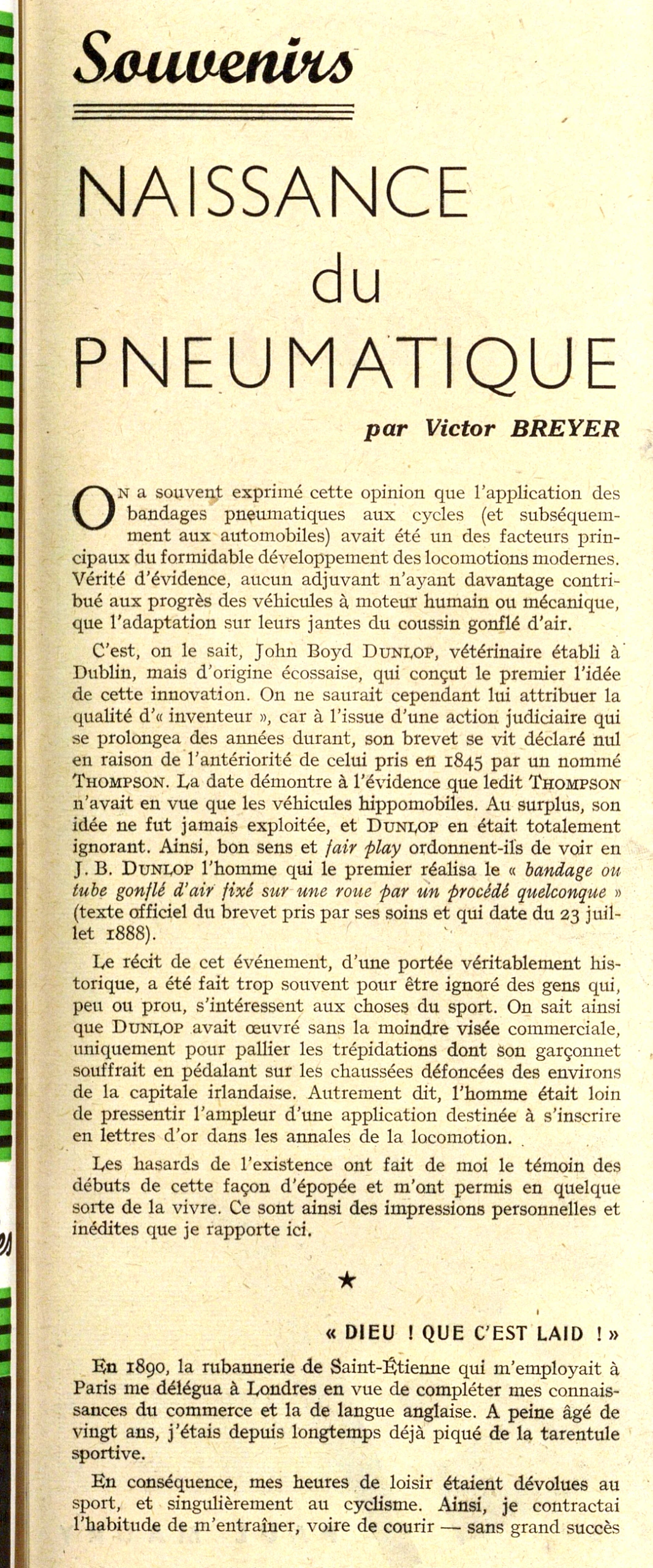
From L’Officiel du cycle, du motocycle et du camping, 2 May 1953, N° 18, the spring number, pages 39 and 41: ‘Souvenirs’: ‘Naissance du pneumatique’ by Victor Breyer, part 1 (left column): the headline, the pneumatic tire of Dunlop and Thompson, ‘Dieu! que c’est laid!’. The title, headings, captions and lists are transcribed as printed; the text is summarized in Ebykr’s words, and the page images carry it in full.
— Page 1 —
Souvenirs
NAISSANCE
du
PNEUMATIQUE
par Victor BREYER
[Ebykr summary; the article’s text is not reproduced. Breyer opens by saying that the application of pneumatic tires to cycles, and later to automobiles, has often been called one of the main factors in the formidable growth of modern locomotion; no aid did more for the progress of human-powered or mechanical vehicles than fitting an air-filled cushion on their rims. It was John Boyd Dunlop, a veterinary surgeon established in Dublin but of Scottish origin, who first conceived the idea. He cannot be called the inventor, however, since after a lawsuit that dragged on for years his patent was declared void because of the earlier one taken in 1845 by a man named Thompson, whose date shows he had only horse-drawn vehicles in view, whose idea was never exploited and of which Dunlop was wholly ignorant. Good sense and fair play therefore lead one to see in J. B. Dunlop the man who first made the « bandage ou tube gonflé d’air fixé sur une roue par un procédé quelconque », the official text of the patent he took out, dated 23 July 1888. The story has been told too often to be unknown to anyone interested in sport: Dunlop worked with no commercial aim, only to ease the jolting his small son suffered pedaling on the broken roads around the Irish capital, and so he was far from sensing the scope of an application destined to be written in letters of gold in the annals of locomotion. Breyer adds that the chances of life made him a witness of the beginnings of this epic, and that what follows is personal and unpublished impressions.]
« DIEU ! QUE C’EST LAID ! »
[Ebykr summary, after a star break. In 1890 the Saint-Étienne ribbon-making firm that employed him in Paris sent him to London to improve his knowledge of trade and of English. Barely twenty, he had long been bitten by the sporting tarantula, so his leisure hours went to sport and especially cycling, and he took up the habit of training and even racing without much success. The column breaks off at the foot of the page in the middle of this sentence and continues on the next block.]
[The first part of a text article, set in a narrow single column of roman type. The rubric “Souvenirs” at the top is in bold italic script-like lettering over a double rule. The title “NAISSANCE du PNEUMATIQUE” is stacked in three lines of large light sans-serif capitals, with the small word “du” centered between the two capital lines, and the byline “par Victor BREYER” below it at the right in bold italics and capitals. The first paragraph opens with a decorated drop capital O. Quoted patent wording is in italics, a star ornament marks the break, and the section heading « DIEU ! QUE C’EST LAID ! » is in bold sans-serif capitals aligned to the right. A green and black striped band runs down the left edge of the item, and a stray letter fragment from a neighboring item shows at the left near the lower middle. No illustration, firm address or signature appears on this block.]
— Page 2 —
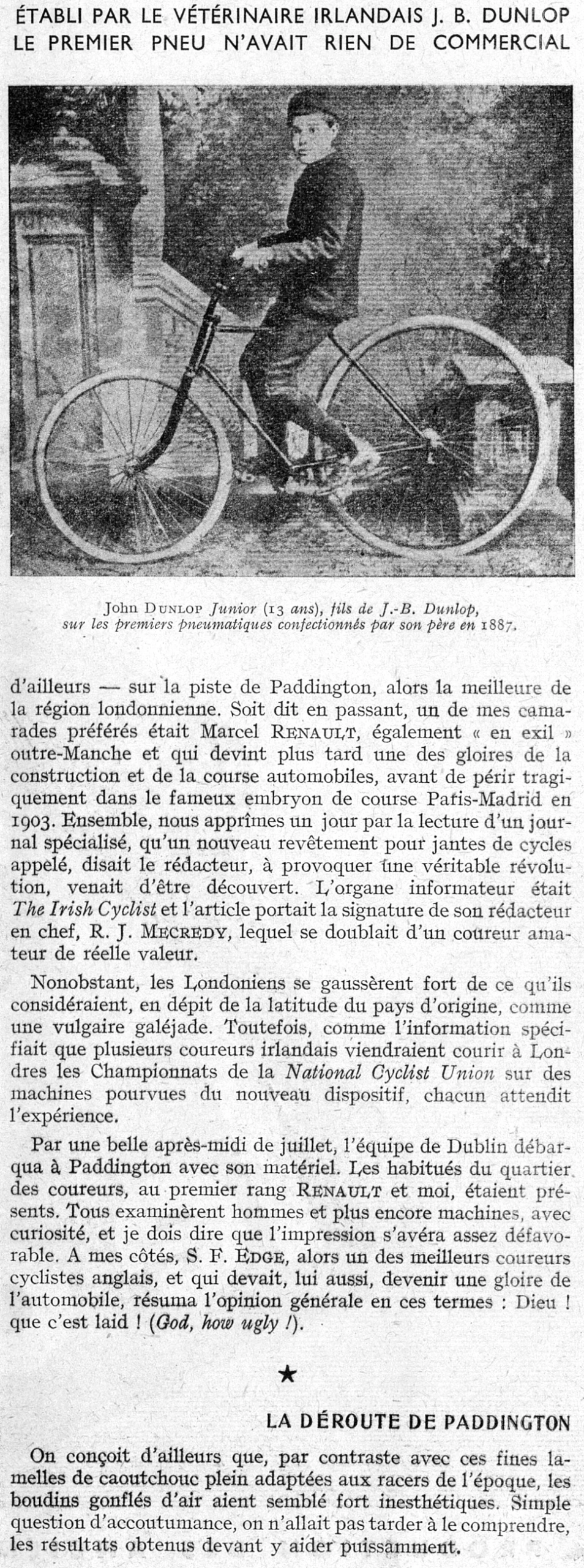
ÉTABLI PAR LE VÉTÉRINAIRE IRLANDAIS J. B. DUNLOP
LE PREMIER PNEU N’AVAIT RIEN DE COMMERCIAL
John DUNLOP Junior (13 ans), fils de J.-B. Dunlop,
sur les premiers pneumatiques confectionnés par son père en 1887.
[Ebykr summary; the article’s text is not reproduced. The crop opens in the middle of a sentence (“d’ailleurs — sur la piste de Paddington”), so the first words belong to the preceding image. Breyer, writing in the first person, recalls that he was then a rider on the Paddington track, at the time the best in the London area, and that one of his favorite comrades there was Marcel Renault, likewise “in exile” across the Channel, who later became a great name in automobile building and racing before dying in the Paris-Madrid affair of 1903. The two read in a specialized journal that a new covering for cycle rims, said to be destined for a real revolution, had just been discovered. The journal was The Irish Cyclist and the article was signed by its editor in chief, R. J. Mecredy, who was also an amateur rider of real merit. The Londoners nonetheless laughed heartily at what they took for a vulgar joke, but when the report said that several Irish riders would come to London for the National Cyclist Union championships on machines fitted with the new device, everyone waited for the trial. On a fine July afternoon the Dublin team landed at Paddington with its equipment. The regulars of the riders’ quarter, Renault and Breyer first among them, examined men and above all machines with curiosity, and the impression was rather unfavorable. Beside Breyer, S. F. Edge, then one of the best English racing cyclists and himself destined to become a name in the automobile, summed up the general opinion: “Dieu ! que c’est laid ! (God, how ugly !)”.]
★
LA DÉROUTE DE PADDINGTON
[Ebykr summary, after a one-star break and the heading above; the article’s text is not reproduced. The author remarks that, by contrast with the thin strips of solid rubber fitted to the racers of the day, the air-filled sausages must have seemed very unaesthetic, a mere matter of getting used to, as the results were soon to help show. The paragraph breaks off at the foot of the column and the sentence carries on at the head of the next image.]
[A column of a magazine page, with a photograph and a caption. Two lines of spaced, widely tracked sans-serif capitals stand across the head as a title over the picture. Below them a halftone photograph, grainy and in sepia-gray tones, shows a boy of about thirteen in a dark jacket and cap sitting astride an early safety bicycle in front of a painted studio backdrop of trees, with a stone pedestal and urn at the left and a balustrade at the right; the bicycle has a bent front fork, a diamond frame, thin spoked wheels and fat tires that show as pale rings round both rims. The caption beneath is set in italic and small capitals, centered under the picture. The running text is in a justified roman book face of one column, with a small black star as a divider and a subheading in bold letter-spaced capitals set flush right. No artist’s signature or agency mark shows on the picture.]
— Page 3 —
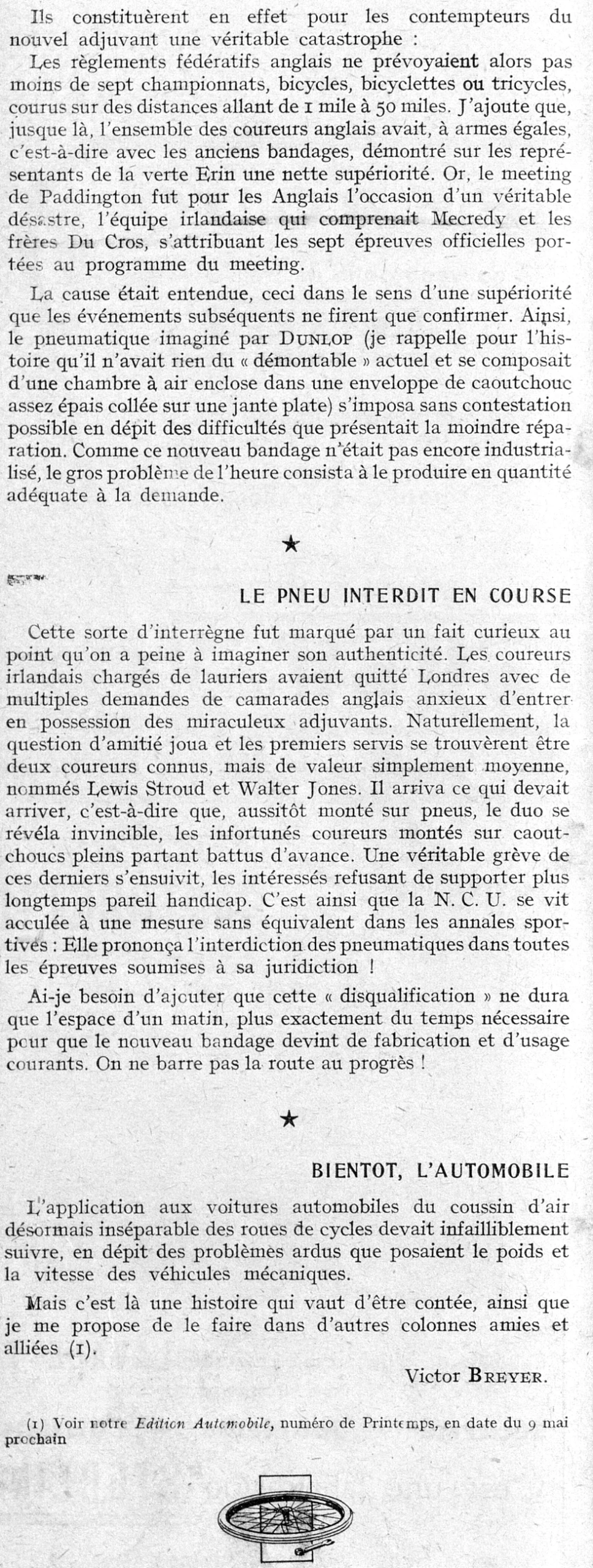
[Ebykr summary; the article’s text is not reproduced. The column opens by continuing the previous image: the inflated tires, says Breyer, were for their detractors a veritable catastrophe. English federation rules then provided for no fewer than seven championships, for “bicycles, bicyclettes ou tricycles” in his words, run over distances from 1 mile to 50 miles. Until then, he adds, English riders on equal terms, meaning on the old solid tires, had shown a clear superiority over the Irish. The Paddington meeting was a disaster for the English: the Irish team, which included Mecredy and the Du Cros brothers, took all seven official events on the program. The cause was settled, and later events only confirmed it. Dunlop’s pneumatic tire, which Breyer recalls for the record had nothing of today’s “démontable” tire and consisted of an air chamber enclosed in a rather thick rubber cover glued to a flat rim, won acceptance beyond dispute despite the difficulty of the slightest repair. Because the new tire was not yet industrialized, the big problem of the hour was to produce it in a quantity adequate to the demand.]
★
LE PNEU INTERDIT EN COURSE
[Ebykr summary; the article’s text is not reproduced. Breyer calls this interregnum marked by a fact so curious that its authenticity is hard to credit. The Irish riders, laden with laurels, left London with many requests from English comrades eager to get hold of the “miraculous” aids. Friendship decided who came first, and the first served were two known but only average riders named Lewis Stroud and Walter Jones. As was bound to happen, once fitted with pneumatic tires the pair proved invincible, and the riders left on solid rubber started beaten in advance. A veritable strike by the latter followed, as they refused to bear such a handicap any longer, and the N. C. U. was driven to a measure without equivalent in sporting annals: it banned pneumatic tires in all events under its jurisdiction. Breyer adds that this “disqualification” lasted no longer than a morning, or more exactly the time needed for the new tire to become a matter of ordinary manufacture and use, and concludes: “On ne barre pas la route au progrès !”]
★
BIENTOT, L’AUTOMOBILE
[Ebykr summary; the article’s text is not reproduced. The application of the air cushion, by now inseparable from cycle wheels, to motor cars was bound to follow, in spite of the hard problems posed by the weight and speed of mechanical vehicles. That, Breyer closes, is a story worth telling, which he proposes to do in other friendly and allied columns, with a footnote reference (1).]
Victor BREYER.
(1) Voir notre Edition Automobile, numéro de Printemps, en date du 9 mai prochain
[A column of running text from a magazine page, with no photograph. The body is set in a justified roman book face with indented paragraphs. Each section heading is in bold, letter-spaced roman capitals set flush right, and a small black star centered on its own line separates the three sections. The signature “Victor BREYER.” is in roman with small capitals, set flush right under the last paragraph. The footnote below it is in smaller type, with the title of the Edition Automobile in italics. At the foot stands a small line drawing, a tailpiece, of a bicycle wheel lying flat and seen in perspective with its spokes, hub and a thick tire, a spanner beside it, and a plain rectangular ruled frame cutting across it; the lowest edge of that frame is clipped at the foot of the image. No artist’s signature or agency mark shows.]
Ebykr presents this material for research and education. If you hold rights to it or notice an ownership issue, please contact us and we will respond promptly.
The Ebykr Digest
New articles, timelines, catalog finds and registry activity — assembled from the archive once a month. Your address is never shared.
Double opt-in. One email per month. Unsubscribe at any time with one click.