About Ebykr
Ebykr celebrates classic and vintage lightweight bicycles through provocative imagery and opinion. Ride along with us.
About Ebykr
Ebykr celebrates classic and vintage lightweight bicycles through provocative imagery and opinion. Ride along with us.

Source: Gallica (Bibliothèque nationale de France), L'Officiel du cycle, du motocycle et du camping, 2 May 1953, N° 18, page 6; ark:/12148/bd6t541823338. Source gallica.bnf.fr / BnF.
| Type | Review |
|---|---|
| Year | 1953 |
| Publisher | L'Officiel du cycle |
| Country | France |
| Language | French |
| Pages | 1 |
| Source | Gallica (Bibliothèque nationale de France), L'Officiel du cycle, du motocycle et du camping, 2 May 1953, N° 18, page 6; ark:/12148/bd6t541823338. Source gallica.bnf.fr / BnF. |
| Credit | Ebykr archive; Bibliothèque nationale de France |
| Identifier | Gallica (BnF) ark:/12148/bd6t541823338/f6 |
| Transcription | Headings and specifications transcribed; article text summarized |
Reference
"Un étalage original fait vendre." L'Officiel du cycle, 2 May 1953. Ebykr, https://ebykr.com/library/lofficiel-du-cycle-1953-05-etalage-original-veno/.
Wikipedia
{{cite magazine |title=Un étalage original fait vendre |magazine=L'Officiel du cycle |date=2 May 1953 |language=French |url=https://ebykr.com/library/lofficiel-du-cycle-1953-05-etalage-original-veno/ |via=Ebykr |access-date=}}UN ÉTALAGE ORIGINAL FAIT VENDRE par Robert VENO, Chargé de Cours d'Étalage à l'Enseignement Technique, Vice-Président de la Fédération des Étalagistes de France.
This is a magazine article, so its running text is summarized here rather than reproduced; the headline, byline, specifications and scores are transcribed as printed.
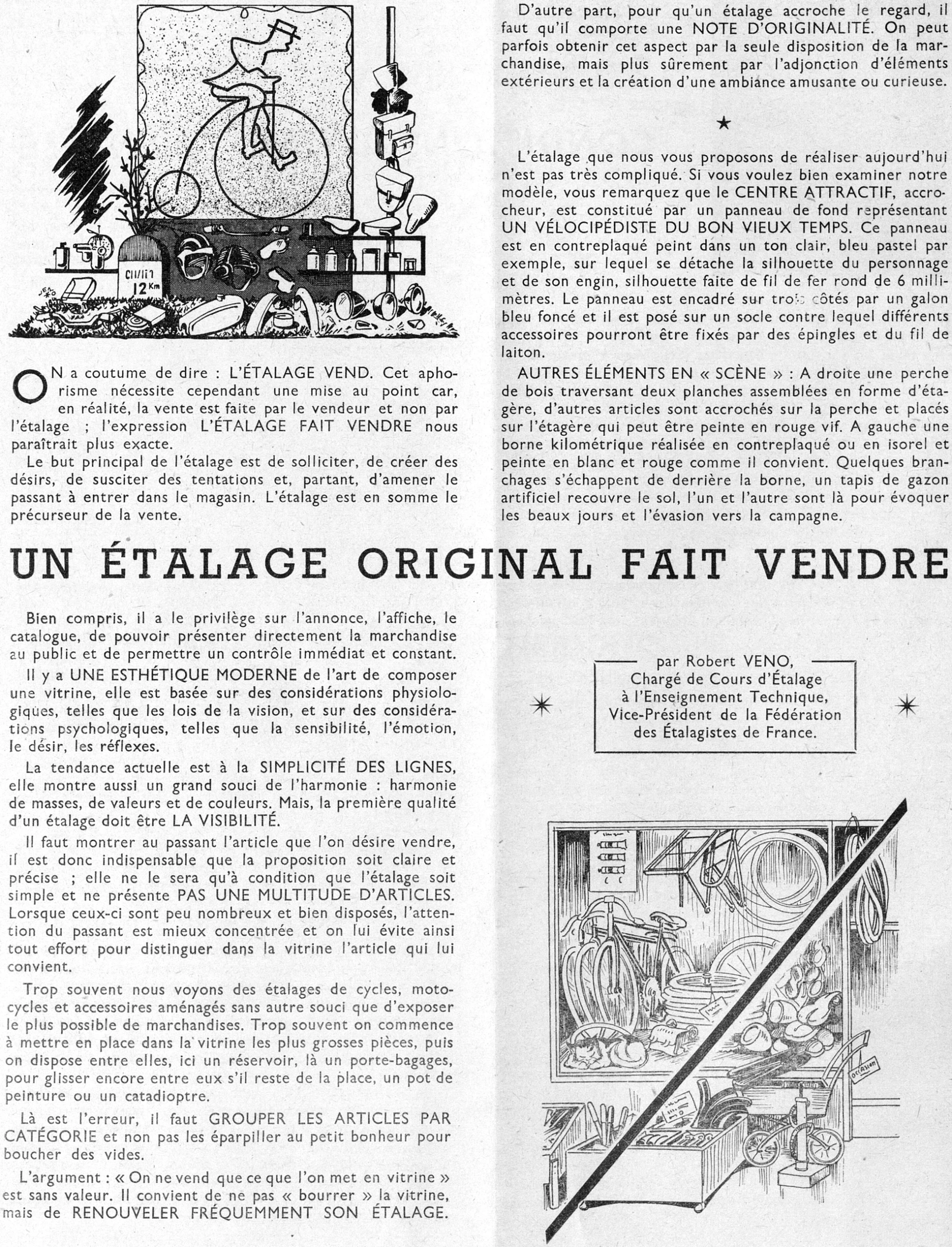
From L’Officiel du cycle, du motocycle et du camping, 2 May 1953, N° 18, the spring number, page 6: “Un étalage original fait vendre” by Robert Veno: shop window display; drawings of a penny-farthing cutout display with accessories and of a window with bicycles, tires and accessories. The title, headings, captions and lists are transcribed as printed; the text is summarized in Ebykr’s words, and the page images carry it in full.
— Page 1 —
UN ÉTALAGE ORIGINAL FAIT VENDRE
par Robert VENO,
Chargé de Cours d’Étalage
à l’Enseignement Technique,
Vice-Président de la Fédération
des Étalagistes de France.
[Ebykr summary; the article’s text is not reproduced. Veno opens with the saying that the display sells, and corrects it: the salesman makes the sale, so the display is better described as helping to sell. Its main purpose is to arouse desires and temptations and so lead the passer-by into the shop; it is the forerunner of the sale. Its advantage over the advertisement, the poster and the catalog is that it shows the goods directly and allows an immediate and constant check. He describes a modern esthetic of window dressing resting on physiological considerations (the laws of vision) and psychological ones (sensitivity, emotion, desire, reflexes). The present trend is toward simplicity of line and harmony of masses, values and colors, but the first quality of a window is visibility. The article must be shown clearly, so the window must be simple and hold no multitude of articles; with few well-placed pieces the passer-by’s attention stays concentrated. He criticizes cycle, motorcycle and accessory windows laid out only to show as much stock as possible: the biggest pieces go in first, then a tank, a luggage carrier, a paint pot or a rear reflector are squeezed between them. His remedy is to group the articles by category rather than scatter them to fill gaps; the argument that one sells only what one puts in the window is worthless, and the window should not be crammed but renewed often.]
[Ebykr summary, after the first column break. A window must also carry a note of originality to catch the eye, obtained sometimes by the arrangement of the goods alone but more surely by outside elements and an amusing or curious atmosphere. After a star break, Veno describes the display he proposes, which he calls not very complicated. Its attraction is a backdrop panel showing a cyclist of the old days, in plywood painted a pale tone such as pastel blue, against which the rider and his machine stand out as a silhouette made of 6 millimeter round wire. The panel is framed on three sides by a dark blue braid and set on a plinth against which accessories can be fixed with pins and brass wire. Other elements of the scene: on the right a wooden pole passing through two boards joined as a shelf unit, with more articles hung on the pole and set on the shelves, which may be painted bright red; on the left a kilometer stone of plywood or Isorel painted white and red; some branches behind the stone and a carpet of artificial grass over the floor, all meant to evoke fine days and escape to the country.]
[A text article with two line drawings, set in two columns of roman type with a few key phrases in capitals. The headline “UN ÉTALAGE ORIGINAL FAIT VENDRE” runs across the full width in large, widely spaced shaded roman capitals. A ruled box at the center right holds the byline in centered roman type, flanked by two small star ornaments. At the upper left a pen-and-ink drawing with a stippled panel shows a penny-farthing rider cut out in outline against a scalloped curtain-like backdrop; on the plinth below lie a helmet, goggles, a lamp, a fuel tank, a mudguard, saddles and small bottles, with a kilometer stone marked “12 Km” at the left, a bare branch and a dark hatched tree shape, and at the right a pole hung with saddlebags, saddles and lamps above a low shelf. A small hand-lettered signature at the lower left of this drawing appears to read “JEAN” with a star, and it is not clearly legible. At the lower right a second line drawing, in finer hatching, is divided by a heavy black diagonal bar: on the upper left a crowded window shows a bicycle, wheels, frames, tires and a sleeping cat; on the lower right an untidy case of tools, a child’s tricycle, a pump, a pram handle and a tag reading “OCCASION”. Each text column begins with a plain paragraph; the first paragraph opens with a large drop capital O. No firm name or address appears.]
Ebykr presents this material for research and education. If you hold rights to it or notice an ownership issue, please contact us and we will respond promptly.
The Ebykr Digest
New articles, timelines, catalog finds and registry activity — assembled from the archive once a month. Your address is never shared.
Double opt-in. One email per month. Unsubscribe at any time with one click.