About Ebykr
Ebykr celebrates classic and vintage lightweight bicycles through provocative imagery and opinion. Ride along with us.
About Ebykr
Ebykr celebrates classic and vintage lightweight bicycles through provocative imagery and opinion. Ride along with us.

Source: Gallica (Bibliothèque nationale de France), L'Officiel du cycle, du motocycle et du camping, 2 May 1953, N° 18, page 35; ark:/12148/bd6t541823338. Source gallica.bnf.fr / BnF.
| Type | Review |
|---|---|
| Year | 1953 |
| Publisher | L'Officiel du cycle |
| Country | France |
| Language | French |
| Pages | 1 |
| Source | Gallica (Bibliothèque nationale de France), L'Officiel du cycle, du motocycle et du camping, 2 May 1953, N° 18, page 35; ark:/12148/bd6t541823338. Source gallica.bnf.fr / BnF. |
| Credit | Ebykr archive; Bibliothèque nationale de France |
| Identifier | Gallica (BnF) ark:/12148/bd6t541823338/f35 |
| Transcription | Headings and specifications transcribed; article text summarized |
Reference
"Deux belles industries françaises : le dérailleur et la roue libre." L'Officiel du cycle, 2 May 1953. Ebykr, https://ebykr.com/library/lofficiel-du-cycle-1953-05-derailleur-roue-libre-raimond/.
Wikipedia
{{cite magazine |title=Deux belles industries françaises : le dérailleur et la roue libre |magazine=L'Officiel du cycle |date=2 May 1953 |language=French |url=https://ebykr.com/library/lofficiel-du-cycle-1953-05-derailleur-roue-libre-raimond/ |via=Ebykr |access-date=}}Deux belles Industries françaises LE DÉRAILLEUR ET LA ROUE LIBRE Nous donnons aujourd'hui la partie industrielle de la conférence faite devant la Société des Ingénieurs de l'Automobile par M. Jean Raimond et que nous reproduisons avec l'aimable autorisation de l'auteur et de la S.I.A. (*) Après avoir fait l'historique du changement de vitesse et l'examen …
This is a magazine article, so its running text is summarized here rather than reproduced; the headline, byline, specifications and scores are transcribed as printed.
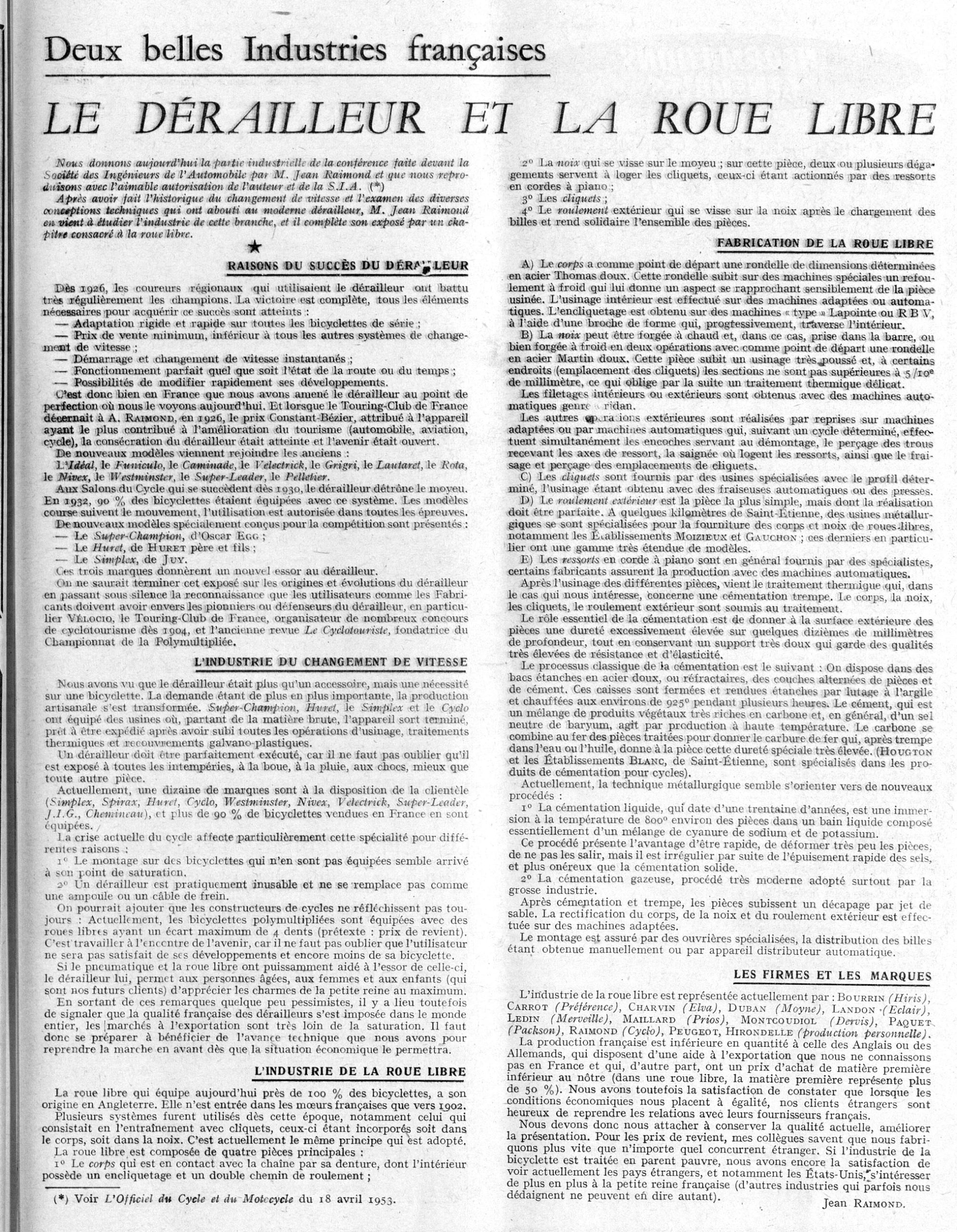
From L’Officiel du cycle, du motocycle et du camping, 2 May 1953, N° 18, the spring number, page 35: ‘Deux belles industries françaises: Le dérailleur et la roue libre’ by Jean Raimond, part 1 (left column): the headline, the introduction, the reasons for the derailleur’s success and the derailleur industry. The title, headings, captions and lists are transcribed as printed; the text is summarized in Ebykr’s words, and the page images carry it in full.
— Page 1 —
Deux belles Industries françaises
LE DÉRAILLEUR ET LA ROUE LIBRE
Nous donnons aujourd’hui la partie industrielle de la conférence faite devant la Société des Ingénieurs de l’Automobile par M. Jean Raimond et que nous reproduisons avec l’aimable autorisation de l’auteur et de la S.I.A. (*)
Après avoir fait l’historique du changement de vitesse et l’examen des diverses conceptions techniques qui ont abouti au moderne dérailleur, M. Jean Raimond en vient à étudier l’industrie de cette branche, et il complète son exposé par un chapitre consacré à la roue libre.
RAISONS DU SUCCÈS DU DÉRAILLEUR
[Ebykr summary; the article’s text is not reproduced. Raimond says that from 1926 regional racers using the derailleur very regularly beat the champions, so the victory was complete, every element needed for that success having been reached, namely:]
— Adaptation rigide et rapide sur toutes les bicyclettes de série ;
— Prix de vente minimum, inférieur à tous les autres systèmes de changement de vitesse ;
— Démarrage et changement de vitesse instantanés ;
— Fonctionnement parfait quel que soit l’état de la route ou du temps ;
— Possibilités de modifier rapidement ses développements.
[Ebykr summary. It was therefore in France that the derailleur was brought to the point of perfection seen in 1953. When the Touring-Club de France awarded A. Raimond in 1926 the Constant-Bézier prize, given to the device that had contributed most to the improvement of touring (automobile, aviation, cycle), the derailleur was consecrated and its future was open. New models joined the old, listed as follows:]
L’Idéal, le Funiculo, le Caminade, le Velectrick, le Grigri, le Lautaret, le Rota, le Nivex, le Westminster, le Super-Leader, le Pelletier.
[Ebykr summary. At the Cycle Salons held from 1930 the derailleur dethroned the hub gear; in 1932, 90 % of bicycles were fitted with the system. Racing models followed the movement and the device was authorized in all events. New models designed especially for competition were presented:]
— Le Super-Champion, d’Oscar Egg ;
— Le Huret, de Huret père et fils ;
— Le Simplex, de Juy.
[Ebykr summary. These three makes gave the derailleur a new surge. Raimond adds that an account of the derailleur’s origins could not end without recalling the gratitude that users and makers owe to its pioneers or defenders, in particular Vélocio, the Touring-Club de France, organizer of many cyclotouring contests from 1904, and the former review Le Cyclotouriste, founder of the Championnat de la Polymultipliée.]
L’INDUSTRIE DU CHANGEMENT DE VITESSE
[Ebykr summary. The derailleur was shown to be more than an accessory, a necessity on a bicycle; with demand rising, craft production changed. Super-Champion, Huret, Simplex and Cyclo equipped factories where the device leaves finished, from raw material through machining, heat treatment and galvano-plastic coatings. A derailleur must be perfectly made, since it is exposed to all weather, mud, rain and knocks more than any other part. At present about ten makes are on offer, named in the text as follows, and more than 90 % of bicycles sold in France carry one:]
(Simplex, Spirax, Huret, Cyclo, Westminster, Nivex, Velectrick, Super-Leader, J.I.G., Chemineau)
[Ebykr summary. The present cycle crisis hits this specialty in particular, for two reasons given in the text:]
1° Le montage sur des bicyclettes qui n’en sont pas équipées semble arrivé à son point de saturation.
2° Un dérailleur est pratiquement inusable et ne se remplace pas comme une ampoule ou un câble de frein.
[Ebykr summary. Raimond adds that cycle makers do not always think ahead: multi-speed bicycles are now fitted with freewheels having a maximum spread of 4 teeth, on the pretext of cost price, which works against the future since the user will not be satisfied with his gearing and still less with his bicycle. If the pneumatic tire and the freewheel greatly helped the bicycle’s rise, the derailleur lets older people, women and children (future customers) enjoy la petite reine to the full. Despite these somewhat pessimistic remarks, he notes that the quality of French derailleurs has won recognition worldwide and that export markets are far from saturated, so the trade should prepare to benefit from its technical lead and resume its advance once the economic situation allows.]
L’INDUSTRIE DE LA ROUE LIBRE
[Ebykr summary. The freewheel, which now equips nearly 100 % of bicycles, originated in England and entered French habits only about 1902. Several systems were used from that time, notably the one with pawls driving either in the body or in the nut; the same principle is still adopted. The freewheel is made of four main parts:]
1° Le corps qui est en contact avec la chaîne par sa denture, dont l’intérieur possède un encliquetage et un double chemin de roulement ;
2° La noix qui se visse sur le moyeu ; sur cette pièce, deux ou plusieurs dégagements servent à loger les cliquets, ceux-ci étant actionnés par des ressorts en cordes à piano ;
3° Les cliquets ;
4° Le roulement extérieur qui se visse sur la noix après le chargement des billes et rend solidaire l’ensemble des pièces.
FABRICATION DE LA ROUE LIBRE
[Ebykr summary. Under headings A to E Raimond describes the making of each part. (A) The body starts as a washer of set dimensions in mild Thomas steel, cold-upset on special machines to approach the finished shape, bored on adapted or automatic machines, and its pawl ratchet cut with a shaped broach on machines of the Lapointe or R B V type. (B) The nut is either hot forged or taken from bar, or cold forged in two operations from a washer of mild Martin steel; it is machined closely, with sections at the pawl seats no more than 5/10 of a millimeter thick, which demands careful heat treatment, and its threads and other operations are done on automatic machines, including the notches for dismounting, the spring-pin holes, the groove for the springs and the milling of the pawl seats. (C) The pawls are supplied by specialist factories to a set profile, machined on automatic milling machines or presses. (D) The outer race is the simplest part but must be made perfectly; a few kilometers from Saint-Étienne, metallurgical works supply freewheel bodies and nuts, notably the Établissements Moizieux and Gauchon, the latter with a very wide range of models. (E) The piano-wire springs are generally supplied by specialists, some makers producing them on automatic machines.]
[Ebykr summary. After machining comes heat treatment, here a case-hardening followed by quenching, applied to the body, nut, pawls and outer race. Its essential role is to give the outer surface an extremely hard layer a few tenths of a millimeter deep over a very soft core that keeps high strength and elasticity. In the classic process, alternate layers of parts and cement are packed in sealed boxes of mild or refractory steel, sealed with clay and heated to about 925 degrees for several hours; the cement, a mixture of carbon-rich vegetable products and usually a neutral barium salt, works at high temperature, the carbon combining with the iron to form an iron carbide that, after quenching in water or oil, gives the special hardness. Houngton and the Établissements Blanc of Saint-Étienne are named as specialists in case-hardening products for cycles. Metallurgical technique now seems to be turning to new processes: (1) liquid case-hardening, about thirty years old, an immersion at about 800 degrees in a bath essentially of sodium and potassium cyanide, which is fast, distorts the parts little and leaves them clean but is irregular because the salts wear out quickly and costs more than solid case-hardening; and (2) gas case-hardening, a very modern process adopted chiefly by large industry. After hardening and quenching the parts are cleaned by sandblasting, the body, nut and outer race are ground on adapted machines, and assembly is done by specialized women workers, the balls being distributed by hand or by an automatic distributor.]
LES FIRMES ET LES MARQUES
L’industrie de la roue libre est représentée actuellement par : Bourrin (Hiris), Carrot (Préférence), Charvin (Elva), Duban (Moyne), Landon (Eclair), Ledin (Merveille), Maillard (Prios), Montcoudiol (Dervis), Paquet (Packson), Raimond (Cyclo), Peugeot, Hirondelle (production personnelle).
[Ebykr summary. French production is smaller in quantity than that of the British or Germans, who have export aid unknown in France and a lower purchase price for raw material, which in a freewheel accounts for more than 50 % of the cost. Raimond is nonetheless pleased to find that when economic conditions put the countries on equal terms, foreign customers are glad to return to their French suppliers. French makers must therefore keep the present quality and improve the presentation; as for cost prices, he says his colleagues know that they manufacture faster than any foreign competitor. If the bicycle industry is treated as a poor relation, he is still pleased to see foreign countries, notably the United States, taking more and more interest in the French petite reine, which he says other industries that sometimes look down on it cannot claim.]
Jean RAIMOND.
(*) Voir L’Officiel du Cycle et du Motocycle du 18 avril 1953.
[A text article without illustration, set in two columns of roman type with a few names in small capitals and the brand and model names in italics. A title in two parts runs across the top: the line “Deux belles Industries françaises” in roman type over a rule, then “LE DÉRAILLEUR ET LA ROUE LIBRE” in large widely spaced italic capitals. The introductory note under it is set in italics. Section headings are in bold sans-serif capitals, centered or set to the right and underlined by a thick rule; star ornaments separate sections. The signature “Jean RAIMOND.” closes the right column in roman type with small capitals, and a footnote in the lower left refers to the issue of 18 April 1953. A small blot hides part of the first heading. No firm address or artist signature appears.]
Ebykr presents this material for research and education. If you hold rights to it or notice an ownership issue, please contact us and we will respond promptly.
The Ebykr Digest
New articles, timelines, catalog finds and registry activity — assembled from the archive once a month. Your address is never shared.
Double opt-in. One email per month. Unsubscribe at any time with one click.