About Ebykr
Ebykr celebrates classic and vintage lightweight bicycles through provocative imagery and opinion. Ride along with us.
About Ebykr
Ebykr celebrates classic and vintage lightweight bicycles through provocative imagery and opinion. Ride along with us.

Source: Gallica (Bibliothèque nationale de France), L'Officiel du cycle, du motocycle et du camping, 2 May 1953, N° 18, page 9; ark:/12148/bd6t541823338. Source gallica.bnf.fr / BnF.
| Type | Review |
|---|---|
| Year | 1953 |
| Publisher | L'Officiel du cycle |
| Country | France |
| Language | French |
| Pages | 1 |
| Source | Gallica (Bibliothèque nationale de France), L'Officiel du cycle, du motocycle et du camping, 2 May 1953, N° 18, page 9; ark:/12148/bd6t541823338. Source gallica.bnf.fr / BnF. |
| Credit | Ebykr archive; Bibliothèque nationale de France |
| Identifier | Gallica (BnF) ark:/12148/bd6t541823338/f9 |
| Transcription | Headings and specifications transcribed; article text summarized |
Reference
"La bicyclette est-elle perfectible ?" L'Officiel du cycle, 2 May 1953. Ebykr, https://ebykr.com/library/lofficiel-du-cycle-1953-05-bicyclette-perfectible-masson/.
Wikipedia
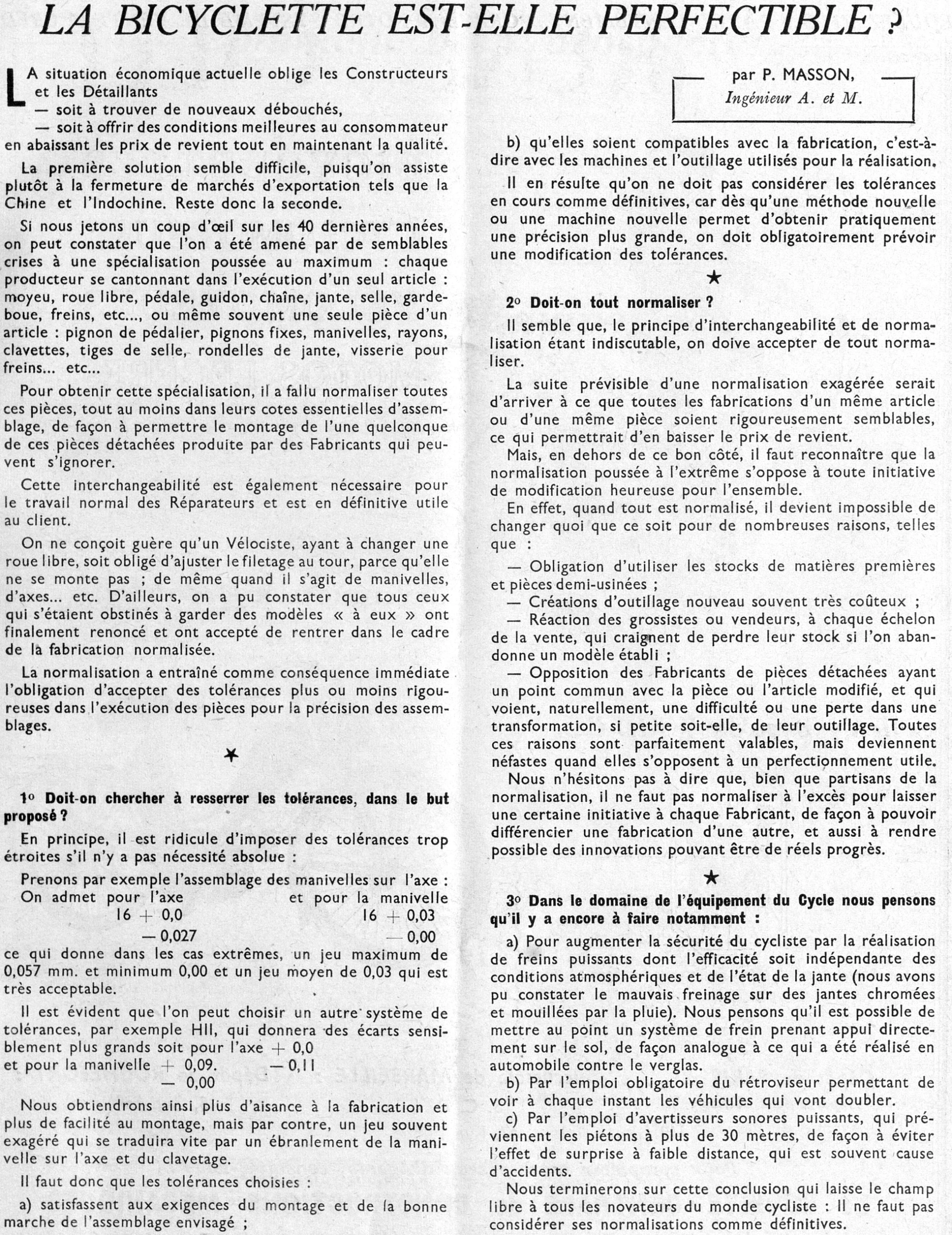
{{cite magazine |title=La bicyclette est-elle perfectible ? |magazine=L'Officiel du cycle |date=2 May 1953 |language=French |url=https://ebykr.com/library/lofficiel-du-cycle-1953-05-bicyclette-perfectible-masson/ |via=Ebykr |access-date=}}LA BICYCLETTE EST-ELLE PERFECTIBLE ? par P. MASSON, Ingénieur A. et M. 1° Doit-on chercher à resserrer les tolérances, dans le but proposé ? Prenons par exemple l'assemblage des manivelles sur l'axe : On admet pour l'axe — et pour la manivelle 16 + 0,0 — 16 + 0,03 — 0,027 — — 0,00 soit …
This is a magazine article, so its running text is summarized here rather than reproduced; the headline, byline, specifications and scores are transcribed as printed.
From L’Officiel du cycle, du motocycle et du camping, 2 May 1953, N° 18, the spring number, page 9: “La bicyclette est-elle perfectible?” by P. Masson, engineer: standardization and tolerances of bicycle parts (hubs, freewheels, cranks) and ideas for better brakes, mirrors and bells. The title, headings, captions and lists are transcribed as printed; the text is summarized in Ebykr’s words, and the page images carry it in full.
— Page 1 —
LA BICYCLETTE EST-ELLE PERFECTIBLE ?
par P. MASSON,
Ingénieur A. et M.
[Ebykr summary; the article’s text is not reproduced. Masson opens by saying that the present economic situation obliges makers and retailers either to find new outlets or to offer the consumer better terms by lowering cost prices while keeping quality. The first course looks hard, since export markets such as China and Indochina are closing, so the second remains. Over the last 40 years similar crises have driven the trade to maximum specialization: each producer keeps to one article (hub, freewheel, pedal, handlebar, chain, rim, saddle, mudguard, brakes) or even to a single part of one (chainwheel sprockets, fixed sprockets, cranks, spokes, cotters, seat pins, rim washers, brake fittings). To achieve this the parts had to be standardized, at least in their essential assembly dimensions, so that parts from makers who may not know one another fit together. Interchangeability also serves repairers and so, in the end, the customer: a dealer fitting a new freewheel should not have to adjust the thread on a lathe, and the same goes for cranks and axles. Makers who clung to models of their own finally gave in and returned to standardized manufacture. A direct consequence was the need to accept tolerances more or less strict in making the parts.]
1° Doit-on chercher à resserrer les tolérances, dans le but proposé ?
[Ebykr summary, after a three-star break. In principle it is ridiculous to impose tolerances narrower than absolutely necessary. As an example Masson takes the fit of cranks on the axle, with the following figures printed in the text:]
Prenons par exemple l’assemblage des manivelles sur l’axe :
On admet pour l’axe — et pour la manivelle
16 + 0,0 — 16 + 0,03
— 0,027 — — 0,00
[Ebykr summary. These give in the extreme cases a maximum clearance of 0.057 mm and a minimum of 0.00, with an average clearance of 0.03 that he calls very acceptable. Another tolerance system, for example H11, could be chosen; it gives clearly larger deviations, printed as follows:]
soit pour l’axe + 0,0 — 0,11
et pour la manivelle + 0,09 — 0,00
[Ebykr summary. This brings more ease in manufacture and assembly but often an excessive clearance that soon shows as looseness of the crank on the axle and of the cotter. The tolerances chosen must therefore (a) meet the requirements of assembly and the proper running of the intended joint and (b) be compatible with manufacture, that is, with the machines and tooling used. It follows that present tolerances should not be taken as final, for as soon as a new method or machine gives practical precision, a change of tolerances must be provided for.]
2° Doit-on tout normaliser ?
[Ebykr summary, after a star break. With interchangeability and standardization beyond dispute, it seems one should accept standardizing everything. The foreseeable result of exaggerated standardization would be that all makes of one article or part become strictly alike, which would lower cost price. But pushed to the extreme it opposes any happy modification of the whole, because when everything is standardized it becomes impossible to change anything, for several reasons which the author lists:]
— Obligation d’utiliser les stocks de matières premières et pièces demi-usinées ;
— Créations d’outillage nouveau souvent très coûteux ;
— Réaction des grossistes ou vendeurs, à chaque échelon de la vente, qui craignent de perdre leur stock si l’on abandonne un modèle établi ;
— Opposition des Fabricants de pièces détachées ayant un point commun avec la pièce ou l’article modifié, et qui voient, naturellement, une difficulté ou une perte dans une transformation, si petite soit-elle, de leur outillage.
[Ebykr summary. All these reasons are perfectly valid but become harmful when they oppose a useful improvement. Masson says that, while a supporter of standardization, one should not standardize to excess, so that each maker keeps some initiative to differentiate his product and to make possible innovations that may be real progress.]
3° Dans le domaine de l’équipement du Cycle nous pensons qu’il y a encore à faire notamment :
[Ebykr summary, after a star break. (a) To raise the cyclist’s safety by powerful brakes whose efficiency is independent of the weather and of the state of the rim; the author has seen poor braking on chromed rims wetted by rain. He thinks a brake system bearing directly on the ground could be developed, in the way done in automobiles against black ice. (b) The compulsory use of a rear-view mirror to show at every moment the vehicles about to overtake. (c) The use of powerful audible warning devices that alert pedestrians at more than 30 meters, to avoid the effect of surprise at short range, which is often a cause of accidents. He closes on a conclusion that leaves the field open to all innovators in the cycling world: one should not consider the standardizations as final.]
[A text article with no illustration, set in two columns of roman type with bold sans-serif subheadings. The title “LA BICYCLETTE EST-ELLE PERFECTIBLE ?” runs across the full width in large italic roman capitals. The byline sits at the upper right in a ruled box, with the author’s name in roman capitals and his qualification in italics. The first paragraph opens with a large drop capital L. Small star ornaments mark the breaks between sections. A few tolerance figures are set in lines of their own inside the left column. No firm name, address or signature appears.]
Ebykr presents this material for research and education. If you hold rights to it or notice an ownership issue, please contact us and we will respond promptly.
The Ebykr Digest
New articles, timelines, catalog finds and registry activity — assembled from the archive once a month. Your address is never shared.
Double opt-in. One email per month. Unsubscribe at any time with one click.