About Ebykr
Ebykr celebrates classic and vintage lightweight bicycles through provocative imagery and opinion. Ride along with us.
About Ebykr
Ebykr celebrates classic and vintage lightweight bicycles through provocative imagery and opinion. Ride along with us.

Source: Gallica (Bibliothèque nationale de France), L'Officiel du cycle, du motocycle et du camping, 20 September 1952, Numéro spécial du Salon 1952, pages 17 and 19; ark:/12148/bd6t541820671. Source gallica.bnf.fr / BnF.
| Type | Review |
|---|---|
| Year | 1952 |
| Publisher | L'Officiel du cycle |
| Country | France |
| Language | French |
| Pages | 2 |
| Source | Gallica (Bibliothèque nationale de France), L'Officiel du cycle, du motocycle et du camping, 20 September 1952, Numéro spécial du Salon 1952, pages 17 and 19; ark:/12148/bd6t541820671. Source gallica.bnf.fr / BnF. |
| Credit | Ebykr archive; Bibliothèque nationale de France |
| Identifier | Gallica (BnF) ark:/12148/bd6t541820671/f17 |
| Transcription | Headings and specifications transcribed; article text summarized |
VERS LE VÉLO DE DEMAIN — par P. MASSON — 1° Surproduction résultant d'une demande exagérée et de prix très rémunérateurs pendant les années qui ont suivi la guerre ; 2° Diminution actuelle de la consommation nationale par suite d'une saturation partielle et momentanée du marché ; 3° Arrêt assez net des exportations, dû en …
This is a magazine article, so its running text is summarized here rather than reproduced; the headline, byline, specifications and scores are transcribed as printed.
From L’Officiel du cycle, du motocycle et du camping, 20 September 1952, the paper’s special number for the 1952 Paris Salon du Cycle et du Motocycle, pages 17 and 19: P. Masson on the causes of the cycle trade’s crisis and the remedies in the bicycle itself, from transmission and tires to mudguards, saddles and cost price. The title, headings, captions and lists are transcribed as printed; the text is summarized in Ebykr’s words, and the page images carry it in full.
— Page 1 —
VERS LE VÉLO DE DEMAIN
— par P. MASSON —
[Ebykr summary; the article’s text is not reproduced. The piece opens on the eve of the Salon and in the face of the crisis the cycle is going through, saying that the paper owes it to itself to affirm its faith in the vitality of the cycle, which will come back more alive after the trial. It then sets out to examine the reasons for that crisis in order to look for a remedy, and calls them numerous:]
1° Surproduction résultant d’une demande exagérée et de prix très rémunérateurs pendant les années qui ont suivi la guerre ;
2° Diminution actuelle de la consommation nationale par suite d’une saturation partielle et momentanée du marché ;
3° Arrêt assez net des exportations, dû en partie aux très bas prix de la concurrence étrangère : Allemagne, Angleterre, Hongrie, Japon. etc…
4° Détournement d’une partie de la clientèle vers le cyclomoteur.
[Ebykr summary; the article’s text is not reproduced. Asking what remedies should be brought to stop this stagnation and start sales again, the author answers with Ford, whom he calls as much a great innovator and bold thinker as a doer: a fall in prices must never be obtained at the cost of the quality of the article nor at the cost of wages, but only by improving the study of the finished product and by intensifying production through a standardization pushed further and further, so as to gain on the total cost of labor. And it must not be forgotten that in any manufactured product there is practically nothing but labor, including in what are called raw materials, since nature never sells anything, and overhead.]
Aspect général
[Ebykr summary; the article’s text is not reproduced. Under this head the author says that the objective examination of a bicycle and of its evolution over more than 20 years allows him to say with near certainty that there will be no deep change in the general form: the petite reine will still be seen with two wheels of equal diameter, mounted on spoked rims and shod with tires, lighter than at present, the two wheels carried by a tubular frame and fork. The making of tubes from strip seems to have reached its height.]
Transmission
[Ebykr summary; the article’s text is not reproduced. As a way of transmitting the effort it is still the system of pedals, cranks, chain and sprockets that is the simplest, the least heavy and the one that gives the best efficiency. It is the chain too that makes gear changes easy to arrange. The author does not think any notable improvement can be had in the transmission.]
Pneumatiques
[Ebykr summary; the article’s text is not reproduced. Taking account of the constant improvement of the roads, the author holds it logical to look for a reduction in the thickness of the rubber tread, which would give more suppleness and lightness.]
Roulements
[Ebykr summary; the article’s text is not reproduced. The principle of ball bearings is equally established by theory and by practice; but the author thinks there would be an improvement to make here in a very large series production, far more precise than the one practiced now, such as that of the makers of annular bearings. It must not be forgotten, he adds, that it is not precision that costs dear, but the dismantling and the retouching caused by a manufacture not precise enough to be interchangeable.]
Garde-boue, carter de chaîne, selles
[Ebykr summary; the article’s text is not reproduced. For all the protective accessories and the saddle the author declares himself in favor of using plastics, which have the advantage of lightness and suppleness and do not fear damage by rust.]
Sécurité
[Ebykr summary; the article’s text is not reproduced. On this head the author holds that much remains to be done on methods of braking, on warning devices and on mirrors, which must constantly give the cyclist a margin of safety in regard to the other users of the road: cars, motorcycles and pedestrians.]
Prix de revient
[Ebykr summary; the article’s text is not reproduced. The author is convinced that a lowering of the cost price, and so of selling prices, is always possible, and that at present that search is becoming a necessity as much for the home market as for the colonial and foreign markets — South America, the Orient, India, China — where French production is seen to fall further and further behind. He therefore suggests:]
1° Économie sur les temps de montage en évitant complètement les retouches par une production de précision ;
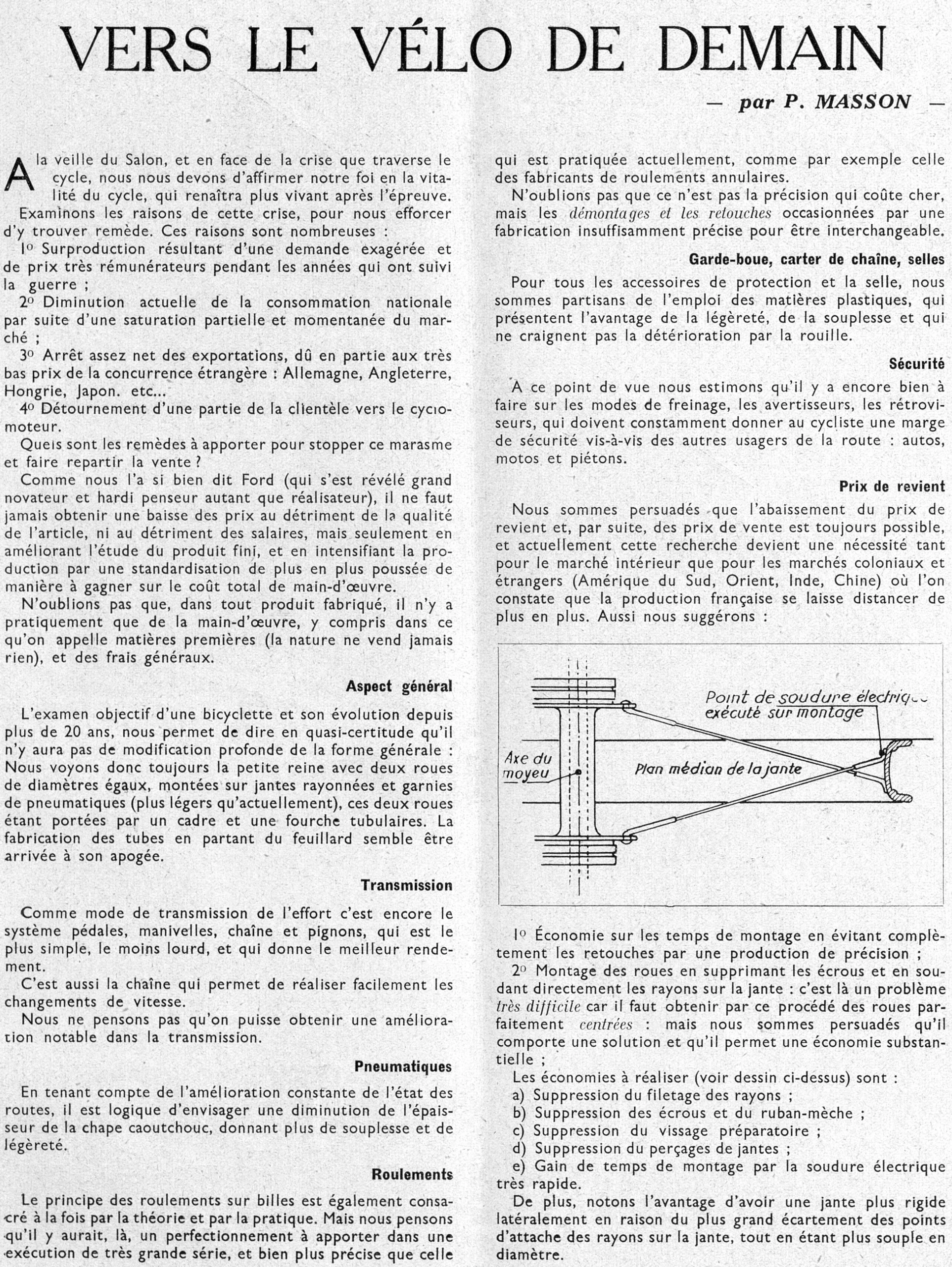
2° Montage des roues en supprimant les écrous et en soudant directement les rayons sur la jante : c’est là un problème très difficile car il faut obtenir par ce procédé des roues parfaitement centrées : mais nous sommes persuadés qu’il comporte une solution et qu’il permet une économie substantielle ;
Les économies à réaliser (voir dessin ci-dessus) sont :
a) Suppression du filetage des rayons ;
b) Suppression des écrous et du ruban-mèche ;
c) Suppression du vissage préparatoire ;
d) Suppression du perçages de jantes ;
e) Gain de temps de montage par la soudure électrique très rapide.
[Ebykr summary; the article’s text is not reproduced. The author notes in addition the advantage of a rim that is more rigid sideways, because the points where the spokes are attached to it stand further apart, while being more flexible in diameter. The article carries over beyond this leaf.]
Point de soudure électrique
exécuté sur montage
Axe du
moyeu
Plan médian de la jante
[A text page set in two columns of sans-serif type, with one line drawing. The article opens with a large drop capital A of three lines and carries no title and no byline on this leaf. The eight subheadings — “Aspect général”, “Transmission”, “Pneumatiques”, “Roulements”, “Garde-boue, carter de chaîne, selles”, “Sécurité” and “Prix de revient” — are set in bold sans-serif, ranged to the right of the column, with white space above and below and no rule. Two phrases in the running text, “démontages et les retouches” and “très difficile” with “centrées”, are picked out in italic serif type. The drawing, which fills the middle of the right column inside a thin ruled box, is a line engraving in plain outline showing a wheel in section from the hub to the rim: the hub shell with its flanges and the dotted center line of its spindle at the left, two spokes running out to the rim at the right, where the rim is drawn in section with its hooked edges, and the upper and lower lines of the rim plane carried across the figure. Three handwritten labels in a sloping script name the parts, “Axe du moyeu” at the left with a leader to the spindle, “Plan médian de la jante” across the middle, and “Point de soudure électrique exécuté sur montage” at the upper right with a leader bent down to the point where a spoke meets the rim. The drawing carries no signature and no caption, the text referring to it as “voir dessin ci-dessus”. Faint show-through from the reverse of the leaf crosses the foot of the page.]
— Page 2 —
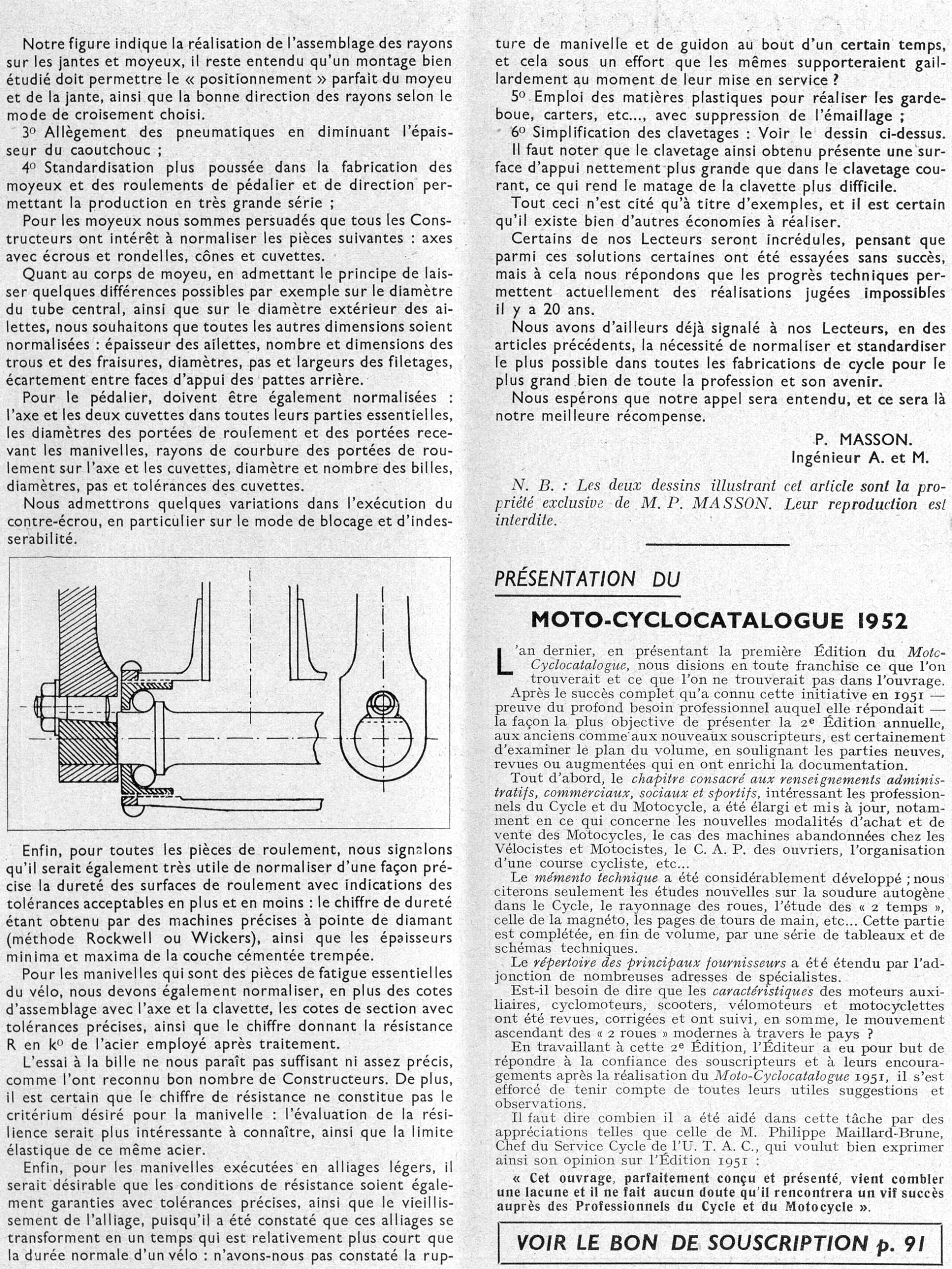
[Ebykr summary; the article’s text is not reproduced. This page carries the end of P. Masson’s “Vers le vélo de demain”, picked up in mid-argument. Masson points to the figure printed with the article, which shows how the spokes are assembled into rims and hubs, and insists that a well studied build must allow perfect “positionnement” of hub and rim as well as the correct lead of the spokes for whichever crossing pattern is chosen. He then continues the numbered list of economies the trade should make.]
3o Allègement des pneumatiques en diminuant l’épaisseur du caoutchouc ;
4o Standardisation plus poussée dans la fabrication des moyeux et des roulements de pédalier et de direction permettant la production en très grande série ;
[Ebykr summary, continuing the same piece. Under the fourth head Masson argues that every maker has an interest in normalizing the same hub parts: axles with their nuts and washers, cones and cups. For the hub shell he allows a few differences, for instance in the diameter of the central tube and in the outside diameter of the flanges, but he asks that every other dimension be fixed — flange thickness, the number and size of the holes and their countersinks, the diameters, pitch and width of the threads, and the spacing between the bearing faces of the rear dropouts. For the bottom bracket he wants the axle and both cups normalized in all their essential parts: the diameters of the bearing tracks and of the seats that take the cranks, the radii of curvature of the bearing tracks on axle and cups, the diameter and number of the balls, and the diameters, pitch and tolerances of the cups. He will allow some variation in the making of the lock ring, in particular in its mode of locking and its resistance to loosening.]
[Ebykr summary, after the drawing. Masson adds that for every bearing part it would be very useful to normalize the hardness of the running surfaces precisely, with the acceptable tolerances above and below, the hardness figure being taken on precise diamond-point machines by the Rockwell or Wickers method, together with the minimum and maximum thickness of the case-hardened and quenched layer. Cranks, which he calls essential fatigue parts of the bicycle, should carry normalized section dimensions with close tolerances besides the fitting dimensions for axle and cotter, and a figure giving the resistance R in kg of the steel used after treatment. The ball test seems to him neither sufficient nor precise enough, as a good number of makers have recognized, and he holds that a resistance figure is not the criterion wanted for a crank: resilience and the elastic limit of the same steel would be more interesting to know. For cranks made in light alloys he asks that the conditions of resistance be guaranteed with close tolerances as well, and that the aging of the alloy be covered, since these alloys change in a time relatively shorter than the normal life of a bicycle — he asks whether cranks and handlebars have not been seen to break after a certain time under an effort they would have carried easily when new.]
5o Emploi des matières plastiques pour réaliser les garde-boue, carters, etc…, avec suppression de l’émaillage ;
6o Simplification des clavetages : Voir le dessin ci-dessus.
[Ebykr summary, closing the piece. Masson notes that the cotter arrangement so obtained presents a markedly larger bearing surface than the usual one, which makes burring over the cotter more difficult. All of this, he says, is cited only as examples, and other economies certainly remain to be made. Some readers will be incredulous, thinking that certain of these solutions have been tried without success, to which he answers that technical progress now allows work judged impossible twenty years ago. He recalls that the magazine has already told its readers, in earlier articles, of the need to normalize and standardize as far as possible in every branch of cycle manufacture, for the greatest good of the whole trade and its future, and he hopes the appeal will be heard, which will be the best reward.]
P. MASSON.
Ingénieur A. et M.
N. B. : Les deux dessins illustrant cet article sont la propriété exclusive de M. P. MASSON. Leur reproduction est interdite.
PRÉSENTATION DU
MOTO-CYCLOCATALOGUE 1952
[Ebykr summary; the article’s text is not reproduced. A publisher’s notice follows below a short rule. Last year, presenting the first edition of the Moto-Cyclocatalogue, the magazine said in all frankness what the work did and did not contain. After the complete success of that initiative in 1951 — proof of the deep professional need it answered — the most objective way to present the second annual edition, to old and new subscribers alike, is to go through the plan of the volume and point out the parts that are new, revised or enlarged. The chapter given to administrative, commercial, social and sporting information for cycle and motorcycle professionals has been widened and brought up to date, notably on the new terms of purchase and sale of motorcycles, the case of machines abandoned at the dealer, the workers’ C. A. P. and the organization of a cycle race. The technical memento has been considerably developed, with new studies on autogenous welding in the cycle trade, the spoking of wheels, the two-stroke and the magneto, and pages of workshop tips, completed at the end of the volume by a series of tables and technical diagrams. The directory of principal suppliers has been extended by many addresses of specialists. The characteristics of auxiliary engines, cyclomotors, scooters, vélomoteurs and motorcycles have been revised and corrected and have followed the rising movement of the modern two-wheeler across the country. In working on this second edition the publisher set out to answer the confidence of the subscribers and their encouragement after the Moto-Cyclocatalogue 1951, and took account of all their useful suggestions and observations. The notice adds how much the publisher was helped by appreciations such as that of M. Philippe Maillard-Brune, head of the cycle department of the U. T. A. C., who gave this opinion of the 1951 edition:]
« Cet ouvrage, parfaitement conçu et présenté, vient combler une lacune et il ne fait aucun doute qu’il rencontrera un vif succès auprès des Professionnels du Cycle et du Motocycle ».
VOIR LE BON DE SOUSCRIPTION p. 91
[A text page in two columns, the Masson article set in a clean sans-serif and the notice below it in a seriffed roman. The left column runs unbroken prose down to a framed line engraving set across the column: a sectional drawing of a crank fitting, with a hatched crank arm in section at the left carrying its cotter and nut, the bottom-bracket axle running away to the right with its cup, balls and bearing tracks drawn in outline, a mirrored pair of cup profiles at the center, and at the right an end view of the crank eye with the round axle bore and the smaller cotter bore crossing it, all in fine unshaded line with dash-dot center lines. No signature appears on the drawing. The right column closes the article with the signature “P. MASSON.” set toward the right above the line “Ingénieur A. et M.”, followed by an italic note reserving the two drawings to M. P. Masson. A short heavy rule divides the column, below which the notice opens with “PRÉSENTATION DU” in spaced italic capitals over a rule and “MOTO-CYCLOCATALOGUE 1952” in heavy sans-serif capitals; its first word takes a large drop capital L. Several terms inside the notice are set in italic, and the quoted appreciation is set in bold. The page ends in a ruled box holding “VOIR LE BON DE SOUSCRIPTION p. 91” in italic capitals. A narrow strip of the neighboring column is cut by the edge of the sheet down the left side.]
Ebykr presents this material for research and education. If you hold rights to it or notice an ownership issue, please contact us and we will respond promptly.
The Ebykr Digest
New articles, timelines, catalog finds and registry activity — assembled from the archive once a month. Your address is never shared.
Double opt-in. One email per month. Unsubscribe at any time with one click.