About Ebykr
Ebykr celebrates classic and vintage lightweight bicycles through provocative imagery and opinion. Ride along with us.
About Ebykr
Ebykr celebrates classic and vintage lightweight bicycles through provocative imagery and opinion. Ride along with us.

Source: Gallica (Bibliothèque nationale de France), L'Officiel du cycle, du motocycle et du camping, 20 September 1952, Numéro spécial du Salon 1952, pages 145, 147, 149, 151 and 152; ark:/12148/bd6t541820671. Source gallica.bnf.fr / BnF.
| Type | Review |
|---|---|
| Year | 1952 |
| Publisher | L'Officiel du cycle |
| Country | France |
| Language | French |
| Pages | 5 |
| Source | Gallica (Bibliothèque nationale de France), L'Officiel du cycle, du motocycle et du camping, 20 September 1952, Numéro spécial du Salon 1952, pages 145, 147, 149, 151 and 152; ark:/12148/bd6t541820671. Source gallica.bnf.fr / BnF. |
| Credit | Ebykr archive; Bibliothèque nationale de France |
| Identifier | Gallica (BnF) ark:/12148/bd6t541820671/f145 |
| Transcription | Headings and specifications transcribed; article text summarized |
Fantaisies et Souvenirs Vélo, Bécane et Bicyclette par Miguel ZAMACOÏS — 145 — — 147 — — 149 — (Suite page 152) Miguel ZAMACOÏS.
This is a magazine article, so its running text is summarized here rather than reproduced; the headline, byline, specifications and scores are transcribed as printed.
From L’Officiel du cycle, du motocycle et du camping, 20 September 1952, the paper’s special number for the 1952 Paris Salon du Cycle et du Motocycle, pages 145 to 152: Miguel Zamacoïs’s “Fantaisies et Souvenirs”: the bicycle as a postman and other everyday riders saw it. The title, headings, captions and lists are transcribed as printed; the text is summarized in Ebykr’s words, and the page images carry it in full.
— Page 1 —
Fantaisies et Souvenirs
Vélo, Bécane et Bicyclette
par Miguel ZAMACOÏS
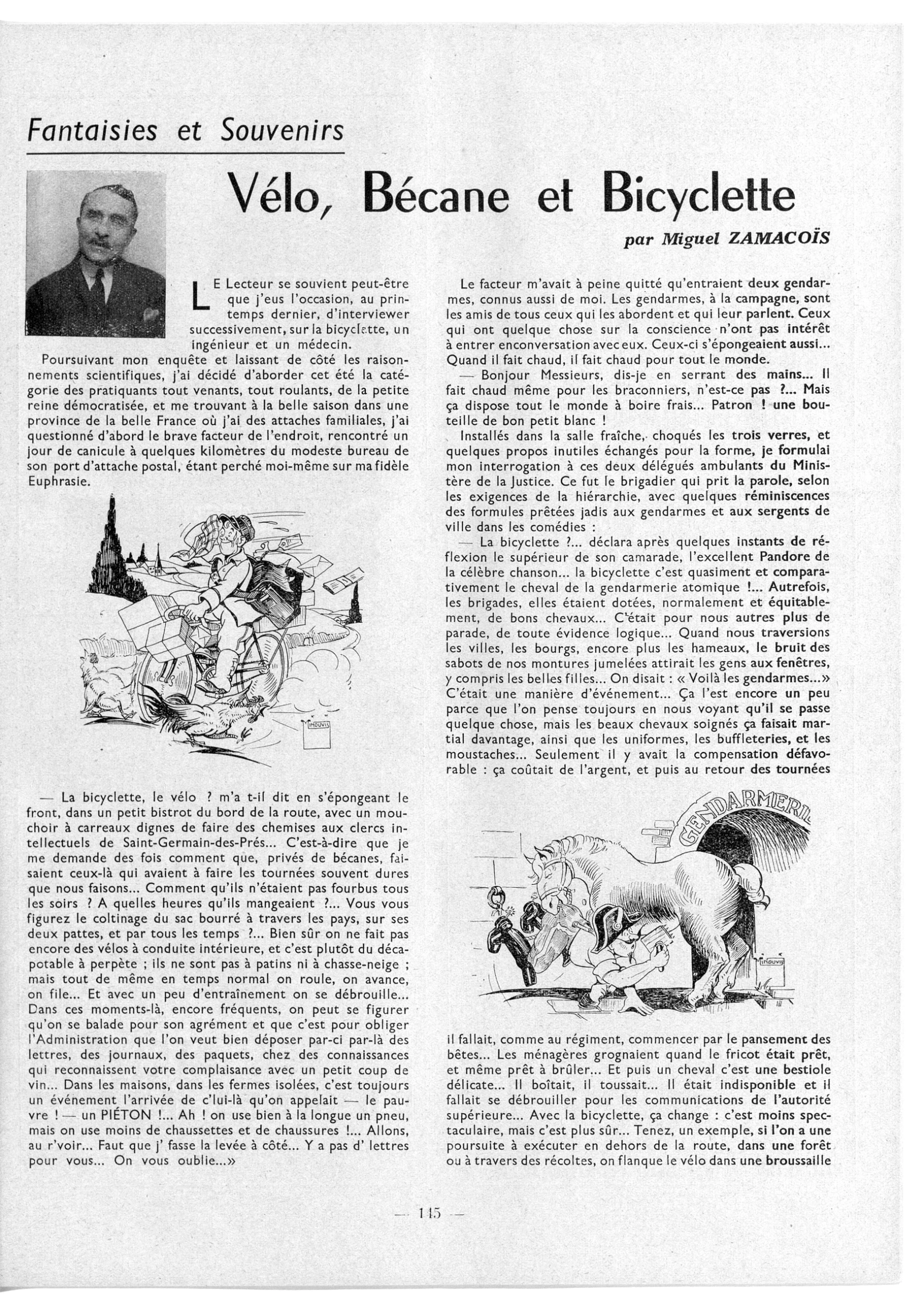
[Ebykr summary; the article’s text is not reproduced. Zamacoïs opens by reminding the reader that last spring he had the chance to interview, one after the other, an engineer and a doctor on the subject of the bicycle. Carrying his inquiry further and leaving scientific reasoning aside, he decided this summer to take on the category of all-comers who ride the democratized petite reine, and, finding himself in the fine season in a province of France where he has family ties, he questioned first the good postman of the place, met on a day of blazing heat a few kilometers from the modest office of his postal home port, while perched himself on his faithful Euphrasie.]
[Ebykr summary, the postman’s answer. Mopping his forehead in a little roadside bistro with a checked handkerchief fit to make shirts for the intellectual clerks of Saint-Germain-des-Prés, the postman says he sometimes wonders how men without machines managed the rounds, often hard ones, that postmen do now: how they were not worn out every evening, at what hours they ate, and what it was to haul a stuffed bag across the country on two legs in all weathers. Bicycles with closed bodies are not made yet, he says, and what he rides is a convertible for life, with no skates and no snowplow, but in normal weather one rolls, one advances, one flies, and with a little training one manages. In such moments, still frequent, a man can imagine that he is out for his own pleasure and that it is to oblige the Administration that he consents to drop letters, newspapers and parcels here and there on acquaintances who acknowledge the favor with a glass of wine. In houses and isolated farms the arrival is always an event for the man who used to be called — poor fellow — a PIÉTON. A tire wears out in the long run, he grants, but fewer socks and fewer shoes are worn. Then he takes his leave: he has the collection to make next door, and there are no letters for the writer, who is forgotten.]
[Ebykr summary, continuing. The postman had hardly left when two gendarmes came in, also known to the author. Gendarmes in the country, he remarks, are the friends of everyone who approaches them and speaks to them, and only those with something on their conscience have an interest in avoiding conversation. These two were mopping their foreheads as well, since when it is hot it is hot for everybody. He greeted them, shook hands, observed that it was hot even for poachers and that such weather disposes everyone to drink cool, and called for a bottle of good little white wine. Settled in the cool room, the three glasses touched and a few useless words exchanged for form, he put his question to these two traveling delegates of the Ministry of Justice. It was the brigadier who spoke, as the hierarchy required, with some echoes of the formulas once given to gendarmes and town sergeants in stage comedies.]
[Ebykr summary, the brigadier’s answer. After some moments of reflection the superior of the pair, the excellent Pandore of the famous song, declares that the bicycle is as good as the horse of the atomic gendarmerie. In the old days, he says, the brigades were equipped normally and fairly with good horses; that was more a matter of parade, plainly enough. When they crossed towns, villages and still more hamlets, the noise of the hooves of their paired mounts brought people to the windows, pretty girls among them, and the cry went up: « Voilà les gendarmes… ». It was a kind of event. It still is a little, because people seeing them always think something is happening, but fine groomed horses looked more martial, and so did the uniforms, the buff leather and the mustaches. Only there was the unfavorable side: it cost money, and on the return from a round one had to begin, as in the regiment, with dressing down the animals. Housewives grumbled when the stew was ready, and even ready to burn. A horse, besides, is a delicate creature: it limped, it coughed, it was unavailable, and a man had to manage somehow for the communications of the higher authority. With the bicycle it is different: less spectacular, but surer. As an example, he says, if a pursuit has to be made off the road, in a wood or across standing crops, the bicycle is flung into a thicket.]
— 145 —
[The opening page of a feature in two columns, set in sans-serif. The rubric “Fantaisies et Souvenirs” stands at the top left in italic sans-serif above a rule, and beside it the title “Vélo, Bécane et Bicyclette” in large light sans-serif, with “par Miguel ZAMACOÏS” in bold italic below and to the right. A square halftone portrait photograph of the author occupies the top of the left column, a middle-aged man with a mustache and short hair in a dark suit and tie, head and shoulders, looking slightly to his left. The text opens with a large drop capital L. Two pen cartoons in free line are printed with the columns. The first, in the left column, shows a country postman freewheeling downhill with his cap pushed back and a checked handkerchief flying from one raised hand, his bag and panniers bursting with parcels, letters and newspapers that scatter behind him, a village with its church and a line of poplars in the background and two hens fleeing from his front wheel. The second, in the right column, shows a stable interior with a heavy horse standing by a wall lettered GENDARMERIE, its hind leg raised over a small gendarme in cocked hat and shirtsleeves who crouches to groom it, with harness, boots and a lantern hanging at the left. Each cartoon carries the signature “Minouvis” in a small ruled rectangle at its lower right. The folio “— 145 —” stands at the foot of the left column.]
— Page 2 —
[Ebykr summary; the article’s text is not reproduced. The brigadier’s answer runs on from the preceding page. The bicycle is flung into a thicket, he says, where it will be fetched later. In the days of the horse there was trouble: left in the wood it risked straying, abandoned at the edge of a field of wheat or clover it wrecked the one or devoured the other. And, far from negligible, the bicycle keeps a man in the muscular wholeness the trade demands. He takes his leave with thanks: the pair are off to make inquiries at the house of a private person whose machine has been stolen, a man who had only to chain it up like everybody else. The author answers that the thing should be handcuffed.]
[Ebykr summary, after a three-star break. Coming back by a roundabout way, the author met the curé by chance, seated in the shade on a tree trunk, and the sight of his bicycle propped against a chestnut nearby gave him the idea of taking in the priest as well. Greetings were exchanged — the curé asked whether the writer was within their walls, an odd formula, he remarks, from people given to raising walls in the open country — and he brought his question round in an easy way.]
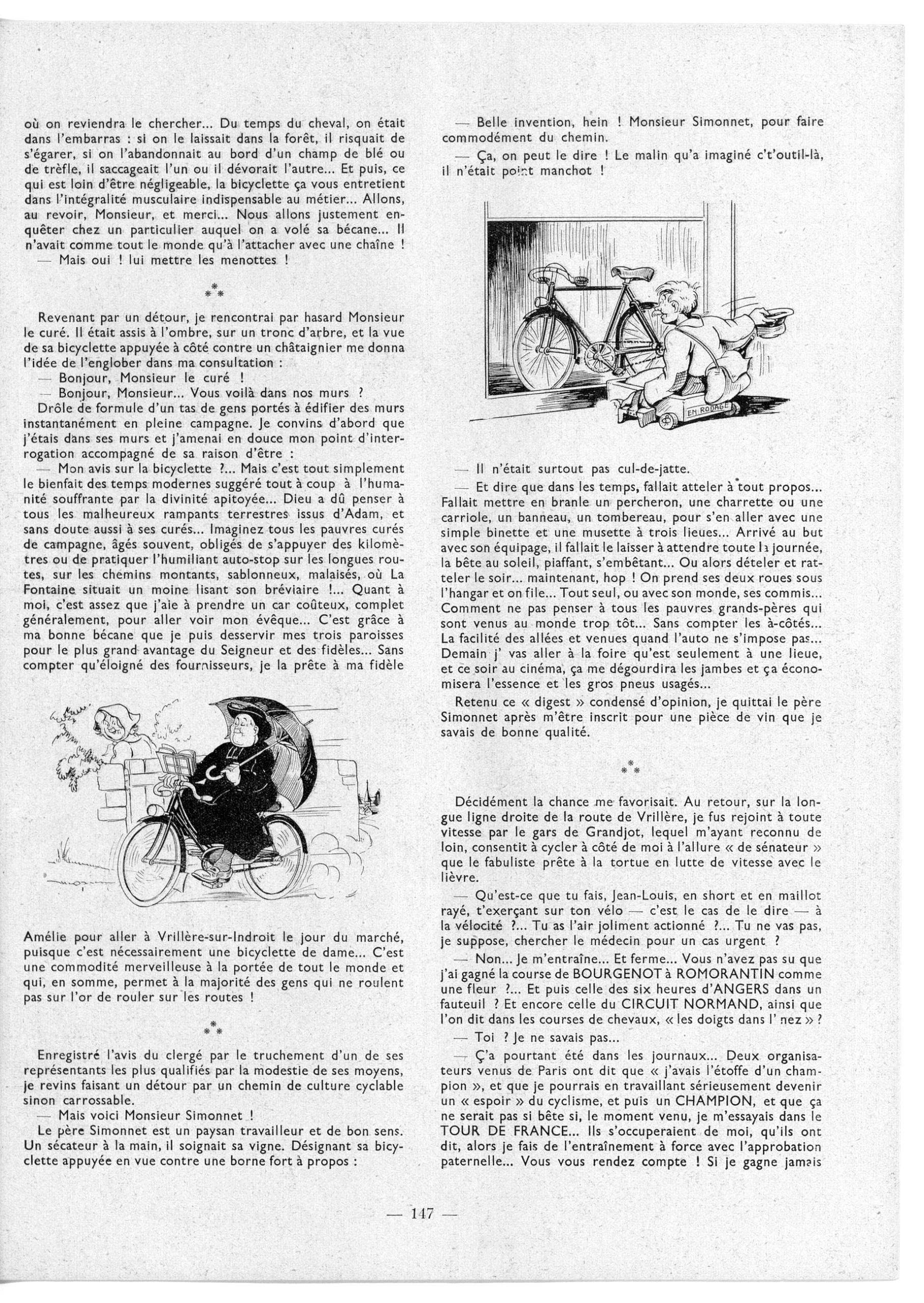
[Ebykr summary, the curé’s answer. The bicycle, to his mind, is quite simply the blessing of modern times suggested all at once to suffering humanity by a divinity moved to pity. God must have thought of all the unhappy earthbound creatures sprung from Adam, and no doubt of his country priests too. The curé asks the writer to imagine all the poor country priests, often old, obliged to trudge kilometers or to practice the humiliating hitchhike on the long roads, on the climbing sandy difficult tracks where La Fontaine placed a monk reading his breviary. For his own part it is enough that he has to take a costly bus, generally full, to go and see his bishop. It is thanks to his good machine that he can serve his three parishes, to the greater advantage of the Lord and of the faithful, and, living far from the tradespeople, he lends it to his faithful Amélie to go to Vrillère-sur-Indroit on market day, since it is of necessity a lady’s bicycle. He calls it a marvelous convenience within everybody’s reach, which in sum lets the majority of people who are not rolling in gold roll along the roads.]
[Ebykr summary, after a three-star break. Having recorded the opinion of the clergy through one of its representatives best qualified by the modesty of his means, the author came back by a farm track fit for cycling if not for carriages, and came upon Monsieur Simonnet. Père Simonnet is a hard-working peasant of good sense who was tending his vine with pruning shears in his hand. Pointing to the bicycle propped very conveniently against a boundary stone, the author remarked that it was a fine invention for covering ground in comfort. Simonnet agreed: the clever man who thought up that tool was no fool — and above all, the author adds, no cripple.]
[Ebykr summary, Simonnet’s answer. To think, he says, that in the old days a man had to harness up for anything at all: set a Percheron going with a cart, a trap, a tip-cart or a tumbrel simply to go three leagues with a hoe and a haversack. Arrived with his equipage he had to leave it waiting all day, the beast in the sun, pawing and bored, or else unharness and harness again in the evening. Now the two wheels are taken from under the shed and away one goes, alone or with the household and the hired men. He thinks of all the poor grandfathers born too soon, and of the side benefits: the ease of coming and going when the motorcar is not called for. Tomorrow he will go to the fair, which is only a league away, and this evening to the cinema, which will loosen his legs and save petrol and worn heavy tires. Having taken down this condensed digest of opinion, the author left Père Simonnet after putting himself down for a cask of wine he knew to be of good quality.]
[Ebykr summary, after a three-star break. Luck was decidedly with him. On the way back, on the long straight of the Vrillère road, he was overtaken at full speed by the Grandjot boy, who, recognizing him from a distance, agreed to ride beside him at the senatorial pace the fabulist lends the tortoise in its race with the hare. The author asked what Jean-Louis was doing in shorts and a striped jersey, training on his bicycle at such velocity, and whether he was fetching the doctor for an urgent case. The lad answered that he was training, and hard: had they not heard that he won the race from Bourgenot to Romorantin in a walk, and the six hours of Angers sitting down, and the Circuit Normand too, as they say in horse racing, with his fingers in his nose? It had been in the papers. Two organizers up from Paris said he had the makings of a champion, that by working seriously he could become a hope of cycling and then a CHAMPION, and that it would not be a foolish thing if, when the time came, he tried himself in the TOUR DE FRANCE. They said they would look after him, so he is training all out with his father’s approval. He asks the writer to think what it would be if he ever wins.]
— 147 —
[A text page in two columns of sans-serif, the piece continued from an earlier page, with no heading. Two pen cartoons in free line are set with the columns. The first, at the foot of the left column, shows a stout country priest in cassock and shovel hat riding a bicycle at speed, an open breviary propped on the handlebar, an opened umbrella held out behind him in his right hand, a peasant woman in a bonnet leaning over a low stone wall and laughing at his passing, a bush at the left and a village spire in the distance at the right. The second, at the head of the right column, is set inside a plain rule: a bicycle stands in a lighted shop window, and in front of it, on the pavement, a legless man propelling himself on a low wheeled trolley lettered EN RODAGE holds out his cap. Neither cartoon carries a visible signature. Three-star ornaments, two stars under one, divide the text in three places, and the folio “— 147 —” stands at the foot of the left column.]
— Page 3 —
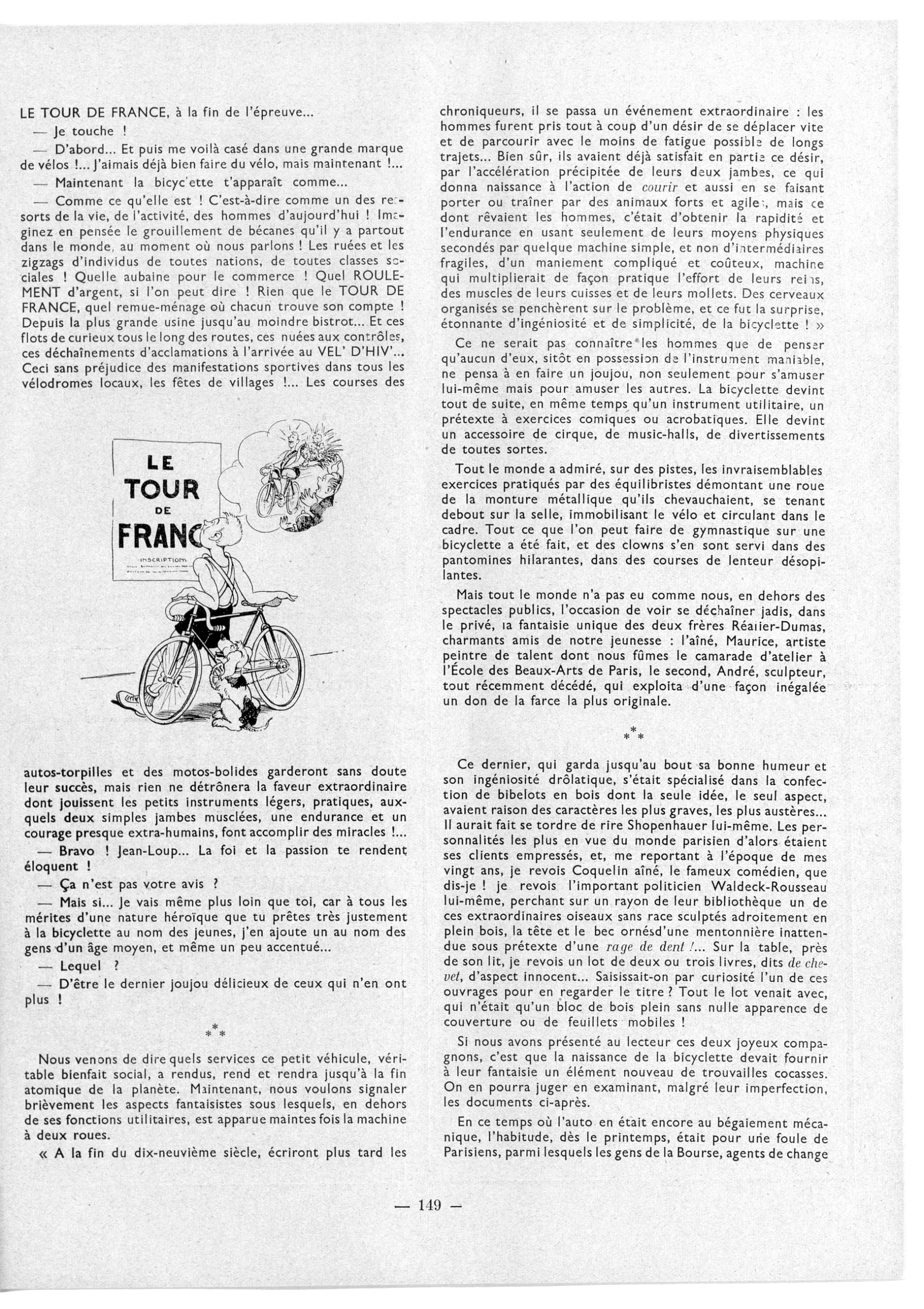
[Ebykr summary; the article’s text is not reproduced. The exchange with the young racer continues from the preceding page. If he ever wins the TOUR DE FRANCE, at the end of the event, he says, he draws the prize money, and then he is placed with a great bicycle marque. He already liked riding, but now! Asked how the bicycle appears to him now, he answers: as what it is, one of the mainsprings of the life and the activity of the men of today. He asks the writer to picture the swarm of machines there is everywhere in the world at the moment they are speaking, the rushes and the zigzags of people of every nation and every social class. What a windfall for trade, what a rolling of money, if the phrase may be allowed. The TOUR DE FRANCE alone is a commotion in which everyone finds his account, from the largest factory down to the smallest bistro, with the floods of onlookers all along the roads, the clouds of them at the controls and the storms of cheering at the finish at the VEL’ D’HIV’. And that is without prejudice to the sporting events in all the local velodromes and the village fêtes. Races of torpedo cars and bullet motorcycles will no doubt keep their success, he says, but nothing will unseat the extraordinary favor enjoyed by the light practical little instruments on which two simple muscled legs, an endurance and a courage almost more than human work miracles.]
[Ebykr summary, continuing. The writer answers Bravo, Jean-Loup: faith and passion make him eloquent. The lad asks whether he does not share his view, and the writer says he does, and goes further: to all the merits of a heroic nature that the young man very justly lends the bicycle in the name of the young, he adds one in the name of people of middle age, and even a little past it. Asked which, he answers: that of being the last delicious plaything of those who have no playthings left.]
[Ebykr summary, after a three-star break. The writer has said what services this little vehicle, a true social benefit, has rendered, renders and will render until the atomic end of the planet. Now he wants to point briefly to the fanciful aspects under which, outside its utilitarian functions, the two-wheeled machine has appeared many times. He sets out a passage as the chroniclers will write it later: at the end of the nineteenth century an extraordinary event took place, in that men were suddenly seized by a desire to move fast and to cover long distances with as little fatigue as possible. They had already satisfied that desire in part by the hurried acceleration of their two legs, which gave birth to the action of running, and by having themselves carried or drawn by strong and agile animals; but what they dreamed of was rapidity and endurance obtained by their own physical means, helped by some simple machine rather than by fragile intermediaries of complicated and costly handling, a machine that would multiply in a practical way the effort of their loins and of the muscles of their thighs and calves. Organized brains bent over the problem, and the surprise, astonishing in its ingenuity and its simplicity, was the bicycle.]
[Ebykr summary, continuing. It would be a poor knowledge of men, he says, to suppose that none of them, once in possession of the handy instrument, thought of making a plaything of it, not only to amuse himself but to amuse others. The bicycle became at once, along with a utilitarian instrument, a pretext for comic or acrobatic exercises, an accessory of the circus, of the music halls and of entertainments of every kind. Everyone has admired, on the tracks, the improbable feats of balancers taking a wheel off the metal mount they rode, standing on the saddle, holding the machine still and moving about inside the frame. Everything that can be done by way of gymnastics on a bicycle has been done, and clowns have used it in hilarious pantomimes and in side-splitting slow races.]
[Ebykr summary, continuing. Not everyone, however, has had his own chance to see, outside the public shows and in private, the unique fancy of the two brothers Réalier-Dumas, charming friends of his youth: the elder, Maurice, a painter of talent whose studio comrade he was at the École des Beaux-Arts de Paris, and the second, André, a sculptor, very recently dead, who exploited an unequaled gift for the most original kind of practical joke.]
[Ebykr summary, after a three-star break. The younger brother, who kept his good humor and his comic ingenuity to the end, had specialized in making wooden knickknacks whose mere idea and mere appearance got the better of the gravest and most austere characters, and would have made Shopenhauer himself double up with laughter. The most prominent figures of the Paris of that day were his eager customers, and, going back to the time when he was twenty, the writer sees again Coquelin aîné, the famous actor — or rather the important politician Waldeck-Rousseau himself — perching on a shelf of their bookcase one of those extraordinary wooden birds of no known breed, head and beak fitted with an unexpected chin bandage on the pretext of a raging toothache. On the table by his bed he sees again a set of two or three innocent-looking bedside books: pick one up out of curiosity to look at its title, and the whole lot came with it, being nothing but a solid block of wood with no appearance of cover or of loose leaves. If the two merry companions have been presented to the reader, it is because the birth of the bicycle was to give their fancy a new element of comic finds, as may be judged, in spite of their imperfection, from the documents that follow.]
[Ebykr summary, continuing. In those days, when the motorcar was still at the stage of mechanical stammering, the habit from the spring onward was, for a crowd of Parisians, among them the people of the Bourse, stockbrokers and others.]
— 149 —
[A text page in two columns of sans-serif, the piece continued, with no heading. One pen cartoon in free line stands in the left column: a thin young racer in shorts and a sleeveless jersey sits astride a track bicycle with his arms on the handlebar and his eyes raised, before a wall bill reading “LE TOUR DE FRANCE” over the word “INSCRIPTIONS” and some ruled lines; a thought cloud above his head shows him winning with a bouquet thrust at him by a woman while a man throws up his hands, and a small terrier sits at the foot of the machine looking up. No signature appears on the cartoon. The name of the young racer is printed Jean-Loup here, though the previous page called him Jean-Louis. Three-star ornaments divide the text in two places, several words are set in italic, and the folio “— 149 —” stands at the foot of the left column.]
— Page 4 —
[Ebykr summary; the article’s text is not reproduced. The sentence runs on from the preceding page: the habit of the Paris crowd, bankers and remisiers among them, was to reach the country round about by train once the day was over. Chatou and its pretty banks of the Seine had many faithful visitors, among them artists and men of letters, Claude Monet, Renoir and Maupassant. Now it was at Chatou, beside the famous restaurant Fournaise, the meeting place of the boating set, that the Réalier-Dumas brothers had their family house, and it was there that the two of them brought off a few turns that have stayed in the memory of those, by now sadly thinned out, who were their amused witnesses.]
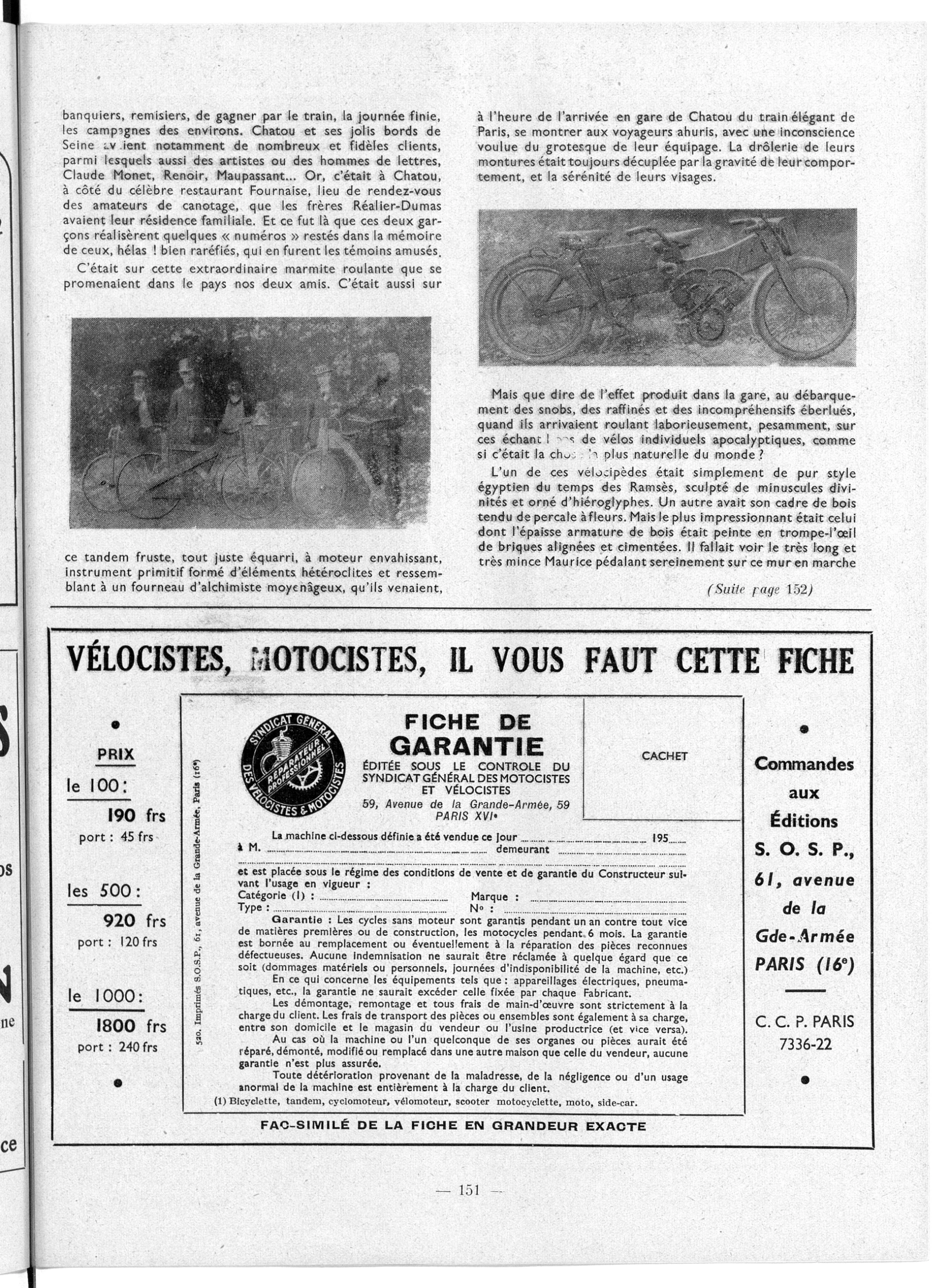
[Ebykr summary, continuing. It was on this extraordinary rolling stewpot that the two friends went about the countryside, and it was on this rough tandem, barely squared off, with its overbearing engine, a primitive instrument made of ill-assorted parts and looking like a medieval alchemist’s furnace, that they used to appear, at the hour when the smart train from Paris reached the station at Chatou, before the bewildered travelers, with a deliberate unawareness of how grotesque their equipage was. The comedy of their mounts, the author says, was always multiplied tenfold by the gravity of their bearing and the serenity of their faces.]
[Ebykr summary, continuing. But what, he asks, of the effect produced in the station, as the snobs, the refined and the bewildered uncomprehending got off the train, when the pair arrived pedaling laboriously and heavily on those apocalyptic samples of individual machines as though it were the most natural thing in the world? One of these velocipedes was simply in the pure Egyptian style of the time of the Ramses, carved with tiny divinities and ornamented with hieroglyphs. Another had its wooden frame covered in flowered percale. But the most impressive was the one whose thick wooden armature was painted in trompe-l’oeil as courses of bricks laid and cemented, and the very long, very thin Maurice had to be seen pedaling serenely on that walking wall.]
(Suite page 152)
[A text page in two columns of sans-serif, the piece continued, with no heading. Two halftone photographs are printed without captions, one in each column. The one in the left column is very dark and coarsely screened: two men are seated on a long low tandem machine with a bulky mass of mechanism between the wheels, a wheel and part of the frame showing clearly at the lower left while the rest of the group is hard to make out against a dark background. The one in the right column, lighter and also coarsely screened, shows a single machine standing alone in profile, a bicycle frame with a large block of apparatus filling the space between the two wheels and a handlebar and saddle above. Neither photograph carries a credit. The article closes with the italic line “(Suite page 152)” set to the right in the right column, under which a double rule cuts the page off; the lower half of the sheet is taken by a ruled advertisement headed “VÉLOCISTES, MOTOCISTES, IL VOUS FAUT CETTE FICHE”, which belongs to a separate record. A strip of the facing page shows down the left edge.]
— Page 5 —
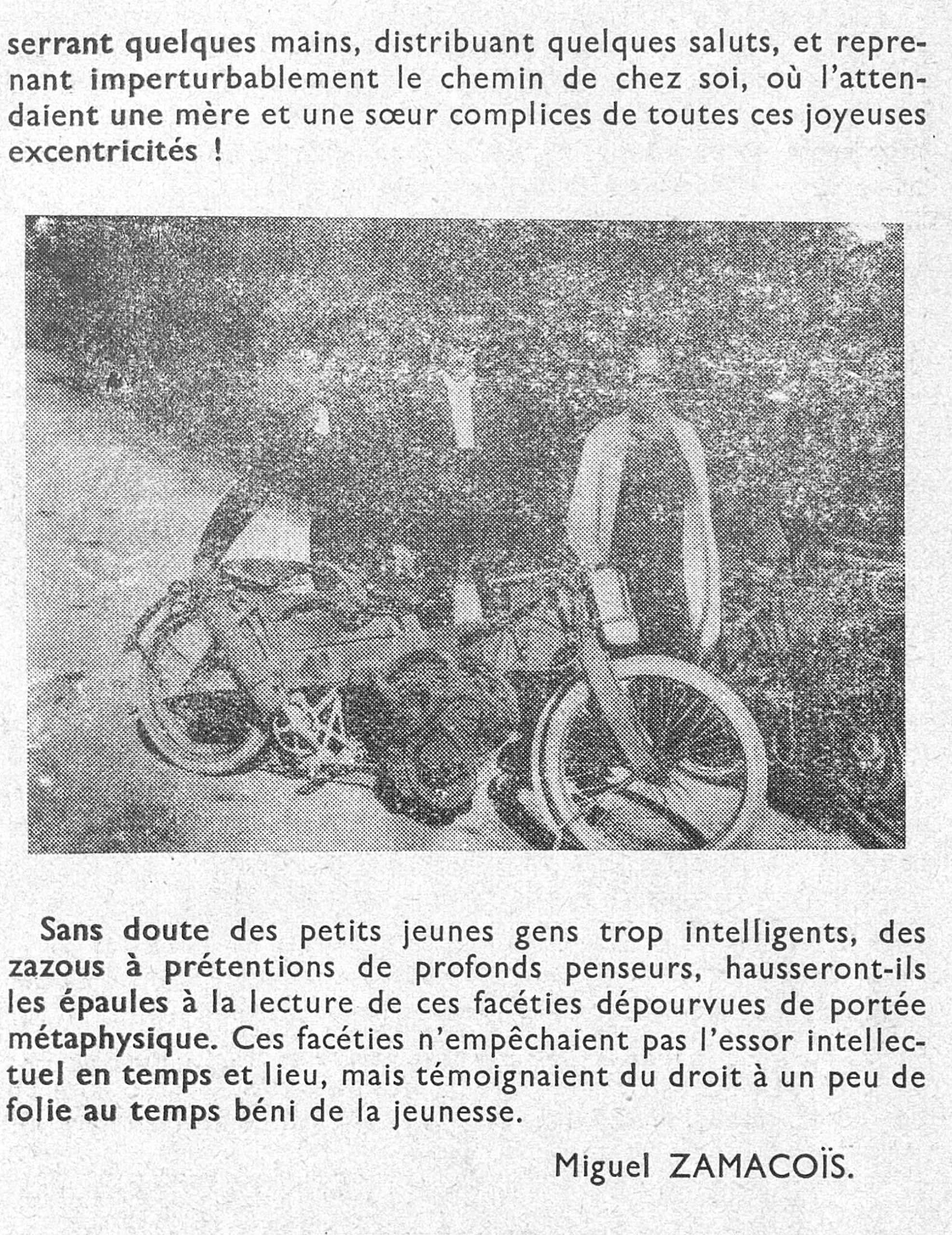
[Ebykr summary; the article’s text is not reproduced. The closing block of the piece, picked up in mid-sentence. The brothers would shake a few hands, hand out a few greetings and take the road home again without turning a hair, where a mother and a sister waited who were accomplices in all these joyous eccentricities.]
[Ebykr summary, the last paragraph. No doubt, Zamacoïs says, some clever young people, some zazous who set up as profound thinkers, will shrug their shoulders at reading of these pranks, which carry no metaphysical weight. The pranks, he answers, did not prevent intellectual growth in its own time and place, but bore witness to the right to a little folly in the blessed season of youth.]
Miguel ZAMACOÏS.
[The closing block of the feature, a single column of sans-serif text with no heading. Four lines of text stand at the head, and below them a coarsely screened halftone photograph without a caption, very dark and hard to read: a man with his back to the camera is seated on a strange bicycle in the open air, the machine showing a looped handlebar or fork at the center and a wheel below it, with foliage behind. Seven lines of text follow under the photograph, and the piece ends with the signature “Miguel ZAMACOÏS.” set in spaced capitals and lower case, centered under the last line. The photograph carries no credit.]
Ebykr presents this material for research and education. If you hold rights to it or notice an ownership issue, please contact us and we will respond promptly.
The Ebykr Digest
New articles, timelines, catalog finds and registry activity — assembled from the archive once a month. Your address is never shared.
Double opt-in. One email per month. Unsubscribe at any time with one click.