About Ebykr
Ebykr celebrates classic and vintage lightweight bicycles through provocative imagery and opinion. Ride along with us.
About Ebykr
Ebykr celebrates classic and vintage lightweight bicycles through provocative imagery and opinion. Ride along with us.

Source: Gallica (Bibliothèque nationale de France), L'Officiel du cycle, du motocycle et du camping, 20 September 1952, Numéro spécial du Salon 1952, pages 9 and 10; ark:/12148/bd6t541820671. Source gallica.bnf.fr / BnF.
| Type | Review |
|---|---|
| Year | 1952 |
| Publisher | L'Officiel du cycle |
| Country | France |
| Language | French |
| Pages | 2 |
| Source | Gallica (Bibliothèque nationale de France), L'Officiel du cycle, du motocycle et du camping, 20 September 1952, Numéro spécial du Salon 1952, pages 9 and 10; ark:/12148/bd6t541820671. Source gallica.bnf.fr / BnF. |
| Credit | Ebykr archive; Bibliothèque nationale de France |
| Identifier | Gallica (BnF) ark:/12148/bd6t541820671/f9 |
| Transcription | Headings and specifications transcribed; article text summarized |
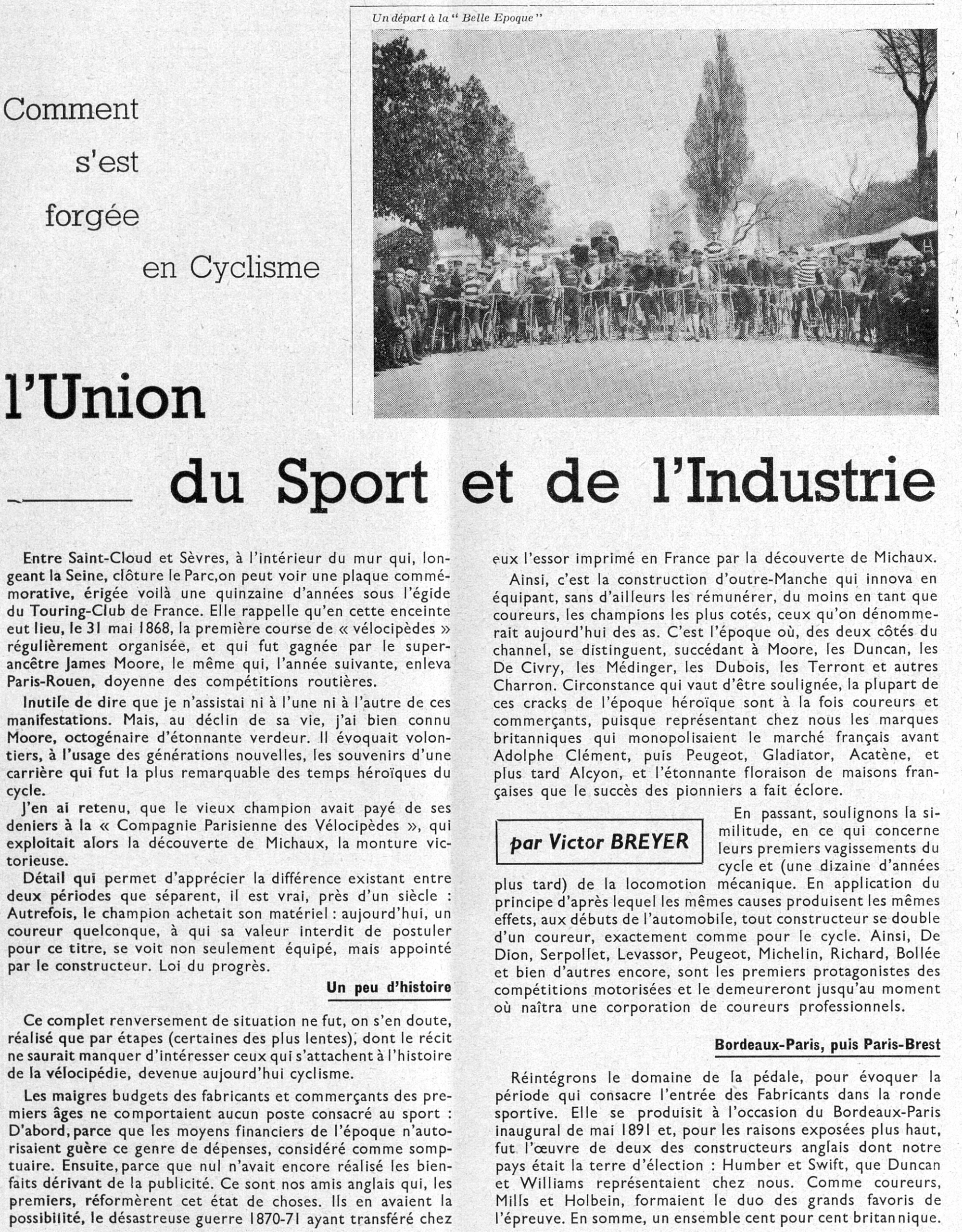
Comment s'est forgée en Cyclisme l'Union du Sport et de l'Industrie par Victor BREYER Un départ à la " Belle Epoque " Un peu d'histoire Bordeaux-Paris, puis Paris-Brest Les Directeurs sportifs Les bienfaits d'une alliance Victor BREYER.
This is a magazine article, so its running text is summarized here rather than reproduced; the headline, byline, specifications and scores are transcribed as printed.
From L’Officiel du cycle, du motocycle et du camping, 20 September 1952, the paper’s special number for the 1952 Paris Salon du Cycle et du Motocycle, pages 9 and 10: Victor Breyer on how the trade came to pay and equip the racing men, from James Moore and the Compagnie Parisienne to Humber, Swift, Clément, Peugeot, Gladiator and Acatène. The title, headings, captions and lists are transcribed as printed; the text is summarized in Ebykr’s words, and the page images carry it in full.
— Page 1 —
Comment
s’est
forgée
en Cyclisme
l’Union
du Sport et de l’Industrie
par Victor BREYER
Un départ à la ” Belle Epoque ”
[Ebykr summary; the article’s text is not reproduced. Breyer opens between Saint-Cloud and Sèvres, inside the wall that runs along the Seine and encloses the Parc, where a commemorative plaque set up about fifteen years ago under the aegis of the Touring-Club de France recalls that in that enclosure, on 31 May 1868, the first regularly organized race of « vélocipèdes » was held, won by the super-ancestor James Moore, the same man who the following year took Paris-Rouen, the oldest of road competitions. He saw neither meeting, he says, but late in Moore’s life he knew him well, an octogenarian of astonishing freshness who readily called up, for the new generations, the memories of a career that was the most remarkable of the heroic times of the cycle. What he kept from it is that the old champion had paid out of his own pocket, to the « Compagnie Parisienne des Vélocipèdes » which then worked Michaux’s invention, for the winning mount. That detail, he says, lets one measure the difference between two periods separated by close on a century: formerly the champion bought his material; today an ordinary racer, whose worth forbids him to lay claim to the title, finds himself not merely equipped but salaried by the constructor. Loi du progrès.]
Un peu d’histoire
[Ebykr summary; the article’s text is not reproduced. Under this head Breyer writes that so complete a reversal was reached only by stages, some of them very slow, whose story cannot fail to interest those attached to the history of vélocipédie, today become cyclisme. The slender budgets of the makers and dealers of the first ages carried no heading for sport: first because the money of the time hardly allowed such spending, which was held to be sumptuary, and next because nobody had yet grasped the benefits of publicity. It was the English friends who first reformed that state of things, and they had the means to do it, the disastrous war of 1870-71 having transferred to them the impulse that Michaux’s invention had given in France. So it was the construction from across the Channel that innovated by equipping — without, for that matter, paying them, at least as racers — the most highly rated champions, those who today would be called aces. That is the period when, on both sides of the channel, following Moore, the Duncan, the De Civry, the Médinger, the Dubois, the Terront and other Charron made their names. A circumstance worth underlining, he adds: most of these cracks of the heroic age were at once racers and tradesmen, since they represented in France the British marques that monopolized the French market before Adolphe Clément, then Peugeot, Gladiator, Acatène and later Alcyon, and the astonishing flowering of French houses that the success of the pioneers brought out. In passing he underlines the likeness between the first cries of the cycle and those, some ten years later, of mechanical locomotion: by the principle that the same causes produce the same effects, at the beginnings of the automobile every constructor was also a racer, exactly as for the cycle. So De Dion, Serpollet, Levassor, Peugeot, Michelin, Richard, Bollée and many others are the first protagonists of motorized competition and will remain so until the day a corporation of professional racers is born.]
Bordeaux-Paris, puis Paris-Brest
[Ebykr summary; the article’s text is not reproduced. Under this head Breyer returns to the realm of the pedal to call up the period that marks the entry of the Fabricants into the sporting round. It came with the inaugural Bordeaux-Paris of May 1891 and, for the reasons set out above, was the work of two of the English constructors for whom France was the chosen ground: Humber and Swift, represented in France by Duncan and Williams. As racers, Mills and Holbein made the pair of great favorites of the event. In short, he writes, an affair a hundred per cent British. The article carries over to the following page.]
[A text page set in two columns of roman type, with the opening display and one photograph. The title is broken into stepped lines of large bold sans-serif lower case that climb across the head of the page: “Comment”, “s’est”, “forgée” and “en Cyclisme” step down the left, then “l’Union” and, larger still, “du Sport et de l’Industrie” run right across, with a short heavy rule set under the left of the last line. The byline “par Victor BREYER” is set in bold italic and roman inside a thin ruled box standing in the left column, between the two columns of text. A halftone photograph fills the upper right quarter of the page and is captioned above it, in italic with typographic quotation marks: a crowd of racing cyclists lined up across a wide road at the start, held back by a cord, with spectators in hats and long coats along both sides, bare trees, a tall dark conifer and the gabled roofs of stands or booths at the right. The photograph is not credited and carries no signature. The two subheadings, “Un peu d’histoire” and “Bordeaux-Paris, puis Paris-Brest”, are set in bold roman, ranged to the right of the column and underscored by a heavy rule.]
— Page 2 —
[Ebykr summary; the article’s text is not reproduced. The page opens in the middle of the account of the first Bordeaux-Paris. Breyer declines to reissue the often told story of the bitter fight between the two men, who came in first and second at the Porte Maillot; at most he recalls that Mills owed the victory as much to his exceptional class as to the battle plan laid down by Duncan, which turned on taking advantage of an unlucky halt by Holbein at Angoulême to break clear, paced by the fastest of the trainers in his service, a sprinter named Lewis Stroud. A few months later, in the first Paris-Brest et retour, came the duel of Terront and Laval that has remained legendary. Of those who had fought between Bordeaux and Paris only Humber and Duncan were left, a combination that secured the success of Terront, which in any case crowned the victory of the better man. There again the shrewd Duncan used a ruse of war, having his racer go round the town of Guingamp so as not to pass the hotel where Laval, then leading, was taking some rest while his helpers watched for Terront to go by in order to alert their man; he was woken in that way only when he had lost all chance of getting back to his rival. One fact of an importance not to be underrated marks the event: the real beginnings, in the sporting and commercial battle, of a French firm that was to give the competition the international character it had lacked. This was the marque created by Adolpe Clément, whose whole merit Breyer says he has lately celebrated in this very paper, and which came into the lists powerfully backed by Frédéric De Civry, once more the adversary of Duncan on the sporting and commercial ground as he had been ten years earlier on every track in Europe. Their rivalry as directeurs sportifs proved every bit as fierce, and it let the French « tandem » take a brilliant revenge on its foreign competitors in the shape of two successive victories in Bordeaux-Paris, 1892 and 1893, first with Stéphane and then with Cottereau, a sprint specialist who, wound up — one would say today, gonflé — by that kind of sorcerer the great Frédéric was, beat Stéphane, by then in the service of the marque Phébus, newly come to racing. Cottereau’s performance has remained legendary and well deserves to: a French sprint champion winning a long-distance road event had not been seen before and the feat has never been repeated, and Cottereau carried it off only by his indomitable energy.]
Les Directeurs sportifs
[Ebykr summary; the article’s text is not reproduced. Under this head Breyer writes that the term « directeur sportif », new at the time, has not come from his pen by chance. With the growth of road racing and the enthusiasm of the masses for that branch of cycling, it now serves to name, within the large staff of the cycle houses that keep their « écurie », a head of department charged with heavy responsibilities and given very wide powers together with a near complete autonomy. Where Duncan and De Civry held those duties along with many others, they now take up almost the whole of the time and activity of the men who hold them. No doubt, he says, this progress has coincided with the progress made in the construction of the cycle, which has put France in the first rank for the production of that light and fine machine a racing bicycle. He does not call up without a backward smile the adventure that befell the house of Peugeot about 1885, until then given to making coffee mills and whose engineers knew nothing of the vélocipède. As was then the rule, Henri Pagis, who ran the Paris agency of Peugeot, took part in races, and wishing to start in the Championnat de France over 100 kilometers round Longchamp he had asked the Valentogney works to build him a racer. The reader is left to judge his stupefaction when, on receiving the machine he had wanted, he found it without ball bearings and mounted on plain hubs. It is true, Breyer adds, that the firm symbolized by the king of the desert has made up for it amply since, and has done not a little to take from the British works the kind of monopoly they had held for many years. Today, with a slight reserve for the threatening construction from beyond the Alps, the French « vélo léger » is about without a rival in the world, and nobody would dare deny that it owes that superiority to racing, the source of every improvement. For almost all the great national marques race, and the whole of their sporting budget, including the publicity without which taking part in competition is not conceivable, reaches several hundred millions. That is a peremptory answer to anyone who would doubt the value of such propaganda: why, he asks, would Alcyon, for example, which under the enlightened direction of Ludovic Feuillet has taken part in racing for close on half a century, keep up that effort if it did not prove to pay?]
Les bienfaits d’une alliance
[Ebykr summary; the article’s text is not reproduced. In conclusion Breyer says that the chief object of this study, plainly too brief given the many sides of the question, has been to stress the undeniable benefits flowing from the union of two elements of cycling long foreign to each other, if not hostile: industry and sport. The close collaboration of the trade authorities and the sporting powers secures, at the same time as it explains, a prosperity once thought bound to be only passing; and the dark forecasts of the gloomy spirits who still believe in its early disappearance are not on the eve of coming true. C.Q.F.D.]
Victor BREYER.
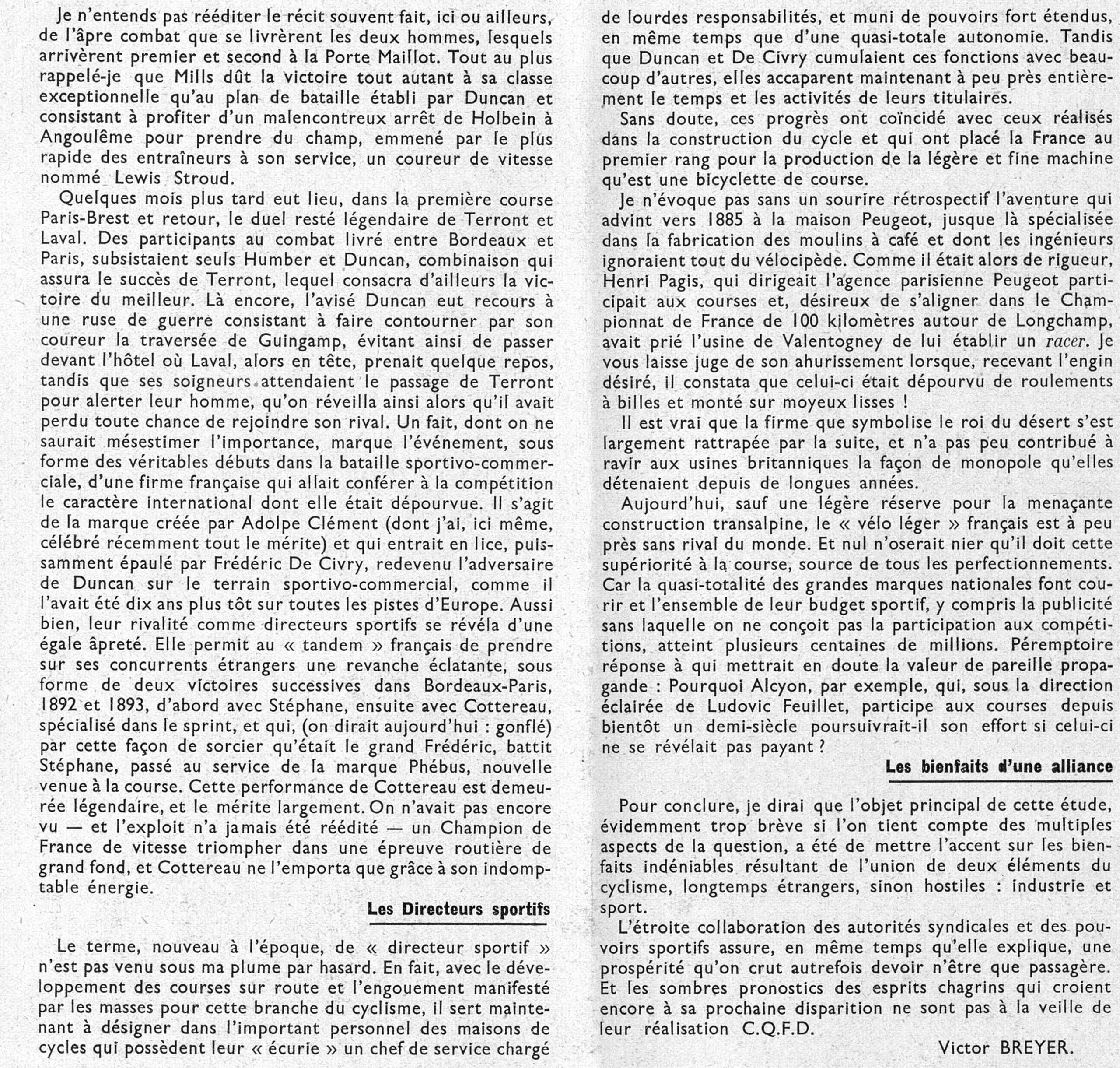
[A text page with no illustration, set in two columns of roman type parted by a wide white gutter. The matter is a continuation, so no title stands at the head and the first column opens straight into the text. The two subheadings, “Les Directeurs sportifs” and “Les bienfaits d’une alliance”, are set in bold roman, ranged to the right of the column and underscored by a heavy rule. The signature “Victor BREYER.” closes the right column, set in roman with the surname in capitals and ranged to the right. Faint show-through from the reverse of the leaf crosses both columns.]
Ebykr presents this material for research and education. If you hold rights to it or notice an ownership issue, please contact us and we will respond promptly.
The Ebykr Digest
New articles, timelines, catalog finds and registry activity — assembled from the archive once a month. Your address is never shared.
Double opt-in. One email per month. Unsubscribe at any time with one click.