About Ebykr
Ebykr celebrates classic and vintage lightweight bicycles through provocative imagery and opinion. Ride along with us.
About Ebykr
Ebykr celebrates classic and vintage lightweight bicycles through provocative imagery and opinion. Ride along with us.

Source: Gallica (Bibliothèque nationale de France), L'Officiel du cycle, du motocycle et du camping, 20 September 1952, Numéro spécial du Salon 1952, page 5; ark:/12148/bd6t541820671. Source gallica.bnf.fr / BnF.
| Type | Review |
|---|---|
| Year | 1952 |
| Publisher | L'Officiel du cycle |
| Country | France |
| Language | French |
| Pages | 1 |
| Source | Gallica (Bibliothèque nationale de France), L'Officiel du cycle, du motocycle et du camping, 20 September 1952, Numéro spécial du Salon 1952, page 5; ark:/12148/bd6t541820671. Source gallica.bnf.fr / BnF. |
| Credit | Ebykr archive; Bibliothèque nationale de France |
| Identifier | Gallica (BnF) ark:/12148/bd6t541820671/f5 |
| Transcription | Headings and specifications transcribed; article text summarized |
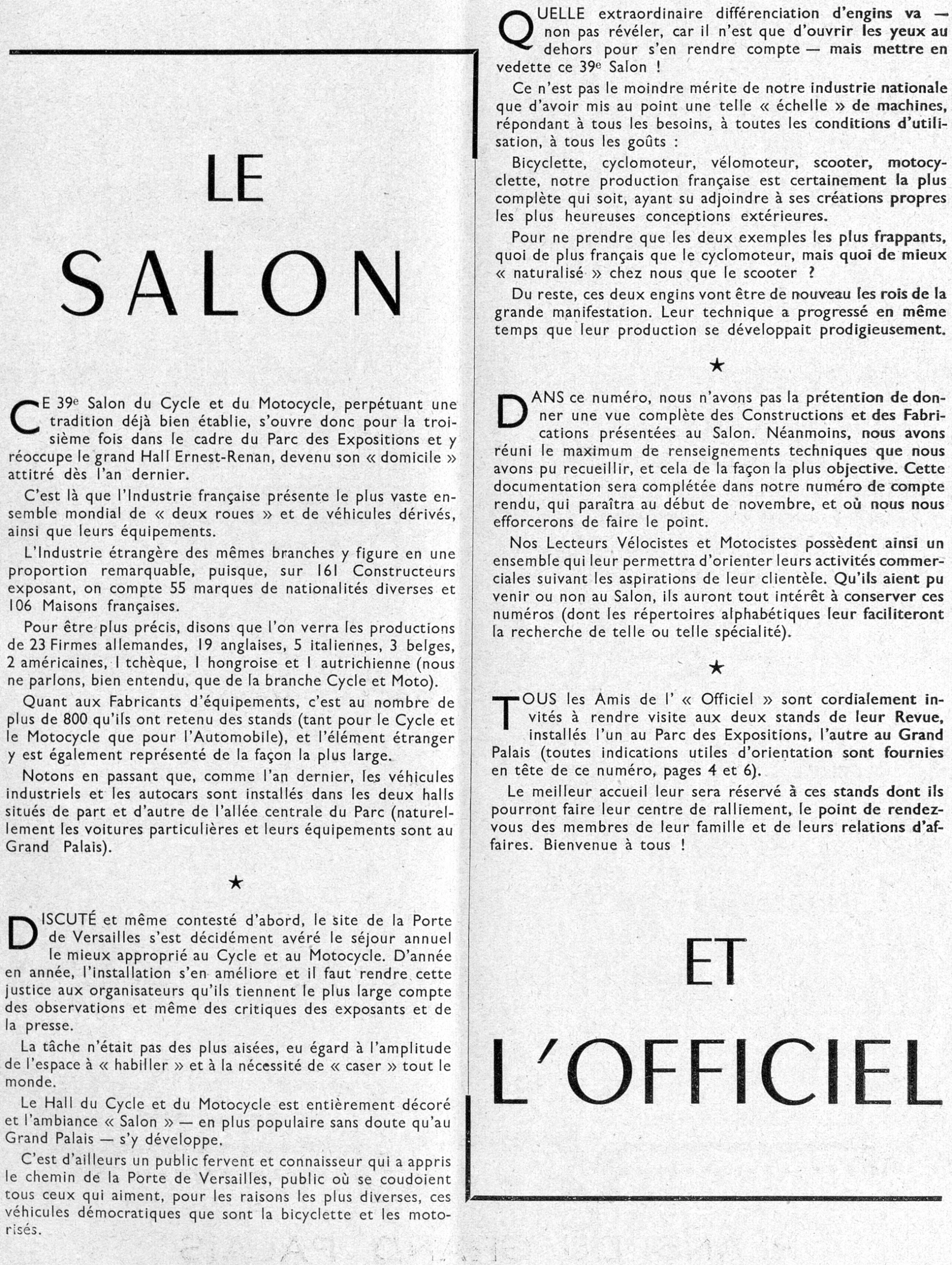
LE SALON ET L'OFFICIEL * * *
This is a magazine article, so its running text is summarized here rather than reproduced; the headline, byline, specifications and scores are transcribed as printed.
From L’Officiel du cycle, du motocycle et du camping, 20 September 1952, the paper’s special number for the 1952 Paris Salon du Cycle et du Motocycle, page 5: the paper’s editorial on the 39th Salon du Cycle et du Motocycle, back in the Hall Ernest-Renan, with its count of exhibitors by nationality. The title, headings, captions and lists are transcribed as printed; the text is summarized in Ebykr’s words, and the page images carry it in full.
— Page 1 —
LE
SALON
ET
L’OFFICIEL
[Ebykr summary; the article’s text is not reproduced. The paper opens by saying that this 39e Salon du Cycle et du Motocycle, carrying on a well established tradition, opens for the third time within the Parc des Expositions and again occupies the big Hall Ernest-Renan, which became its regular “domicile” last year. There French industry shows the largest assembly in the world of « deux roues » and of derived vehicles, together with their equipment. Foreign industry of the same branches figures in remarkable proportion, since among 161 exhibiting constructors there are 55 marques of various nationalities and 106 French houses. To be more exact, the visitor will see the productions of 23 German firms, 19 English, 5 Italian, 3 Belgian, 2 American, 1 Czech, 1 Hungarian and 1 Austrian, counting only the Cycle and Moto branch. As for the makers of equipment, more than 800 have taken stands, as much for the Cycle and the Motocycle as for the Automobile, and the foreign element is represented there on the widest scale as well. The paper notes in passing that, as last year, industrial vehicles and motor coaches are installed in the two halls on either side of the central alley of the Parc, private cars and their equipment being naturally at the Grand Palais.]
*
[Ebykr summary, after the first star break. Discussed and even contested at first, the site of the Porte de Versailles has decidedly proved to be the yearly home best suited to the Cycle and the Motocycle. From year to year the installation improves, and this justice must be done to the organizers, that they take the fullest account of the observations and even of the criticisms of the exhibitors and of the press. The task was not of the easiest, given the size of the space to « habiller » and the need to « caser » everyone. The Hall du Cycle et du Motocycle is entirely decorated and the « Salon » atmosphere, more popular no doubt than at the Grand Palais, develops there. It is moreover a fervent and knowing public that has learned the road to the Porte de Versailles, a public in which all who love, for the most diverse reasons, those democratic vehicles the bicycle and the motorized machines rub shoulders.]
[Ebykr summary; the article’s text is not reproduced. The second column opens by asking what an extraordinary differentiation of machines this 39e Salon is going to put in the spotlight — not reveal, the paper says, since one has only to open one’s eyes out of doors to see it. It calls it not the least merit of the national industry to have worked out such an « échelle » of machines, answering every need, every condition of use and every taste: bicyclette, cyclomoteur, vélomoteur, scooter, motocyclette. French production is certainly the most complete there is, having been able to add to its own creations the happiest conceptions from abroad. To take only the two most striking examples, what is more French than the cyclomoteur, and what is better « naturalisé » in France than the scooter? These two machines, it adds, are again going to be the kings of the great show, their technique having progressed at the same time as their production developed prodigiously.]
*
[Ebykr summary, after the second star break. The paper states that in this number it does not claim to give a complete view of the constructions and manufactures shown at the Salon; nevertheless it has gathered the greatest amount of technical information it could collect, and in the most objective fashion. That documentation will be completed in its compte rendu number, which will appear at the beginning of November and in which it will try to take stock. Its vélociste and motociste readers thus hold a whole that will let them direct their commercial activity according to the wishes of their customers. Whether or not they were able to come to the Salon, they will have every interest in keeping these numbers, whose alphabetical indexes will make the search for any given specialty easier.]
*
[Ebykr summary, after the third star break. All the Friends of the « Officiel » are cordially invited to visit the two stands of their Revue, one installed at the Parc des Expositions, the other at the Grand Palais, all useful directions being given at the head of this number on pages 4 and 6. The best of welcomes awaits them at these stands, which they will be able to make their rallying center and the meeting point of the members of their family and of their business connections. The piece closes: Bienvenue à tous !]
[A text page with no illustration, set in two columns of roman type parted by a thin vertical rule. The title is set very large in light sans-serif capitals and is split across the page: “LE” over “SALON” fills the head of the left column, and “ET” over “L’OFFICIEL” fills the foot of the right column, so that the two columns of text sit between them. Two thin L-shaped rules frame the page, one turning down from the upper left corner and one turning up from the lower right, each enclosing the display line beside it. Each of the five sections opens with a two-line or three-line drop capital — C, D, Q, D and T — and the sections are parted by a single small star set alone on its line and centered. There is no byline, no caption and no signature, and faint show-through from the reverse of the leaf crosses the foot of both columns.]
Ebykr presents this material for research and education. If you hold rights to it or notice an ownership issue, please contact us and we will respond promptly.
The Ebykr Digest
New articles, timelines, catalog finds and registry activity — assembled from the archive once a month. Your address is never shared.
Double opt-in. One email per month. Unsubscribe at any time with one click.