About Ebykr
Ebykr celebrates classic and vintage lightweight bicycles through provocative imagery and opinion. Ride along with us.
About Ebykr
Ebykr celebrates classic and vintage lightweight bicycles through provocative imagery and opinion. Ride along with us.

Source: Gallica (Bibliothèque nationale de France), L'Officiel du cycle, du motocycle et du camping, 20 September 1952, Numéro spécial du Salon 1952, page 152; ark:/12148/bd6t541820671. Source gallica.bnf.fr / BnF.
| Type | Review |
|---|---|
| Year | 1952 |
| Publisher | L'Officiel du cycle |
| Country | France |
| Language | French |
| Pages | 2 |
| Source | Gallica (Bibliothèque nationale de France), L'Officiel du cycle, du motocycle et du camping, 20 September 1952, Numéro spécial du Salon 1952, page 152; ark:/12148/bd6t541820671. Source gallica.bnf.fr / BnF. |
| Credit | Ebykr archive; Bibliothèque nationale de France |
| Identifier | Gallica (BnF) ark:/12148/bd6t541820671/f152 |
| Transcription | Headings and specifications transcribed; article text summarized |
UNE HISTOIRE CYCLISTE ET SA PHILOSOPHIE
This is a magazine article, so its running text is summarized here rather than reproduced; the headline, byline, specifications and scores are transcribed as printed.
From L’Officiel du cycle, du motocycle et du camping, 20 September 1952, the paper’s special number for the 1952 Paris Salon du Cycle et du Motocycle, page 152: the story Philippe Girardet, president of the Chambre Syndicale Nationale du Cycle, told at the wholesale trade’s banquet of the bicycle his father bought him in 1890. The title, headings, captions and lists are transcribed as printed; the text is summarized in Ebykr’s words, and the page images carry it in full.
— Page 1 —
UNE HISTOIRE CYCLISTE
ET SA PHILOSOPHIE
[Ebykr summary; the article’s text is not reproduced. An italic headnote introduces the piece. Last year, at the close of the banquet of the Commerce en Gros du Cycle, M. Philippe Girardet, the genial and witty president of the “Chambre Syndicale Nationale du Cycle”, told the guests the charming little story that follows, which the magazine has gathered for its readers.]
[Ebykr summary, the opening of Girardet’s story, which is printed throughout as a speech in quotation marks. He will tell a story that has at least three merits: first, it is a story belonging to an antediluvian age; second, it is a true story; and last, it is a cycling story. They are to make a jump of 50 years back, to those years of the 1890s when lighting was by gas and oil and people went about in horse trams. The franc was worth 20 sous, gold coins were changed for banknotes because they were too heavy for the pockets — today, he says, the opposite is easily done. Women had leg-of-mutton sleeves, a wasp waist and industrial quantities of petticoats and black stockings. Nobody knew them, because their skirts came down to their heels; now, he says, there are no surprises left.]
[Ebykr summary, continuing. He will now tell two things that will certainly not be believed: that no tax was paid, and that landlords begged people to rent their flats. In that blessed period he reached the age of 14. His father made him a present of a bicycle, bought at the fashionable house and paid 160 francs. He was very pleased with this bicycle, which had an almost straight frame, tires almost like balloons and an almost sufficient lamp, consisting of an oil lamp.]
[The head and the first part of a feature running down the right-hand side of the page, below a rule. The title stands in two lines of heavy seriffed capitals, “UNE HISTOIRE CYCLISTE” set full measure and “ET SA PHILOSOPHIE” stepped to the right beneath it. A headnote of four lines follows in italic seriffed type, with “L’an dernier” in bold italic and the names Philippe Girardet and the Chambre Syndicale Nationale du Cycle set in small capitals and in italic, the title of the chamber inside raised inverted commas. The story itself is set in sans-serif, opening with a guillemet, the first lines in bold and the rest in light type, in paragraphs with no subheadings. No illustration or signature appears in this part.]
— Page 2 —
[Ebykr summary; the article’s text is not reproduced. Girardet’s story continues without a break. Once he had his bicycle he wanted a cycling outfit, since in those days a cycling costume was required. He went back to his mother to be fitted out as a cyclist and got his costume: an English cap, a jacket of a dull brownish color, a jersey, baggy breeches and cycling shoes.]
[Ebykr summary, continuing. A few years ago he found again a photograph showing him at that moment, his left foot on the pedal and his hands on the handlebar. When he saw it he said to himself that he was good-looking at 14, which he had not known at the time; now he knows it, and he is a good deal less so.]
[Ebykr summary, continuing. What pleased him most in the outfit was the shoes. Until that age he had been dressed in what he dares call a standard way: he had the weekday suit and the Sunday suit, which was destined to become the weekday suit. As for the shoes, they were always the same, stout boots with nails underneath. He still hears his mother telling the cobbler to put thick soles on, since the child wears them out terribly. His new shoes therefore pleased him greatly, because they were special shoes, shoes without nails and with thin soles; had he not had his cycling shoes he would have had his thick ones. He could have hung a notice on his chest reading that he had a bicycle and the other had none, so happy was he.]
[Ebykr summary, continuing. That said, he comes back to the year 1951. At the end of May he went to take a cure at Aix-les-Bains. The cure over, the weather having been poor, he decided to go to Cannes and then to Marseille, where he has a charming woman friend, and went to see her.]
[Ebykr summary, continuing. One day they were walking in the avenue parallel to the Croisette. It was very hot, as it always is fine and hot on the Côte d’Azur. He had put on a light jacket, but complained of the heat; he took his coat off, but still dragged his feet a little on the burning pavement. His companion told him that he ought to have some “Aga Khan”. He did not hide his ignorance, and she asked whether he did not know what an Aga Khan was. He answered that he knew very well it was a very stout gentleman whose weight is given in gold, to which she replied that no, they were light shoes the Aga Khan had launched at Cannes.]
[Ebykr summary, continuing. They went into a shop and the salesman brought a pair of shoes. He took one and, believe it or not, it gave him a shock: they were the same as the ones he had at 14. They were his cycling shoes of long ago. He found again the little boy so proud of his bicycle and of his shoes, and said to himself that it was a long time since he was 14.]
[Ebykr summary, the close. His friend, seeing that he was gazing dreamily at the shoes, told him to buy them. He then turned to her and asked how much five times 14 years makes. She said it makes 70 years, and he answered that this was just what he thought.]
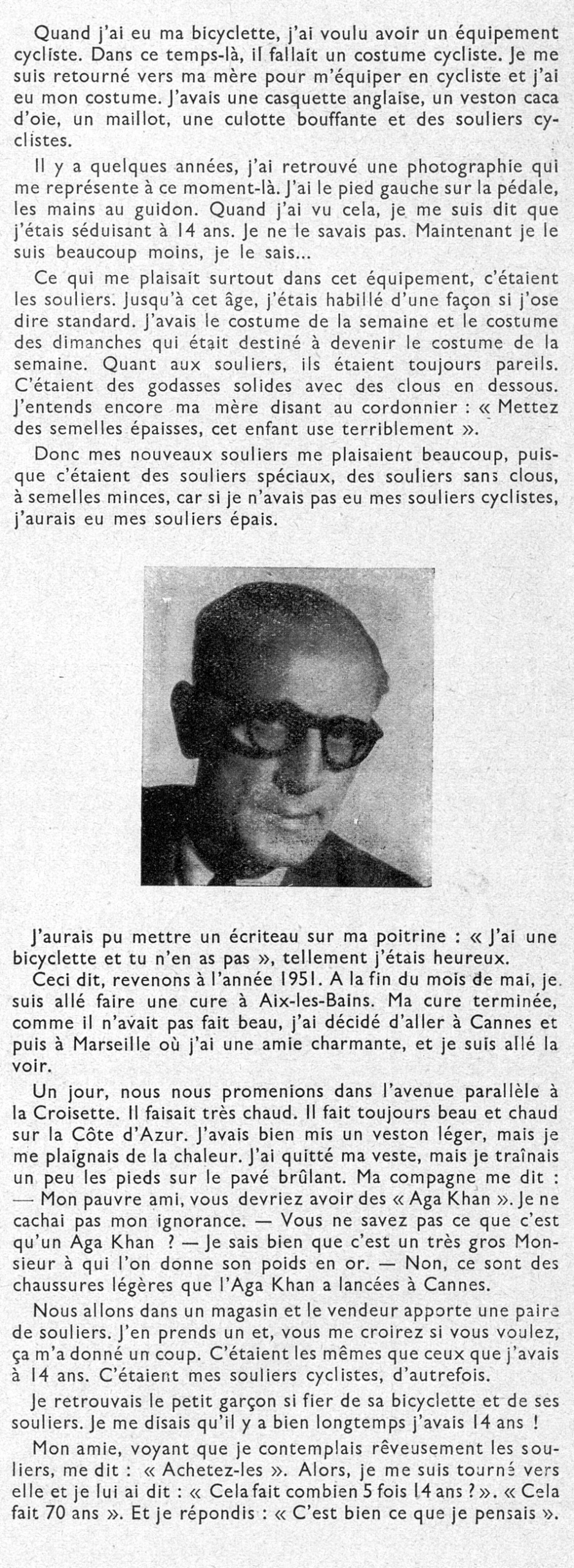
[The rest of the feature, running down the right-hand column of the page, text only apart from one photograph. The type is sans-serif throughout, set as the continuation of a speech in quotation marks, with short passages of dialogue marked by dashes and phrases inside guillemets. A halftone portrait photograph is set into the column: a bald man in dark horn-rimmed spectacles, in a dark suit, white shirt and tie, seen in three-quarter view from his left against a plain light ground, the plate cut square with no caption or credit. The piece ends with the line of dialogue in guillemets and carries no signature at its foot, the author being named only in the headnote above.]
Ebykr presents this material for research and education. If you hold rights to it or notice an ownership issue, please contact us and we will respond promptly.
The Ebykr Digest
New articles, timelines, catalog finds and registry activity — assembled from the archive once a month. Your address is never shared.
Double opt-in. One email per month. Unsubscribe at any time with one click.