About Ebykr
Ebykr celebrates classic and vintage lightweight bicycles through provocative imagery and opinion. Ride along with us.
About Ebykr
Ebykr celebrates classic and vintage lightweight bicycles through provocative imagery and opinion. Ride along with us.

Source: Gallica (Bibliothèque nationale de France), L'Officiel du cycle, du motocycle et du camping, 20 September 1952, Numéro spécial du Salon 1952, pages 95, 97, 98, 101, 103, 105, 107, 109, 111, 113, 115, 116, 119, 121, 123, 125, 127, 129, 131, 133, 134, 137 and 139; ark:/12148/bd6t541820671. Source gallica.bnf.fr / BnF.
 Page 1
 Page 2
 Page 3
 Page 4
 Page 5
 Page 6
 Page 7
 Page 8
 Page 9
 Page 10
 Page 11
 Page 12
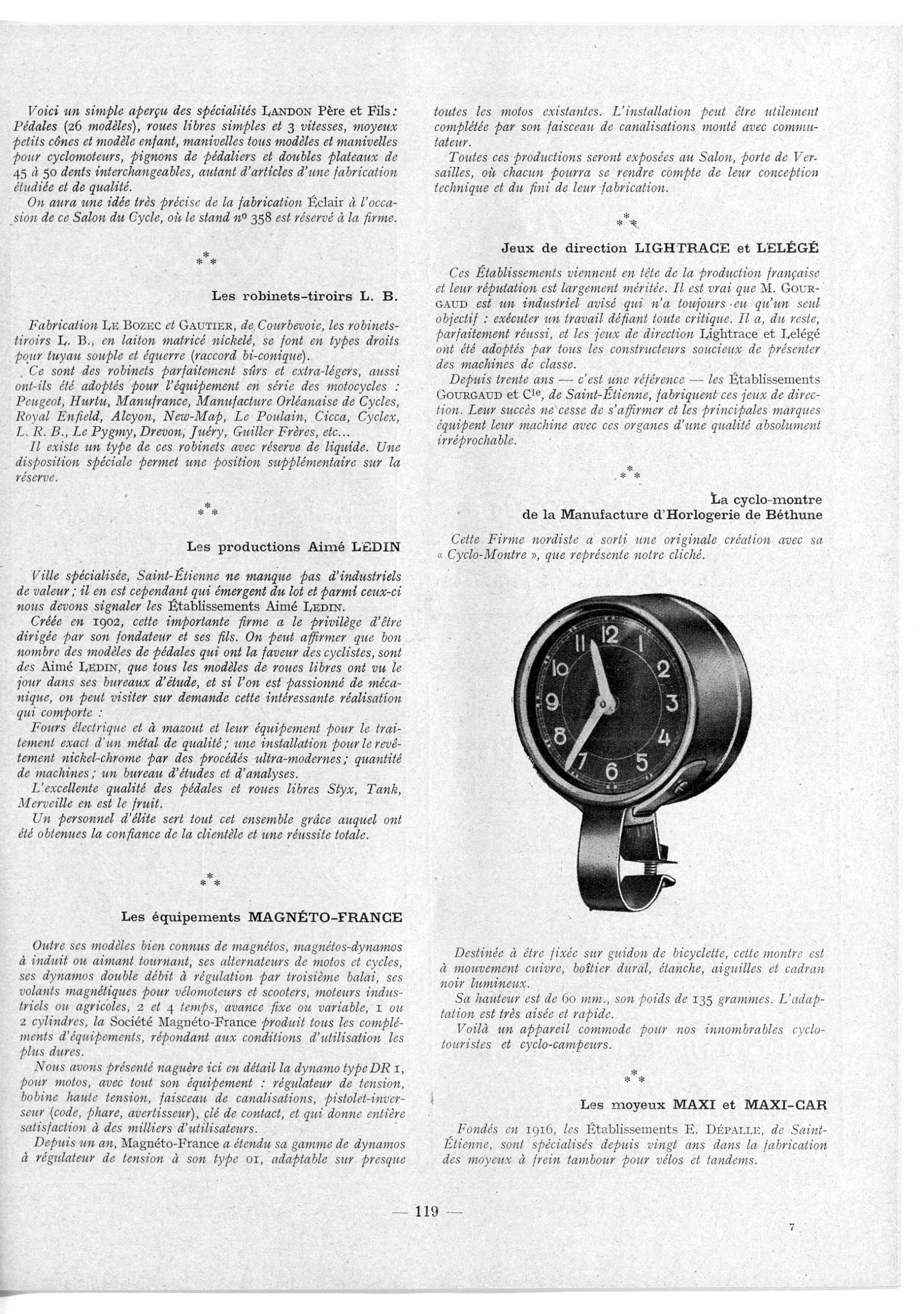 Page 13
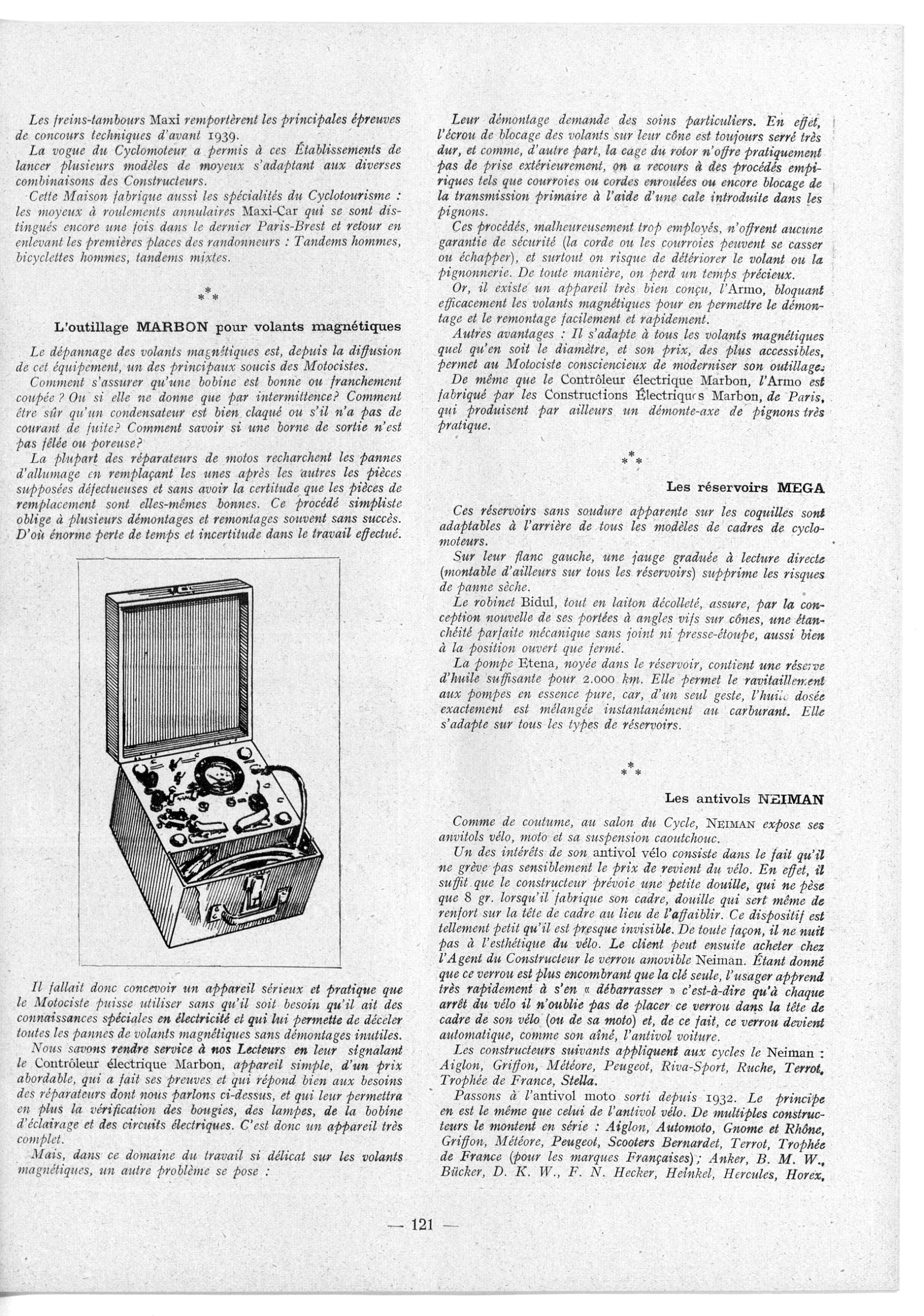 Page 14
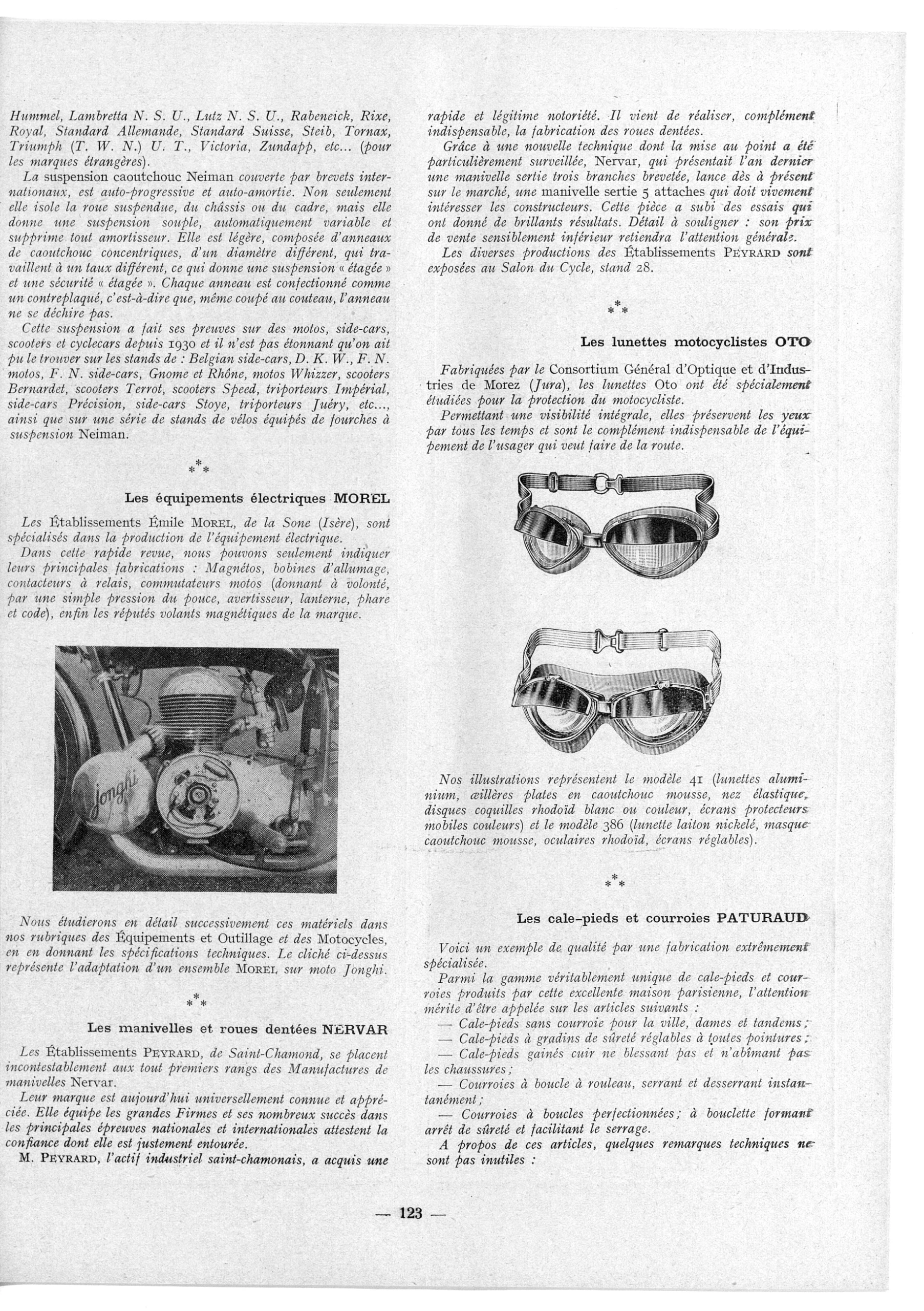 Page 15
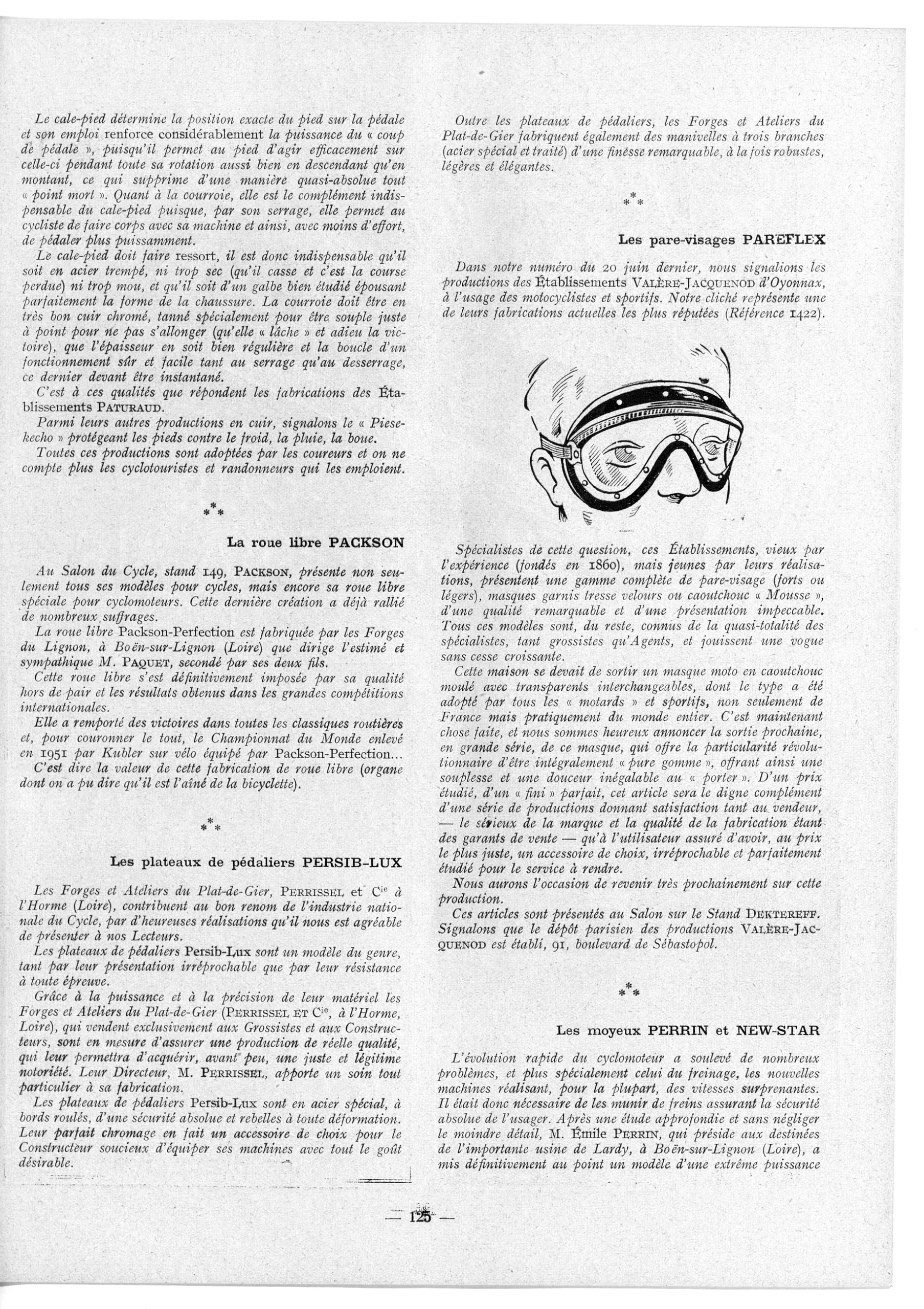 Page 16
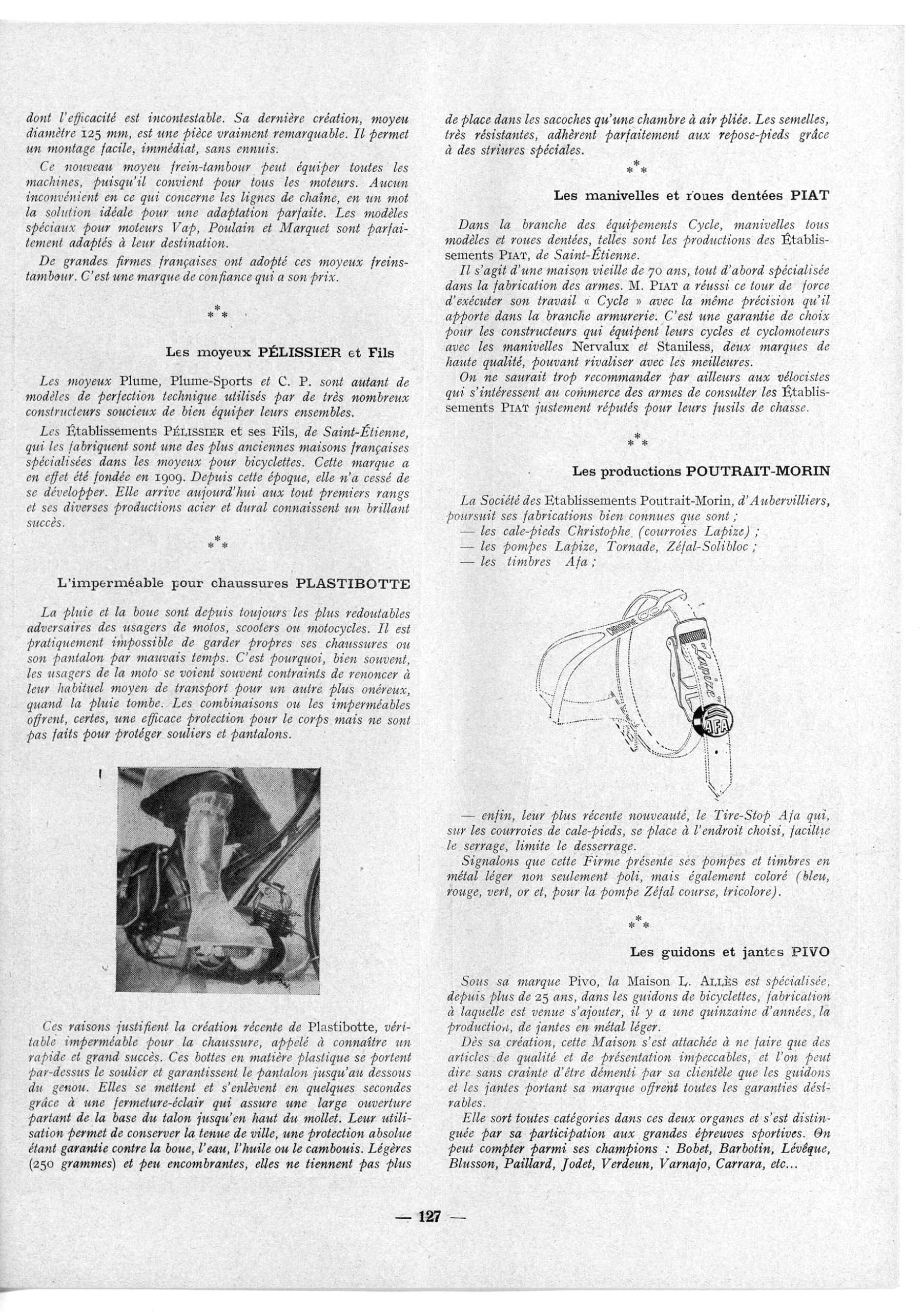 Page 17
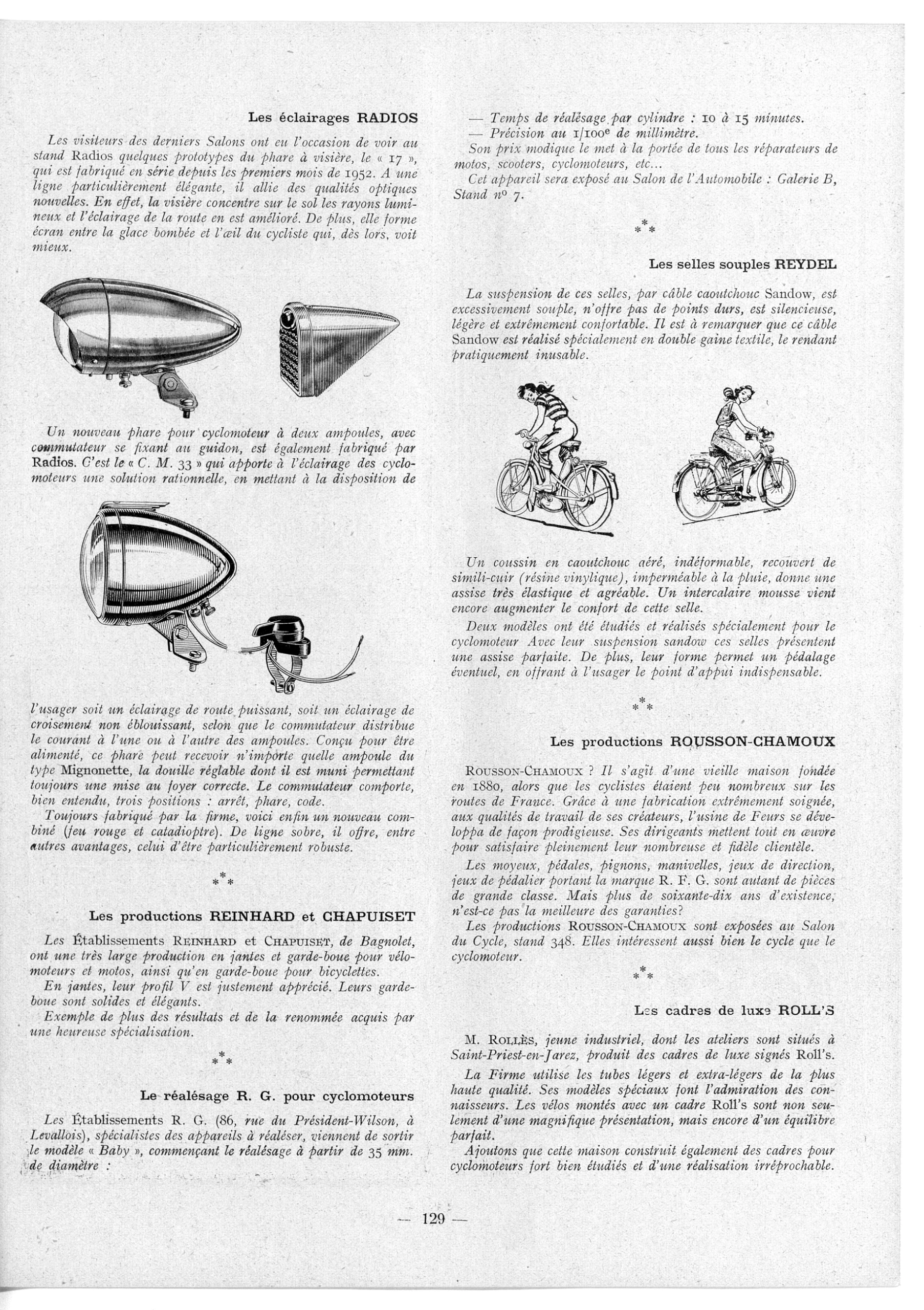 Page 18
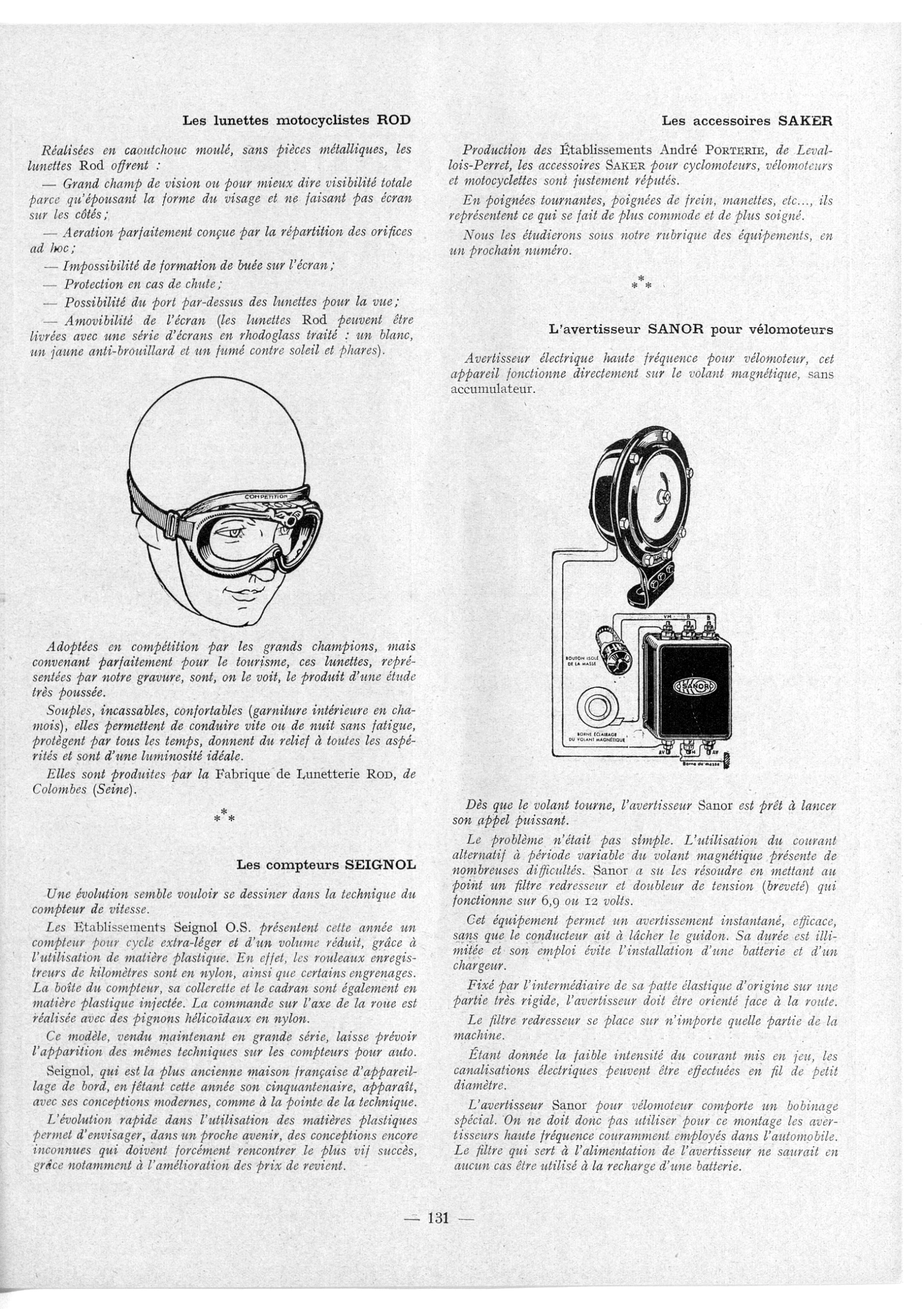 Page 19
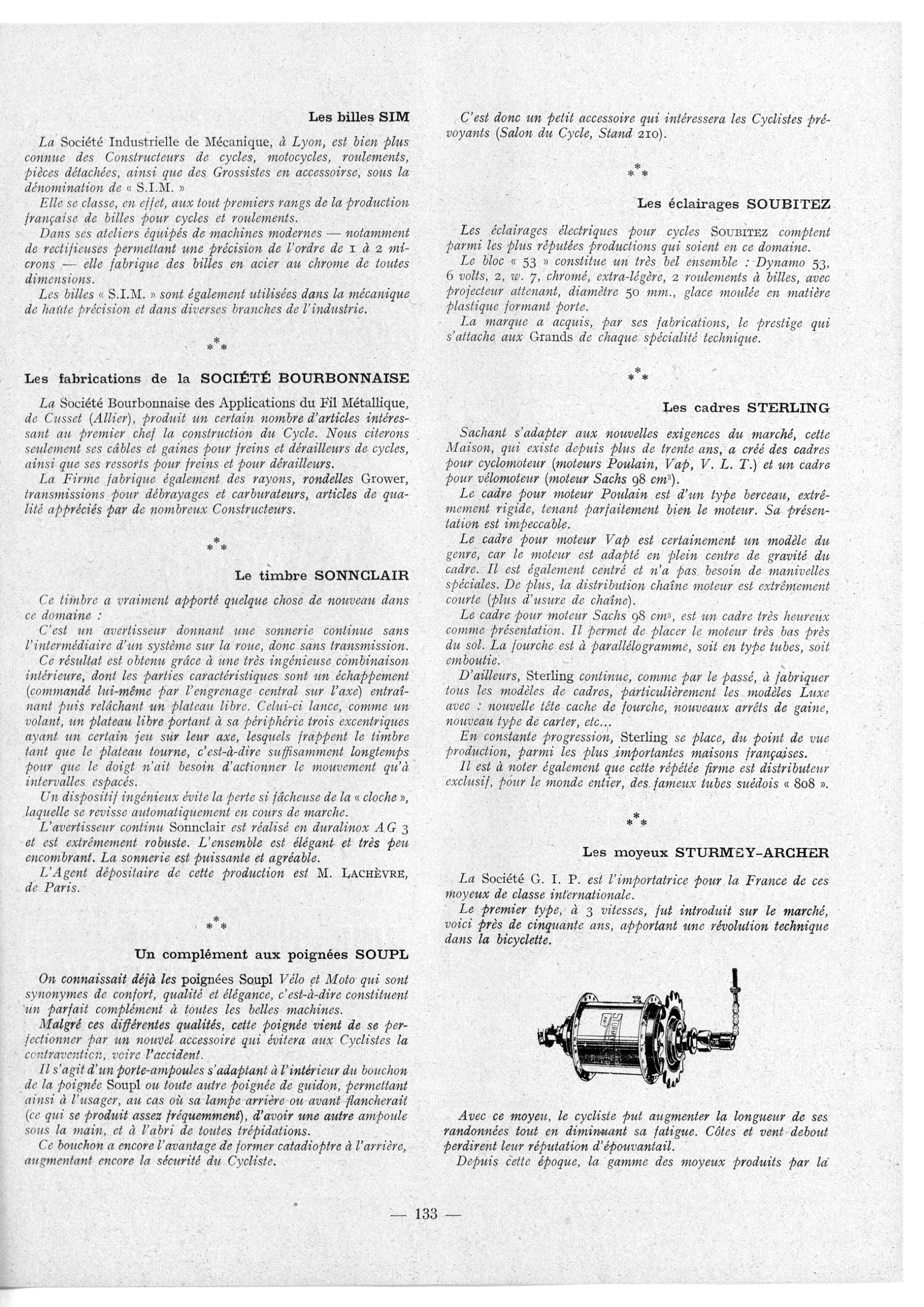 Page 20
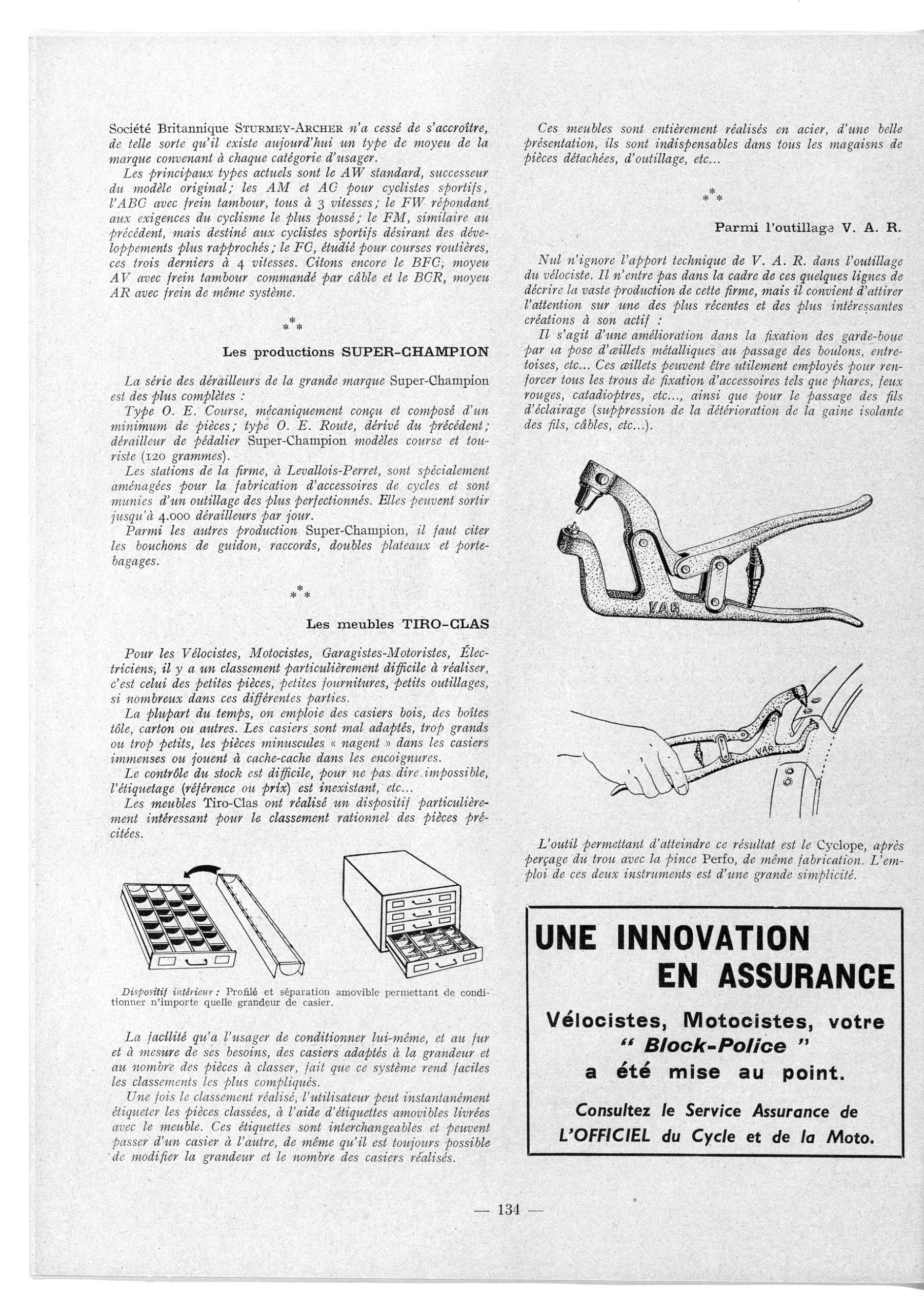 Page 21
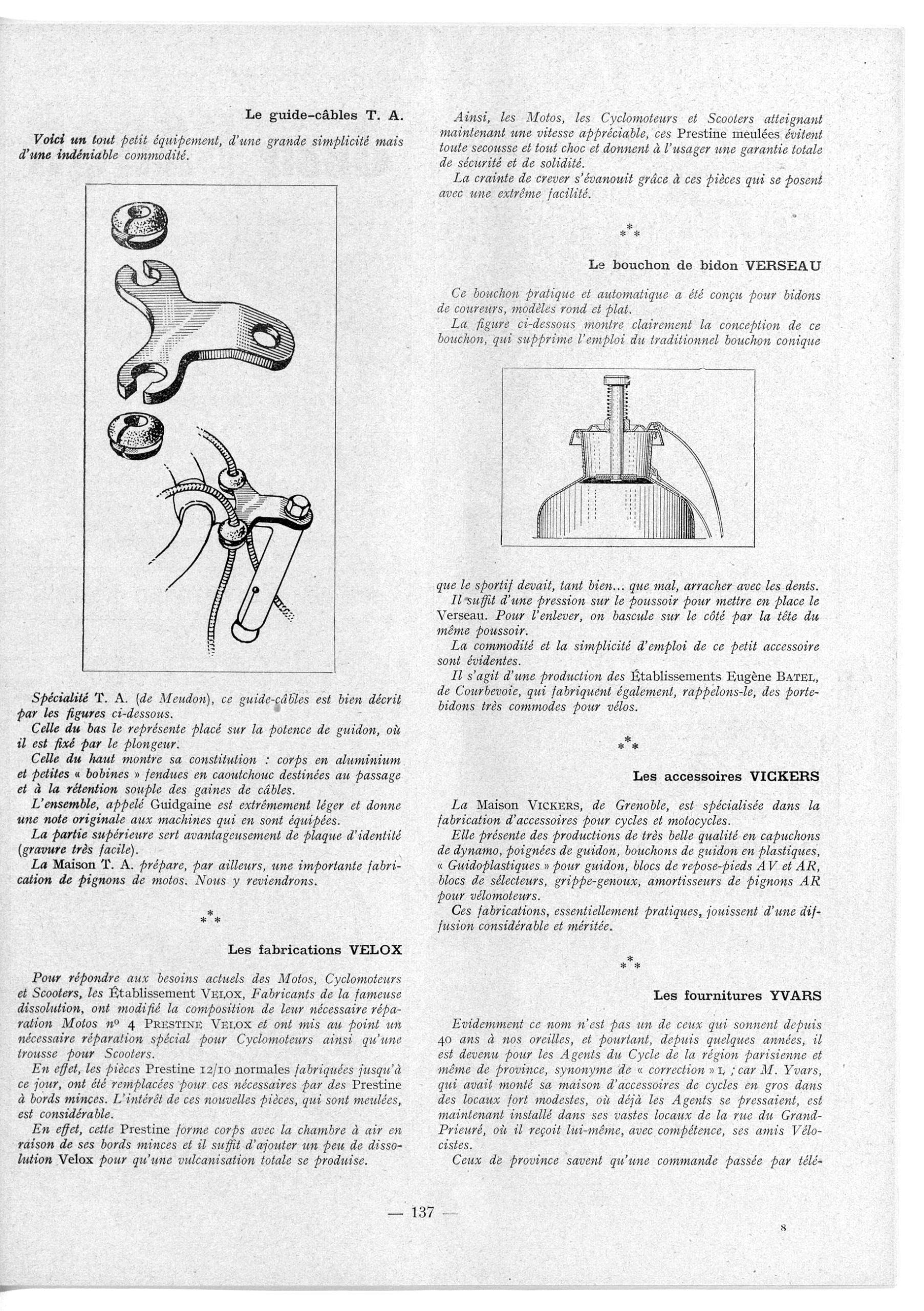 Page 22
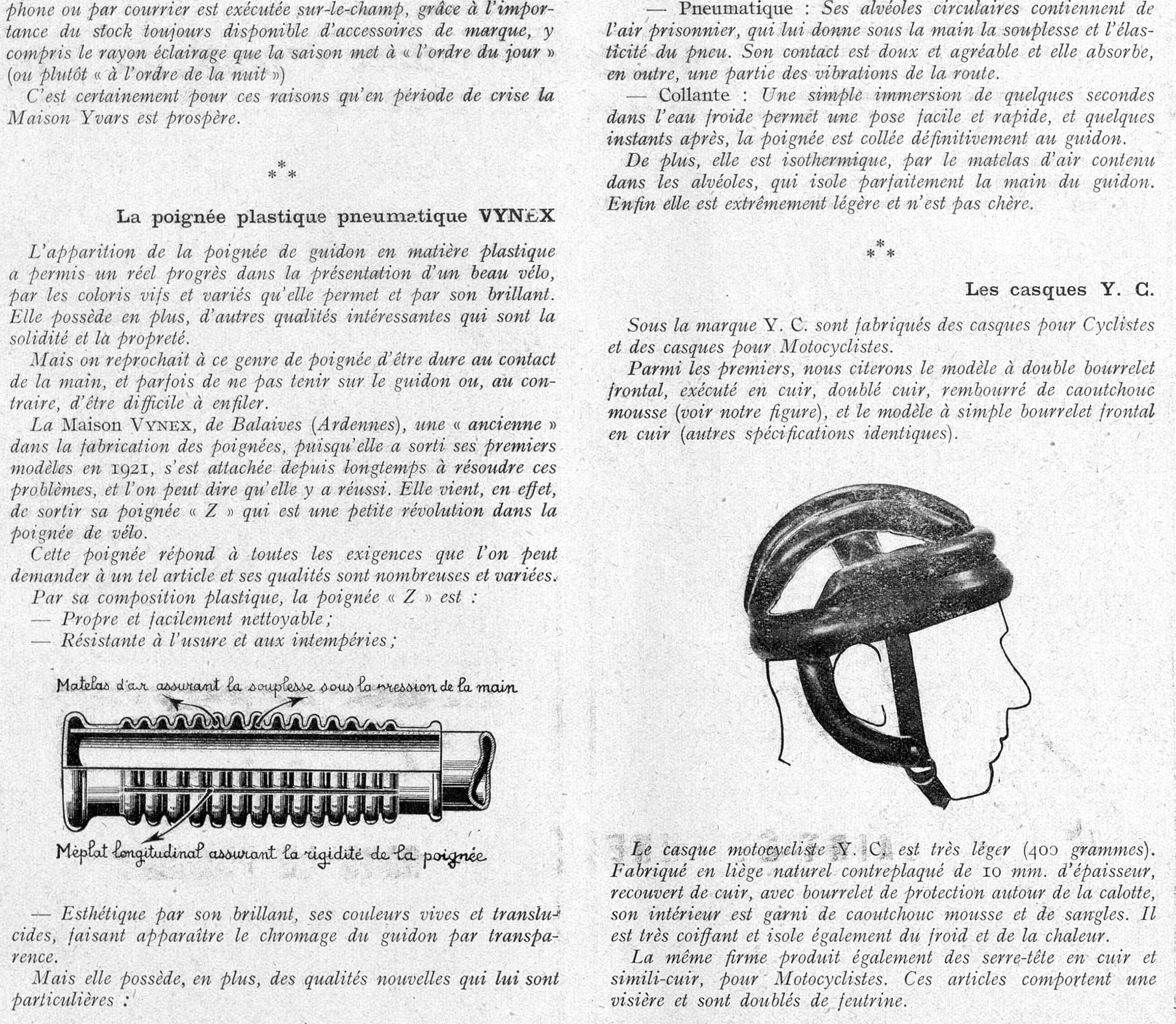 Page 23
| Type | Review |
|---|---|
| Year | 1952 |
| Publisher | L'Officiel du cycle |
| Artist | Daniel Rebour |
| Country | France |
| Language | French |
| Pages | 23 |
| Source | Gallica (Bibliothèque nationale de France), L'Officiel du cycle, du motocycle et du camping, 20 September 1952, Numéro spécial du Salon 1952, pages 95, 97, 98, 101, 103, 105, 107, 109, 111, 113, 115, 116, 119, 121, 123, 125, 127, 129, 131, 133, 134, 137 and 139; ark:/12148/bd6t541820671. Source gallica.bnf.fr / BnF. |
| Credit | Ebykr archive; Bibliothèque nationale de France |
| Identifier | Gallica (BnF) ark:/12148/bd6t541820671/f95 |
| Transcription | Headings and specifications transcribed; article text summarized |
Premier coup d'œil sur les ÉQUIPEMENTS et OUTILLAGES Les volants magnétiques A. B. G. — Un pour fonctionnement sans batterie, éclairage alternatif 12 V ; — Deux pour fonctionnement avec batterie, soit éclairage alternatif, soit éclairage continu, marche et arrêt. Les spécialités « L'ACCESSOIRE MOTO-CYCLISTE » Les fournitures ARGAUD (Suite page 97) — 95 — …
This is a magazine article, so its running text is summarized here rather than reproduced; the headline, byline, specifications and scores are transcribed as printed.
From L’Officiel du cycle, du motocycle et du camping, 20 September 1952, the paper’s special number for the 1952 Paris Salon du Cycle et du Motocycle, pages 95 to 139: the magazine’s first look at the components, accessories and tools shown at the Salon, firm by firm, with their models and drawings. The title, headings, captions and lists are transcribed as printed; the text is summarized in Ebykr’s words, and the page images carry it in full.
— Page 1 —
Premier coup d’œil sur les
ÉQUIPEMENTS et OUTILLAGES
[Ebykr summary; the article’s text is not reproduced. A ruled box opens the survey: here is a first glance at the 1952-53 technique in Equipment and Tooling. As always, this series of notes cannot be complete; it will therefore be followed by a second, which will appear in the paper’s Salon report number (1 November), where the paper will set out objectively the particulars of every manufacture on which it has been able to gather documentation.]
Les volants magnétiques A. B. G.
[Ebykr summary; the article’s text is not reproduced. Thanks to the experience of the Société A. B. G. in the ignition of aviation engines, the magnetic flywheels of that mark give an ignition as powerful as the best magnetos and a lighting conforming to the demands of the Code de la Route. The rotor is made of four magnets and four pole masses assembled by a light alloy cast in a chill mold, so that the whole is very solid and cannot be deformed. The coils, the condenser and the breaker are mounted on the stator, laid out and designed so that they are interchangeable and easily taken down: the coils, for example, undergo no machining after being mounted on the stator, so the user can replace them easily. Coils and condensers are made with the materials and by the manufacturing processes used in building aviation magnetos. The system that breaks the primary current, often sensitive to wear, is particularly carefully made: the cam, in treated steel, is ground to a profile such that the point at which the contacts open changes very little when their gap varies, so the breaker setting is always near the optimum; the characteristics of the primary current and the material of the “toucheau” were chosen so that the gap of the contacts stays nearly constant through the life of the flywheel, the wear of the grains being proportionally equal to the wear of the toucheau. Set during assembly at the works, the flywheel can run several hundred hours without the breaker setting being redone. For an ideal ignition the parasitic tail of the spark, whose harmful effect wears the plugs, would have to be suppressed, and in the A. B. G. flywheel the makers sought to come as close to that as possible: the energy of the high-tension, high-frequency discharge was made a maximum by the use of a short, well-laminated magnetic circuit; the characteristics of the primary winding were determined so that the variation of flux due to the opening of the grains is very large, even at idle, and nearly independent of speed; and the tail of the spark was cut to a minimum by a secondary winding with few turns. The A. B. G. magnetic flywheel gives without a misfire sparks of 8 mm. measured on B. N. A. spark gaps at a speed of 130 t./min., with or without the lighting working; the length of spark obtainable without a misfire depends little on speed, which lets engines be lit and started easily in the worst conditions: very highly compressed engines, plugs showing losses, plugs whose electrodes are too far apart. The Société A. B. G. makes three lighting arrangements:]
— Un pour fonctionnement sans batterie, éclairage alternatif 12 V ;
— Deux pour fonctionnement avec batterie, soit éclairage alternatif, soit éclairage continu, marche et arrêt.
Les spécialités « L’ACCESSOIRE MOTO-CYCLISTE »
[Ebykr summary; the article’s text is not reproduced. The Paris firm L’Accessoire Moto-Cycliste is well known to motorcycle and cycle dealers for the variety of equipment it offers, more particularly in control gear, from complete handlebars for vélomoteurs and motorcycles and twist grips through to levers and control levers. These quality products come from the excellent Magura mark, for which the firm holds the exclusive rights for France and the Union Française. Among the levers of the same manufacture the paper singles out the ratchet lever 11/1, which its clip adapts to handlebars of 22 and 23,5. Its multi-purpose device is designed for declutching (giving a neutral point for machines without a gearbox) and for braking (as a retarder or a lock); it is recommended in particular for cyclomoteurs and vehicles for the disabled and can even serve as an anti-theft device. For equipping motorcycles the firm makes leg shields of very happy effect (tubes bent in a U), fitted at the side with an extremely handy stand; the whole is robust against every test.]
Les fournitures ARGAUD
[Ebykr summary; the article’s text is not reproduced. For nearly half a century the Établissements A. Argaud et Fils, of Paris, have been “la Maison de gros des Vélocistes”. The firm supplies, in the capital, in the provinces and in the Union Française, everything to do with frame building, with the assembly or repair of cycles, with equipping the cyclist, together with spare parts, accessories, tires, tooling and sporting goods, in articles of the first French and foreign marks.]
(Suite page 97)
— 95 —
[The page is type only, with no drawing or photograph. The head carries the title in two parts: “Premier coup d’œil sur les” in large roman lowercase across the top left, then “ÉQUIPEMENTS et OUTILLAGES” in heavy roman capitals below and to the right, each part flanked by a block of three thin parallel rules. The body is set in two columns, the firm notes in italic under bold roman headings, with asterisms of three asterisks between the firms. Across the foot of the first column and into the second runs a ruled box, open at the sides of the type, holding the paper’s introductory note in roman with a large drop capital V. The catchline “(Suite page 97)” closes the second column and the page number “— 95 —” stands centered at the foot.]
— Page 2 —
Les spécialités AFCO
[Ebykr summary; the article’s text is not reproduced. The Société Afco, distributor for the French market of great foreign marks, exhibits on three stands at the Salon du Cycle, porte de Versailles. At stand 301 it presents the J. L. O. productions (auxiliary engines for cycles and cyclomoteurs, engines for vélomoteurs, scooters, motorcycles and voiturettes, from 48 to 398 cm3). At stand 302 it shows the Perry 2 étoiles hub brake, the Perry chain for cycle, cyclomoteur, vélomoteur and motorcycle, and the Perry chain breaker for cycle and motorcycle. At stand 303 it presents the famous Brooks saddles in every model and the Leatheries and Lycett saddles for cycle and cyclomoteur. Wholesalers and cycle dealers will therefore take a keen interest in the stands of the Société Afco.]
Les nouveautés AMAC
[Ebykr summary; the article’s text is not reproduced. Amac, whose name has been tied for more than thirty years to the great motorcycling successes and records, has never for all that stopped its research for better engine output, easier starting, economy of fuel and so on, and every year at the Salon this great carburetion specialist presents novelties that can be wholly trusted, the name Amac being by itself a guarantee of quality and technical perfection. This year, at stand 148 (Hall du Cycle), the visitor will be able to see:]
— Ses carburateurs 912 pour cyclomoteurs comportant un starter à retour automatique, un niveau d’essence stabilisé, un épurateur d’air et silencieux d’admission qui marquent un progrès très net sur tout ce qui avait été réalisé précédemment pour les moteurs au-dessous de 50 cm3 ;
— Ses carburateurs 933 pour vélomoteurs et 4/ 5/ 6/ pour motos, aux particularités suivantes : starter à bouton poussoir, filtre à essence à décantation, visible, épurateur d’air et silencieux d’admission, commandes inversées spéciales pour scooters, etc…
[Ebykr summary, continuing the Amac note. The Amac stand will of course also show the firm’s usual manufactures, well known to and valued by motorcyclists: first its complete series of handlebars for vélomoteurs, motorcycles and scooters, its twist grips, control levers and brake levers, fuel taps, flexible transmissions and lastly, for the exclusive use of the motorcycle trade, the very practical case of spare parts for carburetors. The paper tells motorcycle dealers to visit the stand, which concerns them particularly.]
Les robinets AMERO
[Ebykr summary; the article’s text is not reproduced. The Amero taps, known on the market for their indisputable advantages and for the way their bodies can be set at any angle, have until now been supplied to the makers, and tens of thousands of motorcyclists already value them. By moving its workshops into new premises at Rosny-sous-Bois, the company is now able to increase manufacture so as to supply every maker and dealer. The program drawn up for the 1953 season is very wide: the right model can be chosen among some thirty available, from the simplest through to the “réserve” with double orientability. The model most awaited on the market is the “réserve” in 8/100, which fits every machine; it has a dismountable filter and a handle with detents, and, built in large series, its price is very low. The Société Amero is at present testing a handlebar of an entirely new design: the cable is no longer to break, and its switch is of an unusual presentation.]
Les fourches élastiques des ATELIERS DU DORLAY
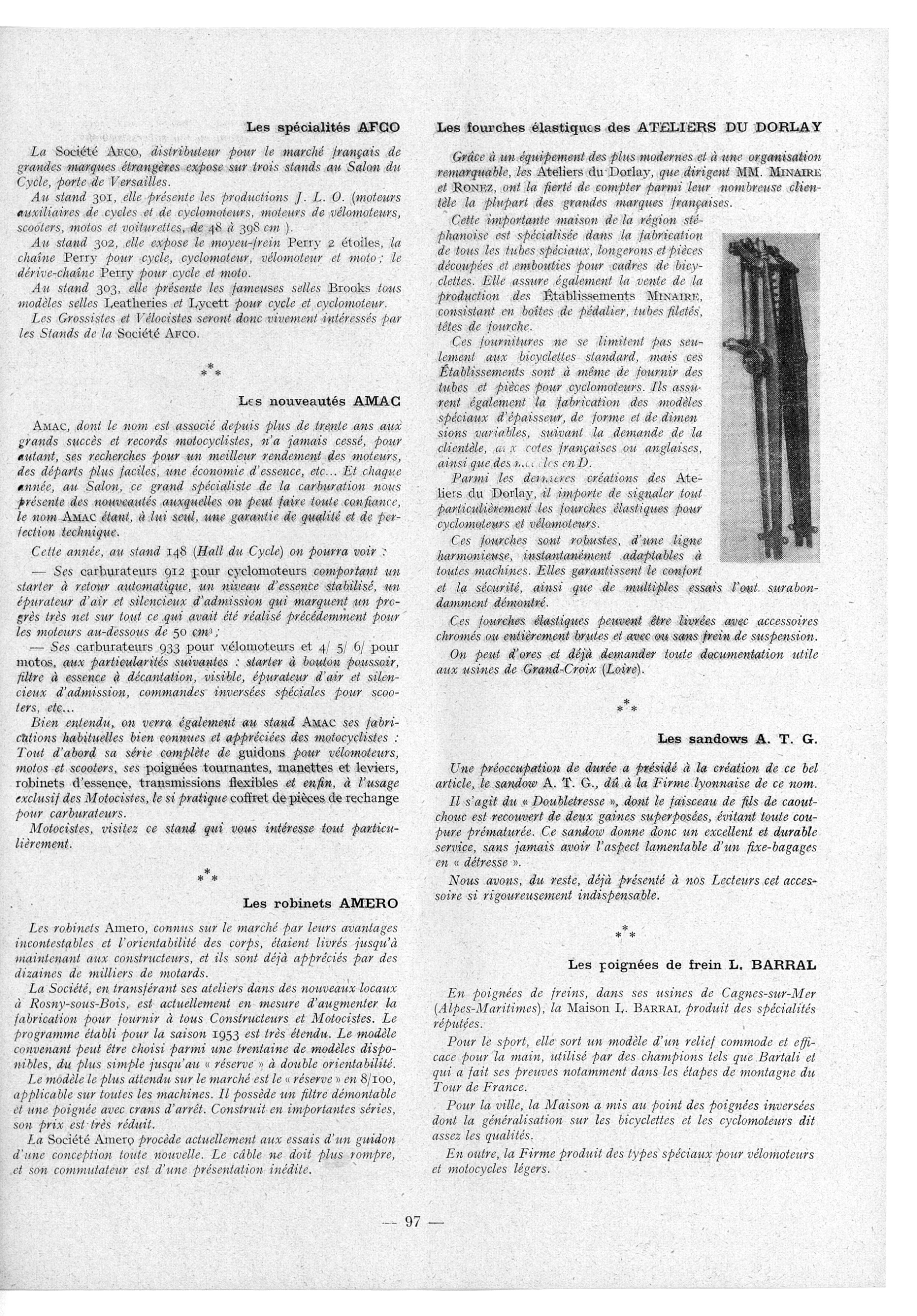
[Ebykr summary; the article’s text is not reproduced. Thanks to equipment of the most modern kind and to a remarkable organization, the Ateliers du Dorlay, directed by MM. Minaire and Ronez, are proud to count most of the great French marques among their numerous customers. This important house of the Saint-Étienne region specializes in making every kind of special tube, frame member and blanked and pressed part for bicycle frames. It also handles the sale of the production of the Établissements Minaire, which consists of bottom-bracket shells, threaded tubes and fork crowns. These supplies are not limited to standard bicycles: the works can furnish tubes and parts for cyclomoteurs, and they also make special models of varying thickness, shape and dimensions to the customer’s demand, to French or English gauges, as well as models in D section. Among the latest creations of the Ateliers du Dorlay the elastic forks for cyclomoteurs and vélomoteurs deserve particular notice. These forks are robust, of a harmonious line and instantly adaptable to any machine; they guarantee comfort and safety, as many trials have abundantly shown. The elastic forks can be delivered with chromed fittings or entirely in the rough and with or without a suspension damper. Any useful documentation may already be asked of the works at Grand-Croix (Loire).]
Les sandows A. T. G.
[Ebykr summary; the article’s text is not reproduced. A concern with long life presided over the creation of this fine article, the A. T. G. sandow, owed to the Lyon firm of that name. It is the “Doubletresse”, whose bundle of rubber threads is covered with two superposed sheaths, so that no premature cut can occur. The sandow therefore gives excellent and lasting service without ever taking on the sorry look of a luggage strap in “distress”. The paper notes that it has already presented this strictly indispensable accessory to its readers.]
Les poignées de frein L. BARRAL
[Ebykr summary; the article’s text is not reproduced. In brake levers, in its works at Cagnes-sur-Mer (Alpes-Maritimes), the Maison L. Barral makes noted specialties. For sport it brings out a model of a shape convenient and effective for the hand, used by champions such as Bartali and proved in particular in the mountain stages of the Tour de France. For town use the house has developed inverted levers, whose general adoption on bicycles and cyclomoteurs says enough for their qualities. The firm also makes special types for vélomoteurs and light motorcycles.]
— 97 —
[The page is set in two columns, the firm notes in italic under bold roman headings, with asterisms of three asterisks between the firms. One illustration sits in the outer column, let into the text of the Ateliers du Dorlay note: a tall halftone photograph, taller than it is wide, of an elastic telescopic front fork for a cyclomoteur seen from the front, the crown and its fittings at the top and the two sliding legs running down the picture, printed in coarse screen against a light gray ground and carrying no signature. The page number “— 97 —” stands centered at the foot. In the AFCO note the superscript that follows “398 cm” in the line about engine sizes has not printed clearly.]
— Page 3 —
La selle bi-place AURORA
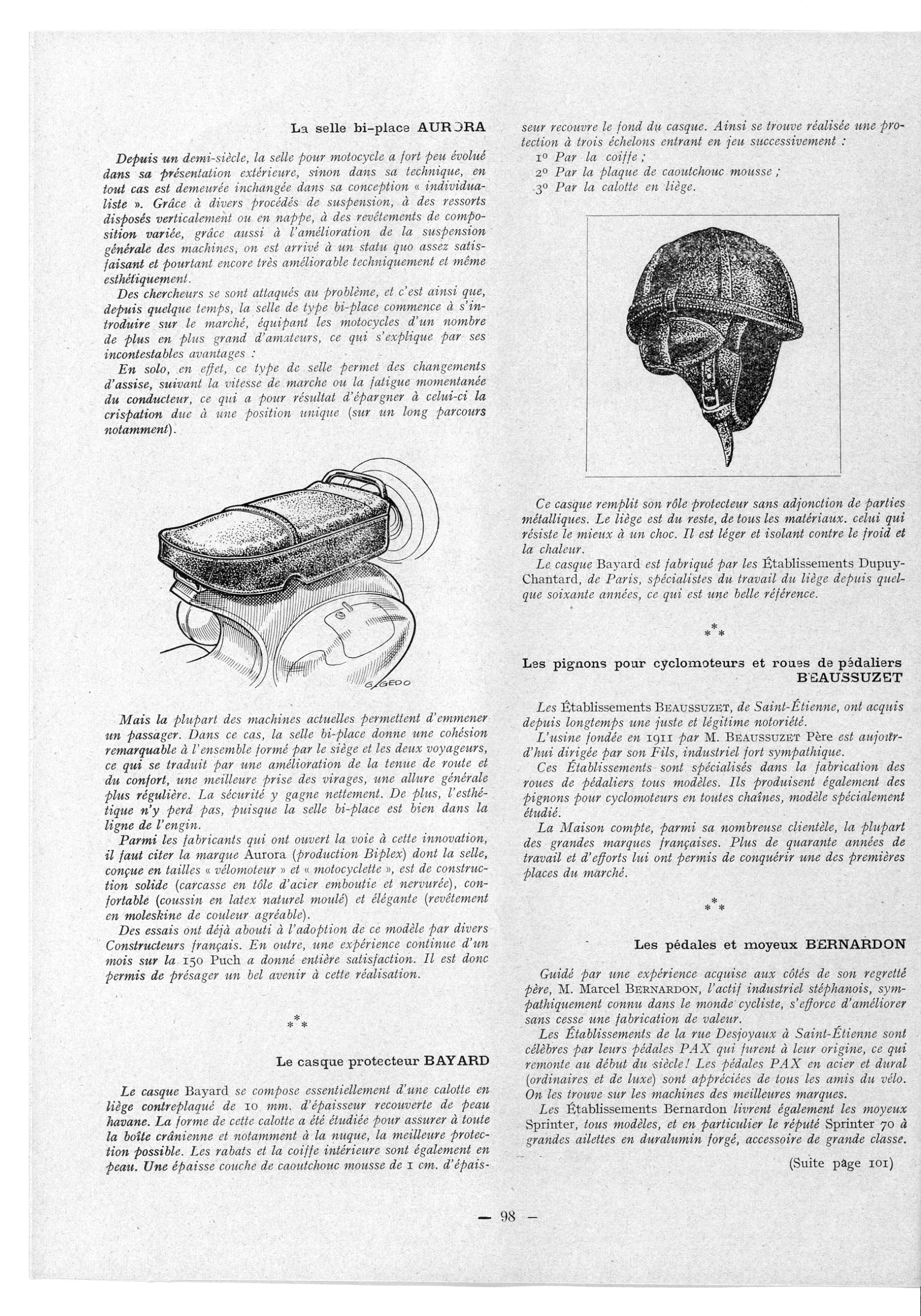
[Ebykr summary; the article’s text is not reproduced. For half a century the motorcycle saddle has evolved very little in its outward presentation, if not in its technique, and in any case has stayed unchanged in its “individualist” conception. Through various suspension systems, springs set vertically or in a mattress, coverings of varied composition and the general improvement of the suspension of machines, a fairly satisfactory status quo has been reached, yet one still much open to improvement technically and even in looks. Researchers attacked the problem, and so for some time the twin-seat type of saddle has begun to come onto the market, equipping the motorcycles of a growing number of enthusiasts, which its indisputable advantages explain. Ridden solo, this type of saddle allows changes of seat according to the speed or the rider’s momentary fatigue, which spares him the cramp of a single position, notably on a long run. But most present machines allow a passenger to be carried, and in that case the twin saddle gives a remarkable cohesion to the whole formed by the seat and the two travelers, which shows in better road holding and comfort, a better hold through corners and a steadier general gait; safety clearly gains. Nor does the look suffer, since the twin saddle sits well in the line of the machine. Among the makers who opened the way to this innovation the paper cites the Aurora mark (a Biplex production), whose saddle, made in “vélomoteur” and “motocyclette” sizes, is of solid construction (a shell of pressed and ribbed sheet steel), comfortable (a cushion of molded natural latex) and elegant (a covering of moleskin in an agreeable color). Trials have already brought several French makers to adopt this model, and in addition a continuous test of one month on the 150 Puch gave entire satisfaction, so a fine future may be foretold for it.]
Le casque protecteur BAYARD
[Ebykr summary; the article’s text is not reproduced. The Bayard helmet consists essentially of a shell of plywood cork 10 mm. thick covered with tan skin. The shape of this shell was studied to give the whole cranium, and the nape in particular, the best possible protection. The flaps and the inner lining are also of skin. A thick layer of foam rubber 1 cm. thick covers the bottom of the helmet. There is thus a protection in three stages which come into play one after the other:]
1º Par la coiffe ;
2º Par la plaque de caoutchouc mousse ;
3º Par la calotte en liège.
[Ebykr summary, continuing the Bayard note. The helmet fills its protective role without any metal parts being added. Cork is, besides, of all materials the one that best resists a shock, and it is light and insulates against cold and heat. The Bayard helmet is made by the Établissements Dupuy-Chantard, of Paris, specialists in working cork for some sixty years, which is a fine reference.]
Les pignons pour cyclomoteurs et roues de pédaliers
BEAUSSUZET
[Ebykr summary; the article’s text is not reproduced. The Établissements Beaussuzet, of Saint-Étienne, long ago won a just and legitimate renown. The works, founded in 1911 by M. Beaussuzet senior, is today run by his son, a very likeable industrialist. The firm specializes in making chainwheels of every model. It also makes sprockets for cyclomoteurs for every chain, a specially studied model. The house counts most of the great French marques among its numerous customers, and more than forty years of work and effort have won it one of the first places in the market.]
Les pédales et moyeux BERNARDON
[Ebykr summary; the article’s text is not reproduced. Guided by experience gained beside his late father, M. Marcel Bernardon, the active Saint-Étienne industrialist, well liked in the cycling world, strives to keep improving a manufacture of worth. The Établissements of the rue Desjoyaux at Saint-Étienne are famous for their PAX pedals, which were their origin and go back to the start of the century. The PAX pedals in steel and dural (ordinary and de luxe) are valued by every friend of the bicycle and are found on the machines of the best marques. The Établissements Bernardon also supply the Sprinter hubs in every model, and in particular the noted Sprinter 70 with large flanges in forged duralumin, an accessory of high class.]
(Suite page 101)
— 98 —
[The page is set in two columns, the firm notes in italic under bold roman headings, with asterisms of three asterisks between the firms. Two illustrations face each other across the page. In the first column, below the Aurora note, a pen-and-ink line drawing shows a twin motorcycle saddle in three-quarter view from the front left, its two cushions divided by a seam, a grab rail at the rear and the shell set over the rear mudguard and wheel of the machine, the body of the machine drawn in loose outline with hatched shading; the drawing is signed “G. GEDO” in capitals at the lower right. In the second column a stipple drawing within a thin rectangular rule shows the Bayard helmet in three-quarter view from the left, a rounded shell with a reinforcing band across it, an ear flap and a chin strap with a buckle, the long strap trailing from the bottom of the frame. The catchline “(Suite page 101)” closes the second column and the page number “— 98 —” stands at the foot.]
— Page 4 —
L’indicateur de direction BIELA
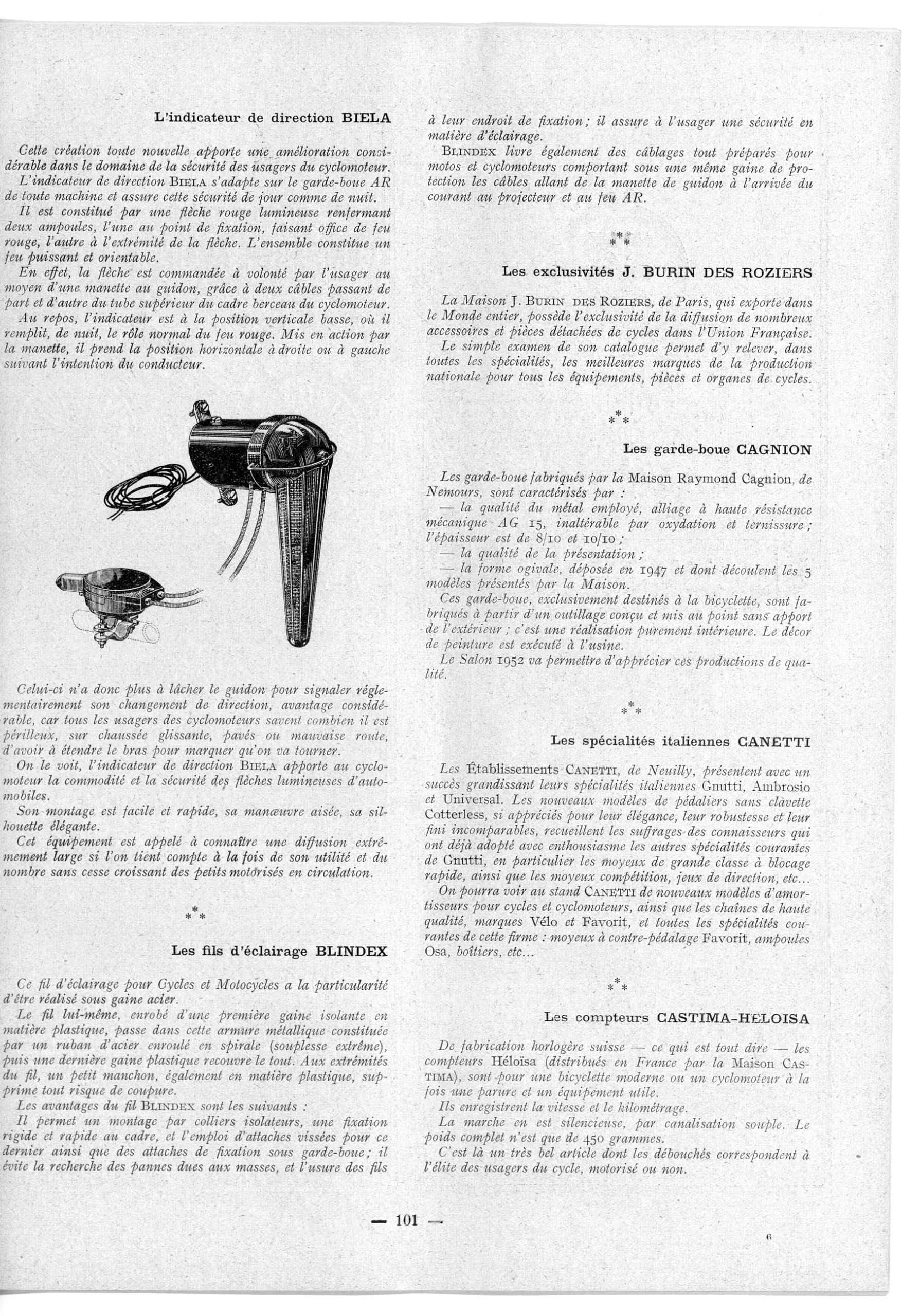
[Ebykr summary; the article’s text is not reproduced. This entirely new creation brings a considerable improvement in the safety of cyclomoteur users. The Biela direction indicator fits on the rear mudguard of any machine and gives that safety by day as by night. It consists of a luminous red arrow holding two bulbs, one at the fixing point serving as the rear red lamp, the other at the tip of the arrow; the whole makes a powerful lamp that can be swung. The arrow is worked at will by the user through a lever on the handlebar, by two cables running on either side of the top tube of the cyclomoteur’s cradle frame. At rest the indicator hangs vertically down, where at night it fills the normal role of the red lamp; set in action by the lever it takes the horizontal position to right or to left as the rider intends. The rider therefore no longer has to let go of the handlebar to signal his change of direction as the regulations require, a considerable advantage, since every cyclomoteur user knows how dangerous it is, on a slippery road, on paving or on a bad surface, to have to put out an arm to mark a turn. The Biela direction indicator thus brings to the cyclomoteur the convenience and the safety of the luminous arrows of motor cars. It is easy and quick to fit, easy to work and elegant in outline. This equipment is bound to spread extremely widely, given both its usefulness and the ever growing number of small motorized machines on the road.]
Les fils d’éclairage BLINDEX
[Ebykr summary; the article’s text is not reproduced. This lighting wire for cycles and motorcycles has the peculiarity of being made under a steel sheath. The wire itself, wrapped in a first insulating sheath of plastic, passes through this metal armor formed of a steel ribbon wound in a spiral (extreme flexibility), and a last plastic sheath covers the whole. At the ends of the wire a small sleeve, also of plastic, removes any risk of a cut. The advantages of the Blindex wire are these: it allows mounting by insulating clips, a rigid and quick fixing to the frame and the use of screwed fasteners for the frame as well as fastenings under the mudguard; it avoids the hunt for faults caused by earthing, and the wear of wires at the point where they are fixed; it gives the user safety in the matter of lighting. Blindex also supplies ready-made wiring harnesses for motorcycles and cyclomoteurs carrying, under one protective sheath, the cables running from the handlebar switch to the current’s arrival at the headlamp and at the rear lamp.]
Les exclusivités J. BURIN DES ROZIERS
[Ebykr summary; the article’s text is not reproduced. The Maison J. Burin des Roziers, of Paris, which exports to the whole world, holds the exclusive distribution of numerous cycle accessories and spare parts in the Union Française. A simple look through its catalog shows, in every specialty, the best marks of the national production for all cycle equipment, parts and components.]
Les garde-boue CAGNION
[Ebykr summary; the article’s text is not reproduced. The mudguards made by the Maison Raymond Cagnion, of Nemours, are marked by:]
— la qualité du métal employé, alliage à haute résistance mécanique AG 15, inaltérable par oxydation et ternissure ; l’épaisseur est de 8/10 et 10/10 ;
— la qualité de la présentation ;
— la forme ogivale, déposée en 1947 et dont découlent les 5 modèles présentés par la Maison.
[Ebykr summary, continuing the Cagnion note. These mudguards, meant for the bicycle alone, are made with tooling designed and developed without outside help; it is a purely in-house achievement. The painted decoration is carried out at the works. The 1952 Salon will let these quality productions be judged.]
Les spécialités italiennes CANETTI
[Ebykr summary; the article’s text is not reproduced. The Établissements Canetti, of Neuilly, present with growing success their Italian specialties Gnutti, Ambrosio and Universal. The new models of cotterless chainsets, Cotterless, so valued for their elegance, their strength and their incomparable finish, win the votes of the connoisseurs who have already adopted with enthusiasm the other current specialties of Gnutti, in particular the high-class hubs with quick release, as well as the competition hubs, headsets and so on. At the Canetti stand may be seen new models of shock absorbers for cycles and cyclomoteurs, as well as the high-quality chains of the Vélo and Favorit marks, and all the firm’s current specialties: Favorit coaster hubs, Osa bulbs, cases and so on.]
Les compteurs CASTIMA-HELOISA
[Ebykr summary; the article’s text is not reproduced. Of Swiss clockmaking manufacture, which says everything, the Héloïsa speedometers (distributed in France by the Maison Castima) are for a modern bicycle or a cyclomoteur at once an ornament and a useful piece of equipment. They record speed and distance. They run silently, through a flexible drive. The complete weight is only 450 grams. It is a very fine article whose outlets match the elite of cycle users, motorized or not.]
— 101 —
[The page is set in two columns, the firm notes in italic under bold roman headings, with asterisms of three asterisks between the firms. One group of line engravings sits in the first column, within the Biela note and without a frame: at the upper right the direction indicator itself, drawn in three-quarter view, a cylindrical lamp body with a lens and clamp at one end and a long tapering arrow blade hanging from it, cross-hatched along its length, two sheathed cables running from the body and a loop of coiled cable laid beside it; at the lower left, drawn smaller, the handlebar lever unit seen from above and slightly in front, a round body on a clamp with two cables leaving it at the side, the clamp’s hidden parts shown in dotted outline. The engravings are unsigned. The page number “— 101 —” stands at the foot of the first column and a small signature figure “6” sits at the foot of the second.]
— Page 5 —
Les dispositifs réfléchissants CATAPHOTES
[Ebykr summary; the article’s text is not reproduced. The Cataphotes, whose name people often tend to take for a common noun although it is an exclusive registered trademark, had already been approved in 1939. Chronologically the Société Anonyme Cataphotes is therefore the originator of reflecting devices in France. Its models for bicycles, vélomoteurs and motorcycles conform to the decrees of 2 June and 14 December 1948. They exist in round (AGR. T. P. C. 7) and rectangular (AGR. T. P. C. 8) types for bicycles, cyclomoteurs and vélomoteurs. The models for motorcycles (AGR. T. P. V. 1, 2, 5 and 9) suit motor cars and small utility vehicles as well.]
Les peintures LA CELLIOSE
[Ebykr summary; the article’s text is not reproduced. The Société La Celliose occupies large premises at Pierre-Bénite, in the Rhône, and its output lets it make paint for the biggest industries of the country and even abroad. The company has taken a particular interest in the problem of enameling cycles and motorcycles: the creation of the Celliosprint stoved enamel quality is the outcome of much research and of decades of experience. It has set out to create for the cycle industry an enamel that is resistant, solid and agreeable to the eye, in bright tones, in transparent as well as in metallic and opaque finishes. The works is active in branches other than the cycle; in particular it makes superlaques for motor-car bodies, enamel for household and sanitary ware and so on. Every paint that leaves the works is strictly referenced; each batch is checked chemically and tried in a special application shop. For nearly a quarter of a century the direction of the firm has been shared between M. F. Guillemot, who supervises the whole technical side of manufacture, and M. J. Guillemot, who takes the commercial management.]
Les jeux de direction et de pédalier CHENET de
Saint-Étienne
[Ebykr summary; the article’s text is not reproduced. For some twenty years this well-regarded house has not ceased to satisfy its faithful customers. The great marques trust it. M. Chênet is a seasoned technician who watches his production closely and neglects nothing to keep its renown. On a fine bicycle his headsets and bottom-bracket sets are an indisputable guarantee. The Établissements Chênet are also specialized in making hub axles, large and small cones, and bottom-bracket axles and cups for repair work; in these articles they are the appointed suppliers of numerous wholesalers.]
Les productions CHAZAL-ROUCHOUSE
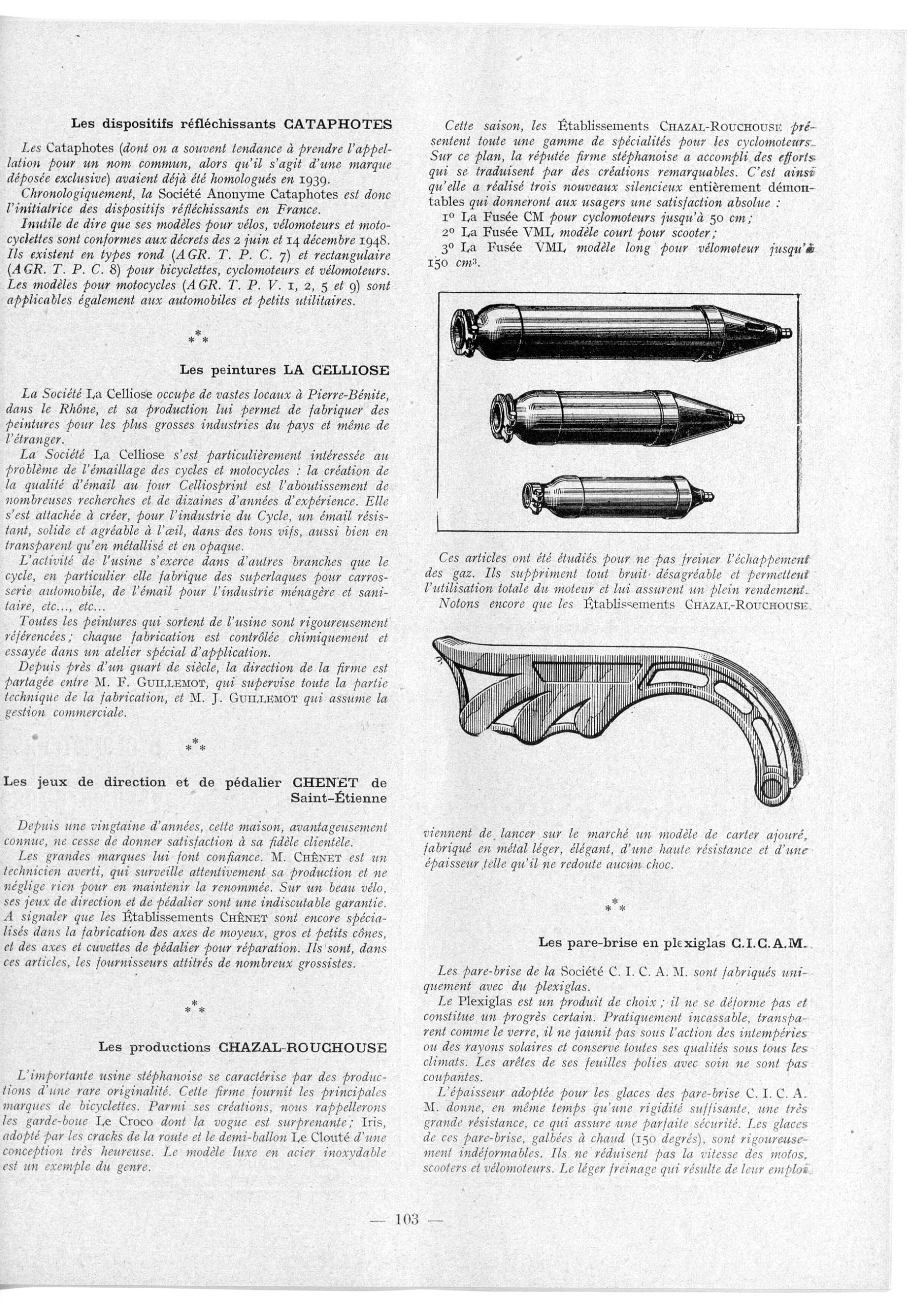
[Ebykr summary; the article’s text is not reproduced. The important Saint-Étienne works is marked by productions of a rare originality. The firm supplies the principal bicycle marques. Among its creations the paper recalls the mudguards Le Croco, whose vogue is surprising; Iris, adopted by the stars of the road; and the half-balloon Le Clouté, of a very happy design. The de luxe model in stainless steel is an example of the kind. This season the Établissements Chazal-Rouchouse present a whole range of specialties for cyclomoteurs. On that ground the noted Saint-Étienne firm has made efforts that show in remarkable creations: it has produced three new silencers, entirely dismountable, that will give users absolute satisfaction:]
1º La Fusée CM pour cyclomoteurs jusqu’à 50 cm ;
2º La Fusée VML modèle court pour scooter ;
3º La Fusée VML modèle long pour vélomoteur jusqu’à 150 cm3.
[Ebykr summary, continuing the Chazal-Rouchouse note. These articles were studied so as not to check the escape of the gases. They suppress every disagreeable noise and allow the engine to be used to the full, assuring it its complete output. The paper notes further that the Établissements Chazal-Rouchouse have just put on the market an openwork chainguard model, made in light metal, elegant, of high strength and of a thickness such that it fears no shock.]
Les pare-brise en plexiglas C.I.C.A.M.
[Ebykr summary; the article’s text is not reproduced. The windscreens of the Société C. I. C. A. M. are made of plexiglas alone. Plexiglas is a choice product; it does not deform and marks a certain advance. Practically unbreakable and transparent as glass, it does not yellow under the weather or the rays of the sun and keeps all its qualities in every climate. The edges of its carefully polished sheets do not cut. The thickness adopted for the screens of the C. I. C. A. M. windscreens gives, together with sufficient rigidity, a very great strength, which makes for perfect safety. The screens of these windscreens, curved hot (150 degrees), cannot be deformed. They do not cut the speed of motorcycles, scooters and vélomoteurs; the slight braking that results from their use — the note breaks off at the foot of the page and runs on to the next.]
— 103 —
[The page is set in two columns, the firm notes in italic under bold roman headings, with asterisms of three asterisks between the firms. Two line engravings sit in the second column. The upper one, enclosed in a thin rectangular rule, shows three exhaust silencers drawn in side view one above another, each a long tapering cylinder cross-hatched for a dark polished finish, with a flanged and clipped collar at the left end and a small tapered outlet at the right, the upper two long and the lowest short. Below the rule a larger unframed engraving shows an openwork chainguard in side view, its long curved body cut with shaped slots and a fin-shaped opening at the front, the metal rendered in close vertical ruling. Neither engraving is signed. The page number “— 103 —” stands at the foot of the first column.]
— Page 6 —
[Ebykr summary; the article’s text is not reproduced. The page opens with the end of the C. I. C. A. M. windscreen note begun on page 103. The slight braking that results from their use is very largely made up for by the better airflow of the machines and by the removal of the eddies of air caused by the rider’s clothes, the rider besides being sheltered in rain or storm. Another very appreciable advantage: by their line the C. I. C. A. M. windscreens have neither angles nor projections, and therefore no weak points. Their use creates a zone of calm that lets the rider keep a normal tone of voice with his passenger and be perfectly heard by him. A patented fixing system in no way hinders the rider’s view, which is always clear; there is on this model neither a surrounding frame nor rivets nor bolts. The C. I. C. A. M. windscreens mount with the greatest ease on the handlebar of any motorcycle, scooter or vélomoteur. The height of the screen can be altered at will. The bulk of the fixing, on the screen as on the handlebar, is cut to the strict minimum. There are two models: all in plexiglas, or with an apron.]
Les fabrications CHOLAIN
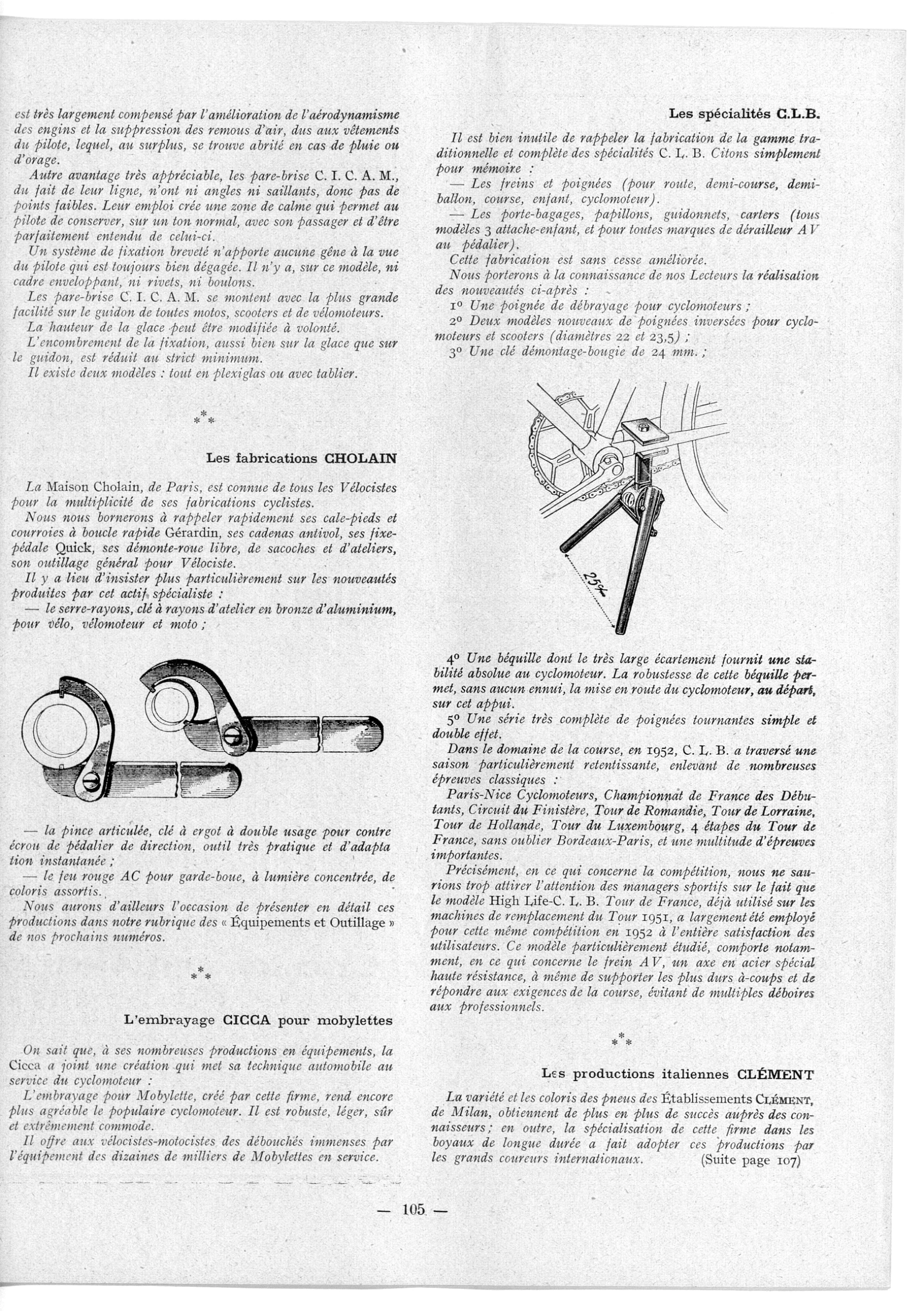
[Ebykr summary; the article’s text is not reproduced. The Maison Cholain, of Paris, is known to every cycle dealer for the many things it makes for the trade. The paper limits itself to a quick reminder of its toe clips and Gérardin quick-buckle straps, its anti-theft padlocks, its Quick pedal fixing, its freewheel removers, its saddlebags and workshop bags and its general tooling for the cycle dealer. The novelties produced by this active specialist deserve particular notice:]
— le serre-rayons, clé à rayons d’atelier en bronze d’aluminium, pour vélo, vélomoteur et moto ;
— la pince articulée, clé à ergot à double usage pour contre écrou de pédalier de direction, outil très pratique et d’adaptation instantanée ;
— le feu rouge AC pour garde-boue, à lumière concentrée, de coloris assortis.
[Ebykr summary, closing the Cholain note. The paper adds that it will have occasion to present these products in detail in the “Équipements et Outillage” column of its coming numbers.]
L’embrayage CICCA pour mobylettes
[Ebykr summary; the article’s text is not reproduced. To its many productions in equipment Cicca has added a creation that puts its motor-car technique at the service of the cyclomoteur: the clutch for the Mobylette, created by this firm, makes the popular cyclomoteur pleasanter still. It is robust, light, sure and extremely handy. It offers cycle and motorcycle dealers immense outlets through the equipping of the tens of thousands of Mobylettes in service.]
Les spécialités C.L.B.
[Ebykr summary; the article’s text is not reproduced. There is no need to recall the manufacture of the traditional and complete range of the C. L. B. specialties. The paper cites simply for the record:]
— Les freins et poignées (pour route, demi-course, demi-ballon, course, enfant, cyclomoteur).
— Les porte-bagages, papillons, guidonnets, carters (tous modèles 3 attache-enfant, et pour toutes marques de dérailleur AV au pédalier).
[Ebykr summary, continuing the C. L. B. note. This manufacture is constantly improved. The paper brings to its readers’ knowledge the following novelties:]
1º Une poignée de débrayage pour cyclomoteurs ;
2º Deux modèles nouveaux de poignées inversées pour cyclomoteurs et scooters (diamètres 22 et 23,5) ;
3º Une clé démontage-bougie de 24 mm. ;
4º Une béquille dont le très large écartement fournit une stabilité absolue au cyclomoteur. La robustesse de cette béquille permet, sans aucun ennui, la mise en route du cyclomoteur, au départ, sur cet appui.
5º Une série très complète de poignées tournantes simple et double effet.
[Ebykr summary, closing the C. L. B. note. In racing, in 1952 C. L. B. went through a particularly resounding season, carrying off many classic events: Paris-Nice Cyclomoteurs, the Championnat de France des Débutants, the Circuit du Finistère, the Tour de Romandie, the Tour de Lorraine, the Tour de Hollande, the Tour du Luxembourg, 4 stages of the Tour de France, without forgetting Bordeaux-Paris, and a host of important events. On competition precisely, the paper cannot too strongly draw the attention of team managers to the fact that the High Life-C. L. B. Tour de France model, already used on the spare machines of the 1951 Tour, was widely employed for that same competition in 1952 to the entire satisfaction of its users. This specially studied model has, as regards the front brake in particular, a pivot of special high-strength steel able to bear the hardest shocks and to meet the demands of racing, sparing the professionals many disappointments.]
Les productions italiennes CLÉMENT
[Ebykr summary; the article’s text is not reproduced. The variety and the colors of the tires of the Établissements Clément, of Milan, win more and more success with the connoisseurs; besides, this firm’s specialization in long-lasting tubulars has brought the great international racers to adopt its products.]
(Suite page 107)
— 105 —
[The page is set in two columns, the firm notes in italic under bold roman headings, with asterisms of three asterisks between the firms. Two line engravings run across the measure. In the first column, within the Cholain note, two tools are drawn side by side in three-quarter view, each a ring head pierced by a large circular opening with a shaped jaw and a screw at its side and a long straight handle, the metal shaded by fine ruling, the right-hand one with a hooked lug over the ring. In the second column, within the C. L. B. note, an engraving shows a cyclomoteur stand in place on a machine, drawn in outline from behind and to one side with the chainwheel, chain, crank and rear wheel sketched in thin line and the stand itself shaded by ruling, its two legs spread wide, a dotted arrow across the lower left marking the spread as “25 c/m”. Neither engraving is signed. A broken rule runs across the foot of the first column, the catchline “(Suite page 107)” closes the second and the page number “— 105 —” stands at the foot.]
— Page 7 —
[Ebykr summary; the article’s text is not reproduced. The page opens with the end of the Clément note begun on page 105. The Clément rims, for the road and for racing, are on the scale of the quality and the elegance of the marque’s tires and tubulars. All these articles are distributed in France by the S. O. F. I. R., which puts first-rank international articles into the cycle trade.]
Les cadres spéciaux CIZERON
[Ebykr summary; the article’s text is not reproduced. M. Cizeron, the active Saint-Étienne industrialist, has been able to make of his works a model factory. The special frames built by his Établissements are of a quality beyond compare. This production is the fruit of a truly modern plant that gathers a highly qualified staff. The frames for cyclotourists and racers, like the Cizeron children’s frames, are of a remarkable elegance and strong against every test, which explains their success, the brilliant consecration of work carried out with taste.]
Les freins C. L. E. M.
[Ebykr summary; the article’s text is not reproduced. The paper recalled last year the history of this great firm of cycle brakes, created as early as 1905 and become in 1923 the Comptoir Lyonnais des Freins de Cycles Édouard Moreau (C. L. E. M.). Manufacture followed the advances of the technique, nickel plating, chrome plating, duralumin and so on. In 1929 M. Moreau took on an eminent collaborator proven in bicycle manufacture, M. Édouard Boisnard; from that moment the house grew and set itself to solve the hardest problems of brake design. Today its reputation for good manufacture needs no making with the builders and commission agents; strong in half a century of experience, it has imposed itself, and its models of brake are adopted by every category of bicycle user: racers, cyclotourists and so on. The brakes now worked (the Randonneur, brakes for the cyclotourist and the cyclomoteur; the C. L. E. M., Sport in light alloy; the C. L. E. M. Touriste; the Autocycliste) give the firm in this field a justified and well deserved preeminence.]
Les fabrications CLÉMENT-BAYARD
[Ebykr summary; the article’s text is not reproduced. Clément-Bayard, a name prestigious above all others in the world of the cycle, carries on in this branch manufactures of first interest for the bicycle and for motorcycles. The firm produces, in its works at Mézières (La Macérienne), spokes and nipples for every “two-wheeler” and supplies numerous builders. The paper finds it worth recalling in a few lines the history of the house founded by Clément-Bayard, the famous pioneer of the cycle and of the motor car: in 1879 he founded the first Société Bayard, whose first works rose in 1886 in the rue Brunel at Paris, in the very center of what was to be the cycle quarter above all; there was a riding school for velocipedes for the use of beginners. In 1896 the Levallois works for aeroplanes and airships was built (premises now belonging to Citroën). In 1898 the first Clément motor car was built under Panhard license. Car building, broken off by the war, began again in 1919 and went on until 1921, when Clément-Bayard leased his works to the Société Citroën. The paper notes further, for the small history, that Clément-Bayard crossed the Channel by airship in 1910 and set the distance record by aeroplane from Biarritz to Kollum in 1913. The company, directed now by M. Dumont, grandson of Clément-Bayard, also builds the Mabec motor cultivators, of which the paper has recently told its readers.]
Les éclairages COURSON
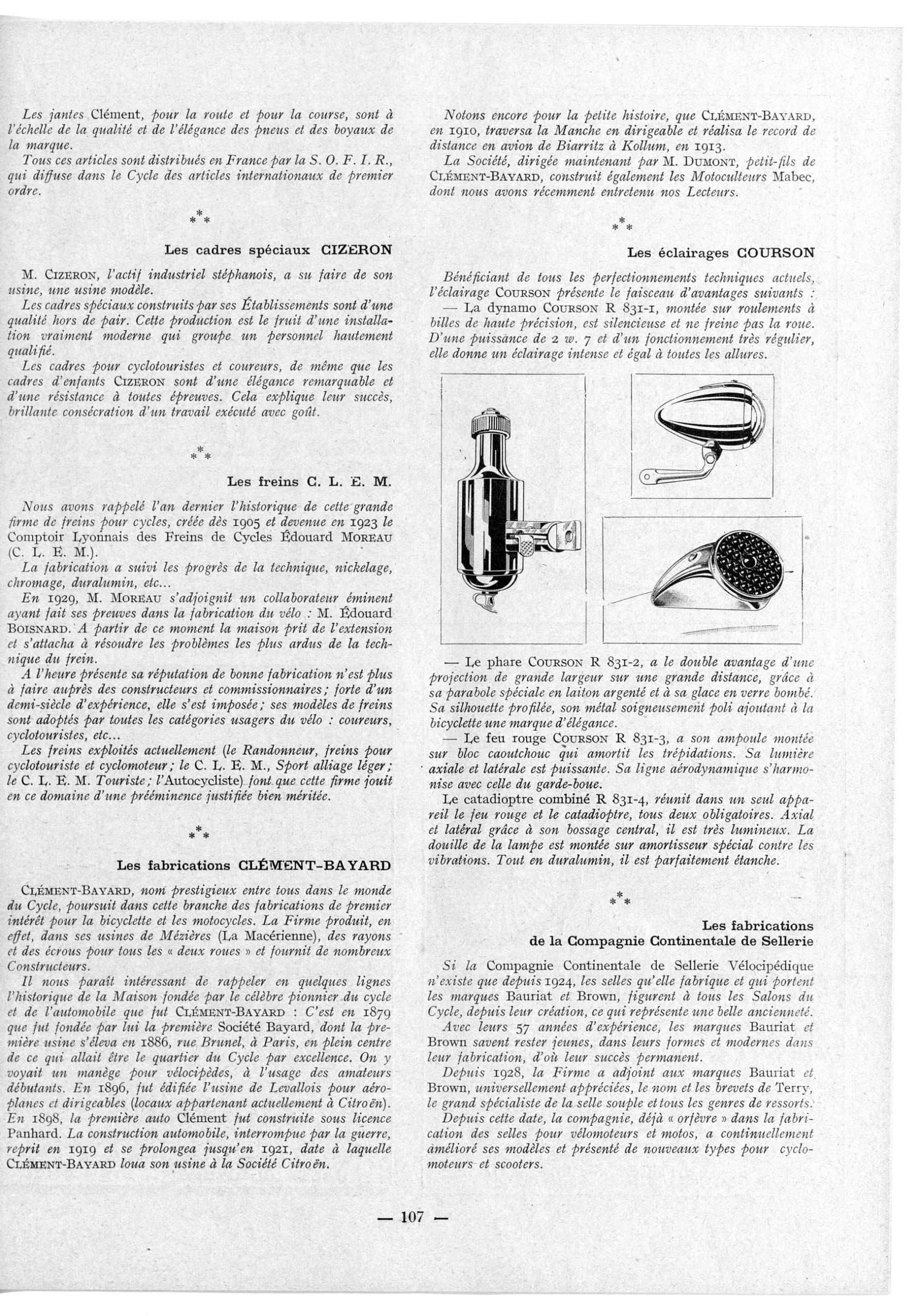
[Ebykr summary; the article’s text is not reproduced. Benefiting by every present technical improvement, the Courson lighting set presents the following sheaf of advantages:]
— La dynamo COURSON R 831-1, montée sur roulements à billes de haute précision, est silencieuse et ne freine pas la roue. D’une puissance de 2 w. 7 et d’un fonctionnement très régulier, elle donne un éclairage intense et égal à toutes les allures.
— Le phare COURSON R 831-2, a le double avantage d’une projection de grande largeur sur une grande distance, grâce à sa parabole spéciale en laiton argenté et à sa glace en verre bombé. Sa silhouette profilée, son métal soigneusement poli ajoutant à la bicyclette une marque d’élégance.
— Le feu rouge COURSON R 831-3, a son ampoule montée sur bloc caoutchouc qui amortit les trépidations. Sa lumière axiale et latérale est puissante. Sa ligne aérodynamique s’harmonise avec celle du garde-boue.
Le catadioptre combiné R 831-4, réunit dans un seul appareil le feu rouge et le catadioptre, tous deux obligatoires. Axial et latéral grâce à son bossage central, il est très lumineux. La douille de la lampe est montée sur amortisseur spécial contre les vibrations. Tout en duralumin, il est parfaitement étanche.
Les fabrications
de la Compagnie Continentale de Sellerie
[Ebykr summary; the article’s text is not reproduced. Although the Compagnie Continentale de Sellerie Vélocipédique has existed only since 1924, the saddles it makes, which bear the marks Bauriat and Brown, have figured at every Salon du Cycle since those Salons began, which is a fine seniority. With their 57 years of experience the marks Bauriat and Brown know how to stay young in their shapes and modern in their manufacture, whence their lasting success. Since 1928 the firm has joined to the universally valued Bauriat and Brown marks the name and the patents of Terry, the great specialist in the sprung saddle and in springs of every kind. Since that date the company, already a “goldsmith” in making saddles for vélomoteurs and motorcycles, has continually improved its models and brought out new types for cyclomoteurs and scooters.]
— 107 —
[The page is set in two columns, the firm notes in italic under bold roman headings, with asterisms of three asterisks between the firms. Three line engravings, each in its own thin rectangular frame, are grouped in the second column within the Courson note. The first, at the left, shows a bottle dynamo standing upright, its knurled driving head at the top, the cylindrical body shaded with broad highlights for polished metal, and a clamp bracket projecting from its side. The second, at the upper right, shows a bullet-shaped headlamp in three-quarter view from the front left, its body banded and polished, the glass set in a rim, with a long curved mounting arm below. The third, at the lower right, shows a combined rear lamp and reflector seen from behind and slightly to the side, teardrop in plan, its circular rear face filled with a dense pattern of raised prisms around a central boss, a fine line ruling the shadow beneath it. None of the three is signed. The page number “— 107 —” stands at the foot of the first column.]
— Page 8 —
[Ebykr summary; the article’s text is not reproduced. The page opens with the end of the Compagnie Continentale de Sellerie note begun on page 107. So it is that at this 39th Salon du Cycle et de la Moto the company will present some novelties that will not fail to hold the visitors’ attention. Besides a very complete range of leather saddles whose smartness and quality are beyond argument, every Terry model, made in the best materials, will be found on its stand:]
— les selles souples pour cyclomoteurs, les selles pour vélomoteurs et motos, dont les nouvelles formes sont modernes et rationnelles ;
— le siège arrière Bauriat, réglable en marche, encore amélioré depuis sa création ;
— enfin, un nouveau siège arrière Terry dont la présentation, la robustesse et la simplicité étonneront plus d’un connaisseur.
[Ebykr summary, closing the Compagnie Continentale note. All these models are presented in imitation leather, in vinyl or in leather and are mounted “façon sellier”.]
Le coffret d’outillage CYCLOUTIL
[Ebykr summary; the article’s text is not reproduced. This article, brought out with great success as early as last year, concerns not only the cycle dealer but, among his customers, every true lover of cycle mechanics. It is a series of tools and wrenches studied specially for the methodical and quick dismantling of bicycles and cyclomoteurs and presented in a case. The tooling has to be seen at work to be understood: it allows the whole operation to be done in less than an hour on an ordinary cycle.]
Les DÉCALCOMANIES INDUSTRIELLES
[Ebykr summary; the article’s text is not reproduced. The decal is, as is known, a lithographic print on a special gummed paper whose property is to allow it to be transferred easily. That transfer is made either with a fat varnish and water or with water alone (the decals called “glissoires”). The use of the decal, which applies to every industry, spread quickly in that of the cycle. It is necessary, however, to use only decals of superior quality to obtain fully satisfying results. The Décalcomanies Industrielles “L’Auto-Décor”, which count more than 30 years of experience, answer that condition perfectly. They allow sleeves, badges and bands to be made, single or double, which improve the presentation of the bicycle and add to its elegance and its renown.]
Les spécialités DISSOPLAST
[Ebykr summary; the article’s text is not reproduced. Besides their excellent and noted rubber solution, on whose qualities there is no need to return, the Établissements Dissoplast are now bringing out, with the keenest success, a new handlebar tape in plastic which has the property of being adhesive, called “Plastoplast Collant”. This tape is applied to the handlebar in the same way as the adhesive cotton tape, so there is no risk of its unwinding in a race; it is besides easier to apply than the non-adhesive tape. Its great advantage is that it makes no fold on the handlebar (having no cloth, it “gives”), contrary to adhesive oilcloth. Although this tape is thinner than the non-adhesive kind, it keeps a good hold on the handlebar thanks to the adhesive; its slight thickness, on the other hand, makes the contact of the hand with the handlebar pleasanter and avoids the bruising caused by the exaggerated extra thickness of the turns. The rolls, which are 4 m. 50 long and 20 mm. wide, allow a racing handlebar to be covered completely, the brake hoods included; the racer therefore uses one roll alone instead of two of 2 m. 50.]
Les spécialités des Éts DRIOT
[Ebykr summary; the article’s text is not reproduced. The paper recalls that it is to the Établissements Driot, founded at Saint-Étienne thirty years ago, that the creation of the elastic luggage strap is owed. In this specialty the Établissements Driot have always been in the van of progress. Cobra-Vélo and Cobra-Moto are particularly happy productions and the indispensable complement of a choice equipment. Other productions of the Établissements Driot: casing for brake and derailleur cables and the Flexilène lighting wire. This casing with its half-hard steel armature has a great flexibility. Its rot-proof plastic covering resists oils, paraffin, petrol, acids and so on. It gives motorcycles and bicycles the modern line and the grand luxe finish. M. Armand Dupré, director of the firm, has just put on the market toe-clip straps of a perfect design. The Établissements Driot also present the Flexi-Rub plastic tape, which gives the handlebar a superb gloss and lets it be kept brand new. This tape stays clean always. It does not fray. It offers the whole range of colors. It is a success that will be keenly valued by the cycle dealers’ customers.]
Les manivelles trois branches A. DUPRAT
[Ebykr summary; the article’s text is not reproduced. The old Saint-Étienne house A. Duprat has long imposed itself by the quality of its manufacture. The famous “Professionnels” cranks have won an amply justified reputation; precision, lightness and elegance are their chief marks. The paper is glad to speak today of M. A. Duprat’s latest creation: the three-arm crank of the Universel type, a new model bound to meet with great success. The Universel type is a crank with three separate arms, of an absolutely remarkable presentation and of everyday use. The prime advantage of this very happily conceived piece lies — and it is an important asset — in its cost price, which proves lower than that of the three-arm crank of classic form. There is therefore an appreciable saving for the builder who equips his machines with the Universel type, and yet the same advantages and the same performance. And besides, the possibility of fitting two chainrings, thanks to a special set of screws. That is to say that M. A. Duprat, as a seasoned technician, has foreseen everything. The three-arm crank of the Universel type counts among the outstanding novelties of the 1952 season.]
Les fabrications T. EBERLEIN
[Ebykr summary; the article’s text is not reproduced. The Maison T. Eberlein, of Paris, produces interesting accessories for the cycle and the motorcycle. Its pumps deserve particular mention, L’Aéro-Pompe in copper and in aluminum for cycles; also its horns for vélomoteurs, motorcycles and motor cars, careful and serious manufactures. Classic articles in design, these pieces of equipment answer to a notion of total quality in the raw materials and the machining as well as in the service asked of them.]
— 109 —
[The page is type only, with no drawing or photograph: the firm notes in italic under bold roman headings, set in two columns, with asterisms of three asterisks between the firms. A broken rule runs across the foot of the first column above the page number “— 109 —”, which stands centered at the foot of the page. Two compositor’s slips stand in the type: in the Dissoplast note the word printed reads “sortent aactuellement”, and in the Driot note the line reads “la gaine pour câbles et fretn ei de dedérailleur”.]
— Page 9 —
Les équipements J. DUNOIS
[Ebykr summary; the article’s text is not reproduced. At the stand of the Etablissements J. Dunois et Fils, in a particularly careful presentation, are the celebrated Mistral pumps in polished chromed brass and the Radieuse-sport and Radieuse brass pumps. The Alu-Dur chainguards, created in 1951, won a legitimate success among constructors during the year. A thoroughly topical novelty is the chain protector for a child’s bicycle, the polished Alu case no 27 E, of elegant form, with rounded edges that do not cut. The house has also put into production a series of covers for the auxiliary engines of cyclomoteurs, the success of motorized cycles having given this new branch of manufacture a good start. As always, the Etablissements J. Dunois et Fils make many parts to order for the constructors of motorcycles and cyclomoteurs.]
Le volant magnétique DYNEX
[Ebykr summary; the article’s text is not reproduced. The Dynex magneto flywheel is presented as a robust, clean apparatus that cannot go out of adjustment, of simple and rigorously controlled construction. Its monobloc rotor, practically undeformable, carries 4 masses inserted in the casting, in which magnets of molecule-oriented Ticonal are set by a patented process. Its steel hub, generously calculated, has a threaded portion into which the hub extractor needed for dismantling is screwed. A cover easily removed by means of a circlip uncovers 3 wide openings that give good visibility and easy adjustment of the contact breaker points. Its stator carries: 1) the high-tension coil of large dimensions, carefully impregnated, tropicalized and housed in a hermetic monobloc case of molded insulant forming the current outlet; 2) the condenser bathed in oil, guaranteed tight by a fully welded glass bead closure; 3) a contact breaker adjustable with a screwdriver, its carefully studied form shielding its contacts from oil splash, with an eccentric for precise adjustment of them; 4) the lighting coil able to give, on demand, either lighting to the cycle standards or reinforced lighting. The Dynex V. 15 flywheel allows the ignition of engines up to 100 cm3 (spark plug electrode gap: 4/10) and lighting to the cycle standards or reinforced.]
Les productions FOURETS frères
[Ebykr summary; the article’s text is not reproduced. All the tooling for cycle constructors and repairers is the formula applied by the Maison Fourets Frères of Saint-Étienne. The Outils-Cycle mark is said to be synonymous with quality, its productions as numerous as they are varied and marked by their finish. Taps, tap holders, dies, die holders, cutters, cup blockers, cup fitting and removing tools for bottom brackets, reamers, chain rivet extractors, a threading machine and spoke cutter, pedal wrenches and pliers are among the specialties of the Maison Fourets Frères, which also makes the “Son’nett” bell, a warning device for the bicycle whose success keeps growing. Simple and robust, this bell is a choice accessory and its working is guaranteed. Without mechanism, the spring can be turned to the position wanted. (Bell in light metal, white or colored in blue, green, red and yellow, spring, screw and clips nickeled, weight 30 grams.)]
Les accessoires E. H. pour Mobylette
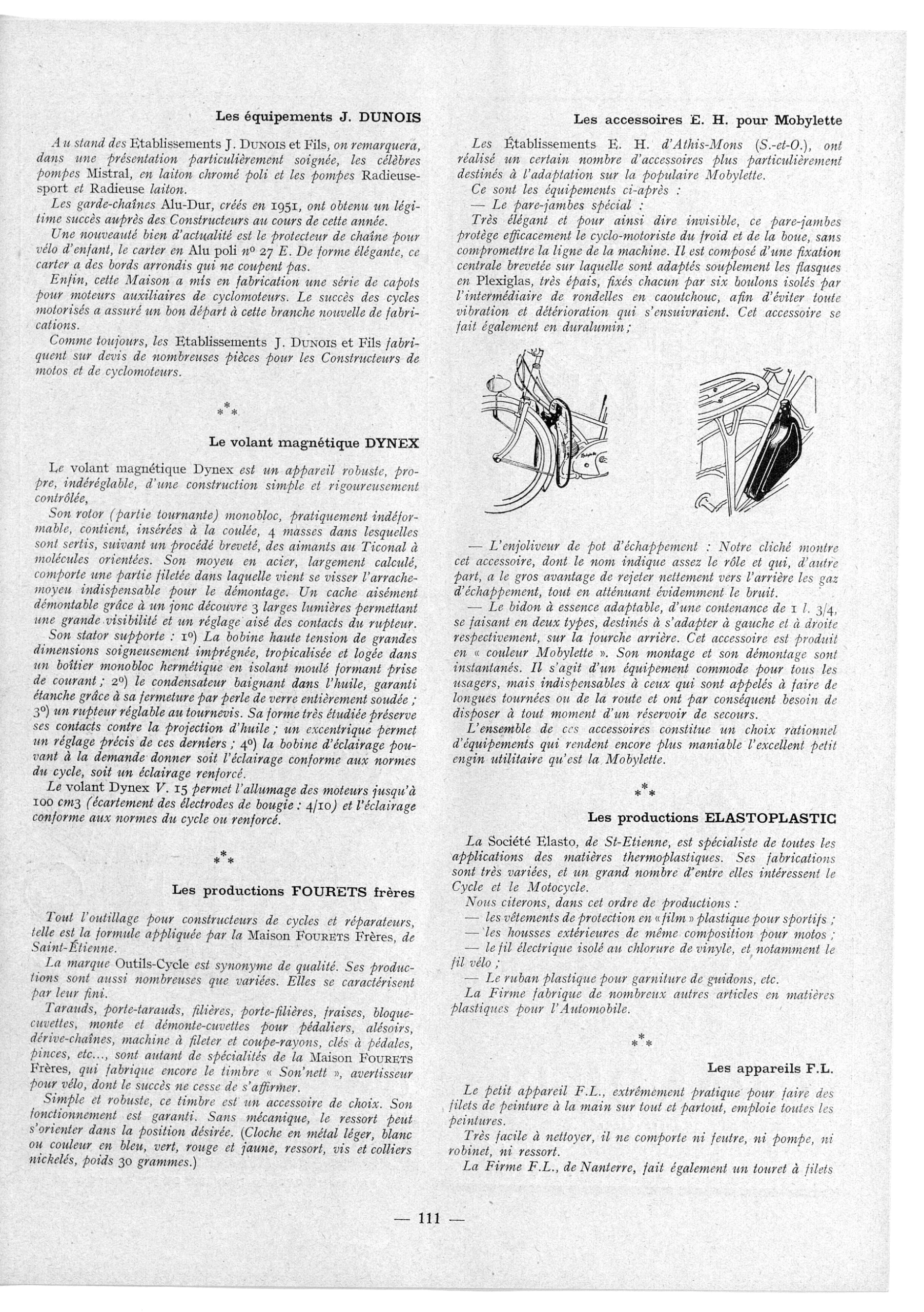
[Ebykr summary; the article’s text is not reproduced. The Établissements E. H. of Athis-Mons (S.-et-O.) have produced a number of accessories intended more particularly for fitting to the popular Mobylette. The first is the special leg shield: very elegant and so to speak invisible, it protects the cyclo-motorist from cold and mud without compromising the line of the machine. It is made up of a patented central fixing to which the very thick Plexiglas panels are flexibly fitted, each held by six bolts insulated by rubber washers so as to avoid any vibration and the deterioration that would follow. The accessory is also made in duralumin. Next is the exhaust silencer trim, shown in the paper’s block, which has the further advantage of throwing the exhaust gases well to the rear while plainly deadening the noise. Last is the adaptable petrol can of 1 l. 3/4 capacity, made in two types to fit respectively on the left and on the right of the rear fork. It is produced in “couleur Mobylette” and its fitting and removal are instantaneous, a convenient fitting for all users and indispensable for those who make long rounds or take the road and so need a reserve tank at any moment. Together these accessories make up a rational choice of equipment that makes the excellent little utility machine that is the Mobylette still more handy.]
Les productions ELASTOPLASTIC
[Ebykr summary; the article’s text is not reproduced. The Société Elasto of St-Etienne specializes in every application of thermoplastic materials. Its manufactures are very varied and a great number of them concern the cycle and the motorcycle. The paper cites, in that order of productions:]
— les vêtements de protection en « film » plastique pour sportifs ;
— les housses extérieures de même composition pour motos ;
— le fil électrique isolé au chlorure de vinyle, et notamment le fil vélo ;
— Le ruban plastique pour garniture de guidons, etc.
[Ebykr summary, continuing the same note. The firm makes many other articles in plastic materials for the motor car.]
Les appareils F.L.
[Ebykr summary; the article’s text is not reproduced. The small F.L. apparatus, described as extremely practical for drawing painted lining by hand on anything and anywhere, takes every paint. Very easy to clean, it has neither felt, nor pump, nor tap, nor spring. The firm F.L. of Nanterre also makes a lining wheel, and the note runs on past the foot of the page.]
— 111 —
[The page is type only above its two drawings: the firm headings are set in bold roman, centered, and the notes in italic in two columns, each firm divided from the next by an asterism of three asterisks. Two line drawings stand side by side at the foot of the right-hand column, each a pen outline with solid black fill on the accessory shown. The left drawing gives the lower rear quarter of a Mobylette seen from the right: the rear wheel and mudguard, the pedal and crank, the rear stays, and the engine and silencer at the center, the silencer carrying a trim piece drawn in solid black with the word Mobylette lettered on the body; a stand rod runs down to the left. The right drawing gives the rear fork and carrier of the same machine from the other side, with the adaptable petrol can mounted in the fork triangle, drawn as a solid black tapering body with a filler at its upper end, a pedal and crank at the lower left. Neither drawing carries a signature. The folio sits centered at the foot of the page between two short rules.]
— Page 10 —
[Ebykr summary, taking up the F.L. note carried over from the foot of page 111; the article’s text is not reproduced. The lining wheel is for work in large series on every metal, on glass and on wood, and its form allows it to be mounted between centers. It uses liquid gold and enamel and draws impeccable lining in record time.]
Le casque motocycliste GENO
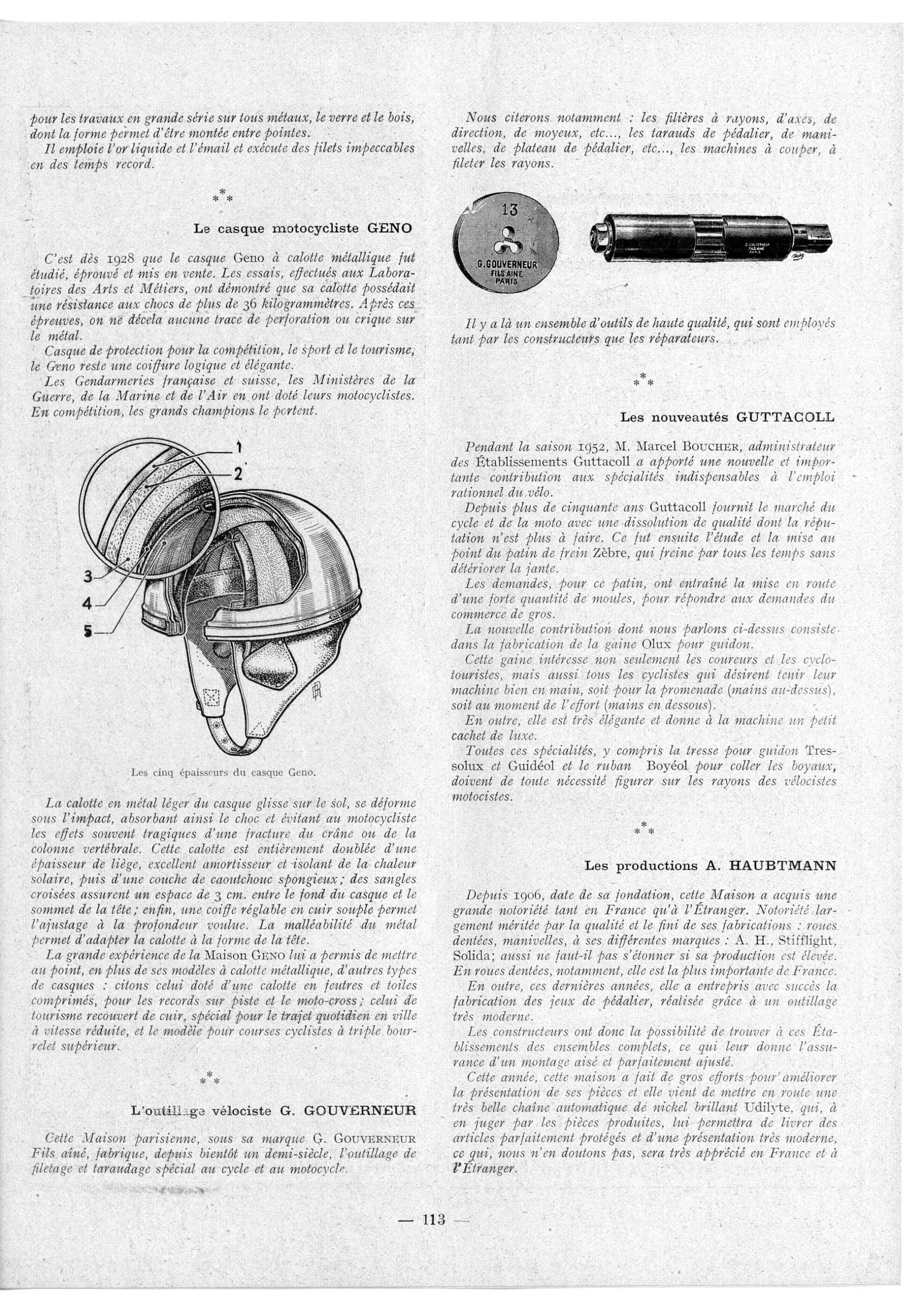
[Ebykr summary; the article’s text is not reproduced. The Geno helmet with a metal shell was studied, tested and put on sale as early as 1928. The tests, carried out at the Laboratoires des Arts et Métiers, showed that its shell had an impact resistance of more than 36 kilogrammètres, and after those tests no trace of perforation or cracking was found on the metal. A protective helmet for competition, sport and touring, the Geno remains a logical and elegant headpiece. The French and Swiss gendarmeries and the Ministries of War, of the Navy and of the Air have equipped their motorcyclists with it, and in competition the great champions wear it.]
Les cinq épaisseurs du casque Geno.
[Ebykr summary, continuing the same note below the drawing. The light-metal shell of the helmet slides on the ground and deforms under the impact, absorbing the shock and sparing the motorcyclist the often tragic effects of a fracture of the skull or of the spine. The shell is lined throughout with a thickness of cork, an excellent damper and insulator against the heat of the sun, then with a layer of sponge rubber; crossed straps keep a space of 3 cm. between the crown of the helmet and the top of the head; last, an adjustable cap of supple leather allows fitting to the depth wanted. The malleability of the metal allows the shell to be adapted to the shape of the head. The long experience of the Maison Geno has let it develop, besides its metal-shelled models, other types of helmet: one with a shell of compressed felts and canvas, for track records and moto-cross; a touring one covered in leather, special for the daily run through town at reduced speed; and the model for cycle racing with a triple upper roll.]
L’outillage vélociste G. GOUVERNEUR
[Ebykr summary; the article’s text is not reproduced. This Paris house, under its mark G. Gouverneur Fils aîné, has made threading and tapping tools special to the cycle and the motorcycle for close to half a century. The paper cites in particular the dies for spokes, for axles, for headsets, for hubs and so on, the taps for bottom brackets, for cranks, for chainwheels and so on, and the machines for cutting and threading spokes. These make up a set of high-quality tools, used by constructors and repairers alike.]
Les nouveautés GUTTACOLL
[Ebykr summary; the article’s text is not reproduced. During the 1952 season M. Marcel Boucher, administrator of the Établissements Guttacoll, brought a new and important contribution to the specialties indispensable to the rational use of the bicycle. For more than fifty years Guttacoll has supplied the cycle and motorcycle trade with a quality rubber solution whose reputation is long established. Then came the study and development of the Zèbre brake block, which brakes in all weathers without damaging the rim; demand for the block led to a large number of molds being started up to meet the orders of the wholesale trade. The new contribution is the manufacture of the Olux handlebar sleeve. The sleeve concerns not only racing men and cyclo-tourists but every cyclist who wants a firm hold on the machine, whether riding on the tops (hands above) or making an effort (hands below). It is also very elegant and gives the machine a small luxury touch. All these specialties, among them the Tressolux and Guidéol handlebar braid and the Boyéol tape for sticking tubular tires, must of necessity appear on the shelves of cycle and motorcycle dealers.]
Les productions A. HAUBTMANN
[Ebykr summary; the article’s text is not reproduced. Since 1906, the date of its foundation, this house has won a wide reputation in France and abroad, well earned by the quality and finish of its manufactures: toothed wheels and cranks, under its several marks A. H., Stifflight and Solida, so that its high output is no surprise. In toothed wheels in particular it is the largest in France. In recent years it has also successfully taken up the manufacture of bottom-bracket sets, by means of very modern tooling. Constructors can therefore find complete assemblies at these works, which assures them of easy and perfectly adjusted fitting. This year the house made a large effort to improve the presentation of its parts and has just started up a very fine automatic line of Udilyte bright nickel which, to judge by the parts produced, will let it deliver articles perfectly protected and of very modern presentation, which the paper does not doubt will be much appreciated in France and abroad.]
— 113 —
[The page is set in two columns, the firm headings in bold roman and the notes in italic, each firm divided from the next by an asterism of three asterisks, and it carries two blocks. The larger is a cutaway line engraving of the Geno motorcycle helmet, about two-thirds of the way down the left-hand column: the helmet is drawn in three-quarter view from the left front, its shell shaded with fine ruling, with a leather neck flap, a chin strap with eyelets and a buckle, and a side pad; the crown is cut open and swung up and to the left like a hinged lid, and the cut edge is drawn as a disk of five stacked layers, hatched and stippled to distinguish them, with leader lines running left to the figures 1, 2, 3, 4 and 5 ranged down the left margin of the block; an interior cradle of crossed straps is drawn inside the shell. Daniel Rebour’s “DR” monogram, the D and the R interlocked and drawn tall and narrow, sits at the lower right of this block, clear of the helmet on the blank ground immediately to the right of the neck flap and at about the height of the chin strap. The caption “Les cinq épaisseurs du casque Geno.” is set in small roman beneath it. The second block, in the upper part of the right-hand column, is a halftone from a photograph showing two G. Gouverneur tools against a plain ground: at the left a round die seen face on, its body ruled with fine lines, the figure 13 above a three-lobed cutting aperture and the lettering G. GOUVERNEUR / FILS AINE / PARIS beneath it; at the right, lying at a slight angle, a long cylindrical tap holder or threading tool in polished steel, knurled at the middle, with a nut at the left end and a square drive at the right, carrying the same lettering G. GOUVERNEUR / FILS AINE / PARIS on its body. A small cursive engraver’s mark of three or four letters sits at the lower right corner of that halftone, below the square drive, and is too small to read with certainty [illisible]. The folio sits centered at the foot of the page between two short rules, and a faint smudge of ink crosses the lower left-hand column.]
— Page 11 —
Les bouchons de guidon lumineux GUIDOPHOT
[Ebykr summary; the article’s text is not reproduced. These handlebar plugs, shown with lively success the year before, fit instantly to every grip by simple pressure. Each plug is made up of a Scotchlite disk mounted on a phosphorescent material and so has the double power of being reflective and fluorescent. By its position the device marks the maximum width of the machine. It is adaptable to bicycles, vélomoteurs and motorcyclettes (Brevet Moriquand). It is a production of the Établissements Morvil, of Voiron (Isère).]
Les bancs d’essais électriques GERBAUD
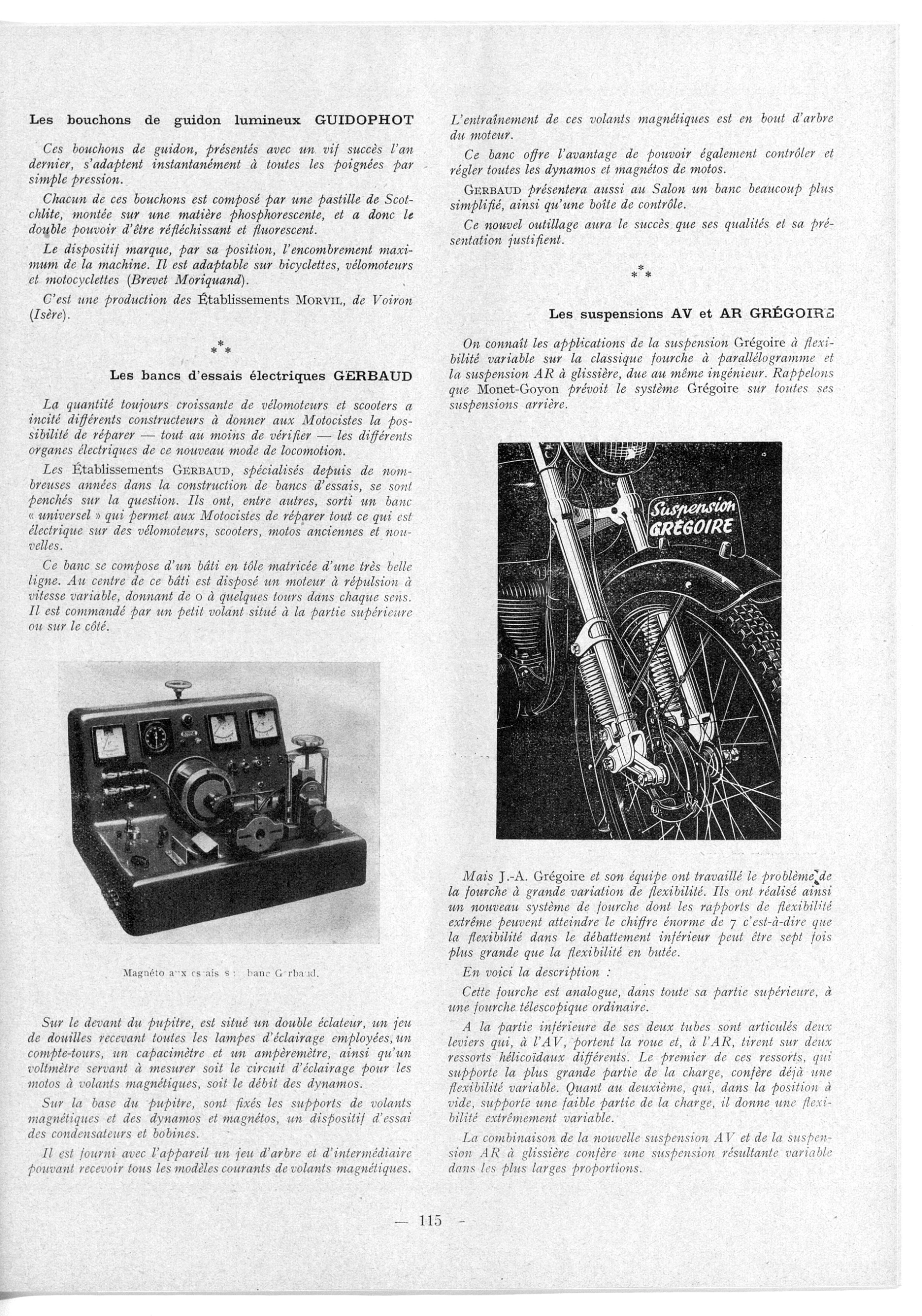
[Ebykr summary; the article’s text is not reproduced. The ever-growing number of vélomoteurs and scooters has led various constructors to give motorcycle dealers the means to repair, or at least to check, the several electrical parts of this new mode of locomotion. The Établissements Gerbaud, specialized for many years in the construction of test benches, have taken up the question. Among other things they have brought out a “universal” bench that lets dealers repair everything electrical on vélomoteurs, scooters and motorcycles old and new. The bench consists of a frame in pressed sheet of very fine line. At the center of the frame is a variable-speed repulsion motor giving from 0 to some revolutions in each direction, controlled by a small handwheel placed at the top or at the side.]
Magnéto aux essais sur banc Gerbaud.
[Ebykr summary, continuing the same note below the photograph. On the front of the desk are a double spark gap, a set of sockets taking all the lighting lamps in use, a revolution counter, a capacitance meter and an ammeter, and a voltmeter for measuring either the lighting circuit of motorcycles with magneto flywheels or the output of dynamos. On the base of the desk are fixed the supports for magneto flywheels, for dynamos and magnetos, and a device for testing condensers and coils. A set of shafts and adapters able to take every current model of magneto flywheel is supplied with the apparatus. These flywheels are driven at the end of the motor shaft. The bench has the further advantage of also allowing every motorcycle dynamo and magneto to be checked and set. Gerbaud will also show at the Salon a much simplified bench, together with a test box. This new tooling will have the success that its qualities and its presentation justify.]
Les suspensions AV et AR GRÉGOIRE
[Ebykr summary; the article’s text is not reproduced. The applications of the Grégoire suspension of variable flexibility on the classic parallelogram fork, and the sliding rear suspension due to the same engineer, are well known, and Monet-Goyon provides for the Grégoire system on all its rear suspensions. But J.-A. Grégoire and his team worked on the problem of a fork of wide variation in flexibility and so produced a new fork system whose ratios of extreme flexibility can reach the enormous figure of 7, that is, the flexibility at the bottom of the travel can be seven times greater than the flexibility at the stop. The description follows: the fork is like an ordinary telescopic fork throughout its upper part. At the lower part of its two tubes are articulated two levers which at the front carry the wheel and at the rear pull on two different helical springs. The first of these springs, which carries the greater part of the load, already gives a variable flexibility. The second, which in the unladen position carries a small part of the load, gives an extremely variable flexibility. The combination of the new front suspension and the sliding rear suspension gives a resulting suspension variable in the widest proportions.]
— 115 —
[The page is set in two columns, the firm headings in bold roman and the notes in italic, with asterisms of three asterisks between the firms, and it carries two blocks. In the lower half of the left-hand column is a halftone from a photograph of the Gerbaud test bench, seen from the front and slightly above against a plain studio ground: a sloping sheet-metal desk whose face carries a large square meter at the left, a round dial at the center, two smaller square meters at the right and a row of terminals and switches, with a small handwheel standing on the top edge; on the flat base in front stand a belt-driven drum, a magneto lying on its mount, a second handwheel on a pillar at the right, a cruciform driving flange and sundry clamps and leads, the whole finished in dark paint with the metal fittings catching the light. Its caption, “Magnéto aux essais sur banc Gerbaud.”, is set in small roman beneath it and is lightly printed. In the middle of the right-hand column is a second block, a line drawing reversed out white on a solid black ground: the front wheel and fork of a motorcycle seen close to from the right and slightly below, with the mudguard, the spoked wheel and the block-tread tire at the right, the engine cylinder and finning at the left, the telescopic fork legs running down the middle to a pivoted lever carrying the hub, and two helical springs of different pitch drawn behind the fork; a number plate hung from the fork carries the words Suspension GRÉGOIRE in a script and a shaded sans-serif. Neither block carries a signature; a faint broken line of type sits directly under the Grégoire block and is too lightly printed to read [illisible]. The folio sits centered at the foot of the page between two short rules.]
— Page 12 —
La roue-libre HIRY’S à roulement annulaire
[Ebykr summary; the article’s text is not reproduced. A specialty of the Maison Bourrin Frères, of Saint-Étienne, a house founded in 1902 that has always kept the favor of a numerous and faithful clientele, the Hiry’s freewheel, triple and quadruple, with annular bearing, is called an almost revolutionary creation. It screws on to every hub of current manufacture, like an ordinary freewheel. For a small repair, or for a simple cleaning of the inside of the freewheel, it comes apart instantly, without unscrewing the hub body. The paper gives the procedure:]
Pour cela, il y a lieu de procéder de la façon suivante :
1o A l’aide d’une clé à molette, dévisser l’écrou portant la marque Hiry’s (attention : le sens de dévissage est celui de la rotation des aiguilles d’une montre) ;
2o L’écrou enlevé, tirer à soi les pignons dentés. Ceux-ci et le roulement annulaire viennent alors, dégageant complètement la noix porte-cliquets.
[Ebykr summary, continuing the same note. For reassembly the operations above are carried out in reverse, after taking care to hold the pawls and their springs at the bottom of their seats, which is easily done with a horseshoe-shaped pincer made from an old spoke; the nut is then firmly tightened.]
Dévissage de la roue libre sur le moyeu :
Ce dévissage se fait en deux temps :
1o Oter les pignons dentés comme il est dit ci-dessus dans le cas d’une réparation ;
2o Prendre la noix porte-cliquets entre les mors d’un étau et la dévisser comme une noix de roue libre ordinaire.
Les productions « J. B. » et « MYLORD »
[Ebykr summary; the article’s text is not reproduced. The Établissements Jean Baron, of Fraisses (Loire), have long held a just and legitimate reputation. By modern tooling, an organization without equal and proven working methods, M. Jean Baron, who enjoys unanimous good will in industrial circles, has won the favor of a clientele that grows steadily, the reward of unceasing effort and particularly careful work. In headsets and bottom-bracket sets of every model (grand luxe included), as in bottom-bracket axles and cups, the J. B. and Mylord marks are a guarantee. For a single reference, the paper offers that the first Frenchman in the Tour de France, Jean Robic, rode a bicycle with a Mylord headset and bottom-bracket set.]
Les spécialités J. D. F.
[Ebykr summary; the article’s text is not reproduced. Among the excellent manufactures of the Maison J. Dunois et Fils the paper cites: the new Alu-Dur chainguards made in manganese-aluminum alloy 20/10e thick, an extra-resistant metal, uniting the rigidity, the coverage, the robustness and the elegance that the most demanding ask for; the racing grip no 949, a new model meeting the requirements of professional racing men, which joins elegance of form and careful presentation to the most advanced technical refinements; and the carrier Le Combiné 828, whose exceptional qualities have been recognized by many constructors of cycles and of cyclomoteurs, who fit it in series. This carrier takes little room and holds, under its platform (which serves as a lid), a perfectly protected bag able to hold everything needed for a repair. Last, the paper does not omit the celebrated Mistral pumps, all in chromed brass, and the Radieuse Sport, special for racing men, in light metal, which continue to carry the fame of the Vincennes firm. In the field of motorcycle accessories the Établissements J. Dunois et Fils have seen the success of their special motorcycle pump Mistral, all in chromed brass, of comfortable dimensions 400 x 28, fitted with a removable metal handle and a folding stirrup, grow among the makers of large machines. That pump is said to unite the greatest number of qualities asked of a good pump.]
Les équipements JEANNERET
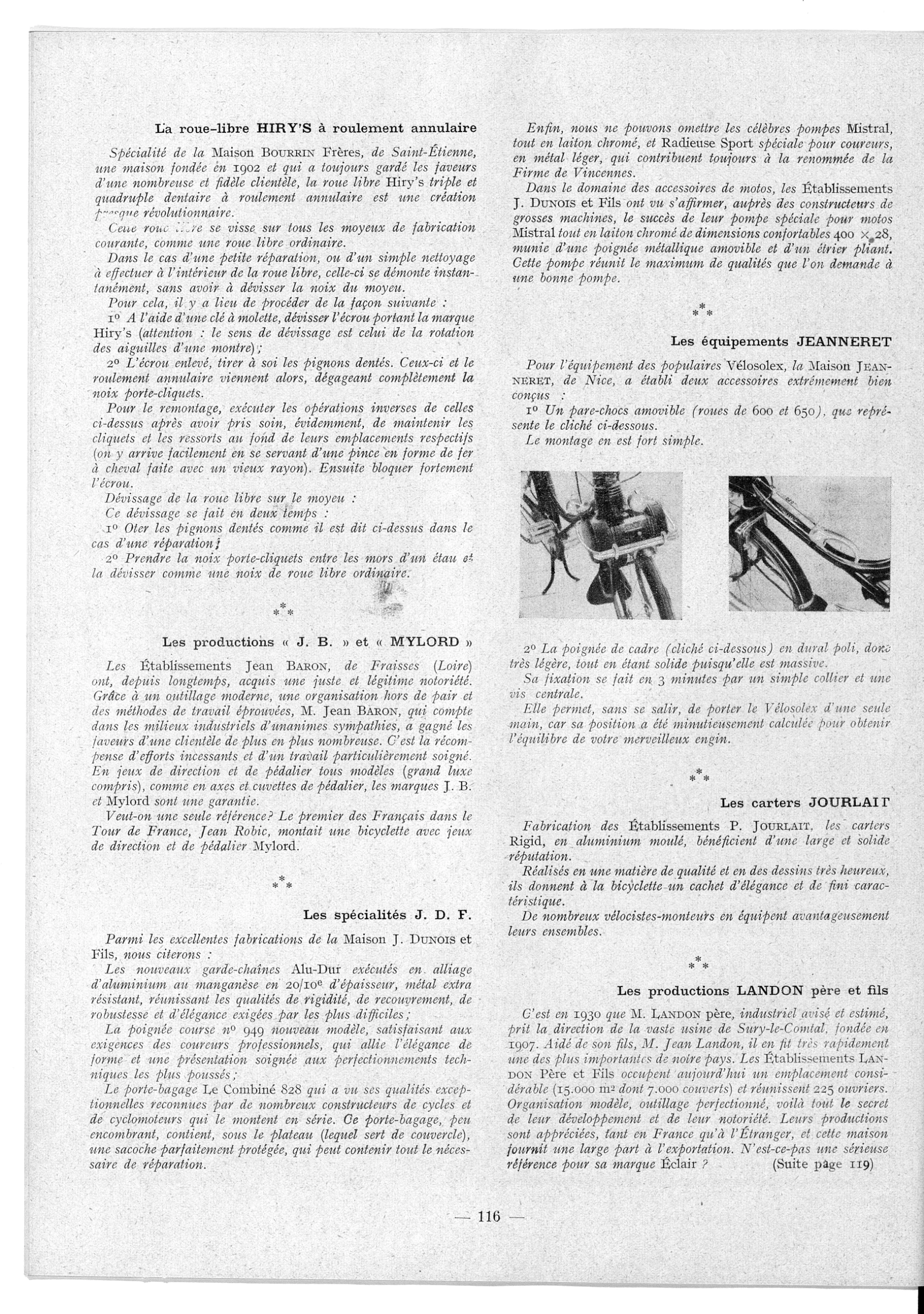
[Ebykr summary; the article’s text is not reproduced. For the equipment of the popular Vélosolex the Maison Jeanneret, of Nice, has produced two extremely well conceived accessories. The first is a removable bumper (for 600 and 650 wheels), shown in the paper’s block, whose fitting is very simple. The second is the frame grip, also shown, in polished and gilded dural, very light while being solid since it is massive; its fixing is done in 3 minutes by a simple clip and a central screw, and it allows the Vélosolex to be carried in one hand without soiling the hand, its position having been minutely calculated to obtain the balance of the machine.]
Les carters JOURLAIT
[Ebykr summary; the article’s text is not reproduced. A manufacture of the Établissements P. Jourlait, the Rigid chaincases in cast aluminum enjoy a wide and solid reputation. Made in a quality material and in very happy designs, they give the bicycle a characteristic touch of elegance and finish, and many cycle assemblers fit them to their machines to advantage.]
Les productions LANDON père et fils
[Ebykr summary; the article’s text is not reproduced. It was in 1930 that M. Landon the elder, a shrewd and esteemed industrialist, took over the direction of the large works at Sury-le-Comtal, founded in 1907. Helped by his son, M. Jean Landon, he very quickly made it one of the most important in the country. The Établissements Landon Père et Fils now occupy a considerable site (15,000 m2, of which 7,000 are covered) and employ 225 workers. A model organization and perfected tooling are the whole secret of their growth and their standing. Their productions are valued in France and abroad, and the house supplies a large share to export, which the paper offers as a serious reference for its Éclair mark.]
(Suite page 119)
— 116 —
[The page is set in two columns, the firm headings in bold roman and the notes in italic, with asterisms of three asterisks between the firms, and it carries two halftone photographs side by side in the upper half of the right-hand column, both coarse-screened close views against an outdoor ground. The left photograph shows the front of a Vélosolex seen from the front and slightly to the left, with the handlebar, the front fork and the wheel, and the removable bumper fitted as a bar across the front of the machine. The right photograph shows a detail of the frame, the tubes running down from the upper left, with the frame grip clamped to the top tube and its loop standing clear of the metal. Neither block carries a caption, a signature or an agency mark; the running text names each as “le cliché ci-dessous”. A faint rubbed smudge of ink lies in the middle of the left-hand column. The direction line “(Suite page 119)” closes the last note at the right of its line, and the folio sits at the foot of the page between two short rules.]
— Page 13 —
[Ebykr summary, taking up the Landon Père et Fils note carried over from page 116; the article’s text is not reproduced. The paper gives a simple outline of the Landon Père et Fils specialties: pedals (26 models), freewheels single and 3-speed, hubs with small cones and a child’s model, cranks of every model and cranks for cyclomoteurs, chainwheel sprockets and interchangeable double chainrings of 45 to 50 teeth, so many articles of a studied manufacture and of quality. A very precise idea of the Éclair manufacture will be had at this Salon du Cycle, where stand no 358 is reserved for the firm.]
Les robinets-tiroirs L. B.
[Ebykr summary; the article’s text is not reproduced. A manufacture of Le Bozec et Gautier, of Courbevoie, the L. B. slide taps, in nickeled pressed brass, are made in straight types for flexible pipe and in an elbow type (bi-conical union). They are described as perfectly safe and extra light, and have accordingly been adopted for the series equipment of the motorcycles: Peugeot, Hurtu, Manufrance, Manufacture Orléanaise de Cycles, Royal Enfield, Alcyon, New-Map, Le Poulain, Cicca, Cyclex, L. R. B., Le Pygmy, Drevon, Juéry, Guiller Frères and others. There is a type of these taps with a reserve of liquid, a special arrangement allowing an extra position on the reserve.]
Les productions Aimé LEDIN
[Ebykr summary; the article’s text is not reproduced. A specialized town, Saint-Étienne does not lack industrialists of worth, but some stand out from the rest, and among them the paper names the Établissements Aimé Ledin. Created in 1902, this important firm has the privilege of being run by its founder and his sons. A good number of the pedal models that cyclists favor are Aimé Ledin, every model of freewheel was born in its drawing offices, and anyone keen on mechanics may visit this interesting plant on request. It comprises electric and oil-fired furnaces and their equipment for the exact treatment of a quality metal; an installation for nickel-chrome plating by ultra-modern processes; a quantity of machines; and a drawing and analysis office. The excellent quality of the Styx, Tank and Merveille pedals and freewheels is the fruit of it. A picked staff serves the whole, and through it the confidence of the clientele and a total success have been won.]
Les équipements MAGNÉTO-FRANCE
[Ebykr summary; the article’s text is not reproduced. Besides its well-known models of magnetos and magneto-dynamos with rotating armature or rotating magnet, its alternators for motorcycles and cycles, its double-output dynamos regulated by a third brush, and its magneto flywheels for vélomoteurs and scooters and for industrial or agricultural engines, 2-stroke and 4-stroke, fixed or variable advance, 1 or 2 cylinders, the Société Magnéto-France produces every complementary fitting, meeting the hardest conditions of use. The paper recalls that it lately described in detail the dynamo type DR 1 for motorcycles, with all its equipment: voltage regulator, high-tension coil, wiring loom, pistol switch (dipped beam, headlamp, horn) and ignition key, which gives entire satisfaction to thousands of users. For the past year Magneto-France has extended its range of dynamos with voltage regulator to its type 01, adaptable to nearly every motorcycle in existence; the installation can usefully be completed by its wiring loom made up with a switch. All these productions will be shown at the Salon, porte de Versailles, where everyone will be able to judge their technical conception and the finish of their manufacture.]
Jeux de direction LIGHTRACE et LELÉGÉ
[Ebykr summary; the article’s text is not reproduced. These works come first in French production and their reputation is well earned. M. Gourgaud is a shrewd industrialist who has had only one object, to turn out work that defies criticism, and he has perfectly succeeded: the Lightrace and Lelégé headsets have been adopted by every constructor anxious to present machines of class. For thirty years, which the paper calls a reference in itself, the Établissements Gourgaud et Cie, of Saint-Étienne, have made these headsets. Their success keeps growing and the leading marques fit their machines with these parts of absolutely irreproachable quality.]
La cyclo-montre
de la Manufacture d’Horlogerie de Béthune
[Ebykr summary; the article’s text is not reproduced. This northern firm has brought out an original creation with its “Cyclo-Montre”, shown in the paper’s block. Intended to be fixed to a bicycle handlebar, the watch has a copper movement and a dural case, is watertight and has luminous hands and a black dial. Its height is 60 mm. and its weight 135 grammes, and fitting it is very easy and quick. The paper calls it a convenient instrument for the countless cyclo-tourists and cyclo-campers.]
Les moyeux MAXI et MAXI-CAR
[Ebykr summary; the article’s text is not reproduced. Founded in 1916, the Établissements E. Dépalle, of Saint-Étienne, have for twenty years specialized in the manufacture of drum-brake hubs for bicycles and tandems, and the note runs on past the foot of the page.]
— 119 —
[The page is set in two columns, the firm headings in bold roman and the notes in italic, with asterisms of three asterisks between the firms, and it carries one block, in the middle of the right-hand column. It is a halftone from a photograph of the Cyclo-Montre, seen from the front and a little to the left against a plain pale ground and much enlarged: a round watch in a deep cylindrical case, its dark dial carrying bold Arabic figures 1 to 12 and two broad hands, a minute track round the rim, and a polished bezel; below the case a curved bracket runs down to a handlebar clip closed by a screw and wing piece, drawn as though clamped on a bar. The heading above it runs on two lines, the second line longer than the first. The block carries no caption, no signature and no agency mark. The folio sits centered at the foot of the page between two short rules, and a printer’s gathering signature, the figure 7, stands alone below the foot of the right-hand column.]
— Page 14 —
[Ebykr summary, taking up the Maxi and Maxi-Car note carried over from page 119; the article’s text is not reproduced. The Maxi drum brakes won the principal technical competitions held before 1939. The vogue of the cyclomoteur has allowed these works to bring out several models of hub suiting the various combinations of the constructors. The house also makes the specialties of cyclotourism: the Maxi-Car hubs with annular bearings, which distinguished themselves once more in the last Paris-Brest et retour by taking the first places among the randonneurs: men’s tandems, men’s bicycles and mixed tandems.]
L’outillage MARBON pour volants magnétiques
[Ebykr summary; the article’s text is not reproduced. Since this equipment spread, the repair of magneto flywheels has been one of the chief worries of motorcycle dealers. How is one to be sure that a coil is good or frankly broken, or whether it gives only intermittently? How to be sure that a condenser has broken down, or that it has no leakage current? How to know whether an output terminal is not cracked or porous? Most motorcycle repairers look for ignition faults by replacing the parts supposed defective one after another, without any certainty that the replacement parts are themselves good. This simplistic method forces several dismantlings and reassemblings, often without success, whence an enormous loss of time and uncertainty in the work done.]
[Ebykr summary, continuing the same note below the drawing. What was needed was a serious and practical apparatus that a dealer could use without special knowledge of electricity and which would let him detect every fault of a magneto flywheel without useless dismantling. The paper says it can serve its readers by pointing out the Contrôleur électrique Marbon, a simple apparatus of accessible price which has proved itself, which answers the needs of the repairers described above and which will also let them check spark plugs, lamps, the lighting coil and the electrical circuits: a very complete apparatus. But in this field of such delicate work on magneto flywheels another problem arises. Dismantling them calls for particular care: the nut locking the flywheel on its cone is always very tightly set and the rotor cage offers practically no outside grip, so recourse is had to empirical methods such as wrapped belts or ropes, or locking the primary drive with a wedge put between the teeth. These methods, unhappily too much used, offer no guarantee of safety, since the rope or the belts may break or slip, and above all they risk damaging the flywheel or the gear train; in any case precious time is lost. Now there exists a very well conceived apparatus, the Armo, which locks magneto flywheels effectively so that they may be taken off and put back easily and quickly. Its other advantages: it fits every magneto flywheel whatever its diameter, and its price, of the most accessible, lets the conscientious dealer modernize his tooling. Like the Contrôleur électrique Marbon, the Armo is made by the Constructions Électriques Marbon, of Paris, which also produce a very practical sprocket-shaft extractor.]
Les réservoirs MEGA
[Ebykr summary; the article’s text is not reproduced. These tanks, without visible welding on the shells, fit at the rear of every model of cyclomoteur frame. On their left flank a graduated direct-reading gauge, which can moreover be fitted to any tank, removes the risk of running dry. The Bidul tap, all in machined brass, gives by the new conception of its sharp-angled seats on cones a perfect mechanical seal without joint or stuffing box, in the open position as well as the closed. The Etena pump, sunk in the tank, holds a reserve of oil sufficient for 2,000 km. It allows refueling at the pumps with pure petrol, since at a single movement the exactly measured oil is mixed instantly with the fuel. It fits every type of tank.]
Les antivols NEIMAN
[Ebykr summary; the article’s text is not reproduced. As usual, Neiman shows at the Salon du Cycle its bicycle and motorcycle locks and its rubber suspension. One merit of its bicycle lock is that it does not appreciably burden the cost price of the bicycle: the constructor need only provide, when he makes the frame, a small socket weighing no more than 8 gr., a socket that even strengthens the head tube instead of weakening it. The device is so small that it is almost invisible, and in any case it does not harm the look of the bicycle. The customer can then buy the removable Neiman bolt from the constructor’s agent. Since this bolt takes more room than the key alone, the user very quickly learns to “get rid of” it, that is, at every stop he does not forget to put the bolt into the head tube of his bicycle or motorcycle, so that the bolt becomes automatic like its elder, the car lock. The paper lists the constructors who fit the Neiman to cycles: Aiglon, Griffon, Météore, Peugeot, Riva-Sport, Ruche, Terrot, Trophée de France and Stella. Turning to the motorcycle lock brought out in 1932, whose principle is the same as that of the bicycle lock, many constructors fit it in series: Aiglon, Automoto, Gnome et Rhône, Griffon, Météore, Peugeot, Scooters Bernardet, Terrot and Trophée de France for the French marques; and Anker, B. M. W., Bücker, D. K. W., F. N. Hecker, Heinkel, Hercules and Horex, the list running on past the foot of the page.]
— 121 —
[The page is set in two columns, the firm headings in bold roman and the notes in italic, with asterisms of three asterisks between the firms, and it carries one block, a line engraving standing in a thin ruled rectangular frame in the middle of the left-hand column. It shows the Marbon electrical tester as a portable case open on a bench, seen from the front and above and drawn in pen with close ruled shading: the lid stands upright behind, its inside lined with narrow vertical boarding and a catch at its top edge; the sloping instrument panel below carries a large round meter at its center, rows of terminals, sockets and small switches, two sprung clips at the left, a lead curling away at the right and two bar switches at the foot; beneath the panel the lower half of the case is drawn with its carrying handle, hinges and lock, and the whole stands at a slight angle so that the far corner recedes. The block carries no caption, no signature and no agency mark. The folio sits at the foot of the page between two short rules.]
— Page 15 —
[Ebykr summary, taking up the Neiman note carried over from page 121; the article’s text is not reproduced. The list of foreign marques fitting the Neiman motorcycle lock in series ends: Hummel, Lambretta N. S. U., Lutz N. S. U., Rabeneick, Rixe, Royal, Standard Allemande, Standard Suisse, Steib, Tornax, Triumph (T. W. N.), U. T., Victoria, Zundapp and others. The Neiman rubber suspension, covered by international patents, is self-progressive and self-damped. Not only does it isolate the suspended wheel from the chassis or the frame, but it gives a supple, automatically variable suspension and does away with every damper. It is light, made up of concentric rubber rings of different diameter working at different rates, which gives a “stepped” suspension and a “stepped” safety. Each ring is built up like a plywood, that is, even cut with a knife the ring does not tear. This suspension has proved itself on motorcycles, side-cars, scooters and cyclecars since 1930, and it is no surprise to have found it on the stands of: Belgian side-cars, D. K. W., F. N. motorcycles, F. N. side-cars, Gnome et Rhône, Whizzer motorcycles, Bernardet scooters, Terrot scooters, Speed scooters, Impérial carrier tricycles, Précision side-cars, Stoye side-cars and Juéry carrier tricycles, among others, as well as on a series of bicycle stands with forks carrying the Neiman suspension.]
Les équipements électriques MOREL
[Ebykr summary; the article’s text is not reproduced. The Établissements Émile Morel, of La Sône (Isère), specialize in the production of electrical equipment. In this rapid review the paper can only indicate their principal manufactures: magnetos, ignition coils, relay contactors, motorcycle switches (giving at will, by a simple pressure of the thumb, horn, sidelamp, headlamp and dipped beam) and last the well-known magneto flywheels of the mark.]
[Ebykr summary, continuing the same note below the photograph. The paper says it will study these products in detail one after another in its Équipements et Outillage and Motocycles columns, giving their technical specifications, and that the block above shows the fitting of a Morel set on a Jonghi motorcycle.]
Les manivelles et roues dentées NERVAR
[Ebykr summary; the article’s text is not reproduced. The Établissements Peyrard, of Saint-Chamond, stand unquestionably in the very first rank of the makers of Nervar cranks. Their mark is now universally known and valued. It equips the great firms, and its many successes in the principal national and international events attest the confidence that justly surrounds it. M. Peyrard, the energetic Saint-Chamond industrialist, has won a rapid and legitimate standing, and has just taken up, as an indispensable complement, the manufacture of toothed wheels. By a new technique whose development was particularly closely watched, Nervar, which the year before showed a patented crank with three set-in arms, now puts on the market a crank with 5 set-in attachments which should keenly interest the constructors. The piece has undergone tests that gave brilliant results, and a detail to underline is that its appreciably lower selling price will hold general attention. The various productions of the Établissements Peyrard are shown at the Salon du Cycle, stand 28.]
Les lunettes motocyclistes OTO
[Ebykr summary; the article’s text is not reproduced. Made by the Consortium Général d’Optique et d’Industries de Morez (Jura), the Oto goggles were specially studied for the protection of the motorcyclist. Allowing full visibility, they shield the eyes in every weather and are the indispensable complement to the equipment of a user who means to take the road.]
[Ebykr summary, continuing the same note below the drawings. The paper states that its illustrations show the model 41 (aluminum goggles, flat eyecups in sponge rubber, elastic nose piece, shell disks in white or colored rhodoid, movable colored protective screens) and the model 386 (goggle in nickeled brass, sponge-rubber mask, rhodoid eyepieces, adjustable screens).]
Les cale-pieds et courroies PATURAUD
[Ebykr summary; the article’s text is not reproduced. The paper offers this as an example of quality by an extremely specialized manufacture. Among the truly unique range of toe clips and straps produced by this excellent Paris house, attention deserves to be called to the following articles:]
— Cale-pieds sans courroie pour la ville, dames et tandems ;
— Cale-pieds à gradins de sûreté réglables à toutes pointures ;
— Cale-pieds gainés cuir ne blessant pas et n’abîmant pas les chaussures ;
— Courroies à boucle à rouleau, serrant et desserrant instantanément ;
— Courroies à boucles perfectionnées ; à bouclette formant arrêt de sûreté et facilitant le serrage.
[Ebykr summary, closing the note at the foot of the page. The paper adds that a few technical remarks about these articles will not be useless, and the note runs on past the foot of the page.]
— 123 —
[The page is set in two columns, the firm headings in bold roman and the notes in italic, with asterisms of three asterisks between the firms, and it carries three blocks. In the lower half of the left-hand column is a halftone from a photograph, close in and taken from the left side of a motorcycle: the finned cylinder and head stand at the center, the frame tubes and the rear of the front wheel behind, and across the foreground lie the polished crankcase and the large round magneto cover, the cover’s securing screws and a slotted boss catching the light; the name “jonghi” is lettered in a lower-case script on the rounded casing at the left. The right-hand column carries two line engravings of goggles, one above the other, drawn in fine pen hatching against the bare paper and seen from the front and slightly above: the upper pair has separate oval eyecups with hinged side shields, a bridge between them and a woven strap running up to a buckle and ring at the top; the lower pair is a one-piece goggle with a broad shaded mask across the brow, two round lenses with raised rims, hinged screens above each lens and a woven strap with a central clasp. None of the three blocks carries a caption, a signature or an agency mark. The folio sits at the foot of the page between two short rules.]
— Page 16 —
[Ebykr summary, taking up the Paturaud note carried over from page 123; the article’s text is not reproduced. The toe clip fixes the exact position of the foot on the pedal and its use considerably increases the power of the pedal stroke, since it lets the foot act effectively on the pedal through the whole of its rotation, going down as well as coming up, which removes in a quasi-absolute way every “dead point”. As for the strap, it is the indispensable complement of the toe clip since, by its tightening, it lets the cyclist become one with his machine and so pedal more powerfully with less effort. The toe clip must act as a spring, so it is indispensable that it be of tempered steel, neither too dry (it breaks and the race is lost) nor too soft, and that it be of a well-studied curve fitting the form of the shoe perfectly. The strap must be of very good chrome leather, tanned specially to be supple to just the right point so as not to stretch (if it goes slack, goodbye to victory), its thickness must be quite even, and the buckle must work surely and easily both in tightening and in loosening, the latter having to be instantaneous. It is to these qualities that the manufactures of the Établissements Paturaud answer. Among their other productions in leather the paper notes the “Piesekecho”, protecting the feet against cold, rain and mud. All these productions are adopted by racing men, and the cyclo-tourists and randonneurs who use them are past counting.]
La roue libre PACKSON
[Ebykr summary; the article’s text is not reproduced. At the Salon du Cycle, stand 149, Packson shows not only all its models for cycles but also its special freewheel for cyclomoteurs, this last creation having already rallied many votes. The Packson-Perfection freewheel is made by the Forges du Lignon, at Boën-sur-Lignon (Loire), directed by the esteemed and well-liked M. Paquet, seconded by his two sons. This freewheel has definitively made its name by its quality without equal and by the results obtained in the great international competitions. It has won victories in every road classic and, to crown it all, the World Championship taken in 1951 by Kubler on a bicycle equipped by Packson-Perfection. That says the worth of this freewheel manufacture, the freewheel being an organ of which it has been said that it is the elder of the bicycle.]
Les plateaux de pédaliers PERSIB-LUX
[Ebykr summary; the article’s text is not reproduced. The Forges et Ateliers du Plat-de-Gier, Perrissel et Cie at L’Horme (Loire), contribute to the good name of the national cycle industry by happy productions that the paper is glad to present to its readers. The Persib-Lux chainrings are a model of their kind, as much by their irreproachable presentation as by their resistance to every test. Thanks to the power and the precision of their plant the Forges et Ateliers du Plat-de-Gier (Perrissel et Cie, at L’Horme, Loire), which sell exclusively to wholesalers and constructors, are able to assure a production of real quality that will shortly win them a just and legitimate standing. Their director, M. Perrissel, gives his manufacture altogether particular care. The Persib-Lux chainrings are of special steel with rolled edges, of absolute safety and proof against every deformation. Their perfect chrome plating makes them an accessory of choice for the constructor anxious to equip his machines with all the taste that could be wished. Besides the chainrings, the Forges et Ateliers du Plat-de-Gier also make three-arm cranks (special treated steel) of remarkable fineness, at once robust, light and elegant.]
Les pare-visages PAREFLEX
[Ebykr summary; the article’s text is not reproduced. In its number of 20 June last the paper noted the productions of the Établissements Valère-Jacquenod of Oyonnax, for the use of motorcyclists and sportsmen; its block shows one of their most esteemed current manufactures (Référence 1422). Specialists in this question, these works, old in experience, having been founded in 1860, but young in their productions, present a complete range of face shields, heavy or light, and masks trimmed with velvet braid or with “Mousse” rubber, of remarkable quality and impeccable presentation. All these models are moreover known to practically every specialist, wholesaler and agent alike, and enjoy a steadily growing vogue. The house owed it to itself to bring out a motorcycle mask in molded rubber with interchangeable transparent screens, a type adopted by every “motard” and sportsman, not only in France but practically the world over. That is now done, and the paper is happy to announce the coming release in large series of this mask, which offers the revolutionary peculiarity of being entirely “pure gum”, giving an unequaled suppleness and softness in the wearing. Of a studied price and a perfect finish, the article will be the worthy complement of a series of productions that satisfy the seller, the seriousness of the mark and the quality of the manufacture being guarantees of sale, as well as the user, assured of having at the fairest price an accessory of choice, irreproachable and perfectly studied for the service it has to give. The paper says it will have occasion to return to this product very shortly. These articles are shown at the Salon on the Stand Dektereff, and the Paris depot of the Valère-Jacquenod productions is at 91, boulevard de Sébastopol.]
Les moyeux PERRIN et NEW-STAR
[Ebykr summary; the article’s text is not reproduced. The rapid evolution of the cyclomoteur has raised many problems, and more particularly that of braking, the new machines for the most part reaching surprising speeds. It was therefore necessary to fit them with brakes assuring the absolute safety of the user. After a thorough study, and without neglecting the smallest detail, M. Émile Perrin, who presides over the destinies of the important Lardy works at Boën-sur-Lignon (Loire), has definitively perfected a model of extreme power, and the note runs on past the foot of the page.]
— 125 —
[The page is set in two columns, the firm headings in bold roman and the notes in italic, with asterisms of three asterisks between the firms, and it carries one block, in the middle of the right-hand column. It is a line drawing in heavy pen, cropped to the head alone: the upper part of a man’s face seen from the front and slightly to the left, his hair in short strokes above the brow, both ears showing, and across his eyes a Pareflex face shield drawn as a broad wavy mask with a studded band at the top, riveted eyelets round its rim and a woven strap passing over the ear; the eyes and the bridge of the nose show through the clear panel, which is drawn in outline with ruled hatching at its edges, and the shaded parts of the mask are filled solid black. The block carries no caption, no signature and no agency mark. A thin broken rule crosses the foot of the left-hand column above the folio, which sits at the foot of the page between two short rules and is partly blotted by a smear of ink.]
— Page 17 —
[Ebykr summary; the article’s text is not reproduced. The page opens on the close of the hub section carried over from the preceding page: the efficacy of the brand’s brakes is called incontestable, and its latest creation, a hub of 125 mm diameter, is described as a truly remarkable piece that allows an easy, immediate installation without trouble. This new drum-brake hub can equip every machine, since it suits all engines; there is no drawback as regards chain lines, and the paper calls it the ideal solution for a perfect adaptation, the special models for the Vap, Poulain and Marquet engines being perfectly adapted to their purpose. Large French firms have adopted these drum-brake hubs, and the paper closes that it is a mark of confidence that has its price.]
* *
Les moyeux PÉLISSIER et Fils
[Ebykr summary; the article’s text is not reproduced. The Plume, Plume-Sports and C. P. hubs are presented as so many models of technical perfection used by very numerous constructors anxious to equip their machines well. The Établissements Pélissier et ses Fils, of Saint-Étienne, who make them, are one of the oldest French houses specialized in hubs for bicycles, the marque having been founded in 1909; since then it has not ceased to develop, it stands today in the very first rank, and its various productions in steel and in dural enjoy a brilliant success.]
* *
L’imperméable pour chaussures PLASTIBOTTE
[Ebykr summary; the article’s text is not reproduced. Rain and mud are called the most formidable adversaries of the users of motorcycles, scooters and motorcycles, since it is practically impossible to keep shoes or trousers clean in bad weather, so that riders are often forced to give up their usual means of transport for another more costly one when the rain falls; overalls and waterproofs offer an effective protection for the body, but are not made to protect shoes and trousers. These reasons justify the recent creation of Plastibotte, a true waterproof for the shoe, which the paper expects to meet a rapid and great success. These boots in plastic are worn over the shoe and protect the trouser up to below the knee. They are put on and taken off in a few seconds thanks to a zip fastener that gives a wide opening running from the base of the heel to the top of the calf. Their use allows town dress to be kept, an absolute protection being guaranteed against mud, water, oil or grease. Light, at 250 grammes, and little cumbersome, they take up no more room in the saddlebags than a folded inner tube, and the very resistant soles grip the footrests perfectly thanks to special striations.]
* *
Les manivelles et roues dentées PIAT
[Ebykr summary; the article’s text is not reproduced. In the branch of Cycle equipment, cranks of every model and chainwheels are the productions of the Établissements Piat, of Saint-Étienne. It is a house 70 years old, specialized at first in the making of arms; M. Piat has brought off the feat of carrying out his “Cycle” work with the same precision he brings to the gunmaking branch, which the paper calls a guarantee of choice for the constructors who equip their cycles and cyclomotors with the Nervalux and Staniless cranks, two marques of high quality able to rival the best. The paper adds that velocists interested in the arms trade cannot be too strongly advised to consult the Établissements Piat, justly famed for their shotguns.]
* *
Les productions POUTRAIT-MORIN
[Ebykr summary; the article’s text is not reproduced. The Société des Etablissements Poutrait-Morin, of Aubervilliers, carries on its well known manufactures, which are:]
— les cale-pieds Christophe (courroies Lapize) ;
— les pompes Lapize, Tornade, Zéfal-Solibloc ;
— les timbres Afa ;
[Ebykr summary; the article’s text is not reproduced. The list closes with the firm’s most recent novelty, the Tire-Stop Afa, which is placed at the chosen point on the toe-clip straps, eases the tightening and limits the loosening. The paper notes that this firm presents its pumps and bells in light metal not only polished but also colored — blue, red, green, gold and, for the Zéfal course pump, tricolor.]
* *
Les guidons et jantes PIVO
[Ebykr summary; the article’s text is not reproduced. Under its marque Pivo, the Maison L. Allès has specialized for more than 25 years in handlebars for bicycles, a manufacture to which the production of light-metal rims was added some fifteen years ago. From its creation this house has kept to articles of quality and of impeccable presentation, and the paper says without fear of being contradicted by its clientele that the handlebars and the rims carrying its marque offer every desirable guarantee. It turns out every category in these two components and has distinguished itself by its part in the great sporting events, counting among its champions Bobet, Barbotin, Lévêque, Blusson, Paillard, Jodet, Verdeun, Varnajo and Carrara.]
[A text page of the review, set in two columns of italic body type with the firm headings centered in bold roman, the marque name in heavier capitals, and a small three-star ornament between one firm and the next. The left column carries one halftone photograph, about half the column wide, printed without a frame: a close view of a rider’s legs and feet on a motorcycle in the rain, wearing the tall plastic overboots pulled up the calf over ordinary shoes, one foot resting on the footrest beside the machine’s pedal and frame tubes, the wet road surface showing behind. The right column carries one line engraving drawn in fine outline with the hidden parts in dotted line: a toe clip lettered CHRISTOPHE on its top plate, seen in three-quarter view with the strap threaded through it, the strap buckle lettered Lapize, and a round knurled Tire-Stop button lettered AFA clamped on the strap below the buckle, the free end of the strap hanging down. No artist signature appears on either illustration. The folio “— 127 —” is centered at the foot of the sheet.]
— Page 18 —
Les éclairages RADIOS
[Ebykr summary; the article’s text is not reproduced. Visitors to the last Salons had the chance to see on the Radios stand some prototypes of the visored headlamp, the “17”, which has been made in series since the first months of 1952. To a particularly elegant line it joins new optical qualities: the visor concentrates the light rays on the ground, so that the lighting of the road is improved, and it further forms a screen between the domed glass and the eye of the cyclist, who from then on sees better. A new headlamp for the cyclomotor with two bulbs and a switch fixing to the handlebar is also made by Radios. It is the “C. M. 33”, which brings a rational solution to the lighting of cyclomotors by putting at the user’s disposal either a powerful road light or a non-dazzling dipped light, according as the switch sends the current to one or the other of the bulbs. Designed to be supplied with current, this headlamp can take any bulb of the Mignonette type, the adjustable holder it carries always allowing a correct focusing, and the switch has, of course, three positions: arrêt, phare, code. Still made by the firm, the paper lastly notes a new combined unit, red light and reflector, of sober line, which among other advantages is particularly robust.]
* *
Les productions REINHARD et CHAPUISET
[Ebykr summary; the article’s text is not reproduced. The Établissements Reinhard et Chapuiset, of Bagnolet, have a very large production in rims and mudguards for cyclomotors and motorcycles, as well as in mudguards for bicycles. In rims their V profile is justly appreciated, and their mudguards are solid and elegant — a further example, the paper says, of the results and the renown gained by a happy specialization.]
* *
Le réalésage R. G. pour cyclomoteurs
[Ebykr summary; the article’s text is not reproduced. The Établissements R. G., at 86, rue du Président-Wilson, à Levallois, specialists in reboring apparatus, have just brought out the “Baby” model, which begins reboring from 35 mm. of diameter:]
— Temps de réalésage par cylindre : 10 à 15 minutes.
— Précision au 1/100e de millimètre.
[Ebykr summary; the article’s text is not reproduced. Its modest price puts it within reach of every repairer of motorcycles, scooters, cyclomotors and the like. The apparatus will be shown at the Salon de l’Automobile: Galerie B, Stand no 7.]
* *
Les selles souples REYDEL
[Ebykr summary; the article’s text is not reproduced. The suspension of these saddles, by Sandow rubber cable, is said to be excessively supple, to offer no hard points, and to be silent, light and extremely comfortable; it is noted that this Sandow cable is made specially in a double textile sheath, which makes it practically unwearable. A cushion of aerated rubber, undeformable, covered with imitation leather in vinyl resin and waterproof against rain, gives a very elastic and agreeable seat, and an interlayer of foam further increases the comfort of this saddle. Two models have been studied and made specially for the cyclomotor; with their sandow suspension these saddles offer a perfect seat, and their shape moreover allows occasional pedaling by giving the user the indispensable point of support.]
* *
Les productions ROUSSON-CHAMOUX
[Ebykr summary; the article’s text is not reproduced. Rousson-Chamoux is an old house founded in 1880, when cyclists were few on the roads of France. Thanks to an extremely careful manufacture and to the working qualities of its founders, the factory at Feurs developed prodigiously, and its directors do everything to satisfy their numerous and faithful clientele fully. The hubs, pedals, sprockets, cranks, headsets and bottom brackets carrying the marque R. F. G. are so many pieces of great class, and the paper asks whether more than seventy years of existence is not the best of guarantees. The Rousson-Chamoux productions are shown at the Salon du Cycle, stand 348, and concern the cycle as much as the cyclomotor.]
* *
Les cadres de luxe ROLL’S
[Ebykr summary; the article’s text is not reproduced. M. Rollès, a young industrialist whose workshops are at Saint-Priest-en-Jarez, produces luxury frames signed Roll’s. The firm uses light and extra-light tubes of the highest quality, and its special models are said to be the admiration of connoisseurs; bicycles built with a Roll’s frame are held to be not only of magnificent presentation but of perfect balance. The paper adds that this house also builds frames for cyclomotors, very well studied and of irreproachable execution.]
[A text page of the review, set in two columns of italic body type with the firm headings centered in bold roman, the marque name in heavier capitals, and a small three-star ornament between one firm and the next. The left column carries two groups of line engravings of lamps, drawn in fine ruled hatching that models the polished metal. The upper group shows two views of the visored headlamp: at the left a long ovoid lamp seen from the side, its hood drawn forward over a domed glass, standing on a slotted bracket with a clamp bolt and a wing screw below; at the right the same lamp seen from behind and above, its tapering back ribbed and its rear face set with a panel of small round studs, with a switch boss at the top. The lower group shows the two-bulb cyclomotor headlamp seen three-quarters from the front, a rounded conical body with a horizontally barred glass, a hood lip over the top, two screw terminals and two wires running out below the mounting bracket, and beside it, drawn separately, the handlebar switch: a small lever block on a split clamp band, with three wires leading away. The right column carries a pair of pen sketches of riders on motorized bicycles seen from the side, each drawn in loose outline on a short line of ground: at the left a young man in a striped jersey crouched over the bars of a machine with a rear carrier and saddlebag, at the right a woman in a flowered dress sitting upright on a similar machine. No artist signature appears on any of the illustrations. The folio “— 129 —” is centered at the foot of the sheet.]
— Page 19 —
Les lunettes motocyclistes ROD
[Ebykr summary; the article’s text is not reproduced. Made in molded rubber, without metal parts, the Rod goggles offer:]
— Grand champ de vision ou pour mieux dire visibilité totale parce qu’épousant la forme du visage et ne faisant pas écran sur les côtés ;
— Aeration parfaitement conçue par la répartition des orifices ad hoc ;
— Impossibilité de formation de buée sur l’écran ;
— Protection en cas de chute ;
— Possibilité du port par-dessus des lunettes pour la vue ;
— Amovibilité de l’écran (les lunettes Rod peuvent être livrées avec une série d’écrans en rhodoglass traité : un blanc, un jaune anti-brouillard et un fumé contre soleil et phares).
[Ebykr summary; the article’s text is not reproduced. Adopted in competition by the great champions but suiting touring perfectly, these goggles, shown in the paper’s engraving, are the product of a very thorough study. Supple, unbreakable and comfortable, with an inner lining of chamois, they allow fast riding or riding by night without fatigue, protect in all weathers, give relief to every irregularity of the road and are of an ideal luminosity. They are made by the Fabrique de Lunetterie Rod, of Colombes (Seine).]
* *
Les compteurs SEIGNOL
[Ebykr summary; the article’s text is not reproduced. An evolution seems to be taking shape in the technique of the speedometer. The Établissements Seignol O.S. present this year a cycle speedometer that is extra light and of reduced bulk thanks to the use of plastic: the kilometer recording drums are of nylon, as are certain gears, while the case of the instrument, its collar and the dial are likewise of injected plastic, and the drive on the wheel spindle is made with helical nylon pinions. This model, now sold in large series, points to the appearance of the same techniques on speedometers for the motorcar. Seignol, which is the oldest French house in dashboard instruments and keeps its fiftieth anniversary this year, appears with its modern conceptions to stand at the forefront of the technique. The rapid evolution in the use of plastics allows conceptions still unknown to be foreseen in the near future, which the paper says must meet the liveliest success, notably thanks to the improvement of cost prices.]
* *
Les accessoires SAKER
[Ebykr summary; the article’s text is not reproduced. A production of the Établissements André Porterie, of Levallois-Perret, the Saker accessories for cyclomotors, vélomoteurs and motorcycles are justly famed. In twistgrips, brake levers, control levers and the like they represent what is most convenient and most carefully made. The paper says it will study them under its equipment column in a coming number.]
* *
L’avertisseur SANOR pour vélomoteurs
[Ebykr summary; the article’s text is not reproduced. A high-frequency electric horn for the vélomoteur, this apparatus works directly off the magnetic flywheel, without an accumulator. As soon as the flywheel turns, the Sanor horn is ready to send out its powerful call. The problem was not simple: the use of the variable-period alternating current of the magnetic flywheel presents numerous difficulties, and Sanor has been able to resolve them by perfecting a patented rectifier and voltage-doubler filter that works on 6, 9 or 12 volts. This equipment allows an instant and effective warning without the rider having to let go of the handlebar; its life is unlimited and its use avoids the installation of a battery and a charger. Fixed by way of its original elastic bracket on a very rigid part, the horn must be turned to face the road, while the rectifier filter can be placed on any part of the machine. Given the low intensity of the current involved, the electric wiring can be run in small-diameter wire. The Sanor horn for the vélomoteur has a special winding, so the high-frequency horns commonly used on the motorcar must not be used for this installation, and the filter that feeds the horn can in no case be used to recharge a battery.]
[A text page of the review, set in two columns of italic body type with the firm headings centered in bold roman, the marque name in heavier capitals, and a small three-star ornament between one firm and the next. The left column carries a line drawing, the width of the column, of a rider’s head seen from the front in plain outline with light hatching: a close-fitting crash cap covers the skull and ears, and over the eyes sits a wide one-piece goggle whose molded rubber frame is lettered COMPETITION along the top edge and ROD on the right-hand side, the elastic strap running back over the cap through a buckle at the left temple. The right column carries a line engraving of the horn installation, drawn in heavy outline with solid blacks: at the top a round horn with a ribbed trumpet behind it, its bolted face ring lettered on one lug, carried on a slotted elastic bracket; below it the rectifier box, its lid lettered SANOR in an oval, standing on its row of terminals, with a push-button beside it; the wiring between them is drawn as plain ruled lines and the parts are lettered VM, B and B above the box, AV, VM and AV below it, with the caption lines BOUTON ISOLÉ DE LA MASSE at the button, BORNE ÉCLAIRAGE DU VOLANT MAGNÉTIQUE at a round terminal at the left and Borne de masse at a hatched ground strip at the lower right. No artist signature appears on either illustration. The folio “— 131 —” is centered at the foot of the sheet.]
— Page 20 —
Les billes SIM
[Ebykr summary; the article’s text is not reproduced. The Société Industrielle de Mécanique, at Lyon, is far better known to constructors of cycles, motorcycles, bearings and spare parts, and to wholesalers in accessories, under the name “S.I.M.” It stands in the very first rank of the French production of balls for cycles and bearings. In its workshops equipped with modern machines — notably grinding machines allowing a precision of the order of 1 to 2 microns — it makes chrome steel balls of every dimension. The “S.I.M.” balls are also used in high-precision mechanics and in various branches of industry.]
* *
Les fabrications de la SOCIÉTÉ BOURBONNAISE
[Ebykr summary; the article’s text is not reproduced. The Société Bourbonnaise des Applications du Fil Métallique, of Cusset (Allier), makes a number of articles of the first interest to cycle construction; the paper cites only its cables and casings for cycle brakes and derailleurs, and its springs for brakes and for derailleurs. The firm also makes spokes, Grower washers and transmissions for clutches and carburetors, articles of quality appreciated by numerous constructors.]
* *
Le timbre SONNCLAIR
[Ebykr summary; the article’s text is not reproduced. This bell is said to have brought something really new to its field: a warning device giving a continuous ring without the intermediary of a system on the wheel, and therefore without transmission. The result is obtained by a very ingenious internal combination whose characteristic parts are an escapement, itself driven by the central gear on the spindle, which carries along and then releases a free plate; this launches, like a flywheel, a free plate carrying at its rim three eccentrics having a certain play on their axis, which strike the bell as long as the plate turns, that is long enough for the finger to need to work the movement only at spaced intervals. An ingenious device avoids the troublesome loss of the “cloche”, which screws itself up again automatically while running. The continuous Sonnclair horn is made in duralinox A G 3 and is extremely robust; the whole is elegant and takes very little room, and the ring is powerful and agreeable. The depositary agent for this production is M. Lachèvre, of Paris.]
* *
Un complément aux poignées SOUPL
[Ebykr summary; the article’s text is not reproduced. The Soupl Vélo and Moto grips were already known as synonymous with comfort, quality and elegance, making a perfect complement to every fine machine. In spite of these qualities, the grip has just been improved by a new accessory which will save cyclists the fine, and even the accident: a bulb holder fitting inside the end plug of the Soupl grip or of any other handlebar grip, so that the user, should his rear or front lamp fail — which happens fairly often — has another bulb to hand, sheltered from all vibration. This plug has the further advantage of forming a reflector at the rear, increasing the cyclist’s safety still more. It is, the paper says, a small accessory that will interest the far-sighted cyclist (Salon du Cycle, Stand 210).]
* *
Les éclairages SOUBITEZ
[Ebykr summary; the article’s text is not reproduced. The Soubitez electric lighting sets for cycles are among the most famous productions in this field. The “53” block makes a very fine set: Dynamo 53, 6 volts, 2, w. 7, chromed, extra light, 2 ball bearings, with an attached headlamp of 50 mm. diameter whose molded plastic glass forms the door. The marque has gained by its manufactures the prestige that attaches to the great names of each technical specialty.]
* *
Les cadres STERLING
[Ebykr summary; the article’s text is not reproduced. Able to adapt to the new demands of the market, this house, which has existed for more than thirty years, has created frames for the cyclomotor, for the Poulain, Vap and V. L. T. engines, and a frame for the vélomoteur with the Sachs 98 cm3 engine. The frame for the Poulain engine is of a cradle type, extremely rigid, holding the engine perfectly, and its presentation is impeccable. The frame for the Vap engine is called a model of its kind, since the engine is fitted at the very center of gravity of the frame; it is also centered and needs no special cranks, and the engine chain run is extremely short, so there is no more chain wear. The frame for the Sachs 98 cm3 engine is very happy in presentation and allows the engine to be placed very low near the ground, its parallelogram fork being either of the tube type or pressed. Sterling moreover continues, as in the past, to make every model of frame, particularly the Luxe models with a new fork-crown cover head, new cable-casing stops, a new type of chaincase and the like. In constant progress, Sterling stands from the point of view of production among the most important French houses. The paper notes also that this firm is the exclusive distributor for the whole world of the famous Swedish “808” tubes.]
* *
Les moyeux STURMEY-ARCHER
[Ebykr summary; the article’s text is not reproduced. The Société G. I. P. is the importer for France of these hubs of international class. The first type, with 3 speeds, was put on the market nearly fifty years ago and brought a technical revolution to the bicycle: with this hub the cyclist could lengthen his rides while lessening his fatigue, and hills and head winds lost their reputation as bugbears. The paragraph breaks off at the foot of the page as the paper begins to describe how the range of hubs made by the firm has grown since that time.]
[A text page of the review, set in two columns of italic body type with the firm headings centered in bold roman, the marque name in heavier capitals, and a small three-star ornament between one firm and the next. The left column carries no illustration. The right column carries one line engraving, about two thirds of the column wide: a three-speed rear hub seen at an angle from the drive side, its polished shell drawn in fine ruled hatching with the flange holes picked out, the shell lettered STURMEY-ARCHER in a diagonal panel with a small plate reading AW-7 beside it, a single sprocket on the driver at the right, and the indicator chain screwed into the end of the axle with a knurled nut and its cable adjuster, the free end of the chain hanging. No artist signature appears on the illustration. The folio “— 133 —” is centered at the foot of the sheet.]
— Page 21 —
[Ebykr summary; the article’s text is not reproduced. The page opens on the close of the Sturmey-Archer section carried over from the preceding page: the range of hubs made by the British Sturmey-Archer company has not ceased to grow, so that there exists today a type of hub of the marque suited to every category of user. The main present types are the AW standard, successor of the original model; the AM and the AC for sporting cyclists; the ABC with drum brake, all of these with 3 speeds; the FW meeting the demands of the most advanced cycling; the FM, similar to the preceding one but intended for sporting cyclists wanting closer gear steps; and the FC, studied for road racing, these last three with 4 speeds. The paper also cites the BFC, a front hub with a cable-operated drum brake, and the BCR, a rear hub with a brake of the same system.]
* *
Les productions SUPER-CHAMPION
[Ebykr summary; the article’s text is not reproduced. The series of derailleurs of the great marque Super-Champion is of the most complete: the type O. E. Course, mechanically conceived and made up of a minimum of parts; the type O. E. Route, derived from it; and the Super-Champion chainset derailleur in racing and touring models, at 120 grammes. The firm’s works at Levallois-Perret are specially laid out for the manufacture of cycle accessories and fitted with tooling of the most advanced kind, and can turn out up to 4,000 derailleurs a day. Among the other Super-Champion productions the paper cites handlebar end plugs, fittings, double chainwheels and carriers.]
* *
Les meubles TIRO-CLAS
[Ebykr summary; the article’s text is not reproduced. For the cycle dealer, the motorcycle dealer, the garage and engine man and the electrician there is one kind of sorting that is particularly hard to achieve, that of the small parts, small supplies and small tools so numerous in these trades. Most of the time wooden racks and boxes of sheet metal, cardboard or other material are used; the racks are badly suited, too large or too small, and the tiniest parts “swim” in huge compartments or play hide-and-seek in the corners. Stock control is difficult, not to say impossible, labeling by reference or by price is non-existent, and so on. The Tiro-Clas furniture has brought out a particularly interesting arrangement for the rational sorting of the parts named.]
Dispositif intérieur : Profilé et séparation amovible permettant de conditionner n’importe quelle grandeur de casier.
[Ebykr summary; the article’s text is not reproduced. The ease with which the user can make up for himself, as his needs grow, compartments suited to the size and the number of the parts to be sorted makes this system handle the most complicated classifications easily. Once the sorting is done, the user can label the sorted parts instantly with removable labels supplied with the unit; these labels are interchangeable and can pass from one compartment to another, just as it remains always possible to change the size and the number of the compartments made up. These units are made entirely in steel, of fine presentation, and the paper calls them indispensable in every shop for spare parts, tooling and the like.]
* *
Parmi l’outillage V. A. R.
[Ebykr summary; the article’s text is not reproduced. The technical contribution of V. A. R. to the cycle dealer’s tooling is known to all, and the paper says it is not within the scope of these few lines to describe the firm’s vast production, but that attention should be drawn to one of the most recent and most interesting creations to its credit: an improvement in the fixing of mudguards by setting metal eyelets at the passage of the bolts, spacers and the like. These eyelets can usefully be employed to reinforce every fixing hole for accessories such as headlamps, rear lights and reflectors, as well as for the passage of the lighting wires, doing away with the damage done to the insulating sheath of wires and cables. The tool that gives this result is the Cyclope, used after the hole has been drilled with the Perfo pliers, of the same make, and the use of these two instruments is of great simplicity.]
UNE INNOVATION
EN ASSURANCE
Vélocistes, Motocistes, votre
” Block-Police ”
a été mise au point.
Consultez le Service Assurance de
L’OFFICIEL du Cycle et de la Moto.
[A text page of the review, set in two columns of italic body type with the firm headings centered in bold roman, the marque name in heavier capitals, and a small three-star ornament between one firm and the next. The lower half of the left column and the top of the right column carry a group of line drawings in plain outline for the filing units: a shallow steel drawer seen in perspective, its floor divided into four rows of small compartments by crosswise partitions, with a curved arrow above it showing how one long channel-section divider, drawn separately alongside, lifts out; and at the right a three-drawer cabinet seen from the front corner, the lowest drawer pulled out to show the same compartments, each drawer front carrying two label holders and a handle. Beneath them runs the caption line in italic and roman type. The right column carries two drawings of the eyelet tool, modeled in fine stipple: above, the Cyclope pliers seen alone from the side, the long curved handles open, the jaw holding a punch and anvil, the body lettered VAR; below, a left hand closing the same pliers on the edge of a mudguard, the tool set over a hole in the metal with the eyelet in place and further holes drawn behind, the hidden part of the mudguard in dotted line and the body again lettered VAR. At the foot of the right column stands a ruled advertisement of the paper itself, set in bold sans-serif capitals and lower case, reading UNE INNOVATION EN ASSURANCE above the lines about the “Block-Police” and the insurance service of L’OFFICIEL du Cycle et de la Moto. No artist signature appears on any of the illustrations. The folio “— 134 —” sits at the lower left of the sheet.]
— Page 22 —
Le guide-câbles T. A.
[Ebykr summary; the article’s text is not reproduced. The paper presents a very small piece of equipment, of great simplicity but of undeniable convenience. A T. A. specialty, of Meudon, this cable guide is said to be well described by the figures printed with the notice: the lower one shows it placed on the handlebar stem, where it is held by the expander bolt, and the upper one shows its make-up, a body in aluminum and small split rubber “bobines” meant for the passage and the supple retention of the cable casings. The whole, called Guidgaine, is extremely light and gives an original note to the machines fitted with it, and the upper part serves usefully as an identity plate, being very easy to engrave. The paper adds that the Maison T. A. is moreover preparing an important manufacture of motorcycle sprockets, to which it will return.]
* *
Les fabrications VELOX
[Ebykr summary; the article’s text is not reproduced. To meet the present needs of motorcycles, cyclomotors and scooters, the Établissement Velox, makers of the famous rubber solution, have changed the make-up of their motorcycle repair outfit no 4 Prestine Velox and have perfected a special repair outfit for cyclomotors as well as a kit for scooters. The normal Prestine 12/10 patches made until now have been replaced in these outfits by Prestine with thin edges, and the paper calls the interest of these new pieces, which are ground, considerable: this Prestine makes one body with the inner tube by reason of its thin edges, and it is enough to add a little Velox solution for a total vulcanization to take place. So, with motorcycles, cyclomotors and scooters now reaching an appreciable speed, these ground Prestine avoid every jolt and shock and give the user a total guarantee of safety and of strength, and the fear of puncturing vanishes thanks to these patches, which are laid on with extreme ease.]
* *
Le bouchon de bidon VERSEAU
[Ebykr summary; the article’s text is not reproduced. This practical and automatic stopper has been designed for racers’ bottles, in round and flat models. The figure printed with the notice shows clearly the conception of this stopper, which does away with the use of the traditional conical cork that the sportsman had to pull out with his teeth as best he could. A press on the plunger is enough to put the Verseau in place; to take it off, it is tipped to the side by the head of the same plunger. The convenience and the simplicity of use of this small accessory are evident. It is a production of the Établissements Eugène Batel, of Courbevoie, who also make, the paper recalls, very convenient bottle cages for bicycles.]
* *
Les accessoires VICKERS
[Ebykr summary; the article’s text is not reproduced. The Maison Vickers, of Grenoble, is specialized in the making of accessories for cycles and motorcycles. It presents productions of very fine quality in dynamo caps, handlebar grips, handlebar end plugs in plastic, “Guidoplastiques” for the handlebar, front and rear footrest blocks, gear-selector blocks, knee grips and rear sprocket dampers for vélomoteurs. These manufactures, essentially practical, enjoy a considerable and deserved diffusion.]
* *
Les fournitures YVARS
[Ebykr summary; the article’s text is not reproduced. The paper grants that this name is not one of those that have sounded in the trade’s ears for 40 years, and yet for some years it has become for the cycle agents of the Paris region and even of the provinces a synonym of “correction”: M. Yvars, who had set up his wholesale cycle accessory house in very modest premises where the agents already crowded in, is now installed in his vast premises in the rue du Grand-Prieuré, where he receives his velocist friends himself and with competence. The section breaks off at the foot of the page as the paper begins to say that those in the provinces know an order placed by telephone…]
[A text page of the review, set in two columns of italic body type with the firm headings centered in bold roman, the marque name in heavier capitals, and a small three-star ornament between one firm and the next. The upper left column is filled by one tall ruled frame holding two line engravings of the cable guide, one above the other. The upper engraving shows the part by itself, laid flat and modeled in close ruled hatching: a flat aluminum body shaped like a three-armed plate, two of its arms notched into open slots and the third pierced by a round hole, with a small split rubber bobbin drawn separately above it and another below. The lower engraving shows the same guide in place, drawn in plain outline: it is clamped under the head of the handlebar stem bolt, the stem and the top of the fork column running away below, with the rubber bobbins seated in its slots and three coiled cable casings threaded through them and curving off to the sides. The right column carries a smaller ruled frame holding a sectioned line engraving of the bottle stopper, drawn in fine vertical ruling: the neck and shoulder of a racing bottle cut open to show the plunger with its milled head standing on a coil spring inside a threaded sleeve, the sealing washer below it, and the wire bail curving down the outside of the bottle. No artist signature appears on any of the illustrations. The folio “— 137 —” is centered at the foot of the left column, and a short rule with the gathering signature “8” stands at the foot of the right column.]
— Page 23 —
[Ebykr summary; the article’s text is not reproduced. The page opens on the close of the Yvars section carried over from the preceding page: those in the provinces know that an order placed by telephone or by post is carried out on the spot, thanks to the size of the stock of branded accessories always on hand, including the lighting department that the season puts “à l’ordre du jour” — or rather “à l’ordre de la nuit”. It is certainly for these reasons, the paper says, that in a period of crisis the Maison Yvars prospers.]
* *
La poignée plastique pneumatique VYNEX
[Ebykr summary; the article’s text is not reproduced. The appearance of the handlebar grip in plastic has allowed a real advance in the presentation of a fine bicycle, by the bright and varied colors it permits and by its gloss, and it has besides other interesting qualities, strength and cleanliness. But this kind of grip was reproached with being hard to the hand, and sometimes with not holding on the handlebar or, on the contrary, with being hard to push on. The Maison Vynex, of Balaives (Ardennes), an “old hand” in the making of grips since it brought out its first models in 1921, has long applied itself to solving these problems, and the paper says it has succeeded: it has just brought out its “Z” grip, which is a small revolution in the bicycle grip. This grip meets every demand that can be made of such an article and its qualities are numerous and varied. By its plastic composition, the “Z” grip is:]
— Propre et facilement nettoyable ;
— Résistante à l’usure et aux intempéries ;
Matelas d’air assurant la souplesse sous la pression de la main
Méplat longitudinal assurant la rigidité de la poignée
— Esthétique par son brillant, ses couleurs vives et translucides, faisant apparaître le chromage du guidon par transparence.
[Ebykr summary; the article’s text is not reproduced. But it has besides new qualities particular to it:]
— Pneumatique : Ses alvéoles circulaires contiennent de l’air prisonnier, qui lui donne sous la main la souplesse et l’élasticité du pneu. Son contact est doux et agréable et elle absorbe, en outre, une partie des vibrations de la route.
— Collante : Une simple immersion de quelques secondes dans l’eau froide permet une pose facile et rapide, et quelques instants après, la poignée est collée définitivement au guidon.
[Ebykr summary; the article’s text is not reproduced. The paper adds that the grip is moreover isothermic, by the air cushion held in the cells, which insulates the hand perfectly from the handlebar, and that it is lastly extremely light and is not dear.]
* *
Les casques Y. C.
[Ebykr summary; the article’s text is not reproduced. Under the marque Y. C. are made helmets for cyclists and helmets for motorcyclists. Among the first the paper cites the model with a double frontal roll, carried out in leather, lined with leather and padded with foam rubber, which is the one shown in its figure, and the model with a single frontal roll in leather, the other specifications being identical. The Y. C. motorcyclist helmet is very light, at 400 grammes; made in natural plywood cork of 10 mm. thickness, covered with leather, with a protecting roll round the crown, its inside is lined with foam rubber and with straps. It sits very well on the head and insulates equally from cold and from heat. The same firm also produces head bands in leather and imitation leather for motorcyclists; these articles carry a visor and are lined with felt.]
[A text page of the review, set in two columns of italic body type with the firm headings centered in bold roman, the marque name in heavier capitals, and a small three-star ornament between one firm and the next. The left column carries a large line engraving of the grip, modeled in close ruled hatching: the grip is drawn in long section, its outer skin cut away to show a row of rounded cells running the length of the body, with a wavy sectioned wall along the top and the flat land along the bottom, and at the right the end of the handlebar tube with the plug and a loop of cable. Two labels in a handwritten script, each with a curving arrow into the drawing, read above and below it. The right column carries a halftone photograph of a cyclist’s helmet seen from the left side on a head drawn in plain outline, the head and face in line and the helmet alone in halftone: a frame of padded leather rolls over the crown with an open gap at the side, the strap running down in front of the ear to a buckle under the chin. Ghost letters from the reverse of the leaf show through in the right column just below the photograph. No artist signature appears on either illustration. The crop ends with the last line of the record and carries no folio.]
Ebykr presents this material for research and education. If you hold rights to it or notice an ownership issue, please contact us and we will respond promptly.
The Ebykr Digest
New articles, timelines, catalog finds and registry activity — assembled from the archive once a month. Your address is never shared.
Double opt-in. One email per month. Unsubscribe at any time with one click.
