About Ebykr
Ebykr celebrates classic and vintage lightweight bicycles through provocative imagery and opinion. Ride along with us.
About Ebykr
Ebykr celebrates classic and vintage lightweight bicycles through provocative imagery and opinion. Ride along with us.

Source: Gallica (Bibliothèque nationale de France), L'Officiel du cycle, du motocycle et du camping, 20 September 1952, Numéro spécial du Salon 1952, pages 24 and 25; ark:/12148/bd6t541820671. Source gallica.bnf.fr / BnF.
| Type | Review |
|---|---|
| Year | 1952 |
| Publisher | L'Officiel du cycle |
| Artist | G. Gédovius |
| Country | France |
| Language | French |
| Pages | 2 |
| Source | Gallica (Bibliothèque nationale de France), L'Officiel du cycle, du motocycle et du camping, 20 September 1952, Numéro spécial du Salon 1952, pages 24 and 25; ark:/12148/bd6t541820671. Source gallica.bnf.fr / BnF. |
| Credit | Ebykr archive; Bibliothèque nationale de France |
| Identifier | Gallica (BnF) ark:/12148/bd6t541820671/f24 |
| Transcription | Headings and specifications transcribed; article text summarized |
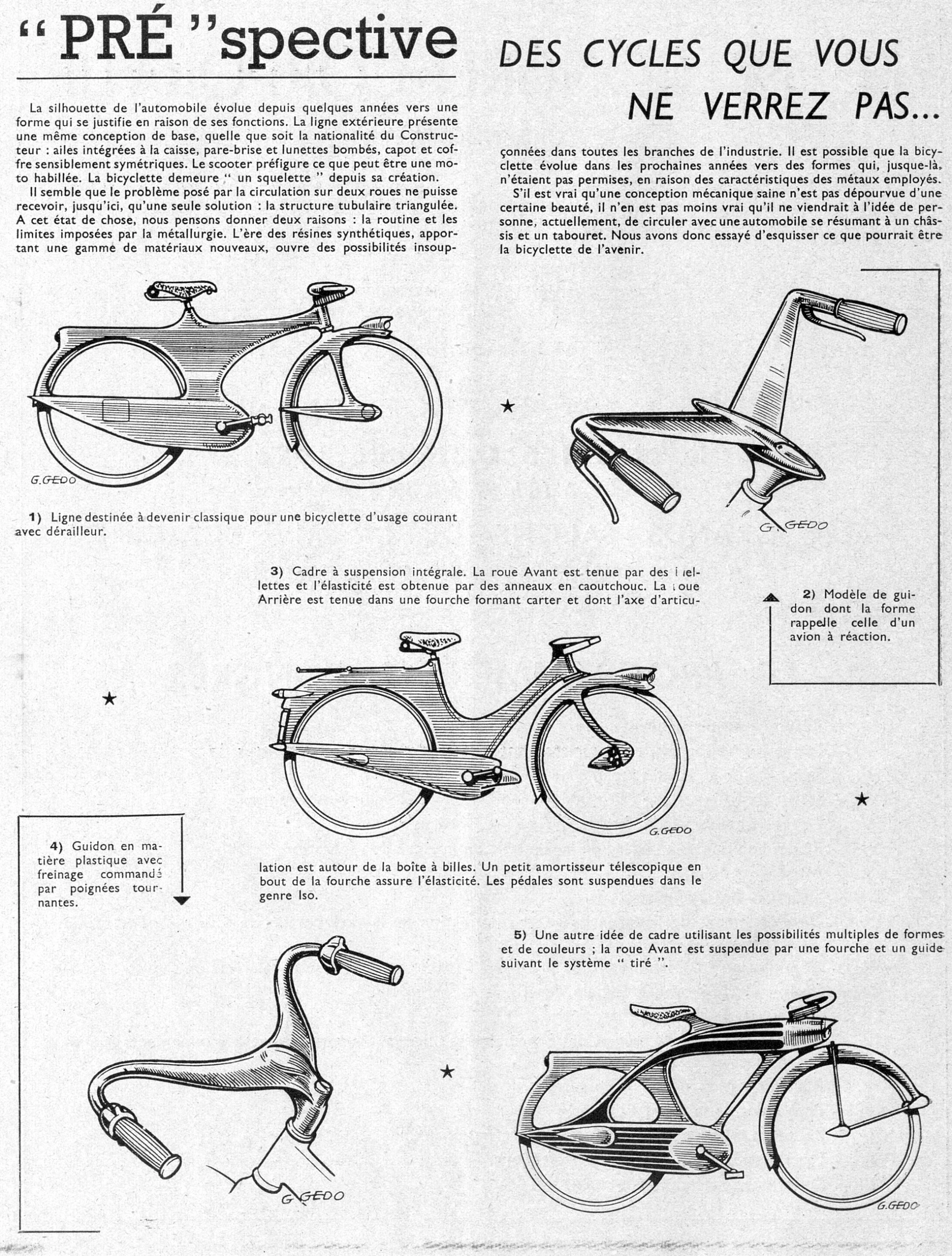
" PRÉ "spective DES CYCLES QUE VOUS NE VERREZ PAS... 1) Ligne destinée à devenir classique pour une bicyclette d'usage courant avec dérailleur. 2) Modèle de guidon dont la forme rappelle celle d'un avion à réaction. 3) Cadre à suspension intégrale. La roue Avant est tenue par des biellettes et l'élasticité est obtenue par des …
This is a magazine article, so its running text is summarized here rather than reproduced; the headline, byline, specifications and scores are transcribed as printed.
From L’Officiel du cycle, du motocycle et du camping, 20 September 1952, the paper’s special number for the 1952 Paris Salon du Cycle et du Motocycle, pages 24 and 25: G. Gédovius’s drawings of bicycles of the future “that you will not see at the Salon”, from a jet-shaped handlebar to a fully suspended frame, with his text. The title, headings, captions and lists are transcribed as printed; the text is summarized in Ebykr’s words, and the page images carry it in full.
— Page 1 —
” PRÉ “spective
DES CYCLES QUE VOUS
NE VERREZ PAS…
[Ebykr summary; the article’s text is not reproduced. Gédovius opens by noting that the silhouette of the automobile has for some years been moving toward a form justified by its functions, and that the outer line shows the same basic conception whatever the nationality of the maker: wings built into the body, curved windscreen and rear window, hood and trunk roughly symmetrical. The scooter, he says, prefigures what a clothed motorcycle can be, while the bicycle has remained “un squelette” since its creation. It seems that the problem set by two-wheeled traffic has so far admitted only one solution, the triangulated tubular structure, and he gives two reasons for this state of things: routine and the limits imposed by metallurgy. The age of synthetic resins, bringing a range of new materials, opens possibilities unsuspected in every branch of industry, and the bicycle may well move in the coming years toward forms that the characteristics of the metals used had not until now allowed. If it is true that sound mechanical design is not without a certain beauty, it is no less true that nobody today would think of driving an automobile reduced to a chassis and a stool. He has therefore tried to sketch what the bicycle of the future might be.]
1) Ligne destinée à devenir classique pour une bicyclette d’usage courant avec dérailleur.
2) Modèle de guidon dont la forme rappelle celle d’un avion à réaction.
3) Cadre à suspension intégrale. La roue Avant est tenue par des biellettes et l’élasticité est obtenue par des anneaux en caoutchouc. La roue Arrière est tenue dans une fourche formant carter et dont l’axe d’articulation est autour de la boîte à billes. Un petit amortisseur télescopique en bout de la fourche assure l’élasticité. Les pédales sont suspendues dans le genre Iso.
4) Guidon en matière plastique avec freinage commandé par poignées tournantes.
5) Une autre idée de cadre utilisant les possibilités multiples de formes et de couleurs ; la roue Avant est suspendue par une fourche et un guide suivant le système ” tiré “.
[The first page of a two-page feature, drawn and written by G. Gédovius. The head carries ” PRÉ “spective in heavy seriffed capitals and lower case with the raised quotation marks printed as part of the word, underscored by a rule, and beside it the title “DES CYCLES QUE VOUS” over “NE VERREZ PAS…” in light sans-serif capitals stepped to the right. Two paragraphs of sans-serif text run beneath the first head. Five pen drawings in plain line, with close parallel hatching standing in for the molded shells, are scattered down the page without frames: a complete machine with a deep teardrop body panel between the wheels and a derailleur, a handlebar and stem seen from in front with swept grips and a winglike crown, a second complete machine with enclosed front and a rear fork forming a chain case, a second handlebar seen from above and in front with its stem flaring into a broad web, and a third complete machine whose frame is built of flat pierced panels with an open triangle between them. Each caption is set in sans-serif with its number in bold, and two of them stand inside right-angled rules ending in a solid triangle that points toward the drawing described. Small solid stars are set in the white spaces between the blocks. Every drawing carries the signature “G. GEDO” in script at its lower right or lower left: under the rear wheel of the first machine, below the stem of the first handlebar, at the foot of the second machine, under the stem of the second handlebar and at the lower right of the third machine.]
— Page 2 —
Texté et dessins originaux de
GEDOVIUS
… AU SALON 1952
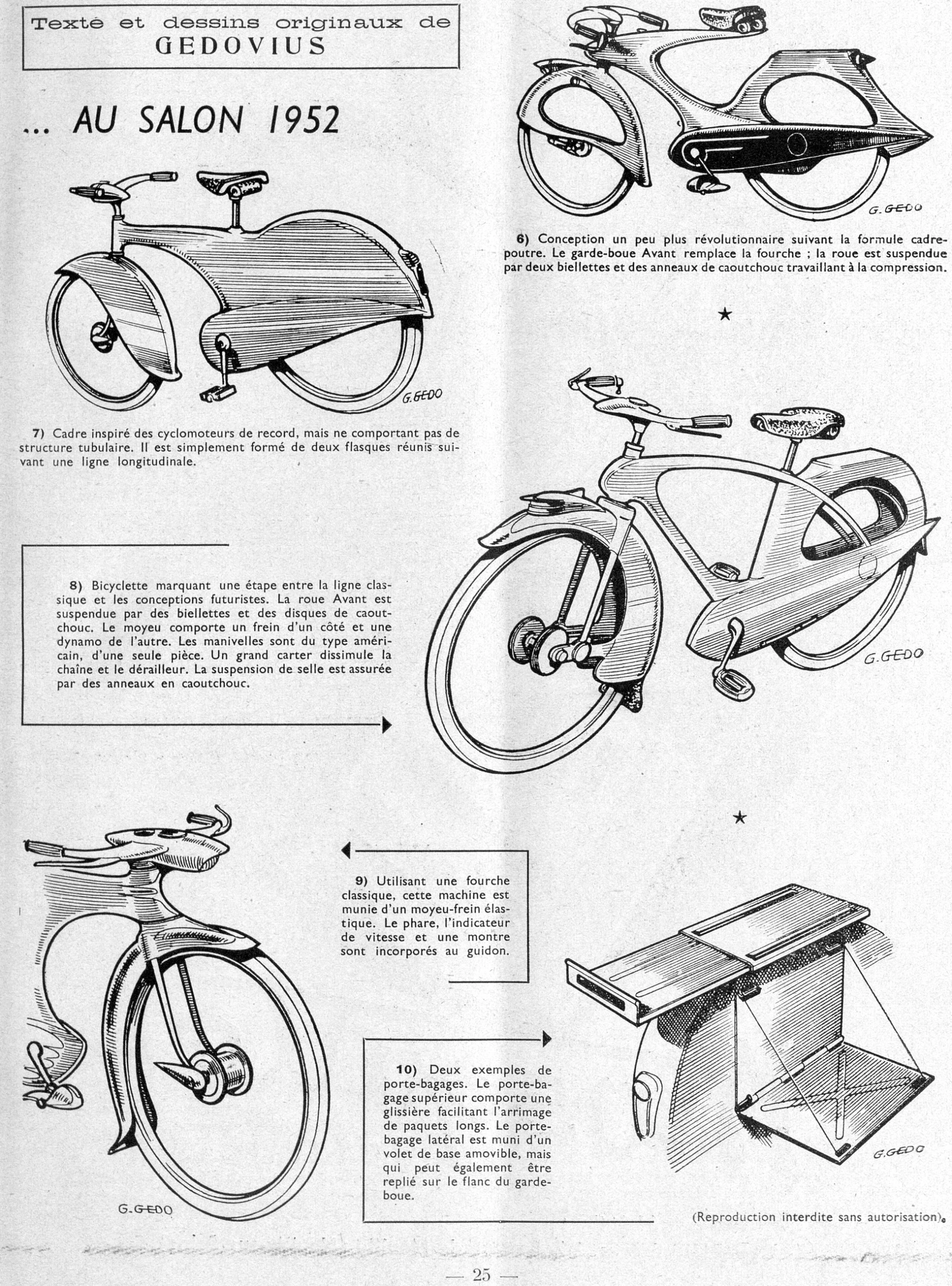
6) Conception un peu plus révolutionnaire suivant la formule cadre-poutre. Le garde-boue Avant remplace la fourche ; la roue est suspendue par deux biellettes et des anneaux de caoutchouc travaillant à la compression.
7) Cadre inspiré des cyclomoteurs de record, mais ne comportant pas de structure tubulaire. Il est simplement formé de deux flasques réunis suivant une ligne longitudinale.
8) Bicyclette marquant une étape entre la ligne classique et les conceptions futuristes. La roue Avant est suspendue par des biellettes et des disques de caoutchouc. Le moyeu comporte un frein d’un côté et une dynamo de l’autre. Les manivelles sont du type américain, d’une seule pièce. Un grand carter dissimule la chaîne et le dérailleur. La suspension de selle est assurée par des anneaux en caoutchouc.
9) Utilisant une fourche classique, cette machine est munie d’un moyeu-frein élastique. Le phare, l’indicateur de vitesse et une montre sont incorporés au guidon.
10) Deux exemples de porte-bagages. Le porte-bagage supérieur comporte une glissière facilitant l’arrimage de paquets longs. Le porte-bagage latéral est muni d’un volet de base amovible, mais qui peut également être replié sur le flanc du garde-boue.
(Reproduction interdite sans autorisation).
— 25 —
[The second page of the feature, carrying the rest of the drawings. At the head, inside a plain ruled box, stands the credit “Texté et dessins originaux de” in letterspaced seriffed type over “GEDOVIUS” in larger letterspaced capitals; below it the title is completed as “… AU SALON 1952” in light sans-serif italic capitals. Five pen drawings in plain line with close parallel hatching stand unframed on the white page. At the upper left is a machine built of two broad flat sides joined along the center line, with its caption below; at the upper right a machine whose frame is a single deep beam, the front mudguard taking the place of the fork; at the center right a three-quarter view from the front of a machine with a faired head and a large chain case; at the lower left a three-quarter view of a low machine on a conventional fork with its instruments set into the handlebar; and at the lower right two luggage carriers alone, an upper rack with a slotted rail and a side carrier with a hinged base flap, drawn in perspective above a hatched mudguard. The captions are set in sans-serif with bold numbers, two of them inside right-angled rules ending in a solid triangle that points at the drawing concerned, and small solid stars fill the gaps. Every drawing carries the signature “G. GEDO” in script, at the lower right of the two machines at the top, of the machine at the center right and of the carriers, and at the lower left under the front wheel of the machine at the lower left. The line “(Reproduction interdite sans autorisation).” stands at the foot above the folio “— 25 —”. The credit line prints “Texté” with an acute accent on the final letter.]
Ebykr presents this material for research and education. If you hold rights to it or notice an ownership issue, please contact us and we will respond promptly.
The Ebykr Digest
New articles, timelines, catalog finds and registry activity — assembled from the archive once a month. Your address is never shared.
Double opt-in. One email per month. Unsubscribe at any time with one click.