About Ebykr
Ebykr celebrates classic and vintage lightweight bicycles through provocative imagery and opinion. Ride along with us.
About Ebykr
Ebykr celebrates classic and vintage lightweight bicycles through provocative imagery and opinion. Ride along with us.

Source: Gallica (Bibliothèque nationale de France), L'Officiel du cycle, du motocycle et du camping, 20 September 1952, Numéro spécial du Salon 1952, pages 47, 48, 51, 53, 55, 57, 58, 63, 65, 67, 69, 73, 75, 77, 78, 81, 83, 85, 87, 88 and 91; ark:/12148/bd6t541820671. Source gallica.bnf.fr / BnF.
 Page 1
 Page 2
 Page 3
 Page 4
 Page 5
 Page 6
 Page 7
 Page 8
 Page 9
 Page 10
 Page 11
 Page 12
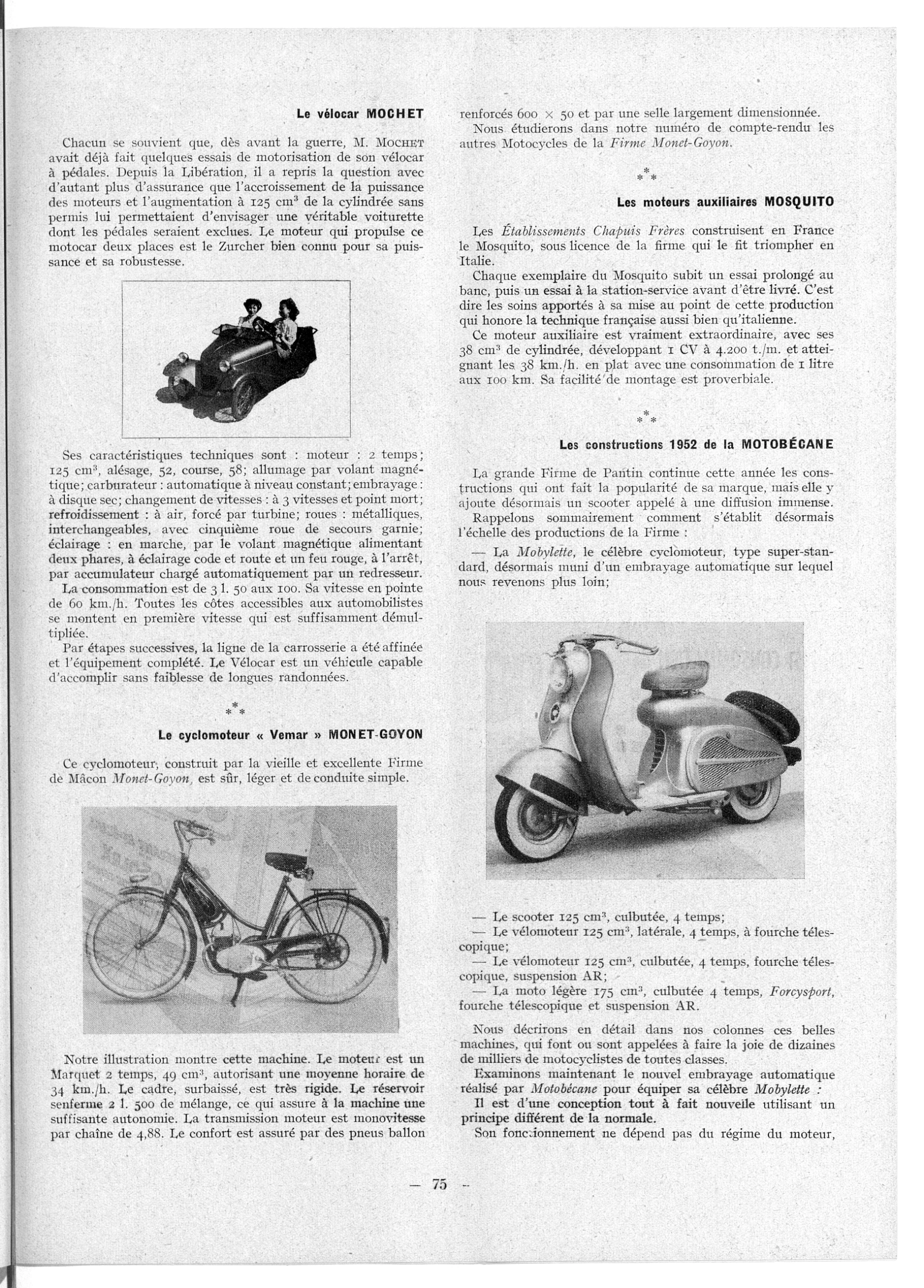 Page 13
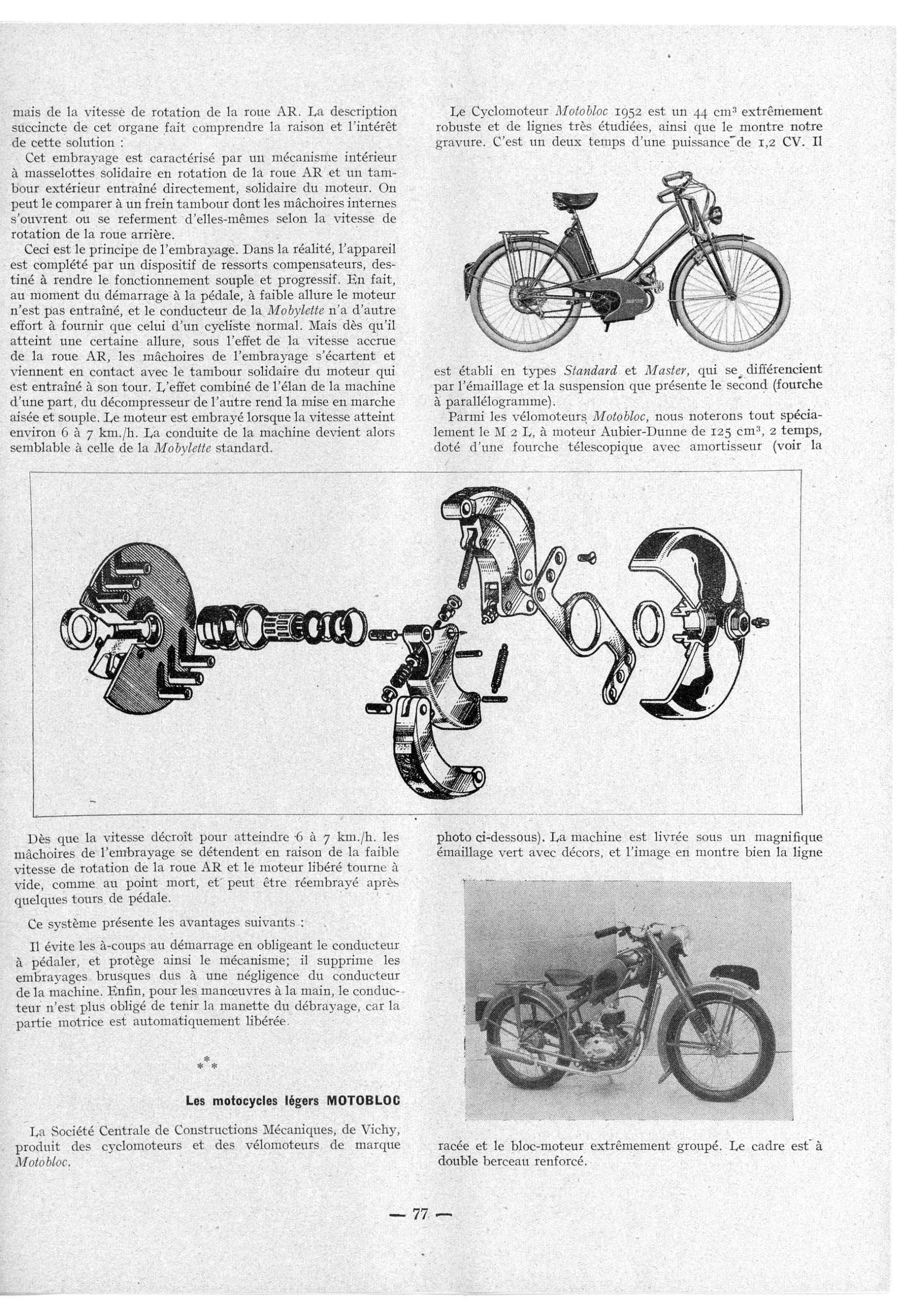 Page 14
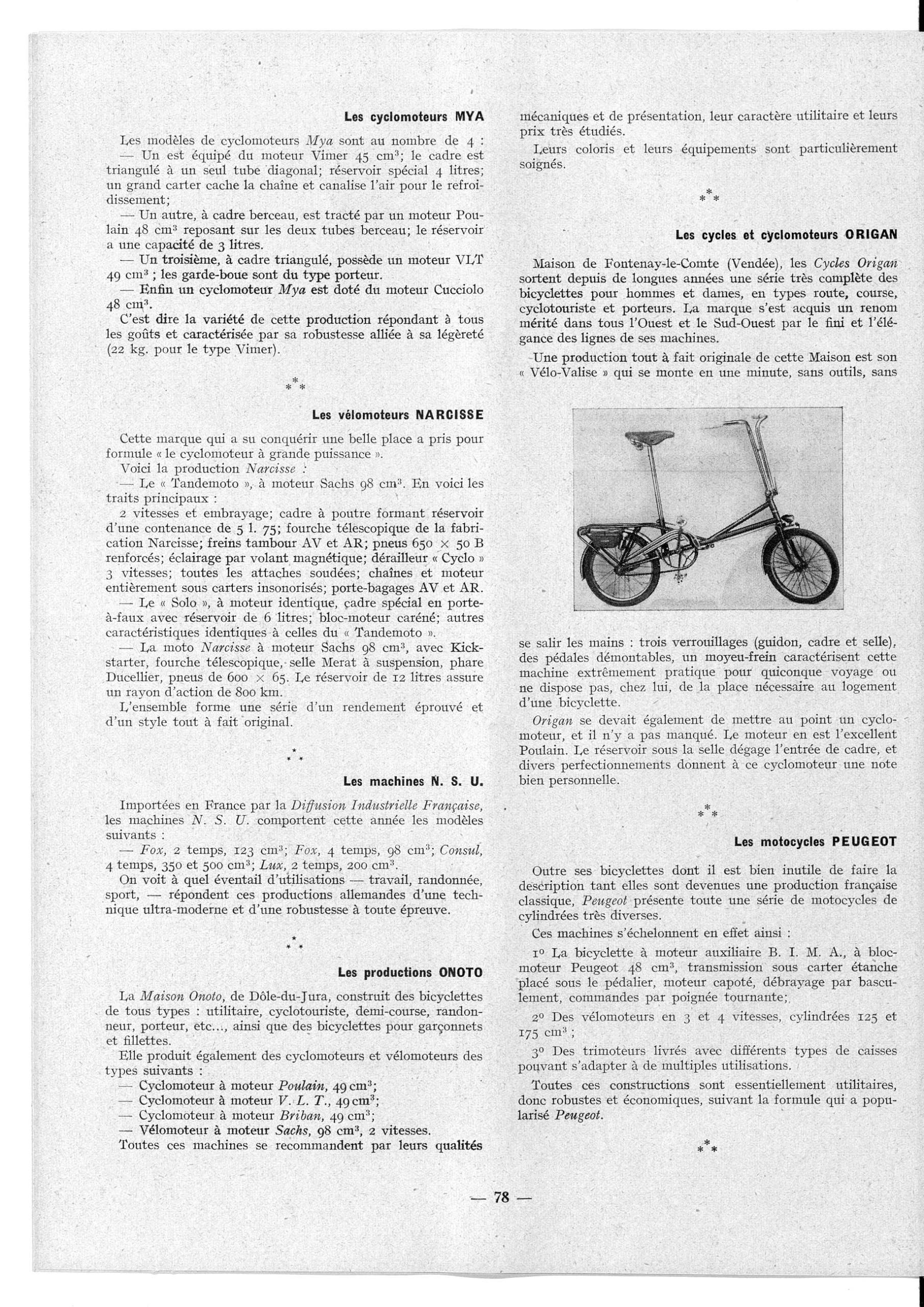 Page 15
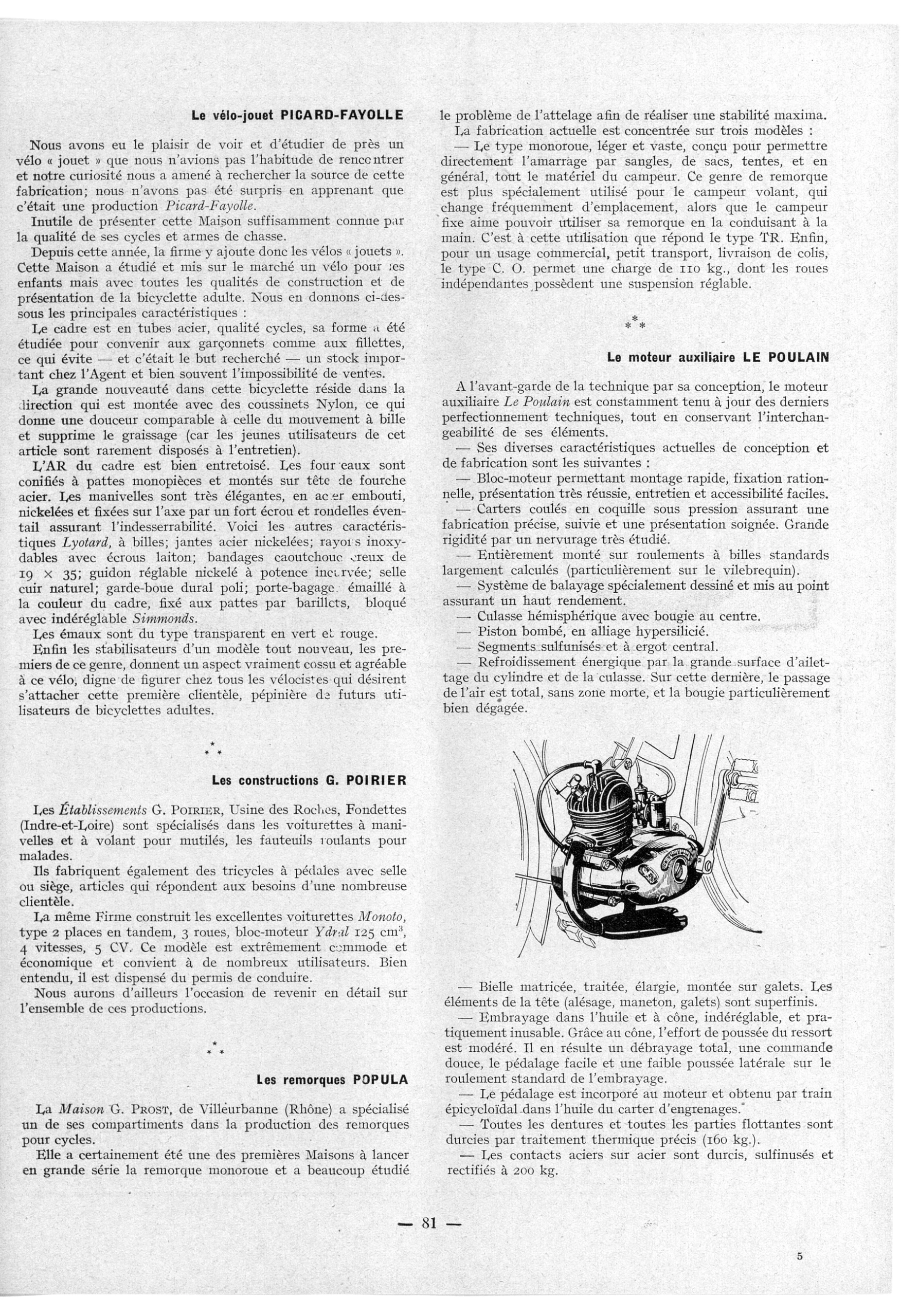 Page 16
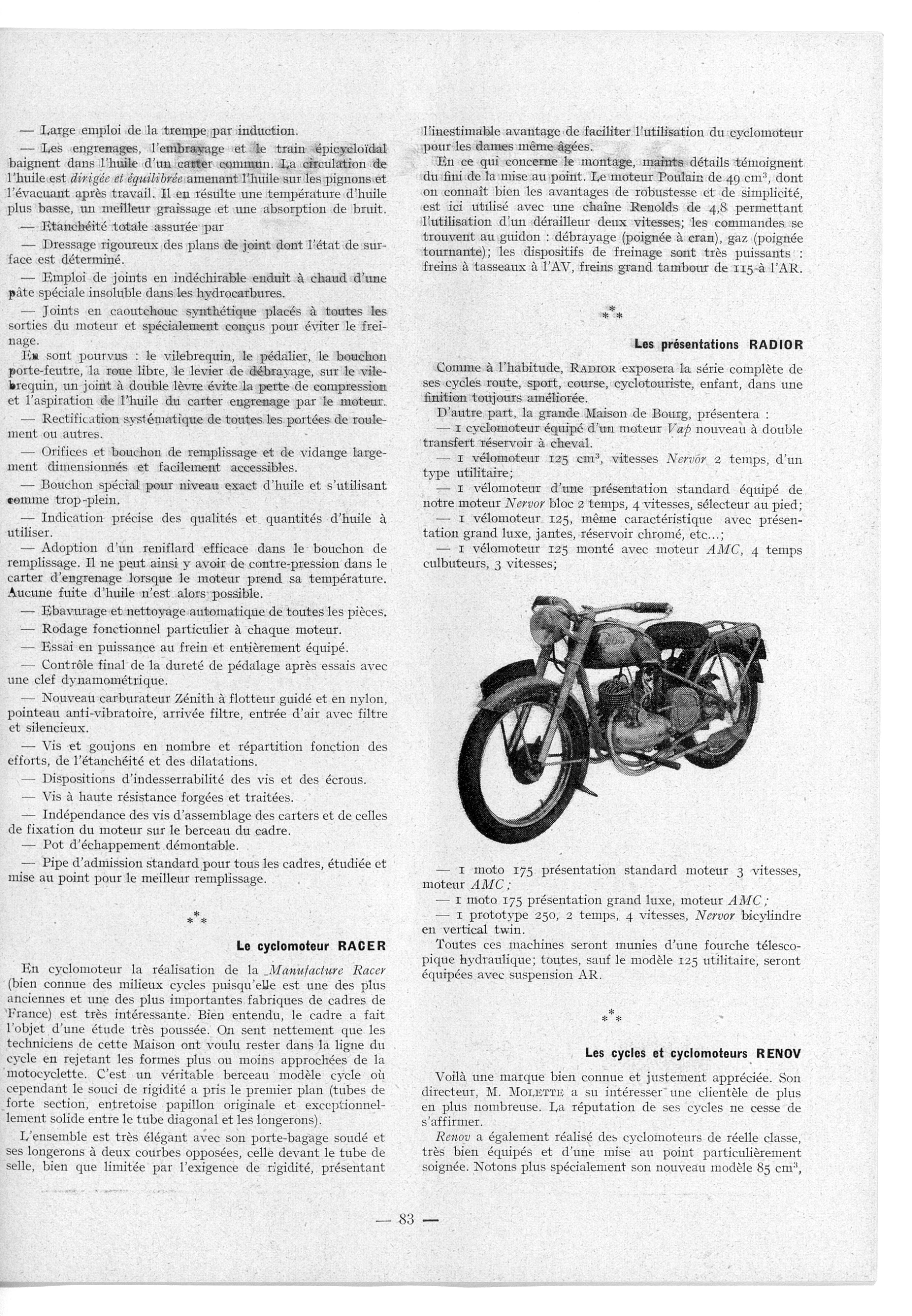 Page 17
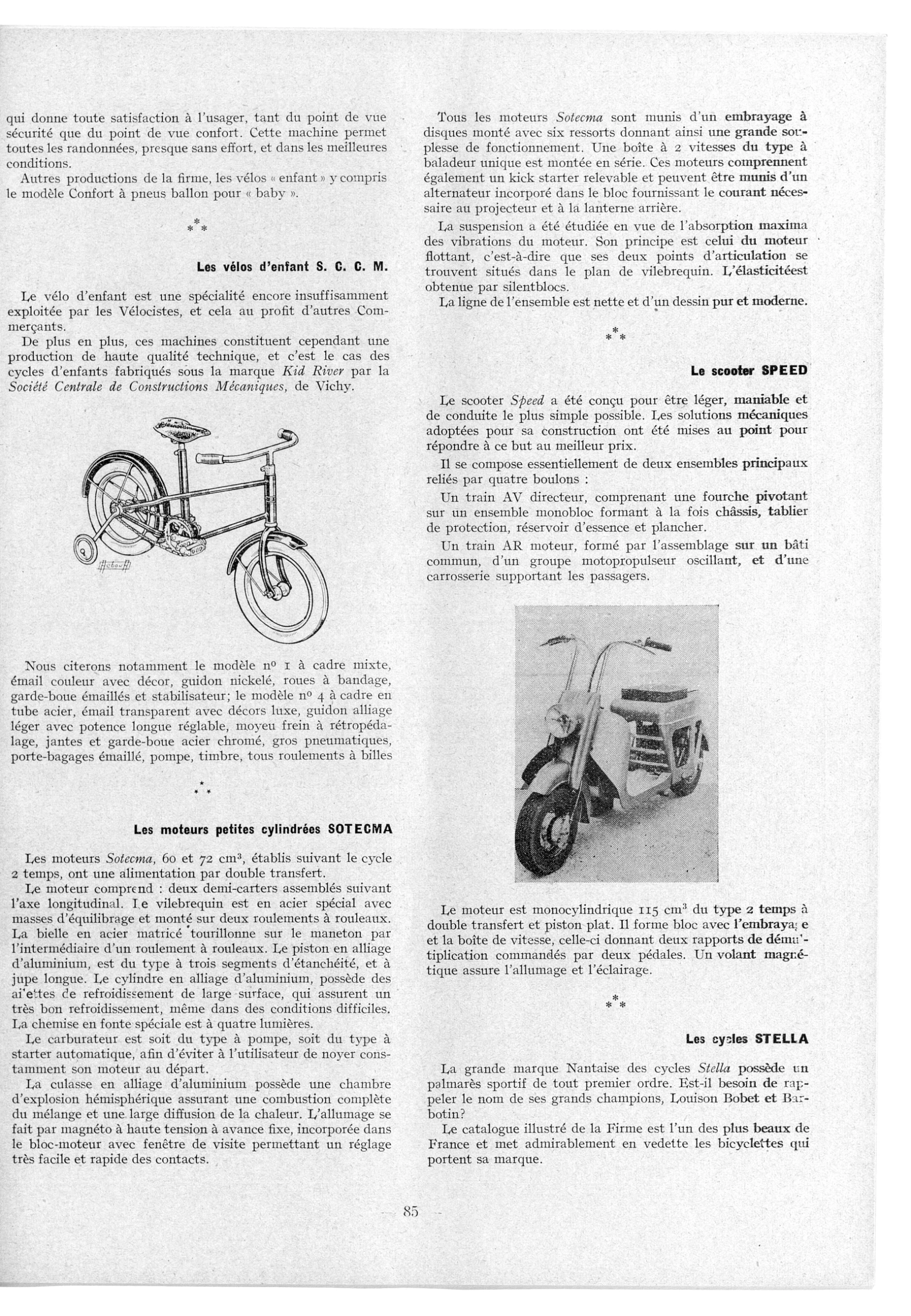 Page 18
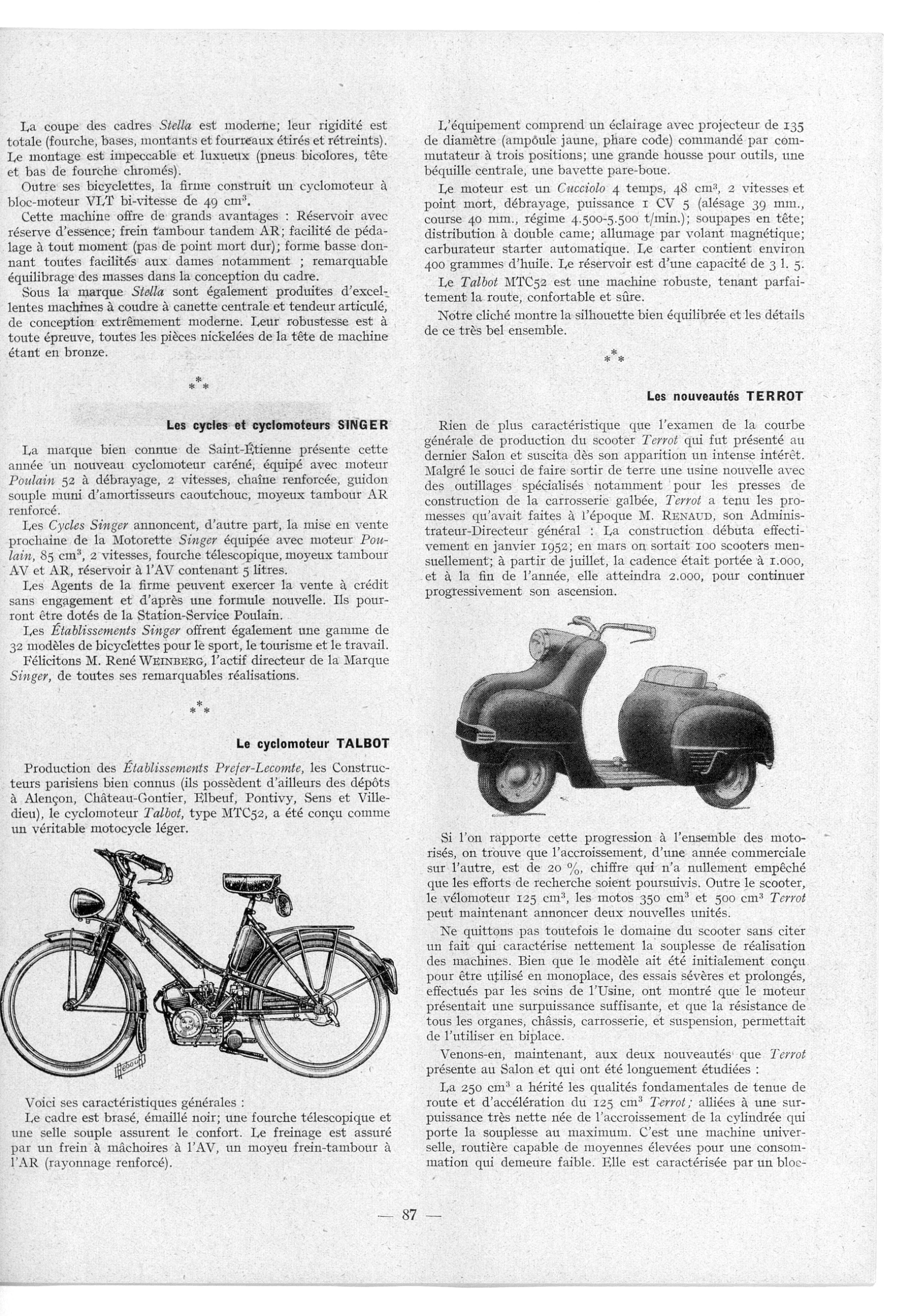 Page 19
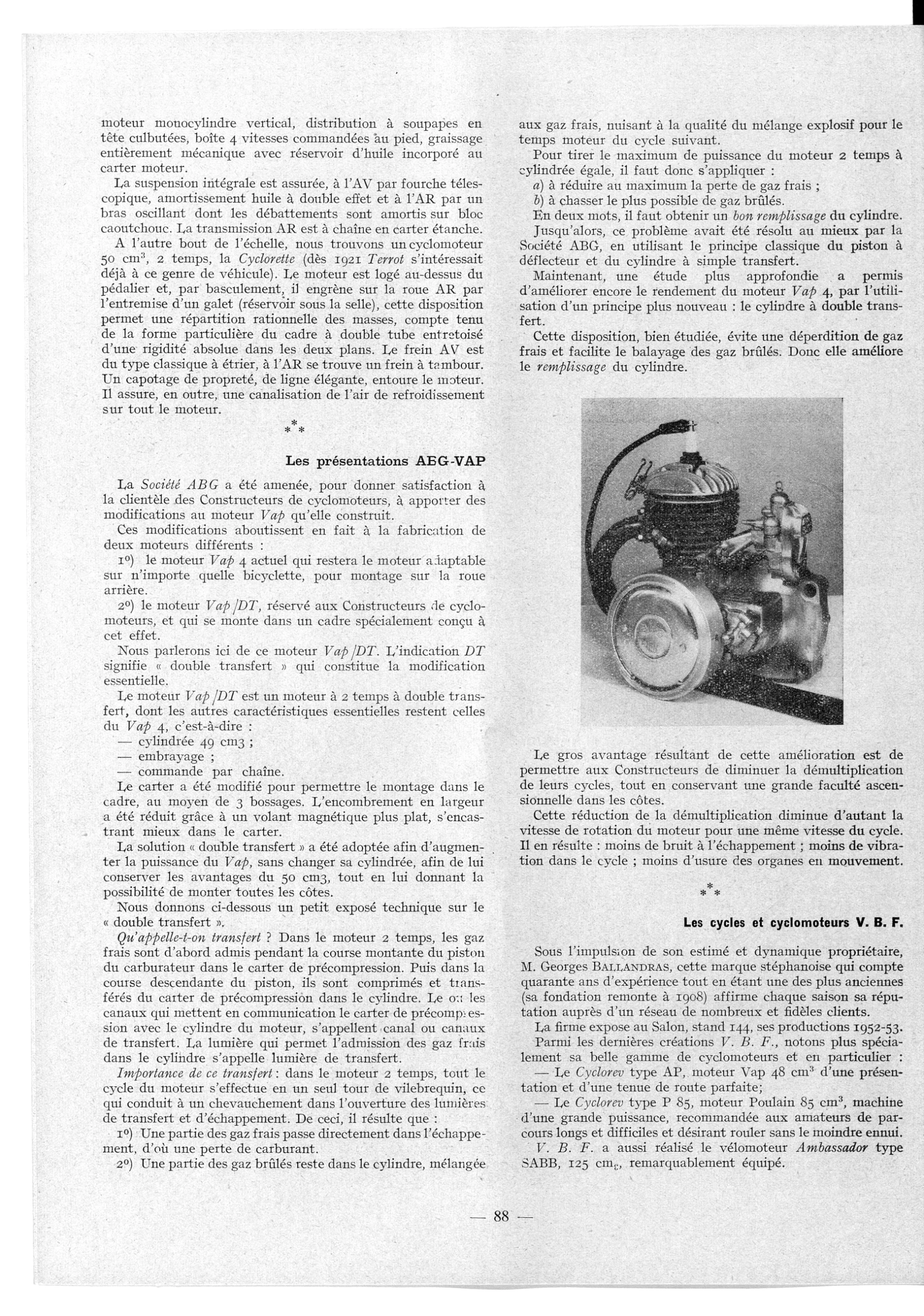 Page 20
 Page 21
| Type | Review |
|---|---|
| Year | 1952 |
| Publisher | L'Officiel du cycle |
| Artist | Daniel Rebour |
| Country | France |
| Language | French |
| Pages | 21 |
| Source | Gallica (Bibliothèque nationale de France), L'Officiel du cycle, du motocycle et du camping, 20 September 1952, Numéro spécial du Salon 1952, pages 47, 48, 51, 53, 55, 57, 58, 63, 65, 67, 69, 73, 75, 77, 78, 81, 83, 85, 87, 88 and 91; ark:/12148/bd6t541820671. Source gallica.bnf.fr / BnF. |
| Credit | Ebykr archive; Bibliothèque nationale de France |
| Identifier | Gallica (BnF) ark:/12148/bd6t541820671/f47 |
| Transcription | Headings and specifications transcribed; article text summarized |
PREMIÈRE PRÉSENTATION des CYCLES, MOTEURS et MOTOCYCLES aux PROGRAMMES 1952=53 AU moment où les nécessités d'impression nous obligent à arrêter la mise en pages de ce numéro, nous n'avons pas la prétention d'avoir pu dresser un panorama complet de la production 1952-53, en Cycles, Moteurs et Motocycles. Néanmoins, les quelque 80 firmes citées dans ces …
This is a magazine article, so its running text is summarized here rather than reproduced; the headline, byline, specifications and scores are transcribed as printed.
From L’Officiel du cycle, du motocycle et du camping, 20 September 1952, the paper’s special number for the 1952 Paris Salon du Cycle et du Motocycle, pages 47 to 91: the magazine’s survey of the 1952-53 production shown at the Salon, firm by firm: bicycles, cyclomoteurs, auxiliary engines, scooters and motorcycles, with their models, engines and prices. The title, headings, captions and lists are transcribed as printed; the text is summarized in Ebykr’s words, and the page images carry it in full.
— Page 1 —
PREMIÈRE PRÉSENTATION
des CYCLES, MOTEURS et MOTOCYCLES
aux PROGRAMMES 1952=53
AU moment où les nécessités d’impression nous obligent à arrêter la mise en pages de ce numéro, nous n’avons pas la prétention d’avoir pu dresser un panorama complet de la production 1952-53, en Cycles, Moteurs et Motocycles. Néanmoins, les quelque 80 firmes citées dans ces pages nous ont mis en mesure de présenter plus de 150 machines.
Dans notre Numéro de Compte rendu, nous compléterons ce tour d’horizon par une nouvelle série de présentations.
Les présentations ALCYON
[Ebykr summary; the article’s text is not reproduced. The old and celebrated Alcyon marque shows at the Salon du Cycle on stand 227, besides its quality bicycles, the following motorized machines: the Alcyonnette of 48 cm3 in standard and luxe types, already well known to the paper’s cyclist readers; its 125 cm3 vélomoteurs with Zurcher two-stroke and A. M. C. four-stroke engines; and its light motorcycle of 175 cm3 with an A. M. C. four-stroke engine. The paper says this range lets the firm satisfy a wide clientele that trusts the marque’s reputation for quality.]
Les motocycles ALMA
[Ebykr summary; the article’s text is not reproduced. The Alma products for 1952 and the marque’s new models will be fitted with hubs of the bloc-central type. The construction is completed by the launch of two 125 cm3 vélomoteurs carrying the Alma engine-gearbox unit, of a scooter and of a low-built triporteur. The paper says the motorcycle dealer will find among these models a scale of prices able to satisfy every category of buyer, and that this Clermont-Ferrand firm recommends itself by the care it puts into its manufacture.]
Les motocyclettes AMBASSADOR
[Ebykr summary; the article’s text is not reproduced. British productions of high class, the Ambassador motorcycles are fitted with Villiers engines. The Suprême type has been called the “aristocrate des lightweights”; it carries, as expected, the telescopic fork and rear suspension. The Embassy type, lighter, is said to be no less elegant and to be marked by its economy, and it too has the telescopic fork. These motorcycles are represented in France by the Diffusion Industrielle Française and carry in Great Britain the slogan The machines for the connoisseurs. The paper prints “Grance-Bretagne” for Grande-Bretagne.]
Les blocs-moteurs A. M. C.
[Ebykr summary; the article’s text is not reproduced. The paper notes that every motorcycle man knows the A. M. C. engines, of the Ateliers de Mécanique du Centre at Clermont-Ferrand, equip in France a very large number of light motorcycles of every marque. It confines itself to citing the 125 cm3 four-stroke with overhead valves and three speeds and the 175 cm3 four-stroke with overhead valves. These proven engines are said to recommend themselves by their robustness, their ease of dismantling and their output, and to enjoy the confidence of very many manufacturers — “et tant vaut le moteur, tant vaut la moto”.]
Les présentations ASPE, DUMONT ET Cie
[Ebykr summary; the article’s text is not reproduced. This firm is known to specialize in importing large German and English marques, and the paper cites only: in 150 cm3 the Durkopp of 2 CV, two-stroke engine, three speeds, telescopic fork, speed at 5,500 t./m. about 86 km./h.; in 250 cm3 the Ardie of 3 CV, two-stroke engine, four speeds, telescopic fork, speed at 4,800 t./m. about 100 km./h.; and in 350 and 500 cm3 the celebrated Matchless singles and twins, whose real speeds are about 120 and 130 km./h. for the singles and reach 145/150 for the twins. These Établissements are said to have built up important stocks of spare parts so as to assure users of these machines a perfect after-sales service.]
Le cyclomoteur et le scooter A.G.F.
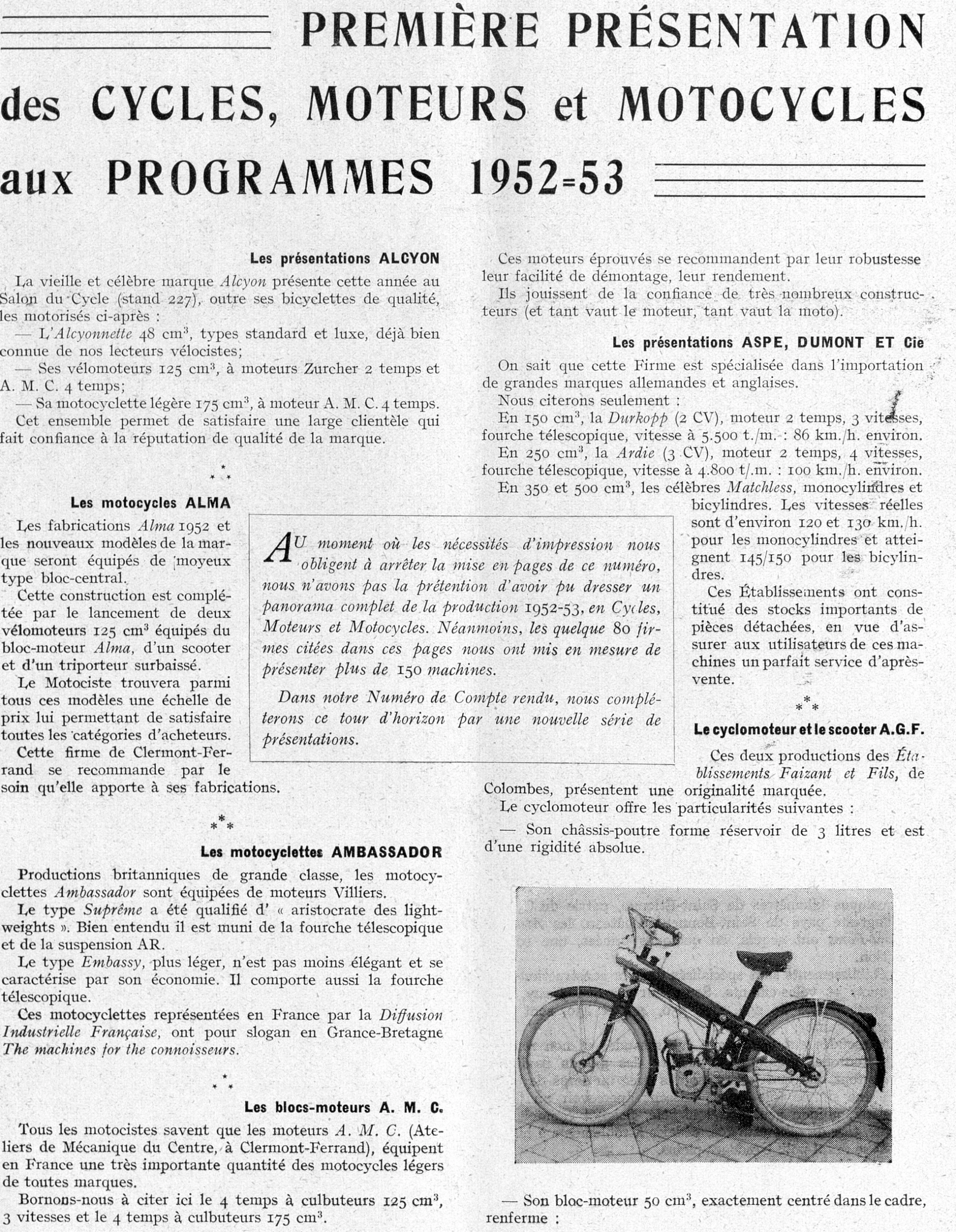
[Ebykr summary; the article’s text is not reproduced. These two productions of the Établissements Faizant et Fils, of Colombes, are said to show a marked originality. The cyclomoteur offers the following particulars: its beam frame forms a tank of 3 liters and is of absolute rigidity; its 50 cm3 engine-gearbox unit, exactly centered in the frame, contains — the list running on to the following page.]
[A full review page in two columns, headed by the standing title of the series set in heavy shaded roman capitals over three lines, “PREMIÈRE PRÉSENTATION / des CYCLES, MOTEURS et MOTOCYCLES / aux PROGRAMMES 1952=53”, with a block of three thin parallel rules closing the line at the left of the first line and at the right of the third. The firm headings are set in bold sans-serif capitals, ranged right over the left column and right over the right column, and the sections are divided by three-star ornaments arranged in a triangle. Marque and model names run in italic inside the roman text. An editor’s note, set in italic with a large drop capital A, stands in a thin ruled rectangle that sits across the middle of the page between the two columns, both columns narrowing to clear it. At the foot of the right column is a halftone photograph of a cyclomoteur seen in full left profile against a plain studio ground, standing on a flagged floor: a step-through machine with a deep beam frame, a small engine unit low in the frame behind a rounded casing, balloon tires, full mudguards with a wide rear flap, a saddle on a plain pillar, a headlamp carried on a bracket above the front mudguard and a chain running to the rear wheel. The photograph carries no caption and no signature.]
— Page 2 —
[Ebykr summary; the article’s text is not reproduced. The notice of the A.G.F. cyclomoteur, carried over from the preceding page, lists what its 50 cm3 engine unit contains: first, a chainwheel set made up of an epicyclic reduction gear and an automatic ratchet, which eases maneuvering at a standstill and free pedaling; second, a double cork-disc clutch worked by a twistgrip and running in oil. The transmission, by a single chain with three different gear ratios of extremely simple use, is said to allow absolutely complete use of the engine’s possibilities whatever the profile of the route, and immediate removal of the rear wheel without any adjustment of the chain. The paper adds that its block shows this very modern machine well.]
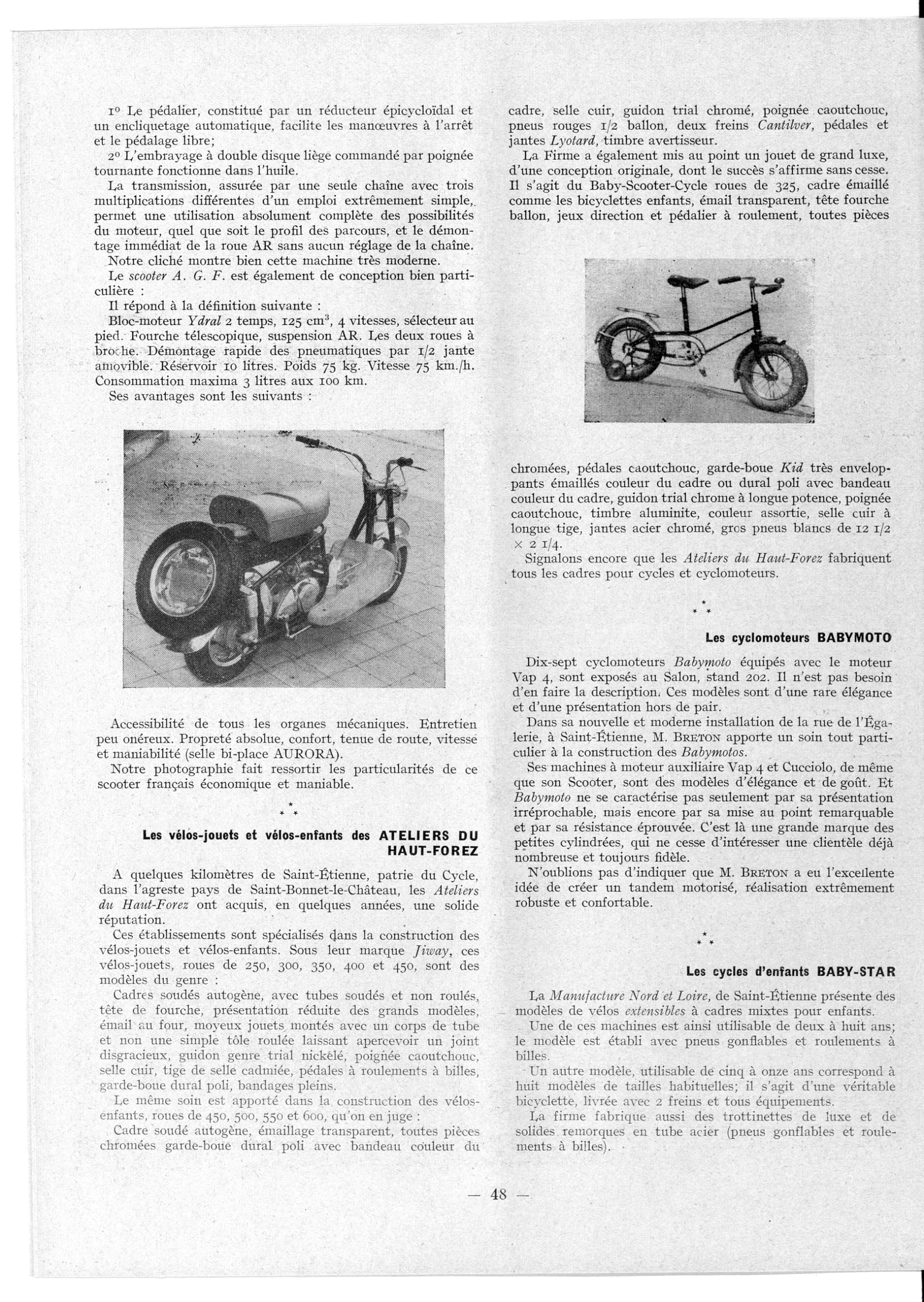
[Ebykr summary; the article’s text is not reproduced. The A.G.F. scooter is likewise said to be of a very particular conception, answering to the following definition: Ydral two-stroke engine unit of 125 cm3, four speeds, foot selector; telescopic fork, rear suspension; both wheels on spindles; quick removal of the tires by a detachable half rim; tank of 10 liters; weight 75 kg.; speed 75 km./h.; maximum consumption 3 liters per 100 km. Its advantages are given as: accessibility of all the mechanical parts, inexpensive upkeep, absolute cleanliness, comfort, road holding, speed and handiness, with an AURORA two-place saddle. The paper says its photograph brings out the particulars of this economical and handy French scooter.]
Les vélos-jouets et vélos-enfants des ATELIERS DU HAUT-FOREZ
[Ebykr summary; the article’s text is not reproduced. A few kilometers from Saint-Étienne, the home of the cycle, in the rural country of Saint-Bonnet-le-Château, the Ateliers du Haut-Forez are said to have won a solid reputation in a few years. The firm specializes in building toy cycles and children’s cycles. Under its Jiway mark the toy cycles, with wheels of 250, 300, 350, 400 and 450, are described as: frames autogenously welded, with welded and not rolled tubes, fork crown, a reduced version of the presentation of the large models, stoved enamel, toy hubs built with a tube body and not a simple rolled sheet leaving an ungraceful seam showing, nickeled trial-pattern handlebar, rubber grips, leather saddle, cadmium-plated seat pillar, pedals on ball bearings, polished dural mudguards and solid tires. The same care is said to go into the children’s cycles with wheels of 450, 500, 550 and 600: frame autogenously welded, transparent enameling, all parts chromed, polished dural mudguards with a band in the color of the frame, leather saddle, chromed trial handlebar, rubber grips, red half-balloon tires, two Cantilver brakes, Lyotard pedals and rims, warning bell. The firm has also brought out a toy of great luxury of an original conception whose success is said to grow steadily, the Baby-Scooter-Cycle with wheels of 325, frame enameled like the children’s bicycles, transparent enamel, balloon fork crown, headset and bottom bracket on bearings, all parts chromed, rubber pedals, very enveloping Kid mudguards enameled in the color of the frame or in polished dural with a band in the color of the frame, chromed trial handlebar with a long stem, rubber grips, aluminite bell in a matching color, leather saddle with a long pillar, chromed steel rims and large white tires of 12 1/2 x 2 1/4. The paper notes further that the Ateliers du Haut-Forez make all kinds of frames for cycles and cyclomoteurs.]
Les cyclomoteurs BABYMOTO
[Ebykr summary; the article’s text is not reproduced. Seventeen Babymoto cyclomoteurs fitted with the Vap 4 engine are shown at the Salon on stand 202, and the paper says no description is needed, the models being of rare elegance and of a presentation beyond compare. In his new and modern works in the rue de l’Égalerie at Saint-Étienne, M. BRETON is said to put very particular care into building the Babymotos. His machines with Vap 4 and Cucciolo auxiliary engines, like his scooter, are called models of elegance and taste, and Babymoto is said to be marked not only by its faultless presentation but by its remarkable development and its proven endurance — a great marque of the small capacities, holding the interest of a clientele already numerous and always faithful. The paper adds that M. BRETON has had the excellent idea of creating a motorized tandem, an extremely robust and comfortable machine.]
Les cycles d’enfants BABY-STAR
[Ebykr summary; the article’s text is not reproduced. The Manufacture Nord et Loire, of Saint-Étienne, shows extensible children’s cycles with mixte frames. One of these machines can be used from two to eight years of age and is built with pneumatic tires and ball bearings. Another model, usable from five to eleven years, corresponds to eight models of the usual sizes and is a true bicycle, delivered with two brakes and complete equipment. The firm also makes luxury scooters and stout trailers in steel tube, with pneumatic tires and ball bearings.]
— 48 —
[A review page in two columns of roman text, the firm headings in bold sans-serif capitals ranged right and the sections divided by three-star ornaments arranged in a triangle. Marque and model names run in italic. Two halftone photographs appear. The first, at the foot of the left column, shows the A.G.F. scooter from the front and a little to the left against a plain pale ground: a deep apron and legshield, a long saddle, a raised handlebar with a mirror on a stalk at the left end, small wheels with full mudguards and the engine and exhaust visible low behind the apron. The second, set in the right column, shows the Baby-Scooter-Cycle in full right profile on a plain floor: a small child’s machine with a low curved open frame, fat balloon tires on small wheels, a short handlebar with rubber grips, a saddle on a long pillar and a flat carrier over the rear wheel, casting a soft shadow to the left. Neither photograph carries a caption or a signature. The page number, “— 48 —”, stands at the foot of the right column.]
— Page 3 —
Les cycles André BERTIN
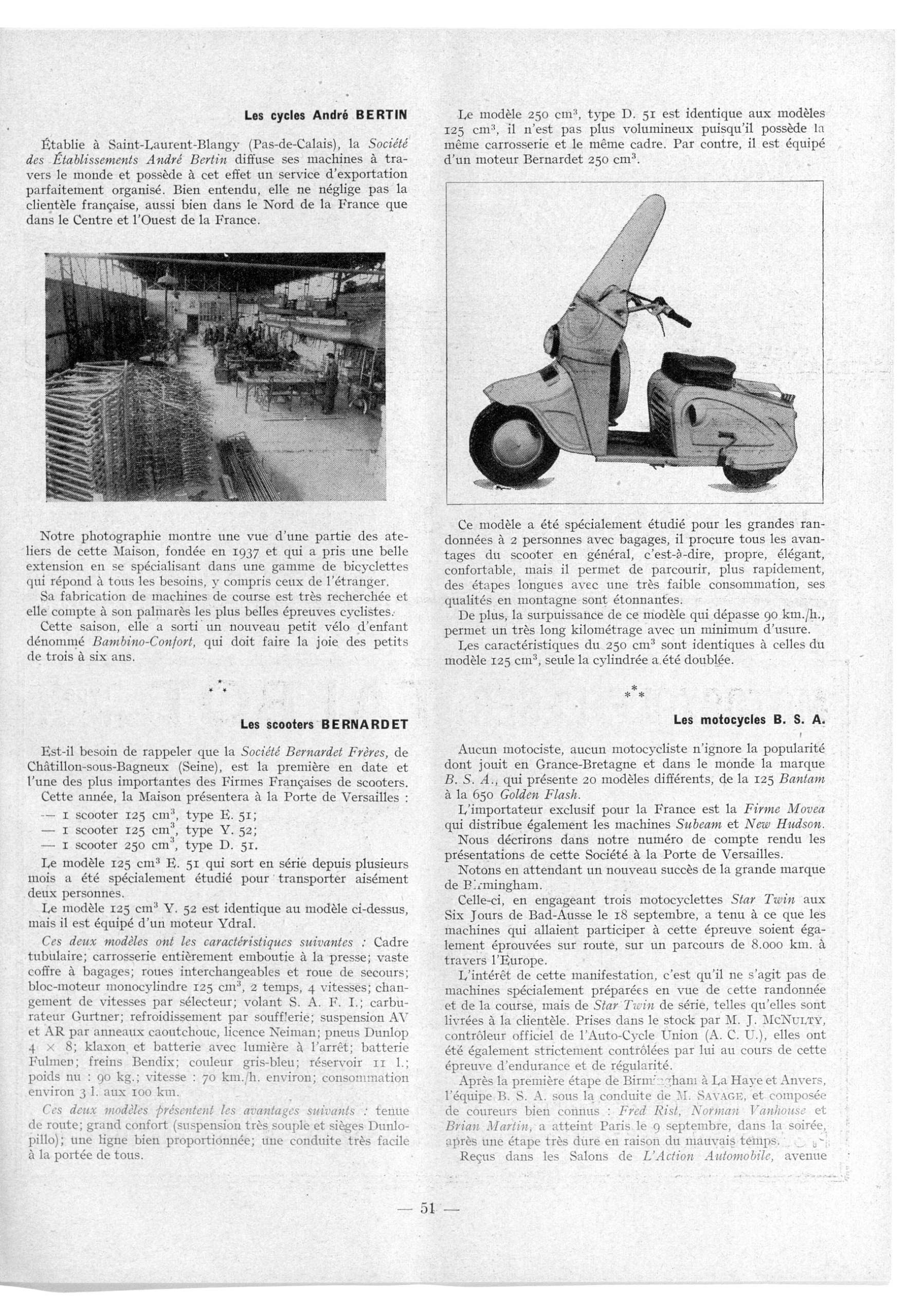
[Ebykr summary; the article’s text is not reproduced. Established at Saint-Laurent-Blangy in the Pas-de-Calais, the Société des Établissements André Bertin sells its machines throughout the world and keeps a perfectly organized export service for the purpose, without neglecting the French clientele, in the north of France as well as in the center and the west. The paper says its photograph shows part of the workshops of this house, founded in 1937, which has grown considerably by specializing in a range of bicycles meeting every need, including those of the foreign market. Its racing machines are said to be much sought after and to count the finest cycling events in their record. This season the firm has brought out a new small child’s bicycle named Bambino-Confort, meant to delight children of three to six years.]
Les scooters BERNARDET
[Ebykr summary; the article’s text is not reproduced. The paper recalls that the Société Bernardet Frères, of Châtillon-sous-Bagneux in the Seine, is the earliest in date and one of the most important of the French scooter firms. This year the house will show at the Porte de Versailles:]
— 1 scooter 125 cm3, type E. 51;
— 1 scooter 125 cm3, type Y. 52;
— 1 scooter 250 cm3, type D. 51.
[Ebykr summary; the article’s text is not reproduced. The 125 cm3 E. 51 model, which has been coming off the line for several months, has been studied specially to carry two people easily. The 125 cm3 Y. 52 model is identical to it but is fitted with an Ydral engine. The 250 cm3 D. 51 model is identical to the 125 cm3 models and is no bulkier, since it has the same body and the same frame; it is fitted instead with a Bernardet engine of 250 cm3. The paper gives the specification of the two 125 cm3 models verbatim, as follows.]
Ces deux modèles ont les caractéristiques suivantes : Cadre tubulaire; carrosserie entièrement emboutie à la presse; vaste coffre à bagages; roues interchangeables et roue de secours; bloc-moteur monocylindre 125 cm3, 2 temps, 4 vitesses; changement de vitesses par sélecteur; volant S. A. F. I.; carburateur Gurtner; refroidissement par soufflerie; suspension AV et AR par anneaux caoutchouc, licence Neiman; pneus Dunlop 4 × 8; klaxon et batterie avec lumière à l’arrêt; batterie Fulmen; freins Bendix; couleur gris-bleu; réservoir 11 l.; poids nu : 90 kg.; vitesse : 70 km./h. environ; consommation environ 3 l. aux 100 km.
Ces deux modèles présentent les avantages suivants : tenue de route; grand confort (suspension très souple et sièges Dunlopillo); une ligne bien proportionnée; une conduite très facile à la portée de tous.
[Ebykr summary; the article’s text is not reproduced. The 250 cm3 model is said to have been studied specially for long touring with two people and luggage. It gives all the advantages of the scooter in general — clean, elegant, comfortable — while letting the rider cover long stages more quickly on a very low consumption, and its qualities in the mountains are called astonishing. Its surplus power, which carries it past 90 km./h., is said to allow very high mileage with a minimum of wear. Its characteristics are identical to those of the 125 cm3 model, only the capacity having been doubled.]
Les motocycles B. S. A.
[Ebykr summary; the article’s text is not reproduced. The paper says no motorcycle trader or rider is unaware of the popularity the B. S. A. marque enjoys in Great Britain and in the world; it shows 20 different models, from the 125 Bantam to the 650 Golden Flash. The exclusive importer for France is the Firme Movea, which also handles the Subeam and New Hudson machines, and the paper will describe this company’s showing at the Porte de Versailles in its report number. It records meanwhile a fresh success for the great Birmingham marque: in entering three Star Twin motorcycles for the Six Days of Bad-Ausse on 18 September, B. S. A. required that the machines taking part also be tested on the road over a course of 8,000 km. across Europe. The interest of the event is said to be that these were not machines specially prepared for the ride and the race but production Star Twins as delivered to customers, taken from stock by M. J. McNULTY, official checker of the Auto-Cycle Union (A. C. U.), and strictly checked by him during this test of endurance and regularity. After the first stage from Birmingham to The Hague and Antwerp, the B. S. A. team led by M. SAVAGE and made up of the well-known riders Fred Rist, Norman Vanhouse and Brian Martin reached Paris on the evening of 9 September after a very hard stage caused by bad weather, and was received in the salons of L’Action Automobile, avenue — the sentence running on to the following page. The paper prints “Grance-Bretagne” for Grande-Bretagne and “Subeam” for Sunbeam.]
— 51 —
[A review page in two columns of roman text, the firm headings in bold sans-serif capitals ranged right over each column and the sections divided by three-star ornaments arranged in a triangle. Firm, marque and model names run in italic, and two short sentences introducing the Bernardet specification are set wholly in italic. Two halftone photographs appear. The first, filling the width of the left column, is an interior of a workshop seen down its length: a long shop under a ridged roof carried on riveted beams, racks of stacked frames or rims in the left foreground, benches and machines ranged along both sides and two or three figures at work in the middle distance under hanging lamps. The second, at the top of the right column inside a thin ruled rectangle, shows a Bernardet scooter in full left profile on a plain white ground: a pressed-steel body with a deep front apron and a tall tapering windscreen above it, a long seat, a handlebar with levers and a mirror, small wheels and a rounded tail casing. Neither photograph carries a caption or a signature. The page number, “— 51 —”, stands at the foot of the left column.]
— Page 4 —
[Ebykr summary; the article’s text is not reproduced. The B. S. A. notice, carried over from the preceding page, closes with the reception in the salons of L’Action Automobile, avenue d’Iéna, where officials and riders were entertained by the representatives of the Movea management, surrounded by the chief agents of the Paris region and by the marque’s French riders Frantz and Charrier of Saint-Cloud among others, as well as by the representatives of Esso Standard. The paper calls it a wholly friendly reception at which the guests could see the impeccable state of the machines and wish the B. S. A. team a happy finish to this interesting test, which it will report on shortly, the event running at the very moment this Salon number goes to press.]
Les cycles et cyclomoteurs « Le CHEMINEAU »
[Ebykr summary; the article’s text is not reproduced. Forty-one years of experience are said to have made the renown of this Saint-Étienne marque. Le Chemineau has worked well for the cycle industry, since its director Joanny PANEL is the “père du dérailleur”, a title the paper says he may legitimately be proud of, and it pays homage to this man of the Tour de France of 1912 who goes on setting an example in the great cyclotouring events — the classic Journée Chemineau counting among the great national gatherings. The marque also builds a cyclomoteur of perfect elegance said to deserve attention. Visitors to the Salon will find the firm on stand 35, where M. Joanny PANEL will show them the models at their leisure.]
Les cyclomoteurs C. N. C.
[Ebykr summary; the article’s text is not reproduced. M. R.-M. FLETCHER, builder of the much appreciated C. N. C. cycles, has developed several cyclomoteur models that the paper calls very fine technical achievements:]
— Le type C. N. C. Cucciolo est équipé du célèbre 4 temps 2 vitesses, puissance 1 CV 1/2, consommation 1 l. aux 100 km. Trois vitesses supplémentaires sont données par dérailleur. La vitesse atteint, rappelons-le, 60 km./h. Les pneus sont des 650 ballon Hutchinson.
— Le type C. N. C. Le Poulain est tracté par l’excellent 49 cm3 que l’on sait (puissance 1 CV 1/4). La vitesse atteint 45 km./h. et la consommation se chiffre par 1 l. 7 aux 100 km. Un dérailleur donne 3 vitesses. Les pneus sont des ballons.
Les cycles et motocycles COLOMB ET BIANCHI
[Ebykr summary; the article’s text is not reproduced. At the Salon the Cycles Colomb, of Bagnolet, show the following, which the paper sets out as a list:]
Au Salon les Cycles Colomb, de Bagnolet, présentent leur série habituelle de bicyclettes modèles route, ville, cyclotourisme et course ;
Une nouvelle série de bicyclettes route, ville et cyclotourisme d’une fabrication très soignée, cadre genre artisan, avec roues et pneus en 700 C ;
Des vélos Bianchi, entre autres le vélo de Fausto Coppi ;
Un cyclomoteur à moteur à deux vitesses permettant de monter des côtes de pourcentage élevé sans pédaler et de marcher sur le plat à 55 à l’heure, des freins puissants, un réservoir de 6 litres permettant de prendre l’essence directement au pompiste, extrêmement propre, d’une ligne très agréable, fabrication et montage très soignés ;
Un cyclomoteur Bianchi Aquilotto ;
Une moto Bianchi 125 cm3, nouveau modèle qui fait fureur en Italie (et l’on connaît les exigences des motocyclistes italiens).
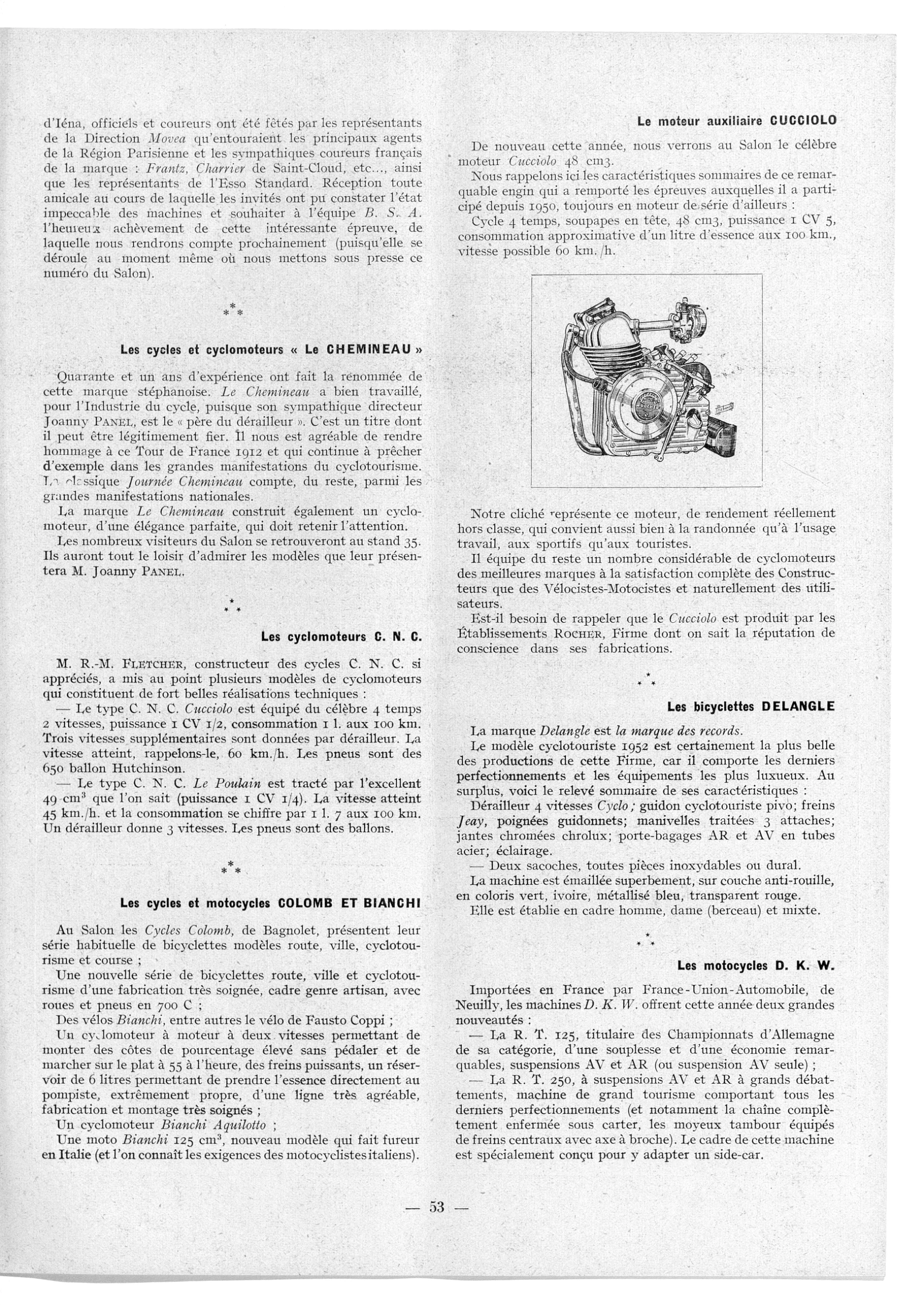
Le moteur auxiliaire CUCCIOLO
[Ebykr summary; the article’s text is not reproduced. The celebrated Cucciolo engine of 48 cm3 is to be seen again at the Salon this year, and the paper recalls the summary characteristics of this remarkable device, which has won the events it has entered since 1950, always as a production engine: four-stroke cycle, overhead valves, 48 cm3, power 1 CV 5, approximate consumption of one liter of petrol per 100 km., possible speed 60 km./h. Its block is said to show an engine of really outstanding output, suited as well to touring as to work use, to sporting riders as to tourists; it equips a considerable number of cyclomoteurs of the best marques to the complete satisfaction of builders, of cycle and motorcycle dealers and of users. The Cucciolo is produced by the Établissements ROCHER, a firm of known conscientiousness in its manufacture.]
Les bicyclettes DELANGLE
[Ebykr summary; the article’s text is not reproduced. The Delangle marque is called “la marque des records”. The 1952 cyclotouriste model is said to be certainly the finest of the firm’s productions, carrying the latest refinements and the most luxurious equipment, and the paper gives the summary of its characteristics as follows.]
Dérailleur 4 vitesses Cyclo ; guidon cyclotouriste pivo; freins Jeay, poignées guidonnets; manivelles traitées 3 attaches; jantes chromées chrolux; porte-bagages AR et AV en tubes acier; éclairage.
— Deux sacoches, toutes pièces inoxydables ou dural.
[Ebykr summary; the article’s text is not reproduced. The machine is superbly enameled over an anti-rust coat, in green, ivory, metallic blue and transparent red, and is made in man’s, lady’s (berceau) and mixte frames.]
Les motocycles D. K. W.
[Ebykr summary; the article’s text is not reproduced. Imported into France by France-Union-Automobile, of Neuilly, the D. K. W. machines offer two great novelties this year:]
— La R. T. 125, titulaire des Championnats d’Allemagne de sa catégorie, d’une souplesse et d’une économie remarquables, suspensions AV et AR (ou suspension AV seule) ;
— La R. T. 250, à suspensions AV et AR à grands débattements, machine de grand tourisme comportant tous les derniers perfectionnements (et notamment la chaîne complètement enfermée sous carter, les moyeux tambour équipés de freins centraux avec axe à broche). Le cadre de cette machine est spécialement conçu pour y adapter un side-car.
— 53 —
[A review page in two columns of roman text, the firm headings in bold sans-serif capitals ranged right over each column and the sections divided by three-star ornaments arranged in a triangle. Firm, marque and model names run in italic. One illustration appears, at the head of the right column inside a thin ruled rectangle: a line engraving in fine pen hatching of the Cucciolo auxiliary engine, drawn from the left and slightly above, showing the finned cylinder and rocker cover, the carburetor and air cleaner on a long inlet pipe at the upper right, the exhaust pipe curving down at the left, the valve-gear rods, the round flywheel cover lettered ROCHER at the center and the finned sump below, with the silencer running off to the right. The drawing is signed at its lower right in a cursive hand struck through with a long diagonal stroke, reading Rebour. No caption is set under it. The page number, “— 53 —”, stands at the foot of the left column.]
— Page 5 —
Les cycles et motorisés DREVON
[Ebykr summary; the article’s text is not reproduced. In its new workshops in the rue Bernard-Palissy at Saint-Étienne, the Société des Manufactures de Cycles DREVON has created a modern factory fitted to the needs of a house in full growth. The firm means more than ever to give individual care to each machine while keeping for the buyer the benefit of a series price, a solution between craft work and uniform, impersonal line production. The quality of the enamels is said to receive the company’s particular attention since the recent installation of its latest-pattern enameling ovens. On the motorized side, stand 62 at the Porte de Versailles will offer an extremely varied choice of cyclomoteurs and motor tandems, from the 707 and 909 models, already well known but widely improved in the light of long experience and fitted with the famous Vap 4 DT engine, up to the vélomoteur and motor tandem using the excellent Sachs engine. The Maison Drevon, which does not believe in the death of the bicycle, shows a very wide range of cycle models in which lightness and efficiency are studied together with elegance and robustness; and, thinking of the young generations who will make up the best of the future clientele, the Saint-Étienne firm offers its young visitors and their parents a very successful set of children’s models, notably its Baby-Ballon on fat tires.]
Le ” vélo-moteur ” et le tandem DERNY
[Ebykr summary; the article’s text is not reproduced. The paper recalls that the Firme Derny-Motor was at the origin of the motorized cycle formula in France, from before the war, and that this marque’s “vélomoteur” and tandem belong administratively, by their capacity, to the vélomoteur class. It then gives the abridged technical description, as follows.]
Moteur deux temps, placé dans la partie inférieure du cadre de la machine, près du pédalier; puissance 1 CV; alésage du cylindre : 48 mm. 5; course : 54 mm.; cylindre : 99 cm3 765; vitesse maximum : 3.500 t./m.; échappement : Le dispositif d’échappement des gaz est constitué par un silencieux; allumage : Par volant magnétique formant poulie; réservoir à essence : En tôle de fer. Un robinet placé à l’origine de la tuyauterie le met en communication avec le carburateur à pulvérisateur et à niveau constant.
Une boîte de vitesse faisant bloc avec le carter moteur permet les démultiplications suivantes, entre l’arbre moteur et la roue arrière :
1o En première vitesse : sortie de boîte : 14/28 × 14/24;
2o En prise : prise = 14/38.
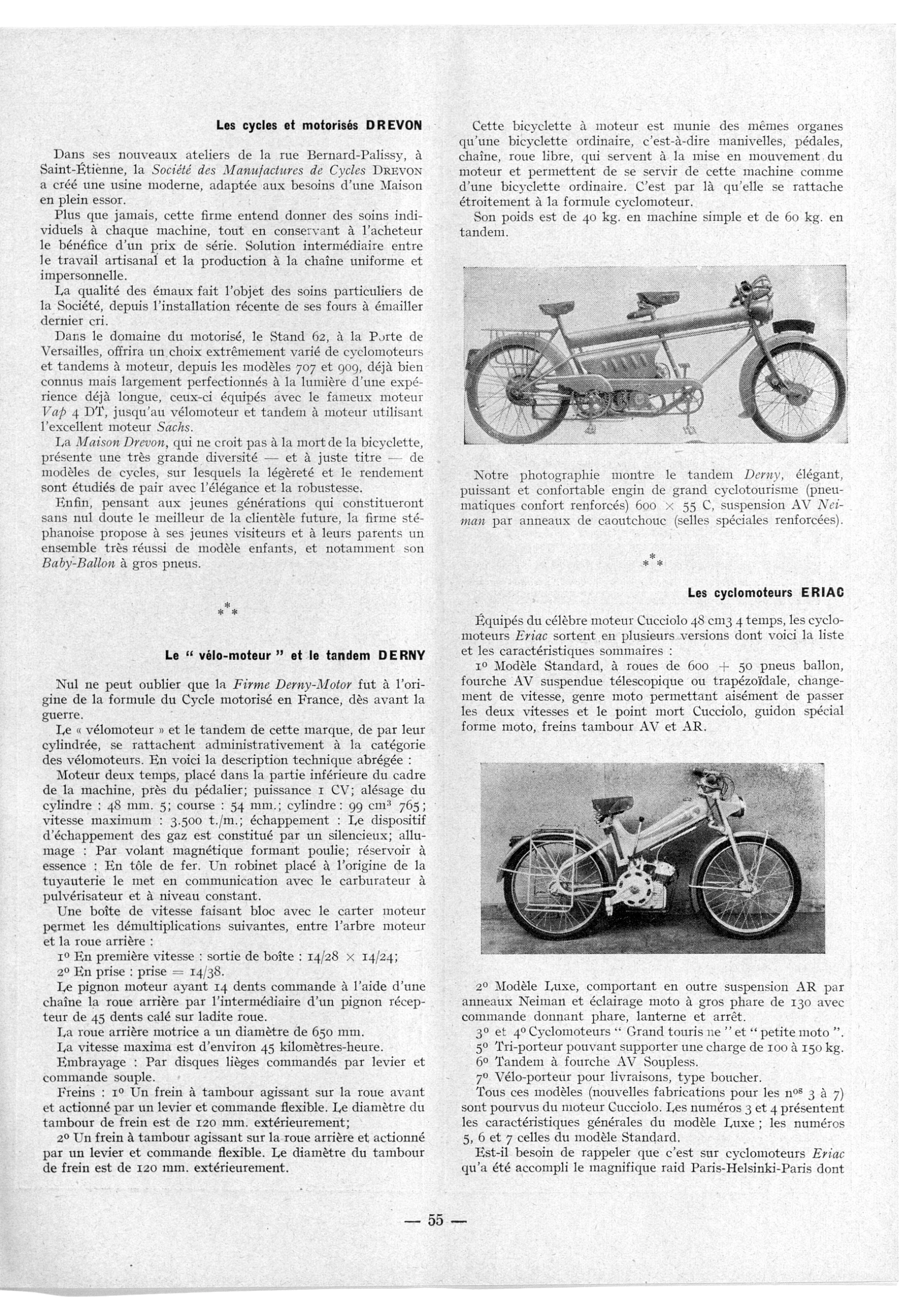
[Ebykr summary; the article’s text is not reproduced. The engine pinion of 14 teeth drives the rear wheel by chain through a 45-tooth receiving sprocket keyed to that wheel; the driving rear wheel is 650 mm. in diameter and the maximum speed is about 45 kilometers an hour. The clutch is by cork discs worked by a lever and a flexible control. The brakes are given as: first, a drum brake acting on the front wheel and worked by a lever and flexible control, the brake drum measuring 120 mm. outside; second, a drum brake acting on the rear wheel and worked by a lever and flexible control, the brake drum likewise 120 mm. outside. The paper adds that this motor bicycle carries the same parts as an ordinary bicycle — cranks, pedals, chain and freewheel — which serve to start the engine and allow the machine to be used as an ordinary bicycle, and that it is by this that it belongs closely to the cyclomoteur formula. Its weight is 40 kg. as a single machine and 60 kg. as a tandem. The photograph is said to show the Derny tandem, an elegant, powerful and comfortable machine for long cyclotouring, with reinforced comfort tires of 600 × 55 C, Neiman front suspension by rubber rings and special reinforced saddles.]
Les cyclomoteurs ERIAC
[Ebykr summary; the article’s text is not reproduced. Fitted with the celebrated Cucciolo four-stroke engine of 48 cm3, the Eriac cyclomoteurs come in several versions, of which the paper gives the list and the summary characteristics, as follows.]
1o Modèle Standard, à roues de 600 + 50 pneus ballon, fourche AV suspendue télescopique ou trapézoïdale, changement de vitesse, genre moto permettant aisément de passer les deux vitesses et le point mort Cucciolo, guidon spécial forme moto, freins tambour AV et AR.
2o Modèle Luxe, comportant en outre suspension AR par anneaux Neiman et éclairage moto à gros phare de 130 avec commande donnant phare, lanterne et arrêt.
3o et 4o Cyclomoteurs ” Grand tourisme ” et ” petite moto “.
5o Tri-porteur pouvant supporter une charge de 100 à 150 kg.
6o Tandem à fourche AV Soupless.
7o Vélo-porteur pour livraisons, type boucher.
[Ebykr summary; the article’s text is not reproduced. All these models, new manufactures for numbers 3 to 7, carry the Cucciolo engine; numbers 3 and 4 have the general characteristics of the Luxe model and numbers 5, 6 and 7 those of the Standard. The paper closes by recalling that it was on Eriac cyclomoteurs that the magnificent Paris-Helsinki-Paris raid was accomplished, the sentence running on to the following page.]
— 55 —
[A review page in two columns of roman text, the firm headings in bold sans-serif capitals ranged right over each column and the sections divided by three-star ornaments arranged in a triangle. Firm, marque and model names run in italic. Two halftone photographs stand in the right column. The upper one shows the Derny motor tandem in full left profile against a plain ground: a long double-saddled frame with a small engine unit low at the bottom bracket, a tank slung under the top tube, fat tires, full mudguards, a carrier over the rear wheel and a bundle strapped at the handlebar. The lower one shows an Eriac cyclomoteur in left profile standing on a floor before a dark panel: a light machine with the Cucciolo engine and its round cover at the bottom bracket, a motorcycle-pattern handlebar, a sprung front fork, a saddle on a pillar and a rear carrier. Neither photograph carries a caption or a signature. In the heading “Grand tourisme” the m of tourisme is broken in the printing and reads “touris ne”. The page number, “— 55 —”, stands at the foot of the left column.]
— Page 6 —
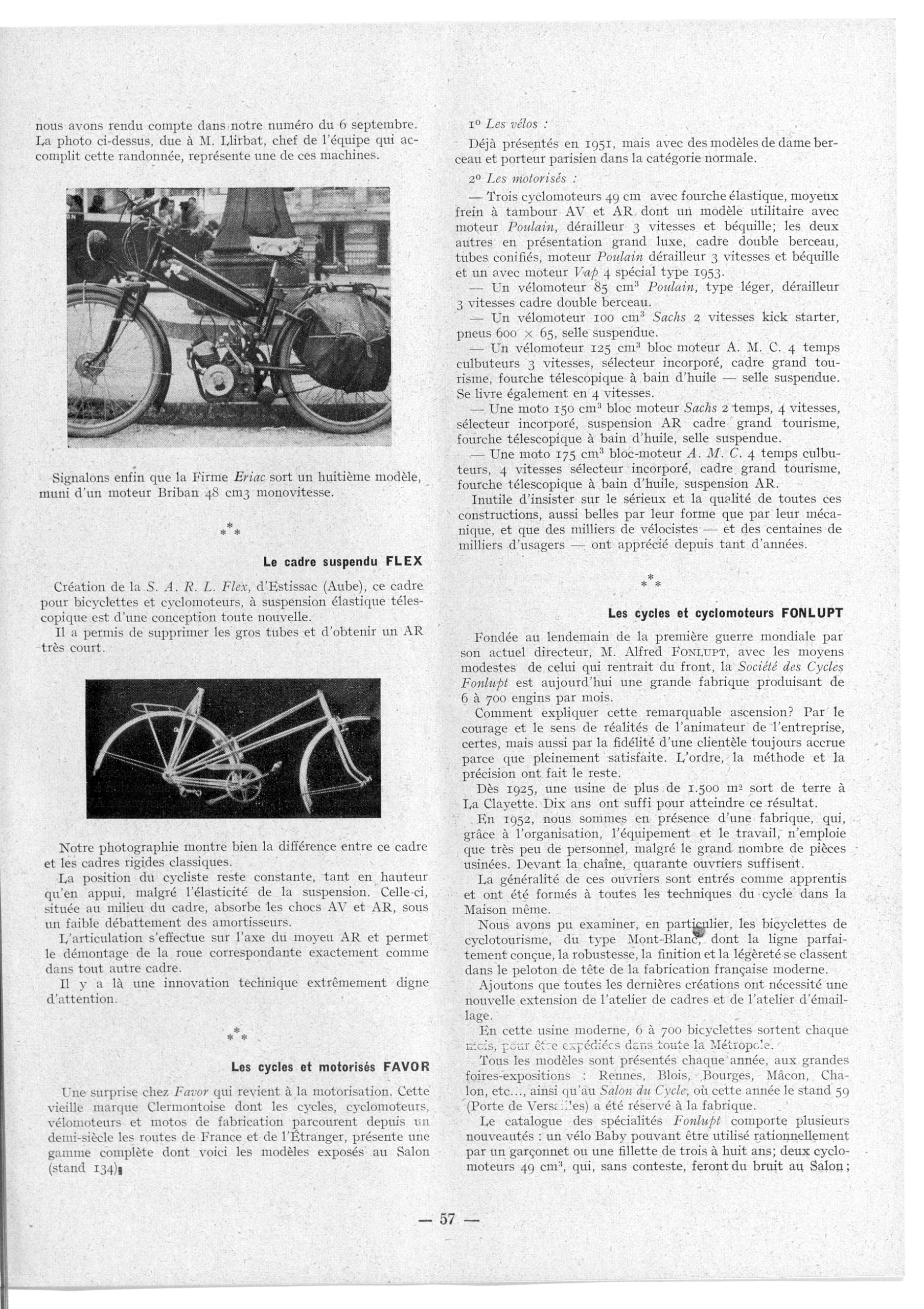
[Ebykr summary; the article’s text is not reproduced. The Eriac notice, carried over from the preceding page, closes by saying that the Paris-Helsinki-Paris raid was reported in the paper’s number of 6 September, and that the photograph above, by M. Llirbat, leader of the team that made the ride, shows one of these machines. The paper notes finally that the Eriac firm is bringing out an eighth model, fitted with a single-speed Briban engine of 48 cm3.]
Le cadre suspendu FLEX
[Ebykr summary; the article’s text is not reproduced. A creation of the S. A. R. L. Flex, of Estissac in the Aube, this frame for bicycles and cyclomoteurs, with telescopic elastic suspension, is said to be of a wholly new conception: it has allowed the large tubes to be done away with and a very short rear end to be obtained. The paper says its photograph shows clearly the difference between this frame and the classic rigid frames. The rider’s position is said to stay constant, in height as in support, in spite of the elasticity of the suspension, which, placed in the middle of the frame, absorbs front and rear shocks on a small movement of the dampers. The articulation works on the spindle of the rear hub and allows that wheel to be taken out exactly as in any other frame. The paper calls it a technical innovation extremely worthy of attention.]
Les cycles et motorisés FAVOR
[Ebykr summary; the article’s text is not reproduced. The paper reports a surprise at Favor, which is returning to motorized machines. This old Clermont marque, whose cycles, cyclomoteurs, vélomoteurs and motorcycles have run the roads of France and abroad for half a century, shows a complete range, of which these are the models exhibited at the Salon on stand 134.]
1o Les vélos :
Déjà présentés en 1951, mais avec des modèles de dame berceau et porteur parisien dans la catégorie normale.
2o Les motorisés :
— Trois cyclomoteurs 49 cm avec fourche élastique, moyeux frein à tambour AV et AR dont un modèle utilitaire avec moteur Poulain, dérailleur 3 vitesses et béquille; les deux autres en présentation grand luxe, cadre double berceau, tubes conifiés, moteur Poulain dérailleur 3 vitesses et béquille et un avec moteur Vap 4 spécial type 1953.
— Un vélomoteur 85 cm3 Poulain, type léger, dérailleur 3 vitesses cadre double berceau.
— Un vélomoteur 100 cm3 Sachs 2 vitesses kick starter, pneus 600 × 65, selle suspendue.
— Un vélomoteur 125 cm3 bloc moteur A. M. C. 4 temps culbuteurs 3 vitesses, sélecteur incorporé, cadre grand tourisme, fourche télescopique à bain d’huile — selle suspendue. Se livre également en 4 vitesses.
— Une moto 150 cm3 bloc moteur Sachs 2 temps, 4 vitesses, sélecteur incorporé, suspension AR cadre grand tourisme, fourche télescopique à bain d’huile, selle suspendue.
— Une moto 175 cm3 bloc-moteur A. M. C. 4 temps culbuteurs, 4 vitesses sélecteur incorporé, cadre grand tourisme, fourche télescopique à bain d’huile, suspension AR.
[Ebykr summary; the article’s text is not reproduced. The paper says there is no need to insist on the seriousness and the quality of all these constructions, as fine in form as in mechanism, which thousands of cycle dealers and hundreds of thousands of users have appreciated for so many years.]
Les cycles et cyclomoteurs FONLUPT
[Ebykr summary; the article’s text is not reproduced. Founded in the years just after the First World War by its present director, M. Alfred FONLUPT, with the modest means of a man coming home from the front, the Société des Cycles Fonlupt is today a large factory turning out 6 to 700 machines a month. The paper credits the rise to the courage and sense of reality of the firm’s leader and to the loyalty of a clientele always growing because fully satisfied, order, method and precision having done the rest. From 1925 a factory of more than 1,500 m2 rose at La Clayette, ten years having sufficed to reach that result. In 1952 the factory is one that, thanks to its organization, equipment and working methods, employs very few people in spite of the great number of parts machined: forty workers suffice on the line, most of them having come in as apprentices and been trained in every cycle technique in the house itself. The paper says it was able to examine in particular the cyclotouring bicycles of the Mont-Blanc type, whose perfectly conceived line, robustness, finish and lightness place them in the leading group of modern French manufacture, and adds that all the latest creations have called for a further enlargement of the frame shop and the enameling shop. From this modern factory 6 to 700 bicycles come each month, to be sent throughout metropolitan France. All the models are shown every year at the great trade fairs — Rennes, Blois, Bourges, Mâcon, Chalon and others — and at the Salon du Cycle, where this year stand 59 at the Porte de Versailles has been reserved for the factory. The catalog of Fonlupt specialties carries several novelties: a Baby cycle that a small boy or girl of three to eight years can use properly, and two cyclomoteurs of 49 cm3 which the paper says will undoubtedly make a stir at the Salon — the sentence running on to the following page.]
— 57 —
[A review page in two columns of roman text, the firm headings in bold sans-serif capitals ranged right over each column and the sections divided by three-star ornaments arranged in a triangle. Firm, marque and model names run in italic. Two halftone photographs stand in the left column. The upper one, taken out of doors, shows an Eriac cyclomoteur in left profile propped at a curb before a building front with a column and steps, people standing behind it: a loaded touring machine with a small engine unit at the bottom bracket, a pannier bag over the rear wheel, a lamp at the front, full mudguards and cables running along the top tube. The lower one shows the bare Flex suspended frame alone against a black ground, lit so that the tubes read as white lines: a lady’s open frame with a long sloping top member, a rear carrier, the suspension linkage in the middle of the frame and the front fork with no wheels, saddle or handlebar fitted. Neither photograph carries a caption or a signature. In the Favor list the capacity of the three cyclomoteurs is set as “49 cm” with the exponent missing. The page number, “— 57 —”, stands at the foot of the right column.]
— Page 7 —
[Ebykr summary; the article’s text is not reproduced. The Fonlupt notice, carried over from the preceding page, gives the description of the ” Cyclosport ” Fonlupt VAP no 1, which the paper sets out as follows.]
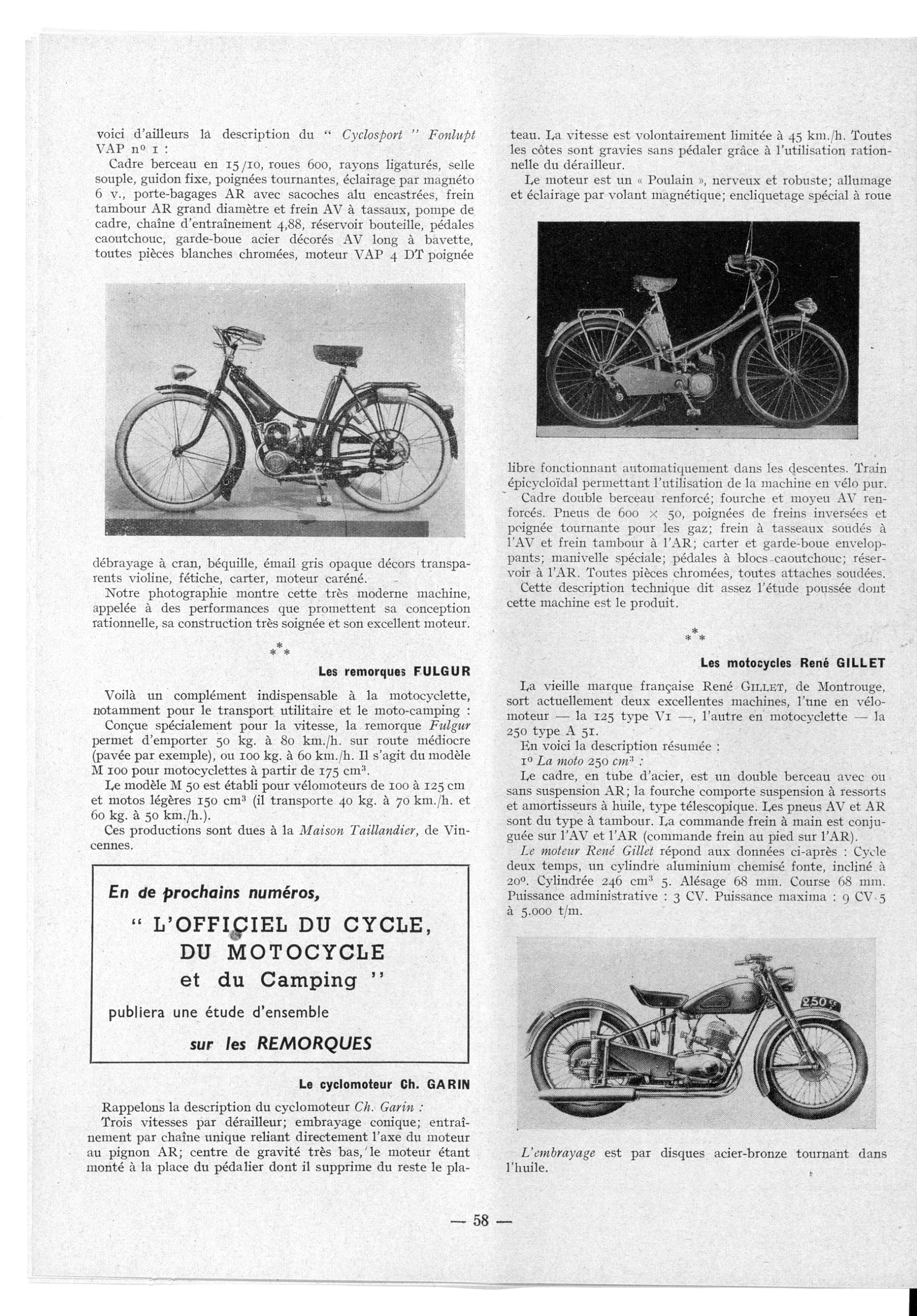
Cadre berceau en 15/10, roues 600, rayons ligaturés, selle souple, guidon fixe, poignées tournantes, éclairage par magnéto 6 v., porte-bagages AR avec sacoches alu encastrées, frein tambour AR grand diamètre et frein AV à tassaux, pompe de cadre, chaîne d’entraînement 4,88, réservoir bouteille, pédales caoutchouc, garde-boue acier décorés AV long à bavette, toutes pièces blanches chromées, moteur VAP 4 DT poignée débrayage à cran, béquille, émail gris opaque décors transparents violine, fétiche, carter, moteur caréné.
[Ebykr summary; the article’s text is not reproduced. The paper says its photograph shows this very modern machine, which its rational conception, its very careful construction and its excellent engine promise will perform well.]
Les remorques FULGUR
[Ebykr summary; the article’s text is not reproduced. The paper calls the trailer an indispensable complement to the motorcycle, notably for utility transport and moto-camping. Designed specially for speed, the Fulgur trailer allows 50 kg. to be carried at 80 km./h. on a poor road, paved for instance, or 100 kg. at 60 km./h.; this is the M 100 model, for motorcycles from 175 cm3 upward. The M 50 model is made for vélomoteurs of 100 to 125 cm and light motorcycles of 150 cm3, and carries 40 kg. at 70 km./h. and 60 kg. at 50 km./h. These productions are due to the Maison Taillandier, of Vincennes.]
En de prochains numéros,
” L’OFFICIEL DU CYCLE,
DU MOTOCYCLE
et du Camping ”
publiera une étude d’ensemble
sur les REMORQUES
Le cyclomoteur Ch. GARIN
[Ebykr summary; the article’s text is not reproduced. The paper recalls the description of the Ch. Garin cyclomoteur, which it gives as follows.]
Trois vitesses par dérailleur; embrayage conique; entraînement par chaîne unique reliant directement l’axe du moteur au pignon AR; centre de gravité très bas, le moteur étant monté à la place du pédalier dont il supprime du reste le plateau. La vitesse est volontairement limitée à 45 km./h. Toutes les côtes sont gravies sans pédaler grâce à l’utilisation rationnelle du dérailleur.
Le moteur est un « Poulain », nerveux et robuste; allumage et éclairage par volant magnétique; encliquetage spécial à roue libre fonctionnant automatiquement dans les descentes. Train épicycloïdal permettant l’utilisation de la machine en vélo pur.
Cadre double berceau renforcé; fourche et moyeu AV renforcés. Pneus de 600 × 50, poignées de freins inversées et poignée tournante pour les gaz; frein à tasseaux soudés à l’AV et frein tambour à l’AR; carter et garde-boue enveloppants; manivelle spéciale; pédales à blocs caoutchouc; réservoir à l’AR. Toutes pièces chromées, toutes attaches soudées.
[Ebykr summary; the article’s text is not reproduced. The paper says this technical description tells well enough the close study of which the machine is the product.]
Les motocycles René GILLET
[Ebykr summary; the article’s text is not reproduced. The old French marque René GILLET, of Montrouge, at present brings out two excellent machines, one a vélomoteur, the 125 type VI, the other a motorcycle, the 250 type A 51. The paper gives the summary description as follows.]
1o La moto 250 cm3 :
Le cadre, en tube d’acier, est un double berceau avec ou sans suspension AR; la fourche comporte suspension à ressorts et amortisseurs à huile, type télescopique. Les pneus AV et AR sont du type à tambour. La commande frein à main est conjuguée sur l’AV et l’AR (commande frein au pied sur l’AR).
Le moteur René Gillet répond aux données ci-après : Cycle deux temps, un cylindre aluminium chemisé fonte, incliné à 20o. Cylindrée 246 cm3 5. Alésage 68 mm. Course 68 mm. Puissance administrative : 3 CV. Puissance maxima : 9 CV 5 à 5.000 t/m.
L’embrayage est par disques acier-bronze tournant dans l’huile.
— 58 —
[A review page in two columns of roman text, the firm headings in bold sans-serif capitals ranged right over each column and the sections divided by three-star ornaments arranged in a triangle. Firm, marque and model names run in italic. An announcement stands in the left column inside a thin ruled rectangle, its first and last lines in bold sloping sans-serif and the paper’s title set across three lines in wide-spaced bold roman capitals. Three halftone photographs appear. The first, in the left column, shows the Fonlupt ” Cyclosport ” cyclomoteur in left profile on a pale ground: an open frame with a faired engine unit at the bottom bracket, a sprung saddle, a lamp low at the front, full mudguards, a rear carrier and a stand under the machine. The second, at the head of the right column, shows the Ch. Garin cyclomoteur in right profile against a black ground, the light catching the tubes: an open frame with the engine unit low where the chainwheel would be, a long casing over the drive, a rear carrier, cables looping from the handlebar and a lamp at the front. The third, lower in the right column, shows the René Gillet 250 motorcycle in right profile against a plain ground: a double-cradle frame with a rounded tank, a sprung saddle, a telescopic fork, deeply valanced mudguards, the exhaust pipe sweeping low to a silencer and a plate at the front of the mudguard lettered 250. None of the three carries a caption or a signature. The page number, “— 58 —”, stands at the foot of the left column.]
— Page 8 —
[Ebykr summary; the article’s text is not reproduced. The page opens in the middle of the René Gillet entry carried over from the preceding page. The paper finishes the description of the larger machine: the gearbox gives 4 speeds, built from a 3-step intermediate pinion and three pinions made fast to the secondary shaft by a pair of dog-clutch sliders worked by a fork-and-cam system; the weight empty is 114 kg; at 5,000 r.p.m. the speeds are 40 km./h. in first, 54.5 km./h. in second, 77.5 km./h. in third and 105 km./h. in fourth. It then turns to the second machine of the range, headed “2° Le vélomoteur 125 cm³”: a reinforced and lowered single-cradle frame, a fork sprung by conical coil springs, and drum brakes front and rear with the two coupled, the rear worked by the foot.]
Le moteur René GILLET, deux temps, un cylindre à 15°, répond aux données ci-après : Cylindrée 124 cm³ — Alésage 52 mm. — Course 58 mm. 6 — Cylindre en aluminium avec chemise fonte spéciale.
Puissance administrative : 1 CV.
Puissance maxima : 4 CV à 4.000 t/m. — Allumage par volant magnétique — Graissage par mélange de 5 à 10 % d’huile dans le carburant suivant le degré de rodage.
[Ebykr summary; the article’s text is not reproduced. The gearbox of the 125 is described in the same terms as the larger machine: 4 speeds from a 3-step pinion and 3 pinions made fast to the secondary shaft by 2 dog-clutch sliders, worked by a fork system itself commanded by a cam that spaces the gear positions. The total weight is 62 kg.]
*
* *
Les motocycles légers GIMA
[Ebykr summary; the article’s text is not reproduced. The paper reports that the Société G. I. M. A. of Chamalières (Puy-de-Dôme) shows this year the range that made its name, with a few improvements, and recalls the models:]
— Un vélomoteur 125 cm³, 3 vitesses, moteur A. M. C.; 4 temps culbuté;
— Un vélomoteur 125 cm³, 4 vitesses, moteur A. M. C.;
— Une moto 175 cm³, 4 vitesses, 4 temps (poids 96 kg.);
— Une moto 175 cm³, 4 vitesses, moteur A. M. C. 4 temps culbuté, fourche télescopique, suspension AR (poids : 110 kg.).
[Ebykr summary; the article’s text is not reproduced. The firm will also show the prototype of a new 175 cm³ model with an A. M. C. engine and an oscillating rear suspension with hydraulic damper; its fork is to be of the telescopic and hydraulic pattern.]
*
* *
Le cyclomoteur « LE GITAN »
[Ebykr summary; the article’s text is not reproduced. Le Gitan, made by the Établissements Brunelière of Machecoul (Loire-Inférieure), is called a very fine machine marked by an ideal suspension (an elastic fork), a perfectly centered engine — the well known Vap 4 — and an assembly built from first-choice parts and components. The paper then gives its technical data, which it says confirm the care taken over the machine:]
Cadre type berceau spécial avec fourche élastique; tous tubes renforcés; guidon type cyclomoteur avec poignées tournantes Saker; roues avec pneumatiques 600 × 50 B, rayonnage renforcé; garde-boue enveloppants acier émaillé; manivelles traitées chromées; freins-tambour avant et arrière commandés par poignées inversées; éclairage Soubitez avec phare laiton, deux ampoules commutateur sur guidon; selle cuir très souple; béquille support, porte-bagages avec sacoches; carters protecteurs spéciaux pour le moteur; échappement des gaz par Silencieux Wilman; tuyau d’échappement chromé; boîte de pédalier avec excentrique permettant le réglage de la tension de chaîne; relais au pédalier par double pignon monté sur roulement à billes S. K. F.; chaîne de 4-88.
[Ebykr summary; the article’s text is not reproduced. That description answers to the “luxe” model, which is finished in blue, red, green or black enamel. The “standard” model is said to be of equal technical quality, differing only in these points:]
Fourche type ballon renforcé; frein à tasseaux à l’AV, tambour à l’AR; éclairage Soubitez avec phare de 60 mm.; selle souple; tuyau d’échappement émaillé.
*
* *
Le nouveau vélomoteur GNOME et RHONE
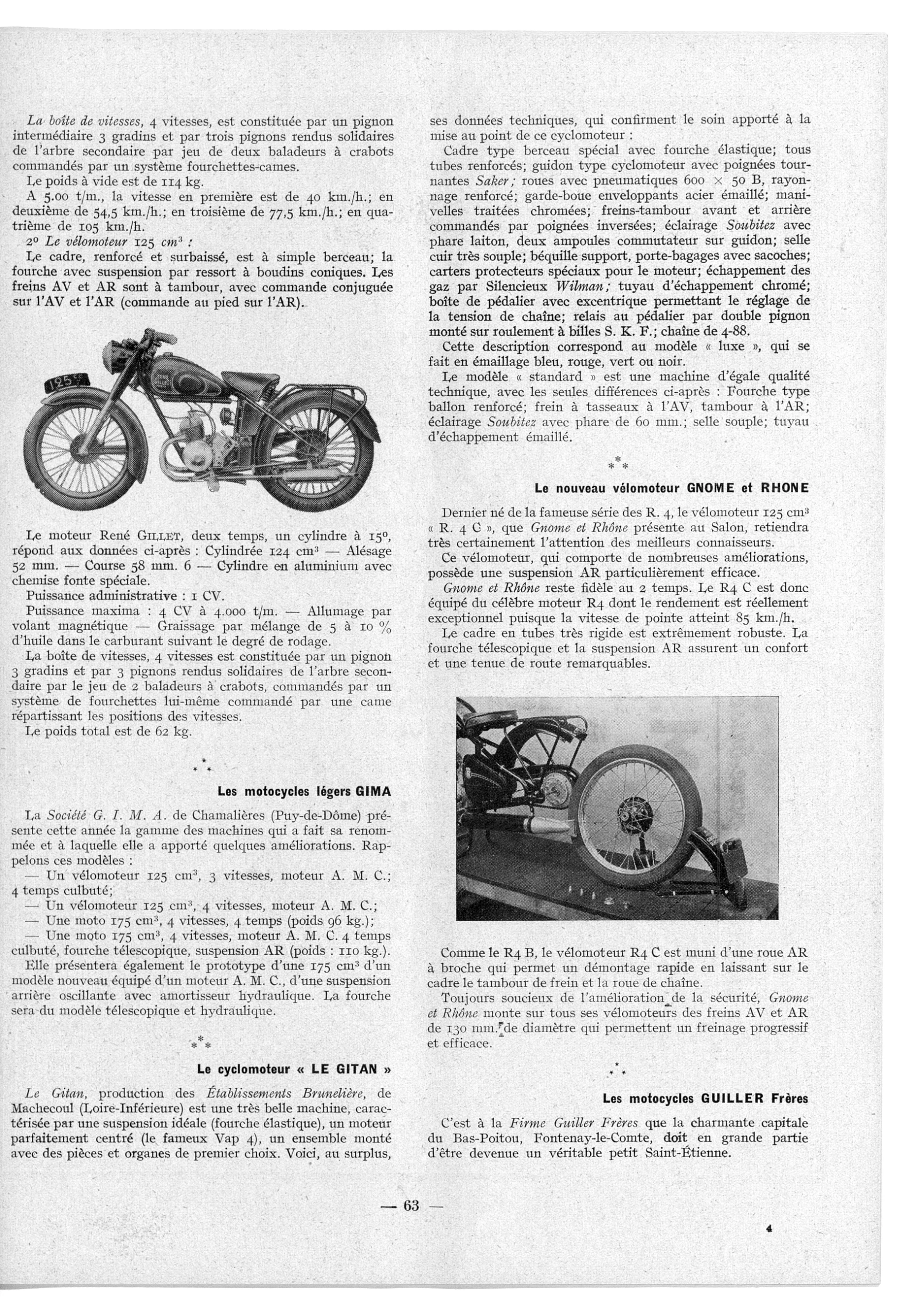
[Ebykr summary; the article’s text is not reproduced. The paper presents the 125 cm³ “R. 4 C”, the latest born of the famous R. 4 series, which Gnome et Rhône shows at the Salon and which it expects to hold the attention of the best judges. The machine carries many improvements and a particularly effective rear suspension. Gnome et Rhône stays faithful to the two-stroke, so the R4 C has the celebrated R4 engine, whose output the paper calls truly exceptional since the top speed reaches 85 km./h. The very rigid tubular frame is called extremely robust, and the telescopic fork with the rear suspension is said to give remarkable comfort and road holding. Like the R4 B, the R4 C has a rear wheel on a spindle that allows quick removal while the brake drum and the chain wheel stay on the frame. Always concerned to improve safety, Gnome et Rhône fits all its lightweight motorcycles with front and rear brakes of 130 mm. diameter, which it says give progressive and effective braking.]
*
* *
Les motocycles GUILLER Frères
[Ebykr summary; the article’s text is not reproduced. The paper opens the entry by saying that the charming capital of the Bas-Poitou, Fontenay-le-Comte, owes it in great part to the Firme Guiller Frères that it has become a real little Saint-Étienne. The entry carries over to the following page.]
— 63 —
[A text page of the Salon review, set in two columns of roman type with a wide white gutter and no rule between them. Each firm’s heading is a short line of bold sans-serif capitals and lower case, set centered to the right of its column, and the sections are parted by a three-star ornament set point upward. Two halftone photographs break the columns. The first, low in the left column, shows a motorcycle in full left profile standing on a plain ground, its front number plate lettered 1952; the machine has a sprung front fork, a rounded tank, a saddle and a pillion pad, fully spoked wheels and a low exhaust running back to a silencer. The second, low in the right column, is a close three-quarter view from the rear of the back end of a lightweight motorcycle standing on a boarded platform, showing the sprung rear fork and its damper struts, the chain run and brake drum, the spoked rear wheel with its hub and the mudguard, with a pair of legs and shoes of a bystander at the right edge. Neither photograph is captioned and neither carries a signature. The page number is set at the foot of the left column as “— 63 —”, and a small signature figure 4 sits at the foot of the right column below a short rule.]
— Page 9 —
[Ebykr summary; the article’s text is not reproduced. The page opens in the middle of the Guiller Frères entry carried over from the preceding page. The paper says it is forced to limit itself here to a simple enumeration of the Guiller motorcycle range, to which it will return:]
— Un cyclomoteur à moteur Le Poulain.
— Un vélomoteur à moteur A. M. C. 125 cm³ 4 temps, 3 vitesses.
— Un vélomoteur à moteur A. M. C. 125 cm³ 4 temps, 4 vitesses, sélecteur au pied, fourche télescopique et suspension AR.
— Une motocyclette à moteur A. M. C. 175 cm³, grand tourisme, 4 vitesses, fourche télescopique et suspension AR.
— Un scooter très élégant à bloc-moteur A. M. C. 125 cm³, 4 temps, 3 vitesses, nouveauté de l’année.
[Ebykr summary; the article’s text is not reproduced. The paper adds that the firm counts on its record of honors such events as Rome-Nice-Paris, the Circuits de Haute-Normandie and du Sud-Ouest, Saint-Étienne-Paris-Saint-Étienne, Paris-Nice, the Course de Tarare and others.]
*
* *
Le cyclomoteur « de poche » GRANDIÈRE
[Ebykr summary; the article’s text is not reproduced. Among the very great variety of cyclomotors appearing every day, the Maison Grandière of Villeneuve-le-Roi (S.-et-O.) has set out to do something original, a machine conceived more particularly for town users, who meet special problems of traffic and of “housing” the machine that called for a solution. To that end Grandière has made a “cyclomoteur de poche”, a machine reduced in size by the use of small-diameter wheels. The very strong frame has a double top element. A telescopic fork of Grandière make, with an excellent saddle and reinforced super-ballon tires of 450 × 55, are said to give the machine a comfort and a hold that make it very pleasant to use even on the road and over the longest runs. The rims are ribbed, with spokes of 15. The Grandière cyclomotor has a tank of 2 1/2 liters under the saddle, a welded carrier of good bearing surface and a handy stand. It is called very handy and is controlled by a twist grip. The brakes have been closely studied: a cantilever at the front, a drum at the rear. The engine is the well regarded Poulain of 49 cm³, type Constructeur, and the chainset is built into the crankcase. The speed easily reaches 40 km./h. The paper concludes that it is on the whole a fine and original machine, elegant, stable and as easy to ride as to house, and that it answers the wishes of a great many users.]
*
* *
Les motocycles GUZZI
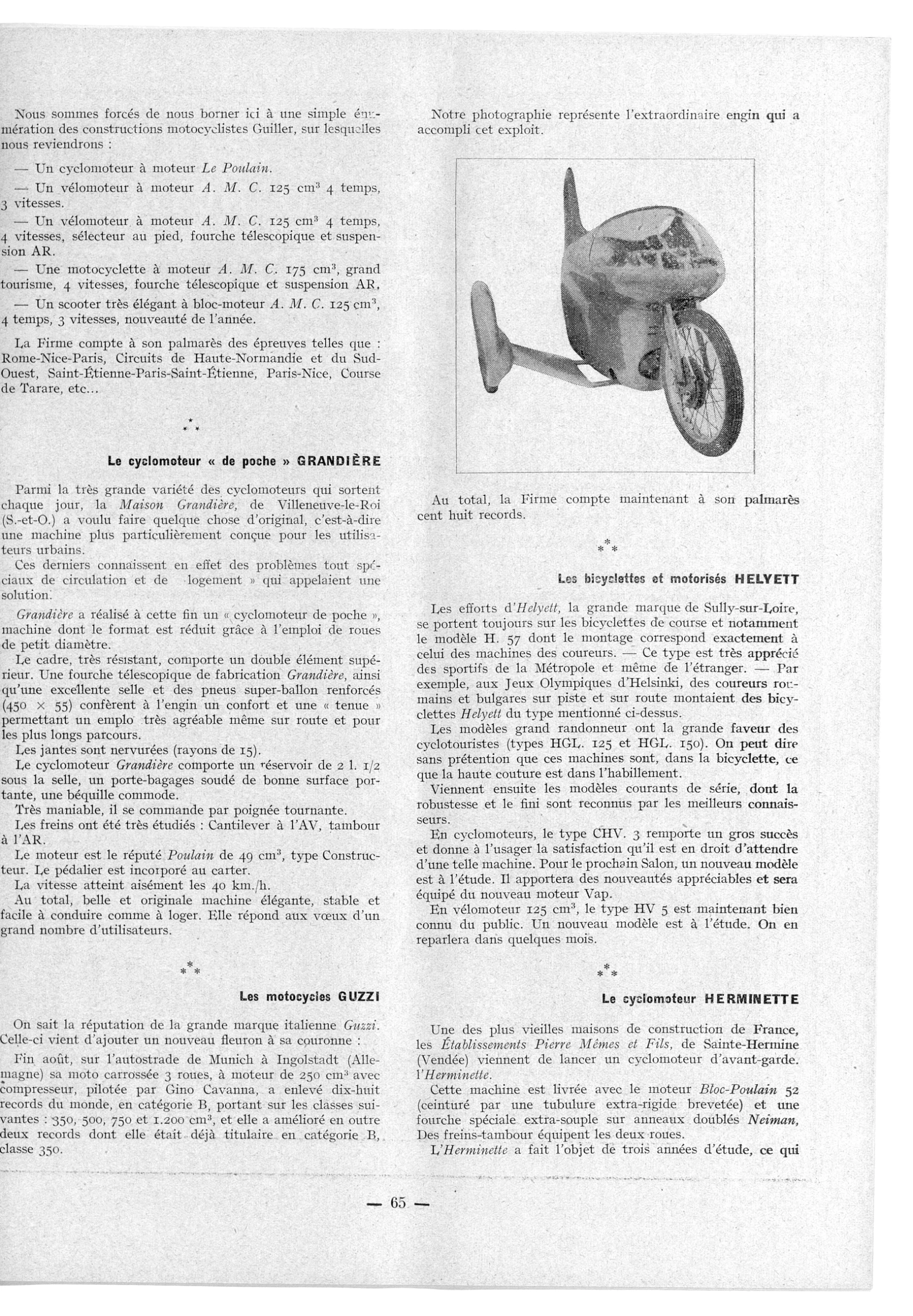
[Ebykr summary; the article’s text is not reproduced. The paper recalls the reputation of the great Italian marque Guzzi and reports a fresh jewel added to its crown: at the end of August, on the Munich to Ingolstadt autobahn in Germany, its faired three-wheeled machine with a 250 cm³ supercharged engine, ridden by Gino Cavanna, took eighteen world records in category B over the 350, 500, 750 and 1,200 cm³ classes, and in addition improved two records it already held in category B, class 350. The paper says its photograph shows the extraordinary machine that performed the feat, and that the firm now counts one hundred and eight records on its record of honors.]
*
* *
Les bicyclettes et motorisés HELYETT
[Ebykr summary; the article’s text is not reproduced. The paper says the efforts of Helyett, the great marque of Sully-sur-Loire, still bear on racing bicycles and in particular on the H. 57 model, whose build answers exactly to that of the racing men’s machines; the type is much liked by sportsmen at home and even abroad, and at the Helsinki Olympic Games Romanian and Bulgarian riders on track and road rode Helyett bicycles of that type. The grand randonneur models, types HGL. 125 and HGL. 150, are said to enjoy great favor with cyclotourists, and the paper claims without pretension that these machines are to the bicycle what high fashion is to clothing. Then come the ordinary series models, whose robustness and finish it says the best judges acknowledge. In cyclomotors the CHV. 3 type is reported a great success that gives the user the satisfaction he is entitled to expect from such a machine; a new model is under study for the coming Salon, which will bring appreciable novelties and will have the new Vap engine. In the 125 cm³ lightweight motorcycle class the HV 5 type is now well known to the public, and a new model is under study of which the paper will speak again in a few months.]
*
* *
Le cyclomoteur HERMINETTE
[Ebykr summary; the article’s text is not reproduced. One of the oldest building houses in France, the Établissements Pierre Mêmes et Fils of Sainte-Hermine (Vendée), have just launched an advanced cyclomotor, the Herminette. The machine is delivered with the Bloc-Poulain 52 engine, girdled by a patented extra-rigid tube assembly, and a special extra-supple fork on doubled Neiman rings; drum brakes are fitted to both wheels. The paper adds that the Herminette has been the subject of three years of study, and the entry carries over to the following page.]
— 65 —
[A text page of the Salon review, set in two columns of roman type with a wide white gutter and no rule between them. Each firm’s heading is a line of bold sans-serif capitals and lower case ranged to the right of its column, and the sections are parted by a three-star ornament set point upward. One halftone photograph, high in the right column, sits inside a thin ruled box: it shows the Guzzi record machine seen from the front three-quarter, a fully enclosed teardrop shell covering the whole machine with a tall upright tail fin rising behind the cockpit, a long low outrigger arm reaching to a small stabilizing pad at the left, and the front wheel showing at the right under the shell. The photograph is not captioned and carries no signature. The page number is set at the foot of the left column as “— 65 —”, and a faint line of show-through from the type on the reverse of the leaf crosses the foot of both columns.]
— Page 10 —
[Ebykr summary; the article’s text is not reproduced. The page opens in the middle of the Herminette entry carried over from the preceding page. The paper says the three years of study will not surprise technicians who remember the care with which M. Pierre Mêmes had perfected, as early as 1920, his Vieil-Or extra-piste bicycle, which had a lively success at the Salons of 1922, 1923 and 1925; and that it was in 1900 that this veteran cycle builder had brought out his Blanche-Hermine marque, the name borrowed from the charming little Vendée town where the firm has its seat, after having well before that date already shown cycle models to the trade. The Herminette cyclomotor, called fresh proof of the vitality of this likeable house, is said to enjoy a notable vogue in Normandy, in Brittany and in the west of France.]
*
* *
Les motocyclettes JAWA
[Ebykr summary; the article’s text is not reproduced. Jawa motorcycles, of well regarded Czechoslovak make, are represented in France by the Établissements J. Poch of Neuilly-sur-Seine. The paper reports that the firm shows the full range of these machines on its stand this year, that is:]
— Le vélomoteur 123 cm³, 2 temps, petite machine de grande performance.
— La moto légère 148 cm³, 2 temps, de conception nouvelle, à fourche télescopique (comme la 123).
— La 248 cm³, 2 temps, monocylindre, motocyclette ultra-moderne (sélecteur au pied avec débrayage automatique).
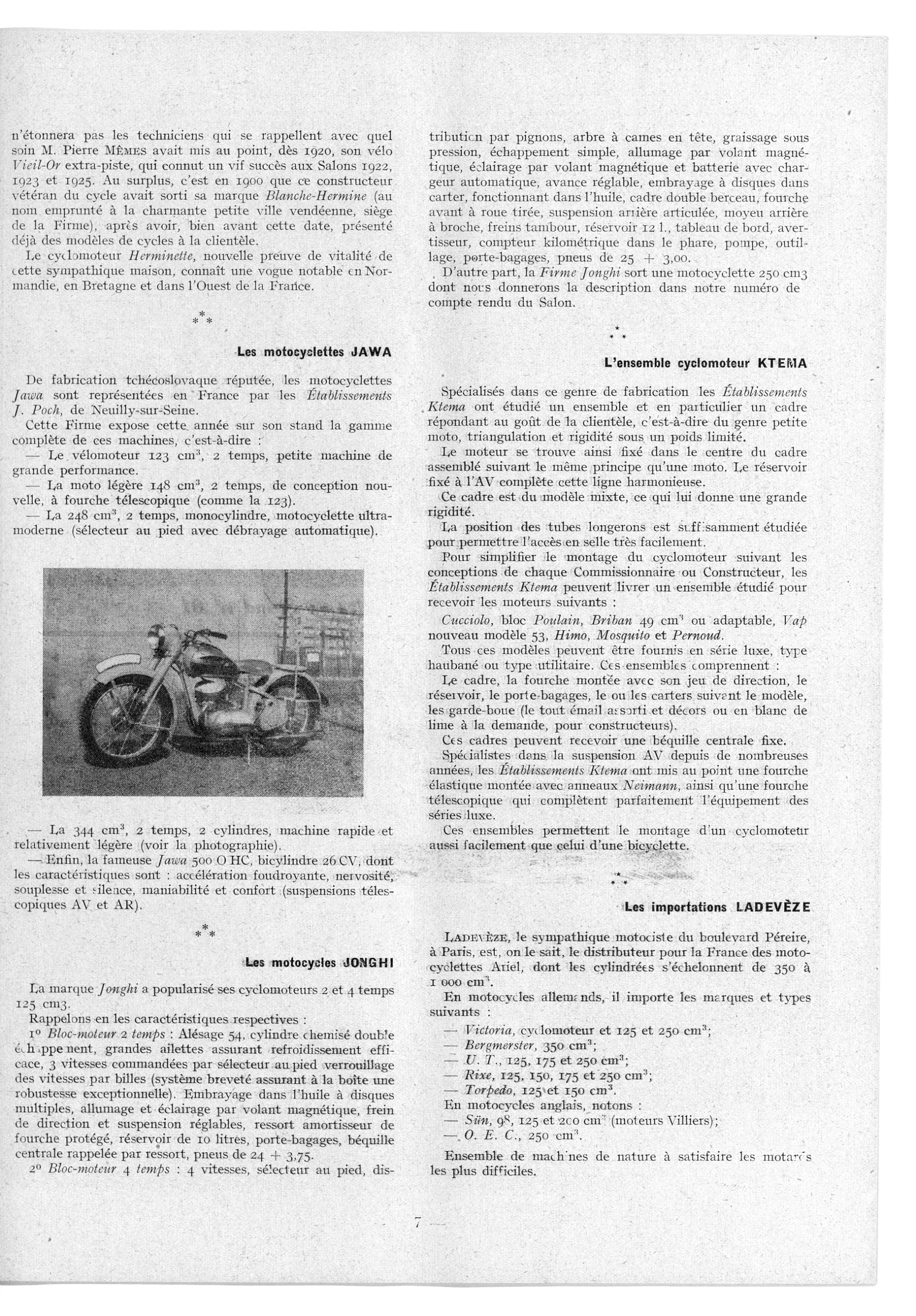
— La 344 cm³, 2 temps, 2 cylindres, machine rapide et relativement légère (voir la photographie).
— Enfin, la fameuse Jawa 500 O HC, bicylindre 26 CV, dont les caractéristiques sont : accélération foudroyante, nervosité, souplesse et silence, maniabilité et confort (suspensions télescopiques AV et AR).
*
* *
Les motocycles JONGHI
[Ebykr summary; the article’s text is not reproduced. The paper says the Jonghi marque has made its 2-stroke and 4-stroke 125 cm³ cyclomotors popular, and recalls the characteristics of each:]
1° Bloc-moteur 2 temps : Alésage 54, cylindre chemisé double échappement, grandes ailettes assurant refroidissement efficace, 3 vitesses commandées par sélecteur au pied verrouillage des vitesses par billes (système breveté assurant à la boîte une robustesse exceptionnelle). Embrayage dans l’huile à disques multiples, allumage et éclairage par volant magnétique, frein de direction et suspension réglables, ressort amortisseur de fourche protégé, réservoir de 10 litres, porte-bagages, béquille centrale rappelée par ressort, pneus de 24 + 3,75.
2° Bloc-moteur 4 temps : 4 vitesses, sélecteur au pied, distribution par pignons, arbre à cames en tête, graissage sous pression, échappement simple, allumage par volant magnétique, éclairage par volant magnétique et batterie avec chargeur automatique, avance réglable, embrayage à disques dans carter, fonctionnant dans l’huile, cadre double berceau, fourche avant à roue tirée, suspension arrière articulée, moyeu arrière à broche, freins tambour, réservoir 12 l., tableau de bord, avertisseur, compteur kilométrique dans le phare, pompe, outillage, porte-bagages, pneus de 25 + 3,00.
[Ebykr summary; the article’s text is not reproduced. The paper adds that the Firme Jonghi is also bringing out a 250 cm3 motorcycle, of which it will give the description in its Salon report number.]
*
* *
L’ensemble cyclomoteur KTEMA
[Ebykr summary; the article’s text is not reproduced. Specialists in this kind of manufacture, the Établissements Ktema have worked out a complete set and in particular a frame answering to the taste of the trade, that is of the small-motorcycle kind, with triangulation and rigidity at a limited weight. The engine is thus fixed in the center of the frame, assembled on the same principle as a motorcycle, and the tank fixed at the front completes that harmonious line. The frame is of the mixed model, which the paper says gives it great rigidity, and the position of the longitudinal tubes is studied enough to let the rider get into the saddle very easily. To simplify building a cyclomotor to the ideas of each commission agent or maker, the Établissements Ktema can deliver a set worked out to take the following engines:]
Cucciolo, bloc Poulain, Briban 49 cm³ ou adaptable, Vap nouveau modèle 53, Himo, Mosquito et Pernoud.
[Ebykr summary; the article’s text is not reproduced. All these models can be supplied in the luxe series, the stayed type or the utility type, and the sets comprise the frame, the fork mounted with its head bearings, the tank, the carrier, the casing or casings according to the model, and the mudguards, the whole in matched enamel with decoration or in white primer to order for makers. The frames can take a fixed central stand. Specialists in front suspension for many years, the Établissements Ktema have perfected an elastic fork mounted with Neimann rings, and a telescopic fork, which the paper says complete the equipment of the luxe series perfectly. These sets, it concludes, allow a cyclomotor to be built up as easily as a bicycle.]
*
* *
Les importations LADEVÈZE
[Ebykr summary; the article’s text is not reproduced. Ladevèze, the likeable motorcycle dealer of the boulevard Péreire in Paris, is as is known the distributor for France of Ariel motorcycles, whose capacities run from 350 to 1,000 cm³. In German motorcycles the paper says he imports the following marques and types:]
— Victoria, cyclomoteur et 125 et 250 cm³;
— Bergmerster, 350 cm³;
— U. T., 125, 175 et 250 cm³;
— Rixe, 125, 150, 175 et 250 cm³;
— Torpedo, 125 et 150 cm³.
En motocycles anglais, notons :
— Sün, 98, 125 et 200 cm³ (moteurs Villiers);
— O. E. C., 250 cm³.
[Ebykr summary; the article’s text is not reproduced. The paper closes the entry by calling it a body of machines of a kind to satisfy the most demanding motorcyclists.]
— 67 —
[A text page of the Salon review, set in two columns of roman type with a wide white gutter and no rule between them. Each firm’s heading is a line of bold sans-serif capitals and lower case ranged to the right of its column, and the sections are parted by a three-star ornament set point upward. One halftone photograph, set in the middle of the left column without a frame, shows a motorcycle in full left profile standing on a boarded floor in front of a plain wall with a window and a doorway behind it: a telescopic front fork, a deeply valanced front mudguard, a rounded tank, a sprung saddle, a large silencer running low on the near side and spoked wheels. The photograph is not captioned and carries no signature. The page number sits at the foot of the left column, and a faint smudge of show-through from the reverse of the leaf crosses the foot of the right column above the Ladevèze heading.]
— Page 11 —
Les scooters LAMBRETTA
[Ebykr summary; the article’s text is not reproduced. The paper calls Lambretta one of the two great classics going back to the very origins of the “scooter” movement of the past few years. This year the marque has launched new models, the Lambretta D and LD, which differ from one another only in that the LD carries a fairing meant to satisfy users most particular about looks, the two models being identical in structure and in mechanism.]
En voici les caractéristiques :
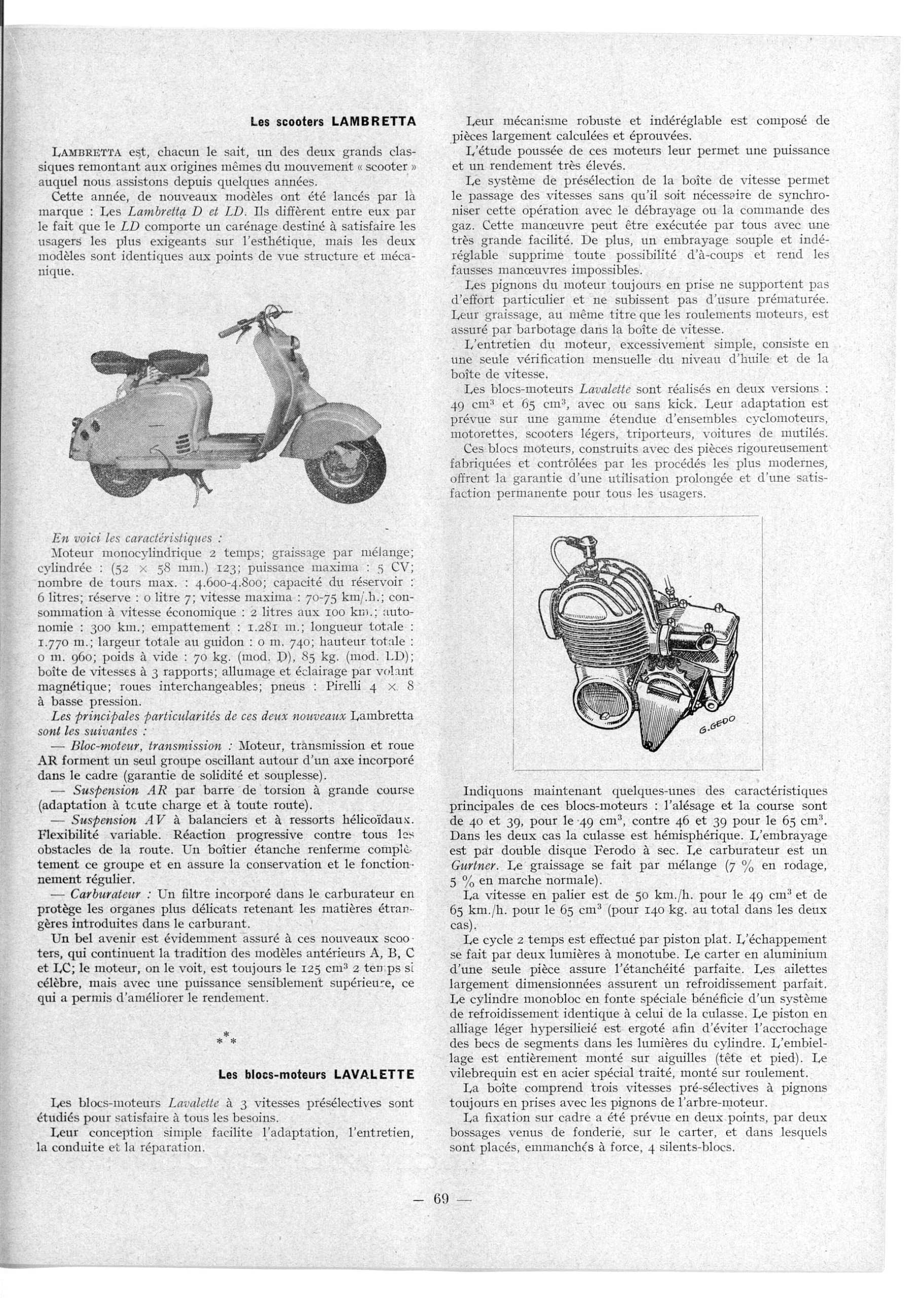
Moteur monocylindrique 2 temps; graissage par mélange; cylindrée : (52 × 58 mm.) 123; puissance maxima : 5 CV; nombre de tours max. : 4.600-4.800; capacité du réservoir : 6 litres; réserve : 0 litre 7; vitesse maxima : 70-75 km/.h.; consommation à vitesse économique : 2 litres aux 100 km.; autonomie : 300 km.; empattement : 1.281 m.; longueur totale : 1.770 m.; largeur totale au guidon : 0 m. 740; hauteur totale : 0 m. 960; poids à vide : 70 kg. (mod. D), 85 kg. (mod. LD); boîte de vitesses à 3 rapports; allumage et éclairage par volant magnétique; roues interchangeables; pneus : Pirelli 4 × 8 à basse pression.
Les principales particularités de ces deux nouveaux Lambretta sont les suivantes :
— Bloc-moteur, transmission : Moteur, transmission et roue AR forment un seul groupe oscillant autour d’un axe incorporé dans le cadre (garantie de solidité et souplesse).
— Suspension AR par barre de torsion à grande course (adaptation à toute charge et à toute route).
— Suspension AV à balanciers et à ressorts hélicoïdaux. Flexibilité variable. Réaction progressive contre tous les obstacles de la route. Un boîtier étanche renferme complètement ce groupe et en assure la conservation et le fonctionnement régulier.
— Carburateur : Un filtre incorporé dans le carburateur en protège les organes plus délicats retenant les matières étrangères introduites dans le carburant.
[Ebykr summary; the article’s text is not reproduced. The paper judges a fine future evidently assured to these new scooters, which continue the tradition of the earlier A, B, C and LC models; the engine, it notes, is still the famous 125 cm³ two-stroke, but with a noticeably higher output, which has allowed the performance to be improved.]
*
* *
Les blocs-moteurs LAVALETTE
[Ebykr summary; the article’s text is not reproduced. The Lavalette engine units with 3 preselective speeds are said to be worked out to meet every need. Their simple conception is claimed to make fitting, upkeep, riding and repair easy; their robust and non-adjustable mechanism is built of amply calculated and proved parts, and the close study of these engines gives them very high power and efficiency. The gearbox preselection system allows the gears to be changed without having to synchronize the movement with the clutch or the throttle, an operation the paper says anyone can perform very easily, while a supple and non-adjustable clutch removes any possibility of snatch and makes false movements impossible. The engine pinions, always in mesh, bear no particular load and suffer no premature wear, and are lubricated, like the engine bearings, by splash in the gearbox. Upkeep of the engine is called extremely simple, a single monthly check of the oil level and of the gearbox. The Lavalette units are made in two versions, 49 cm³ and 65 cm³, with or without a kick-start, and fitting them is provided for over a wide range of cyclomotor sets, motorettes, light scooters, carrier tricycles and invalid cars. Built with parts rigorously made and checked by the most modern methods, these units are said to offer the guarantee of long use and permanent satisfaction to every user.]
[Ebykr summary; the article’s text is not reproduced, continued after the engraving. The paper then gives some of the main characteristics of these engine units: bore and stroke are 40 and 39 for the 49 cm³, against 46 and 39 for the 65 cm³, and in both cases the head is hemispherical. The clutch is by a dry Ferodo double disk and the carburetor is a Gurtner; lubrication is by mixture, 7 % while running in and 5 % in normal use. The speed on the level is 50 km./h. for the 49 cm³ and 65 km./h. for the 65 cm³, for a total weight of 140 kg. in both cases. The two-stroke cycle is worked by a flat piston and the exhaust by two ports to a single tube. The one-piece aluminum crankcase gives perfect sealing, and amply sized fins give perfect cooling. The monobloc cylinder of special cast iron has the same cooling system as the head. The piston, in a high-silicon light alloy, is pegged to keep the ring ends from catching in the cylinder ports. The connecting rod assembly is mounted entirely on needle rollers at big end and little end, and the crankshaft is of treated special steel on a bearing. The box holds three preselective speeds on pinions always in mesh with those of the engine shaft. Fixing to the frame is provided at two points, by two bosses cast on the crankcase, into which 4 rubber mountings are forced.]
— 69 —
[A text page of the Salon review, set in two columns of roman type with a wide white gutter and no rule between them. Each firm’s heading is a line of bold sans-serif capitals and lower case ranged to the right of its column, and the sections are parted by a three-star ornament set point upward. Two illustrations break the columns. The first, high in the left column and unframed, is a halftone photograph of a scooter in full left profile, the body enclosing the engine behind a step-through floor, a sprung saddle with a separate pillion pad behind it, the handlebar standing on a slim column above the front leg shield and small wheels with deep mudguards. The second, in the middle of the right column inside a thin ruled box, is a line engraving of an engine unit seen from the front three-quarter, drawn with hatching and showing the finned cylinder and head, the plug and its lead, the intake and carburetor at the right, the gearbox casing behind, the flywheel cover at the lower left and a kick-start lever; it is signed in capitals “G. GEDO” at its lower right. Neither illustration is captioned. The page number is set at the foot of the page between the columns.]
— Page 12 —
Le moteur pour cyclomoteur LE MISTRAL
Le Mistral est un moteur pour cyclomoteur, caractérisé :
1° par sa puissance. — Des performances étonnantes ont été réalisées par ce moteur « Super-carré » (40 mm. d’alésage, 38 cm. de course) de 48 cm3 ;
2° par sa souplesse, due :
a) au fonctionnement du moteur lui-même qui permet des reprises extrêmement rapides ;
b) à sa boîte à deux vitesses et un débrayage ; le tout commandé par une poignée tournante au guidon ;
3° par sa simplicité. — Un très petit nombre de pièces entrent dans sa construction.
[Ebykr summary; the article’s text is not reproduced. The paper says these three essential characteristics make it an engine within the reach of every cyclomotor user, and a machine fitted with it suits the working man as well as the tourist, and is also a machine for the sporting rider fond of long runs at a good pace without having to worry about the difficulties of the route. A universal engine that fits the particular taste of cyclomotor enthusiasts, Le Mistral is meant for every itinerary without distinction. Built by the Établissements Gravelais-Bondol of Saint-Étienne, the engine is shown at the Salon du Cycle, stand 151.]
*
* *
La construction MAGNAT-DEBON
[Ebykr summary; the article’s text is not reproduced. On the threshold of this 39th Salon du Cycle the paper runs through the Magnat-Debon catalog and looks at what the firm’s production will be for 1953, taking the new things first:]
1° Un cyclomoteur (Type VRI) d’une cylindrée de 50 cm³, 2 temps, dont la conception en a été étudiée dans ses moindres détails.
[Ebykr summary; the article’s text is not reproduced. The engine is set above the chainset and, by tipping, drives the rear wheel through a roller; the tank is under the saddle; the frame is of double tube with a cross stay, which the paper calls perfectly rigid. Braking is by a conventional brake at the front and by a drum at the rear. The whole engine is further surrounded by a very elegantly lined cowl that gives the passenger effective protection.]
2° Une moto 250 cm³ (Type MOD) caractérisée par un bloc-moteur monocylindre vertical.
[Ebykr summary; the article’s text is not reproduced. It has a 4-speed box worked by a foot change, fully mechanical lubrication and a crankcase forming the oil tank; a happy stroke, the paper says, has allowed a filter enveloping the carburetor to be used. Front suspension is by telescopic fork and rear by an oscillating fork whose travel is damped by a rubber block. Beside these two new models the paper finds the “old acquaintances”: first the 125 cm³ lightweight motorcycle, type M4TD, whose production in the 1951-1952 season shows an increase of 25 % over 1950-1951; then the classic 4 CV 350 cm³, type B4TL, and 5 CV 500 cm³, type C4TS motorcycles, whose deliveries in the season just past likewise show a rising curve; then the latest born of the family, which appeared in the course of the spring, the scooter type SI, already in favor with many users. Since it was introduced, and to make the production line easier to start, the scooter had been delivered without accessories; it is now possible to fit it with a second rear seat, a brief-case carrier on the front apron, a speedometer built into the front fairing, leather panniers and so forth. The paper concludes by recalling that Magnat-Debon has always had the reputation of delivering a bicycle impeccable in line and in quality, which has allowed it, in spite of the crisis of the 1951-1952 season, to hold a sales figure very close to that of the 1950-1951 season.]
*
* *
Les motocycles MANDILLE ET ROUX
[Ebykr summary; the article’s text is not reproduced. Mandille et Roux — M. R. — a well regarded old French marque, shows the following machines:]
— Son cyclomoteur à bloc-moteur Vap 4, 48 cm³, 2 temps bien entendu doté d’un débrayage, machine d’une finition luxueuse ;
— Son vélomoteur « type cyclomoteur », à bloc-moteur Sachs 98 cm³, avec 2 vitesses, point mort, débrayage, de lignes rappelant beaucoup le précédent (typique réservoir oblique correspondant à la partie supérieure du berceau);
— Son tandem à moteur, même conception, même moteur (réservoir 6 litres);
— Son vélomoteur proprement dit, à moteur Ydral 125 cm³; 2 temps, 4 vitesses, sélecteur au pied, fourche télescopique.
*
* *
Les remorques MARVEL
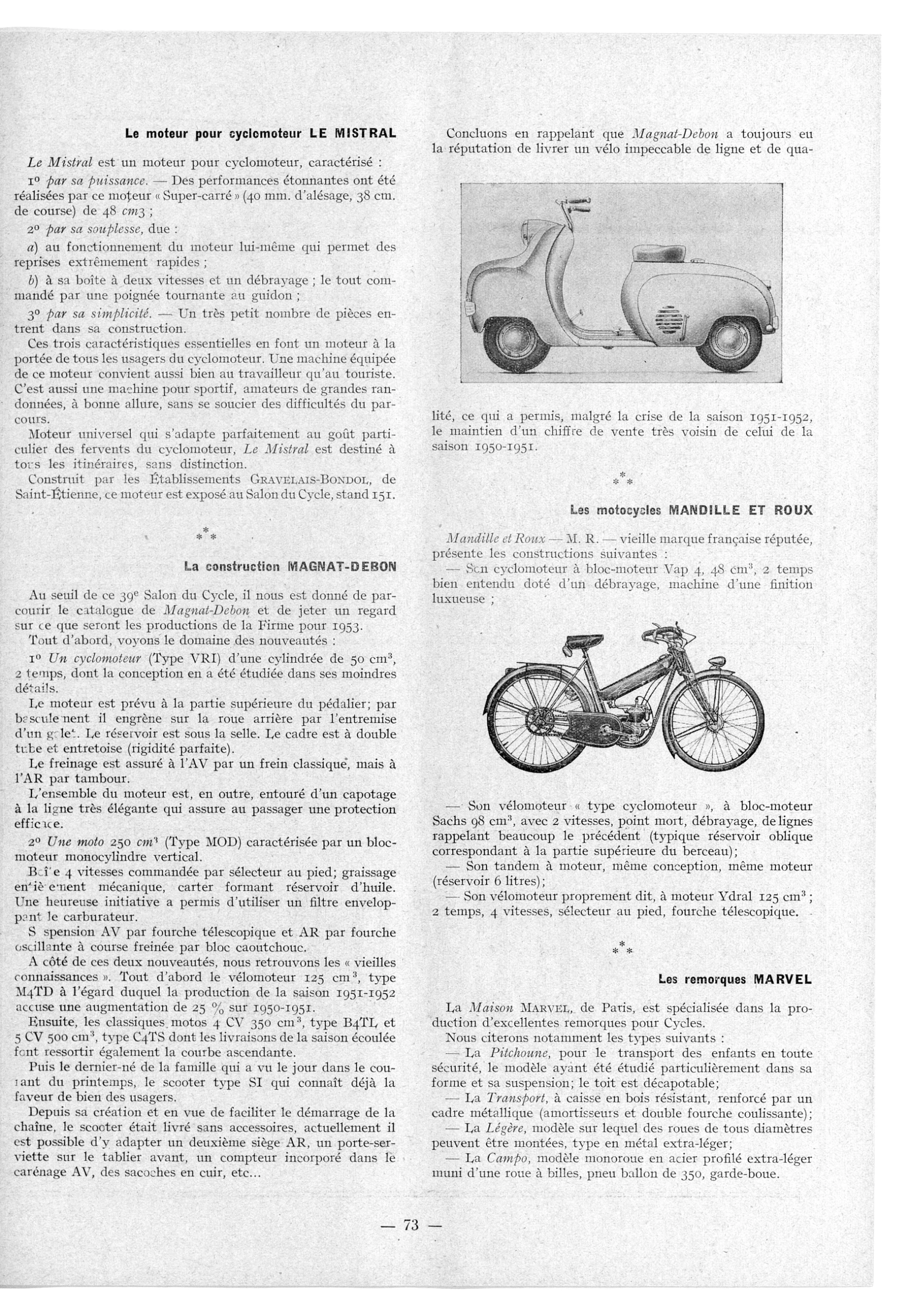
[Ebykr summary; the article’s text is not reproduced. The Maison Marvel of Paris is said to specialize in the production of excellent trailers for cycles, and the paper cites in particular the following types:]
— La Pitchoune, pour le transport des enfants en toute sécurité, le modèle ayant été étudié particulièrement dans sa forme et sa suspension; le toit est décapotable;
— La Transport, à caisse en bois résistant, renforcé par un cadre métallique (amortisseurs et double fourche coulissante);
— La Légère, modèle sur lequel des roues de tous diamètres peuvent être montées, type en métal extra-léger;
— La Campo, modèle monoroue en acier profilé extra-léger muni d’une roue à billes, pneu ballon de 350, garde-boue.
— 73 —
[A text page of the Salon review, set in two columns of roman type with a wide white gutter and no rule between them. Each firm’s heading is a line of bold sans-serif capitals and lower case ranged to the right of its column, and the sections are parted by a three-star ornament set point upward. Two illustrations break the right column. The upper one, inside a thin ruled box, is a shaded wash drawing of a scooter in full left profile against a plain ground, with a deep front leg shield running down to an enclosing front mudguard, a long step-through floor, a saddle over a rounded rear body with a louvered vent panel and a kick-start lever, a slim handlebar column and small wheels with fat tires. The lower one, unframed, is a line and halftone drawing of a motorized bicycle in full right profile, with a sloping tank filling the upper frame triangle, a sprung saddle, a rear carrier, a headlamp on a bracket at the fork crown, a chaincase and the engine unit low at the bottom bracket. Neither illustration is captioned and neither carries a signature. The page number is set at the foot of the left column, and a faint line of show-through from the reverse of the leaf crosses the foot of both columns.]
— Page 13 —
Le vélocar MOCHET
[Ebykr summary; the article’s text is not reproduced. The paper recalls that everyone remembers how, before the war already, M. Mochet had made some trials at motorizing his pedal vélocar, and that since the Liberation he has taken the question up again with all the more confidence because the growth in engine power and the raising of the licence-free capacity to 125 cm³ allowed him to think of a real small car with the pedals left out. The engine that drives this two-seat motocar is the Zurcher, well known for its power and its robustness.]
Ses caractéristiques techniques sont : moteur : 2 temps; 125 cm³, alésage, 52, course, 58; allumage par volant magnétique; carburateur : automatique à niveau constant; embrayage : à disque sec; changement de vitesses : à 3 vitesses et point mort; refroidissement : à air, forcé par turbine; roues : métalliques, interchangeables, avec cinquième roue de secours garnie; éclairage : en marche, par le volant magnétique alimentant deux phares, à éclairage code et route et un feu rouge, à l’arrêt, par accumulateur chargé automatiquement par un redresseur.
[Ebykr summary; the article’s text is not reproduced. The consumption is given as 3 liters 50 per 100 and the top speed as 60 km./h.; every hill open to motorists is climbed in first gear, which the paper says is geared low enough. By successive stages the line of the body has been refined and the equipment completed, and the Vélocar is called a vehicle able to carry out long runs without weakness.]
*
* *
Le cyclomoteur « Vemar » MONET-GOYON
[Ebykr summary; the article’s text is not reproduced. This cyclomotor, built by the old and excellent Mâcon firm Monet-Goyon, is called safe, light and simple to ride. The paper says its illustration shows the machine. The engine is a Marquet two-stroke of 49 cm³, allowing an average of 34 km./h. The lowered frame is called very rigid; the tank holds 2 liters 500 of mixture, which gives the machine sufficient range. The engine drive is single speed by a 4.88 chain, and comfort is provided by reinforced 600 × 50 balloon tires and an amply sized saddle. The paper adds that it will study the other Monet-Goyon motorcycles in its Salon report number.]
*
* *
Les moteurs auxiliaires MOSQUITO
[Ebykr summary; the article’s text is not reproduced. The Établissements Chapuis Frères build the Mosquito in France under licence from the firm that made it a success in Italy. Every Mosquito, the paper says, undergoes a long bench test and then a test at the service station before delivery, which shows the care taken over a product that honors French as well as Italian engineering. The auxiliary engine is called truly extraordinary, with its 38 cm³ capacity developing 1 CV at 4,200 r.p.m. and reaching 38 km./h. on the level with a consumption of 1 liter per 100 km. Its ease of fitting is called proverbial.]
*
* *
Les constructions 1952 de la MOTOBÉCANE
[Ebykr summary; the article’s text is not reproduced. The great Pantin firm carries on this year the machines that made its marque popular, but now adds a scooter the paper expects to be very widely sold. It then recalls in brief how the scale of the firm’s production now stands:]
— La Mobylette, le célèbre cyclomoteur, type super-standard, désormais muni d’un embrayage automatique sur lequel nous revenons plus loin;
— Le scooter 125 cm³, culbutée, 4 temps;
— Le vélomoteur 125 cm³, latérale, 4 temps, à fourche télescopique;
— Le vélomoteur 125 cm³, culbutée, 4 temps, fourche télescopique, suspension AR;
— La moto légère 175 cm³, culbutée 4 temps, Forcysport, fourche télescopique et suspension AR.
[Ebykr summary; the article’s text is not reproduced. The paper promises to describe these fine machines in detail in its columns, machines that make or are to make the delight of tens of thousands of motorcyclists of every class. It then turns to the new automatic clutch Motobécane has made to equip its celebrated Mobylette, calling it of an entirely new conception using a principle different from the usual one, and begins to explain that its action does not depend on the speed of the engine. The entry carries over to the following page.]
— 75 —
[A text page of the Salon review, set in two columns of roman type with a wide white gutter and no rule between them. Each firm’s heading is a line of bold sans-serif capitals and lower case ranged to the right of its column, and the sections are parted by a three-star ornament set point upward. Three halftone photographs break the columns. The first, high in the left column inside a thin ruled box, shows a small open two-seat car in three-quarter view from the front left, very low and narrow, with cycle-type front mudguards, a louvered bonnet, two lamps and a folded hood behind; two women sit side by side in it, the one at the wheel looking toward the camera. The second, lower in the left column and unframed, shows a motorized bicycle in left profile standing against a plain wall, with an open loop frame, a tank slung under the top run, a rear carrier, a sprung saddle, full mudguards and the engine unit low at the bottom bracket. The third, in the right column and unframed, shows a scooter in three-quarter view from the front left standing on a plain ground, with a tall curved front leg shield and apron, a long step-through floor, a saddle over a rounded rear body with a louvered side panel and small deeply guarded wheels. None of the three is captioned and none carries a signature. The page number is set at the foot of the page between the columns, and the inner edge of the left column runs close to the binding fold.]
— Page 14 —
[Ebykr summary; the article’s text is not reproduced. The page opens in the middle of the Motobécane entry carried over from the preceding page, on the new automatic clutch of the Mobylette. Its action depends not on the engine speed but on the speed of rotation of the rear wheel, and the paper gives a short description to make the reason and the interest of the solution plain. The clutch is marked by an inner bob-weight mechanism turning with the rear wheel and an outer drum driven directly and turning with the engine; the paper compares it to a drum brake whose inner shoes open or close of themselves according to the speed of rotation of the rear wheel. That is the principle; in fact the device is completed by a set of compensating springs meant to make the action supple and progressive. At the moment of starting by pedal, at low speed, the engine is not driven and the Mobylette rider has no more effort to make than an ordinary cyclist; but as soon as he reaches a certain pace, under the effect of the increased speed of the rear wheel, the clutch shoes move apart and come into contact with the drum turning with the engine, which is driven in its turn. The combined effect of the machine’s momentum on the one hand and of the decompressor on the other makes starting easy and smooth. The engine is engaged when the speed reaches about 6 to 7 km./h., and riding the machine then becomes like riding the standard Mobylette. As soon as the speed falls back to 6 or 7 km./h. the clutch shoes relax because of the low speed of rotation of the rear wheel, and the freed engine turns without load, as in neutral, and can be re-engaged after a few turns of the pedals.]
Ce système présente les avantages suivants :
[Ebykr summary; the article’s text is not reproduced. The paper lists them in one paragraph: it avoids snatch at starting by obliging the rider to pedal, and so protects the mechanism; it does away with the abrupt engagements caused by a rider’s carelessness; and finally, for maneuvering by hand, the rider no longer has to hold the clutch lever, since the driving part is freed automatically.]
*
* *
Les motocycles légers MOTOBLOC
[Ebykr summary; the article’s text is not reproduced. The Société Centrale de Constructions Mécaniques, of Vichy, makes cyclomotors and lightweight motorcycles of the Motobloc marque. The 1952 Motobloc cyclomotor is a 44 cm³ called extremely robust and of very carefully studied line, as the paper’s engraving shows; it is a two-stroke of 1.2 CV power, and is made in the Standard and Master types, which differ in the enamel and in the suspension the second carries, a parallelogram fork. Among the Motobloc lightweight motorcycles the paper notes in particular the M 2 L, with an Aubier-Dunne engine of 125 cm³, two-stroke, carrying a telescopic fork with a damper, and refers the reader to the photograph below. The machine is delivered in a magnificent green enamel with decoration, and the picture shows well its clean-lined look and the extremely compact engine unit. The frame is of reinforced double cradle.]
— 77 —
[A text page of the Salon review, set in two columns of roman type with a wide white gutter and no rule between them. The firm heading is a line of bold sans-serif capitals and lower case ranged to the right of the left column, and the sections are parted by a three-star ornament set point upward. Three illustrations break the page. The first, in the upper right column and unframed, is a halftone of a motorized bicycle in right profile with an open loop frame, a rear carrier, a sprung saddle, a headlamp at the fork crown, full mudguards and the enclosed engine unit at the bottom bracket. The second, set in a wide ruled box across the full measure of both columns in the middle of the page, is a line engraving of a clutch shown in exploded view, the parts laid out along an axis from left to right: a hatched backplate with its studs and a cover ring at the left, then a train of rings, a splined boss, washers and spacers, then the shoe carrier with its springs and pivots, a perforated link plate, a loose ring and at the right the shaded drum with its shoes and a nut; the drawing is hatched throughout and carries no signature. The third, low in the right column inside a halftone block, shows a lightweight motorcycle in right profile standing on a plain ground, with a telescopic fork, a deeply valanced front mudguard, a rounded tank, a saddle, the engine unit low in the frame and spoked wheels. None of the three is captioned. The page number is set at the foot of the left column.]
— Page 15 —
Les cyclomoteurs MYA
[Ebykr summary; the article’s text is not reproduced. Mya lists four cyclomotor models. One takes the Vimer 45 cm³ engine in a triangulated frame with a single diagonal tube, a special 4 liter tank and a large case that hides the chain and channels air for cooling. A second, on a cradle frame, is driven by a Poulain 48 cm³ engine resting on the two cradle tubes, with a 3 liter tank. A third, again on a triangulated frame, has a V.L.T. 49 cm³ engine and carrier-type mudguards. The fourth Mya cyclomotor carries the Cucciolo 48 cm³ engine. The paper calls the range varied enough for every taste and marked by robustness allied to lightness, 22 kg for the Vimer type.]
*
* *
Les vélomoteurs NARCISSE
[Ebykr summary; the article’s text is not reproduced. The paper says this marque, which has won itself a fine place, has taken as its formula “le cyclomoteur à grande puissance”. The Narcisse production is three machines. The “Tandemoto” has a Sachs 98 cm³ engine, 2 speeds and a clutch, a beam frame forming a tank of 5 liters 75, a telescopic fork of Narcisse manufacture, drum brakes front and rear, reinforced 650 x 50 B tires, lighting by magnetic flywheel, a “Cyclo” 3-speed derailleur, all fittings welded, chains and engine wholly enclosed under sound-deadened cases and carriers front and rear. The “Solo” has the same engine, a special cantilevered frame with a 6 liter tank and a faired engine block, the rest as the “Tandemoto”. The Narcisse motorcycle has the Sachs 98 cm³ engine with kick-starter, telescopic fork, sprung Merat saddle, Ducellier headlamp and 600 x 65 tires, its 12 liter tank giving a range of 800 km. The paper calls the whole a series of proven performance and a wholly original style.]
*
* *
Les machines N. S. U.
[Ebykr summary; the article’s text is not reproduced. Imported into France by the Diffusion Industrielle Française, the N. S. U. machines comprise this year the Fox, 2-stroke, 123 cm³; the Fox, 4-stroke, 98 cm³; the Consul, 4-stroke, 350 and 500 cm³; and the Lux, 2-stroke, 200 cm³. The paper remarks on the range of uses these German productions answer, work, touring and sport, and credits them with an ultra-modern technique and a robustness proof against anything.]
*
* *
Les productions ONOTO
[Ebykr summary; the article’s text is not reproduced. The Maison Onoto, of Dôle-du-Jura, builds bicycles of every type, utility, cyclotouring, half-racing, randonneur, carrier and so on, as well as bicycles for boys and girls. It also produces cyclomotors with the Poulain 49 cm³ engine, with the V. L. T. 49 cm³ engine and with the Briban 49 cm³ engine, and a vélomoteur with the Sachs 98 cm³ engine and 2 speeds. The paper says all these machines recommend themselves by their mechanical and presentational qualities, their utilitarian character and their very carefully studied prices, and that their colors and their equipment are particularly well cared for.]
*
* *
Les cycles et cyclomoteurs ORIGAN
[Ebykr summary; the article’s text is not reproduced. A house of Fontenay-le-Comte (Vendée), the Cycles Origan have for many years turned out a very complete series of bicycles for men and women in road, racing, cyclotouring and carrier types, and the paper says the marque has earned a reputation throughout the West and the South-West for the finish and the elegance of the lines of its machines. A wholly original production of the house is its “Vélo-Valise”, which assembles in one minute without tools and without dirtying the hands: three locking devices, at handlebar, frame and saddle, demountable pedals and a hub brake mark out a machine the paper calls extremely practical for anyone who travels or who has no room at home to house a bicycle. Origan has also brought out a cyclomotor, with the Poulain engine, the tank under the saddle leaving the frame entry clear, and various refinements giving it a note of its own.]
*
* *
Les motocycles PEUGEOT
[Ebykr summary; the article’s text is not reproduced. Besides its bicycles, which the paper says need no description since they have become a classic French production, Peugeot presents a whole series of motorcycles of very various capacities. They run as follows: first, the B. I. M. A. auxiliary-engined bicycle, with a Peugeot 48 cm³ engine block, transmission under a sealed case set beneath the bottom bracket, a cowled engine, declutching by tilting and controls by twist grip; second, vélomoteurs in 3 and 4 speeds, of 125 and 175 cm³; third, trimotors delivered with different types of body able to suit many uses. The paper calls all these constructions essentially utilitarian, hence robust and economical, after the formula that has made Peugeot popular.]
— 78 —
[A text page of the Salon review, set in two columns of roman type. Each firm heading is a short line of bold sans-serif capitals and small capitals set flush right at the head of its section, and the sections are parted by a cluster of three asterisks centered in the column. One illustration sits in the right column, a halftone photograph inside a thin rectangular rule: the Origan « Vélo-Valise » seen in profile from the right, a small-wheeled bicycle with a low open frame of paired tubes running from the head to the rear axle, a long exposed seat pillar carrying a sprung saddle, a long stem rising to flat handlebars, a five-arm chainwheel, a hub-braked front wheel and a rear carrier over the mudguard; the machine stands against a plain pale ground and carries no caption and no signature. The page number is set at the foot of the page between short dashes.]
— Page 16 —
Le vélo-jouet PICARD-FAYOLLE
[Ebykr summary; the article’s text is not reproduced. The paper says it had the pleasure of seeing and studying closely a “toy” bicycle of a kind it was not used to meeting, and that its curiosity led it to the source: a Picard-Fayolle production, a house it calls well enough known for the quality of its cycles and sporting guns. This year the firm adds toy bicycles, a machine for children carrying all the building and presentation qualities of the adult bicycle. The frame is of steel tube, cycle quality, its shape studied to suit boys and girls alike, which avoids a large stock at the agent and often the impossibility of selling. The great novelty lies in the steering, mounted on Nylon bushes, which gives a smoothness comparable to that of a ball movement and does away with greasing, since the young users of this article are rarely disposed to maintenance. The rear of the frame is well cross-braced. The fork blades are tapered with one-piece ends and mounted on a steel fork crown. The cranks are called very elegant, of pressed steel, nickeled and fixed on the axle by a strong nut and fan washers that keep them from loosening. The other fittings are Lyotard pedals with balls, nickeled steel rims, stainless spokes with brass nipples, hollow rubber tires of 19 x 35, an adjustable nickeled handlebar on a curved stem, a natural leather saddle, polished dural mudguards and a carrier enameled to the color of the frame, fixed to the ends by barrel clamps and locked with a Simmonds self-locking nut. The enamels are of the transparent type in green and red. Finally stabilizers of a wholly new model, the first of their kind, give the machine what the paper calls a really well-appointed and pleasing look, fit to be stocked by every cycle dealer who wishes to attach this first clientele, the nursery of future users of adult bicycles.]
*
* *
Les constructions G. POIRIER
[Ebykr summary; the article’s text is not reproduced. The Établissements G. Poirier, Usine des Roches, Fondettes (Indre-et-Loire), are specialized in crank-driven and wheel-steered invalid carriages for the disabled and in wheelchairs for the sick. They also make pedal tricycles with saddle or seat, articles answering the needs of a numerous clientele. The same firm builds the Monoto voiturettes, a 2-seat tandem type on 3 wheels with an Ydral 125 cm³ engine unit, 4 speeds and 5 CV, which the paper calls extremely convenient and economical and suited to many users, and which of course needs no driving license. The paper says it will have occasion to return in detail to the whole of these productions.]
*
* *
Les remorques POPULA
[Ebykr summary; the article’s text is not reproduced. The Maison G. Prost, of Villeurbanne (Rhône), has specialized one of its departments in the production of trailers for cycles. The paper says it was certainly one of the first houses to launch the single-wheel trailer in large series and has given much study to the coupling in order to obtain maximum stability. Present manufacture is concentrated on three models. The single-wheel type, light and roomy, is designed to let bags, tents and camping gear in general be strapped on directly, and is used more particularly by the moving camper who changes site often, while the fixed camper likes to be able to use his trailer by pulling it by hand: the TR type answers that use. Finally, for commercial use, small transport and parcel delivery, the C. O. type allows a load of 110 kg and has independent wheels with adjustable suspension.]
*
* *
Le moteur auxiliaire LE POULAIN
[Ebykr summary; the article’s text is not reproduced. The paper calls the Le Poulain auxiliary engine in the forefront of technique by its design, constantly kept up to date with the latest refinements while keeping its parts interchangeable. Its present features of design and manufacture are given as: an engine unit allowing quick mounting, rational fixing, a very successful presentation and easy maintenance and access; cases die-cast under pressure for precise, consistent manufacture and a careful presentation, with great rigidity from a carefully studied ribbing; entirely mounted on standard ball bearings generously calculated, particularly on the crankshaft; a scavenging system specially designed and developed for high efficiency; a hemispherical head with the plug at the center; a domed piston in high-silicon alloy; sulfinized rings with a central peg; energetic cooling from the large finned area of cylinder and head, the air passing completely over the head with no dead zone and the plug particularly well cleared; a forged, treated and widened connecting rod running on rollers, the head parts, bore, crankpin and rollers, superfinished; a cone clutch running in oil, self-adjusting and practically everlasting, the cone keeping the spring thrust moderate and giving complete declutching, a smooth control, easy pedaling and a low side thrust on the standard clutch bearing; pedaling incorporated in the engine and obtained by an epicyclic train in the oil of the gear case; all teeth and all floating parts hardened by precise heat treatment to 160 kg; and steel-on-steel contacts hardened, sulfinized and ground to 200 kg.]
— 81 —
[A text page of the Salon review, set in two columns of roman type. Each firm heading is a short line of bold sans-serif capitals and small capitals set flush right at the head of its section, and the sections are parted by a cluster of three asterisks centered in the column. One illustration sits low in the right column, a line engraving in heavy black with white highlights and no frame: the Le Poulain auxiliary engine seen from the right and slightly above, mounted in a bicycle frame whose tubes, rear wheel and tire are drawn in thin outline around it; the finned cylinder and hemispherical head stand upright with a plug lead looped over them, the carburetor and a small cylindrical float chamber sit at the right of the barrel, a rounded gear case fills the lower half with the pedal crank and a bright control lever against it, and the exhaust pipe runs forward at the foot. The drawing carries no caption and no signature. The page number is set at the foot of the page between short dashes, and a small gathering figure 5 stands at the lower right corner of the page.]
— Page 17 —
[Ebykr summary; the article’s text is not reproduced. The page opens in the middle of the Le Poulain list of features. Induction hardening is widely used. The gears, the clutch and the epicyclic train run in the oil of a common case, the oil circulation being “dirigée et équilibrée”, brought onto the pinions and drawn off after work, which gives a lower oil temperature, better lubrication and sound absorption. Complete sealing is obtained by rigorous facing of the joint faces, whose surface finish is specified; by tear-proof joints hot-coated with a special paste insoluble in hydrocarbons; and by synthetic rubber seals at every outlet of the engine, specially designed to avoid drag, fitted to the crankshaft, the bottom bracket, the felt-holder plug, the freewheel and the declutching lever, with a double-lip seal on the crankshaft that prevents loss of compression and the drawing of gear-case oil into the engine. All bearing and other seats are systematically ground. The filling and draining orifices and plug are generously sized and easily reached, and a special plug gives the exact oil level and serves as an overflow. The qualities and quantities of oil to be used are precisely stated. An effective breather has been adopted in the filler plug, so that no back pressure can build in the gear case as the engine comes up to temperature and no oil leak is then possible. All parts are deburred and cleaned automatically, each engine gets its own functional running-in, and each is tested for power on the brake fully equipped, with a final check of the pedaling stiffness after test with a torque wrench. There is a new Zénith carburetor with a guided nylon float, an anti-vibration needle, a filtered feed and an air intake with filter and silencer. Screws and studs are set in number and distribution according to stresses, sealing and expansion, with anti-loosening arrangements for screws and nuts, forged and treated high-tensile screws, and the case assembly screws independent of those that fix the engine to the frame cradle. The silencer is demountable and the standard inlet pipe suits every frame, studied and developed for the best filling.]
*
* *
Le cyclomoteur RACER
[Ebykr summary; the article’s text is not reproduced. The paper calls the cyclomotor of the Manufacture Racer very interesting, the house being well known in cycle circles as one of the oldest and most important frame builders in France. The frame has been closely studied and the paper says its technicians plainly wished to stay in the cycle line, rejecting shapes more or less borrowed from the motorcycle: it is a true cradle of cycle model in which the concern for rigidity has nevertheless come first, with large-section tubes and an original and exceptionally strong butterfly cross-brace between the diagonal tube and the side members. The whole is called very elegant with its welded carrier and its side members in two opposed curves, the one in front of the seat tube, though limited by the demand for rigidity, giving the inestimable advantage of making the cyclomotor easy to use for ladies, even elderly ones. In the fitting out, many details show the finish of the development. The Poulain engine of 49 cm³, whose advantages of robustness and simplicity are well known, is used here with a Renolds chain of 4.8 allowing a two-speed derailleur to be used; the controls are on the handlebar, declutching by a notched grip and throttle by twist grip; the braking is called very powerful, with block brakes at the front and a large 115 drum brake at the rear.]
*
* *
Les présentations RADIOR
[Ebykr summary; the article’s text is not reproduced. As usual Radior will show the complete series of its road, sport, racing, cyclotouring and child bicycles in a finish always improved. The great house of Bourg will also present a cyclomotor with a new Vap engine with double transfer and a saddle tank; a 125 cm³ vélomoteur, Nervor 2-stroke speeds, of a utility type; a vélomoteur of standard presentation with the firm’s Nervor 2-stroke engine unit, 4 speeds and foot selector; a 125 vélomoteur of the same specification in a grand luxe presentation with chromed rims and tank; a 125 vélomoteur fitted with the AMC engine, 4-stroke with rockers, 3 speeds; a 175 motorcycle in standard presentation with a 3-speed AMC engine; a 175 motorcycle in grand luxe presentation with the AMC engine; and a 250 prototype, 2-stroke, 4 speeds, a Nervor vertical twin. All these machines will have a hydraulic telescopic fork, and all but the 125 utility model will have rear suspension.]
*
* *
Les cycles et cyclomoteurs RENOV
[Ebykr summary; the article’s text is not reproduced. The paper calls Renov a well known and justly appreciated marque whose director, M. Molette, has been able to interest an ever larger clientele, the reputation of his cycles growing steadily. Renov has also built cyclomotors of real class, very well equipped and particularly carefully developed, and the paper notes especially its new 85 cm³ model.]
— 83 —
[A text page of the Salon review, set in two columns of roman type. Each firm heading is a short line of bold sans-serif capitals and small capitals set flush right at the head of its section, and the sections are parted by a cluster of three asterisks centered in the column. One illustration sits in the right column, a halftone photograph without a frame, printed coarsely and very dark: a Radior motorcycle seen in three-quarter view from the front left against a plain ground, with a deeply valanced front mudguard, a telescopic fork, a headlamp in a nacelle, a rounded tank, a sprung saddle and a pillion pad, the finned cylinder and gearbox standing clear at the center and the exhaust pipe sweeping low to the rear. It carries no caption and no signature. The page number is set at the foot of the page between short dashes, and print from the other side of the leaf shows faintly through the upper left column.]
— Page 18 —
[Ebykr summary; the article’s text is not reproduced. The page opens in the middle of the preceding firm’s notice, which says the machine gives the user every satisfaction from the point of view of safety as of comfort and allows every kind of ride almost without effort and in the best conditions. Other productions of the firm are its children’s bicycles, among them the Confort model on balloon tires for the “baby”.]
*
* *
Les vélos d’enfant S. C. C. M.
[Ebykr summary; the article’s text is not reproduced. The paper calls the child’s bicycle a specialty still too little exploited by cycle dealers, to the profit of other tradesmen, although these machines increasingly amount to a production of high technical quality, as with the children’s cycles made under the Kid River mark by the Société Centrale de Constructions Mécaniques, of Vichy. It cites in particular model no 1, with a mixed frame, colored enamel with decoration, nickeled handlebar, cushion-tired wheels, enameled mudguards and a stabilizer; and model no 4, with a steel-tube frame, transparent enamel with luxury decoration, a light-alloy handlebar on a long adjustable stem, a back-pedaling hub brake, chromed steel rims and mudguards, large pneumatic tires, an enameled carrier, pump and bell, and ball bearings throughout.]
*
* *
Les moteurs petites cylindrées SOTECMA
[Ebykr summary; the article’s text is not reproduced. The Sotecma engines of 60 and 72 cm³ are built on the 2-stroke cycle with double transfer feed. The engine has two half-cases assembled on the longitudinal axis; the crankshaft is of special steel with balance weights and runs on two roller bearings, and the forged steel connecting rod turns on the crankpin through a roller bearing. The aluminum alloy piston has three sealing rings and a long skirt. The aluminum alloy cylinder has large-area cooling fins that give very good cooling even in difficult conditions, and the special cast iron liner has four ports. The carburetor is either of the pump type or with an automatic choke, to save the user from constantly flooding his engine on starting. The aluminum alloy head has a hemispherical combustion chamber giving complete burning of the mixture and a wide spread of the heat, and ignition is by high-tension magneto with fixed advance built into the engine unit with an inspection window that makes setting the contacts very easy and quick. All Sotecma engines have a disk clutch mounted with six springs, which gives great smoothness of operation, and a 2-speed gearbox of the single sliding-gear type is fitted as standard. The engines also have a folding kick starter and can be fitted with an alternator built into the unit, supplying the current for the headlamp and the rear lamp. The suspension has been studied for maximum absorption of the engine vibration, on the floating-engine principle, its two pivot points lying in the plane of the crankshaft, the elasticity being obtained by silent blocks. The line of the whole is called clean and of a pure, modern design.]
*
* *
Le scooter SPEED
[Ebykr summary; the article’s text is not reproduced. The Speed scooter has been designed to be light, handy and as simple as possible to ride, the mechanical solutions adopted for its construction having been worked out to meet that aim at the best price. It consists essentially of two main assemblies joined by four bolts: a steering front unit, with a fork pivoting on a one-piece assembly that forms at once chassis, protective apron, fuel tank and floor; and a rear power unit, made by assembling on a common frame an oscillating power group and a body carrying the passengers. The engine is a single-cylinder of 115 cm³, 2-stroke with double transfer and a flat piston. It forms a unit with the clutch and the gearbox, which gives two reduction ratios controlled by two pedals. A magnetic flywheel provides ignition and lighting.]
*
* *
Les cycles STELLA
[Ebykr summary; the article’s text is not reproduced. The paper calls the great Nantes marque Stella the holder of a first-rate competition record and asks whether it need recall the names of its great champions, Louison Bobet and Barbotin. The firm’s illustrated catalog is called one of the finest in France and shows off admirably the bicycles that carry its mark.]
— 85 —
[A text page of the Salon review, set in two columns of roman type. Each firm heading is a short line of bold sans-serif capitals and small capitals set flush right at the head of its section, and the sections are parted by a cluster of three asterisks centered in the column. Two illustrations. In the left column, a line engraving in fine outline, without a frame, of the S. C. C. M. “Kid River” child’s bicycle seen in three-quarter view from the front right: a small machine with a sloping mixed frame, a long seat pillar carrying a stippled saddle, upturned handlebars with ribbed grips, a chainwheel and a chain to the rear wheel, valanced mudguards over cushion-tired wheels and a single stabilizer wheel on an arm beside the rear wheel. It is signed at the lower left of the drawing, in the clear space just below and left of the stabilizer wheel, with the draftsman’s boxed monogram: the name in script enclosed in a long ruled rectangle crossed at each end by two slanting vertical strokes, reading “Rebour”. In the right column, a halftone photograph in a plain rectangular screen panel, the Speed scooter seen in three-quarter view from the front left against a light ground, with a high bent handlebar, a flat apron, a one-piece floor and a louvered side panel over the rear engine housing. Neither illustration carries a caption. The page number is set at the foot of the page between short dashes.]
— Page 19 —
[Ebykr summary; the article’s text is not reproduced. The page opens in the middle of the Stella notice. The cut of the Stella frames is called modern and their rigidity complete, the fork, chainstays, seatstays and fork blades being drawn and swaged; the fitting out is called impeccable and luxurious, with two-color tires and chromed fork crown and fork ends. Besides its bicycles the firm builds a cyclomotor with a two-speed VLT engine unit of 49 cm³, a machine the paper says offers great advantages: a tank with a fuel reserve, a tandem drum brake at the rear, easy pedaling at any moment with no hard dead center, a low shape giving every facility to ladies in particular, and a remarkable balance of the masses in the design of the frame. Under the Stella mark are also produced sewing machines with a central bobbin and an articulated tensioner, of extremely modern design, their robustness proof against anything, every nickeled part of the machine head being of bronze.]
*
* *
Les cycles et cyclomoteurs SINGER
[Ebykr summary; the article’s text is not reproduced. The well known Saint-Étienne marque presents this year a new faired cyclomotor with a Poulain 52 engine with declutching, 2 speeds, a reinforced chain, a flexible handlebar fitted with rubber dampers and a reinforced rear drum hub. The Cycles Singer also announce the coming sale of the Singer Motorette with a Poulain 85 cm³ engine, 2 speeds, a telescopic fork, front and rear drum hubs and a 5 liter tank at the front. The firm’s agents may sell on credit without commitment under a new formula, and may be given the Station-Service Poulain. The Établissements Singer also offer a range of 32 bicycle models for sport, touring and work. The paper congratulates M. René Weinberg, the active director of the Singer marque, on all his remarkable work.]
*
* *
Le cyclomoteur TALBOT
[Ebykr summary; the article’s text is not reproduced. A production of the Établissements Prefer-Lecomte, the well known Paris builders, who also have depots at Alençon, Château-Gontier, Elbeuf, Pontivy, Sens and Villedieu, the Talbot cyclomotor, type MTC52, has been designed as a true light motorcycle. Its general characteristics: the frame is brazed and enameled black; a telescopic fork and a sprung saddle give the comfort; braking is by a jaw brake at the front and a drum-brake hub at the rear with reinforced spoking. The equipment includes lighting with a 135 diameter headlamp, a yellow bulb and a dipped beam, controlled by a three-position switch, a large tool cover, a center stand and a mud flap. The engine is a Cucciolo 4-stroke of 48 cm³ with 2 speeds and a neutral, declutching and a power of 1 CV 5, bore 39 mm, stroke 40 mm, speed 4,500 to 5,500 rpm; overhead valves; double-cam timing; ignition by magnetic flywheel; carburetor with automatic choke. The case holds about 400 grams of oil and the tank has a capacity of 3 l. 5. The paper calls the Talbot MTC52 a robust machine, holding the road perfectly, comfortable and safe, and says its block shows the well balanced silhouette and the details of this very handsome whole.]
*
* *
Les nouveautés TERROT
[Ebykr summary; the article’s text is not reproduced. The paper says nothing is more characteristic than the general production curve of the Terrot scooter, which was shown at the last Salon and aroused intense interest from the moment it appeared. Despite the task of raising a new factory from the ground with specialized tooling, notably the presses for building the curved body, Terrot has kept the promises made at the time by M. Renaud, its administrator and director general: construction actually began in January 1952; in March 100 scooters a month were coming out; from July the rate was raised to 1,000; and at the end of the year it will reach 2,000 and go on rising. Related to the whole motorized trade, the increase from one commercial year to the next is 20 per cent, a figure that has in no way stopped research going on. Besides the scooter, the 125 cm³ vélomoteur and the 350 cm³ and 500 cm³ Terrot motorcycles, the firm can now announce two new units. Before leaving the scooter the paper cites a fact that marks the flexibility of these machines: although the model was first designed for single-seat use, severe and prolonged tests carried out by the works showed that the engine had sufficient reserve of power and that the strength of every part, chassis, body and suspension, allowed it to be used two-up. Coming to the two novelties Terrot shows at the Salon, both long studied: the 250 cm³ has inherited the fundamental road-holding and acceleration qualities of the 125 cm³ Terrot, allied to a very clear reserve of power born of the increase in capacity, which carries flexibility to the maximum. The paper calls it a universal machine, a road machine capable of high averages for a consumption that remains low, and marked by an engine unit [the sentence runs on to the following page].]
— 87 —
[A text page of the Salon review, set in two columns of roman type. Each firm heading is a short line of bold sans-serif capitals and small capitals set flush right at the head of its section, and the sections are parted by a cluster of three asterisks centered in the column. Two illustrations. Across the foot of the left column, a line engraving in fine outline without a frame: the Talbot MTC52 cyclomotor seen in profile from the left, a step-through machine with a large headlamp on a bracket at the head, flexible handlebars with lever and grip, a sprung saddle with a tool roll slung behind it, a tank slung in the frame, a four-stroke engine unit low between the wheels with its carburetor and silencer, a chain to the rear wheel, valanced mudguards, a rear carrier and a mud flap. It is signed at the lower left of the drawing, in the open space just behind the front wheel and below the engine, with the draftsman’s boxed monogram: the name in script enclosed in a long ruled rectangle crossed at each end by two slanting vertical strokes, reading “Rebour”. In the right column, a halftone photograph without a frame, printed dark: the Terrot scooter seen in profile from the left against a plain ground, with a deeply curved apron and front mudguard in one shell, a high handlebar, a flat floor, a long two-seat saddle pad and a louvered rear body over the engine. Neither illustration carries a caption. The page number is set at the foot of the page between short dashes.]
— Page 20 —
[Ebykr summary; the article’s text is not reproduced. The page opens in the middle of the Terrot notice. The new 250 is marked by a vertical single-cylinder engine unit with overhead rocker-operated valves, a 4-speed foot-controlled gearbox and entirely mechanical lubrication with the oil tank built into the crankcase. Full suspension is given at the front by a telescopic fork with double-acting oil damping and at the rear by a swinging arm whose movement is damped on a rubber block, the rear transmission being by chain in a sealed case. At the other end of the scale comes a 50 cm³ two-stroke cyclomotor, the Cyclorette, the paper noting that Terrot was already interested in this kind of vehicle as early as 1921. Its engine is housed above the bottom bracket and engages the rear wheel by tilting, through a roller, the tank being under the saddle; this arrangement allows a rational distribution of the masses, given the particular shape of the cross-braced double-tube frame, which is absolutely rigid in both planes. The front brake is of the classic caliper type and there is a drum brake at the rear. An elegantly lined cover keeps the engine clean and also channels the cooling air over the whole engine.]
*
* *
Les présentations ABG-VAP
[Ebykr summary; the article’s text is not reproduced. The Société ABG has been led, to satisfy the clientele of the cyclomotor builders, to make changes to the Vap engine it builds, changes that in fact result in two different engines: first, the present Vap 4 engine, which will remain the engine adaptable to any bicycle, for mounting on the rear wheel; second, the Vap/DT engine, reserved to the cyclomotor builders, which mounts in a frame specially designed for it. The paper deals here with the Vap/DT. The letters DT stand for “double transfert”, the essential modification. The Vap/DT is a 2-stroke engine with double transfer whose other essential characteristics stay those of the Vap 4, that is a capacity of 49 cm3, a clutch and chain drive. The case has been modified to allow mounting in the frame by means of 3 bosses, and the width has been reduced thanks to a flatter magnetic flywheel which fits better into the case. The double-transfer solution was adopted to increase the power of the Vap without changing its capacity, so as to keep it the advantages of the 50 cm3 while giving it the ability to climb every hill.]
[Ebykr summary, continuing the same section under the paper’s short technical explanation of the “double transfert”. It asks what transfer means: in the 2-stroke engine the fresh gas is first admitted during the upward stroke of the piston from the carburetor into the precompression case, then on the downward stroke it is compressed and transferred from that case into the cylinder; the passage or passages that connect the precompression case with the cylinder are called the transfer passage or passages, and the port that admits the fresh gas into the cylinder is called the transfer port. On the importance of this transfer: in the 2-stroke the whole cycle is completed in a single turn of the crankshaft, which leads to an overlap in the opening of the transfer and exhaust ports, with the result that, first, part of the fresh gas passes straight into the exhaust, which is a loss of fuel, and second, part of the burned gas stays in the cylinder mixed with the fresh gas, harming the quality of the explosive mixture for the power stroke of the following cycle. To draw the maximum power from a 2-stroke of equal capacity one must therefore work to reduce the loss of fresh gas as far as possible and to drive out as much burned gas as possible: in two words, to obtain a good filling of the cylinder. Until now the Société ABG had solved this problem as well as it could by using the classic principle of the deflector piston and the single-transfer cylinder. A deeper study has now allowed the efficiency of the Vap 4 engine to be improved further by the use of a newer principle, the double-transfer cylinder. This arrangement, carefully studied, avoids a loss of fresh gas and makes the scavenging of the burned gas easier, so it improves the filling of the cylinder. The great advantage of the improvement is to let the builders lower the gearing of their machines while keeping a great climbing ability on hills, and that reduction of the gearing lowers the engine speed for the same road speed, which gives less exhaust noise, less vibration in the machine and less wear of the moving parts.]
*
* *
Les cycles et cyclomoteurs V. B. F.
[Ebykr summary; the article’s text is not reproduced. Under the impulse of its esteemed and dynamic proprietor, M. Georges Ballandras, this Saint-Étienne marque, which counts forty years of experience while being one of the oldest, its foundation going back to 1908, confirms its reputation every season with a network of numerous and faithful customers. The firm shows its 1952-53 productions at the Salon, stand 144. Among the latest V. B. F. creations the paper notes especially its fine range of cyclomotors, in particular the Cyclorev type AP, with a Vap 48 cm³ engine, of a perfect presentation and road holding, and the Cyclorev type P 85, with a Poulain 85 cm³ engine, a machine of great power recommended to those who like long and difficult routes and wish to ride without the least trouble. V. B. F. has also built the Ambassador vélomoteur, type SABB, 125 cm³, remarkably equipped.]
— 88 —
[A text page of the Salon review, set in two columns of roman type. Each firm heading is a short line of bold sans-serif capitals and small capitals set flush right at the head of its section, and the sections are parted by a cluster of three asterisks centered in the column. One illustration sits in the right column, a halftone photograph in a plain rectangular screen panel: the ABG-VAP engine unit standing alone on a flat surface, lit from the right and casting a dark shadow, seen from the left and slightly above, with the finned cylinder and domed head upright at the center, a plug lead curving over the top, a curved exhaust pipe sweeping down at the left, the carburetor and its controls at the right, and the broad disk of the magnetic flywheel cover filling the lower left of the unit. It carries no caption and no signature. The page number is set at the foot of the page between short dashes.]
— Page 21 —
Le cyclomoteur VÉLOSOLEX
[Ebykr summary; the article’s text is not reproduced. More than 300,000 Vélosolex in circulation say enough, the paper writes, about the popularity of this machine, which owes its spread to proven qualities, notably its extreme simplicity, the robustness of its materials, its economy in purchase, in use and in upkeep, and its safety, since its speed is deliberately limited to 30 km an hour. The Vélosolex shown at the Salon keeps the general characteristics of the earlier machines but carries recent improvements as well, in particular a device for quickly taking the engine off the frame, so that in a few minutes the Vélosolex can be turned into an ordinary bicycle, allowing repair without leaving the user without any means of transport; a special milled nut for instant adjustment of the brakes; and an increase of power on hills, the Vélosolex climbing every 6 per cent gradient easily without pedaling, and beyond that the climb being made without fatigue.]
*
* *
Les scooters VESPA A. C. M. A.
[Ebykr summary; the article’s text is not reproduced. The paper recalls the main lines of the history of the famous Vespa scooter. It was in order to reconvert part of the aviation works of the Société Piaggio et Cie, of Genoa, after the events of 1939-1944, that the technicians of that firm were led to study and build the unitary type of vehicle that gave birth to the Vespa scooter, the prototype being named as early as the autumn of 1945. The lines and the characteristic noise of the vehicle allowed it to be compared to the wasp, whence the name Vespa in Italian. The various improvements and modifications made it possible to bring out the Vespa scooter in 125 cm³, and it is this type of scooter that is now built in France by the Société A. C. M. A. in the works at Fourchambault (Nièvre). The paper asks whether it need recall that the main characteristics of the Vespa are the abandonment of every tradition proper to the so-called classic motorcycle, in order to offer the user of this new vehicle a very advanced comfort and protection. The first Vespa to leave the Piaggio et Cie works had small wheels and a 2-stroke engine with 2 speeds, of 100 cm³ capacity, this in particular to meet the requirements of the Italian highway code. It was afterward found that the power of the engine did not allow a passenger to be carried normally besides the rider, so it proved essential for the technicians to continue their studies to give birth to a new series whose essential difference was to be an increase in capacity. The success of the new vehicle could not leave the other countries of Europe indifferent, whence the rise in France, in Germany and in England of works specially tooled for the large-series production of the scooter, and it is known at what rate the Nivernais works now turn out this machine, which enjoys so prodigious a vogue.]
L’ÉDITION 1952 du ” MOTO-CYCLOCATALOGUE ”
EST PARUE
HATEZ-VOUS DE PASSER COMMANDE
en utilisant le bon ci-dessous
BON DE COMMANDE AU MOTO-CYCLOCATALOGUE 1952
à adresser aux Editions S. O. S. P., 61, avenue de la Grande-Armée, Paris (16e)
Je soussigné……………………………… Profession………………………………
Adresse complète……………………………… Dépt………………………………
déclare souscrire à un exemplaire de l’Edition 1952 du MOTO – CYCLOCATALOGUE
Je verse à ce jour la somme de 800 fr., plus 125 fr. pour envoi franco recommandé, soit au total 925 fr. au compte postal S. O. S. P. Paris 7336-22.
Date :………………………………1952 Signature :
CACHET
— 91 —
[The last page of the Salon review, set in two columns of roman type, with a ruled advertisement panel running the full width across the foot. Each firm heading is a short line of bold sans-serif capitals and small capitals set flush right at the head of its section, and the sections are parted by a cluster of three asterisks centered in the column. One illustration sits in the right column, a halftone photograph without a frame: the Vespa scooter seen in profile from the left against a plain ground, its one-piece shell curving from the apron over the engine cowl, with a headlamp on the handlebar, a sprung single saddle, a flat floor, small disk wheels and a shaded shadow laid in under it. It carries no caption and no signature. The advertisement below is a plain black rule box in bold sans-serif capitals and italic, its upper half announcing the 1952 edition of the “Moto-Cyclocatalogue” and its lower half, parted from it by a dashed cutting line, an order coupon set with dotted rules for the subscriber to fill in and a small ruled box at the lower right lettered “CACHET”. The page number is set at the foot of the page between short dashes.]
Ebykr presents this material for research and education. If you hold rights to it or notice an ownership issue, please contact us and we will respond promptly.
The Ebykr Digest
New articles, timelines, catalog finds and registry activity — assembled from the archive once a month. Your address is never shared.
Double opt-in. One email per month. Unsubscribe at any time with one click.
