About Ebykr
Ebykr celebrates classic and vintage lightweight bicycles through provocative imagery and opinion. Ride along with us.
About Ebykr
Ebykr celebrates classic and vintage lightweight bicycles through provocative imagery and opinion. Ride along with us.

Source: Gallica (Bibliothèque nationale de France), L'Officiel du cycle, du motocycle et du camping, 20 September 1952, Numéro spécial du Salon 1952, pages 13 and 15; ark:/12148/bd6t541820671. Source gallica.bnf.fr / BnF.
| Type | Review |
|---|---|
| Year | 1952 |
| Publisher | L'Officiel du cycle |
| Country | France |
| Language | French |
| Pages | 2 |
| Source | Gallica (Bibliothèque nationale de France), L'Officiel du cycle, du motocycle et du camping, 20 September 1952, Numéro spécial du Salon 1952, pages 13 and 15; ark:/12148/bd6t541820671. Source gallica.bnf.fr / BnF. |
| Credit | Ebykr archive; Bibliothèque nationale de France |
| Identifier | Gallica (BnF) ark:/12148/bd6t541820671/f13 |
| Transcription | Headings and specifications transcribed; article text summarized |
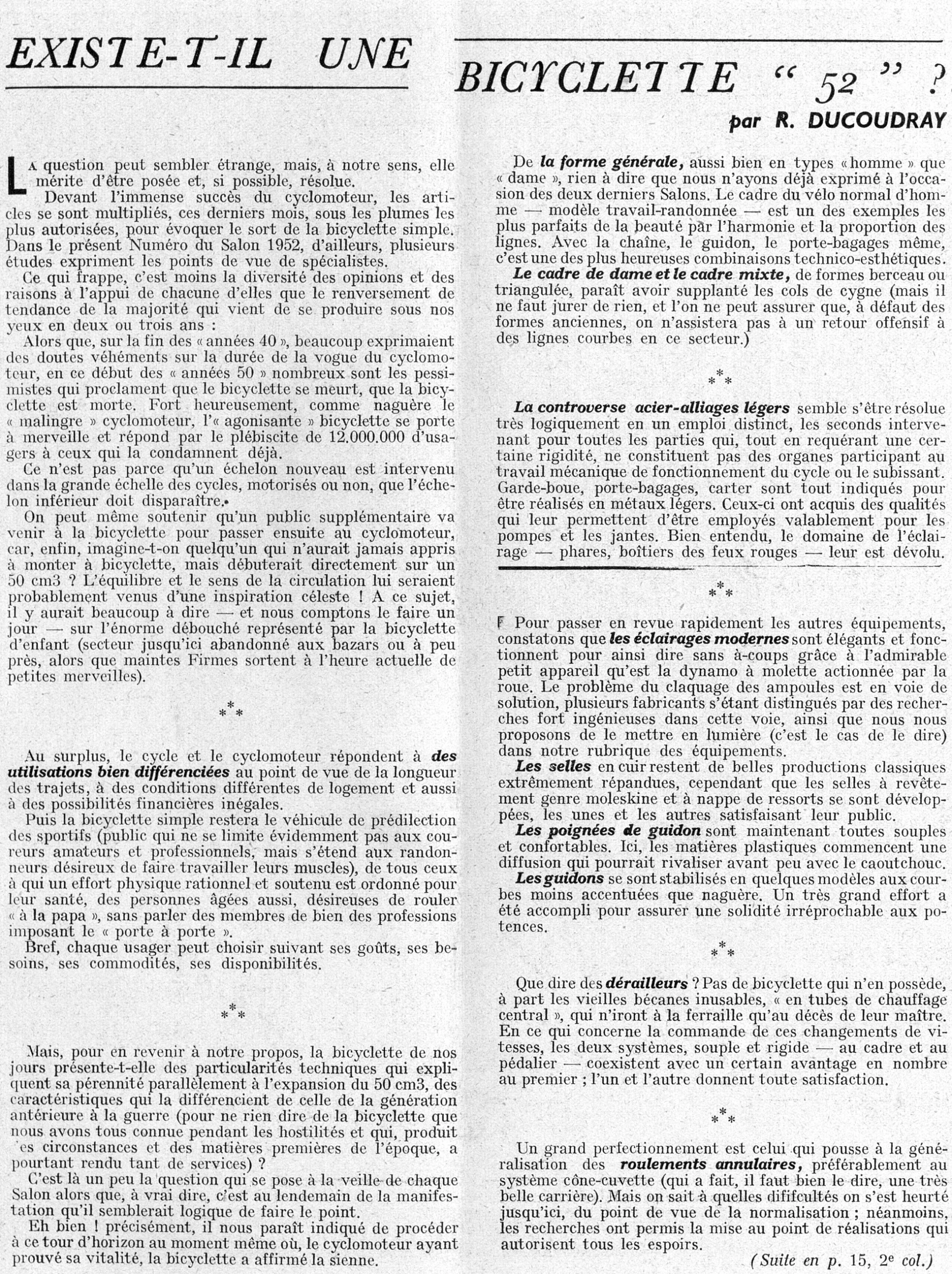
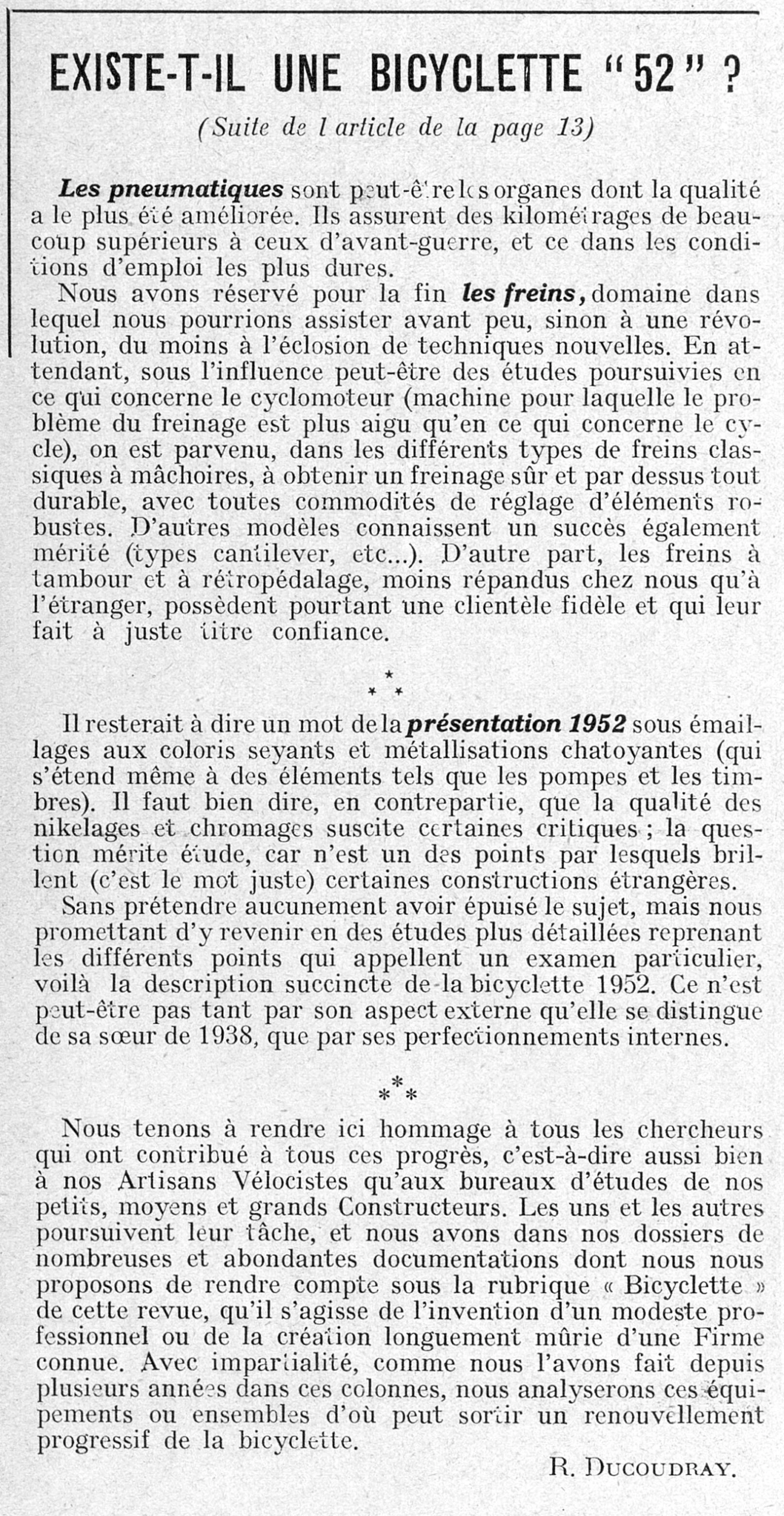
EXISTE-T-IL UNE BICYCLETTE “ 52 ” ? par R. DUCOUDRAY * * * * * * * * * * * * * * * * * * (Suite en p. 15, 2e col.) EXISTE-T-IL UNE BICYCLETTE " 52 " ? (Suite de l article de la page 13) * * * * * * …
This is a magazine article, so its running text is summarized here rather than reproduced; the headline, byline, specifications and scores are transcribed as printed.
From L’Officiel du cycle, du motocycle et du camping, 20 September 1952, the paper’s special number for the 1952 Paris Salon du Cycle et du Motocycle, pages 13 and 15: R. Ducoudray on whether the 1952 bicycle differs from its predecessors, part by part, from the frame and its alloys to lighting, saddles, derailleurs and bearings. The title, headings, captions and lists are transcribed as printed; the text is summarized in Ebykr’s words, and the page images carry it in full.
— Page 1 —
EXISTE-T-IL UNE
BICYCLETTE “ 52 ” ?
par R. DUCOUDRAY
[Ebykr summary; the article’s text is not reproduced. The paper opens by granting that the question may seem strange, but holds that it deserves to be put and, if possible, settled. Faced with the immense success of the cyclomoteur, articles have multiplied in recent months under the most authorized pens to call up the fate of the plain bicycle, and in this Salon 1952 number several studies give the views of specialists. What is striking is less the variety of the opinions, and of the reasons behind each, than the reversal of the majority tendency that has taken place in two or three years: at the end of the « années 40 » many were voicing strong doubts about how long the cyclomoteur’s vogue would last, and now, at the start of the « années 50 », many pessimists proclaim that the bicycle is dying, that the bicycle is dead. Very happily, like the « malingre » cyclomoteur not long ago, the « agonisante » bicycle is doing marvelously and answers those who already condemn it with the plebiscite of 12.000.000 users. It is not because a new rung has appeared in the great ladder of cycles, motorized or not, that the lower rung must disappear. One may even hold that an added public will come to the bicycle and pass afterward to the cyclomoteur, for can one imagine anyone who had never learned to ride a bicycle starting straight off on a 50 cm3? Balance and a sense of traffic would have to come to him by heavenly inspiration. On that head there would be much to say, and the paper means to say it one day, about the enormous outlet of the child’s bicycle, a sector left until now more or less to the bazaars although many Firms are at present turning out little marvels.]
*
* *
[Ebykr summary, after the first three-star break. The paper adds that the cycle and the cyclomoteur answer, in its italics, to « des utilisations bien différenciées » as regards the length of the journeys, different conditions of housing and unequal means. Then the plain bicycle will remain the chosen vehicle of sporting people — a public plainly not limited to amateur and professional racers but reaching to randonneurs wishing to work their muscles — and of all those for whom a rational and sustained physical effort is ordered for their health, of older people too who wish to ride « à la papa », to say nothing of the members of many trades that impose the « porte à porte ». In short, every user may choose according to his tastes, his needs, his convenience and his means.]
*
* *
[Ebykr summary, after the second three-star break. Coming back to the subject, the paper asks whether the bicycle of today shows technical particularities that explain its permanence alongside the expansion of the 50 cm3, characteristics that set it apart from the pre-war generation, to say nothing of the bicycle everyone knew during the hostilities, which, the product of the circumstances and of the raw materials of the time, nevertheless rendered so many services. That, it says, is rather the question put on the eve of every Salon, although to tell the truth it would seem more logical to take stock the day after the show. Precisely so, it answers: a survey seems called for at the very moment when, the cyclomoteur having proved its vitality, the bicycle has affirmed its own. On « la forme générale », in man’s as in woman’s types, it has nothing to say that it has not already said at the two last Salons: the frame of the normal man’s machine, the travail-randonnée model, is one of the most perfect examples of beauty through the harmony and proportion of its lines, and with the chain, the handlebar and even the carrier it makes one of the happiest technical and esthetic combinations. « Le cadre de dame et le cadre mixte », of cradle or triangulated form, appears to have supplanted the swan-neck patterns, although one must swear to nothing and nobody can promise that, for want of the older shapes, an offensive return of curved lines will not be seen in that sector.]
*
* *
[Ebykr summary, after the third three-star break. The paper holds that « la controverse acier-alliages légers » appears to have settled itself very logically in a distinct use for each, the light alloys coming in for all the parts that, while calling for a certain rigidity, are not organs taking part in or bearing the mechanical work of the cycle. Mudguards, carriers and chain cases are all marked out to be made in light metals, which have gained qualities that let them be used soundly for pumps and rims; and the field of lighting, lamps and the bodies of rear lights, falls to them as a matter of course.]
*
* *
[Ebykr summary, after the fourth three-star break. Passing the other equipment rapidly in review, the paper finds « les éclairages modernes » elegant and working practically without a break thanks to that admirable little device the roller dynamo driven by the wheel; the problem of blown bulbs is on the way to solution, several makers having distinguished themselves by very ingenious research in that direction, which the paper means to bring to light in its equipment section. « Les selles » in leather remain fine classic products and extremely widespread, while saddles with a moleskin-type covering and a bed of springs have developed, each kind satisfying its own public. « Les poignées de guidon » are now all supple and comfortable, and here plastics are beginning a spread that could before long rival rubber. « Les guidons » have settled into a few models with curves less marked than formerly, and a very great effort has been made to give the stems an irreproachable strength.]
*
* *
[Ebykr summary, after the fifth three-star break. On « dérailleurs », the paper says there is no bicycle without one, apart from the old unwearable bécanes « en tubes de chauffage central », which will go for scrap only at the death of their master. As to the control of these gear changes, the two systems, flexible and rigid — on the frame and on the chainset — exist side by side with a certain advantage in numbers to the first; both give every satisfaction.]
*
* *
[Ebykr summary, after the sixth three-star break. A great improvement, the paper says, is the one pressing for the general adoption of « roulements annulaires » in preference to the cone-and-cup system, which has had, it must be said, a very fine career. But everyone knows the difficulties met so far as regards standardization; nevertheless the research has allowed designs that permit every hope. The section closes with the direction to the continuation.]
(Suite en p. 15, 2e col.)
[A text page with no illustration, set in two columns of roman type parted by a thin vertical rule that stops short in the right column. The piece begins with a large black drop capital L of two lines, followed by small capitals, and carries no title line and no byline on this leaf. The sections are parted by an ornament of three stars set as a triangle, one star over two, centered in the column. Within the running text the topic of each paragraph is picked out in bold italic — “la forme générale”, “Le cadre de dame et le cadre mixte”, “La controverse acier-alliages légers”, “les éclairages modernes”, “Les selles”, “Les poignées de guidon”, “Les guidons”, “dérailleurs” and “roulements annulaires” — while quoted or colloquial phrases stand between guillemets. A stray letter F has been left standing at the head of the paragraph that opens “Pour passer en revue rapidement les autres équipements”, and a short heavy rule, pieced out by a lighter broken rule, crosses the right column above the star ornament in its middle. The last line of the right column, “(Suite en p. 15, 2e col.)”, is set in italic and ranged right. There is no signature on this leaf.]
— Page 2 —
EXISTE-T-IL UNE BICYCLETTE ” 52 ” ?
(Suite de l article de la page 13)
[Ebykr summary; the article’s text is not reproduced. The continuation opens on « Les pneumatiques », which the paper calls perhaps the parts whose quality has been improved the most: they give mileages far above those of before the war, and that under the hardest conditions of use. It has kept « les freins » for the end, a field in which, before long, if not a revolution then at least the appearance of new techniques may be seen. For the time being, under the influence perhaps of the studies pursued on the cyclomoteur — a machine for which the problem of braking is sharper than for the cycle — the different types of classic jaw brakes have been brought to a braking that is sure and above all lasting, with every convenience of adjustment and robust parts. Other models meet a success equally deserved, the cantilever types among them. Drum brakes and back-pedaling brakes, less widespread in France than abroad, nevertheless keep a faithful clientele that trusts them with good reason.]
*
* *
[Ebykr summary, after the first three-star break. A word remains to be said, the paper writes, about the « présentation 1952 » under becoming enamel colors and shimmering metallic finishes, which reaches even such parts as pumps and bells. In return, it must be said that the quality of the nickel plating and the chromium plating draws certain criticism, and the question deserves study, since it is one of the points on which certain foreign constructions shine — the right word. Claiming in no way to have exhausted the subject, but promising to come back to it in more detailed studies taking up the various points that call for particular examination, the paper offers that as the short description of the 1952 bicycle. It is perhaps not so much by its outward look that it differs from its sister of 1938 as by its internal improvements.]
*
* *
[Ebykr summary, after the second three-star break. The paper closes by paying tribute to all the researchers who have contributed to this progress, the Artisans Vélocistes as much as the drawing offices of the small, medium and large Constructeurs. Both go on with their work, and the paper says it holds in its files abundant documentation on which it means to report under the « Bicyclette » heading of the review, whether the matter be the invention of a modest tradesman or the long matured creation of a known Firm. With impartiality, as it has done for several years in these columns, it will analyze the equipment and the assemblies out of which a progressive renewal of the bicycle may come.]
R. DUCOUDRAY.
[A single wide column of roman type, set across the measure and enclosed at the left and the right by thin vertical rules, with a heavy rule above the title and another below the text. The title “EXISTE-T-IL UNE BICYCLETTE ” 52 ” ?” is set in bold sans-serif capitals across the head, the figure between typographic quotation marks, and under it, ranged right, the line “(Suite de l article de la page 13)” in italic within parentheses, the apostrophe after the l failing to print. As on the first leaf, the topic of each paragraph is picked out in bold italic — “Les pneumatiques”, “les freins” and “présentation 1952” — and the sections are parted by an ornament of three stars set as a triangle, one star over two. The signature “R. DUCOUDRAY.” closes the piece, set in roman with the surname in small capitals and ranged to the right. There is no illustration on the item.]
Ebykr presents this material for research and education. If you hold rights to it or notice an ownership issue, please contact us and we will respond promptly.
The Ebykr Digest
New articles, timelines, catalog finds and registry activity — assembled from the archive once a month. Your address is never shared.
Double opt-in. One email per month. Unsubscribe at any time with one click.