About Ebykr
Ebykr celebrates classic and vintage lightweight bicycles through provocative imagery and opinion. Ride along with us.
About Ebykr
Ebykr celebrates classic and vintage lightweight bicycles through provocative imagery and opinion. Ride along with us.

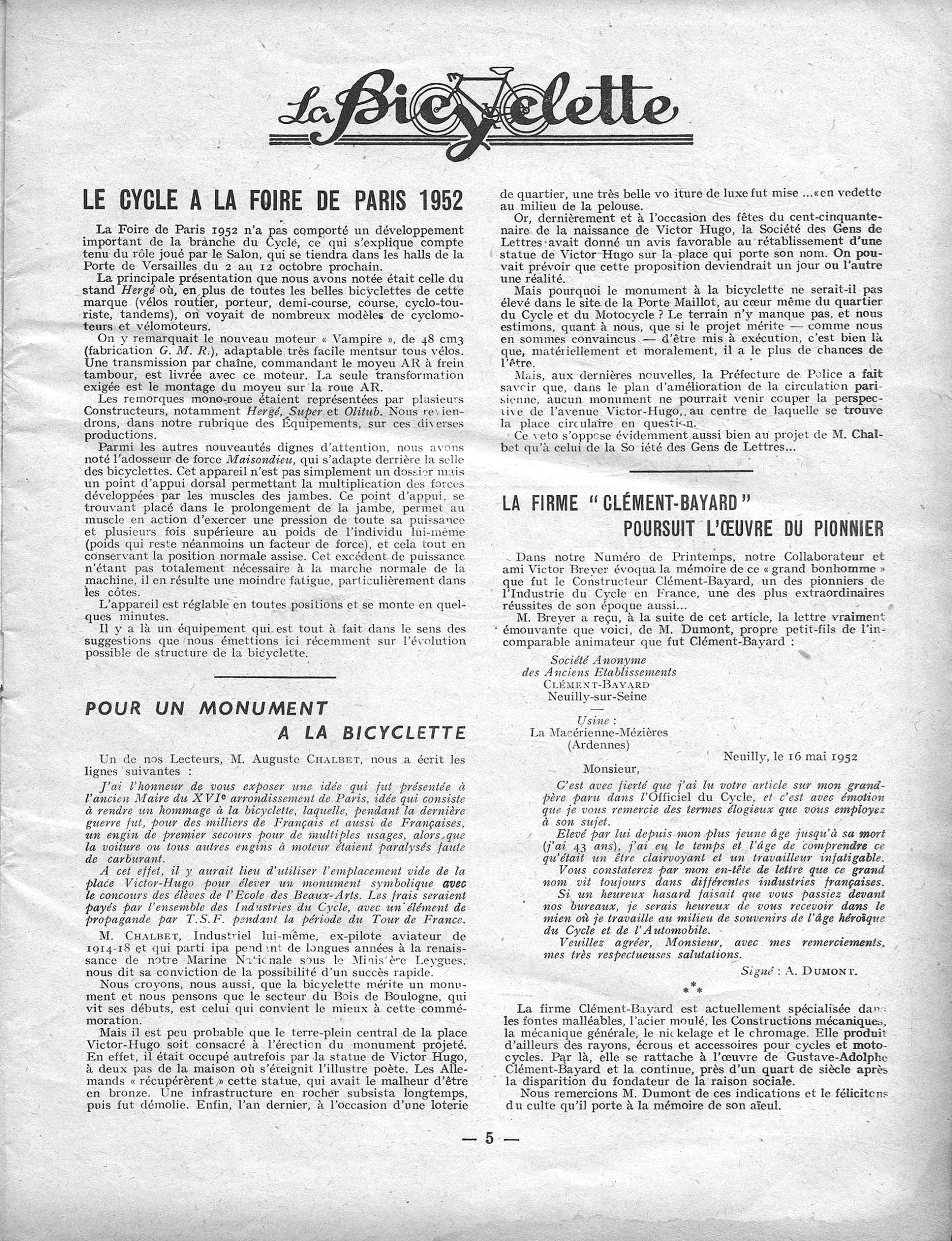
Source: L'Officiel du cycle, du motocycle et du camping, N° 24, 14 June 1952, page 5; scan of the issue from Cycle Memory (Mémoire du Cycle), Collection privée F.
| Type | Review |
|---|---|
| Year | 1952 |
| Publisher | L'Officiel du cycle |
| Country | France |
| Language | French |
| Pages | 1 |
| Source | L'Officiel du cycle, du motocycle et du camping, N° 24, 14 June 1952, page 5; scan of the issue from Cycle Memory (Mémoire du Cycle), Collection privée F. |
| Credit | Ebykr archive |
| Identifier | Permalink https://cyclememory.org/fr/search-coll-list.php?collectionID=325&docID=B-1-0000001004 |
| Transcription | Headings and specifications transcribed; article text summarized |
La Bicyclette LE CYCLE A LA FOIRE DE PARIS 1952 POUR UN MONUMENT A LA BICYCLETTE LA FIRME “ CLÉMENT-BAYARD ” POURSUIT L'ŒUVRE DU PIONNIER Société Anonyme des Anciens Etablissements CLÉMENT-BAYARD Neuilly-sur-Seine Usine : La Macérienne-Mézières (Ardennes) Neuilly, le 16 mai 1952 Signé : A. DUMONT. — 5 —
This is a magazine article, so its running text is summarized here rather than reproduced; the headline, byline, specifications and scores are transcribed as printed.
“La Bicyclette”, L’Officiel du cycle, 14 June 1952, page 5: three items, the cycle trade at the 1952 Foire de Paris (Hergé, G.M.R., Olitub, Maisondieu), a proposal for a monument to the bicycle in Paris and the Clément-Bayard firm carrying on the pioneer’s work, with its letter of 16 May 1952. The headings and the letter’s address and signature are transcribed as printed; the text is summarized in Ebykr’s words, and the page image carries it in full.
— Page 1 —
La Bicyclette
LE CYCLE A LA FOIRE DE PARIS 1952
POUR UN MONUMENT A LA BICYCLETTE
LA FIRME “ CLÉMENT-BAYARD ” POURSUIT L’ŒUVRE DU PIONNIER
Société Anonyme des Anciens Etablissements CLÉMENT-BAYARD Neuilly-sur-Seine
Usine : La Macérienne-Mézières (Ardennes)
Neuilly, le 16 mai 1952
Signé : A. DUMONT.
[Ebykr summary; the article’s text is not reproduced. The magazine’s “La Bicyclette” page carries three items. The first, on the cycle trade at the Foire de Paris 1952, says the fair showed little growth in the cycle branch because the Salon was to be held in the halls of the Porte de Versailles from 2 to 12 October. The main display was the Hergé stand, which showed the marque’s bicycles (routier, porteur, demi-course, course and cyclo-touriste models and tandems) beside many cyclomoteurs and vélomoteurs; among them the new 48 cm3 “Vampire” engine made by G. M. R., which fits almost any bicycle and comes with a chain drive to a rear hub with a drum brake, the only change needed being the fitting of that hub to the rear wheel. Single-wheel trailers were shown by several makers, notably Hergé, Super and Olitub, which the magazine promises to cover in its Équipements column. It also notes the Maisondieu “adosseur de force”, a back rest fitted behind the saddle that gives the rider a dorsal point of support in line with the leg, so the leg muscles can push with several times the body’s weight while the rider stays seated normally; the surplus effort eases fatigue, above all on climbs. It adjusts to any position, fits in a few minutes and, the writer says, matches suggestions the paper recently made about the bicycle’s possible evolution. The second item, “Pour un monument à la bicyclette”, prints a letter from a reader, M. Auguste Chalbet, proposing a monument to the bicycle, which served thousands of French men and women in the last war when cars and other motor vehicles had no fuel; the idea had already been put to the former mayor of the XVIe arrondissement of Paris. He suggests the empty site on the place Victor-Hugo, a design by students of the Ecole des Beaux-Arts, costs paid by the cycle industries and publicity by T.S.F. during the Tour de France. Chalbet is described as an industrialist, a pilot in 1914-18 and a long-time worker for the rebirth of the Marine Nationale under the Ministère Leygues. The magazine backs the idea but favors the Bois de Boulogne, where the bicycle began, and doubts the place Victor-Hugo: its statue of Victor Hugo, near the house where the poet died, was taken by the Germans for its bronze, its rock base later demolished, and a luxury car was shown on its lawn last year during a local lottery; the Société des Gens de Lettres, for the 150th anniversary of Hugo’s birth, had approved restoring a statue of Hugo there. The writer then proposes the Porte Maillot, heart of the cycle and motorcycle quarter, but reports that the Préfecture de Police, under its plan to improve Paris traffic, will allow no monument to break the perspective of the avenue Victor-Hugo, which rules out both Chalbet’s plan and the Société des Gens de Lettres’ statue. The third item recalls that the paper’s collaborator Victor Breyer wrote in the spring number about the constructor Clément-Bayard, a pioneer of the cycle industry in France, and prints the letter Breyer then received from M. Dumont, the founder’s grandson, on the letterhead of the Société Anonyme des Anciens Etablissements Clément-Bayard of Neuilly-sur-Seine, works at La Macérienne-Mézières (Ardennes). Dumont, now 43 and raised by his grandfather until the latter’s death, thanks Breyer for the article in L’Officiel du Cycle, remembers him as clear-sighted and tireless, says the name lives on in several French industries and invites him to his office among relics of the heroic age of the cycle and the automobile. The magazine adds that the firm now specializes in malleable castings, cast steel, mechanical construction, general engineering, nickel and chrome plating, and makes spokes, nuts and accessories for cycles and motorcycles, carrying on the work of Gustave-Adolphe Clément-Bayard nearly a quarter of a century after the founder’s death, and it thanks M. Dumont.]
[The page’s head is a drawn script title, “La Bicyclette”, in which a line drawing of a bicycle supplies the middle letters, its two wheels forming the c’s on either side of a long-tailed y, over three rules; there are no photographs or other drawings, and no signature or monogram on the page.]
— 5 —
Ebykr presents this material for research and education. If you hold rights to it or notice an ownership issue, please contact us and we will respond promptly.
The Ebykr Digest
New articles, timelines, catalog finds and registry activity — assembled from the archive once a month. Your address is never shared.
Double opt-in. One email per month. Unsubscribe at any time with one click.