About Ebykr
Ebykr celebrates classic and vintage lightweight bicycles through provocative imagery and opinion. Ride along with us.
About Ebykr
Ebykr celebrates classic and vintage lightweight bicycles through provocative imagery and opinion. Ride along with us.

Source: Gallica (Bibliothèque nationale de France), L'Officiel du cycle, du motocycle et du camping, 3 May 1952, N° 18, pages 19 and 20; ark:/12148/bd6t54182062z. Source gallica.bnf.fr / BnF.
| Type | Review |
|---|---|
| Year | 1952 |
| Publisher | L'Officiel du cycle |
| Country | France |
| Language | French |
| Pages | 2 |
| Source | Gallica (Bibliothèque nationale de France), L'Officiel du cycle, du motocycle et du camping, 3 May 1952, N° 18, pages 19 and 20; ark:/12148/bd6t54182062z. Source gallica.bnf.fr / BnF. |
| Credit | Ebykr archive; Bibliothèque nationale de France |
| Identifier | Gallica (BnF) ark:/12148/bd6t54182062z/f19 |
| Transcription | Headings and specifications transcribed; article text summarized |
Reference
"Les Vélocistes ne sont pas de simples « marchands de vélos »" L'Officiel du cycle, 3 May 1952. Ebykr, https://ebykr.com/library/lofficiel-du-cycle-1952-05-velocistes-pas-de-simples-marchands-breyer/.
Wikipedia
{{cite magazine |title=Les Vélocistes ne sont pas de simples « marchands de vélos » |magazine=L'Officiel du cycle |date=3 May 1952 |language=French |url=https://ebykr.com/library/lofficiel-du-cycle-1952-05-velocistes-pas-de-simples-marchands-breyer/ |via=Ebykr |access-date=}}Les Vélocistes ne sont pas de simples " Marchands de Vélos " par Victor BREYER CHERS SOUVENIRS UN GRAND BONHOMME UNE ASCENSION PRODIGIEUSE UNE LOI NON ÉCRITE LE RÉSULTAT Victor BREYER.
This is a magazine article, so its running text is summarized here rather than reproduced; the headline, byline, specifications and scores are transcribed as printed.
From L’Officiel du cycle, du motocycle et du camping, 3 May 1952, N° 18, the spring number, pages 19 and 20: ‘Les Vélocistes ne sont pas de simples marchands de vélos’ by Victor Breyer: history of the cycle trade and of Adolphe Clément (Clément-Bayard). The title, headings, captions and lists are transcribed as printed; the text is summarized in Ebykr’s words, and the page images carry it in full.
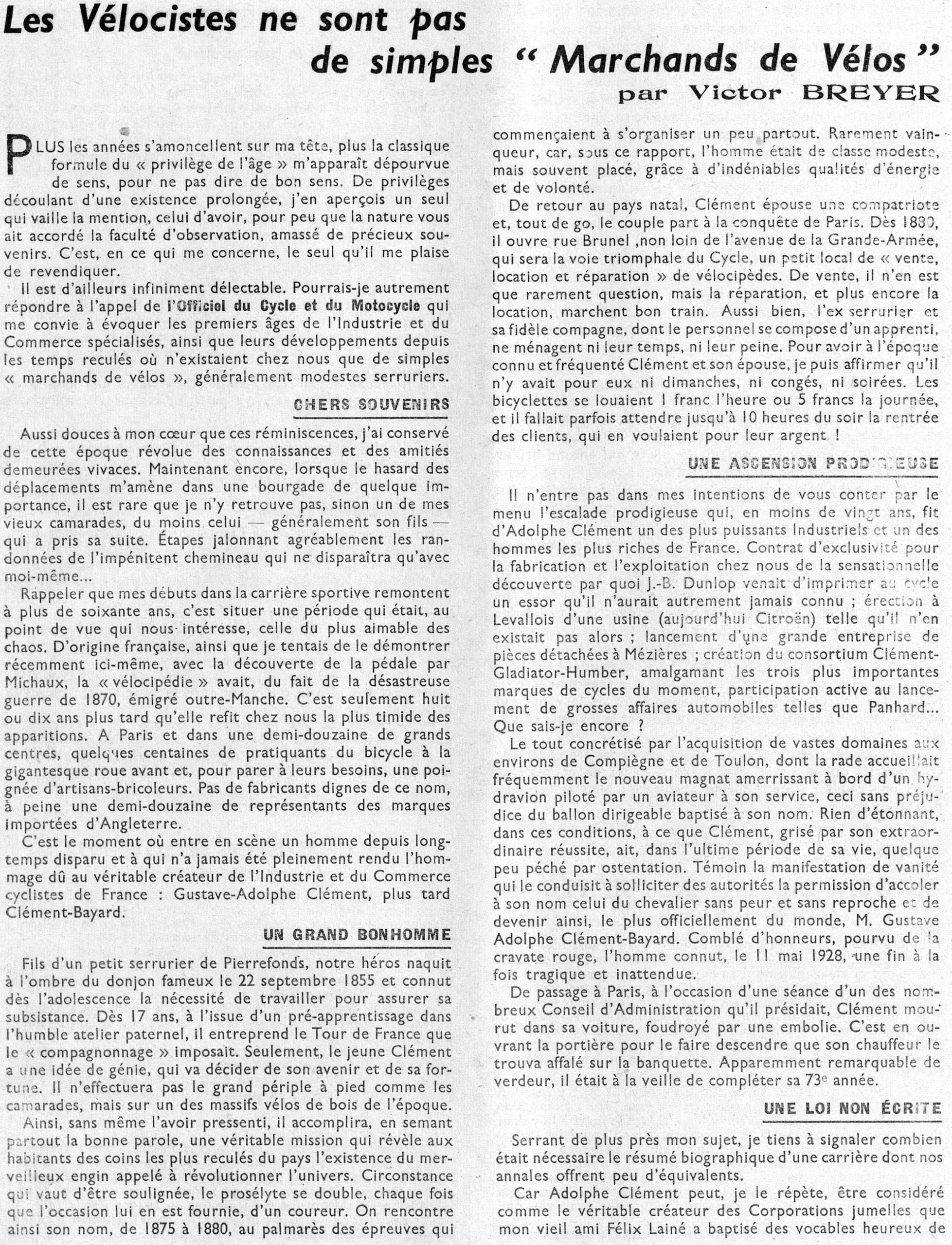
— Page 1 —
Les Vélocistes ne sont pas
de simples ” Marchands de Vélos ”
par Victor BREYER
[Ebykr summary; the article’s text is not reproduced. Breyer, writing in the first person, says that as the years pile up the classic phrase “privilege of age” seems to him empty, and that the only privilege of a long life he can see is a stock of precious memories, which he is pleased to claim. He takes up the call of the Officiel du Cycle et du Motocycle to recall the first ages of the specialized industry and trade, and their growth from times when there were only modest locksmiths who were simply “marchands de vélos”.]
CHERS SOUVENIRS
[Ebykr summary; the article’s text is not reproduced. From that bygone era he has kept acquaintances and friendships that remain lively, and when his travels take him into a sizable town he rarely fails to find there, if not one of his old comrades, then the one, generally a son, who took over from him. His own start in sporting life goes back more than sixty years, a period that was the most amiable of chaos. As he tried to show recently in the same review, with the discovery of the pedal by Michaux, the “vélocipède” was of French origin but had emigrated across the Channel because of the disastrous war of 1870, and it came back to France only eight or ten years later in the most timid appearances. In Paris and half a dozen big centers there were a few hundred riders of the bicycle with the gigantic front wheel and a handful of craftsman-tinkerers to supply their needs, no makers worthy of the name and barely half a dozen agents of makes imported from England. At that moment a man long since gone comes on the scene, to whom the tribute due to the true creator of the French cycle industry and trade has never been fully paid: Gustave-Adolphe Clément, later Clément-Bayard.]
UN GRAND BONHOMME
[Ebykr summary; the article’s text is not reproduced. Clément, son of a small locksmith of Pierrefonds, was born in the shadow of the famous keep on 22 September 1855 and knew from adolescence the need to work for a living. At 17, after a preliminary apprenticeship in his father’s humble workshop, he undertook the Tour de France required by the “compagnonnage”, but with an idea of genius that would decide his future and fortune: he did not make the great round on foot like his comrades but on one of the massive wooden velocipedes of the day. Without foreseeing it, he thus carried out a true mission, sowing the good word and revealing to the people of the remotest corners of the country the marvelous machine that was to revolutionize the world, and he doubled his converts with a racer whenever he could. His name appears from 1875 to 1880 in the records of the races that were beginning to be organized here and there, rarely as winner, since the man was of modest class, but often placed thanks to undeniable energy and will. On returning to his native land Clément married a fellow countrywoman and the couple set out to conquer Paris. From 1880 he opened in the rue Brunel, not far from the avenue de la Grande-Armée, a small shop for “sale, hire and repair” of velocipedes, where sale was rarely in question but repair and above all hire went briskly. The former locksmith and his faithful companion, whose staff was one apprentice, spared neither time nor trouble, and Breyer, who knew them both then, affirms that they had no Sundays, no holidays and no evenings: bicycles were hired at 1 franc an hour or 5 francs a day, and one sometimes had to wait until 10 at night for the customers to return.]
UNE ASCENSION PRODIGIEUSE
[Ebykr summary; the article’s text is not reproduced. Breyer does not mean to recount in detail the prodigious climb which in less than twenty years made Adolphe Clément one of the most powerful industrialists and one of the richest men in France. It included an exclusive contract for making and selling in France the sensational discovery by which J.-B. Dunlop had given the cycle an impetus it would never otherwise have known; the building at Levallois of a factory, today Citroën, such as did not then exist; the launch of a large spare-parts enterprise at Mézières; the creation of the Clément-Gladiator-Humber consortium, joining the three most important cycle makes of the moment; and an active part in launching big motor-car businesses such as Panhard. The whole was made concrete in the purchase of vast estates near Compiègne and Toulon, where the roadstead often welcomed the new magnate coming ashore from a seaplane flown by an aviator in his service, quite apart from the airship christened with his name. It is no wonder that Clément, intoxicated by his extraordinary success, sinned somewhat through ostentation in the last period of his life, as shown by his vanity in asking the authorities for permission to add to his name that of the knight without fear and without reproach and so to become, most officially, M. Gustave Adolphe Clément-Bayard. Laden with honors and wearing the red necktie, he met on 11 May 1928 an end both tragic and unexpected: passing through Paris for a meeting of one of the many boards he chaired, he died in his car, struck down by an embolism, and his chauffeur found him slumped on the seat when he opened the door. Apparently remarkably hale, he was on the eve of completing his 73rd year.]
UNE LOI NON ÉCRITE
[Ebykr summary; the article’s text is not reproduced. Coming closer to his subject, Breyer says how necessary this biographical summary was of a career for which the annals offer few equivalents. Adolphe Clément may, he repeats, be regarded as the true creator of the twin trades that his old friend Félix Lainé christened with happy terms. The section continues on the next page.]
[A page of printed text only, with no photograph, drawing, advertisement or agency mark. The headline stands at the head of the page in two lines of heavy slanted sans-serif type, with the second line set between quotation marks, and the byline “par Victor BREYER” in bold sans-serif capitals and italic at the right below it. The article follows in two justified columns of serif type with a large decorative initial letter at the opening. Four short subheadings, “CHERS SOUVENIRS”, “UN GRAND BONHOMME”, “UNE ASCENSION PRODIGIEUSE” and “UNE LOI NON ÉCRITE”, are set in bold small capitals and each underlined by a thin rule at the right edge of its column. The subheading in the right column is partly marred by a smudge over one letter.]
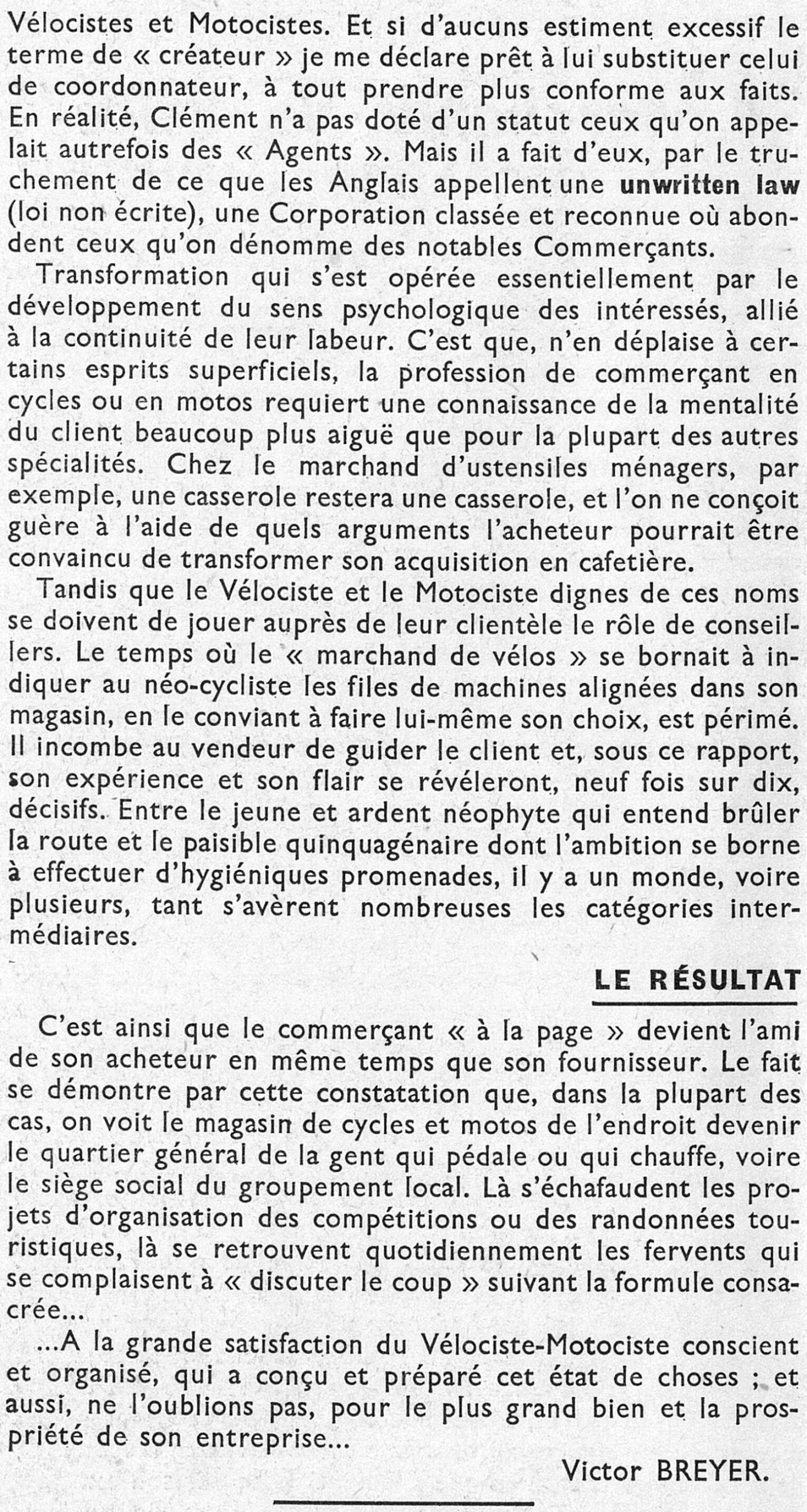
— Page 2 —
[Ebykr summary, continuing “UNE LOI NON ÉCRITE” from the previous image; the article’s text is not reproduced. The twin trades are those of Vélocistes and Motocistes. If some find the word “creator” excessive, Breyer says he is ready to replace it with “coordinator”, which is closer to the facts. Clément did not give those once called “Agents” a legal status, but through what the English call an “unwritten law” he made of them a recognized and ranked trade in which notable merchants abound. The change came mainly through the development of the dealers’ psychological sense joined to the continuity of their work. Whatever some superficial minds may think, the cycle or motorcycle merchant needs a much sharper knowledge of the customer’s mentality than most other specialties: a saucepan sold by a housewares dealer will stay a saucepan, and one can hardly see what arguments could persuade the buyer to turn it into a coffee pot. A Vélociste and Motociste worthy of the names must play the part of adviser to the clientele; the day when the “marchand de vélos” merely pointed the new cyclist to the rows of machines lined up in his shop and left him to choose is past. The seller must guide the customer, and his experience and flair will be decisive nine times out of ten, for between the young ardent novice who means to burn up the road and the peaceful man of fifty whose ambition is hygienic outings there lies a world, or several, so numerous are the intermediate categories.]
LE RÉSULTAT
[Ebykr summary; the article’s text is not reproduced. In this way the up-to-date merchant becomes the friend of his buyer as well as his supplier. This is shown by the fact that in most cases the local cycle and motorcycle shop becomes the headquarters of the people who pedal or who burn fuel, and even the registered seat of the local group. There projects for organizing competitions or tourist outings are hatched, and the devotees meet daily to “discuss the matter” in the consecrated phrase. The closing lines add, after suspension dots, that this is to the great satisfaction of the conscious and organized Vélociste-Motociste, who conceived and prepared this state of affairs, and also, Breyer adds, for the greater good and prosperity of his business.]
Victor BREYER.
[A page of printed text only, with no photograph, drawing, advertisement or agency mark. The text is set in a single justified column of sans-serif type with an indented first line to each paragraph and one phrase in bold sans-serif, an English term in the middle of the first paragraph. The subheading “LE RÉSULTAT” stands at the right in bold small capitals, underlined by a thin rule. The signature “Victor BREYER.” is set at the lower right in the same type as the text, and a short thin rule centered below it closes the article. The first lines at the top continue the previous page of the article.]
Ebykr presents this material for research and education. If you hold rights to it or notice an ownership issue, please contact us and we will respond promptly.
The Ebykr Digest
New articles, timelines, catalog finds and registry activity — assembled from the archive once a month. Your address is never shared.
Double opt-in. One email per month. Unsubscribe at any time with one click.