About Ebykr
Ebykr celebrates classic and vintage lightweight bicycles through provocative imagery and opinion. Ride along with us.
About Ebykr
Ebykr celebrates classic and vintage lightweight bicycles through provocative imagery and opinion. Ride along with us.

Source: Gallica (Bibliothèque nationale de France), L'Officiel du cycle, du motocycle et du camping, 3 May 1952, N° 18, pages 55 and 57; ark:/12148/bd6t54182062z. Source gallica.bnf.fr / BnF.
| Type | Review |
|---|---|
| Year | 1952 |
| Publisher | L'Officiel du cycle |
| Country | France |
| Language | French |
| Pages | 2 |
| Source | Gallica (Bibliothèque nationale de France), L'Officiel du cycle, du motocycle et du camping, 3 May 1952, N° 18, pages 55 and 57; ark:/12148/bd6t54182062z. Source gallica.bnf.fr / BnF. |
| Credit | Ebykr archive; Bibliothèque nationale de France |
| Identifier | Gallica (BnF) ark:/12148/bd6t54182062z/f55 |
| Transcription | Headings and specifications transcribed; article text summarized |
Reference
"Vélo, bécane et bicyclette." L'Officiel du cycle, 3 May 1952. Ebykr, https://ebykr.com/library/lofficiel-du-cycle-1952-05-velo-becane-bicyclette-zamacois/.
Wikipedia
{{cite magazine |title=Vélo, bécane et bicyclette |magazine=L'Officiel du cycle |date=3 May 1952 |language=French |url=https://ebykr.com/library/lofficiel-du-cycle-1952-05-velo-becane-bicyclette-zamacois/ |via=Ebykr |access-date=}}Vélo, Bécane et Bicyclette par Miguel ZAMACOÏS QUAND ON EST COMMERÇANT-VENDEUR ; QUAND ON EST ACHETEUR ; QUAND ON EST COUREUR SPORTIF ; QUAND, PERCHÉ DESSUS, ON S'APPLIQUE A NE DONNER OU A NE RECEVOIR AUCUN FACHEUX « COUP DE TAMPON » ; QUAND, UN PNEU CREVÉ, ON LE RESSUSCITE SUR PLACE ; QUAND ON …
This is a magazine article, so its running text is summarized here rather than reproduced; the headline, byline, specifications and scores are transcribed as printed.
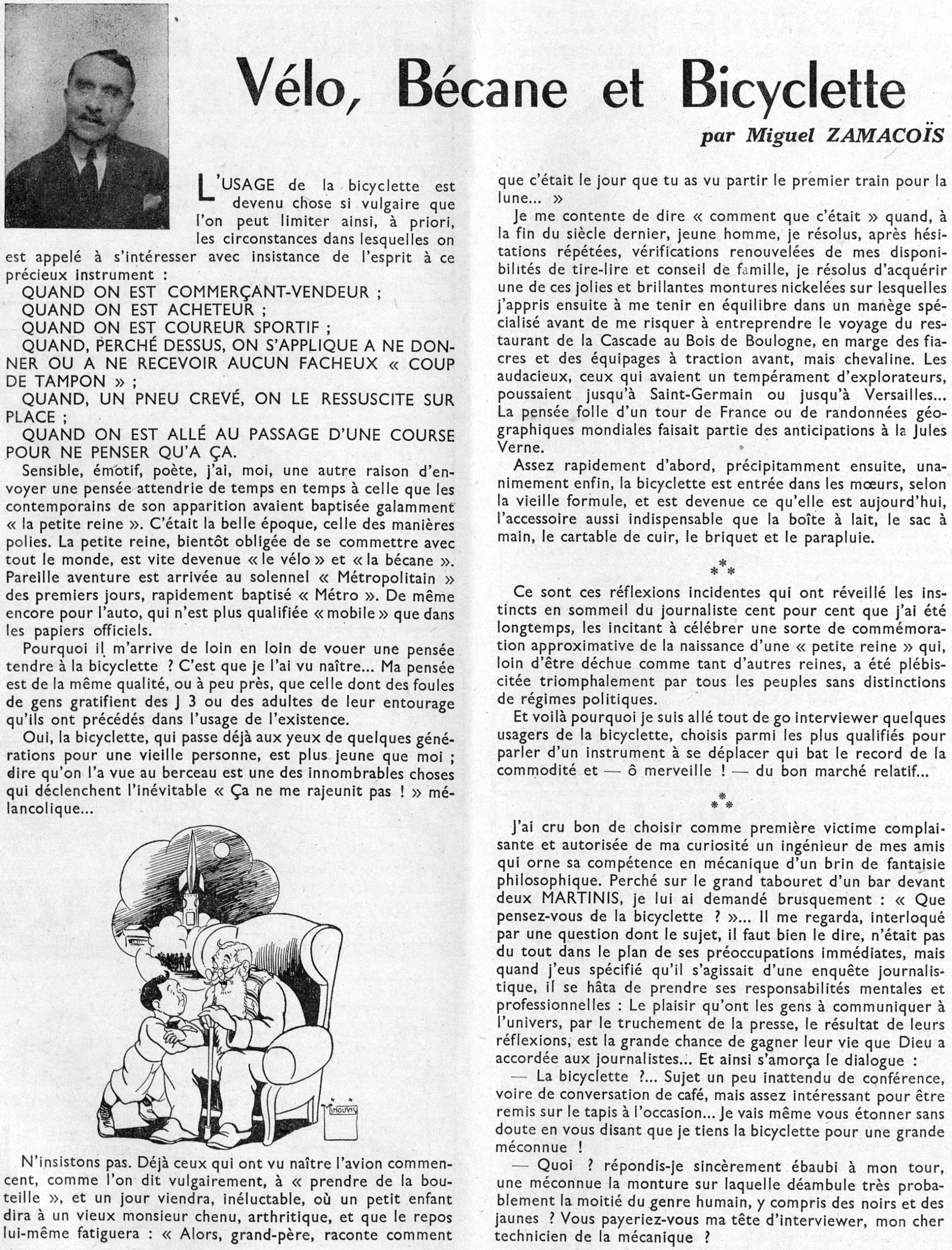
From L’Officiel du cycle, du motocycle et du camping, 3 May 1952, N° 18, the spring number, pages 55 and 57: vélo, Bécane et Bicyclette by Miguel Zamacoïs: a humorous tribute to the bicycle; portrait of the author, a cartoon of a grandfather and child. The title, headings, captions and lists are transcribed as printed; the text is summarized in Ebykr’s words, and the page images carry it in full.
— Page 1 —
Vélo, Bécane et Bicyclette
par Miguel ZAMACOÏS
[Ebykr summary; the article’s text is not reproduced. The author opens by saying that the use of the bicycle has become so commonplace that the occasions on which one takes a close mental interest in this precious instrument can be listed in advance. They are:]
QUAND ON EST COMMERÇANT-VENDEUR ;
QUAND ON EST ACHETEUR ;
QUAND ON EST COUREUR SPORTIF ;
QUAND, PERCHÉ DESSUS, ON S’APPLIQUE A NE DONNER OU A NE RECEVOIR AUCUN FACHEUX « COUP DE TAMPON » ;
QUAND, UN PNEU CREVÉ, ON LE RESSUSCITE SUR PLACE ;
QUAND ON EST ALLÉ AU PASSAGE D’UNE COURSE POUR NE PENSER QU’A ÇA.
[Ebykr summary, continuing. The author, sensitive, emotional and a poet by his own account, has another reason to send a tender thought now and then to the machine that its contemporaries gaily christened “la petite reine”. That was the belle époque, the time of polite manners. The little queen soon had to mix with everyone and quickly became “le vélo” and “la bécane”, just as the solemn “Métropolitain” of the first days was soon called “Métro” and the automobile is no longer called “mobile” except in official papers. His tender thought comes, he says, because he saw the bicycle born; it is of the same quality as the one many people give to a J 3 or to the older adults around them whom they have outlived. The bicycle, which already looks like an old person to some generations, is younger than he is, and saying that one saw it in its cradle brings the inevitable melancholy “Ça ne me rajeunit pas !”]
[Ebykr summary, after a cartoon. The author adds that those who saw the airplane born already begin to “prendre de la bouteille”, and a day will come when a small child will say to a decrepit, arthritic old gentleman, whom even rest tires, “Alors, grand-père, raconte comment c’était le jour que tu as vu partir le premier train pour la lune…”]
[Ebykr summary, in the second column. The author says he is content to say “comment que c’était” when, at the end of the last century, as a young man and after repeated hesitation, checks of his pocket money and a family council, he resolved to buy one of those pretty bright nickel-plated mounts, on which he then learned to keep his balance in a specialized riding school before venturing the trip from the Cascade restaurant to the Bois de Boulogne, alongside the cabs and carriages with front traction but horse power. The bold ones, with an explorer’s temperament, pushed on to Saint-Germain or Versailles. The wild idea of a tour of France or of geographical journeys round the world belonged to the anticipations in the manner of Jules Verne. Fairly quickly at first, hurriedly after, and unanimously in the end, the bicycle entered the customs and became as indispensable an accessory as the milk can, the handbag, the leather satchel, the lighter and the umbrella.]
***
[Ebykr summary, after a three-star break. These incidental thoughts awakened the sleeping instincts of the journalist the author long was, and urged him to celebrate an approximate commemoration of the birth of a “petite reine” that, far from being deposed like so many queens, has been voted in triumphantly by all peoples whatever their political regimes. He therefore went at once to interview some users of the bicycle, chosen among the most qualified to speak of a means of getting about that beats the record of convenience and, marvelously, of relative cheapness.]
***
[Ebykr summary, after a three-star break. As first willing and authorized victim of his curiosity the author chose an engineer friend who adorns his mechanical skill with a touch of philosophical fancy. Perched on a high bar stool before two Martinis, he asked him abruptly “Que pensez-vous de la bicyclette ?”. The engineer, taken aback by a subject far from his immediate worries, took up his mental and professional responsibilities once told it was a newspaper inquiry, remarking that the pleasure people take in telling the universe through the press the result of their reflections is the great chance of earning a living that God has granted journalists. The dialogue then began. The engineer called the bicycle an odd subject for a lecture or even café talk but interesting enough to be raised again, and said he held it to be a great unrecognized thing. The author, sincerely amazed, replied by asking how a mount on which probably half of mankind, Black and Asian people included, ambles along could be called unrecognized, and asked whether the engineer would pay for his head as an interviewer.]
[A magazine page opening a humorous article, set in a mixed layout of roman sans-serif text in two columns. At the upper left a small halftone portrait photograph shows a man with a mustache, in a dark suit, tie and a pocket handkerchief, looking toward the camera. The title “Vélo, Bécane et Bicyclette” is set across the head in large heavy sans-serif type, with the byline “par Miguel ZAMACOÏS” in bold italic beneath it at the right. The first paragraph opens with a large initial L; its list of six occasions is set in capitals, one to a line. A black line cartoon at the lower left of the first column shows a small boy in short trousers standing with folded arms before an old bearded man in spectacles seated in a winged armchair with a cane, and a thought cloud above them holds a rocket on its launch pad and the moon. The cartoon is signed “MINOUVIS” in a small box at its lower right. Three-star breaks mark the later divisions of the text. There is no firm’s name or address.]
— Page 2 —
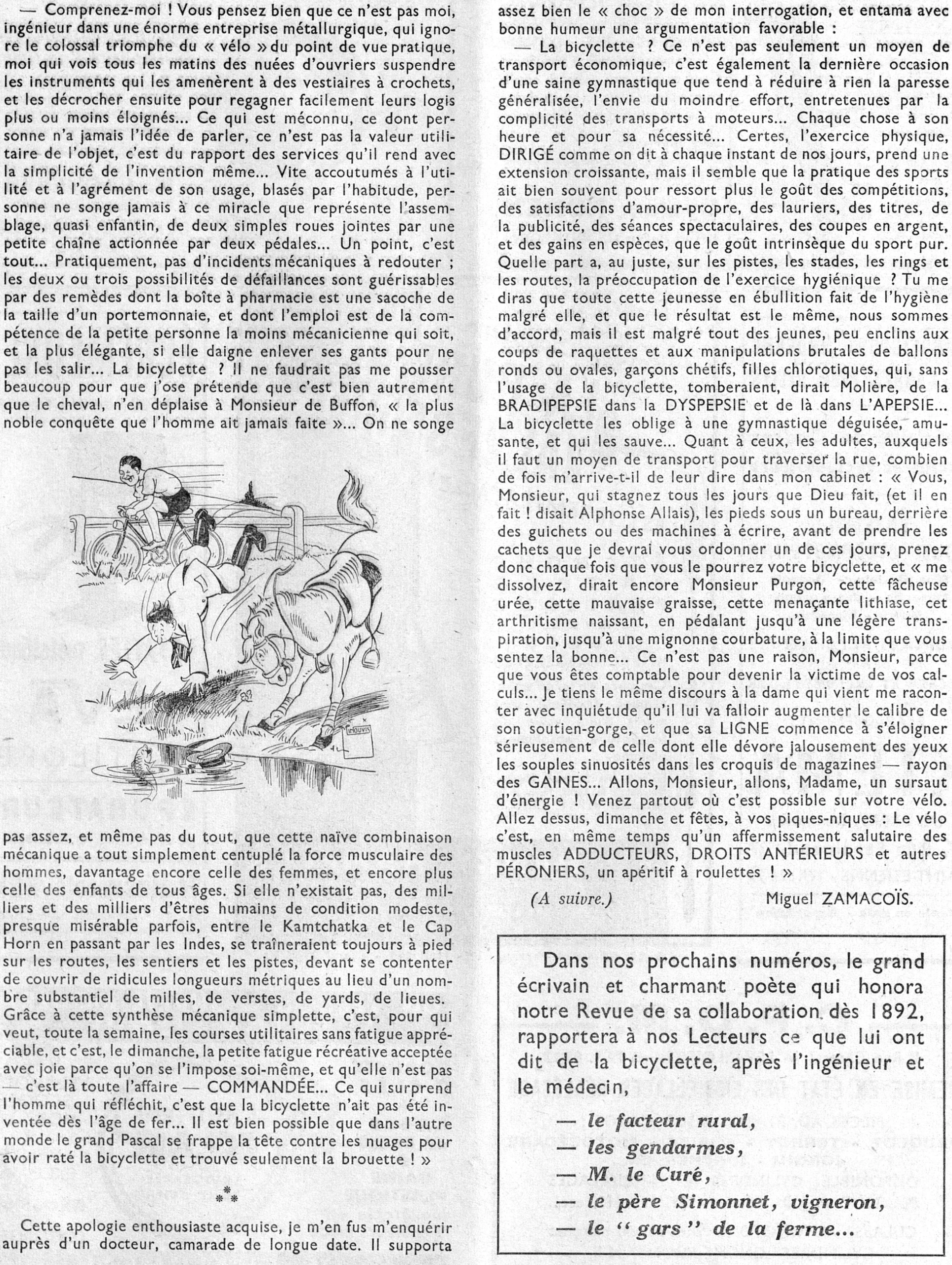
[Ebykr summary; the article’s text is not reproduced. The engineer goes on speaking, in the interview begun on the first page of the article. He says that the author must not think that he, an engineer in an enormous metallurgical firm, ignores the colossal practical triumph of the “vélo”: every morning he sees swarms of workers hang up the machines that brought them on hooked cloakroom racks and take them down again to get home. What is unrecognized, and what nobody thinks of mentioning, is not the utility of the object but the ratio of the services it renders to the simplicity of the invention itself. Quickly used to its usefulness and pleasantness, and jaded by habit, nobody thinks of the miracle of the almost childish assembly of two plain wheels joined by a small chain driven by two pedals. Practically no mechanical incident is to be feared; the two or three possible failures are cured by remedies whose medicine chest is a purse the size of a wallet, within the skill of the least mechanical and most elegant little person if she agrees to take off her gloves. He says he would almost dare claim that the bicycle is, much more than the horse, whatever Monsieur de Buffon may think of “la plus noble conquête que l’homme ait jamais faite”. Nobody thinks enough, or at all, that this naive mechanical combination has simply multiplied a hundredfold the muscular strength of men, still more of women and still more of children of all ages. Without it thousands and thousands of people of modest, sometimes almost wretched condition, between Kamchatka and Cape Horn by way of India, would still drag themselves on foot along roads, paths and tracks, covering ridiculous metric lengths instead of a substantial number of miles, versts, yards and leagues. Thanks to this simple mechanical synthesis there are, for whoever wants them, utility errands all week without appreciable fatigue and, on Sunday, a small recreational fatigue gladly accepted because it is self-imposed and not, as he puts it, COMMANDÉE. What surprises the thinking man is that the bicycle was not invented as early as the iron age, and he says that in the other world the great Pascal may be striking his head against the clouds for having missed the bicycle and found only the wheelbarrow.]
***
[Ebykr summary, after a three-star break at the foot of the first column. This enthusiastic apology secured, the author went to inquire of a doctor, an old comrade. The doctor takes the shock of the question fairly well and, continuing at the head of the second column, begins a favorable argument in good humor. The doctor says that the bicycle is not only an economic means of transport but also the last chance of a healthy gymnastic that generalized laziness and the wish for the least effort, fed by the complicity of motor transport, tend to reduce to nothing. Directed physical exercise is spreading, but sport often seems driven more by the taste for competitions, pride, laurels, titles, publicity, spectacular shows, silver cups and cash winnings than by the pure love of sport, and he asks how large a part hygiene plays on tracks, stadiums, rings and roads. The young, he grants, do hygiene in spite of themselves, but some are puny boys and chlorotic girls, unfond of racket blows and the brutal handling of round or oval balls, who without the bicycle would fall, as Molière would say, from BRADIPEPSIE into DYSPEPSIE and from there into L’APEPSIE; the bicycle forces on them an amusing disguised gymnastic that saves them. To adults who need transport to cross the street he says in his office, with a reference to Alphonse Allais and to Monsieur Purgon, that they should take the bicycle whenever they can, pedaling to a light perspiration and a pleasant stiffness, to dissolve urea, bad fat, threatening lithiasis and incipient arthritism; being an accountant is no reason to become the victim of one’s calculations. He gives the same speech to the lady who comes anxious that she must enlarge the size of her brassiere and that her LIGNE is moving away from the one whose supple curves she envies in magazine sketches of the girdle department. His appeal to both is a surge of energy: go everywhere possible on the bicycle, ride it to Sunday and holiday picnics, since the bike is at once a healthy strengthening of the ADDUCTEURS, DROITS ANTÉRIEURS and other PÉRONIERS muscles and an “apéritif à roulettes”.]
(A suivre.)
Miguel ZAMACOÏS.
Dans nos prochains numéros, le grand écrivain et charmant poète qui honora notre Revue de sa collaboration dès 1892, rapportera à nos Lecteurs ce que lui ont dit de la bicyclette, après l’ingénieur et le médecin,
— le facteur rural,
— les gendarmes,
— M. le Curé,
— le père Simonnet, vigneron,
— le “ gars ” de la ferme…
[The second page of a humorous magazine article, set in two columns of sans-serif text with a black line cartoon in the lower half of the left column. The cartoon shows a cyclist in shorts and a short-sleeved shirt riding past a post-and-rail fence in the background, while in the foreground a man in a jacket and tie has been thrown over the head of a horse that has stopped dead at the edge of a pond; he dives head first toward the water, where a fish looks up at a floating hat. It is signed “MINOUVIS” in a small box at the lower right of the drawing. A centered group of three stars in a triangle closes the engineer’s speech at the foot of the first column, and a new paragraph about the doctor begins beneath it. The words “(A suivre.)” in italic stand at the lower left of the second column beside the printed signature “Miguel ZAMACOÏS.” at the right. Below the signature a rectangular notice in a thin black frame, the magazine’s own teaser for coming issues, announces in larger roman type the next interviewees, with five dashed lines in bold italic. A few words in the text are in capitals, and shadow lettering from the reverse of the leaf shows faintly through the paper beside the notice.]
Ebykr presents this material for research and education. If you hold rights to it or notice an ownership issue, please contact us and we will respond promptly.
The Ebykr Digest
New articles, timelines, catalog finds and registry activity — assembled from the archive once a month. Your address is never shared.
Double opt-in. One email per month. Unsubscribe at any time with one click.