About Ebykr
Ebykr celebrates classic and vintage lightweight bicycles through provocative imagery and opinion. Ride along with us.
About Ebykr
Ebykr celebrates classic and vintage lightweight bicycles through provocative imagery and opinion. Ride along with us.

Source: Gallica (Bibliothèque nationale de France), L'Officiel du cycle, du motocycle et du camping, 3 May 1952, N° 18, pages 51 and 53; ark:/12148/bd6t54182062z. Source gallica.bnf.fr / BnF.
| Type | Review |
|---|---|
| Year | 1952 |
| Publisher | L'Officiel du cycle |
| Country | France |
| Language | French |
| Pages | 2 |
| Source | Gallica (Bibliothèque nationale de France), L'Officiel du cycle, du motocycle et du camping, 3 May 1952, N° 18, pages 51 and 53; ark:/12148/bd6t54182062z. Source gallica.bnf.fr / BnF. |
| Credit | Ebykr archive; Bibliothèque nationale de France |
| Identifier | Gallica (BnF) ark:/12148/bd6t54182062z/f51 |
| Transcription | Headings and specifications transcribed; article text summarized |
Reference
"Comment organiser une course cycliste sur route ?" L'Officiel du cycle, 3 May 1952. Ebykr, https://ebykr.com/library/lofficiel-du-cycle-1952-05-organiser-course-cycliste-sur-route/.
Wikipedia
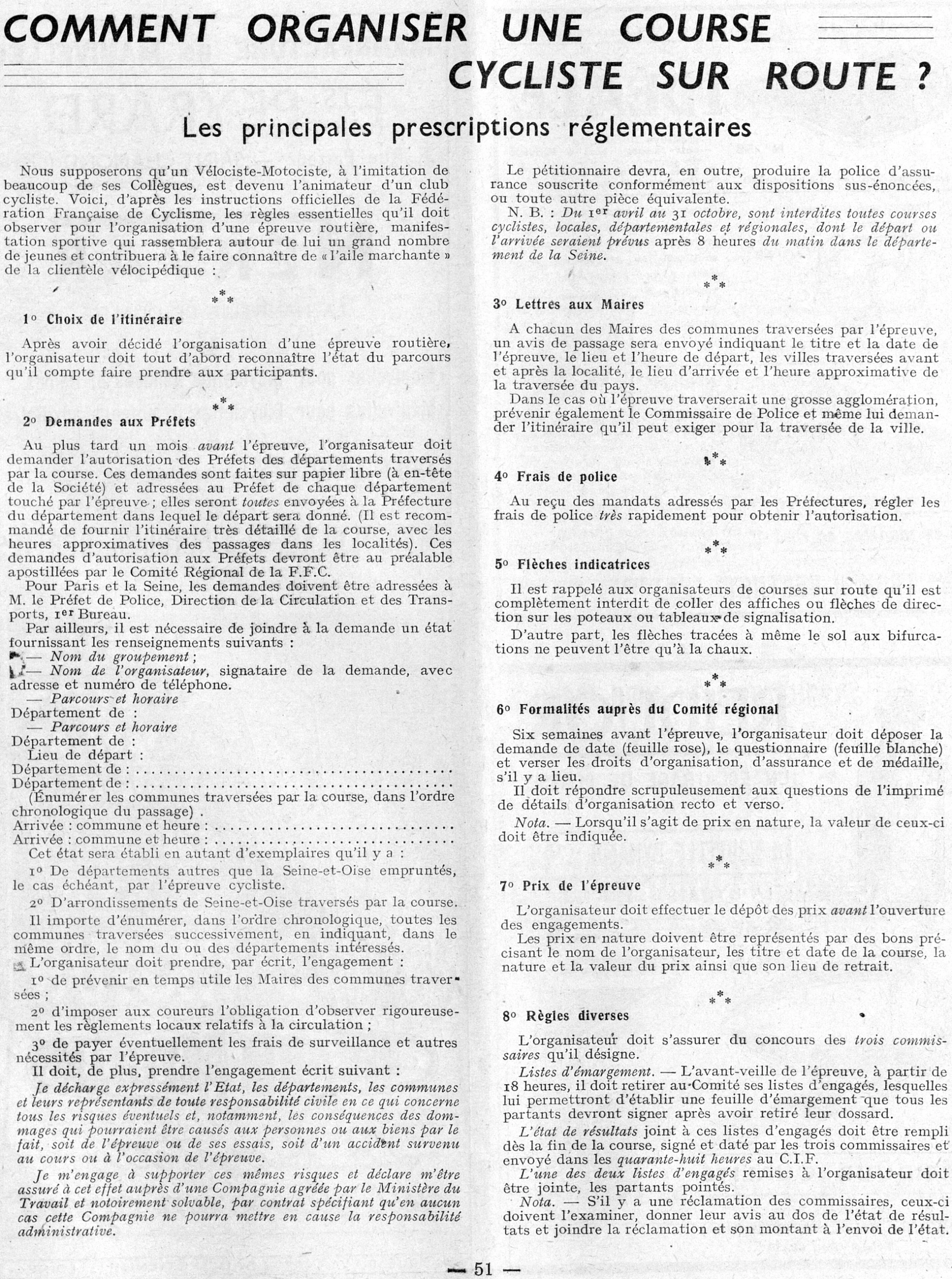
{{cite magazine |title=Comment organiser une course cycliste sur route ? |magazine=L'Officiel du cycle |date=3 May 1952 |language=French |url=https://ebykr.com/library/lofficiel-du-cycle-1952-05-organiser-course-cycliste-sur-route/ |via=Ebykr |access-date=}}COMMENT ORGANISER UNE COURSE CYCLISTE SUR ROUTE ? Les principales prescriptions réglementaires *** 1o Choix de l'itinéraire *** 2o Demandes aux Préfets — Nom du groupement ; — Nom de l'organisateur, signataire de la demande, avec adresse et numéro de téléphone. — Parcours et horaire Département de : — Parcours et horaire Département de : …
This is a magazine article, so its running text is summarized here rather than reproduced; the headline, byline, specifications and scores are transcribed as printed.
From L’Officiel du cycle, du motocycle et du camping, 3 May 1952, N° 18, the spring number, pages 51 and 53: comment organiser une course cycliste sur route? Les principales prescriptions réglementaires: rules of the Fédération Française de Cyclisme for organizing a road race (itinerary, prefect permissions, letters to mayors, police costs, arrows, regional committee, prizes). The title, headings, captions and lists are transcribed as printed; the text is summarized in Ebykr’s words, and the page images carry it in full.
— Page 1 —
COMMENT ORGANISER UNE COURSE CYCLISTE SUR ROUTE ?
Les principales prescriptions réglementaires
[Ebykr summary; the article’s text is not reproduced. The author supposes that a Vélociste-Motociste, like many of his colleagues, has become the moving spirit of a cycling club. He then gives, from the official instructions of the Fédération Française de Cyclisme, the essential rules to observe in organizing a road event, a sporting occasion that will gather many young people around him and make him known to the “aile marchante” of the cycle-buying public.]
***
1o Choix de l’itinéraire
[Ebykr summary; the article’s text is not reproduced. Once the event is decided, the organizer must first survey the condition of the course he means the entrants to take.]
***
2o Demandes aux Préfets
[Ebykr summary; the article’s text is not reproduced. At the latest one month before the event the organizer must ask the authorization of the Prefects of the departments crossed. The requests are made on plain paper (the society’s letterhead), addressed to the Prefect of each department touched, and all sent to the Prefecture of the department where the start is given. A very detailed itinerary with approximate times of passage through each locality is recommended. The requests must first be endorsed by the Regional Committee of the F.F.C. For Paris and the Seine they go to the Préfet de Police, Direction de la Circulation et des Transports, 1er Bureau. A statement must be attached to the request giving the following particulars, laid out on the page as a form:]
— Nom du groupement ;
— Nom de l’organisateur, signataire de la demande, avec adresse et numéro de téléphone.
— Parcours et horaire
Département de :
— Parcours et horaire
Département de :
Lieu de départ :
Département de : …………………………………….
Département de : …………………………………….
(Énumérer les communes traversées par la course, dans l’ordre chronologique du passage) .
Arrivée : commune et heure : …………………………………….
Arrivée : commune et heure : …………………………………….
Cet état sera établi en autant d’exemplaires qu’il y a :
1o De départements autres que la Seine-et-Oise empruntés, le cas échéant, par l’épreuve cycliste.
2o D’arrondissements de Seine-et-Oise traversés par la course.
[Ebykr summary, continuing item 2. It is important to list all the communes crossed in chronological order, naming in the same order the department or departments concerned.]
L’organisateur doit prendre, par écrit, l’engagement :
1o de prévenir en temps utile les Maires des communes traversées ;
2o d’imposer aux coureurs l’obligation d’observer rigoureusement les règlements locaux relatifs à la circulation ;
3o de payer éventuellement les frais de surveillance et autres nécessités par l’épreuve.
Il doit, de plus, prendre l’engagement écrit suivant :
Je décharge expressément l’Etat, les départements, les communes et leurs représentants de toute responsabilité civile en ce qui concerne tous les risques éventuels et, notamment, les conséquences des dommages qui pourraient être causés aux personnes ou aux biens par le fait, soit de l’épreuve ou de ses essais, soit d’un accident survenu au cours ou à l’occasion de l’épreuve.
Je m’engage à supporter ces mêmes risques et déclare m’être assuré à cet effet auprès d’une Compagnie agréée par le Ministère du Travail et notoirement solvable, par contrat spécifiant qu’en aucun cas cette Compagnie ne pourra mettre en cause la responsabilité administrative.
[Ebykr summary, in the second column. The petitioner must also produce the insurance policy taken out under the provisions above, or any equivalent paper.]
N. B. : Du 1er avril au 31 octobre, sont interdites toutes courses cyclistes, locales, départementales et régionales, dont le départ ou l’arrivée seraient prévus après 8 heures du matin dans le département de la Seine.
***
3o Lettres aux Maires
[Ebykr summary; the article’s text is not reproduced. Each Mayor of the communes crossed is to be sent a notice of passage giving the title and date of the event, the place and hour of the start, the towns crossed before and after his locality, the place of the finish and the approximate hour of passage through his area. If the event crosses a large town, the Commissaire de Police should also be warned and even asked for the route he may require through the town.]
***
4o Frais de police
[Ebykr summary; the article’s text is not reproduced. On receipt of the money orders sent by the Prefectures, the police costs are to be paid very quickly in order to obtain the authorization.]
***
5o Flèches indicatrices
[Ebykr summary; the article’s text is not reproduced. Organizers are reminded that it is entirely forbidden to stick posters or direction arrows on signposts or road-sign boards. Arrows drawn on the ground at forks may be made with lime only.]
***
6o Formalités auprès du Comité régional
[Ebykr summary; the article’s text is not reproduced. Six weeks before the event the organizer must file the request for a date (pink sheet) and the questionnaire (white sheet) and pay the organization, insurance and medal fees where they apply. He must answer carefully the questions of the form of organizing details, front and back. A note adds that when prizes are in kind their value must be stated.]
***
7o Prix de l’épreuve
[Ebykr summary; the article’s text is not reproduced. The organizer must deposit the prizes before entries open. Prizes in kind are represented by vouchers stating the organizer’s name, the title and date of the race, the nature and value of the prize and the place where it is collected.]
***
8o Règles diverses
[Ebykr summary; the article’s text is not reproduced. The organizer must secure the help of three commissaires whom he names. Under the heading Listes d’émargement, on the “avant-veille” of the event (two days before) from 18 hours he collects from the Committee his lists of entrants, from which he draws up a signing-in sheet that every starter must sign after collecting his number. The results sheet attached to these lists must be completed as soon as the race ends, signed and dated by the three commissaires and sent within forty-eight hours to the C.I.F. One of the two lists of entrants handed to the organizer must be attached, with the starters ticked. A note says that if the commissaires receive a protest they must examine it, give their opinion on the back of the results sheet and attach the protest and its fee to the sheet sent in.]
— 51 —
[Text only, a full page of rules. The title “COMMENT ORGANISER UNE COURSE CYCLISTE SUR ROUTE ?” is set across the head on two lines in heavy italic sans-serif capitals, with a set of three thin horizontal rules beside each line, one at the lower left and one at the upper right. A subtitle in lighter sans-serif type, “Les principales prescriptions réglementaires”, stands beneath it. The body is in two columns of roman type with indented paragraphs, numbered subheadings in bold sans-serif type from 1o to 8o, each set apart by a small triangle of three stars. Some phrases and the signed undertaking are in italic, and one passage of the second item is laid out as a form with dotted lines for filling in. There is no illustration, no signature and no firm’s name or address. The page number “51” appears between dashes at the foot.]
— Page 2 —
9o Droits d’organisation
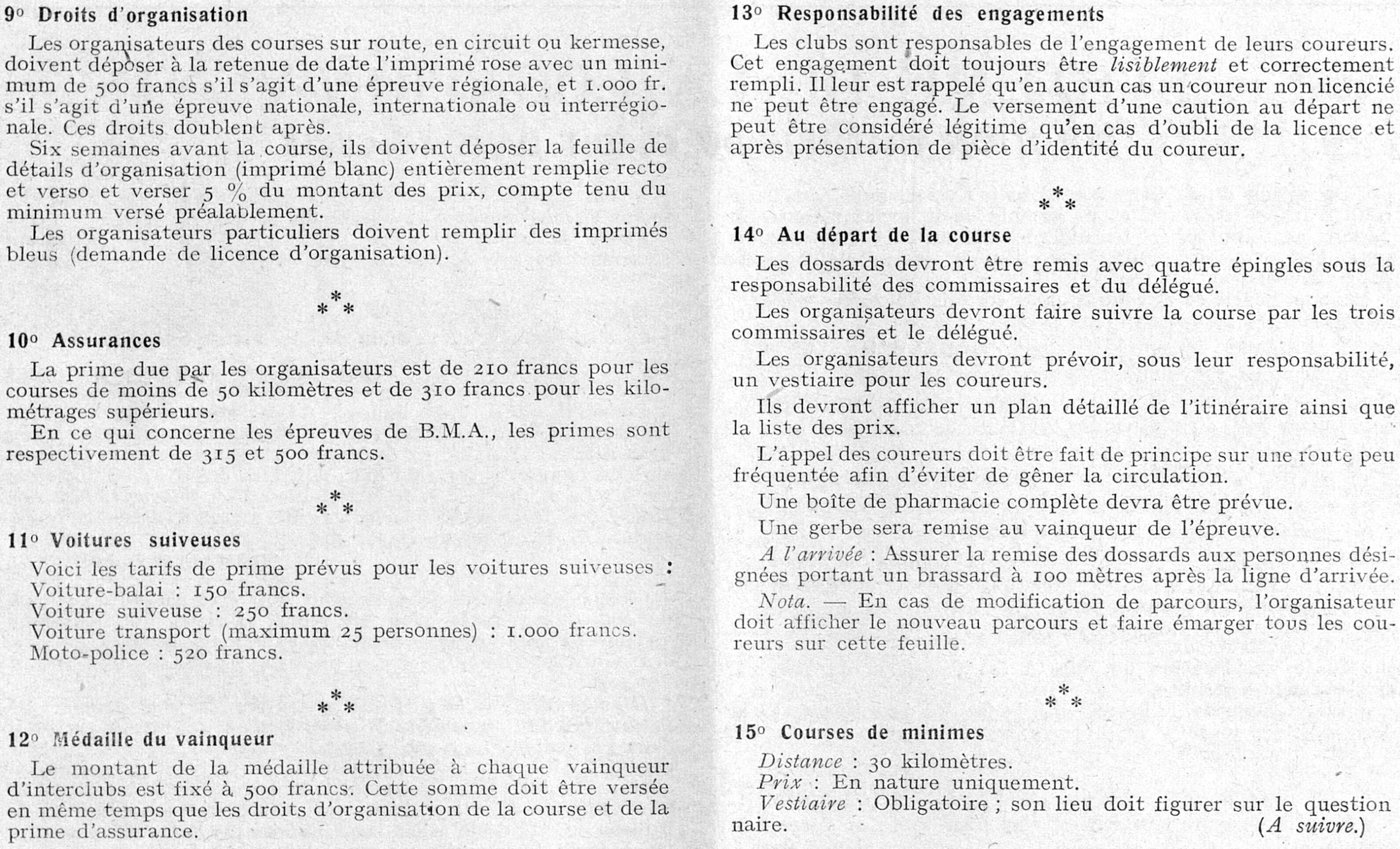
[Ebykr summary; the article’s text is not reproduced. Organizers of road races, circuit races or kermesses must file the pink form when reserving a date, with a minimum of 500 francs for a regional event and 1.000 fr. for a national, international or interregional one; these fees double afterward. Six weeks before the race they must file the sheet of organizing details (white form) completely filled in on front and back and pay 5 % of the amount of the prizes, allowing for the minimum already paid. Private organizers must fill in blue forms (application for an organizing license).]
***
10o Assurances
[Ebykr summary; the article’s text is not reproduced. The premium owed by organizers is 210 francs for races under 50 kilometers and 310 francs for longer distances. For B.M.A. events the premiums are respectively 315 and 500 francs.]
***
11o Voitures suiveuses
Voici les tarifs de prime prévus pour les voitures suiveuses :
Voiture-balai : 150 francs.
Voiture suiveuse : 250 francs.
Voiture transport (maximum 25 personnes) : 1.000 francs.
Moto-police : 520 francs.
***
12o Médaille du vainqueur
[Ebykr summary; the article’s text is not reproduced. The amount of the medal given to each winner of an interclub race is fixed at 500 francs. The sum must be paid at the same time as the organization fees of the race and the insurance premium.]
***
13o Responsabilité des engagements
[Ebykr summary; the article’s text is not reproduced. Clubs are responsible for the entry of their riders, which must always be filled in legibly and correctly. They are reminded that an unlicensed rider can in no case be entered. A deposit at the start can be considered legitimate only when the license has been forgotten and after the rider shows an identity document.]
***
14o Au départ de la course
[Ebykr summary; the article’s text is not reproduced. Numbers are to be handed out with four pins under the responsibility of the commissaires and the delegate. The organizers must have the three commissaires and the delegate follow the race. They must provide, under their responsibility, a changing room for the riders, post a detailed plan of the itinerary together with the list of prizes, hold the roll call of riders as a rule on a little-used road so as not to hinder traffic, and keep a complete first-aid box. A sheaf of flowers is handed to the winner of the event.]
A l’arrivée : Assurer la remise des dossards aux personnes désignées portant un brassard à 100 mètres après la ligne d’arrivée.
[Ebykr summary, closing a note. If the course is changed, the organizer must post the new course and have all the riders sign in on that sheet.]
***
15o Courses de minimes
Distance : 30 kilomètres.
Prix : En nature uniquement.
Vestiaire : Obligatoire ; son lieu doit figurer sur le questionnaire.
(A suivre.)
[Text only, the second page of a continued article of rules, set in two columns of roman type with indented paragraphs. Numbered subheadings in bold sans-serif type, from 9o to 15o, each follow a small triangle of three stars. Some words and run-in labels such as “A l’arrivée”, “Nota”, “Distance”, “Prix” and “Vestiaire” are in italic. The fees for the following cars are laid out as four short lines, one price to a line. The words “(A suivre.)” in italic close the text at the lower right. There is no illustration, no signature and no firm’s name or address.]
Ebykr presents this material for research and education. If you hold rights to it or notice an ownership issue, please contact us and we will respond promptly.
The Ebykr Digest
New articles, timelines, catalog finds and registry activity — assembled from the archive once a month. Your address is never shared.
Double opt-in. One email per month. Unsubscribe at any time with one click.