About Ebykr
Ebykr celebrates classic and vintage lightweight bicycles through provocative imagery and opinion. Ride along with us.
About Ebykr
Ebykr celebrates classic and vintage lightweight bicycles through provocative imagery and opinion. Ride along with us.

Source: Gallica (Bibliothèque nationale de France), L'Officiel du cycle, du motocycle et du camping, 3 May 1952, N° 18, pages 9, 10, 13 and 15; ark:/12148/bd6t54182062z. Source gallica.bnf.fr / BnF.
| Type | Review |
|---|---|
| Year | 1952 |
| Publisher | L'Officiel du cycle |
| Country | France |
| Language | French |
| Pages | 4 |
| Source | Gallica (Bibliothèque nationale de France), L'Officiel du cycle, du motocycle et du camping, 3 May 1952, N° 18, pages 9, 10, 13 and 15; ark:/12148/bd6t54182062z. Source gallica.bnf.fr / BnF. |
| Credit | Ebykr archive; Bibliothèque nationale de France |
| Identifier | Gallica (BnF) ark:/12148/bd6t54182062z/f9 |
| Transcription | Headings and specifications transcribed; article text summarized |
Reference
"L'Effort de vente et ses moyens." L'Officiel du cycle, 3 May 1952. Ebykr, https://ebykr.com/library/lofficiel-du-cycle-1952-05-effort-de-vente-et-ses-moyens/.
Wikipedia
{{cite magazine |title=L'Effort de vente et ses moyens |magazine=L'Officiel du cycle |date=3 May 1952 |language=French |url=https://ebykr.com/library/lofficiel-du-cycle-1952-05-effort-de-vente-et-ses-moyens/ |via=Ebykr |access-date=}}L'Effort de Vente et ses Moyens A tous nos Lecteurs... I. — Quelques constatations et principes 1° Il faut que le client ait pleine satisfaction à l'égard de tout ce qui lui a été « vendu » (travaux et équipements). 2° Il faut qu'il n'ait pas l'impression d'avoir été poussé à des dépenses inutiles ou …
This is a magazine article, so its running text is summarized here rather than reproduced; the headline, byline, specifications and scores are transcribed as printed.
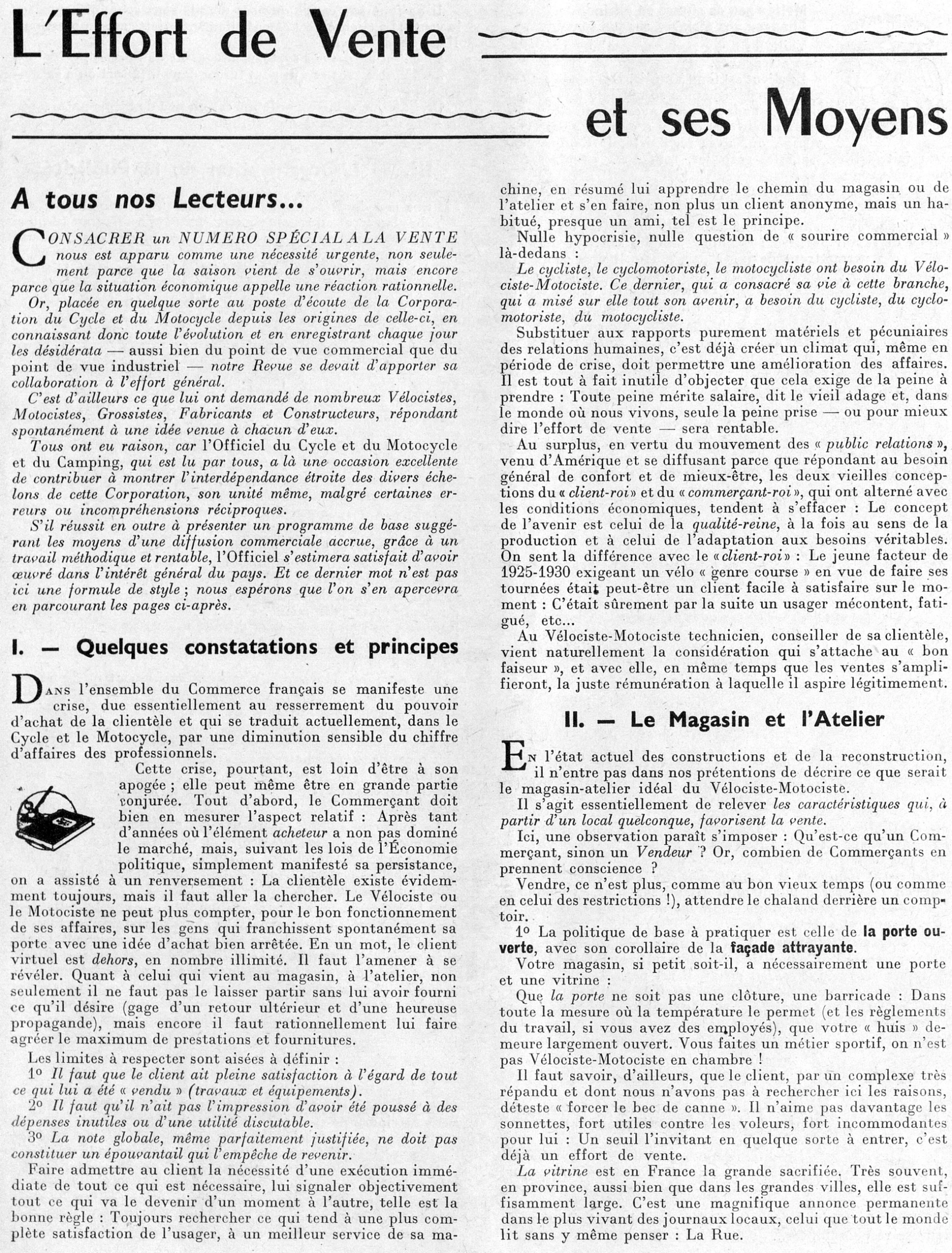
From L’Officiel du cycle, du motocycle et du camping, 3 May 1952, N° 18, the spring number, pages 9, 10, 13 and 15: ‘L’Effort de vente et ses moyens’: foreword ‘A tous nos lecteurs’, I. observations and principles, II. the shop and the workshop (the Vélociste-Motociste’s trade). The title, headings, captions and lists are transcribed as printed; the text is summarized in Ebykr’s words, and the page images carry it in full.
— Page 1 —
L’Effort de Vente et ses Moyens
A tous nos Lecteurs…
[Ebykr summary; the article’s text is not reproduced. The editors explain that devoting a special number to selling seemed an urgent necessity, both because the season has just opened and because the economic situation calls for a rational response. The review, which has stood as a listening post of the cycle and motorcycle trade since its origins and records its wishes from both the commercial and the industrial side, felt bound to contribute to the general effort. Many Vélocistes, Motocistes, wholesalers, manufacturers and constructors have asked for this, each from an idea of his own, and the review sees an excellent chance to show the close interdependence, and indeed the unity, of the trade’s various levels in spite of some mutual errors or misunderstandings. If it also manages to set out a basic program suggesting the means of a wider commercial reach through methodical and profitable work, the Officiel will consider that it has worked in the general interest of the country, and it states that this last phrase is not a mere figure of speech.]
I. — Quelques constatations et principes
[Ebykr summary; the article’s text is not reproduced. A crisis is felt throughout French commerce, caused mainly by the tightening of the customers’ buying power, and in the cycle and motorcycle trade it shows as a marked fall in the dealers’ turnover. The crisis is far from its peak and may largely be warded off. The dealer must first measure its relative side: after many years in which the buyer did not dominate the market but, following the laws of economics, merely made his persistence felt, there has been a reversal. Customers still exist, but they must be sought out; the Vélociste or Motociste can no longer count on people who walk in of their own accord with a settled idea of buying, because the virtual customer is outside in unlimited numbers and must be brought to reveal himself. Whoever does come to the shop or the workshop should not leave without being given what he wants, as a pledge of a return visit and of good word of mouth, and should be led reasonably to accept the largest possible range of services and supplies. The limits to respect are easily defined, and the text lists them as follows.]
1° Il faut que le client ait pleine satisfaction à l’égard de tout ce qui lui a été « vendu » (travaux et équipements).
2° Il faut qu’il n’ait pas l’impression d’avoir été poussé à des dépenses inutiles ou d’une utilité discutable.
3° La note globale, même parfaitement justifiée, ne doit pas constituer un épouvantail qui l’empêche de revenir.
[Ebykr summary, continuing section I. The good rule is to make the customer accept the need for immediate work on everything necessary, to point out objectively what will soon become necessary, and always to seek what tends toward fuller satisfaction of the user and better service of his machine, in short to teach him the way to the shop or workshop and make him not an anonymous customer but a regular, almost a friend. There is no hypocrisy and no “commercial smile” in this: the cyclist, the moped rider and the motorcyclist need the Vélociste-Motociste, who has given his life to this branch and staked his whole future on it, and he needs them. Putting human relations in place of purely material and financial ones creates a climate that should improve business even in a time of crisis, and it is no use objecting that this takes trouble, because only the effort taken, that is the selling effort, will pay. The movement of “public relations”, which came from America and spreads because it answers a general need for comfort and well-being, is fading the two old notions of the “customer as king” and the “merchant as king”, and the concept of the future is “quality as queen”, both in production and in adapting to true needs. As an illustration the author cites the young postman of 1925-1930 who demanded a racing-style bicycle for his rounds, an easy customer to satisfy at the moment but surely later a discontented and tired user. To the technician Vélociste-Motociste, adviser to his clientele, comes the esteem given to the “good maker” and, as sales grow, the fair pay to which he rightly aspires.]
II. — Le Magasin et l’Atelier
[Ebykr summary; the article’s text is not reproduced. Given the present state of building and reconstruction, the editors do not claim to describe the ideal shop and workshop of the Vélociste-Motociste, but only to note the features that, in any premises, favor sales. A merchant is above all a seller, and few merchants are aware of it. Selling no longer means, as in the good old days or in the time of restrictions, waiting behind a counter for the passerby. The first rule of policy is the “open door” and its corollary, the attractive façade. A shop however small has a door and a window. The door should not be a fence or a barricade but, as far as the weather and the labor rules allow, stand wide open, since the dealer follows a sporting trade; customers dislike having to force the way in, and a threshold that invites them in is already a selling effort. The window is the great sacrificed element in France, although it is often wide enough, and it is a magnificent permanent advertisement in the liveliest of local newspapers, the street. The section continues on the next page.]
[A full page of printed text and a small drawing. The title “L’Effort de Vente” is set at the upper left in large heavy sans-serif capitals and lower case, and “et ses Moyens” at the right of the next line in the same type, each half joined by a wavy double rule that runs across the free space of its line. Below it the article is set in two justified columns of serif body type with bold sans-serif subheadings, and some paragraphs and sentences are in italic. Each of the three major sections opens with a large decorative initial letter. Near the middle of the left column a small line drawing of an open book and a pen in an inkwell sits to the left of a paragraph that wraps around it. A few phrases in the right column are picked out in bold sans-serif. No advertisement, artist signature or agency mark appears.]
— Page 2 —
CYCLES-MOTOS
Mettez peu de choses en vitrine,
Changez vos étalages chaque semaine…
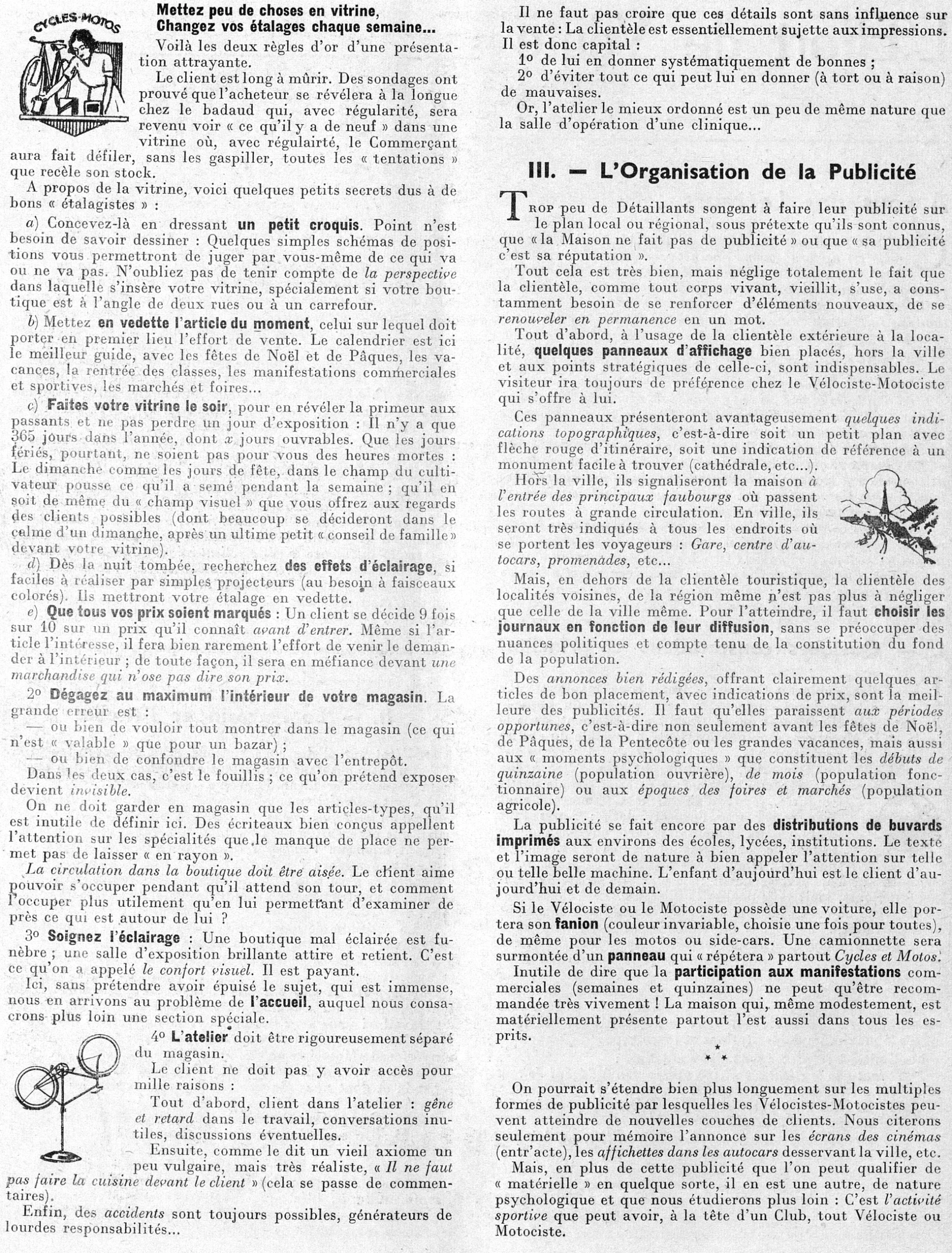
[Ebykr summary, continuing section II of “L’Effort de Vente et ses Moyens”; the article’s text is not reproduced. These are the two golden rules of an attractive presentation. The customer is slow to ripen: surveys have shown that the buyer reveals himself in the end in the idler who regularly comes back to see “what is new” in a window where the merchant has regularly paraded, without wasting them, all the “temptations” in his stock. For the window the author gives a few secrets from good window dressers. (a) “un petit croquis”: design the window by sketching it, since a few simple position diagrams let the dealer judge what works, with an eye to the perspective in which the window sits, especially at a corner or crossroads. (b) “en vedette l’article du moment”: feature the article on which the selling effort should fall first, with the calendar as guide: Christmas and Easter, holidays, the return to school, commercial and sporting events, markets and fairs. (c) “Faites votre vitrine le soir”: dress the window in the evening to reveal its freshness to passersby and lose no day of display, since holidays should not be dead hours; as in the farmer’s field, what is sown during the week grows on Sunday, and many possible customers decide in the calm of a Sunday after a last family council in front of the window. (d) “des effets d’éclairage”: from nightfall use lighting effects, easily made with simple projectors, if need be with colored beams, to make the display stand out. (e) “Que tous vos prix soient marqués”: mark all prices, because a customer decides nine times out of ten on a price he knows before entering, will rarely make the effort to come in and ask, and will distrust a piece of merchandise that does not dare to state its price.]
[Ebykr summary, continuing. Second, clear the inside of the shop as much as possible. The great error is either to try to show everything in the shop, which suits only a bazaar, or to confuse the shop with the warehouse; in both cases the result is a jumble in which what is meant to be shown becomes invisible. Only the standard articles should be kept in the shop, while well designed notices draw attention to the specialties that lack of space keeps off the shelves, and movement in the shop should be easy, because the customer likes to occupy himself while he waits his turn and can do so best by examining what is around him. Third, look after the lighting: a poorly lit shop is gloomy, while a bright showroom attracts and holds, which has been called visual comfort and pays. The author then says that, without having exhausted an immense subject, he arrives at the problem of the welcome (“l’accueil”), to which a special section is given further on. Fourth, “L’atelier” must be strictly separated from the shop and the customer should not have access to it, for many reasons: a customer in the workshop brings hindrance and delay in the work, useless conversations and possible arguments; next, as a rather vulgar but very realistic old axiom has it, one should not do the cooking in front of the customer, which needs no comment; and finally accidents are always possible and bring heavy responsibilities.]
[Ebykr summary, continuing at the head of the right column. These details are not without influence on sales, because the clientele is essentially subject to impressions, and it is therefore capital to give it good ones systematically and to avoid everything that may give it bad ones, rightly or wrongly. The text sets this out in two points.]
1° de lui en donner systématiquement de bonnes ;
2° d’éviter tout ce qui peut lui en donner (à tort ou à raison) de mauvaises.
[Ebykr summary, continuing. The best ordered workshop is somewhat of the same nature as the operating room of a clinic; the sentence ends on suspension dots.]
III. — L’Organisation de la Publicité
[Ebykr summary; the article’s text is not reproduced. Too few retailers think of advertising locally or regionally, on the pretext that they are known, that the house does not advertise or that its reputation is its advertising. This neglects the fact that a clientele, like any living body, ages and wears out and needs constantly to be reinforced and renewed. First, for customers from outside the town, a few well placed billboards outside the town and at its strategic points are indispensable, since the visitor will always prefer the Vélociste-Motociste who offers himself. They should carry some topographical indications, either a small plan with a red route arrow or a reference to an easily found monument such as the cathedral; outside the town they should point out the house at the entrance to the main suburbs where the busy roads pass, and in town at every spot frequented by travelers, namely the station, the bus terminal and the promenades. Beyond the tourist trade, the customers of neighboring places and of the region are not to be neglected either, and for them newspapers should be chosen by circulation, regardless of political shade. Well written advertisements clearly offering a few well selling articles with prices are the best publicity, and they should appear at the right times: before Christmas, Easter, Whitsun or the long holidays, and at the “psychological moments” of the start of the fortnight for working people, the start of the month for civil servants and the times of fairs and markets for the farming population. Advertising is also done by handing out printed blotters near schools, lycées and institutions, with text and picture that draw attention to a fine machine, since the child of today is the customer of today and tomorrow. A dealer’s car should carry its pennant in an unchanging color chosen once and for all, as should motorcycles and sidecars, and a small van should bear a panel repeating “Cycles et Motos” everywhere. Taking part in commercial events, weeks and fortnights, is strongly recommended, because the house that is materially present everywhere, even modestly, is present in all minds.]
*
* *
[Ebykr summary, after a three-star break. There is much more to say on the many forms of advertising by which dealers can reach new layers of customers; the author mentions only, as a reminder, the notice on cinema screens during the intermission and the small posters in the buses serving the town. Besides this advertising, which may be called material, there is another of a psychological nature, to be studied further on: the sporting activity that every Vélociste or Motociste can have at the head of a club. The article continues on a later page.]
[A full page of printed text with three small line illustrations, all unsigned. At the upper left is a woodcut-style engraving of a shop-window figure, a person with bobbed hair seen from the waist up, bent over a display shelf and arranging boxes beside a bicycle wheel and frame, with the words “CYCLES-MOTOS” lettered in an arc over the head. In the right column a small engraved vignette shows a church spire among trees and rooftops on a hillside, with a few sloping lines beneath. At the lower left, set into the left column, a line drawing shows a bicycle mounted by its frame on a tall stand with a single post, wheels turning free, as in a repair workshop. The text runs in two justified columns of serif type with a bold sans-serif headline over the first column and a bold sans-serif subheading over the third section; phrases in bold sans-serif and in italic mark the key points, and the section opens with a large decorative initial letter. A group of three small stars arranged as a triangle stands before the last paragraphs. No advertisement, artist signature or agency mark appears.]
— Page 3 —
IV. — La prospection de la Clientèle
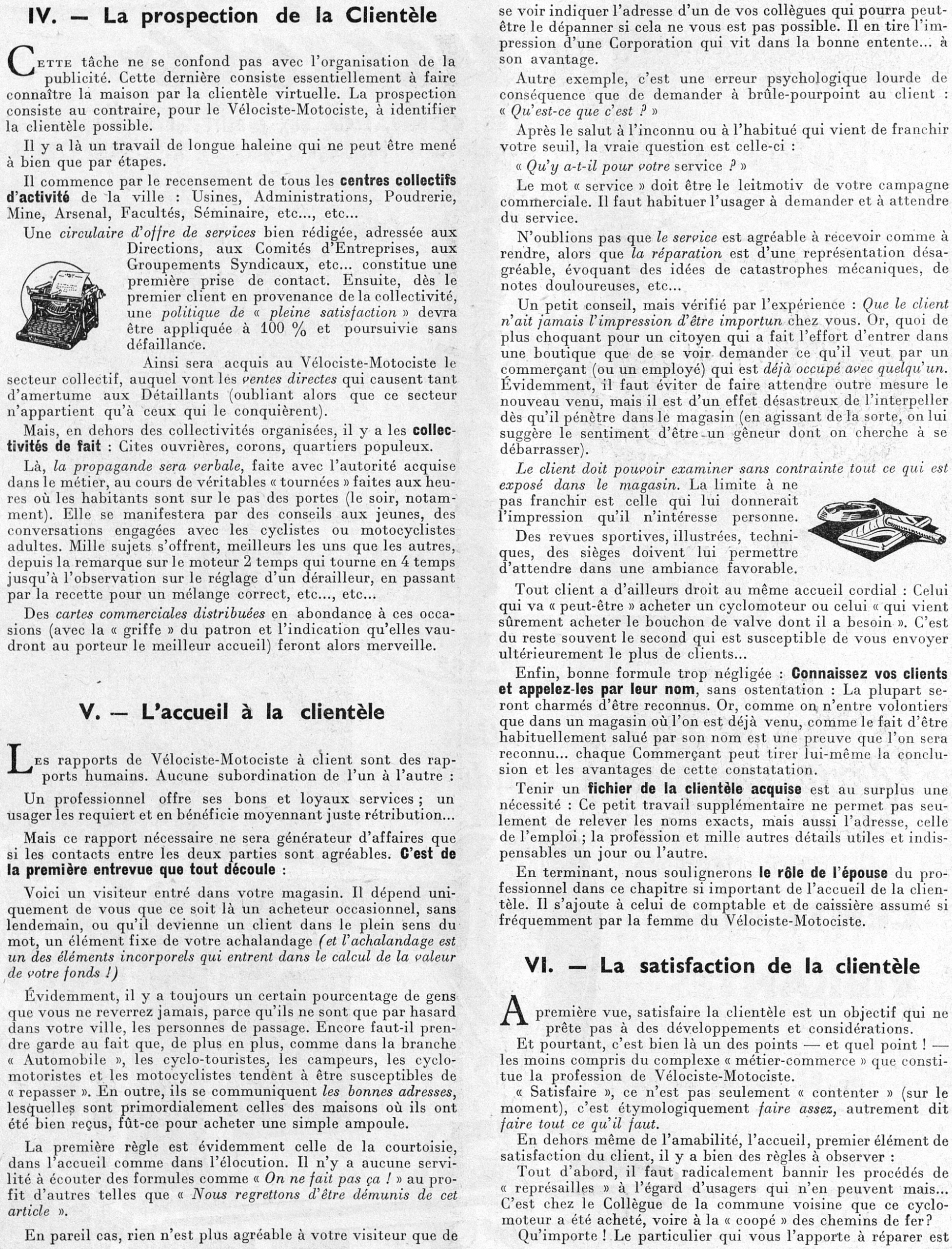
[Ebykr summary; the article’s text is not reproduced. Prospecting is not the same task as organizing advertising: advertising makes the house known to the virtual clientele, while prospecting means that the Vélociste-Motociste identifies the possible clientele. It is long work that can only be done in stages. It begins with a census of all the collective centers of activity in the town, such as factories, administrations, the powder works, the mine, the arsenal, the faculties and the seminary. A well written circular offering services, addressed to managements, works committees and union groups, is a first contact; then, from the first customer who comes from the group, a policy of “full satisfaction” must be applied at 100 percent and pursued without fail. In this way the collective sector is won for the dealer, including the direct sales that embitter retailers, who forget that this sector belongs only to those who conquer it. Beyond the organized groups there are the groups in fact: workers’ housing estates, mining rows and working-class districts. There the propaganda will be oral, carried out with the authority the dealer has earned in the trade, in real rounds made at the hours when residents are on their doorsteps, in the evening in particular, through advice to the young and talk with adult cyclists and motorcyclists on a thousand subjects, from a remark on the two-stroke engine that runs on four strokes to a point on adjusting a derailleur or the recipe for a correct fuel mixture. Business cards handed out freely on these occasions, bearing the owner’s signature and a note that they will earn the bearer the best welcome, will work wonders.]
V. — L’accueil à la clientèle
[Ebykr summary; the article’s text is not reproduced. The relations of dealer and customer are human relations with no subordination: a professional offers his good and loyal services and a user asks for them and benefits from them for fair payment. But this necessary relation creates business only if the contacts are agreeable, and everything flows from the first meeting. Whether a visitor entering the shop is a one-time buyer or becomes a true customer, a fixed element of the trade whose goodwill counts in the value of the business, depends solely on the dealer. There will always be a share of people never seen again because they are passing through, but even they must be watched, since cycle tourists, campers, moped riders and motorcyclists tend, as in the automobile branch, to come back and pass on the good addresses, which are those of the houses where they were well received, even to buy a simple bulb. The first rule is courtesy, in the welcome as in the way of speaking: there is no servility in saying that the house regrets being out of an article rather than that “this is not done”. In such a case nothing pleases the visitor more than to be given the address of a colleague who may be able to help, and he draws the impression of a trade that lives in good understanding. It is a heavy psychological error to ask a customer bluntly “Qu’est-ce que c’est ?”; after the greeting the real question is what there is for his service, and the word “service” should be the leitmotiv of the commercial campaign, since service is pleasant to receive and give while repair suggests mechanical catastrophes and painful bills. A short piece of advice, proved by experience: the customer must never feel that he is a nuisance. There is nothing more shocking for a citizen who has made the effort to enter a shop than to be asked what he wants by a merchant or an employee already busy with someone, so the newcomer should not be kept waiting beyond measure, yet it is disastrous to accost him the moment he enters. The customer should be able to examine without constraint everything shown in the shop, the limit being the impression that he interests nobody, and sports, illustrated and technical magazines and seats should let him wait in a favorable atmosphere. Every customer has a right to the same cordial welcome, whether the one who “perhaps” will buy a moped or the one who is surely coming for a valve cap, and it is often the second who sends the most customers later. A formula too often neglected is to know customers and call them by name, without ostentation, since most are charmed to be recognized and people enter willingly only where they have been before. Keeping a file of the clientele won is a further necessity, noting not only exact names but also the address, the place of work, the occupation and a thousand other details useful one day or another. In closing, the author stresses the role of the dealer’s wife in this welcome, in addition to the bookkeeping and cashier work she so often assumes.]
VI. — La satisfaction de la clientèle
[Ebykr summary; the article’s text is not reproduced. At first sight, satisfying the customer is an objective that needs no development, yet it is one of the least understood points of the complex trade-business of the Vélociste-Motociste. To satisfy is not only to please for the moment but, etymologically, to do enough, in other words to do all that is needed. Apart from friendliness and the welcome, there are rules to observe. First, “reprisal” methods toward users who cannot help it must be banished radically, as when a moped was bought from a colleague in the neighboring commune or at the railway workers’ cooperative; the author answers that this does not matter and begins a sentence on the private customer who brings such a machine in for repair, which breaks off at the foot of the page. The section continues on the next page.]
[A full page of printed text with two small line illustrations, both unsigned. In the left column a shaded line drawing of an old office typewriter with a sheet of paper in the carriage sits inside a faint circle, with the text wrapping around it. In the right column a smaller engraved drawing shows magazines or newspapers and a cap or other soft object lying on a flat table top seen at an angle. The article is set in two justified columns of serif type, with bold sans-serif subheadings for sections IV, V and VI, each section opening on a large decorative initial letter; phrases in bold sans-serif or italic mark key points. No advertisement, artist signature or agency mark appears.]
— Page 4 —
[Ebykr summary, continuing section VI of “L’Effort de Vente et ses Moyens”; the article’s text is not reproduced. The customer who comes to the dealer for repair, even one who came by chance, is a customer who is coming back onto the right path, and the dealer should make him return by reasoning. The author then holds that the matter should be pressed closer.]
1° Les ventes sur demande et les autres :
[Ebykr summary; the article’s text is not reproduced. A gentleman comes into the shop wanting a bulb: has the dealer made the effort to sell him two, and does it take great arguments to manage it? Another wants to change his dynamo, which no longer works, and a word on the good appearance of his machine will turn it into a complete lighting set sold. A broken mudguard is to be replaced: the dealer must be diplomatic and sell the pair by pointing out differences of shape and color.]
2° Les prestations de services :
[Ebykr summary; the article’s text is not reproduced. A moped is brought in for one repair and the dealer notices that the fuel pipe is no longer tight: a word at the right moment and an article is sold, the work of fitting being very little since it is the placing of the goods that counts. When an engine no longer runs smoothly and the customer asks for one repair because he has his own idea, the dealer should courteously state the necessary reservations before taking it apart; it would be disastrous to do only what the user asked and neglect an essential operation just because it would exceed his request. The customer should be warned in good time and in any case always be shown the worn and broken parts. The result is a machine truly in working order handed back to the user, not one that gives out after three kilometers, in which case the customer will always blame the work done and never think of what was not done though it deserved to be.]
3° L’examen des machines :
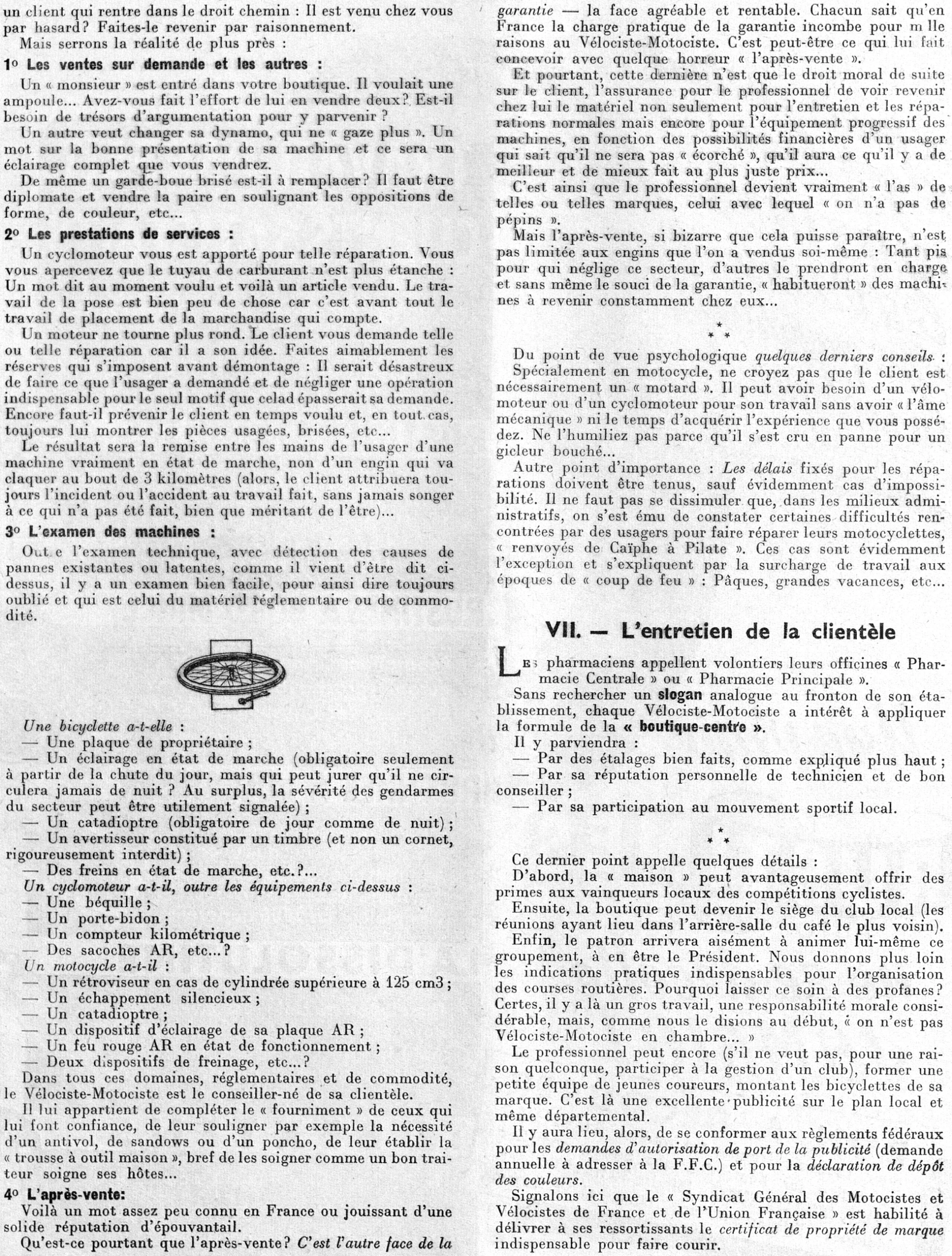
[Ebykr summary; the article’s text is not reproduced. Besides the technical examination, which detects existing or latent causes of breakdown, there is an easy examination almost always forgotten, that of the equipment required by regulation or for convenience. The text then lists the points to check, in three lists.]
Une bicyclette a-t-elle :
— Une plaque de propriétaire ;
— Un éclairage en état de marche (obligatoire seulement à partir de la chute du jour, mais qui peut jurer qu’il ne circulera jamais de nuit ? Au surplus, la sévérité des gendarmes du secteur peut être utilement signalée) ;
— Un catadioptre (obligatoire de jour comme de nuit) ;
— Un avertisseur constitué par un timbre (et non un cornet, rigoureusement interdit) ;
— Des freins en état de marche, etc.?…
Un cyclomoteur a-t-il, outre les équipements ci-dessus :
— Une béquille ;
— Un porte-bidon ;
— Un compteur kilométrique ;
— Des sacoches AR, etc…?
Un motocycle a-t-il :
— Un rétroviseur en cas de cylindrée supérieure à 125 cm3 ;
— Un échappement silencieux ;
— Un catadioptre ;
— Un dispositif d’éclairage de sa plaque AR ;
— Un feu rouge AR en état de fonctionnement ;
— Deux dispositifs de freinage, etc…?
[Ebykr summary, continuing. In all these domains of regulation and convenience, the Vélociste-Motociste is the born adviser of his clientele. It is for him to complete the equipment of those who trust him, for example by stressing the need for an antitheft lock, for elastic straps (“sandows”) or a poncho, and by making up their “home tool kit”, in short to look after them as a good caterer looks after his guests.]
4° L’après-vente:
[Ebykr summary; the article’s text is not reproduced. After-sales service is a word little known in France, or one with a solid reputation as a scarecrow. It is the other side of the warranty, the pleasant and profitable side. In France the practical burden of the warranty falls for a thousand reasons on the Vélociste-Motociste, which may be why he looks on “l’après-vente” with some horror. Yet after-sales is only the moral right of continuation over the customer, the professional’s assurance of seeing the equipment return to him not only for upkeep and ordinary repairs but also for the progressive fitting out of the machines according to the means of a user who knows he will not be fleeced and will have the best and best made at the fairest price. In this way the professional truly becomes the ace of certain makes, the one with whom there are no troubles. After-sales service is not limited to machines the dealer has sold himself: too bad for whoever neglects this sector, since others will take it up and, without the worry of the warranty, will accustom machines to come back constantly to them.]
*
* *
[Ebykr summary, after a three-star break. A few last psychological counsels. In motorcycling especially, the customer is not necessarily a “motard”: he may need a vélomoteur or a cyclomoteur for his work without having a mechanical soul or the time to gain the dealer’s experience, and he should not be humiliated because he thought his machine had broken down when only a jet was blocked. Another important point is that the times set for repairs must be kept, except where impossible. In administrative circles there has been concern at some difficulties users meet in getting their motorcycles repaired, being sent from pillar to post, but these are exceptions explained by the overload of work in the rush periods of Easter, the long holidays and so on.]
VII. — L’entretien de la clientèle
[Ebykr summary; the article’s text is not reproduced. Pharmacists like to call their shops “Pharmacie Centrale” or “Pharmacie Principale”. Without seeking a similar slogan for the front of his premises, each Vélociste-Motociste has an interest in applying the formula of the “boutique-centre”, which he will reach by the three means listed below.]
— Par des étalages bien faits, comme expliqué plus haut ;
— Par sa réputation personnelle de technicien et de bon conseiller ;
— Par sa participation au mouvement sportif local.
*
* *
[Ebykr summary, after a three-star break. The last point calls for some details. First, the house may usefully offer prizes to the local winners of cycling competitions. Next, the shop can become the seat of the local club, whose meetings take place in the back room of the nearest café. Finally, the owner can easily lead the group himself and be its President; the practical guidance indispensable for organizing road races is promised further on, and the author asks why this task should be left to outsiders, admitting a great deal of work and considerable moral responsibility but recalling that, as said at the start, one is not a Vélociste-Motociste in one’s bedroom. The professional who does not wish to run a club may instead form a small team of young racers riding the bicycles of his make, which is excellent publicity on the local and even departmental level. The federal rules must then be followed for requests for authorization to carry advertising, an annual request to be sent to the F.F.C., and for the declaration of registered colors. The text adds that the “Syndicat Général des Motocistes et Vélocistes de France et de l’Union Française” is empowered to issue to its members the certificate of ownership of a make that is needed in order to race.]
[A full page of printed text with one small line drawing, unsigned. In the middle of the left column a drawing in line and light shading shows a bicycle wheel with fine spokes seen at a slant, set inside a thin rectangular frame, with a small tool or lever lying across the lower rim; the three checklists for a bicycle, a cyclomoteur and a motorcycle follow it, set in a plainer type with long dashes before each item. The article is set in two justified columns of serif type with bold sans-serif run-in headings for the numbered parts, a bold sans-serif subheading for section VII over a large decorative initial letter, and italic for some phrases. Two groups of three small stars arranged as triangles mark breaks in the right column. No advertisement, artist signature or agency mark appears.]
Ebykr presents this material for research and education. If you hold rights to it or notice an ownership issue, please contact us and we will respond promptly.
The Ebykr Digest
New articles, timelines, catalog finds and registry activity — assembled from the archive once a month. Your address is never shared.
Double opt-in. One email per month. Unsubscribe at any time with one click.